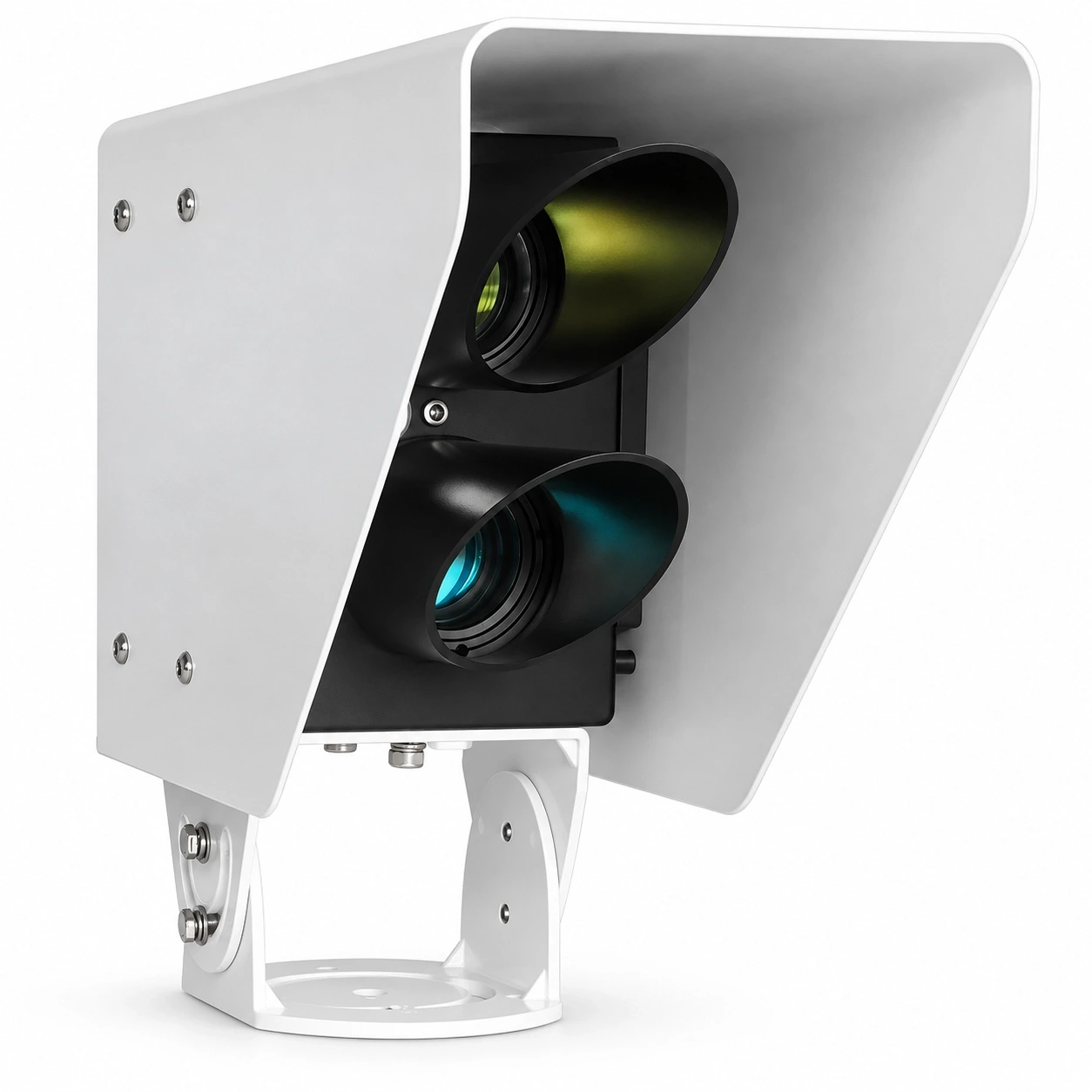
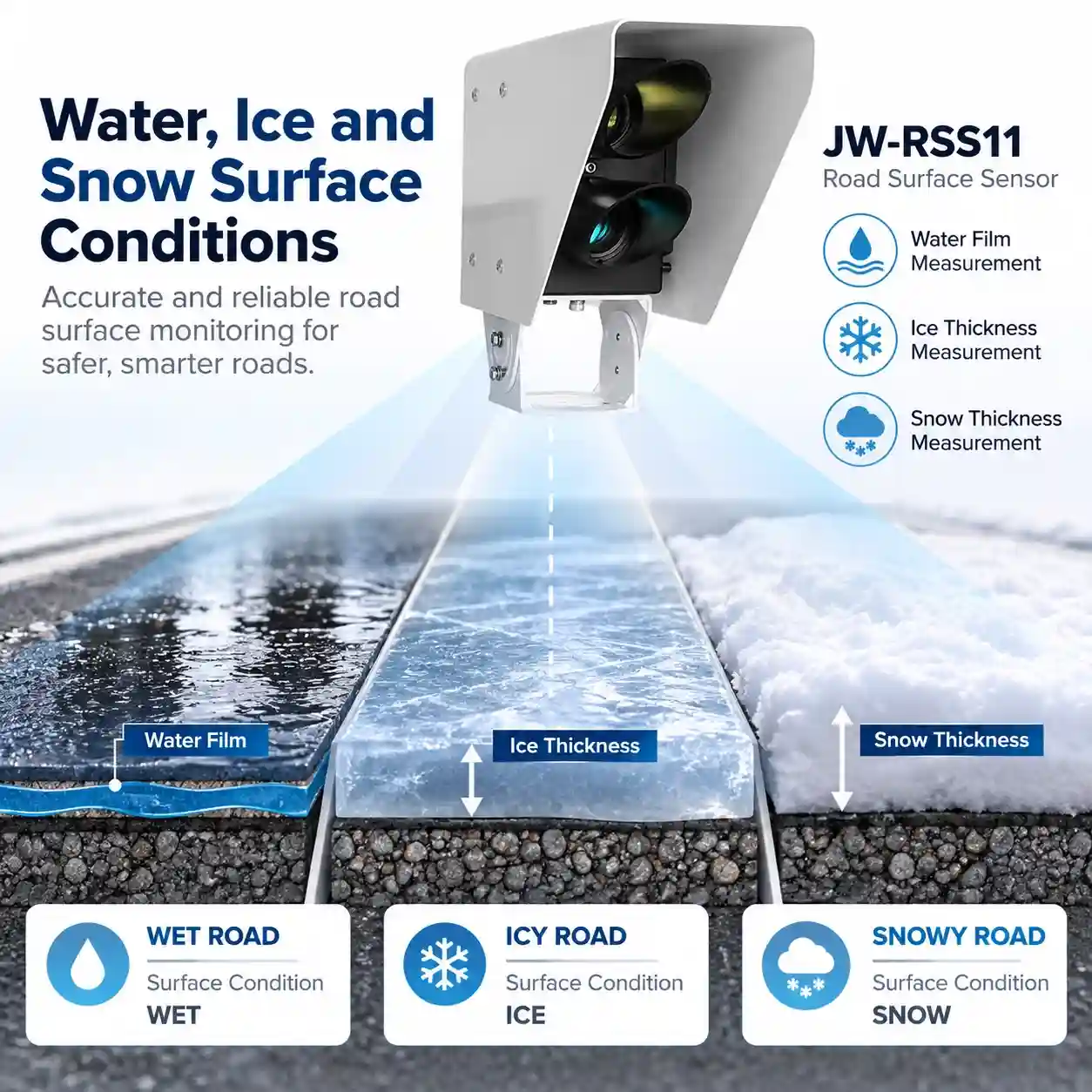
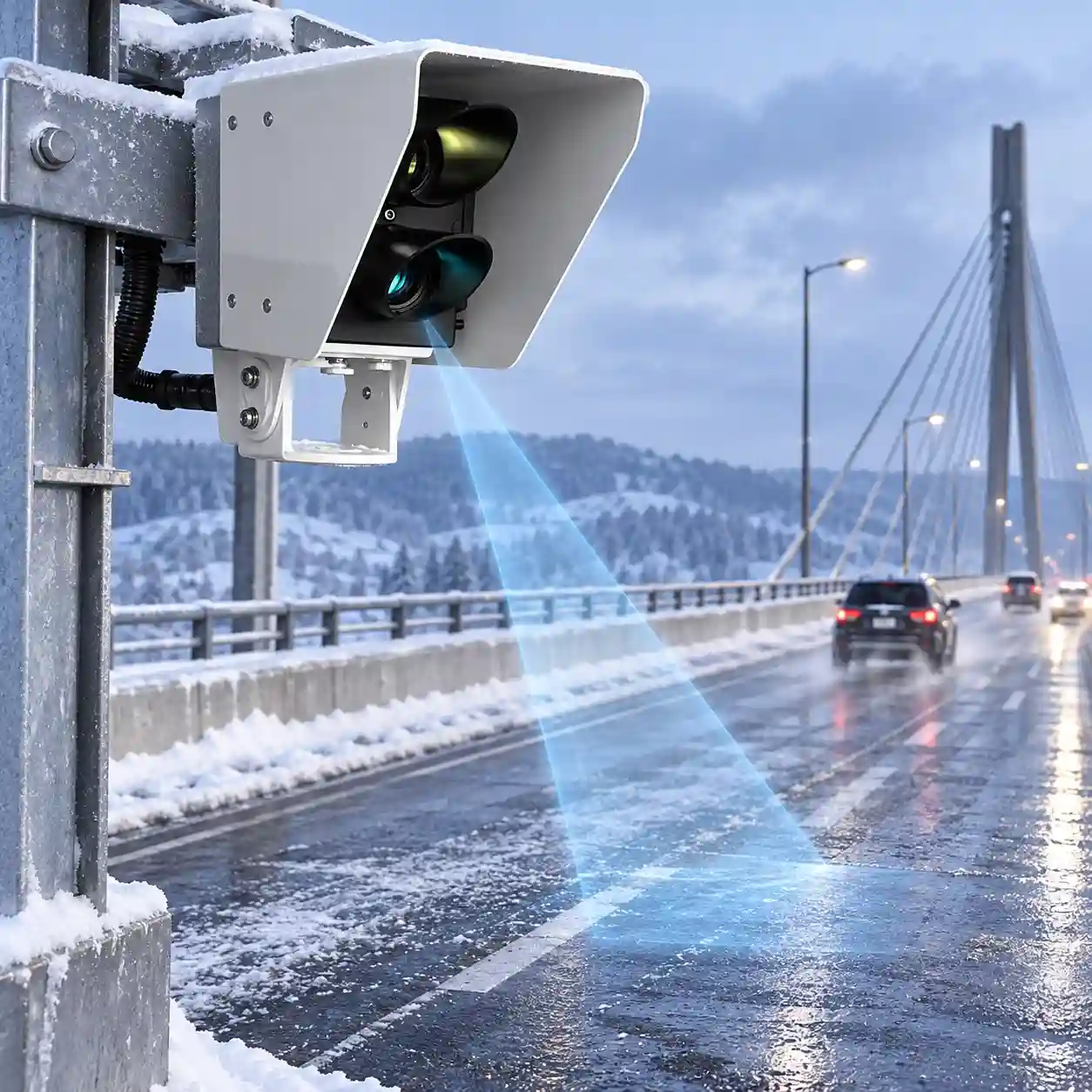
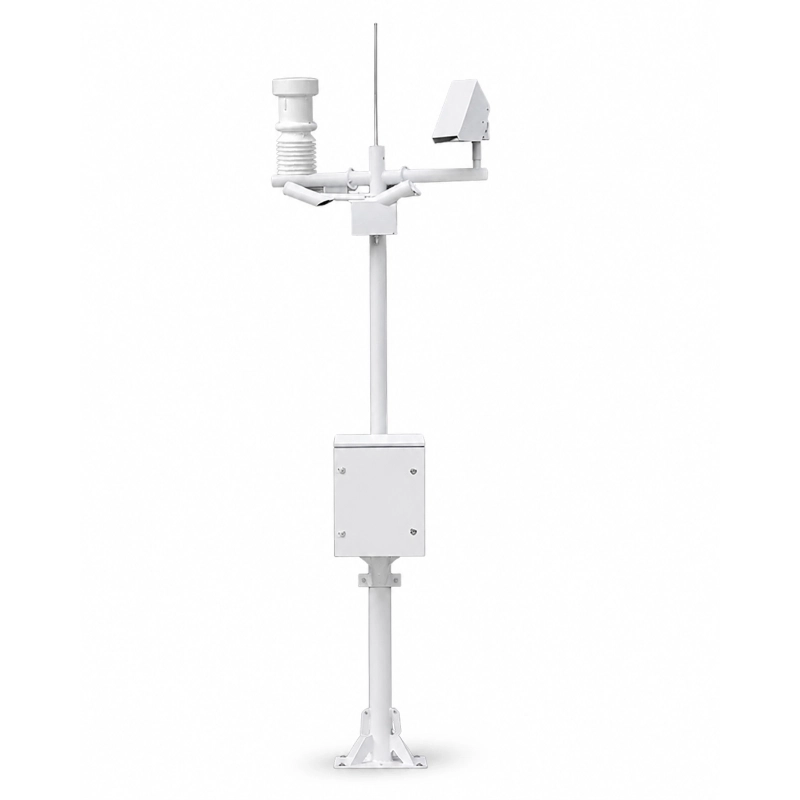
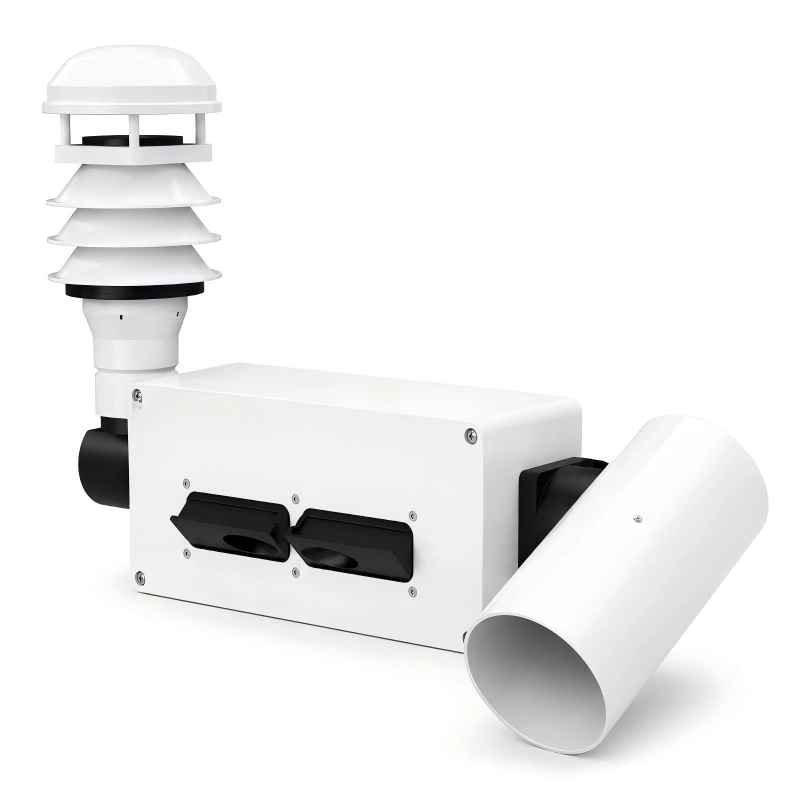
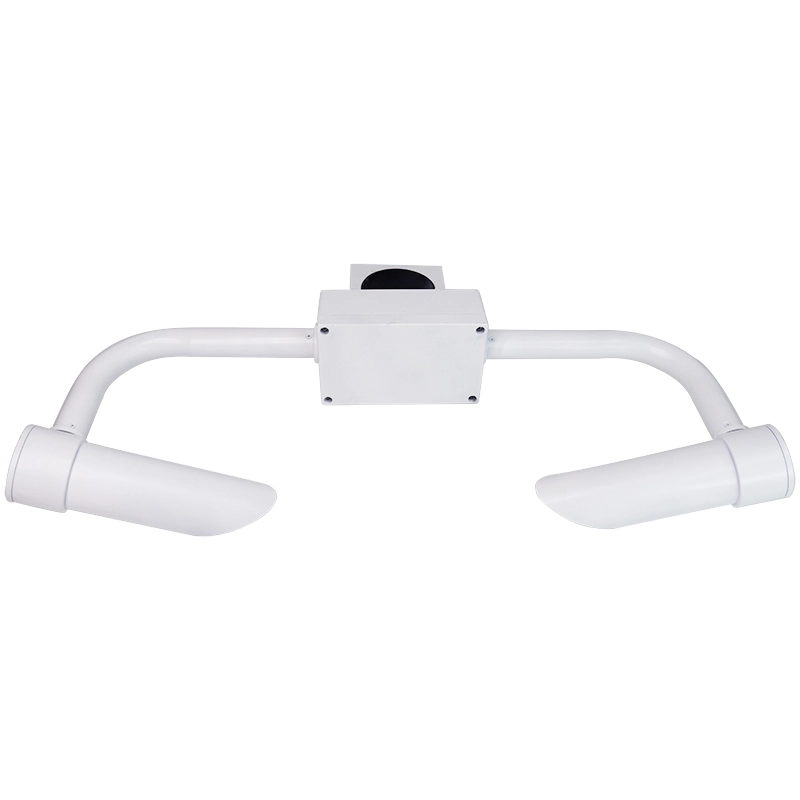
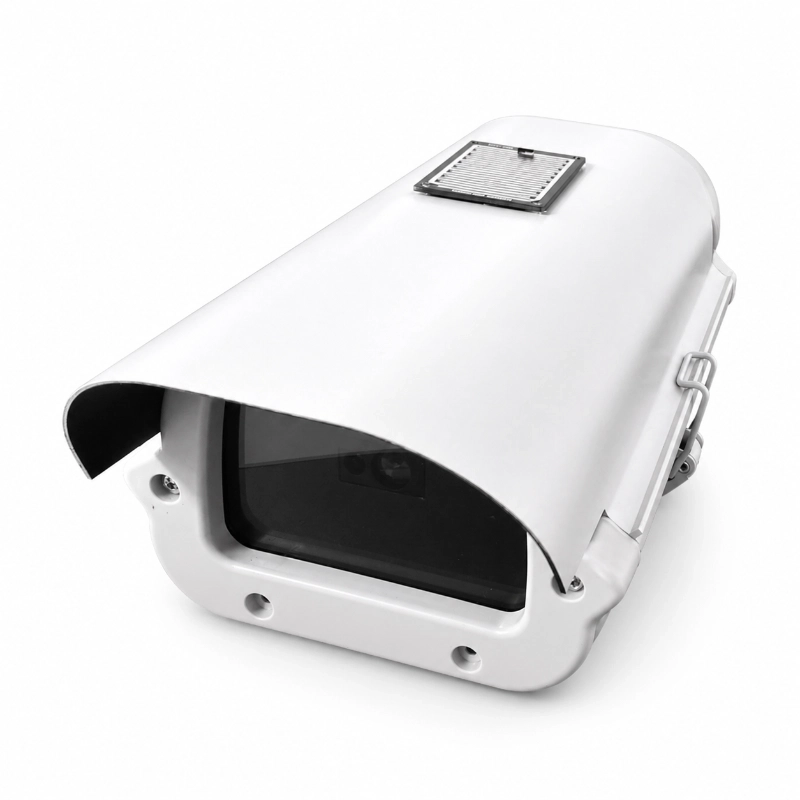
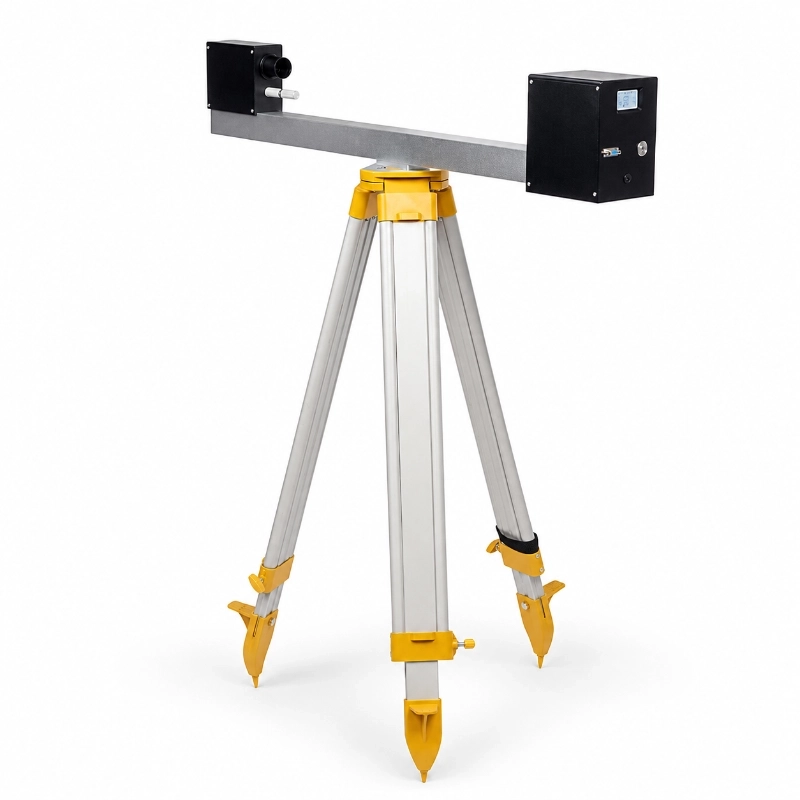
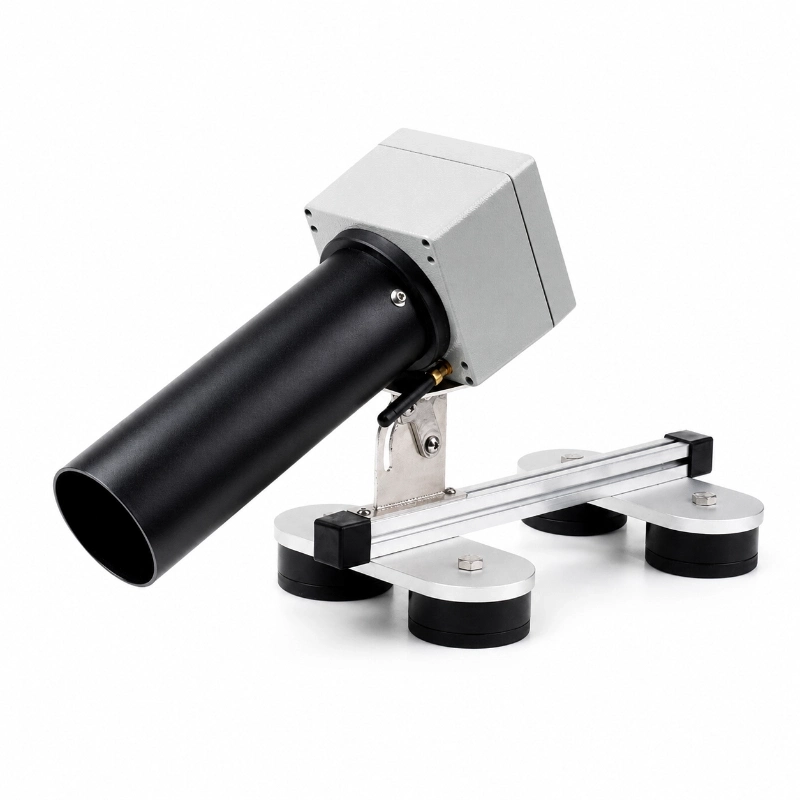
The JW-RSS11 Non-Contact Road Surface Sensor is a multispectral infrared sensing instrument designed to monitor pavement conditions without physical contact with the road. It detects water film, ice, snow, and surface slipperiness, providing essential measurements for winter road maintenance, highway safety, and Road Weather Information Systems (RWIS).
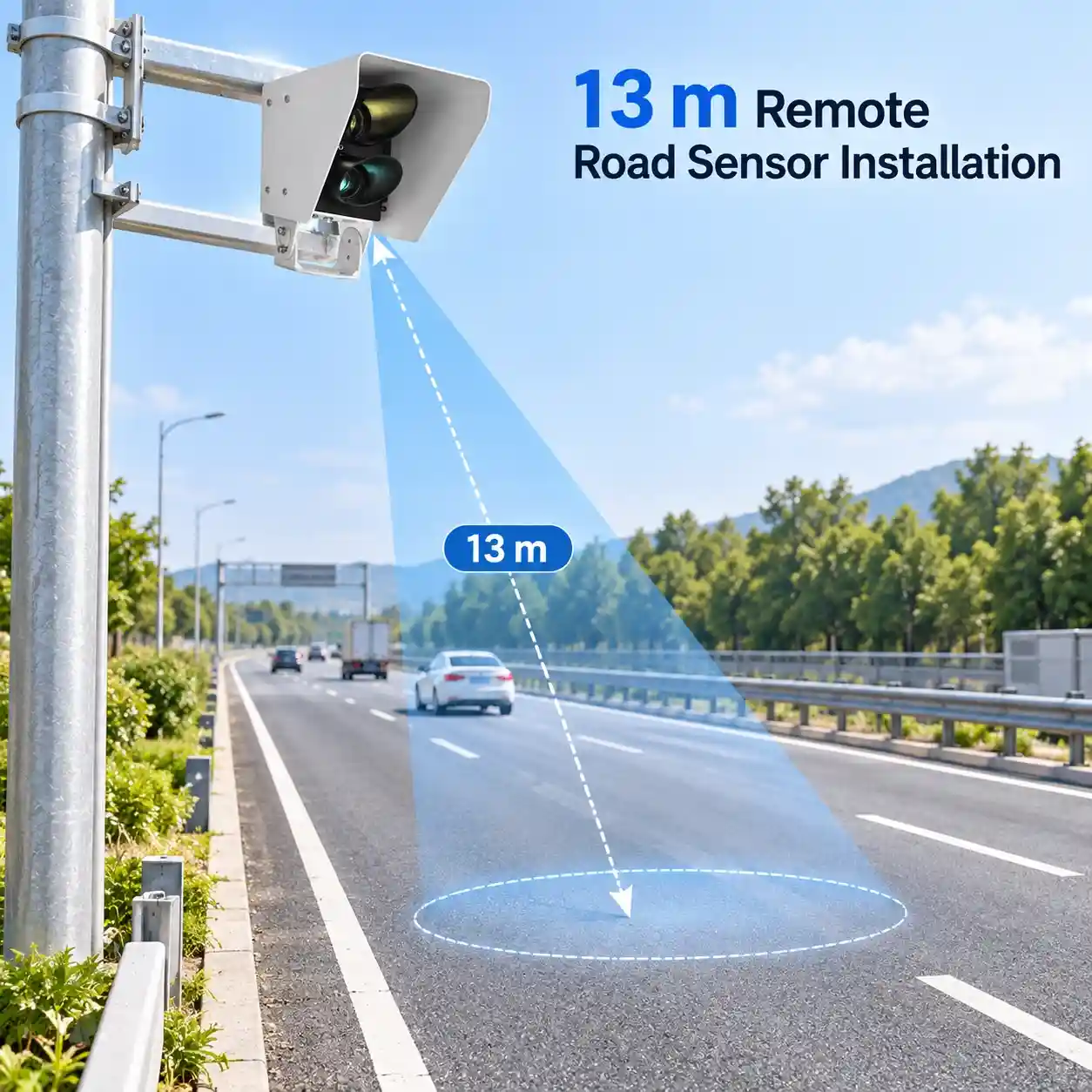
With a remote infrared detection distance of up to 13 meters, the JW-RSS11 can be installed above the road on suitable roadside structures or existing monitoring stations. Its non-invasive design avoids the need to cut pavement or embed sensors in the road surface.
The sensor supports RS485 and RS232 communication and features optical lens contamination detection with automatic compensation. It is suitable for integration into highway weather monitoring networks, bridge icing monitoring systems, and intelligent transportation infrastructure.
1. What Is a Non-Contact Road Surface Sensor?
A non-contact road surface sensor measures pavement conditions remotely using optical detection technology.
Unlike embedded pavement sensors, which must be installed within the road structure, the JW-RSS11 observes a target area from an elevated position.
This makes it particularly useful for existing roads where pavement excavation is difficult or undesirable.
The sensor collects information about water, ice, snow, surface temperature, and road slipperiness. These measurements help road operators assess changing weather-related pavement conditions.
Typical users include highway operators, road maintenance contractors, transportation departments, and intelligent transportation system integrators.
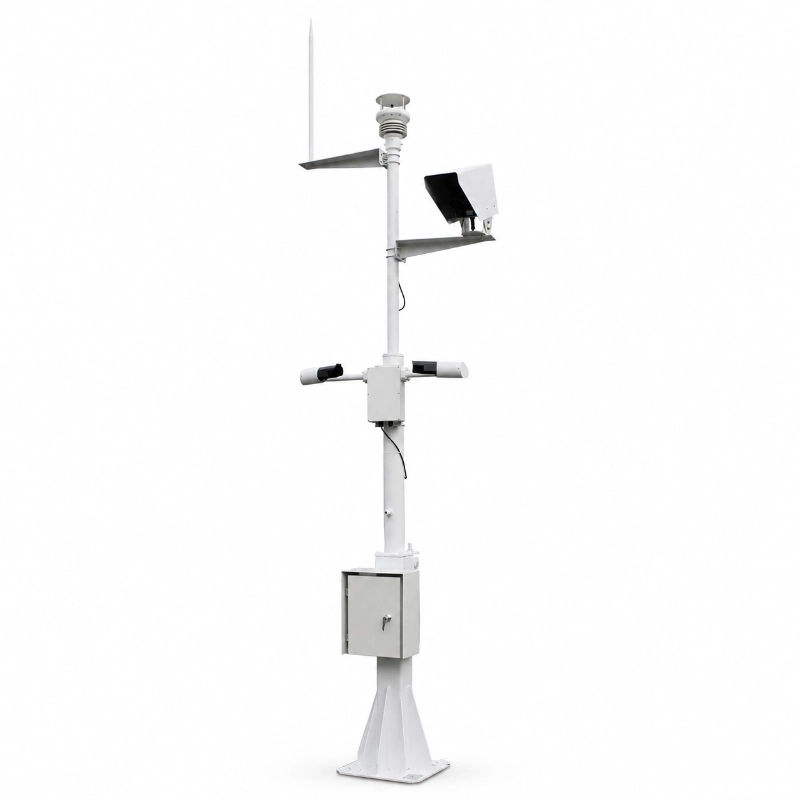
When integrated with additional meteorological equipment, the sensor forms part of a complete road weather monitoring network.
2. How Does Multispectral Infrared Road Detection Work?
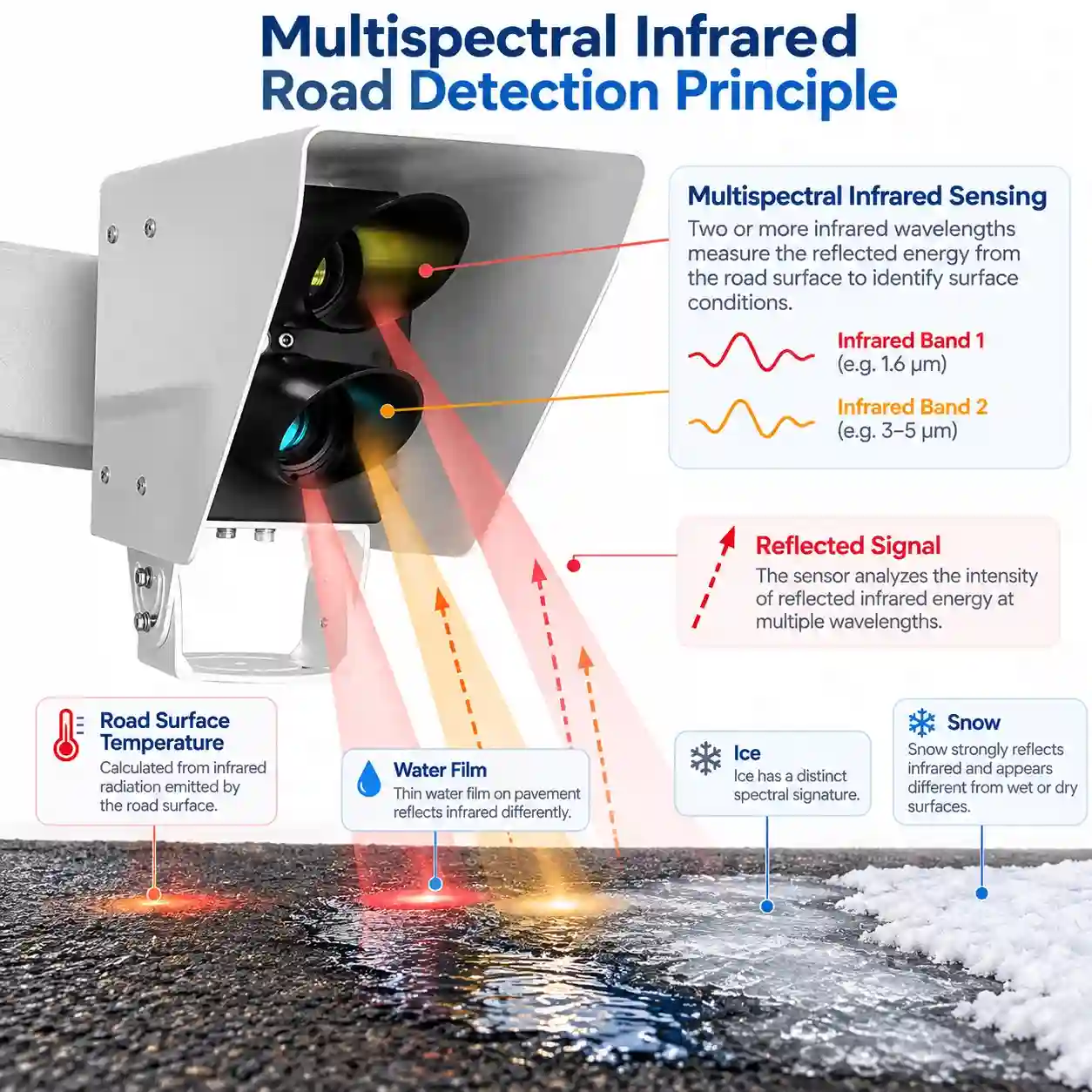
The JW-RSS11 uses multispectral infrared remote sensing technology to detect different pavement surface conditions.
2.1 Infrared Optical Measurement
Water, ice, snow, and relatively dry pavement have different optical characteristics.
By analyzing infrared signals associated with the monitored surface, a multispectral sensor can distinguish between these conditions.
The JW-RSS11 processes the optical information to identify pavement status and measure relevant surface parameters.
Because measurement takes place remotely, the sensing unit does not need to contact the road.
2.2 Water Film Thickness Detection
Water accumulation affects road surface conditions and may contribute to reduced tire traction.
The JW-RSS11 measures water film thickness from 0 to 10 mm, with a resolution of 0.01 mm.
The specified water film measurement accuracy is 0.1 mm.
This measurement helps road operators distinguish between changing moisture conditions and evaluate water accumulation at selected monitoring locations.
Water film monitoring can also support drainage assessment and winter road safety management.
2.3 Ice and Snow Thickness Measurement
The sensor provides standard measurement ranges of:
Ice film thickness: 0–10 mm
Snow thickness: 0–10 mm
An expanded snow measurement range of up to 2,000 mm is listed as an optional configuration.
Ice and snow information helps maintenance teams identify changing winter pavement conditions.
The measurements can be combined with road temperature and local weather observations to support maintenance decisions.
2.4 Road Slipperiness Assessment
The JW-RSS11 reports road slipperiness as a dimensionless value from 0 to 1, with 0.01 resolution.
This parameter provides an indication of changing surface slipperiness.
It should be interpreted together with surface condition, water film, ice thickness, and temperature rather than treated as a replacement for standardized tire-pavement friction testing.
3. Technical Specifications
Parameter
Specification
Model
JW-RSS11
Sensor Type
Non-Contact Road Surface Sensor
Measurement Technology
Multispectral Infrared Remote Sensing
Infrared Detection Distance
Up to 13 m
Power Supply
DC 12–24 V
Maximum Power Consumption
6 W, including lens heating
Operating Temperature
-40°C to +70°C
Water Film Thickness
0–10 mm
Water Film Accuracy
0.1 mm
Water Film Resolution
0.01 mm
Ice Thickness
0–10 mm
Snow Thickness
0–10 mm
Optional Snow Range
Up to 2,000 mm
Road Slipperiness
0–1
Slipperiness Resolution
0.01
Road Surface Temperature
-40°C to +60°C
Optional Road Temperature Extension
Down to -50°C
Road Surface Classification
Dry, Damp, Wet, Snow, Ice, Ice-Water Mixture
Lens Contamination Monitoring
Supported
Automatic Contamination Compensation
Supported
Road Surface Materials
Asphalt, Concrete
Communication Interfaces
RS485, RS232
Installation
Non-Contact Fixed Installation
Optional parameters: Ambient temperature and humidity, atmospheric pressure, frost point, freezing point, salt-related information, and additional surface materials are subject to configuration and availability.
Specification note: These values are based on the referenced RSS11 technical configuration. Confirm the final JW-RSS11 datasheet, selected options, and electrical interface documentation before ordering.
4. Road Surface Conditions Monitored by JW-RSS11
The sensor provides more than a basic wet-or-dry indication.
Its measurement outputs allow monitoring systems to distinguish several relevant pavement conditions.
Dry and Damp Pavement
A dry surface indicates the absence of significant detected moisture.
Damp pavement describes a surface with limited moisture, which may occur after light rainfall, condensation, or partial drying.
Monitoring these conditions helps operators observe transitions between dry and wet roads.
Wet Pavement and Water Accumulation
Rainfall can create water films of varying thickness.
The JW-RSS11 provides quantitative water film information that can be used alongside drainage, rainfall, and local weather observations.
This is particularly useful at locations where standing water or poor drainage is a concern.
Ice-Covered Pavement
Ice can develop when moisture is present and pavement temperatures fall to freezing conditions.
The sensor detects ice-related surface conditions and measures ice thickness within its specified range.
This information supports winter maintenance planning and road icing risk assessment.
Snow-Covered Pavement
Snow accumulation changes the surface condition and may reduce road accessibility.
The JW-RSS11 identifies snow-related conditions and provides snow thickness measurements.
The extended snow range should only be specified when the corresponding optional configuration is confirmed.
Ice-Water Mixed Conditions
During melting or refreezing events, pavement may contain both ice and liquid water.
These transitional conditions are important because surface characteristics may change quickly.
The sensor reports ice-water mixed surface conditions to help monitoring systems distinguish them from dry, wet, or fully ice-covered pavement.
5. Applications in Road Weather Monitoring
5.1 Highway Winter Maintenance
Winter road maintenance requires information about road temperature, moisture, ice formation, and snow accumulation.
The JW-RSS11 provides fixed-location pavement observations that help maintenance teams evaluate conditions at selected road sections.
Typical monitoring locations include highways exposed to freezing temperatures, elevated roads, and regions experiencing frequent snowfall.
Sensor data may be used with weather forecasts, maintenance records, and road inspection reports to support operational decisions.
5.2 Bridge Deck Ice Monitoring
Bridge decks are important monitoring locations because their temperature behavior can differ from nearby ground-supported roads.
An infrared road condition sensor mounted at an appropriate position can monitor the bridge surface without embedding an instrument in the deck.
This arrangement is useful where structural protection or traffic management considerations make road cutting undesirable.
For complete bridge weather monitoring, additional atmospheric and precipitation sensors may be integrated.
5.3 Accident-Prone Road Sections
Some road locations experience recurring moisture accumulation, frost, or icing.
Examples include shaded areas, curves, exposed sections, and locations with drainage limitations.
The JW-RSS11 can provide ongoing measurements from these locations.
Monitoring data may support maintenance scheduling and warning decisions, subject to the requirements of the local road authority.
5.4 Mountain Roads and Snowfall Regions
Mountain roads can experience substantial temperature changes over short distances.
Altitude, shading, wind exposure, and snowfall can produce different pavement conditions across nearby road sections.
Installing fixed infrared road surface sensors at representative locations helps operators observe local conditions.
A network of sensors can provide broader coverage than a single monitoring point.
5.5 Intelligent Transportation Systems
The JW-RSS11 can be integrated into traffic monitoring infrastructure through its RS485 or RS232 interface.
A compatible roadside controller can collect measurements and transmit them to a central monitoring platform.
Potential system-level applications include condition dashboards, historical analysis, and maintenance alerts.
These advanced functions depend on the selected controller, communication equipment, and software platform.
6. Advantages of Non-Contact Installation
Embedded pavement sensors require installation within the road surface.
For existing highways and bridges, cutting the pavement may involve construction work, traffic control, and additional maintenance considerations.
The JW-RSS11 provides an alternative through overhead remote measurement.
No Pavement Excavation
The sensing device can be mounted above the road, leaving the target pavement intact.
This is especially relevant for completed road surfaces and existing monitoring infrastructure.
Flexible Mounting Locations
The sensor may be installed on a suitable support structure or integrated into an existing roadside weather station.
The target area must remain visible within the specified measurement geometry.
Convenient Inspection
The external installation arrangement provides access to the device without removing road material.
Maintenance plans should still account for installation height, optical cleanliness, and safe access.
Existing Weather Network Integration
The sensor’s serial interfaces facilitate connection to compatible road weather monitoring equipment.
7. Optical Lens Contamination Detection and Compensation
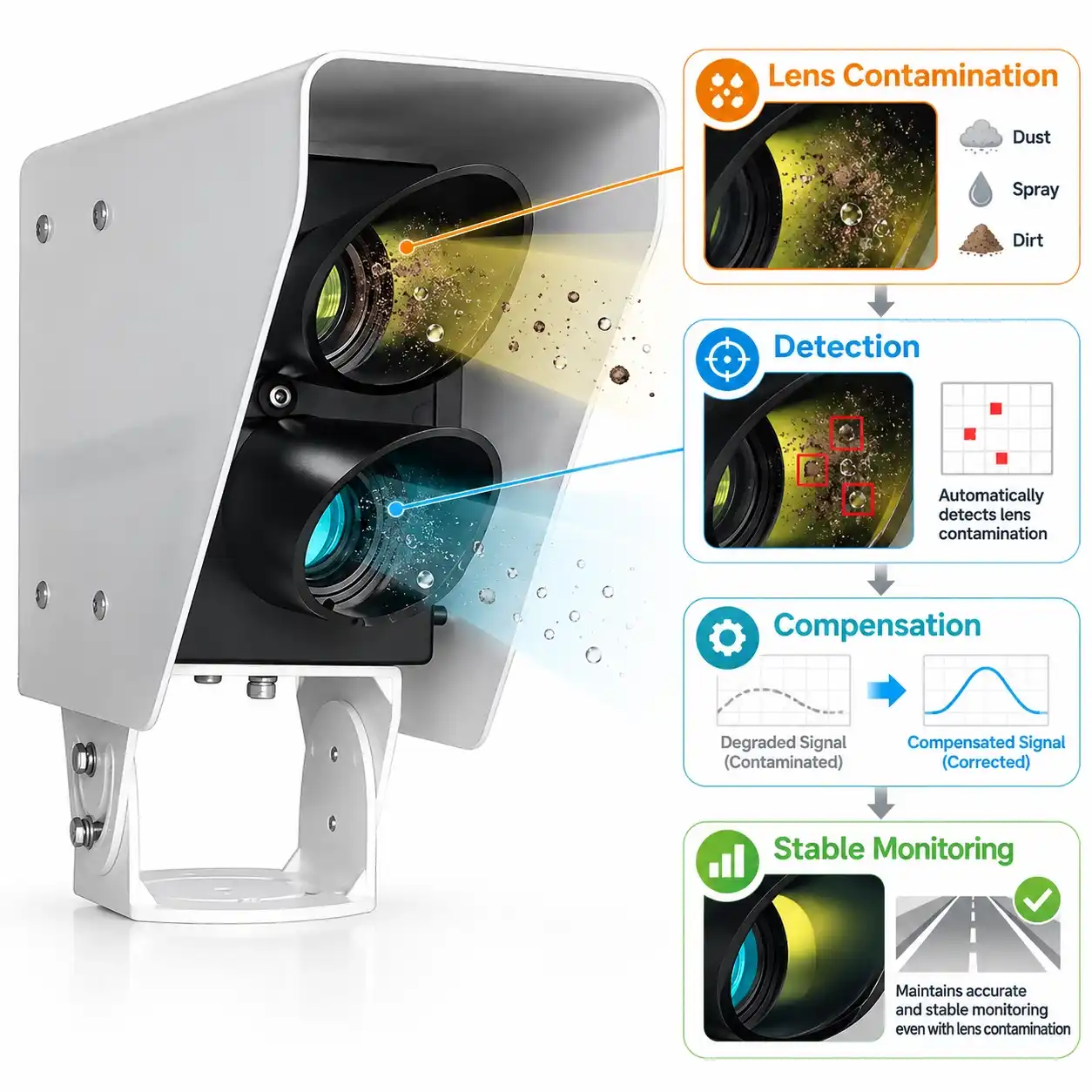
Outdoor optical sensors may be exposed to dust, airborne particles, moisture, and other contaminants.
Accumulation on an optical window can affect the signals used for measurement.
The JW-RSS11 includes optical lens contamination detection and internal automatic contamination compensation.
These functions help the monitoring system identify and compensate for changes associated with optical contamination.
However, automatic compensation does not eliminate the need for maintenance.
Regular visual inspection and cleaning remain important, particularly at locations exposed to road spray, dust, and heavy contamination.
The device also has a lens heating function, included in its specified maximum power consumption.
8. Installation Considerations
The JW-RSS11 is intended for fixed, non-contact road monitoring installations.
Select a Representative Surface
Choose a road section that reflects the conditions the project needs to monitor.
For example, a bridge monitoring project should target a suitable bridge surface rather than an unrelated roadside area.
Maintain an Unobstructed Optical Path
The optical measurement path must remain clear.
Avoid locations where barriers, signs, vegetation, or structural components may obstruct the target pavement.
Respect the Detection Distance
The infrared measurement distance is specified as up to 13 m.
Final mounting height, measurement angle, and target geometry should follow the installation instructions supplied with the selected product configuration.
Provide Suitable Power
The sensor requires a DC 12–24 V supply.
The power design should account for the maximum specified consumption of 6 W, including lens heating.
Connect Communication Interfaces
RS485 and RS232 interfaces are available for integration with compatible monitoring systems.
Communication protocol documentation, wiring diagrams, and data register definitions should be confirmed before commissioning.
Perform Commissioning Checks
After installation, verify sensor communication, target surface positioning, and the plausibility of reported road conditions.
Local validation under relevant road and weather conditions is recommended before enabling operational warning thresholds.
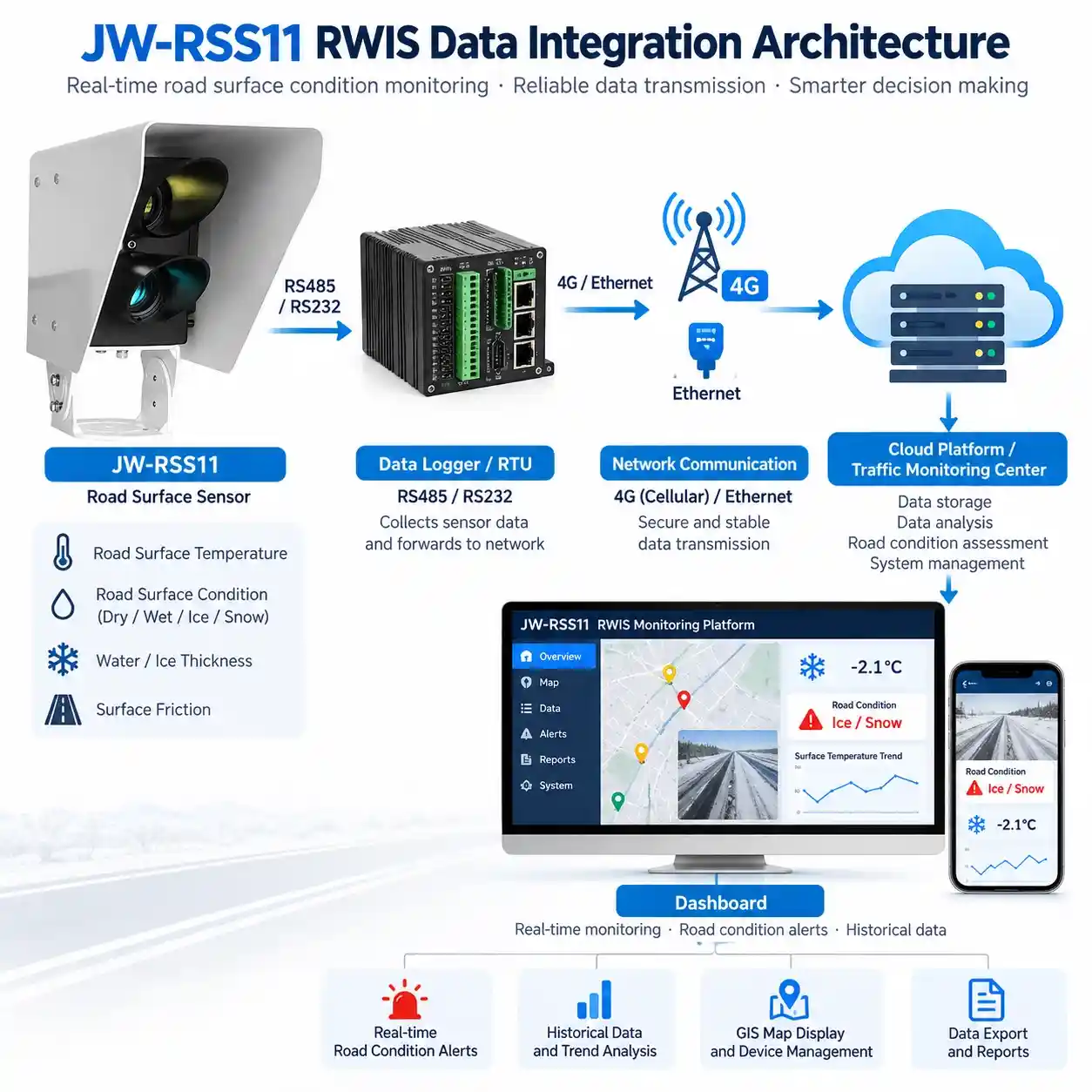
9. Integration with Road Weather Information Systems
A Road Weather Information System combines measurements from road surface instruments and meteorological sensors to support transportation operations.
The JW-RSS11 serves as the pavement monitoring component within such a system.
A typical architecture is:
JW-RSS11 Road Surface Sensor → RS485/RS232 Data Acquisition Unit → Communication Network → RWIS Monitoring Platform
Additional monitoring equipment may include:
Air temperature and humidity sensors
Rainfall monitoring instruments
Wind speed and direction sensors
Visibility monitoring sensors
Cameras for visual road inspection
The combined monitoring system can provide information about atmospheric conditions and the road surface.
The appropriate configuration depends on monitoring coverage, installation requirements, measurement objectives, and communication needs.
11. Request JW-RSS11 Technical Information
The JW-RSS11 Non-Contact Road Surface Sensor is designed for projects requiring remote pavement monitoring without embedded road installation.
Its multispectral infrared detection, up to 13 m measurement distance, optical contamination compensation, and serial communication interfaces make it suitable for fixed road weather monitoring applications.
For project evaluation, please provide your intended road surface, mounting arrangement, communication requirements, and monitoring objectives.
Contact JW-IoT for the JW-RSS11 datasheet, configuration options, interface information, quotation, and integration support.
1. What does the JW-RSS11 road surface sensor measure?
A
It detects water film, ice, snow, road surface temperature, slipperiness, and pavement conditions such as dry, damp, wet, ice, snow, and ice-water mixture.
Q
2. What is the maximum infrared detection distance?
A
The specified maximum detection distance is 13 m. Actual mounting geometry should follow the installation documentation.
Q
3. Can the sensor detect road ice thickness?
A
Yes. The standard ice thickness measurement range is 0–10 mm.
Q
4. Does the sensor require pavement cutting?
A
No. The JW-RSS11 uses non-contact optical measurement and can be mounted above the road surface.
Q
5. Can it be used on concrete and asphalt?
A
Yes. Both concrete and asphalt are listed as supported road surface materials.
Q
6. Does it support automatic optical contamination compensation?
A
Yes. The referenced configuration includes optical contamination monitoring and automatic compensation.
Q
7. What communication interfaces are available?
A
The JW-RSS11 supports RS485 and RS232 communication.
Q
8. Is the sensor suitable for bridge icing monitoring?
A
Yes. It can provide pavement condition measurements for a suitable bridge monitoring location when properly installed.
Q
9. Can JW-RSS11 predict black ice before it forms?
A
The sensor detects existing surface conditions and provides relevant measurements. Predictive black ice warnings require additional environmental observations, forecasting logic, and appropriate validation.
Q
10.Can the sensor be integrated with an existing RWIS?
A
Yes, provided the data acquisition system supports the sensor's communication interface and protocol.
Q
11. Is the 2,000 mm snow measurement range standard?
A
No. The expanded snow measurement range is an optional configuration and must be confirmed before ordering.
 +86 13520127780
 info@jingelway.com