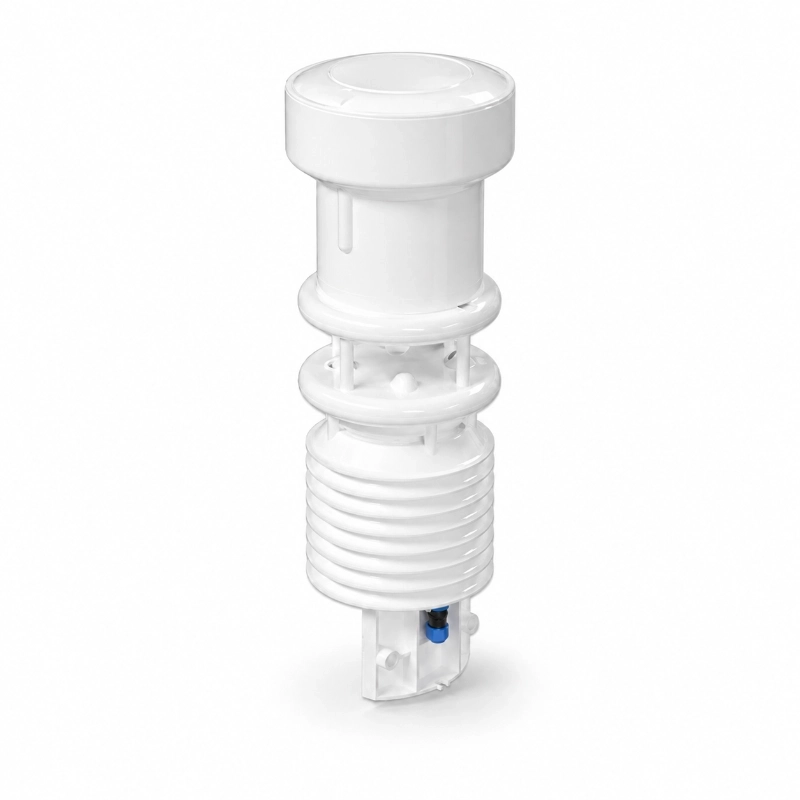
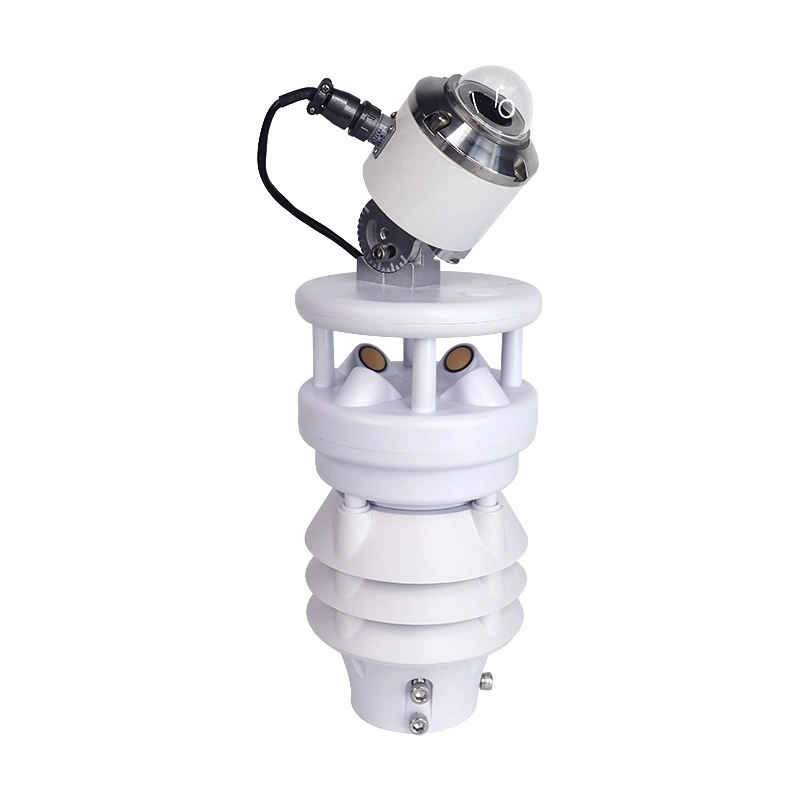
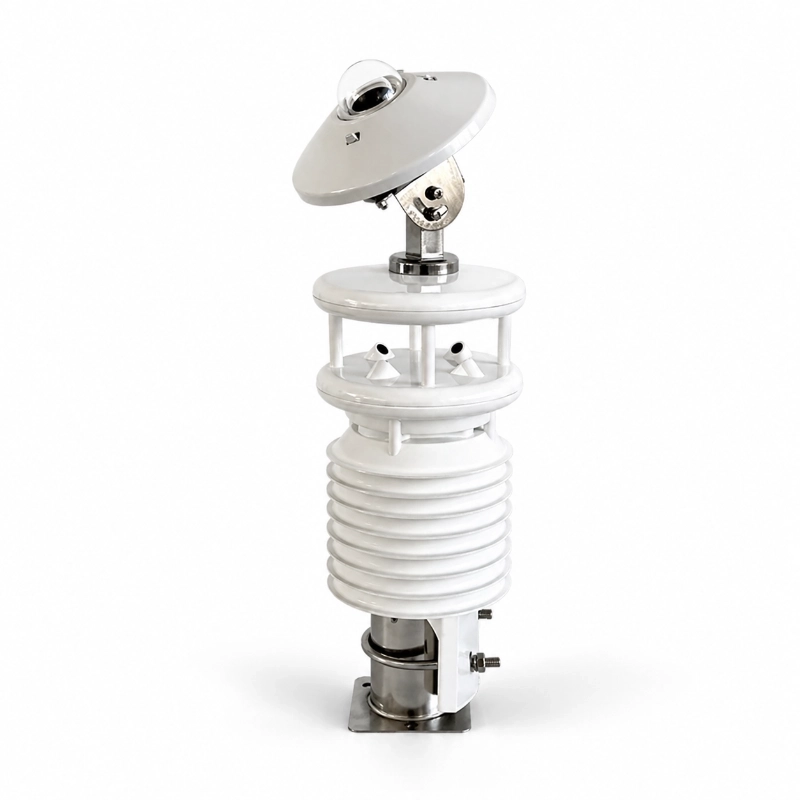
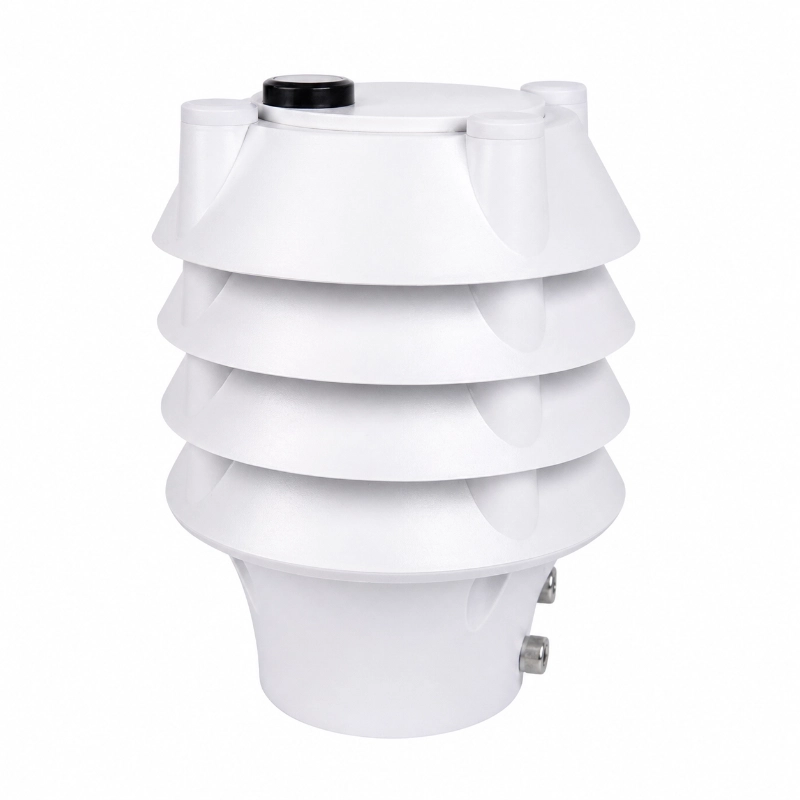
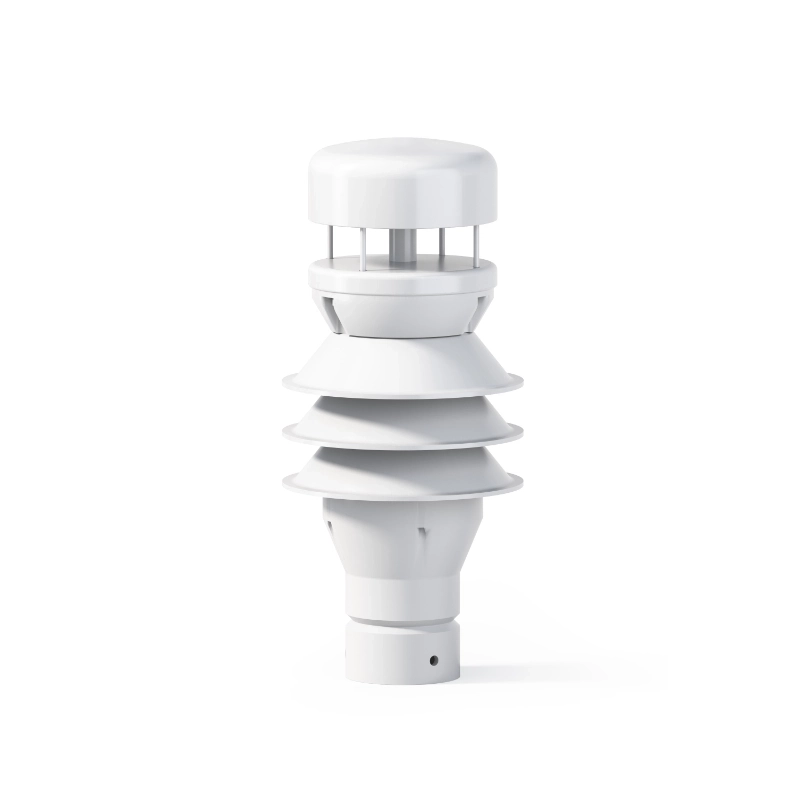
HomeProductsWeather StationMini Compact Weather Station with Ultrasonic Wind and Radar Rainfall
  • Compact weather station with ultrasonic wind sensor
  • Radar rainfall compact weather station for IoT projects
  • Ultrasonic wind speed and direction sensor station

Mini Compact Weather Station with Ultrasonic Wind and Radar Rainfall

Key Features

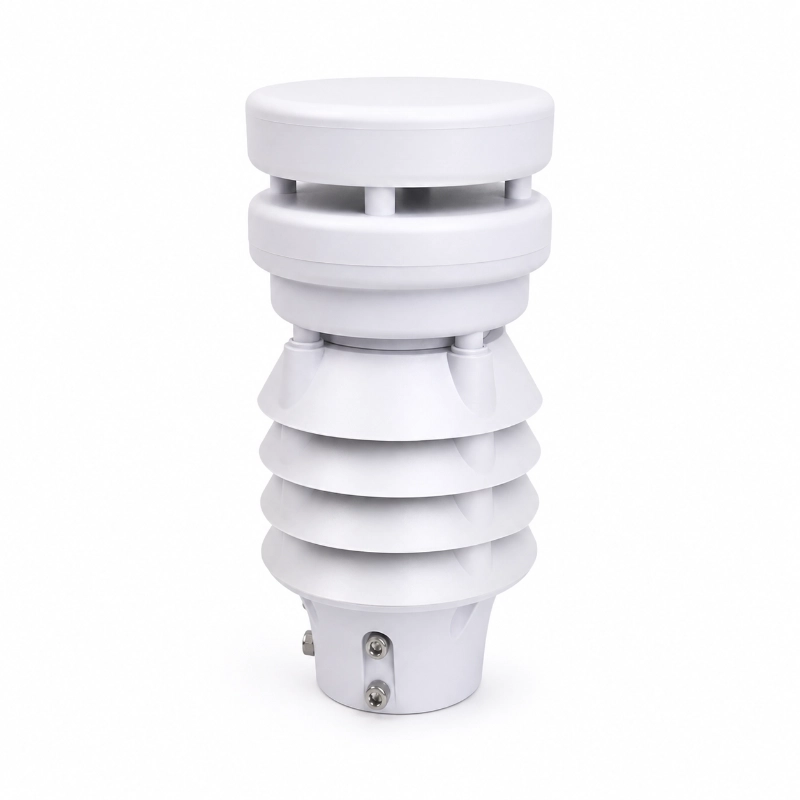
  • Compact mini weather station design: Maximum dimension up to 153.30 mm, suitable for space-limited installations.
  • Ultrasonic wind speed and direction measurement: Measures wind speed from 0–60 m/s and wind direction from 0–359.9°.
  • No moving parts: Ultrasonic sensing principle avoids mechanical wear and supports long-term outdoor use.
  • High-resolution wind data: Wind speed resolution up to 0.01 m/s and wind direction resolution up to 0.1°.
  • 4Hz high-frequency sampling: Captures wind changes quickly for real-time environmental monitoring.
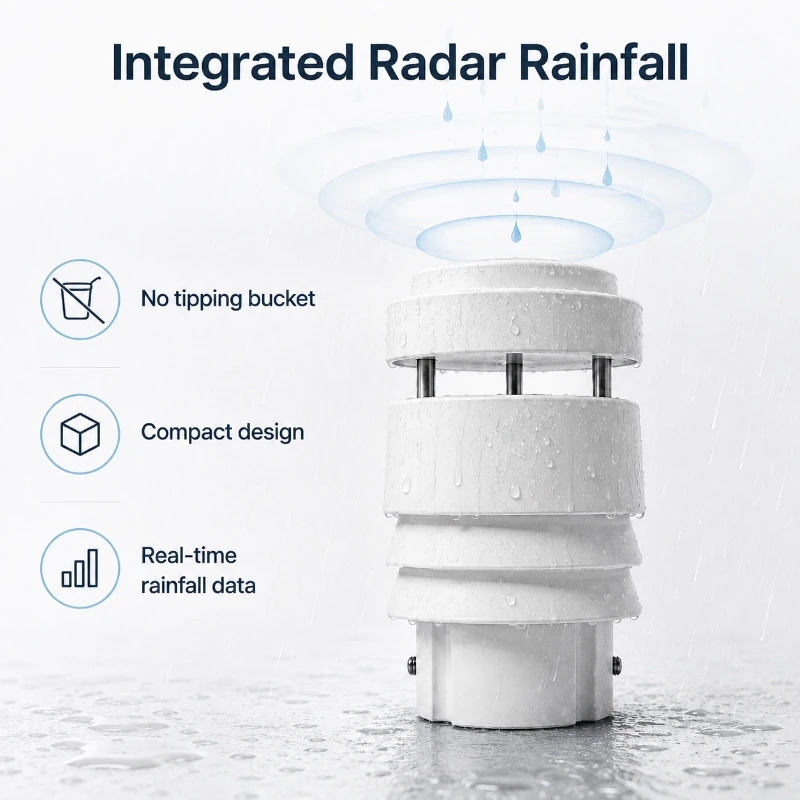
  • Radar rainfall measurement option: New radar rainfall technology helps provide clearer rainfall data without traditional tipping-bucket mechanical structure.
  • Up to 8 measurement parameters: Supports air temperature, air humidity, wind speed, wind direction, atmospheric pressure, rainfall, illuminance, and solar radiation.
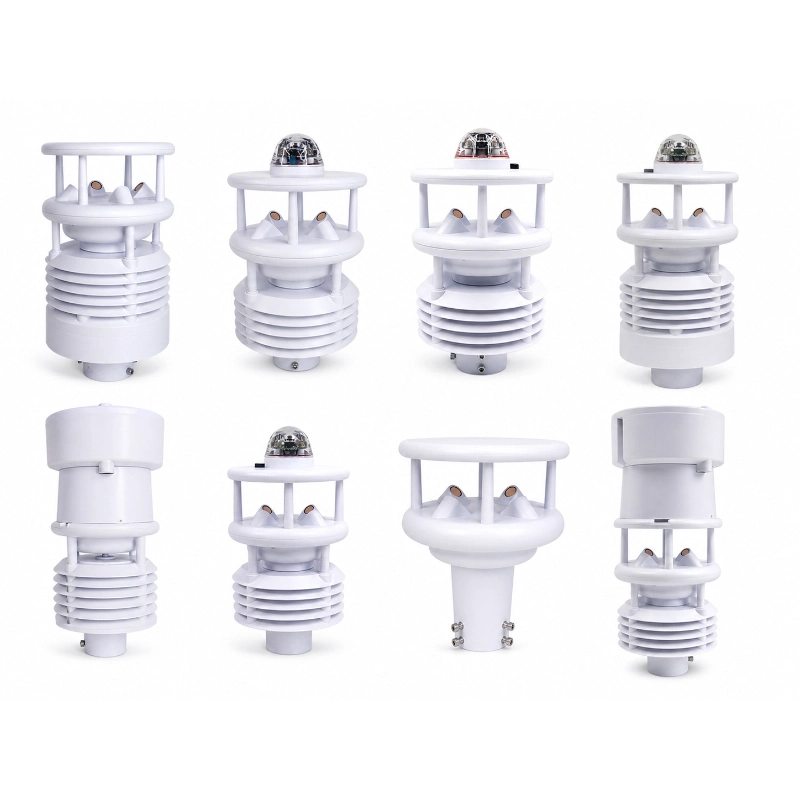
  • Multiple model configurations: Available in XF802, XF805, XF806, and XF808 configurations for different monitoring requirements.
  • Small body with strong performance: Designed for smart agriculture, greenhouse monitoring, weather stations, and IoT projects.

Product Description

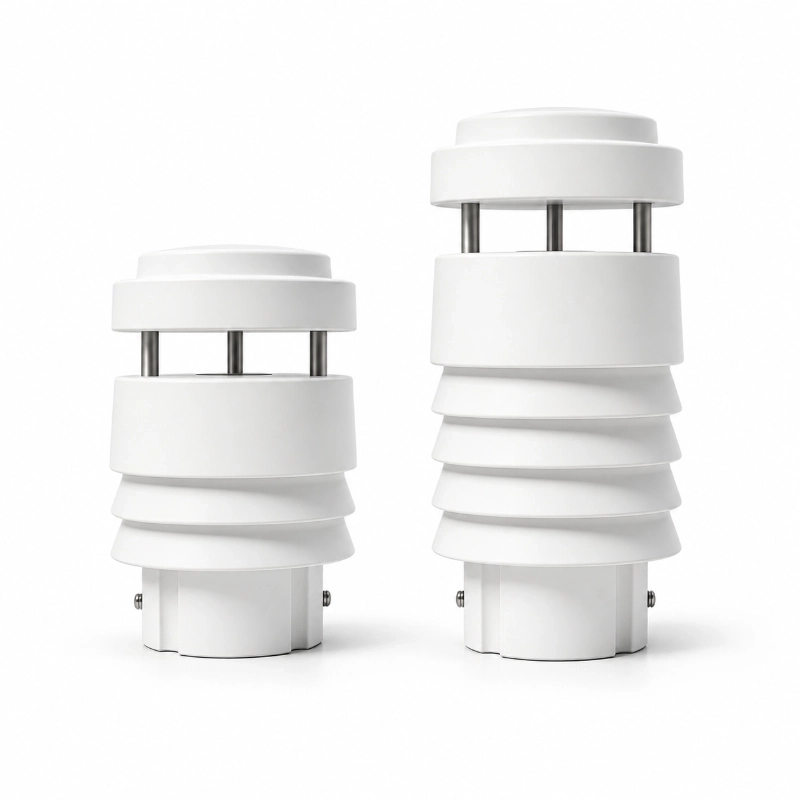
The JW-XF802 series is a mini all-in-one weather station designed for projects that require multiple meteorological parameters in a compact outdoor sensor.

The series uses ultrasonic technology to measure wind speed and wind direction without conventional rotating wind cups or wind vanes. Selected configurations also integrate radar rainfall measurement together with air temperature, relative humidity, atmospheric pressure, illuminance and solar radiation.

With a maximum body dimension of approximately 83.03 × 153.30 mm, the JW-XF802 series is suitable for installations where mounting space, wiring and system integration need to be minimized.

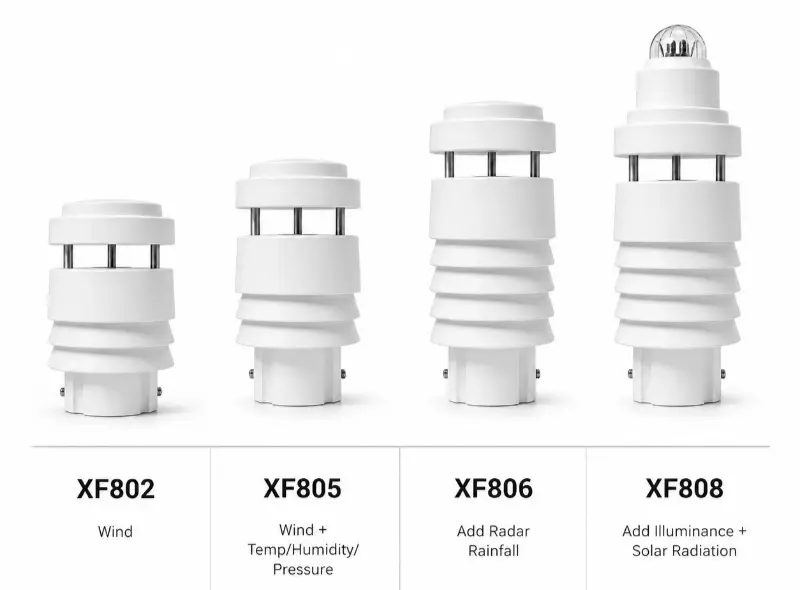
Four configurations are available:

  • XF802: ultrasonic wind speed and wind direction
  • XF805: wind, air temperature, humidity and atmospheric pressure
  • XF806: wind, air temperature, humidity, pressure and radar rainfall
  • XF808: eight-parameter weather monitoring with illuminance and solar radiation

The weather station can be evaluated for smart agriculture, greenhouses, irrigation systems, solar PV sites, environmental monitoring, campus weather stations and distributed IoT projects.

Product Highlights

Mini Integrated Structure

The JW-XF802 series integrates multiple sensing elements into one compact enclosure.

The maximum product dimension is approximately 83.03 × 153.30 mm, making the sensor suitable for:

  • Compact monitoring poles
  • Greenhouse structures
  • Agricultural field stations
  • Small outdoor equipment cabinets
  • Solar-powered monitoring points
  • Distributed IoT installations
  • Space-limited environmental stations

The integrated structure can reduce the number of individual brackets, external sensor cables and separate installation positions required at the monitoring site.

Ultrasonic Wind Measurement

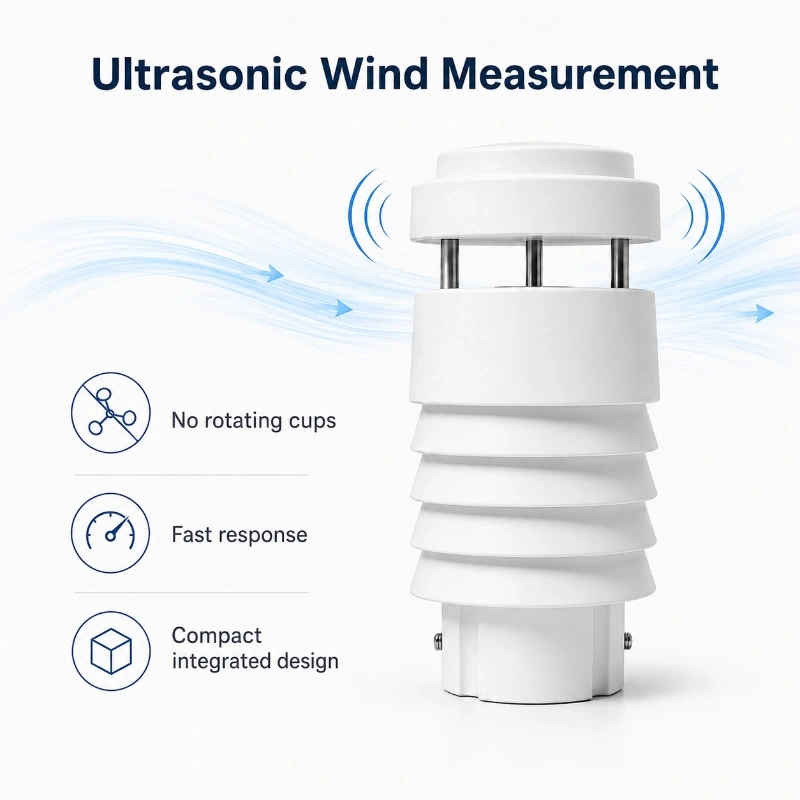
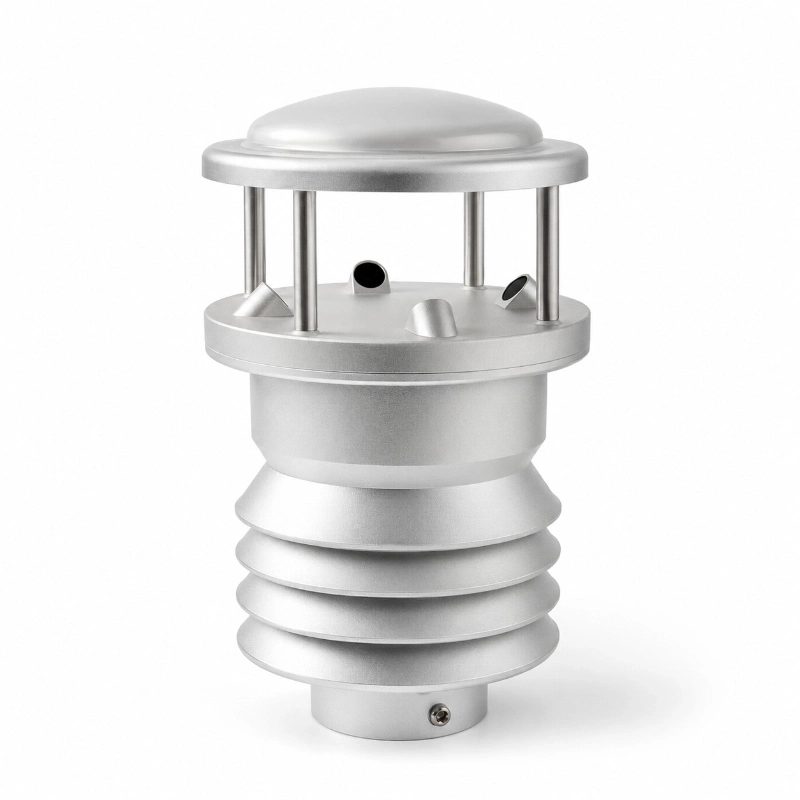
Wind speed and wind direction are measured using ultrasonic sensing technology.

The wind module supports:

  • Wind-speed range: 0–60 m/s
  • Wind-direction range: 0–359.9°
  • Wind-speed resolution: up to 0.01 m/s
  • Wind-direction resolution: up to 0.1°
  • Sampling frequency: up to 4 Hz

Because the measurement principle does not require conventional rotating wind cups or a mechanical wind vane, the sensor avoids wear associated with moving wind-measurement components.

Regular cleaning, visual inspection and data verification are still recommended for reliable long-term outdoor operation.

Radar Rainfall Measurement

The XF806 and XF808 configurations include integrated radar rainfall measurement.

The radar module detects precipitation without using the bucket-and-tipping mechanism found in a traditional tipping-bucket rain gauge.

This design is suitable for projects where the customer prioritizes:

  • Compact construction
  • Integrated installation
  • No tipping-bucket mechanism
  • Reduced mechanical components
  • Real-time rainfall intensity data
  • Multi-parameter monitoring in one device

The rainfall measurement range is 0–200 mm/h.

Radar rainfall and tipping-bucket rainfall use different measurement principles. Customers with regulatory, hydrological or research-grade precipitation requirements should confirm the required rainfall accuracy, resolution and applicable standard before model selection.

Up to Eight Monitoring Parameters

Depending on the selected model, the JW-XF802 series can measure:

  1. Air temperature
  2. Relative humidity
  3. Wind speed
  4. Wind direction
  5. Atmospheric pressure
  6. Rainfall
  7. Illuminance
  8. Solar radiation

This allows system integrators to select a model according to the project instead of purchasing unused parameters.

Four Model Configurations

The product series is available in XF802, XF805, XF806 and XF808 configurations.

The model structure allows customers to choose between:

  • Wind-only monitoring
  • Basic five-parameter weather monitoring
  • Weather monitoring with radar rainfall
  • Complete eight-parameter monitoring

Designed for IoT Integration

The compact weather station can be connected to compatible data-acquisition and communication equipment according to the confirmed product interface.

Possible system components include:

  • Data logger
  • RTU
  • PLC
  • 4G IoT gateway
  • LoRaWAN node or gateway
  • Local monitoring server
  • Cloud monitoring platform
  • Customer-owned software platform

The required output, communication settings and data protocol must be confirmed before ordering.

Model Selection

Model Size Air Temperature Air Humidity Wind Speed Wind Direction Pressure Rainfall Illuminance Solar Radiation
XF802 83.03 × 108.30 mm Optional Optional Yes Yes Optional Optional Optional Optional
XF805 83.03 × 153.30 mm Yes Yes Yes Yes Yes Optional Optional Optional
XF806 83.03 × 153.30 mm Yes Yes Yes Yes Yes Yes Optional Optional
XF808 83.03 × 153.30 mm Yes Yes Yes Yes Yes Yes Yes Yes

Which Model Should You Choose?

Choose XF802 When:

  • The project primarily requires wind speed and wind direction.
  • The available mounting space is limited.
  • The customer wants an ultrasonic wind sensor without mechanical wind cups.
  • Other weather parameters are already measured by separate sensors.
  • The unit will be integrated into an existing monitoring station.

Choose XF805 When:

  • The project requires wind speed and wind direction.
  • Air temperature and humidity are required.
  • Atmospheric pressure is required.
  • Rainfall and solar radiation are not required.
  • The station will be used for basic agricultural, greenhouse or environmental monitoring.

Choose XF806 When:

  • The project requires the five parameters available in XF805.
  • Integrated rainfall measurement is also required.
  • A compact radar rainfall module is preferred.
  • The application involves agriculture, irrigation, roads or general outdoor weather monitoring.

Choose XF808 When:

  • The project requires all eight available parameters.
  • Solar radiation and illuminance data are needed.
  • The customer wants the most complete model in the series.
  • The installation is used for agriculture, solar PV, environmental research or comprehensive IoT monitoring.

Measurement Parameters

Parameter Range
Air Temperature -40°C to 85°C
Air Humidity 0–100% RH
Wind Speed 0–60 m/s
Wind Direction 0–359.9°
Atmospheric Pressure 500–1100 hPa
Rainfall 0–200 mm/h
Illuminance 0–100 KLux
Solar Radiation 0–1500 W/m²

Important Specification Note

Measurement accuracy, operating voltage, power consumption, output signal, communication protocol, cable definition, enclosure rating and operating-environment limits should be confirmed against the latest technical datasheet before procurement or tender submission.

Do not use estimated or generic values for engineering design.

Ultrasonic Wind Measurement

How It Works

The sensor transmits ultrasonic signals between internal transducers.

Wind changes the travel time of the signals. The instrument uses these changes to calculate wind speed and wind direction.

Unlike a conventional cup-and-vane assembly, ultrasonic wind measurement does not require rotating wind cups, bearings or a mechanical wind-direction vane.

Practical Benefits

The ultrasonic design can support:

  • Compact product dimensions
  • No wind-cup bearing wear
  • No mechanical wind-vane alignment
  • Fast response to changing wind
  • High-frequency data acquisition
  • Easier integration into a multi-parameter housing

Installation Considerations

Even a high-performance wind sensor can produce unrepresentative data when installed in a poor location.

Avoid installing the weather station:

  • Directly beside a wall
  • Below a roof edge
  • Behind a large solar panel
  • Beside an exhaust outlet
  • Under dense tree cover
  • Inside a location blocked by greenhouse structures
  • Too close to other large sensors
  • Where the mounting pole causes significant airflow interference

The sensor should be installed vertically and in an open position appropriate for the project.

Where wind-direction data is required, align the orientation mark according to the product installation instructions.

Radar Rainfall Measurement

Non-Tipping Rain Detection

The radar rainfall module measures precipitation without collecting water in a tipping-bucket mechanism.

This allows rainfall measurement to be integrated into the same compact body as the wind and meteorological sensing modules.

Suitable Applications

Radar rainfall measurement may be considered for:

  • Agricultural weather stations
  • Irrigation monitoring
  • Greenhouse external weather monitoring
  • Roadside weather nodes
  • Solar-powered stations
  • Distributed environmental monitoring
  • Campus weather stations
  • IoT monitoring projects

What Customers Should Confirm

Before selecting the radar rainfall model, confirm:

  • Required rainfall range
  • Required rainfall resolution
  • Required accuracy
  • Minimum detectable rainfall
  • Reporting interval
  • Local rainfall characteristics
  • Whether accumulated rainfall is required
  • Whether a specific meteorological standard applies
  • Whether a dedicated reference rain gauge is also required

Radar rainfall should not automatically be described as more accurate than a tipping-bucket rain gauge. The appropriate technology depends on the project objective and measurement requirement.

Recommended Applications

Smart Agriculture

The XF805, XF806 and XF808 models can provide local weather data for:

  • Field microclimate monitoring
  • Orchard monitoring
  • Irrigation management
  • Crop-weather analysis
  • Spraying-condition assessment
  • Frost and heat-risk evaluation
  • Agricultural IoT platforms

The weather station can be combined with:

  • Soil moisture sensors
  • Soil temperature sensors
  • Soil EC sensors
  • Multi-depth soil sensors
  • Leaf wetness sensors
  • PAR sensors
  • Irrigation controllers

For large farms, multiple monitoring points may be required because terrain, crops, irrigation zones and elevation can create different microclimates.

Greenhouse Monitoring

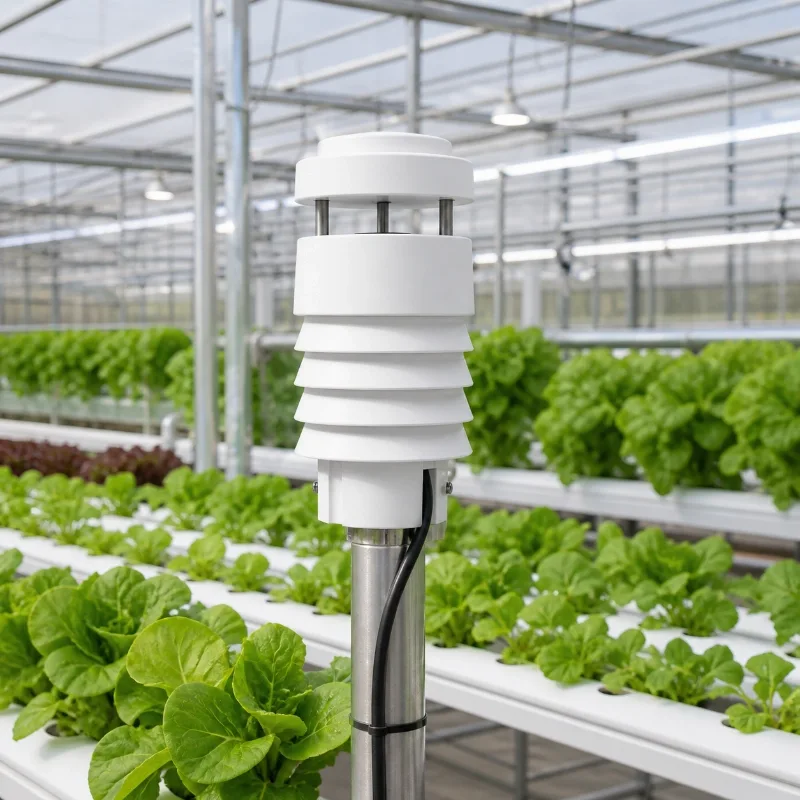
The compact structure is suitable for greenhouse projects where installation space is limited.

Possible uses include:

  • Monitoring external weather conditions
  • Supporting ventilation control
  • Evaluating temperature and humidity trends
  • Recording wind and rainfall outside the greenhouse
  • Integrating weather data with greenhouse control software

For indoor greenhouse measurements, sensor position should be selected carefully to avoid direct irrigation spray, heating outlets, ventilation fans and localized heat sources.

Irrigation Systems

Rainfall, temperature, humidity and solar data can support irrigation planning.

The weather station can provide environmental inputs to a platform or controller, but irrigation decisions should also consider:

  • Soil moisture
  • Crop type
  • Root depth
  • Soil texture
  • Growth stage
  • Irrigation-zone conditions
  • Local evapotranspiration model

Weather data alone should not be treated as a complete irrigation-control strategy.

Solar PV Monitoring

The XF808 model includes solar radiation and illuminance measurement and may be evaluated for distributed solar or commercial rooftop projects.

Possible monitored parameters include:

  • Ambient temperature
  • Relative humidity
  • Atmospheric pressure
  • Wind speed
  • Wind direction
  • Rainfall
  • Illuminance
  • Solar radiation

For formal PV performance assessment, confirm whether the project requires a dedicated pyranometer, reference cell, plane-of-array irradiance sensor, PV module temperature sensor or soiling sensor.

The integrated solar radiation module should be selected according to the required measurement class and project specification.

Environmental Monitoring

The product can be used as the meteorological component of a broader environmental monitoring station.

It can provide weather data for interpreting:

  • Air-quality readings
  • Dust movement
  • Gas dispersion
  • Noise conditions
  • Urban microclimates
  • Industrial boundary conditions

Additional PM, gas or noise sensors normally require separate monitoring modules or an expanded station configuration.

Campus and Research Monitoring

The mini weather station can support:

  • School weather observation
  • University field projects
  • Environmental research
  • Demonstration stations
  • Experimental agriculture
  • Distributed sensor networks

Researchers should confirm calibration, data-access requirements and measurement uncertainty before selecting a model.

Smart City and IoT Nodes

The compact body can be integrated into distributed smart-city monitoring points where installation space is limited.

Possible installation locations include:

  • Smart poles
  • Public parks
  • Residential communities
  • Transport facilities
  • Roadside monitoring points
  • Municipal environmental stations

The communication method should be selected according to site power, gateway coverage, data frequency and the number of deployed stations.

Typical System Architecture

A typical remote monitoring system can use the following data chain:

JW-XF802 Series Weather Station

RS485 or Confirmed Sensor Output

Data Logger, RTU or IoT Gateway

4G, LoRaWAN, Ethernet or Other Network

Cloud Platform or Local Server

Data Dashboard, Historical Trends, Alarms and API

Local Wired Integration

For a local control cabinet or PLC system, the weather station can be connected through the confirmed output interface.

Before integration, confirm:

  • Power supply
  • Signal type
  • Communication address
  • Baud rate
  • Data bits
  • Parity
  • Register map
  • Polling interval
  • Cable length
  • Grounding method

Remote 4G Monitoring

A 4G gateway can be used when the monitoring point has cellular coverage.

This configuration is suitable for:

  • Remote farms
  • Solar plants
  • Roads
  • Outdoor environmental sites
  • Standalone weather stations

LoRaWAN Monitoring

LoRaWAN can support distributed low-power monitoring points connected to one gateway.

Actual transmission performance depends on:

  • Gateway height
  • Antenna selection
  • Buildings
  • Terrain
  • Vegetation
  • Radio-frequency interference
  • Regional frequency plan

Platform and API Integration

JW-IoT can evaluate connection to:

  • JW-IoT monitoring software
  • Customer-owned platforms
  • Private servers
  • SCADA systems
  • Agricultural IoT platforms
  • Environmental monitoring software

Customers should provide the required communication protocol, data format, reporting interval and server interface before ordering.

Installation Guidelines

1. Select an Open Monitoring Position

Install the weather station where the measured air and wind conditions represent the target area.

Avoid locations affected by:

  • Building heat
  • Air-conditioning outlets
  • Chimneys
  • Irrigation spray
  • Reflective surfaces
  • Large walls
  • Dense vegetation
  • Machinery exhaust
  • Obstructed airflow

2. Install the Sensor Vertically

The sensor body should be installed in the correct vertical orientation.

A tilted or unstable mounting position may affect wind, rainfall or other measurements.

3. Align Wind Direction Correctly

Where the product uses a north-reference mark, align the mark according to the installation manual.

After installation, verify the displayed wind direction against the known sensor orientation.

4. Use a Stable Mounting Pole

The mounting pole and bracket should resist vibration and movement.

Check:

  • Pole diameter
  • Bracket compatibility
  • Bolt tightness
  • Corrosion protection
  • Cable strain relief
  • Maintenance access

5. Protect Power and Communication Lines

Outdoor power and signal cables should be protected from:

  • Water ingress
  • Cable tension
  • Abrasion
  • Rodents
  • UV exposure
  • Lightning-induced surges
  • Incorrect grounding

Use suitable waterproof connectors, cable conduits and surge-protection devices according to the project design.

6. Keep the Sensor Clear

Do not place solar panels, antennas, cameras or large enclosures directly beside the wind and rainfall sensing area.

Maintain sufficient clearance according to the installation drawing.

7. Verify Data After Installation

After commissioning, check:

  • Temperature plausibility
  • Humidity plausibility
  • Pressure value
  • Wind-speed response
  • Wind-direction orientation
  • Rainfall response
  • Solar-radiation response
  • Communication stability
  • Timestamp and reporting interval

Maintenance Recommendations

The compact weather station has no conventional wind cups or wind vane, but it is not maintenance-free.

Recommended maintenance includes:

  • Clean dust and deposits from the housing.
  • Remove bird droppings, insects and debris.
  • Check that the wind-measurement area is unobstructed.
  • Inspect the radar rainfall sensing surface.
  • Check mounting bolts and brackets.
  • Inspect cables and waterproof connectors.
  • Verify power-supply voltage.
  • Check communication quality.
  • Compare data with a reference instrument when required.
  • Follow the recommended calibration interval.
  • Review abnormal or flat-line data promptly.

Maintenance frequency should be adjusted for dusty, coastal, icy, industrial or high-pollution environments.

Product Advantages

Compact Size

The small enclosure is suitable for monitoring stations with limited mounting space.

Flexible Model Selection

Four configurations allow customers to select the required parameters without automatically purchasing the complete eight-parameter model.

No Conventional Wind Cups

Ultrasonic wind measurement removes rotating wind-cup and wind-vane components from the sensor design.

Integrated Radar Rainfall Option

The XF806 and XF808 models provide rainfall measurement without a traditional tipping-bucket mechanism.

High-Frequency Wind Sampling

A sampling frequency of up to 4 Hz helps capture short-term changes in wind conditions.

Wide Wind-Speed Range

The 0–60 m/s range supports a variety of outdoor monitoring applications, subject to the confirmed accuracy and operating specification.

Multi-System Integration

The product can be evaluated for connection to RTUs, gateways, PLCs and IoT platforms according to the confirmed output interface.

Suitable for OEM Projects

JW-IoT can evaluate project-based documentation, branding, configuration and integration requirements for distributors and system integrators.

Request a Quote for the JW-XF802 Series

The correct model depends on the parameters required by your project.

Choose:

  • XF802 for compact ultrasonic wind monitoring
  • XF805 for basic five-parameter weather monitoring
  • XF806 for five weather parameters plus radar rainfall
  • XF808 for complete eight-parameter monitoring

Send us your parameter list, communication method, installation environment and project quantity.

Get a Quote

Request Technical Datasheet

Send Your Project Specifications

Contact JW-IoT

FAQ

  • Q

    1. What parameters can the JW-XF802 series measure?

    A

    Depending on the selected model, the series can measure air temperature, relative humidity, wind speed, wind direction, atmospheric pressure, rainfall, illuminance and solar radiation.

  • Q

    2. What is the difference between XF802, XF805, XF806 and XF808?

    A

    XF802 is primarily designed for ultrasonic wind measurement. XF805 adds temperature, humidity and atmospheric pressure. XF806 adds radar rainfall. XF808 adds illuminance and solar radiation to provide all eight available parameters.

  • Q

    3. Does the weather station have moving wind components?

    A

    No conventional rotating wind cups or mechanical wind vane are used. Wind speed and wind direction are measured using ultrasonic technology.

  • Q

    4. What is the wind-speed measurement range?

    A

    The listed wind-speed range is 0–60 m/s, with resolution up to 0.01 m/s. Accuracy should be confirmed in the latest technical datasheet.

  • Q

    5. What is the wind-direction range?

    A

    The listed wind-direction range is 0–359.9°, with resolution up to 0.1°.

  • Q

    6. Which models include radar rainfall?

    A

    The XF806 and XF808 configurations include radar rainfall measurement.

  • Q

    7. Is radar rainfall more accurate than a tipping-bucket rain gauge?

    A

    Not necessarily. The two technologies use different measurement principles. Selection should be based on required accuracy, resolution, maintenance conditions, rainfall characteristics and applicable standards.

  • Q

    8. Is the product suitable for smart agriculture?

    A

    Yes. The XF805, XF806 and XF808 models can provide weather data for farms, orchards, greenhouses and irrigation systems. They can also be combined with soil and crop sensors.

  • Q

    9. Can it be used for solar PV monitoring?

    A

    The XF808 includes solar radiation and weather parameters and may be used in distributed PV monitoring. Projects requiring performance-grade irradiance data should confirm whether a dedicated pyranometer or reference cell is necessary.

WhatsApp

Leave a message!

Leave a message!