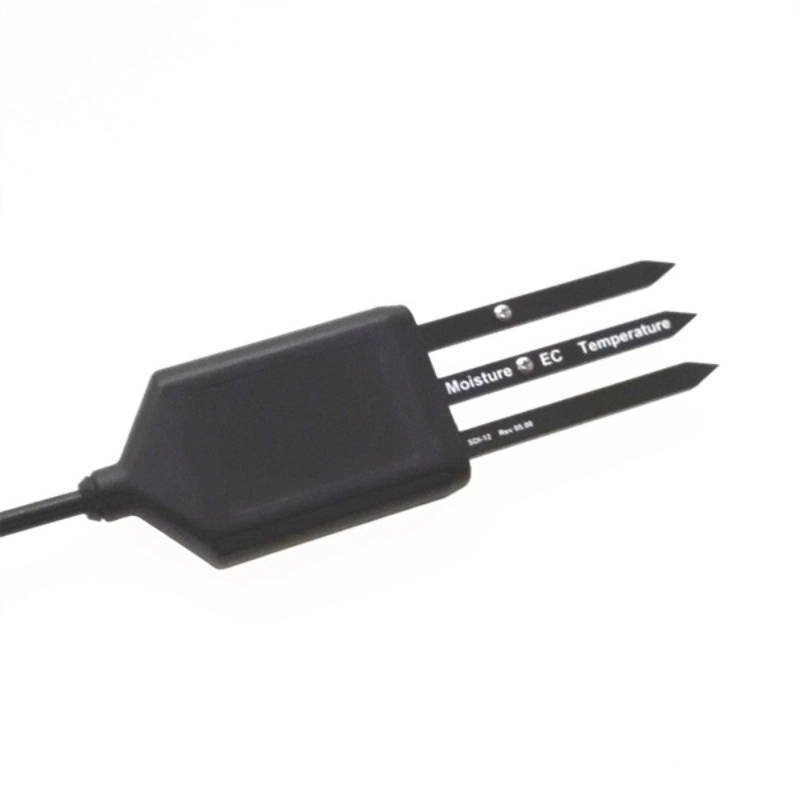
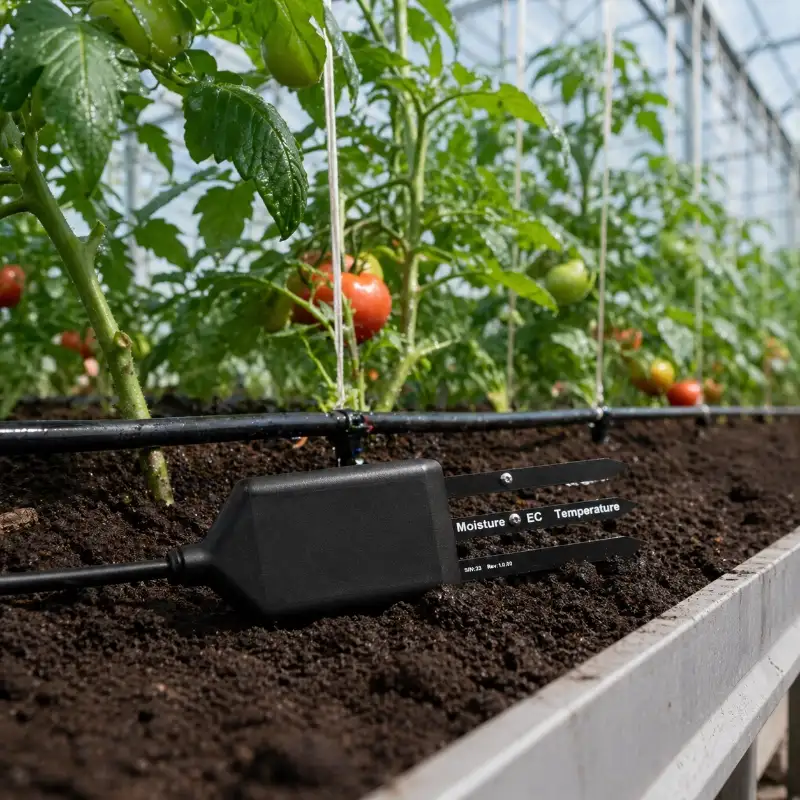
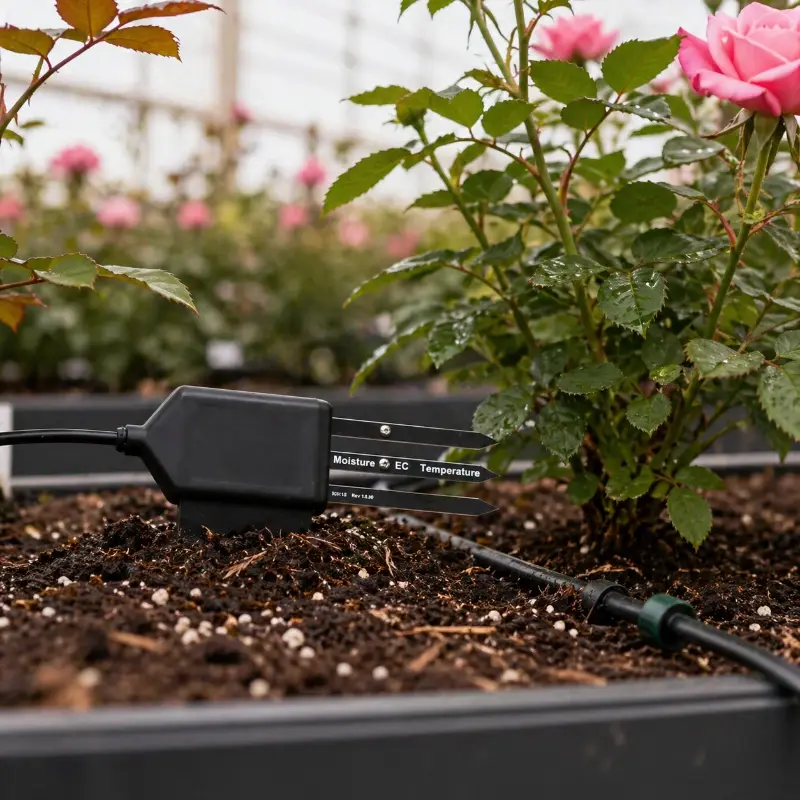
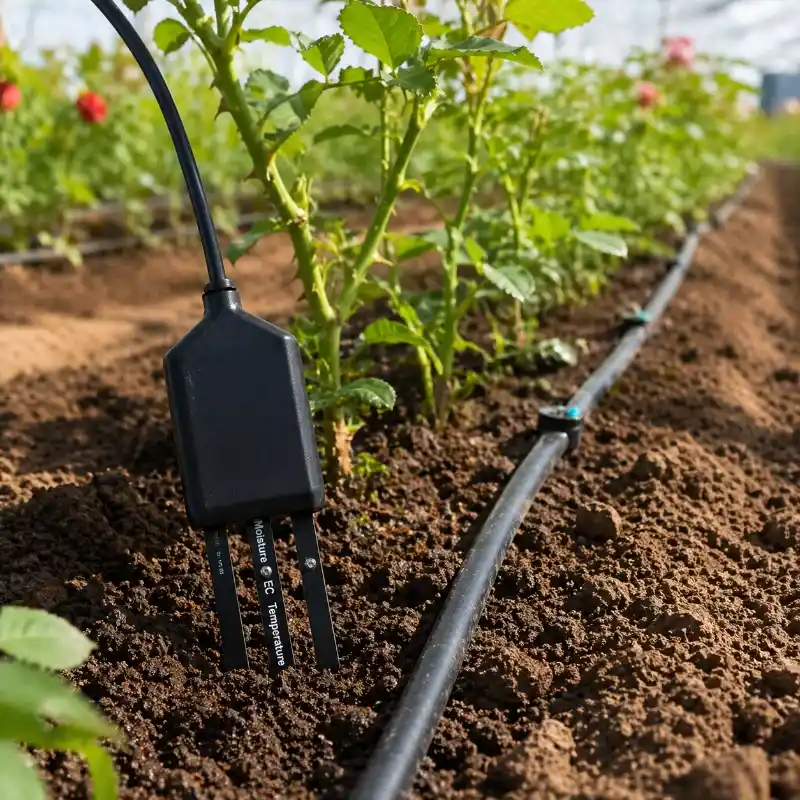
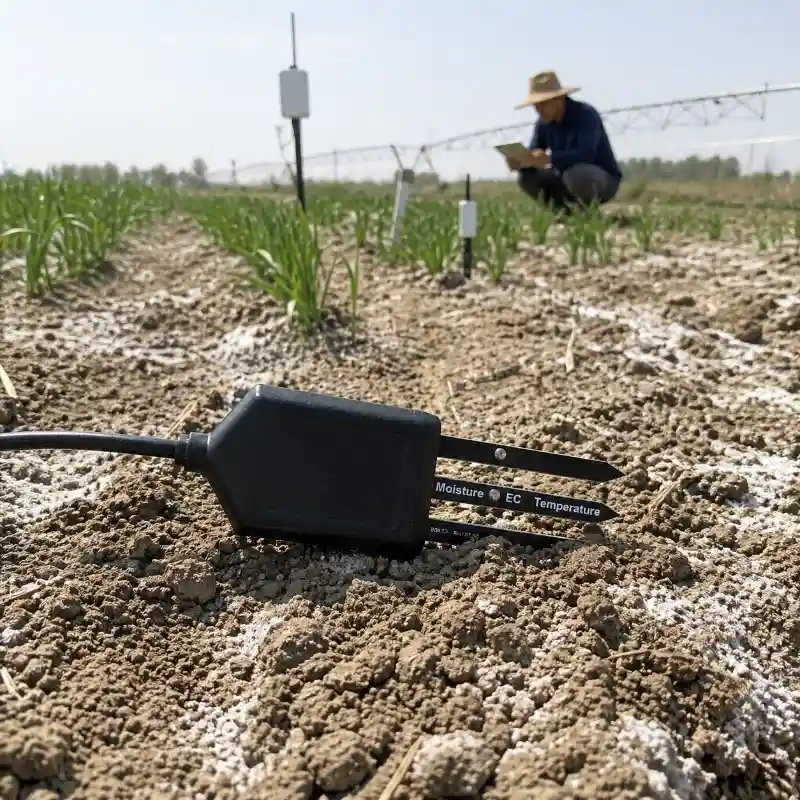
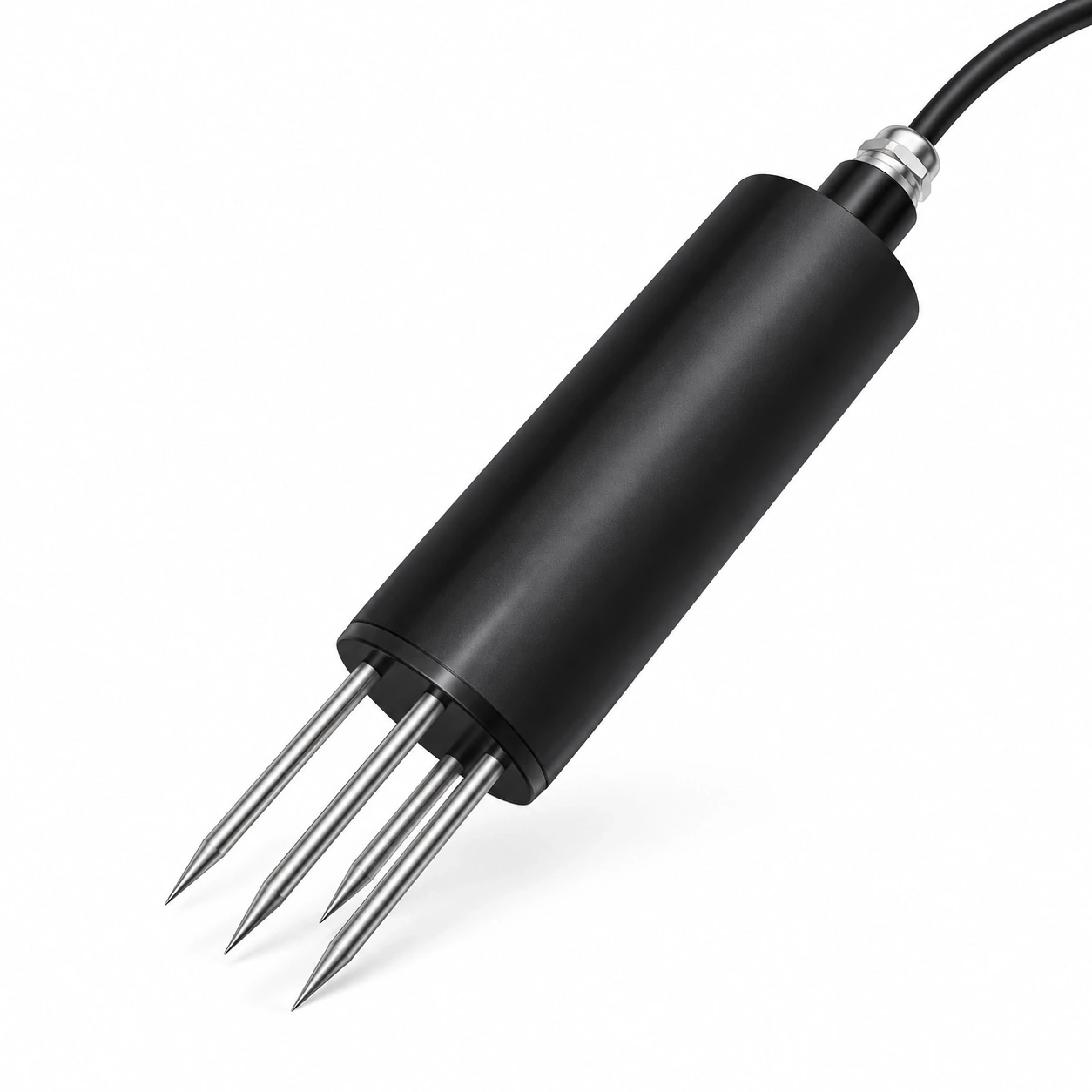
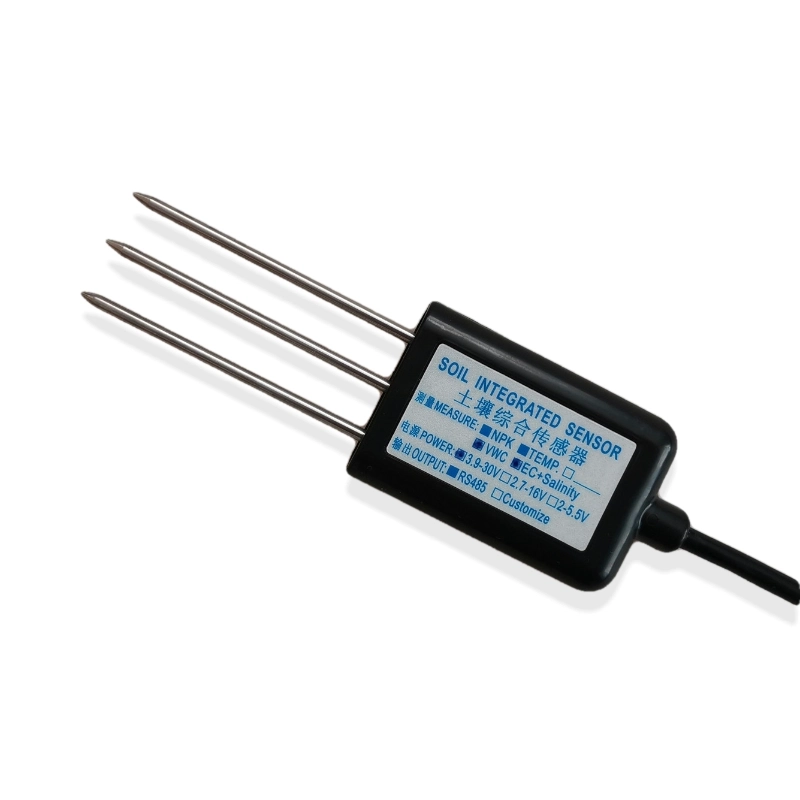
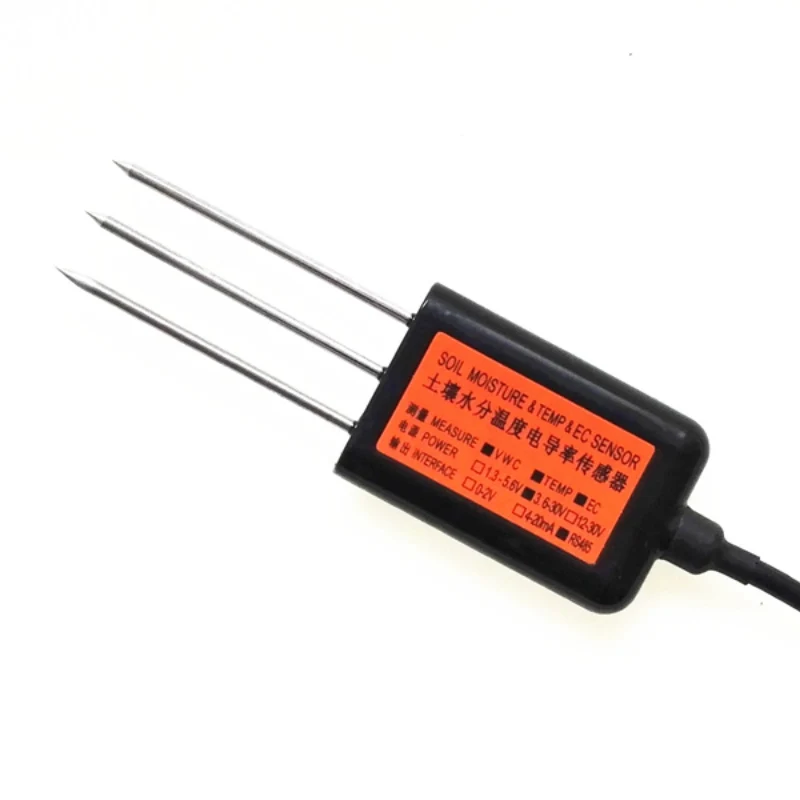
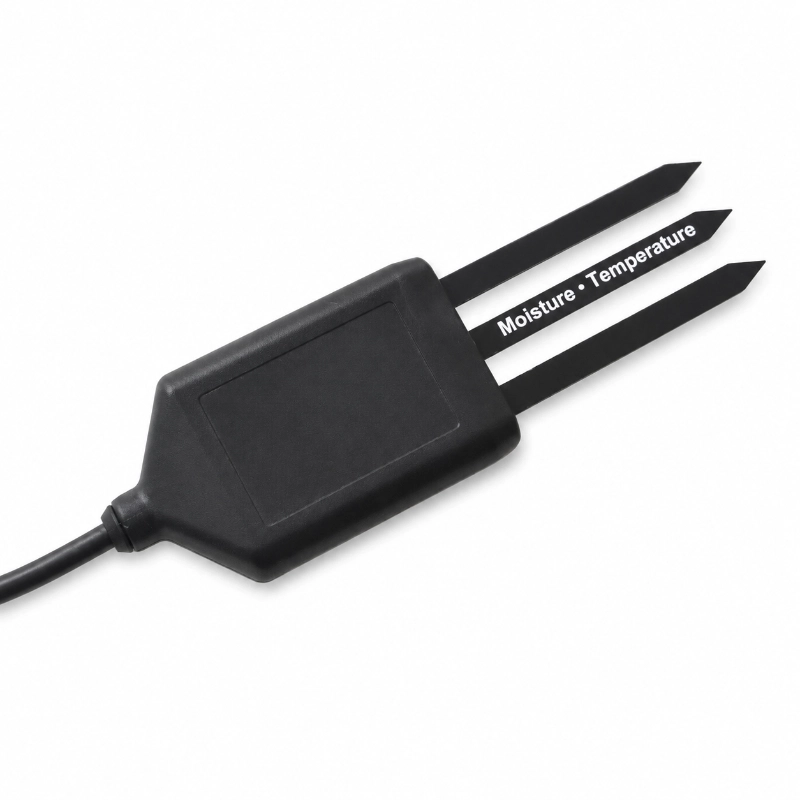
The JW-S3S(Z11) Soil Moisture EC Temperature Sensor is a compact, multi-parameter soil monitoring probe designed for precision farming, smart irrigation, greenhouse cultivation, fertigation management, and soil salinity monitoring.
It measures three essential soil parameters:
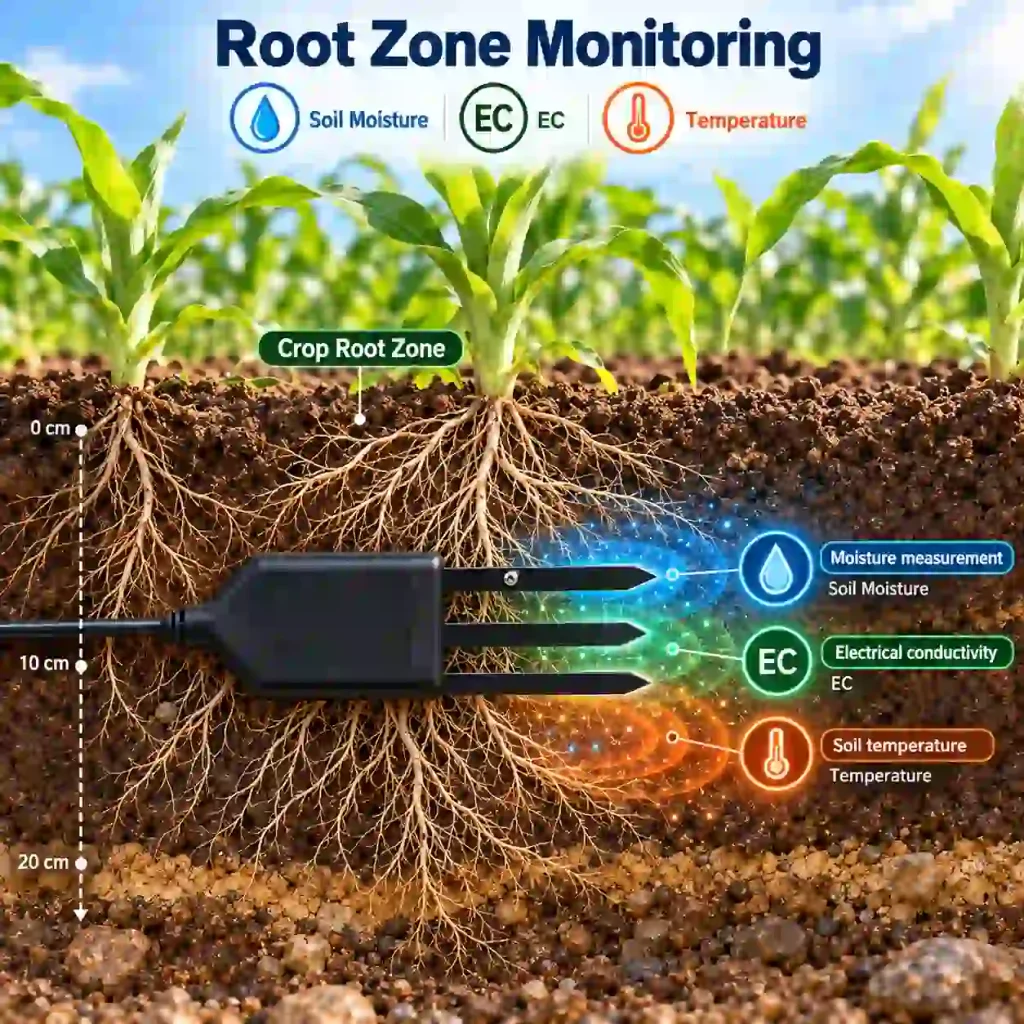
Soil moisture: Volumetric water content (VWC) for irrigation scheduling and root-zone water management.
Soil electrical conductivity (EC): Soil conductivity changes associated with soluble salts and fertilizer application.
Soil temperature: Root-zone temperature conditions relevant to crop growth and measurement interpretation.
The sensor combines Frequency Domain Reflectometry (FDR) technology for moisture measurement with an AC bridge method for electrical conductivity monitoring.
With optional RS485 Modbus RTU or 0–2V analog output, a 3.9–30V DC power supply, and IP68 waterproof construction, the JW-S3S(Z11) can be integrated into agricultural IoT systems, irrigation controllers, data loggers, and remote monitoring networks.
It is suitable for agricultural system integrators, greenhouse automation companies, irrigation equipment manufacturers, and research organizations requiring combined soil moisture, salinity, and temperature monitoring.
A soil moisture EC temperature sensor is an agricultural monitoring instrument that measures soil water content, electrical conductivity, and temperature at a selected location.
Unlike a basic soil moisture meter that only measures water content, a combined sensor provides additional information about the soil environment.
Measurement
What It Indicates
Agricultural Application
Soil moisture
Volumetric water content
Irrigation scheduling
Soil EC
Electrical conductivity associated with dissolved ions and soil conditions
Salinity monitoring and fertigation evaluation
Soil temperature
Temperature near the installed probe
Root-zone monitoring
These parameters are interrelated.
For example, soil electrical conductivity can vary when moisture changes, even without an equivalent change in the total amount of salt in the soil. Temperature also affects conductivity measurements.
Monitoring all three parameters helps users interpret changing root-zone conditions more effectively than moisture measurements alone.
However, EC does not directly measure the concentration of individual nutrients such as nitrogen, phosphorus, or potassium.
How Does the Soil Moisture Sensor Work?
FDR Soil Moisture Measurement
The JW-S3S(Z11) uses Frequency Domain Reflectometry (FDR) to estimate volumetric soil water content.
FDR technology measures changes in the dielectric properties of the material surrounding the sensing electrodes.
Because water has different dielectric characteristics from soil minerals and air, changes in water content affect the measured dielectric response.
The sensor converts this response into a volumetric moisture reading.
FDR technology is widely used in soil moisture monitoring, agricultural irrigation, and environmental measurement.
However, measurement accuracy can be affected by soil texture, bulk density, salinity, and installation quality. Site-specific verification may be appropriate for demanding applications.
The sensor uses an AC bridge measurement method to determine soil electrical conductivity.
Electrical conductivity reflects how readily electric current passes through the measured medium. In soil, it is influenced by factors including water content, dissolved ions, temperature, and soil properties.
EC measurements can help users observe:
Changes in soil salinity
Conductivity trends following fertilizer application
Effects of irrigation and rainfall
Potential salt accumulation in the root zone
Changes associated with water and fertilizer management
Important: The sensor measures soil EC under its installed measurement conditions. These readings should not automatically be treated as equivalent to laboratory saturated-paste extract conductivity (ECe).
Soil Temperature Measurement
The integrated temperature measurement helps users monitor conditions near the probe.
Soil temperature information may be useful for greenhouse management, crop research, irrigation experiments, and understanding conductivity changes.
The product also includes temperature compensation for EC measurement within the specified compensation range.
Technical Parameters
Item
Parameters
Model No.
JW-S3S(Z11)
Product Type
Soil moisture EC temperature sensor
Measurement Parameters
Soil moisture, EC, teperature
Extended Parameters
Salinity, TDS, dielectric constant
Soil Moisture Principle
FDR method
EC Measurement Principle
AC bridge method
Output Options
0–2V voltage output or RS485 Modbus-RTU
Power Supply
3.9–30V DC
Static Power Consumption
6 mA at 24V DC
Soil Moisture Range
Optional 0–50% or 0–100%
Moisture Resolution
0.03% from 0–50%, 1% from 50–100%
Moisture Accuracy
±2% from 0–50%, ±3% from 50–100%
EC Range
0–5000 μS/cm, 0–10000 μS/cm, or 0–20000 μS/cm
EC Resolution
10 μS/cm from 0–10000 μS/cm, 50 μS/cm from 10000–20000 μS/cm
EC Accuracy
±3% from 0–10000 μS/cm, ±5% from 10000–20000 μS/cm
EC Temperature Compensation
Built in, 0–50°C
Temperature Range
-40–80°C
Temperature Resolution
0.1°C
Temperature Accuracy
±0.5°C
Operating Environment
-40–85°C
Protection Rating
IP68
Probe Material
Corrosion resistant special electrode
Sealing Material
Black flame retardant epoxy resin
Installation Method
Fully buried or probes fully inserted into measured medium
Standard Cable Length
2 m
Cable Customization
Available on request
Connection Method
Pre installed cold pressed terminal
Dimensions
35 × 11 × 111 mm
Electrode Length
51 mm
RS485 Soil Moisture Sensor for Agricultural IoT Integration
The JW-S3S(Z11) supports integration into digital agriculture monitoring systems through its optional RS485 Modbus RTU interface.
RS485 is commonly used for industrial and agricultural sensor networks because it supports wired communication between compatible devices.
Typical System Architecture
Soil Moisture EC Temperature Sensor → RS485 Data Logger / RTU → Communication Gateway → Monitoring Platform
In a typical deployment:
The probe measures soil moisture, EC, and temperature.
A compatible data logger or RTU reads the sensor through Modbus RTU.
The acquisition equipment stores or forwards the measurement data.
A communication gateway can transmit data through an available 4G, LoRaWAN, or other supported network.
The monitoring platform displays trends and supports irrigation decisions.
The JW-S3S(Z11) is a wired sensor. Wireless transmission requires compatible external communication equipment.
RS485 Modbus or Analog Output?
Feature
RS485 Modbus RTU
0–2V Analog
Signal type
Digital
Analog voltage
Typical connection
Data logger, RTU, industrial controller
Compatible analog acquisition input
Multi-parameter registers
Supported according to register map
Depends on ordered version
Integration
Modbus-compatible systems
Voltage-input systems
Best for
Digital agricultural IoT networks
Simple or existing analog monitoring systems
Application Scenarios
Smart Irrigation
The sensor provides real time soil moisture and EC data to help determine irrigation timing, irrigation amount, and soil salinity changes.
Greenhouse Monitoring
Suitable for greenhouse vegetables, flowers, seedlings, herbs, potted plants, and controlled environment agriculture.
Soil Salinity Monitoring
Helps monitor salt accumulation, salt leaching effects, and salinity stress in agricultural soils.
Fertigation Management
Can be used to monitor conductivity changes caused by fertilizer application, helping prevent over fertilization and root zone salt stress.
Precision Agriculture
Suitable for IoT based soil monitoring networks, field data collection, and crop growth decision support.
Scientific Research
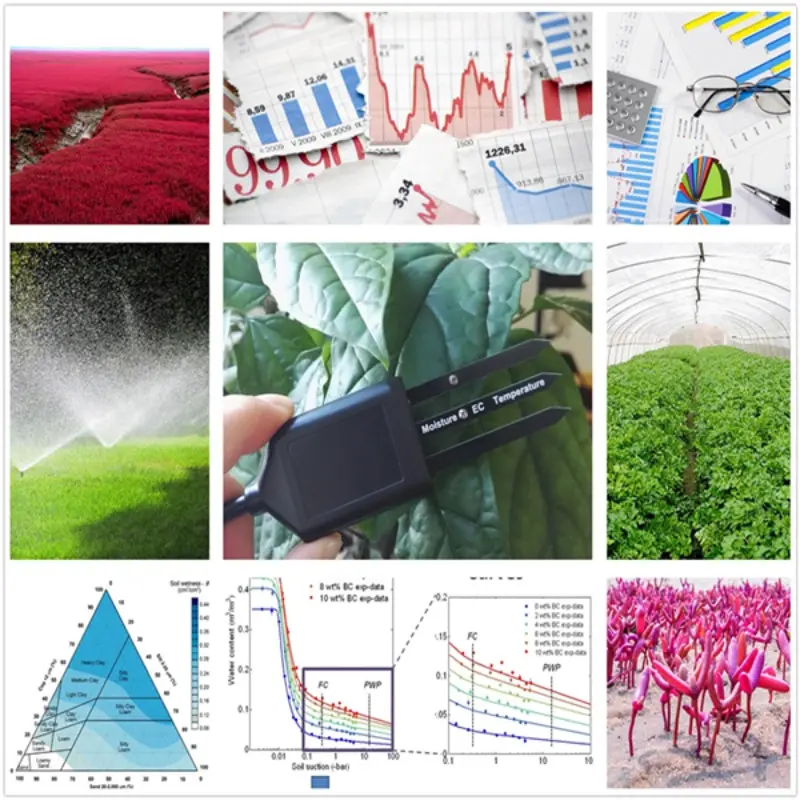
Useful for soil water and salt dynamics, salinized soil improvement, irrigation experiments, and plant growth studies.
Nutrient Solution and Substrate Monitoring
The sensor can also be used for water fertilizer integrated solutions, nutrient solutions, and growing media conductivity monitoring.
Soil Salinity Meter vs. Soil EC Sensor: What Is the Difference?
The terms soil salinity meter and soil EC sensor are sometimes used interchangeably, but they do not always represent the same measurement method.
A soil EC sensor measures electrical conductivity under specific measurement conditions.
A laboratory salinity assessment may use conductivity measured in a prepared soil extract, such as a saturated-paste extract.
These results are not automatically interchangeable.
The JW-S3S(Z11) supports conductivity monitoring in soil and other manufacturer-supported measurement media. It can be used to observe conductivity trends, but the measured value must be interpreted according to the measurement method, soil conditions, and calibration.
For professional agricultural applications, users should establish appropriate reference conditions rather than relying on a single universal soil EC threshold.
Installation Guidelines for Soil Moisture and EC Monitoring
Correct installation is essential for representative soil moisture, EC, and temperature measurements.
Method 1: Direct Soil Insertion
For temporary measurements or suitable surface installations:
Select a representative monitoring location.
Remove stones and obstacles that could damage the electrodes.
Insert the probe vertically into the soil.
Ensure the electrodes are fully inserted and in close contact with the surrounding soil.
Avoid shaking or forcing the probe during installation.
Connect the sensor to the compatible measurement equipment.
Check readings for stability.
Method 2: Buried Soil Installation
For continuous soil monitoring:
Dig a pit to the required monitoring depth.
Prepare a suitable installation surface on the pit wall.
Insert the probe horizontally into undisturbed soil.
Ensure close contact between the electrodes and surrounding soil.
Backfill the pit carefully and restore soil contact.
Protect the cable and connection components.
Allow the soil to stabilize before interpreting monitoring trends.
Important Measurement Considerations
The original product guidance recommends soil volumetric moisture preferably above approximately 20% when evaluating EC.
This is a product-specific practical recommendation, not a universal threshold for every soil.
In dry soil, electrical conduction pathways can be limited, making EC interpretation more difficult.
For reliable trend analysis, compare readings under similar moisture and temperature conditions when possible.
It measures soil moisture, electrical conductivity, and temperature. Through RS485 Modbus registers, it can also provide salinity, TDS, and dielectric constant data.
Q
2. What output options are available?
A
The sensor supports 0–2V analog voltage output and RS485 Modbus-RTU digital output. Custom output options can also be provided for project requirements.
Q
3. Can it be used for smart irrigation?
A
Yes. Soil moisture data helps control irrigation timing, while EC data helps monitor fertilizer concentration and salt accumulation.
Q
4. Can JW-IoT integrate this sensor into a greenhouse monitoring system?
A
Yes. JW-IoT can integrate this soil moisture EC sensor with RTUs, irrigation controllers, LoRaWAN nodes, 4G gateways, cloud dashboards, and mobile apps.
Q
5. What is the EC measurement range?
A
The sensor supports optional EC ranges of 0–5000 μS/cm, 0–10000 μS/cm, and 0–20000 μS/cm.
Q
6. Is the sensor waterproof?
A
Yes. The sensor has an IP68 protection rating and can be used for long term buried monitoring or immersed applications.
Q
7. Can it be used in fertigation systems?
A
Yes. The sensor can be used to monitor water fertilizer integrated solutions, nutrient solutions, and soil conductivity changes after fertilization.
Q
8. Can JW-IoT provide a complete smart irrigation solution with this sensor?
A
Yes. JW-IoT can provide a complete solution including soil sensors, data loggers, gateways, cloud platforms, dashboards, alarms, and irrigation control integration.
Q
9. Why is soil EC important?
A
Soil EC reflects soluble salt concentration. High EC may indicate salt stress, over fertilization, poor drainage, or salinity accumulation, which can affect root water uptake and crop growth.
Q
10. What is the temperature measurement range?
A
The sensor measures temperature from -40°C to 80°C, with 0.1°C resolution and ±0.5°C accuracy.
Q
11. Can JW-IoT customize cable length?
A
Yes. JW-IoT can provide customized cable lengths according to field, greenhouse, orchard, or research installation requirements.
Q
12. Why should soil moisture be above 20% for EC measurement?
A
Because the sensor measures soluble ions in the soil. When the soil is too dry, soluble ions cannot fully reflect actual soil conductivity. Measurements after irrigation or rainfall are usually more representative.
 +86 13520127780
  info@jingelway.com