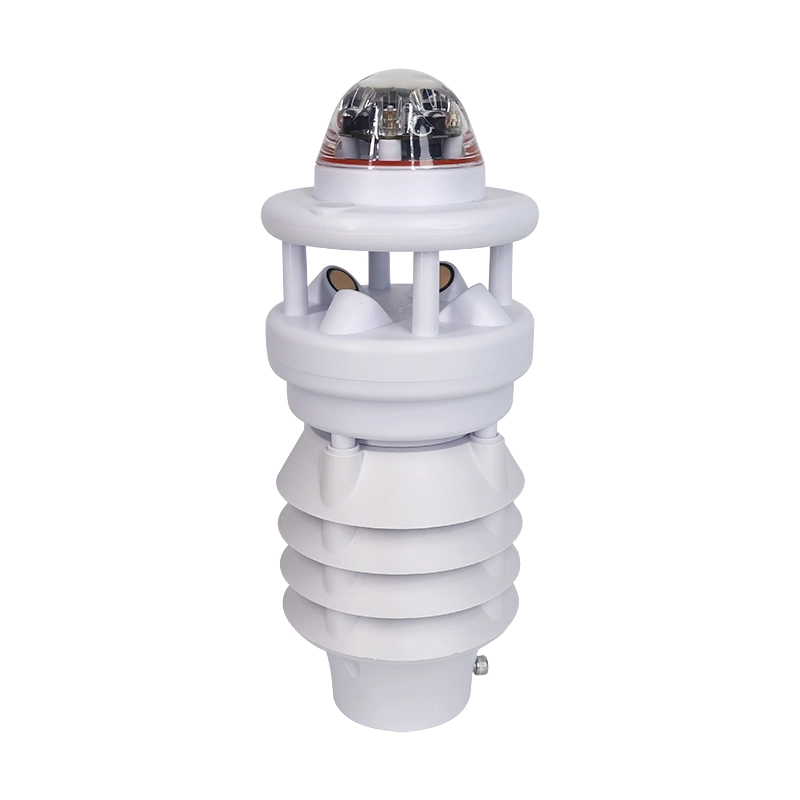
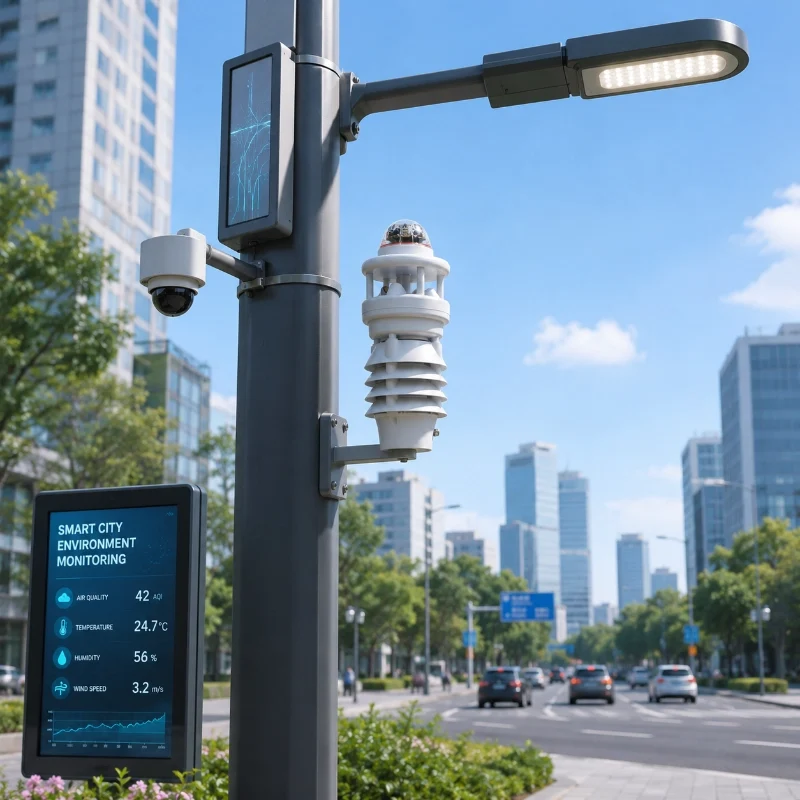
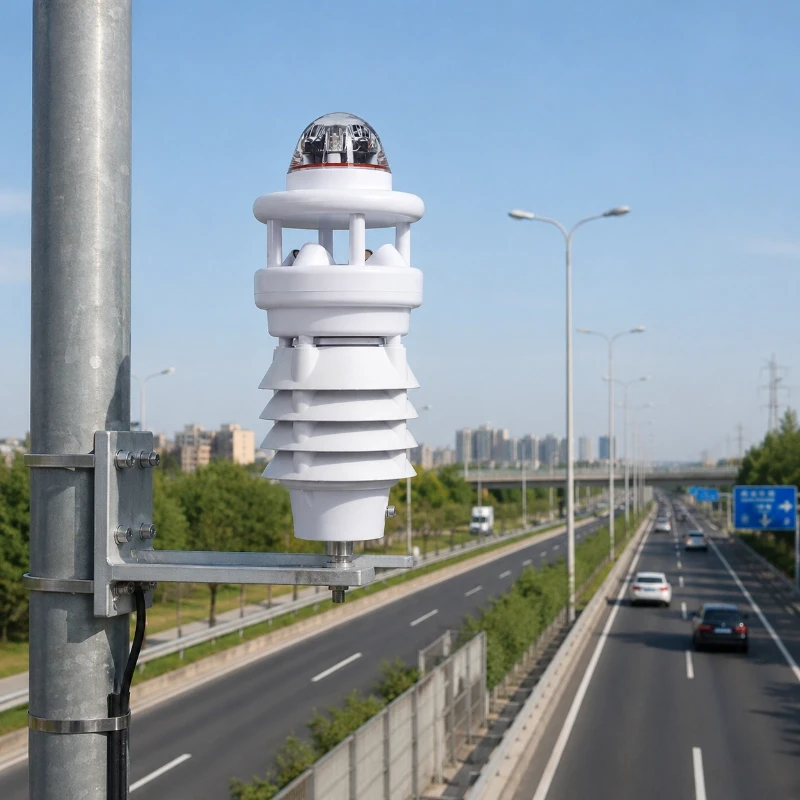
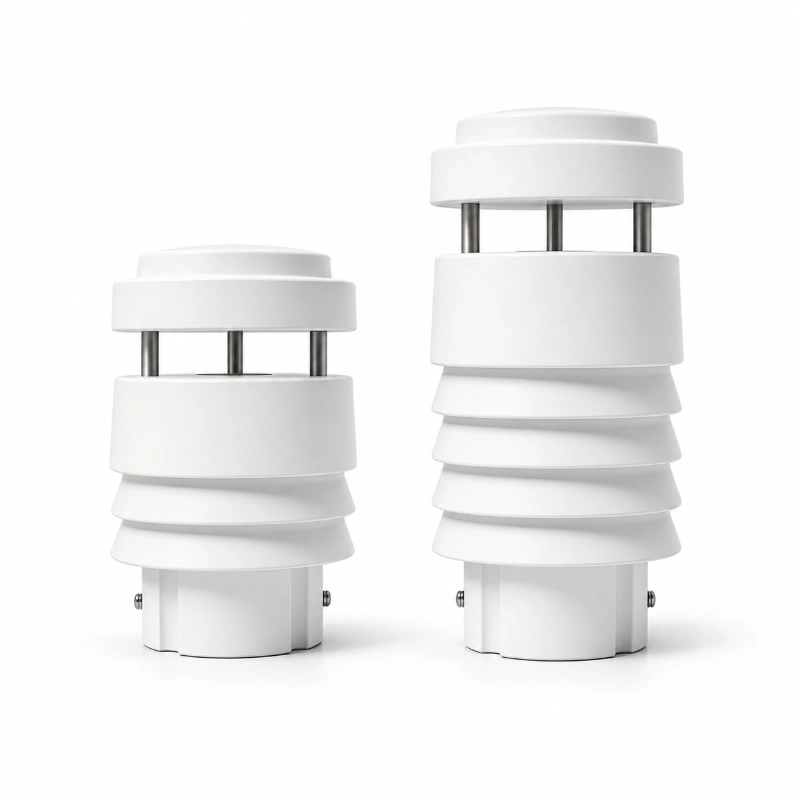
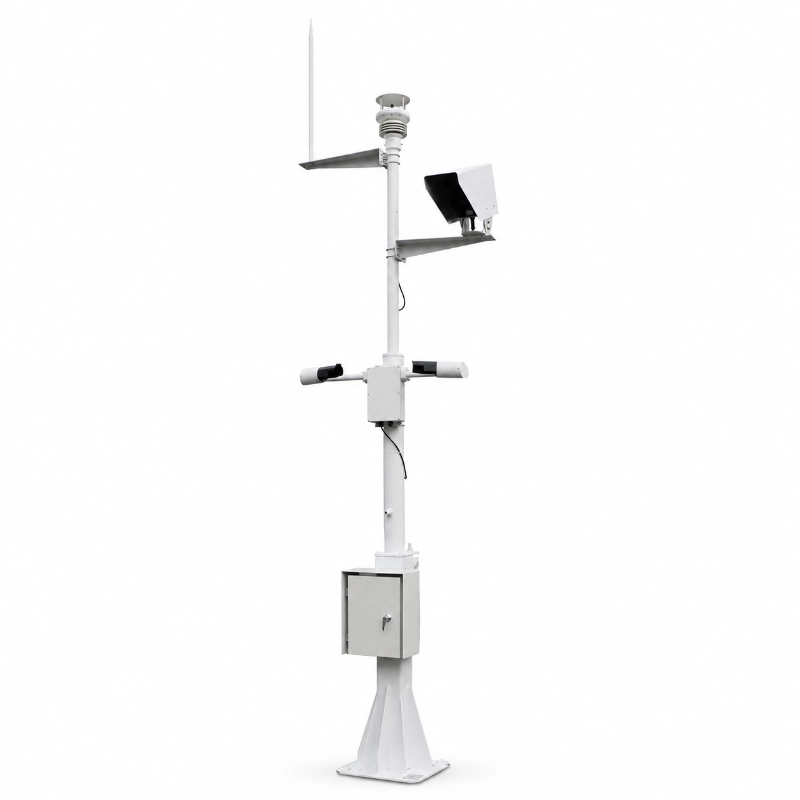
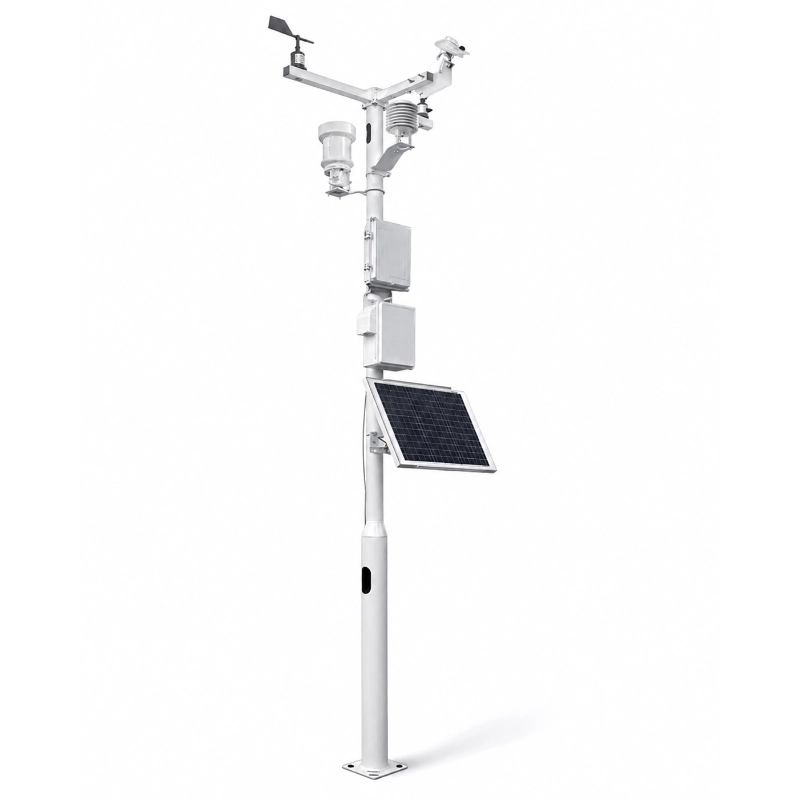
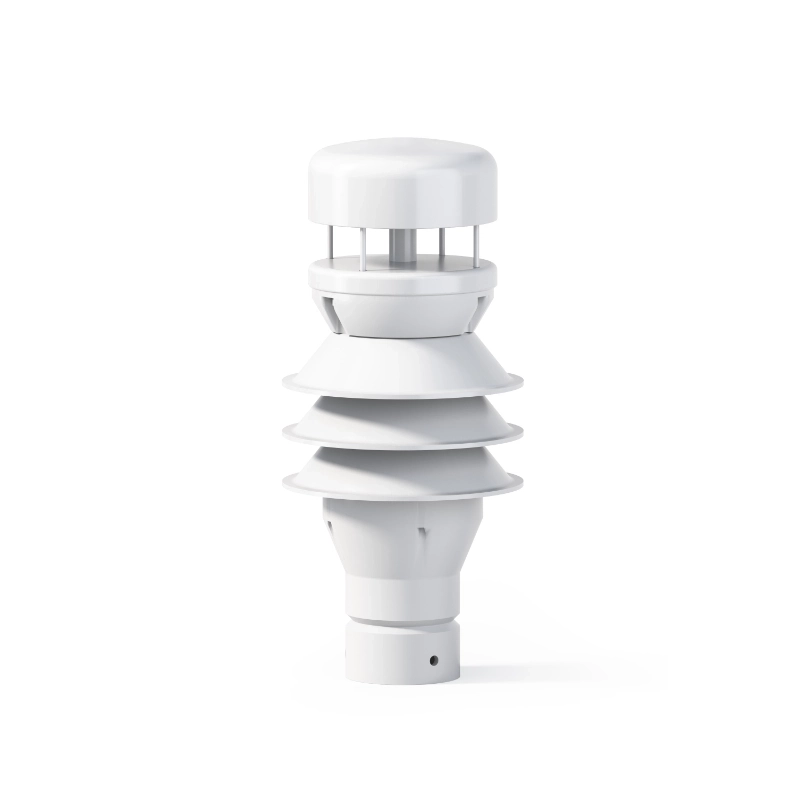
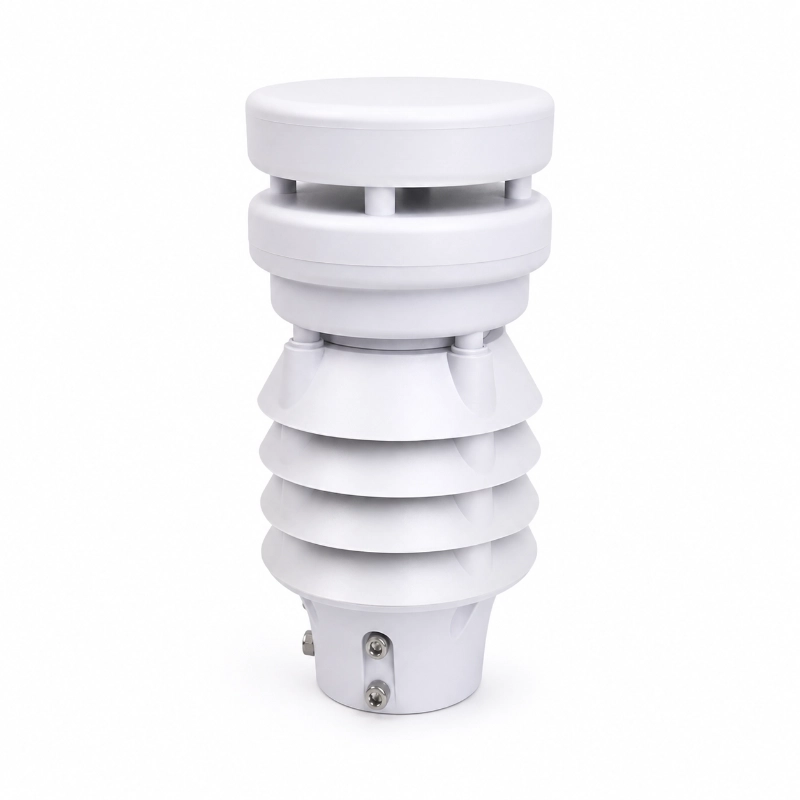
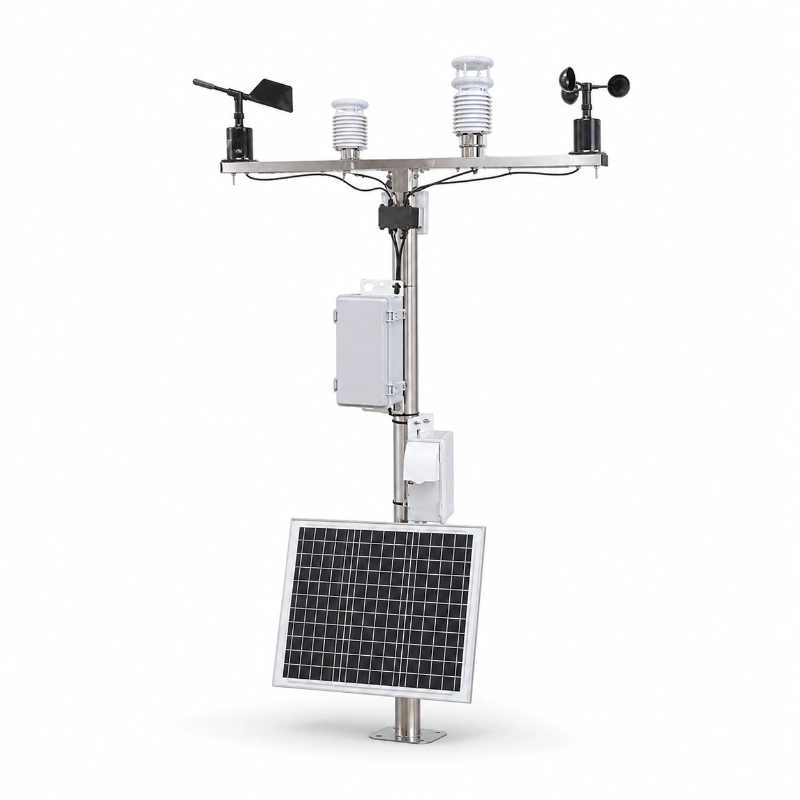
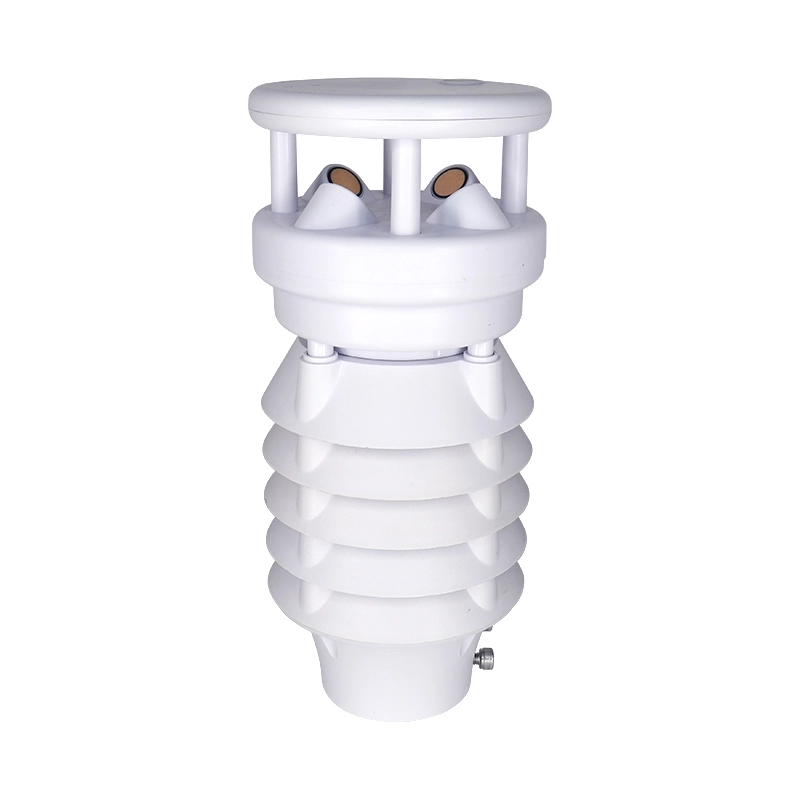
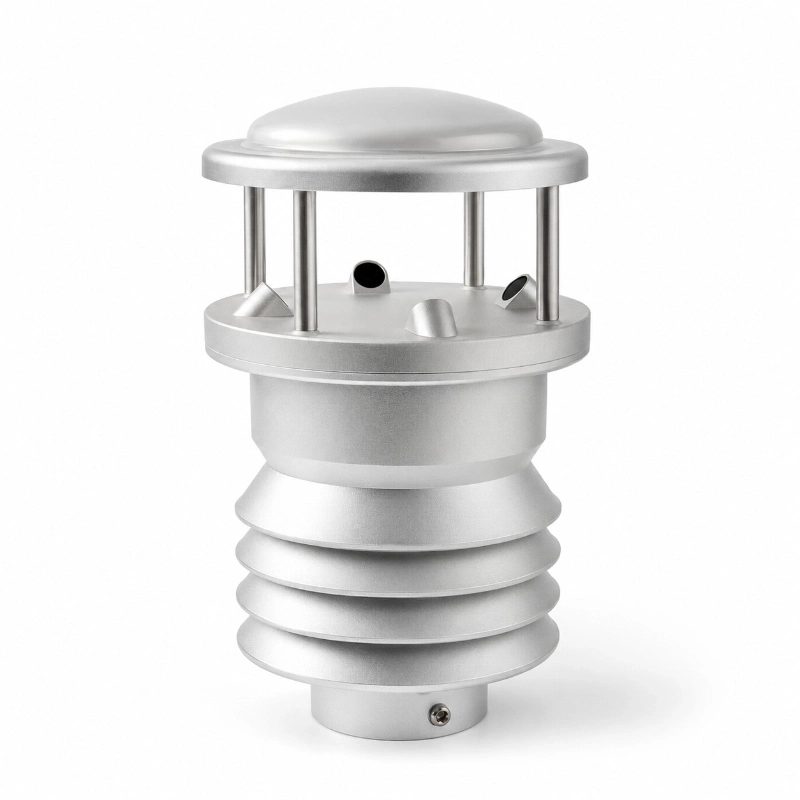
The JW-XF900(YN28) Ten-in-One Compact Weather Station is an integrated outdoor environmental monitoring sensor designed to measure meteorological, particulate matter and noise parameters from one compact device.
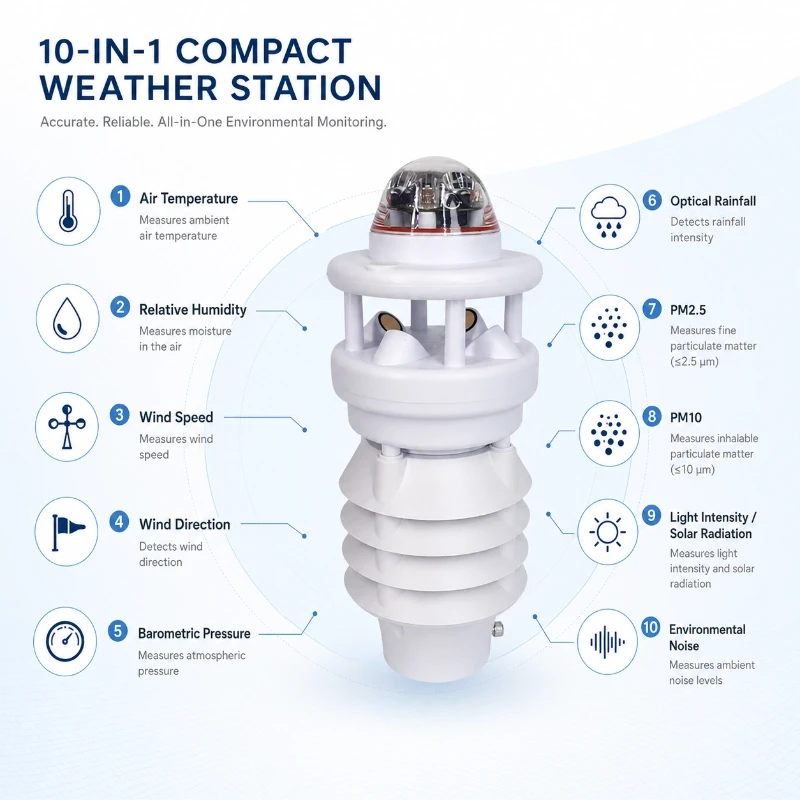
It continuously measures:
Air temperature
Relative humidity
Wind speed
Wind direction
Barometric pressure
Optical rainfall
PM2.5
PM10
Light intensity or solar radiation
Environmental noise
The integrated structure reduces the number of separate sensors, mounting brackets, communication cables and field connection points required at each monitoring location.
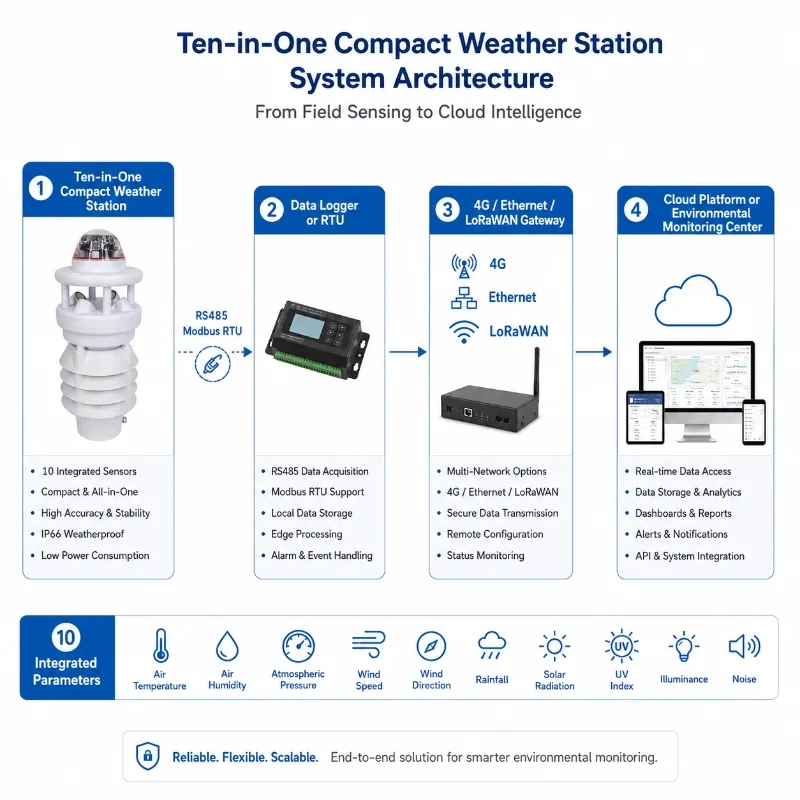
With standard RS485 Modbus RTU output, the weather station can connect to RTUs, data loggers, PLCs, IoT gateways, smart light poles, environmental monitoring cabinets and third-party cloud platforms.
It is suitable for smart city environmental networks, roadside monitoring, traffic infrastructure, industrial parks, campuses, parks, construction areas and distributed outdoor IoT projects.
Which Ten Parameters Does the Station Measure?
1. Air Temperature
The internal temperature sensor measures outdoor air temperature from -40°C to 85°C.
A three-layer radiation shield helps reduce direct solar heating and allows air to circulate around the sensing element.
Temperature data can be used for:
Urban microclimate monitoring
Road weather assessment
Environmental trend analysis
Heat-stress studies
Equipment operating-condition monitoring
Smart park and campus monitoring
2. Relative Humidity
Relative humidity is measured from 0 to 100% RH.
Humidity data helps explain changes in thermal comfort, fog risk, condensation and particulate matter conditions.
High humidity may also influence how particulate matter measurements are interpreted, particularly in environments with fog, mist or hygroscopic aerosols.
3. Wind Speed
Wind speed is measured from 0 to 60 m/s using ultrasonic technology.
Unlike a cup anemometer, the ultrasonic module does not rely on bearings or rotating mechanical components. This reduces wear and routine mechanical maintenance.
Wind speed data can support:
Pollution dispersion analysis
Road and bridge weather monitoring
Construction safety
Smart city micro-weather networks
Industrial park environmental monitoring
Renewable energy site assessment
4. Wind Direction
The station measures wind direction from 0 to 359.9°.
Wind direction can help users understand where airborne particles, dust, noise or industrial emissions may be coming from.
When monitoring roads, industrial parks or construction sites, wind direction data provides useful context for interpreting PM2.5 and PM10 changes.
5. Barometric Pressure
Barometric pressure is measured from 500 to 1100 hPa.
Pressure data supports general weather observation, microclimate analysis and changing-weather interpretation.
6. Optical Rainfall
The station uses an optical rainfall module instead of a mechanical tipping bucket.
The module detects raindrops on its sensing surface and estimates rainfall according to drop size and quantity.
Key advantages include:
Compact structure
No tipping mechanism
No collection funnel
Reduced risk of mechanical blockage
Faster rain-event detection
Easier integration into smart poles and compact installations
The standard rainfall measuring range is 0 to 200 mm/h, with a resolution of 0.2 mm.
Optical rainfall measurement is especially useful when the project prioritizes compact installation and rain-event monitoring. Projects requiring regulatory-grade accumulated rainfall should confirm the required measurement method and project standard before selection.
7. PM2.5
The particulate matter module uses laser scattering technology to estimate the concentration of fine particles with an aerodynamic diameter of approximately 2.5 micrometres or less.
The standard measuring range is 0 to 500 μg/m³, expandable to 1000 μg/m³ according to configuration.
PM2.5 monitoring can support:
Urban air quality networks
Roadside pollution monitoring
Industrial park monitoring
Construction dust assessment
Campus and community monitoring
Public environmental information systems
8. PM10
PM10 represents larger inhalable particles with an aerodynamic diameter of approximately 10 micrometres or less.
Monitoring both PM2.5 and PM10 helps distinguish changes in fine particles from larger dust or resuspended road particles.
A PM2.5 or PM10 reading alone does not always explain why particle concentration has changed. Combining particulate data with weather information provides more context.
Wind and Particle Dispersion
Higher wind speed may dilute local particles or transport dust and pollution from another area.
Wind direction can help identify whether increased particle levels are associated with a road, construction site, industrial source or another nearby area.
Rainfall and Particle Concentration
Rain can remove suspended particles from the air and reduce dust resuspension from roads and exposed ground.
Monitoring rainfall and PM at the same location makes it easier to compare pollution changes before, during and after a rain event.
Humidity and PM Interpretation
Humidity can influence particle growth, fog formation and optical particle measurement conditions.
Recording humidity alongside PM data helps operators interpret unusual trends more carefully.
Noise and Human Activity
Noise changes may indicate traffic congestion, construction work, industrial activity or public events.
When noise, PM and weather data are monitored together, the platform can provide a more complete picture of local environmental conditions.
Compact Weather Station vs Separate Sensors
A split monitoring system may use an individual sensor for every parameter. This can provide flexibility, but it also requires more brackets, cables, junction boxes and communication ports.
Comparison
Compact Ten-in-One Station
Separate Sensor System
Installation space
Low
Higher
Number of mounting brackets
Fewer
More
Field wiring
Simplified
More complex
Communication interfaces
One main connection
Multiple connections
Individual sensor replacement
More integrated
More flexible
Smart pole installation
Suitable
May require larger cabinet
Project customization
Configuration-based
Highly modular
Maintenance access
Centralized
Distributed
Choose the compact station when installation space, wiring simplicity and rapid deployment are priorities.
Choose separate sensors when the project requires:
Temperature humidity wind speed wind direction pressure rainfall PM2.5 PM10 light or solar radiation noise
Air Temperature Range
-40 to 85°C
Air Temperature Accuracy
±0.3°C at 25°C
Air Temperature Resolution
0.01°C
Humidity Range
0 to 100%RH
Humidity Accuracy
±3%RH from 10% to 90%RH non condensing
Wind Speed Range
0 to 60 m/s
Wind Speed Accuracy
±0.3 plus 0.03V m/s when V ≤ 30 m/s
Wind Direction Range
0 to 359.9°
Wind Direction Accuracy
±3° when wind speed is below 10 m/s
Barometric Pressure Range
500 to 1100 hPa
Barometric Pressure Accuracy
±0.5 hPa at 25°C from 950 to 1100 hPa
Rainfall Type
Optical rainfall measurement
Rainfall Range
0 to 200 mm/h
Rainfall Resolution
0.2 mm
PM2.5 Range
0 to 500 μg/m³ expandable to 1000 μg/m³
PM10 Range
0 to 500 μg/m³ expandable to 1000 μg/m³
Light Range
0 to 100 KLux
Solar Radiation Range
0 to 2000 W/m²
Noise Range
30 to 130 dB
Working Temperature
-40 to 80°C
Standard Output
RS485 Modbus RTU
Optional Output
SDI 12 with additional module
Power Supply
DC 9 to 30V
Protection Rating
IP65
Cable
Standard 3 m cable optional 10 m communication cable
Mounting Method
Sleeve mounting standard flange or bent plate optional
Optional Function
Heating function
The PM, rainfall, wind and noise measurement technologies and the above specification ranges are consistent with the product information currently published on the JW-IoT page.
Final specifications may vary by configuration. Confirm the selected light or solar radiation module, output protocol, heating function, cable length and installation accessories before ordering.
RS485 Modbus Integration
The standard RS485 Modbus RTU interface allows the weather station to connect to:
Data loggers
Remote terminal units
PLC systems
Smart pole controllers
Industrial IoT gateways
4G communication terminals
LoRaWAN nodes or gateways
Ethernet gateways
Local SCADA systems
Third-party cloud platforms
A typical monitoring architecture is:
Ten-in-One Compact Weather Station
→ RS485 Modbus RTU
→ Data Logger or RTU
→ 4G, Ethernet or LoRaWAN Gateway
→ Cloud Platform or Environmental Monitoring Center
The integrated station provides one consolidated data source for ten environmental parameters.
JW-IoT can support protocol documentation, gateway selection, cloud dashboard connection and project-based integration. The company’s broader solution scope includes sensor hardware, gateways, data acquisition, dashboards and system integration.
Typical Applications
Smart City Environmental Monitoring
The station can be installed across urban blocks to collect localized weather, PM and noise data.
The compact structure is suitable for installation on smart light poles where space and wiring capacity are limited.
The device can share the pole’s power supply and communication infrastructure, subject to project design.
Typical monitoring outputs include:
Weather conditions
PM2.5 and PM10
Environmental noise
Rain events
Light intensity
Local wind conditions
Installation should keep the sensor away from lamp heat, electromagnetic interference and pole-mounted obstacles.
Roadside and Traffic Monitoring
Roadside monitoring can combine:
Wind speed and direction
Rainfall
PM2.5 and PM10
Noise
Visibility-related environmental context
Temperature and humidity
This information can support traffic environmental studies, road maintenance planning and local pollution analysis.
For dedicated road weather projects, visibility and pavement-condition sensors may be added separately.
Construction-Site Monitoring
The station can support continuous monitoring of:
Construction dust
Environmental noise
Wind direction
Wind speed
Rainfall
Temperature and humidity
Wind data helps determine where dust may be transported, while rainfall data helps explain reductions in airborne particles.
The station is an environmental monitoring tool. Whether the data meets a specific construction regulation or legal reporting standard depends on local rules, calibration requirements and project specifications.
Industrial Parks
Industrial parks may deploy the station near:
Factory boundaries
Internal roads
Material storage areas
Logistics zones
Worker activity areas
Community interfaces
The combined data helps operators compare weather conditions with particle and noise trends.
Parks, Campuses and Scenic Areas
The station can provide environmental data for:
Public information screens
Campus management
Park operations
Visitor information
Environmental education
Outdoor event planning
Local comfort assessment
Renewable Energy Sites
The weather station can also support general environmental monitoring at solar and wind power sites.
For solar projects, select the solar radiation version rather than the light-intensity version when irradiance data is required.
For performance-grade PV monitoring, a dedicated pyranometer and PV module temperature sensor may still be more appropriate.
Installation Recommendations
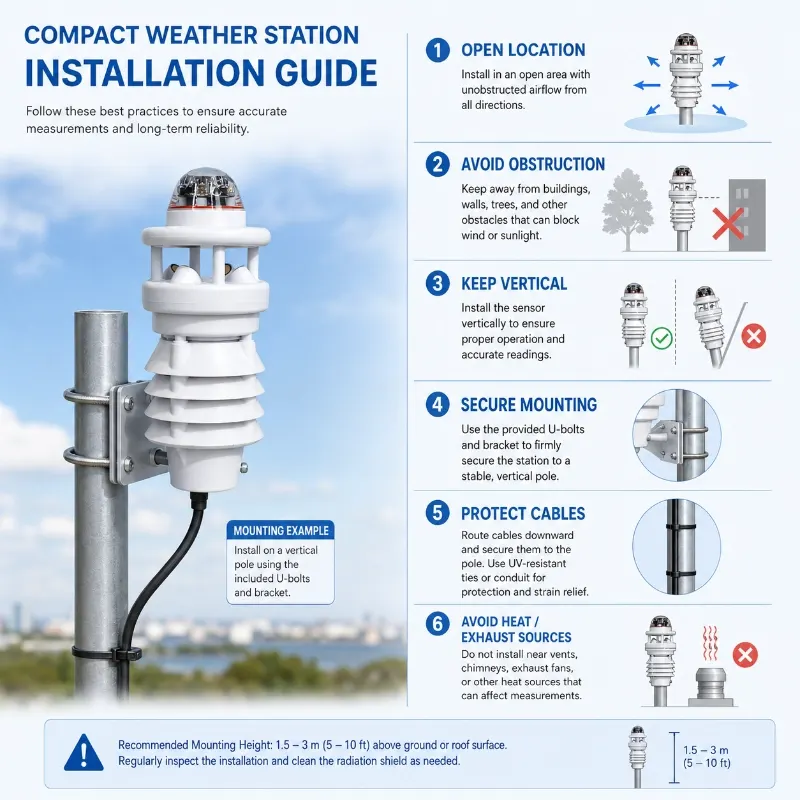
Select an Open and Representative Location
Install the station where the surrounding conditions represent the monitoring objective.
Avoid locations directly beside:
Walls
Large signs
Trees
Exhaust outlets
Cooling towers
Air-conditioning units
Strong vibration sources
High-temperature equipment
Avoid Wind Obstruction
The ultrasonic wind module requires open airflow.
Nearby structures may create turbulence, wind shadows or accelerated airflow, causing data that does not represent the wider site.
The station should be mounted above or away from nearby obstacles according to the project’s measurement objective.
Protect the PM Sampling Area
Keep the PM air inlet clear.
Do not allow:
Mounting plates
Cable loops
Decorative covers
Smart pole housings
Rain shields
Leaves or insects
to block the sampling path.
The PM inlet should not be placed directly beside vehicle exhausts unless the objective is to monitor those emissions specifically.
Reduce Noise Measurement Interference
The microphone can detect sound generated by the installation itself.
Avoid mounting the station where vibration, loose metal parts, cooling fans, transformers or electrical cabinet noise may influence the readings.
Secure all brackets and cables to reduce wind-induced rattling.
Keep the Optical Rain Surface Clean
Dust, leaves, insects, bird droppings, snow or other contamination may affect optical rainfall detection.
Inspect and clean the rainfall surface regularly.
Consider Smart Pole Heat Sources
Streetlights, power supplies and communication equipment may generate heat.
Install the weather station where lamp heat and cabinet exhaust will not influence temperature and humidity measurement.
Plan Cable and Surge Protection
Use suitable:
Shielded communication cable
Grounding
Surge protection
Waterproof connectors
Cable conduit
Drip loops
Lightning protection
according to local electrical design requirements.
Consider Heating for Cold Conditions
An optional heating function can be configured for cold or condensation-prone sites.
Heating requirements should be evaluated according to local minimum temperature, freezing rain, snow, frost and available power.
How to Select the Correct Configuration
Before requesting a quotation, confirm the following information:
Project application
Number of monitoring points
Installation height
Light intensity or solar radiation requirement
PM measuring range
Noise monitoring requirement
RS485 or SDI-12 output
Local data logger or RTU model
4G, LoRaWAN or Ethernet communication
Cloud platform or API requirement
Power supply availability
Solar power system requirement
Cable length
Minimum winter temperature
Heating requirement
Mounting pole diameter
Lightning and surge protection requirements
OEM or white-label requirements
When Should You Choose Another Sensor?
The ten-in-one station is suitable when one compact unit must provide broad environmental data.
Another product may be more appropriate when:
Only PM Monitoring Is Required
Choose a dedicated particulate matter sensor when the project only requires PM2.5, PM10, temperature and humidity.
Choose a gas-enabled environmental weather station when the project also requires parameters such as CO, NO₂, SO₂, O₃, H₂S or combustible gases.
Regulatory Noise Monitoring Is Required
A dedicated professional sound-level meter may be required when the project must comply with a specific acoustic standard, frequency analysis requirement or legal reporting method.
High-Accuracy Rainfall Is Required
A dedicated weighing or tipping-bucket rain gauge may be more suitable when the project requires a specific rainfall standard, calibration method or long-term precipitation climatology.
Maintenance Recommendations
A compact station reduces the number of separate instruments, but it still requires regular inspection.
Recommended checks include:
Clean the optical rainfall surface
Inspect the PM sampling inlet
Remove insects, dust and debris
Check cable connectors
Tighten mounting hardware
Inspect the radiation shield
Check for condensation
Confirm wind measurement is unobstructed
Check microphone opening
Review abnormal data trends
Inspect grounding and surge protection
Confirm the station remains vertical
Verify communication stability
Maintenance frequency should be based on dust, rainfall, pollution, insects, salt spray, snow and site accessibility.
Request a Ten-in-One Weather Station Configuration
Send JW-IoT your application, required parameters, number of monitoring points, communication method, installation conditions and platform requirements.
Our team will help configure a suitable compact weather station, communication gateway and remote monitoring solution.
1. What parameters does this compact weather station measure?
A
It measures temperature, humidity, wind speed, wind direction, barometric pressure, optical rainfall, PM2.5, PM10, light or solar radiation, and environmental noise.
Q
2. Does the station support RS485 Modbus RTU?
A
Yes. The standard version supports RS485 Modbus RTU output for connection with RTUs, data loggers, gateways, and IoT platforms.
Q
3. Can JW-IoT use this product for smart city monitoring projects?
A
Yes. JW-IoT can provide this compact weather station for smart city, intelligent lamp post, urban environmental monitoring, and grid based air quality projects.
Q
4. How does the rainfall sensor work?
A
The station uses optical rainfall measurement. It detects rain drops on the sensor surface and calculates rainfall based on drop size and quantity.
Q
5. Does it measure PM2.5 and PM10?
A
Yes. The product uses laser scattering technology to monitor PM2.5 and PM10 particulate matter concentration.
Q
6. Can JW-IoT provide a version for solar PV or wind power sites?
A
Yes. JW-IoT can configure the station for solar PV environmental monitoring or wind power meteorological monitoring, including wind, rainfall, pressure, light, or solar radiation data.
Q
7. Is the product suitable for outdoor installation?
A
Yes. It has an IP65 protection rating and is designed for outdoor environmental and weather monitoring applications.
Q
8. Can the product support cold weather applications?
A
Yes. A heating function can be customized when the project requires improved performance in cold or condensation prone environments.
Q
9. Can JW-IoT support OEM or system integration?
A
Yes. JW-IoT can support project integration through RS485 Modbus RTU, optional SDI 12 customization, and IoT platform connection.
 +86 13520127780
  info@jingelway.com