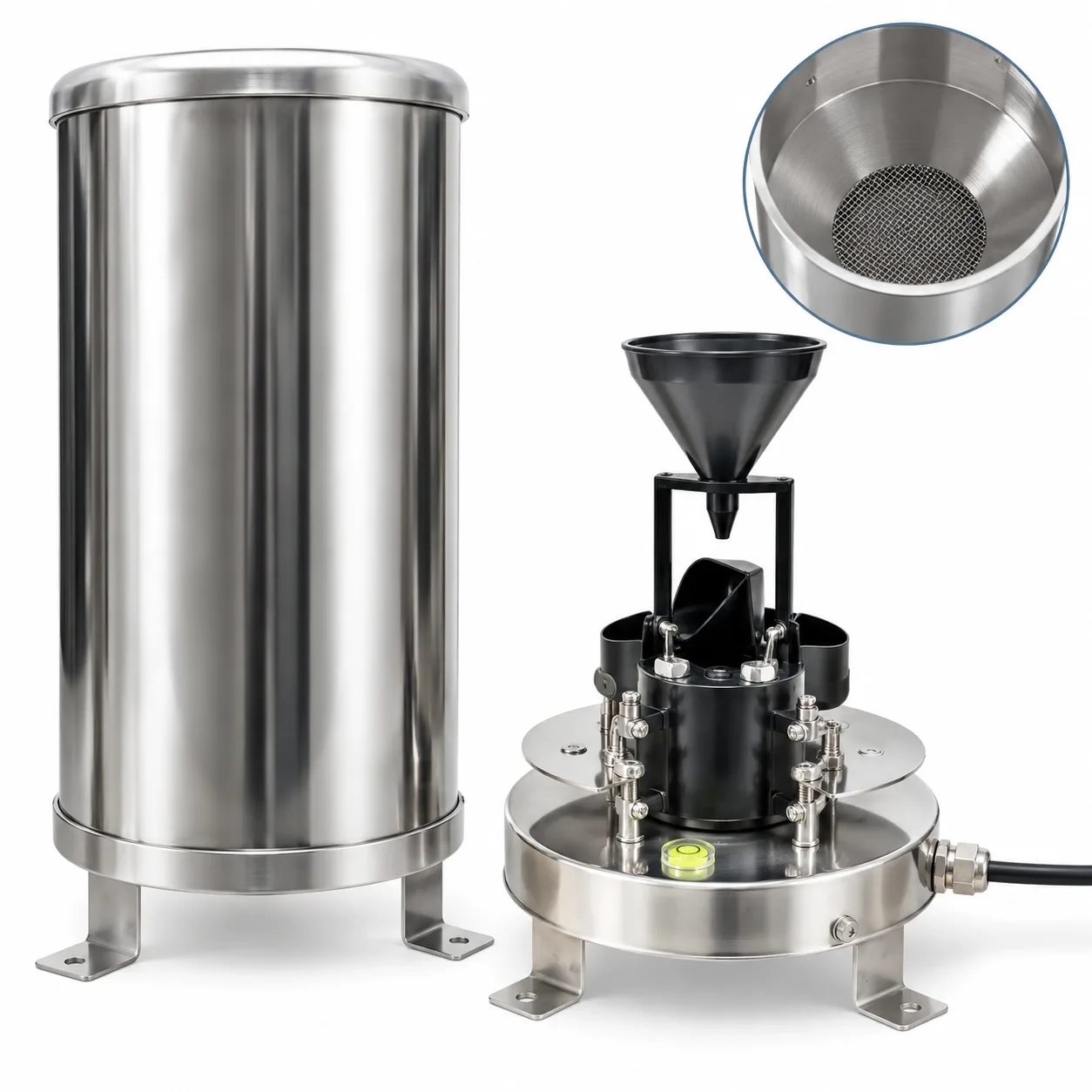
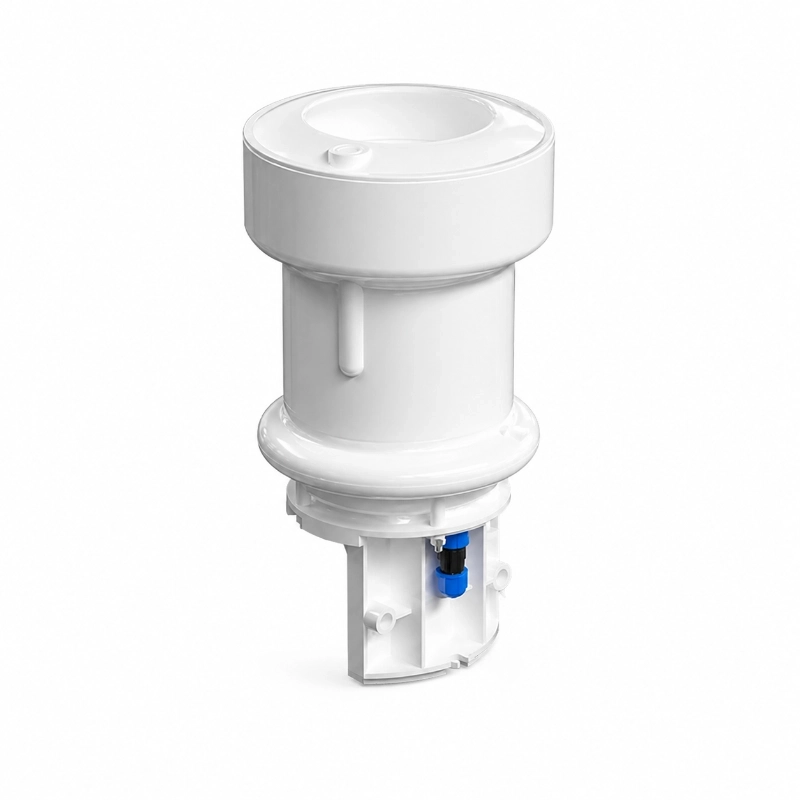
JW-TBRG2 is a 0.2 mm tipping bucket rain gauge designed for automatic rainfall measurement in hydrological monitoring, weather stations, environmental observation, water supply systems, natural disaster monitoring, climate research and smart agriculture.
The instrument combines a stainless steel body and base with an ABS UV-stabilized plastic tipping bucket. Rainfall is collected through a 200 mm diameter inlet, guided through the internal funnel, and measured by a calibrated tipping mechanism. The standard version generates a reed-switch pulse output with 5 pulses per millimeter, corresponding to 0.2 mm rainfall per tip. An RS485 output version is optional for digital monitoring systems.
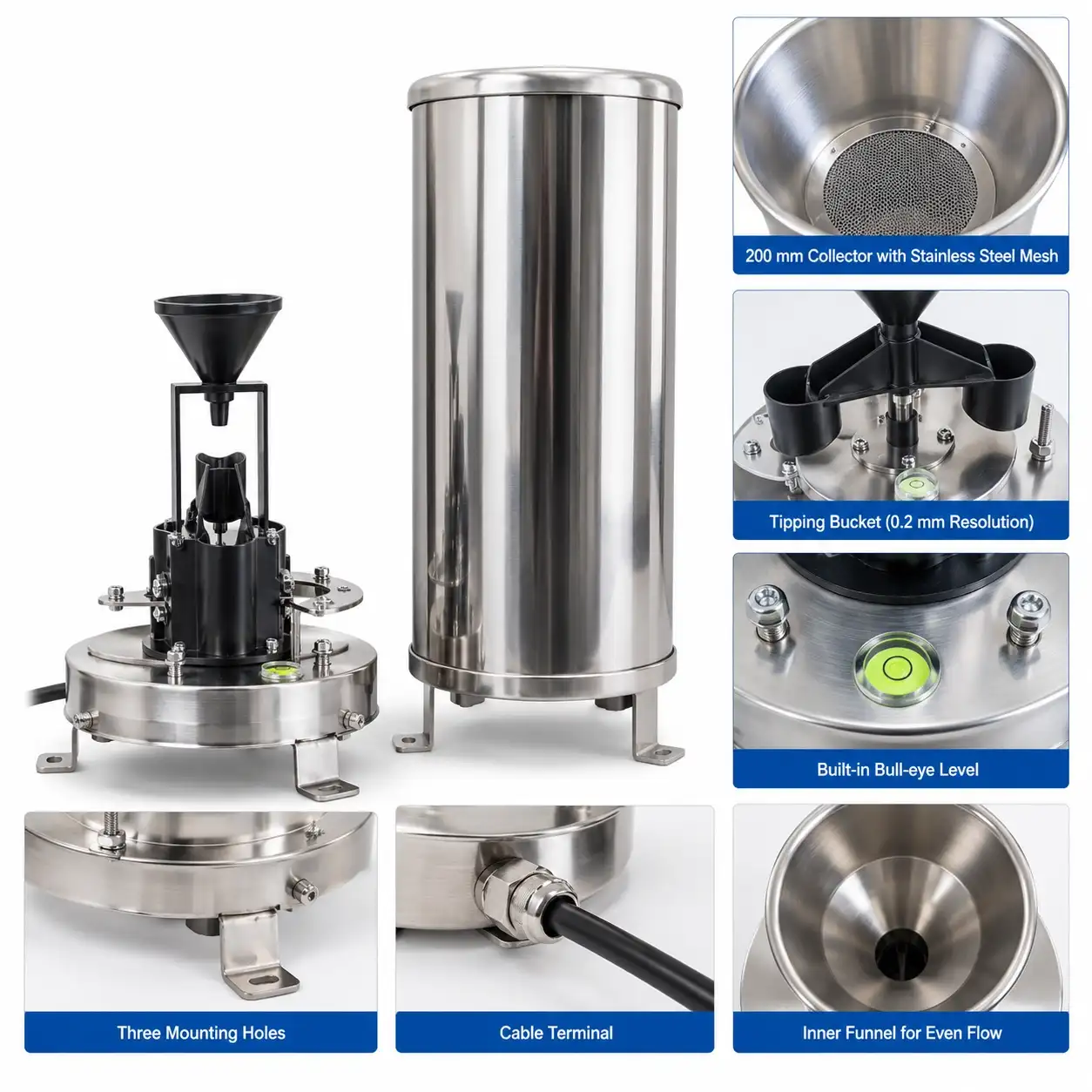
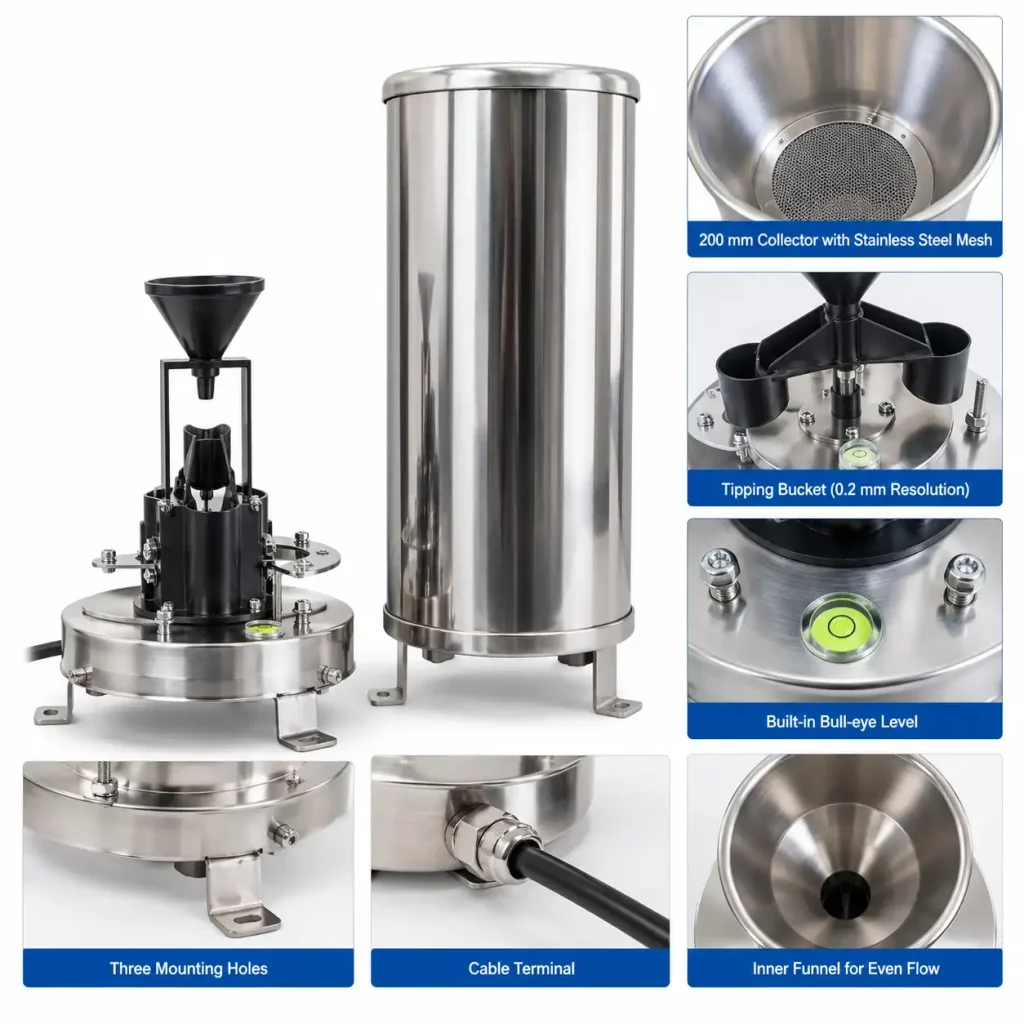
The design includes an inner funnel to help equalize rainfall flow into the measuring mechanism, a stainless steel mesh to reduce debris entry, a bull-eye level for installation, and a straight-through discharge mechanism. These features make the JW-TBRG2 suitable for fixed outdoor rainfall monitoring where reliable automatic data acquisition is required.
1. Product Overview
The JW-TBRG2 Tipping Bucket Rain Gauge is designed for automatic rainfall measurement using a proven mechanical tipping-bucket principle.
Rain entering the 200 mm collector is directed through the internal funnel into the tipping bucket assembly. When the calibrated volume corresponding to 0.2 mm of rainfall is reached, the bucket tips.
The tipping action activates a rugged magnetic proximity reed switch, generating a pulse signal that can be counted by a data logger, RTU, PLC or rainfall monitoring terminal.
For the standard output:
5 pulses = 1 mm rainfall
or:
1 pulse = 0.2 mm rainfall
The rain gauge can therefore be integrated into automatic monitoring networks for rainfall accumulation and event monitoring.
The instruction manual also notes that the design incorporates an inner funnel intended to help even the rainfall flow entering the gauge, which supports more stable measurement as rainfall rates increase.
For complete field deployment, the JW-TBRG2 can be integrated into a broader Weather Monitoring Station or hydrological monitoring network according to project requirements. JW-IoT weather monitoring systems support rainfall together with temperature, humidity, wind, pressure, radiation and other environmental parameters.
2. How Does the JW-TBRG2 Tipping Bucket Rain Gauge Work?
The measuring process consists of several steps:
Rainfall enters through the stainless steel collector.
A stainless steel mesh helps block larger debris.
Water is directed through the funnel.
The secondary funnel guides rainfall into the tipping mechanism.
Rain fills one side of the calibrated bucket.
Once the calibrated volume is reached, the bucket tips.
The reed switch detects the tipping movement.
A pulse is generated.
Water is discharged through the drainage mechanism.
The opposite side of the bucket moves into position for the next measurement.
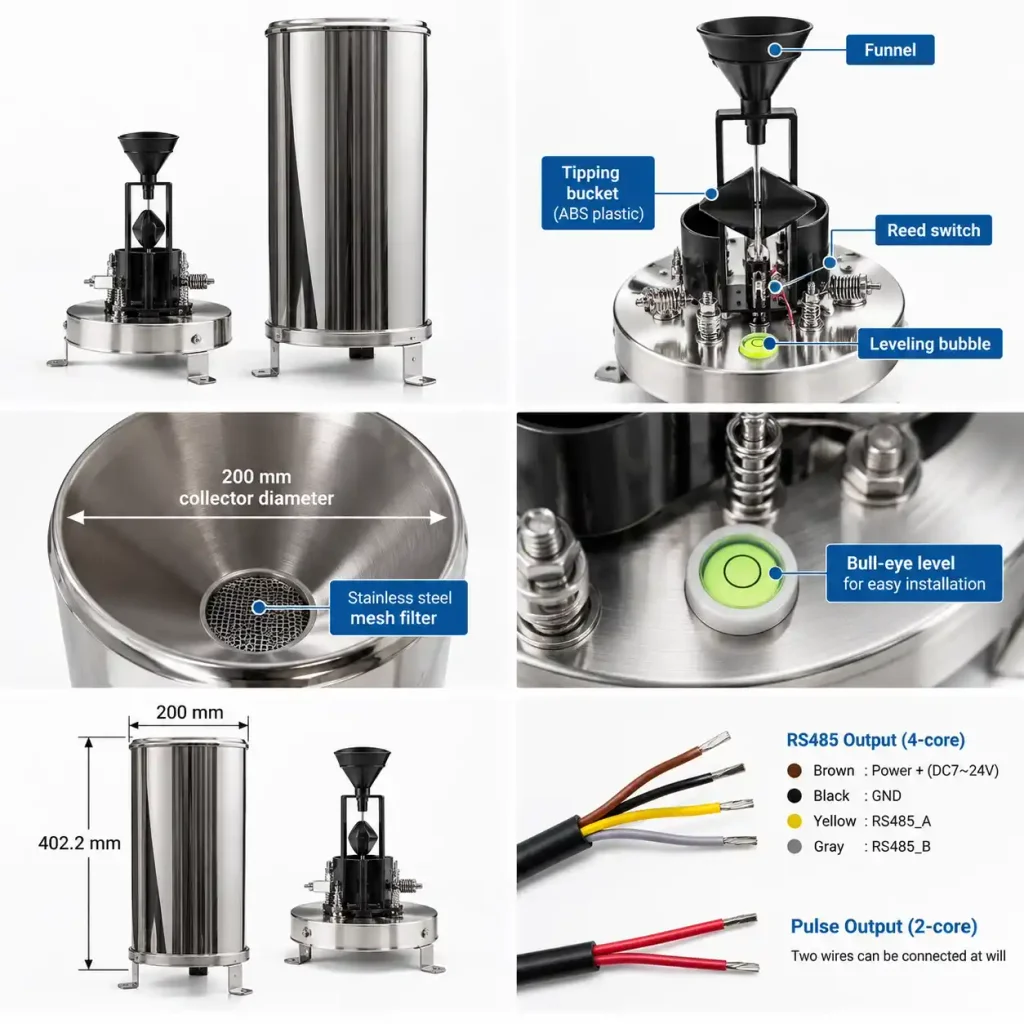
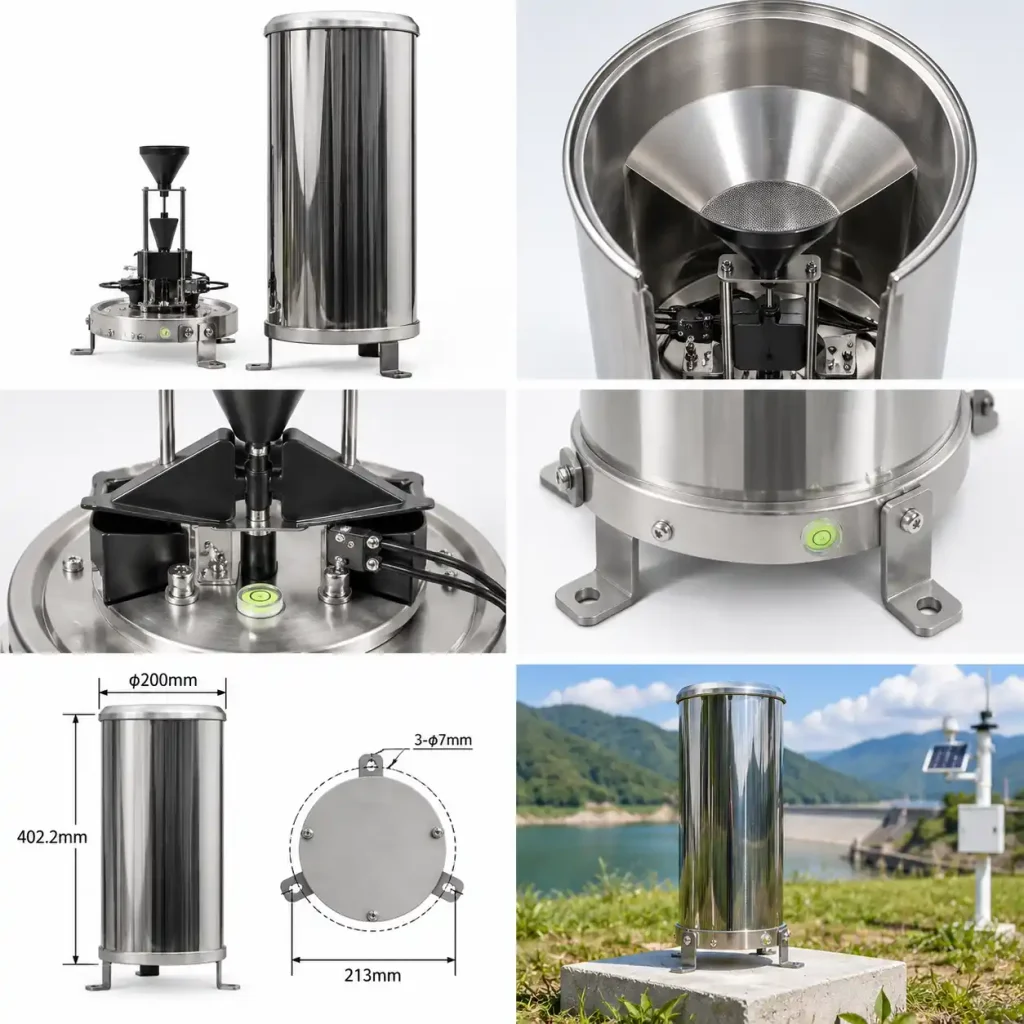
The component diagram in the manual identifies the major internal elements as the enclosure assembly, funnel, bracket, tips/bucket, reed switch, discharge holder, mounting foot and bull-eye level.
The detailed component illustration on page 5 further identifies the secondary funnel, bull-eye level, ABS UV-stabilized plastic bucket, reed switch, cable terminal, mounting foot and discharge holder, helping clarify the complete measurement structure.
3. Stainless Steel Construction with Plastic Tipping Bucket
The JW-TBRG2 uses a combination of metal and engineering plastic components.
According to the manual:
Body: Stainless steel
Base: Stainless steel
Tipping bucket: ABS UV-stabilized plastic
This distinction is important.
The product should therefore be described as a stainless steel tipping bucket rain gauge, but the internal tipping bucket itself is not stainless steel.
The polished stainless steel exterior is designed for fixed outdoor installations, while the lightweight UV-stabilized plastic bucket is used as part of the tipping measurement mechanism.
4. Technical Specifications
Parameter
Specification
Model
JW-TBRG2
Product Type
Tipping Bucket Rain Gauge
Resolution
0.2 mm
Body Material
Stainless steel
Base Material
Stainless steel
Tipping Bucket
ABS UV-stabilized plastic
Rainfall Capacity
≤4 mm/min
Accuracy
±≤2% at ≤1 mm/min
Accuracy at Higher Rate
±≤4% at ≤4 mm/min
Collector Diameter
200 mm ±0.3%
Collector Area
314 cm²
Height
402.2 mm
Collector Cutting Edge Angle
40–45°
Standard Output
Pulse, reed switch
Pulse Rate
5 pulses/mm
Optional Output
RS485
Pulse Power Specification
Max DC24V, 100mA
RS485 Power Supply
DC5V or DC7–24V
Switch
Rugged magnetic proximity
Leveling
Bull-eye level with leveling screw adjustment
Debris Protection
Stainless steel mesh inside collector
Mounting
Three mounting holes
Discharge
Straight-through flow mechanism
Working Temperature
-20°C to 80°C
Working Humidity
0–95% RH
5. Rainfall Measurement Accuracy
The JW-TBRG2 specification distinguishes accuracy according to rainfall rate.
At rainfall intensity:
≤1 mm/min
the specified accuracy is:
±≤2%
At rainfall intensity:
≤4 mm/min
the specified accuracy is:
±≤4%.
This distinction should be kept on the product page because it gives system integrators a clearer understanding of expected performance under different rainfall conditions.
Rather than presenting a single accuracy value, the page should preserve the two operating conditions stated in the manual.
6. 200 mm Rain Collector
The collector diameter is specified as:
200 mm ±0.3%
with a collector area of:
314 cm².
The manual lists a 200 mm / 8-inch bucket top diameter among the product features.
The collector cutting edge has an acute angle of:
40–45°.
The upper collector and internal funnel guide incoming rainfall toward the calibrated measurement assembly.
7. Pulse Output
Pulse is the standard output for JW-TBRG2.
The sensor uses a:
Reed switch / rugged magnetic proximity switch
and provides:
5 pulses per millimeter
Because the measuring resolution is 0.2 mm:
1 pulse = 0.2 mm rainfall
This makes the pulse version suitable for:
Hydrological RTUs
Rainfall data loggers
Pulse counters
PLC digital inputs
Automatic weather station controllers
Remote telemetry terminals
The pulse circuit is specified for a maximum of:
DC24V, 100mA.
For pulse output, the manual states that the two-wire terminal can be connected without polarity restriction.
8. Optional RS485 Output
An RS485 version is available as an option.
The manual specifies RS485 power supply as:
DC5V or DC7–24V.
For the DC7–24V RS485 wiring version, the four-core cable definition is:
Wire Color
Function
Brown
Power + (DC7–24V)
Black
GND
Yellow
RS485_A
Gray
RS485_B
A typical system can therefore be configured as:
JW-TBRG2 Rain Gauge → RS485 Modbus → RTU / Data Logger / PLC → Wireless or Wired Communication → Cloud Platform
This configuration is suitable for digital hydrological and IoT monitoring systems.
9. RS485 Modbus Communication
The manual provides Modbus communication details for the RS485 version.
Default communication parameters are:
Slave address: 2
Baud rate: 9600
Data bits: 8
Stop bit: 1
Parity: None
The manual also provides commands for:
Reading rainfall value
Clearing rainfall value
Modifying device address
For rainfall data, the manual gives the example:
0x0008 / 10 = 0.8 mm
which indicates that the returned rainfall value is interpreted in 0.1 mm units in the RS485 protocol example.
This communication functionality is useful for remote monitoring systems where rainfall data must be read digitally rather than counted as discrete pulses.
10. Built-In Debris Protection
Outdoor rain gauges can be affected by leaves, insects and other material entering the collector.
JW-TBRG2 includes a stainless steel mesh inside the collector to help reduce debris entry.
The mesh is also specifically listed in the product features as a method for preventing debris from entering the funnel.
This does not eliminate the need for maintenance.
The filter and mesh should still be checked and cleaned periodically, especially at sites exposed to vegetation, dust or insects.
11. Bull-Eye Level and Installation Adjustment
A tipping bucket instrument must be installed level for the tipping mechanism to operate correctly.
JW-TBRG2 therefore incorporates a bull-eye level and leveling screw adjustment.
The installation procedure in the manual specifies:
Fix the rain gauge to the ground or installation plate using M6 expansion screws.
Adjust the instrument according to the bull-eye level.
Connect the two-core pulse cable to the red terminal when using the pulse version.
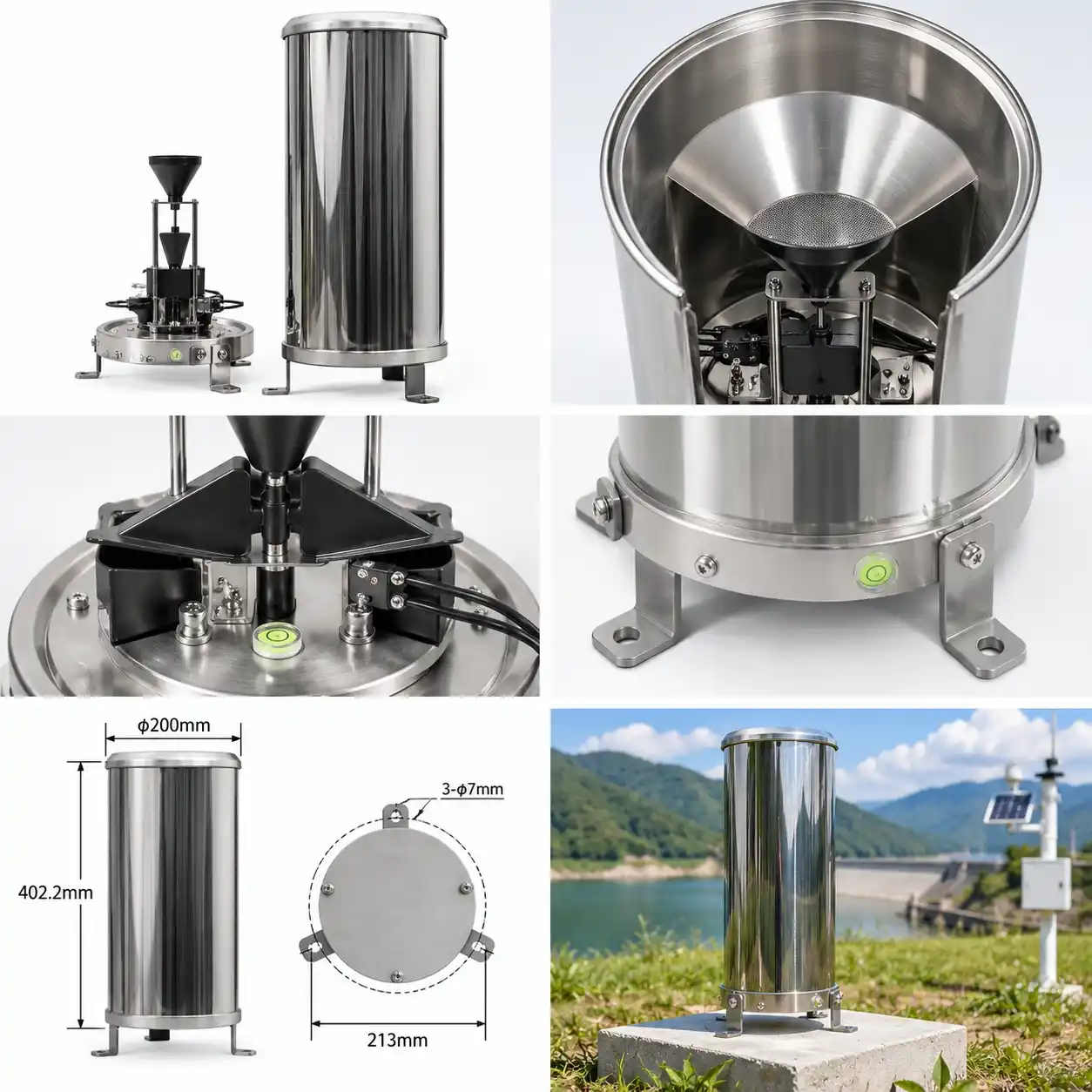
The base uses three mounting positions, arranged around the bottom assembly.
12. Dimensions
The manual specifies an overall height of:
402.2 mm
and a collector diameter of approximately:
200 mm.
The dimension drawing on page 5 also shows the complete vertical enclosure, internal funnel and base arrangement.
For engineering design, mounting layout should be checked against the installation drawing before preparing the mounting plate or concrete foundation.
13. Hydrological Monitoring
The JW-TBRG2 is suitable for hydrological monitoring, where rainfall is commonly analyzed together with river, reservoir or canal water-level data. A typical system may combine the tipping bucket rain gauge with water-level sensors, an RTU, wireless communication and a centralized platform.
For projects requiring rainfall and water-level data in the same architecture, see the JW-IoT Water Level Monitoring System. This solution integrates rain gauges, water-level sensors, flow sensors, RTUs and communication equipment for real-time hydrological monitoring.erefore be deployed together with water-level monitoring equipment in remote hydrological stations.
14. Natural Disaster Monitoring
Rainfall measurement can also form part of a wider disaster-risk monitoring system. For example, precipitation data may be combined with water-level, flow, video and local alarm devices in a Flood Monitoring System. JW-IoT’s smart water and environmental monitoring portfolio includes flood monitoring, water-level monitoring and weather monitoring solutions.
15. Weather Monitoring Stations
JW-TBRG2 can be integrated into an automatic weather monitoring station.
Typical accompanying sensors may measure:
Air temperature
Relative humidity
Atmospheric pressure
Wind speed
Wind direction
Solar radiation
Rainfall pulse data or RS485 data can be collected by the same monitoring controller or weather station data logger.
The manual lists weather monitoring stations as a standard application.
16. Smart Agriculture
For agricultural projects, rainfall information can be combined with soil moisture, soil temperature, weather and crop-environment data. Explore JW-IoT Smart Agriculture IoT Solutions for irrigation, soil monitoring, greenhouse and field monitoring applications.
The rain gauge can also be incorporated into a Smart Agriculture Weather Station for Crop Monitoring, where rainfall may be monitored together with air temperature, humidity, wind, pressure, solar radiation and soil parameters.
17. Environmental and Climate Research
The product manual lists both environmental monitoring and climate research as applications.
For research or long-term observation sites, the rain gauge can be deployed as a dedicated precipitation sensor or as part of a multi-parameter weather station.
Its pulse or optional RS485 output allows automatic collection of rainfall data over extended monitoring periods.
18. Water Supply System Monitoring
Another application specifically identified in the manual is water supply system monitoring.
Rainfall information can contribute to monitoring projects where precipitation conditions need to be evaluated together with catchment, reservoir or water resource information.
The exact role of rainfall data depends on the design of the complete water monitoring system.
A simple rainfall accumulation interface is preferred
The monitoring system already calculates rainfall from pulse counts
Standard output is:
5 pulses/mm
or:
0.2 mm per pulse
Choose RS485 When:
A digital network is required
Multiple Modbus sensors are connected to one controller
Rainfall data needs to be read directly by an RTU or PLC
Remote digital monitoring is preferred
The choice should be confirmed before ordering because the wiring and power requirements differ between pulse and RS485 versions.
22. Build a Rainfall Monitoring System with JW-IoT
JW-TBRG2 can be used as a standalone rainfall sensor or as one component in a wider monitoring network.
A complete system may include:
Tipping bucket rain gauge
Water-level sensor
Weather sensors
RTU or data logger
Wireless communication equipment
Solar power system
Cloud monitoring platform
When requesting a configuration, provide:
Application
Number of monitoring points
Pulse or RS485 requirement
Power supply
Communication method
Required additional sensors
Data platform requirements
This helps determine a suitable monitoring architecture.
Contact JW-IoT for JW-TBRG2 rain gauge specifications, RS485 communication support and hydrological monitoring integration.
FAQ
Q
1. What is this tipping bucket rain gauge used for?
A
It is used to measure rainfall amount, rainfall intensity, and rainfall duration for weather stations, hydrology, agriculture, forestry, and environmental monitoring projects.
Q
2. How does the tipping bucket rain gauge work?
A
Rainwater enters the collection inlet and flows into the tipping bucket. When the bucket reaches the calibrated volume, it tips and outputs one pulse signal.
Q
4. Can JW-IoT provide RS485 Modbus RTU output?
A
Yes. JW-IoT can provide the RS485 Modbus RTU version for integration with RTUs, data loggers, IoT gateways, and cloud monitoring platforms.
Q
5. What is the rain collection diameter?
A
The rain collection diameter is φ200 mm.
Q
6. Is the sensor suitable for outdoor installation?
A
Yes. The stainless steel housing and IP65 protection make it suitable for long-term outdoor rainfall monitoring.
Q
6. Is the sensor suitable for outdoor installation?
A
Yes. The stainless steel housing and IP65 protection make it suitable for long-term outdoor rainfall monitoring.
Q
7. Can JW-IoT support smart agriculture rainfall monitoring projects?
A
Yes. JW-IoT can provide this rain gauge for smart farms, irrigation systems, greenhouse monitoring, and agricultural weather stations.
Q
8. What output signals are available?
A
Available outputs include pulse signal, 4–20mA, and RS485 Modbus RTU.
Q
9. Why choose JW-IoT stainless steel rain gauges?
A
JW-IoT stainless steel rain gauges provide durable construction, stable tipping performance, multiple output options, and easy integration for weather and hydrology monitoring systems.
 +86 13520127780
  info@jingelway.com