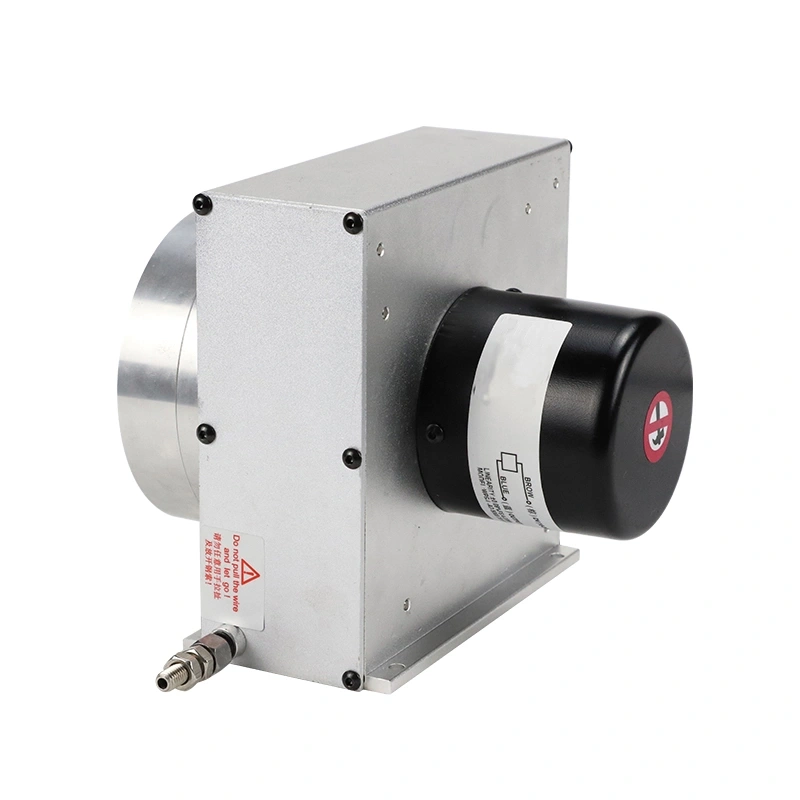
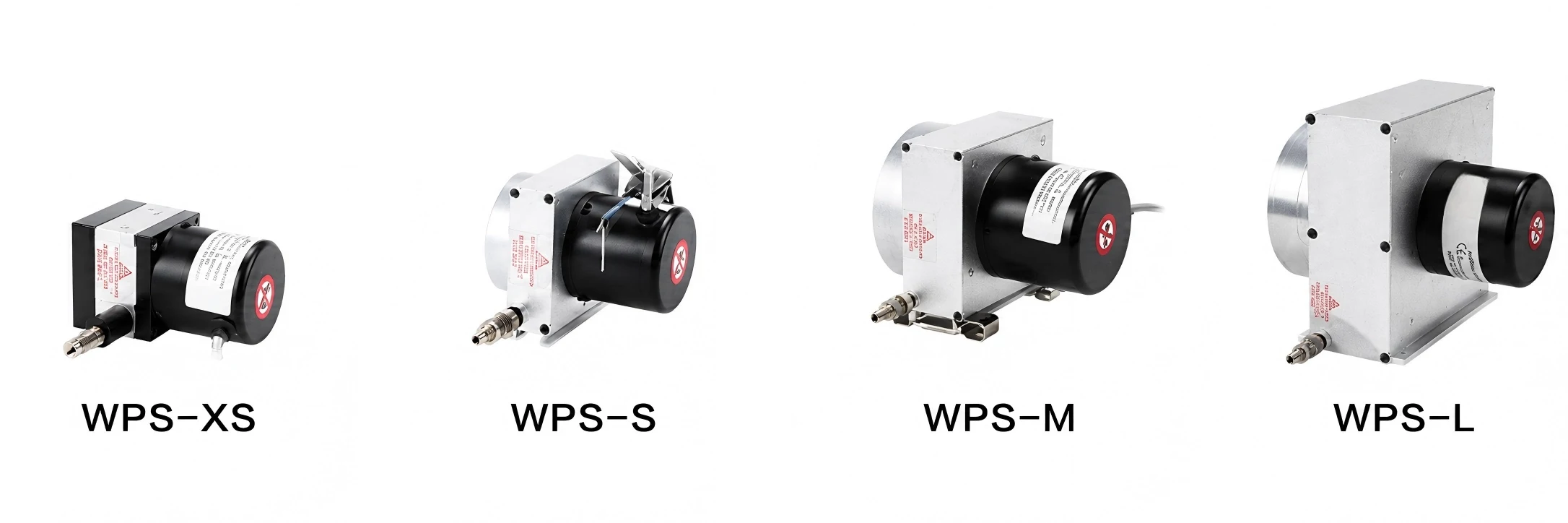
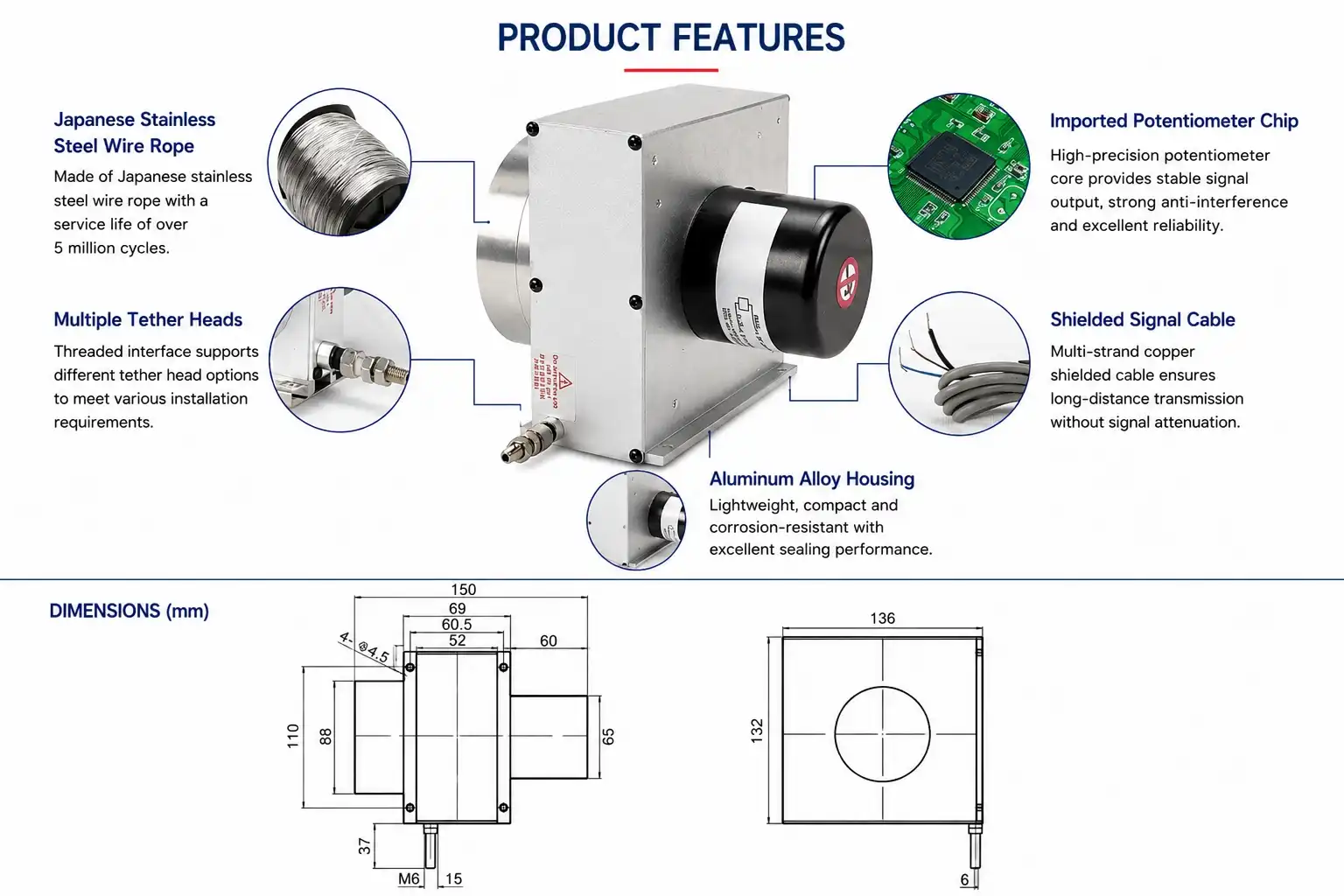
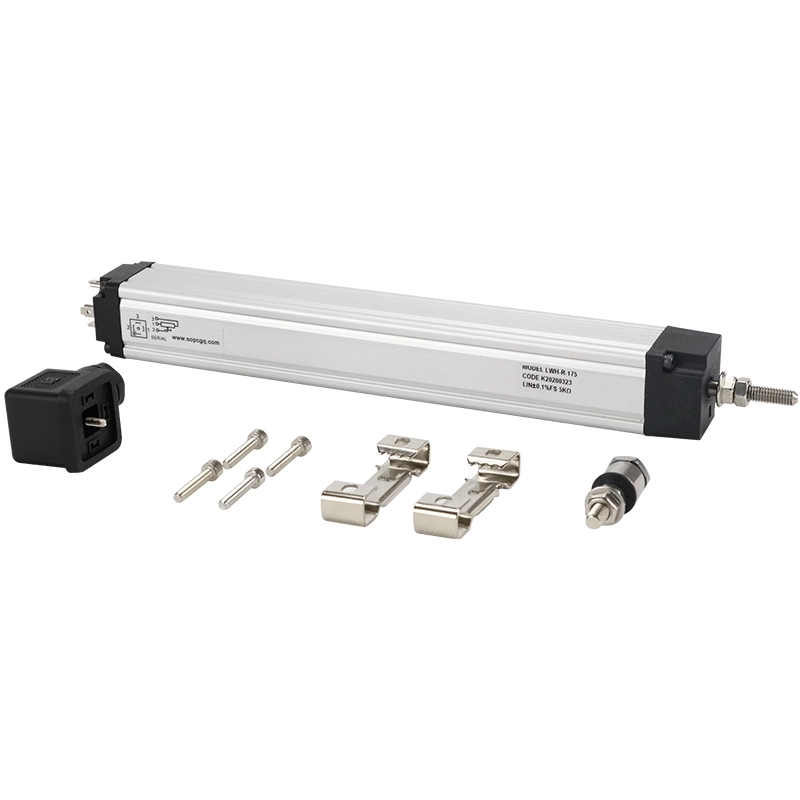
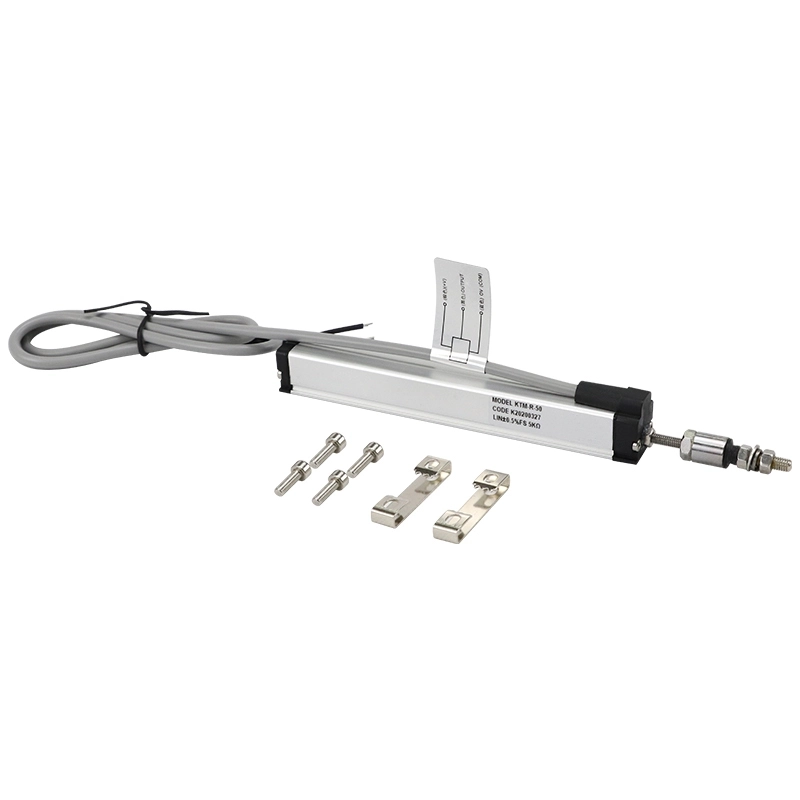
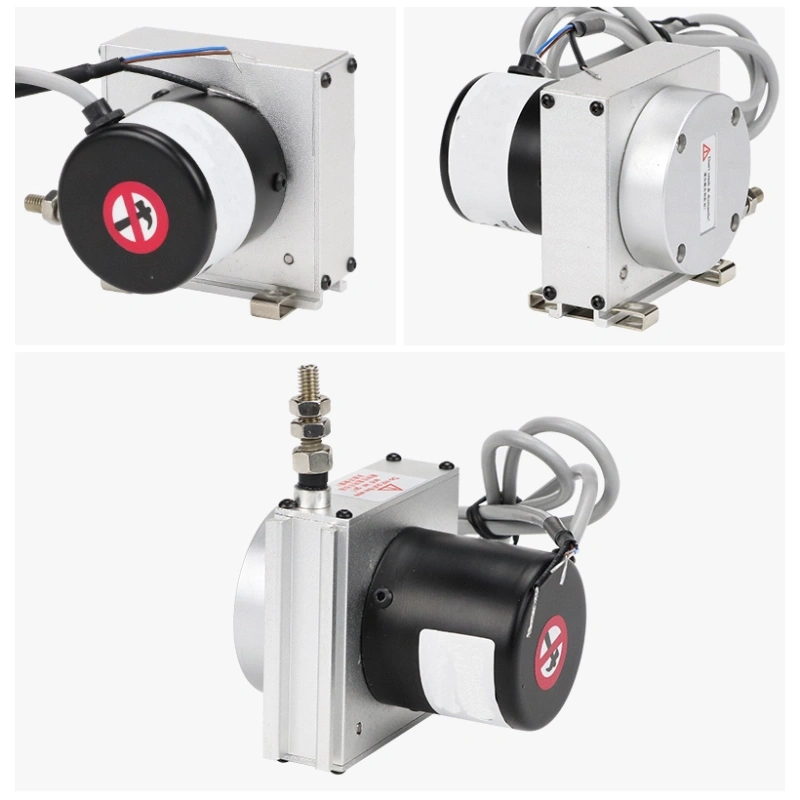
The JW-WPS-L(S13) Draw Wire Displacement Sensor is designed for long-range linear displacement and position measurement from 6000mm to 16000mm.
It converts the linear movement of a target into a measurable electrical signal through a retractable stainless-steel wire rope and internal sensing mechanism.
Compared with rod-type linear displacement sensors, a draw wire sensor can measure much longer travel while keeping the sensor body relatively compact. This makes it suitable for equipment and structures where the measuring point may move several meters.
Typical applications include:
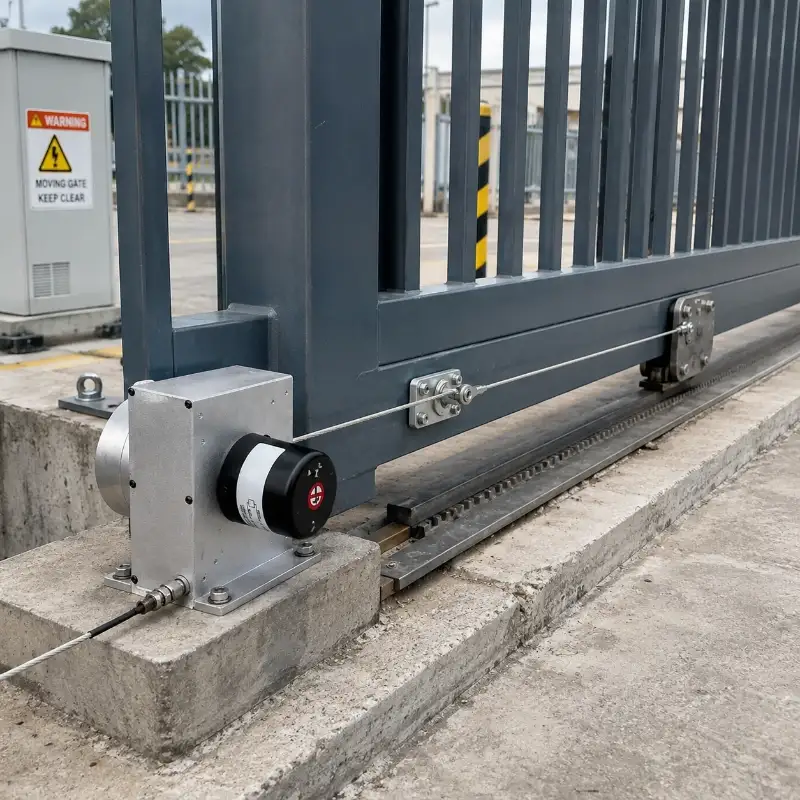
Large gate opening measurement
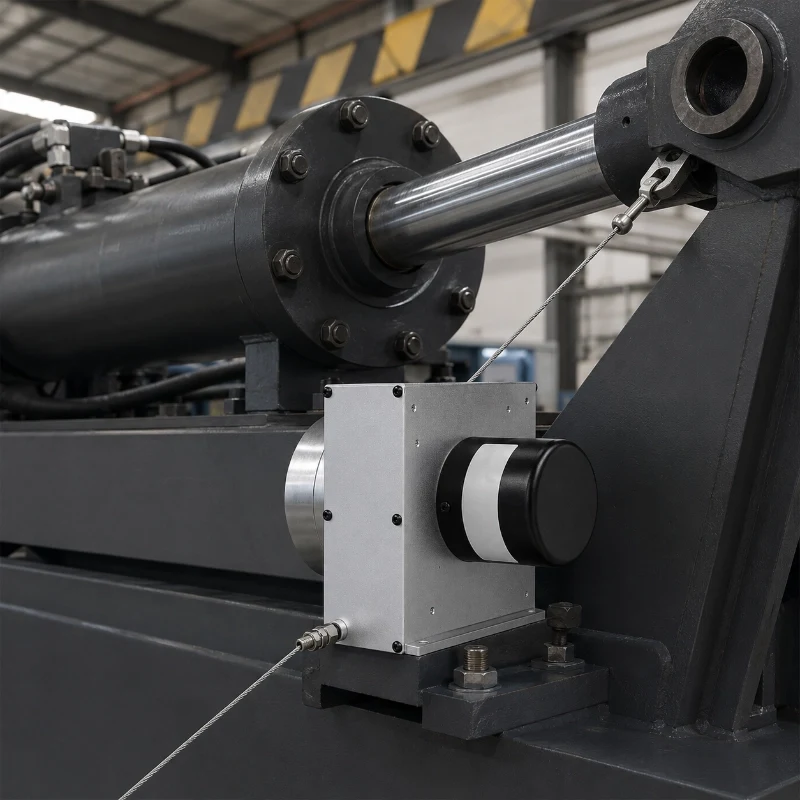
Hydraulic equipment
Lifting and positioning systems
Large industrial machinery
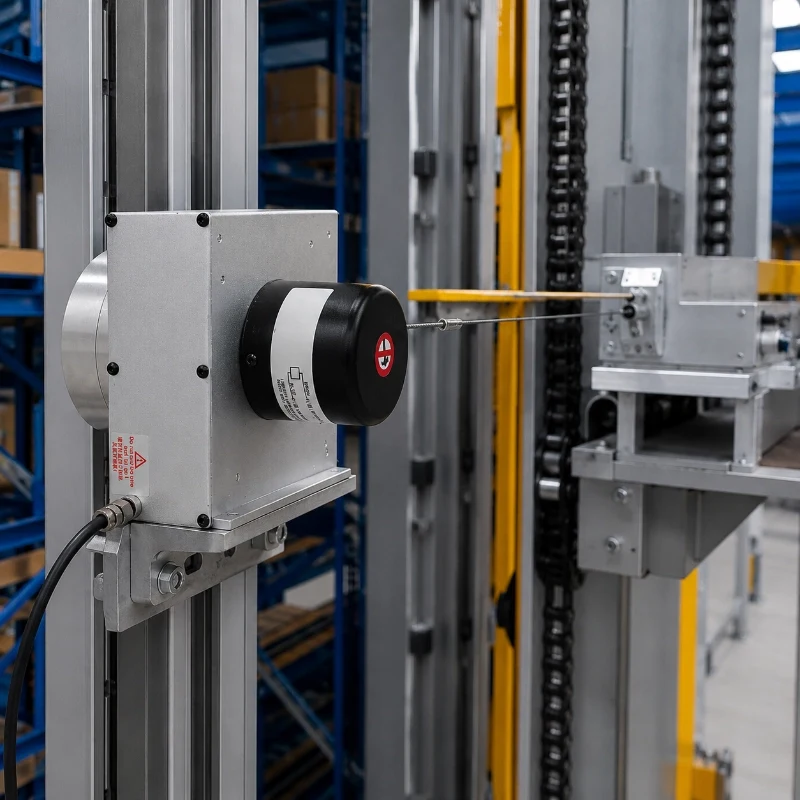
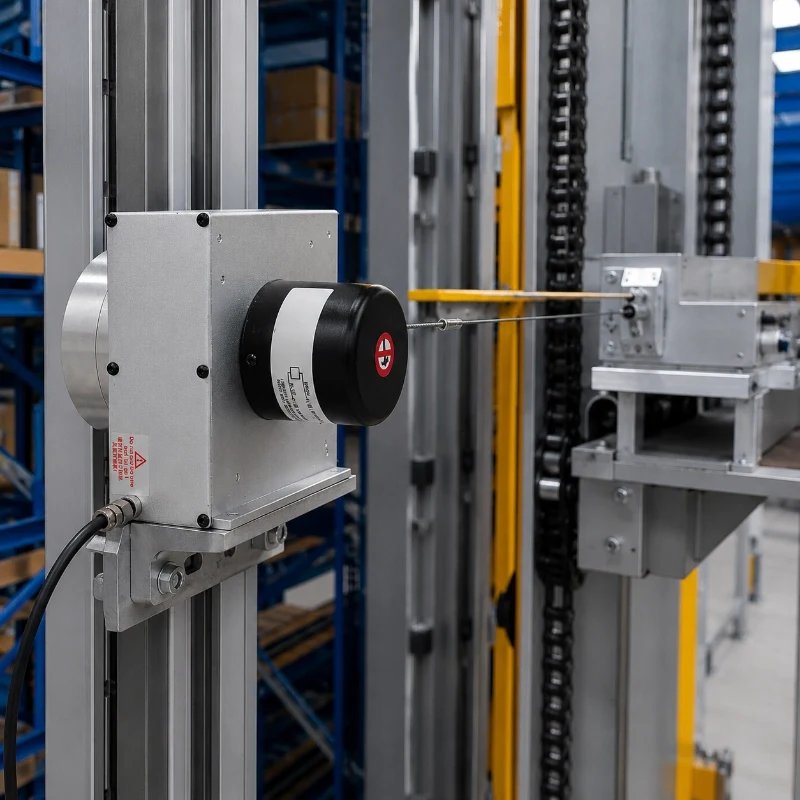
Warehouse positioning equipment
Construction machinery
Long-travel automation systems
Large moving platforms
Structural movement monitoring
Depending on the selected configuration, the JW-WPS-L(S13) series can support current, voltage, resistance, pulse and digital output options. The product also uses an industrial aluminum-alloy housing and IP65 protection for demanding installations.
What Is a Draw Wire Displacement Sensor?
A draw wire displacement sensor—also called a cable displacement sensor, pull wire sensor, string potentiometer or wire position sensor—measures linear movement by extending and retracting a flexible measuring cable.
The sensor body remains fixed while the end of the wire rope is connected to the moving object.
As the target moves:
Target Movement
↓
Wire Rope Extension
↓
Internal Spool Rotation
↓
Position Conversion
↓
Electrical Output Signal
This makes draw wire technology particularly useful where direct installation of a long rod-type sensor would require too much installation space.
Why Use a 6000-16000mm Draw Wire Sensor?
A 6–16 meter measuring range is designed for applications where conventional short-stroke linear sensors are no longer practical.
Typical conditions include:
Moving distance exceeds several meters
Sensor installation space is limited
The target moves in a relatively straight path
Continuous position feedback is required
Large machinery or civil equipment must be monitored
For movements below approximately 6000mm, a smaller draw wire sensor may provide a more compact solution.
When the target moves away from the sensor, the wire is pulled from the spool.
The spool rotation corresponds to the extension distance. The internal sensing mechanism then converts this rotation into an electrical signal representing linear displacement.
When the target moves back toward the sensor, the spring mechanism retracts the wire while maintaining suitable tension.
Because the sensing body remains stationary, very long movement can be measured without requiring a sensor body equal to the full measuring distance.
Technical Specifications
Item
Specification
Product Type
Draw Wire Displacement Sensor
Model Series
L Type
Measuring Range
6000 to 16000mm
Standard Linearity
0.25%FS
Precision Linearity
0.05% to 0.08%FS
Repeatability
0.002%FS to 0.001%FS
Current Output
4 to 20mA or 20 to 4mA
Voltage Output
0 to 10VDC or 10 to 0VDC
Resistance Output
0 to 5kΩ or 0 to 10kΩ
Pulse Output
3600 to 5000 ppr incremental AB phase or ABZ phase
Digital Output
RS485 or absolute encoder signal optional including CAN Open and Profinet
Supply Voltage
24VDC
Pulse Type Supply Voltage
5 to 24VDC
Pulling Force
650 ±70g
Service Life
5 million reciprocating cycles
Protection Rating
IP65
Housing Material
Aluminum alloy
Fixed Screw
M4
Mounting Method
Bracket mounting
Tether Screw Installation
M6
Left to Right Mounting Distance
61 ±0.5mm
Front to Back Mounting Distance
100mm
Mounting Screw
M4
Applications
Large Gate Opening Monitoring
One of the most suitable applications for a 6–16m draw wire displacement sensor is large gate position measurement.
Possible applications include:
Sluice gates
Reservoir gates
Flood-control gates
Large industrial doors
Hydraulic gates
The sensor body can be installed on a fixed structure while the measuring cable is attached to the moving gate.
As the gate opens or closes, the wire extension changes continuously, allowing the control system to determine the opening position.
For water infrastructure projects, the displacement sensor can work together with other monitoring equipment such as:
Water level sensors
Gate controllers
RTUs
Alarm systems
Hydraulic and Heavy Machinery
Large hydraulic machinery may have strokes far beyond the range of compact linear displacement sensors.
A draw wire sensor can be installed beside the hydraulic mechanism and connected to the moving component.
Typical measurements include:
Hydraulic cylinder extension
Press position
Boom movement
Mechanical platform movement
Equipment stroke
The flexible wire design allows the sensor to monitor long movement without installing a multi-meter rigid sensor alongside the cylinder.
Lifting and Hoisting Equipment
Long-range displacement monitoring is useful for:
Lifting platforms
Hoists
Crane mechanisms
Elevators
Material handling systems
The sensor can provide continuous position information for movement control, travel monitoring or limit management.
For safety-related equipment, the displacement sensor should be used as part of an engineered control system rather than as the sole safety device.
Warehouse and Large Automation Equipment
Automated storage and retrieval systems can require several meters of horizontal or vertical movement.
Draw wire sensors can measure:
Shuttle position
Lifting platform height
Storage carriage movement
Long-axis travel
Conveyor positioning
Output signals can then be processed by compatible PLC or control equipment.
Structural and Engineering Movement Monitoring
Long-range cable displacement measurement can also support engineering monitoring where relatively large movement may occur.
Possible applications include:
Large structural joints
Dam components
Retaining structures
Mining infrastructure
Large mechanical structures
JW-IoT also includes the 6000–16000mm draw wire sensor within its structural health monitoring product portfolio.
For structural monitoring, sensor selection should consider expected displacement, movement direction, mounting stability and environmental conditions.
6000-16000mm vs 2500-6000mm Draw Wire Sensor
Comparison
2500-6000mm Model
6000-16000mm Model
Measurement Range
Medium to long stroke
Long to very long stroke
Typical Movement
Up to 6m
6-16m
Main Application
Machinery and gates
Large gates and heavy equipment
Installation Scale
Medium
Large
Product Positioning
Industrial long stroke
Long-range industrial measurement
Choose the 2500-6000mm model when the maximum movement remains below 6m.
Choose the 6000-16000mm model when the project requires several meters of additional measuring travel.
6000-16000mm vs 16000-30000mm Sensor
Comparison
6000-16000mm
16000-30000mm
Range
6-16m
16-30m
Positioning
Long range
Extra-long range
Typical Application
Gate, hydraulic and large machine
Very large structure and extra-long travel
Installation Requirement
Large industrial system
Extra-large measurement system
Avoid automatically selecting the largest measuring range.
A measuring range reasonably matched to the expected movement generally provides a more appropriate mechanical configuration for the project.
Installation quality has a major influence on wire life and measurement reliability.
1. Keep the Wire as Straight as Possible
Install the sensor so the wire travels directly between:
Sensor outlet
Moving measurement point
Avoid unnecessary angular deviation.
JW-IoT’s adjacent draw-wire product guidance recommends keeping the wire path as straight as possible and minimizing angular deviation; where the movement is not linear, a suitable guide or pulley should be considered.
2. Do Not Allow Sudden Retraction
Do not pull the cable out and release it suddenly.
Rapid uncontrolled retraction may damage:
Wire rope
Internal spool
Sensor housing
Always allow controlled movement.
3. Protect the Stainless-Steel Wire
Avoid exposure to:
Welding sparks
Sharp edges
Cutting tools
Heavy debris
Excessive contamination
Mechanical impact
For outdoor installation, inspect the wire and outlet periodically.
4. Use a Guide for Non-Linear Movement
If the target does not travel directly away from the sensor, use an engineered guide or pulley system.
The cable should not repeatedly rub against surrounding structures.
5. Verify Full Travel Before Commissioning
Before operation:
Move the equipment slowly through its complete expected stroke.
Confirm that the cable remains aligned.
Confirm that the wire does not reach its maximum extension.
Check the output signal throughout the movement.
Verify the mechanical mounting points.
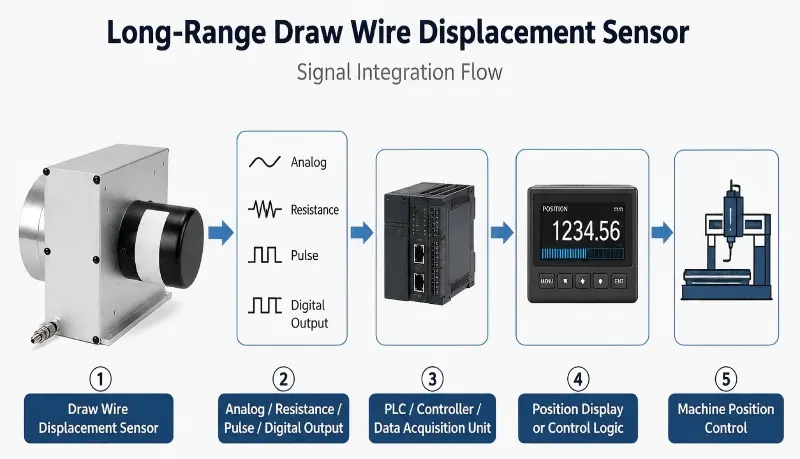
Typical Signal Integration
Depending on the selected output configuration, a typical system can follow:
Draw Wire Displacement Sensor
↓
Analog / Resistance / Pulse / Digital Output
↓
PLC / Controller / Data Acquisition Unit
↓
Position Display or Control Logic
↓
Machine Position Control
For remote monitoring projects, communication should normally be handled by the connected controller, RTU or data acquisition equipment rather than assuming that every sensor configuration communicates directly with a cloud platform.
How to Select the Correct Draw Wire Displacement Sensor
Before requesting a quotation, provide the following information.
1. Maximum Travel
Determine the maximum expected displacement.
Do not select a range that is shorter than the actual maximum movement.
2. Required Output
Confirm whether the control system requires:
Current
Voltage
Resistance
Pulse
Digital interface
3. Required Accuracy
Specify the required:
Linearity
Repeatability
Resolution
This is especially important for positioning and closed-loop control applications.
4. Movement Direction
Confirm whether movement is:
Horizontal
Vertical
Inclined
Non-linear
This affects installation design.
5. Operating Environment
Provide information about:
Temperature
Humidity
Dust
Water exposure
Vibration
Corrosion
Outdoor installation
6. Motion Speed
High-speed or rapidly accelerating movement should be evaluated against the mechanical capability of the wire and spool system.
Request a 6000-16000mm Draw Wire Displacement Sensor Quote
1. What is a draw wire displacement sensor used for?
A
A draw wire displacement sensor is used to measure linear movement, stroke length, and position changes in industrial equipment, gates, lifting systems, robots, and automation machinery.
Q
2. What measuring range does this model support?
A
This L-type model supports an ultra-long measuring range from 6000mm to 16000mm, which is suitable for long-distance displacement measurement applications.
Q
3. What output signals are available?
A
The sensor supports current output, voltage output, resistance output, pulse output, and optional digital outputs such as RS485, CAN Open, and Profinet.
Q
4. Is this sensor suitable for harsh industrial environments?
A
Yes. With an IP65 protection rating, aluminum alloy body, and durable internal structure, it is suitable for a wide range of industrial environments.
Q
5. Can JW-IoT provide different signal output options?
A
Yes. JW-IoT can support multiple signal configurations according to project requirements, including analog, pulse, and digital communication outputs.
Q
6. What industries commonly use this sensor?
A
It is widely used in reservoir gate control, warehouse positioning, construction machinery, industrial robots, hydraulic systems, packaging equipment, elevators, and long-stroke automation applications.
Q
7. Does JW-IoT support OEM and project integration?
A
Yes. JW-IoT can support OEM projects and industrial integration needs for displacement monitoring, automation feedback, and long-distance position control.
Q
8. How should the sensor be installed for best performance?
A
The rope should move in as straight a line as possible, with minimal angle deviation. For non-linear movement, a suitable pulley should be used to guide the rope path.
Q
9. Why choose JW-IoT for draw wire displacement sensors?
A
JW-IoT provides practical industrial sensing solutions with flexible configuration options, stable performance, and support for a wide range of position measurement applications.
 +86 13520127780
  info@jingelway.com