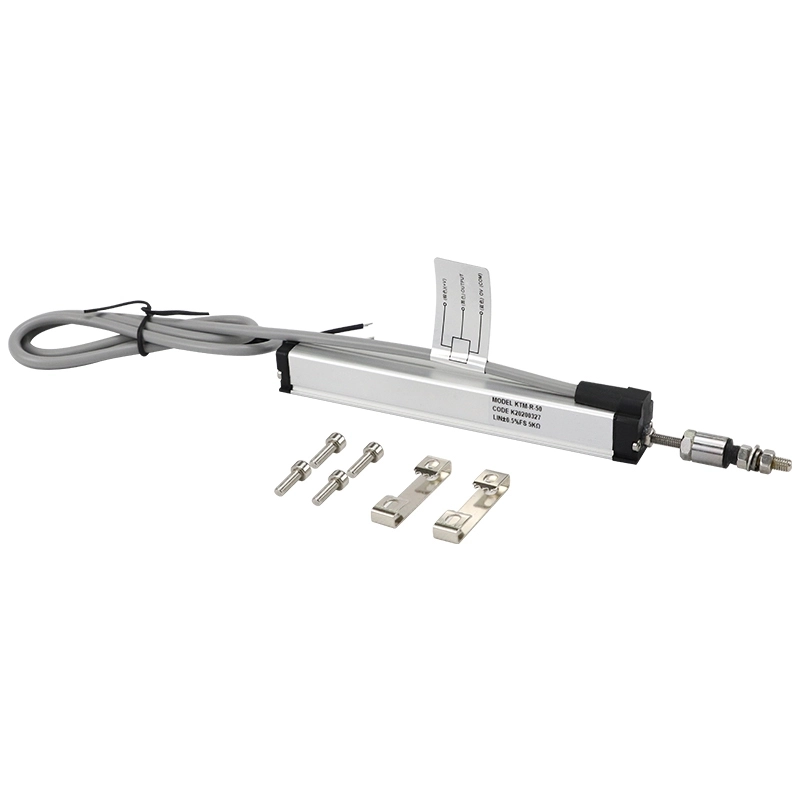
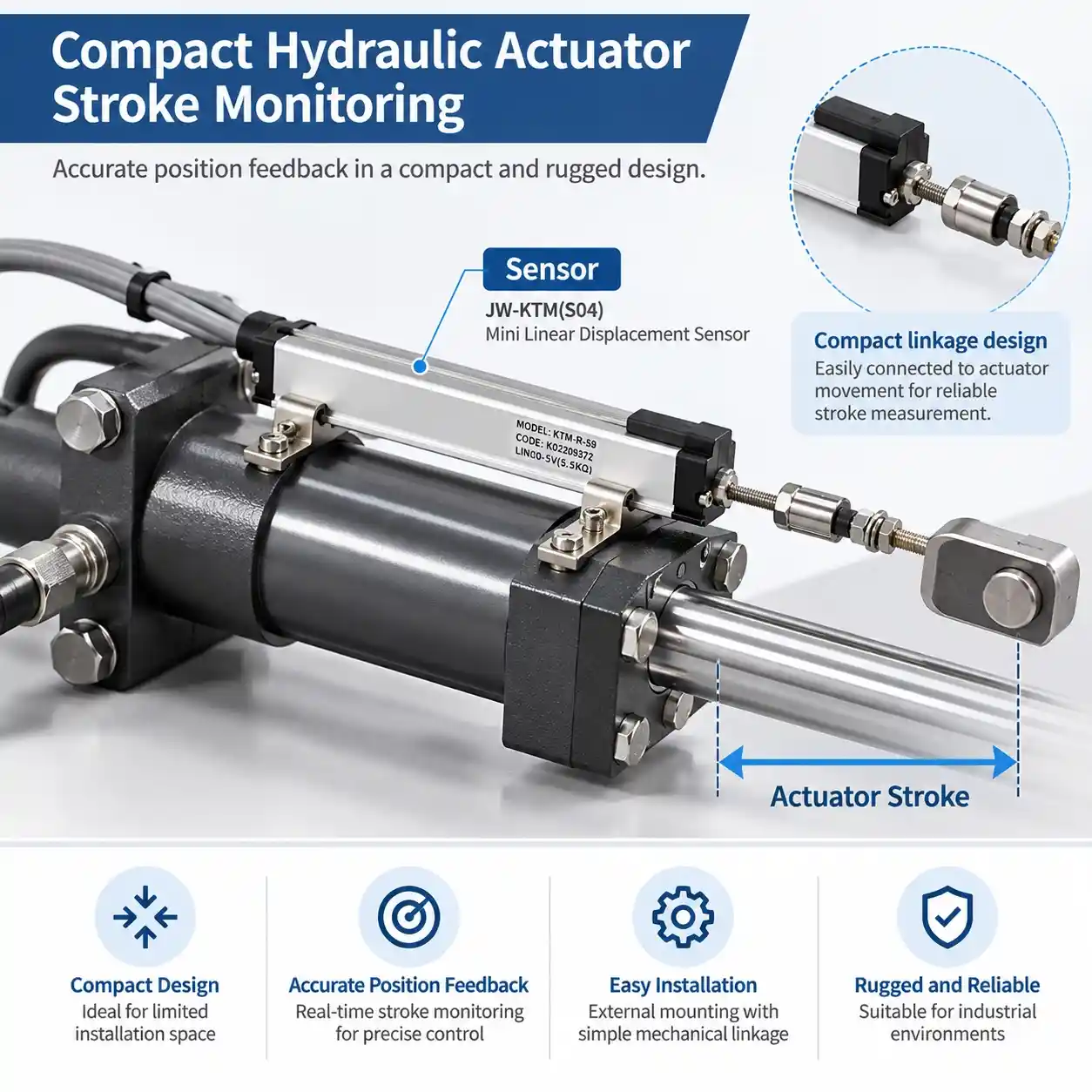
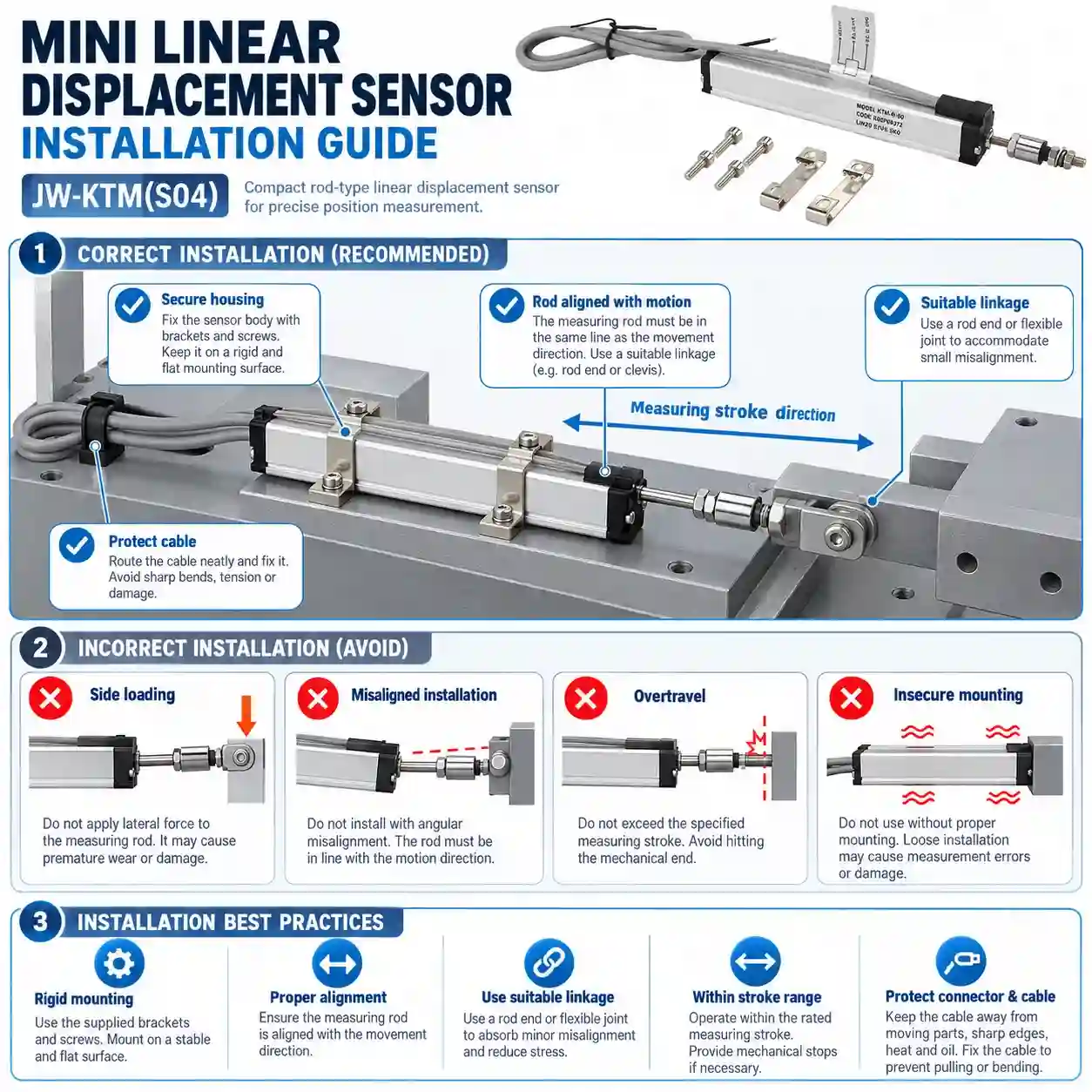
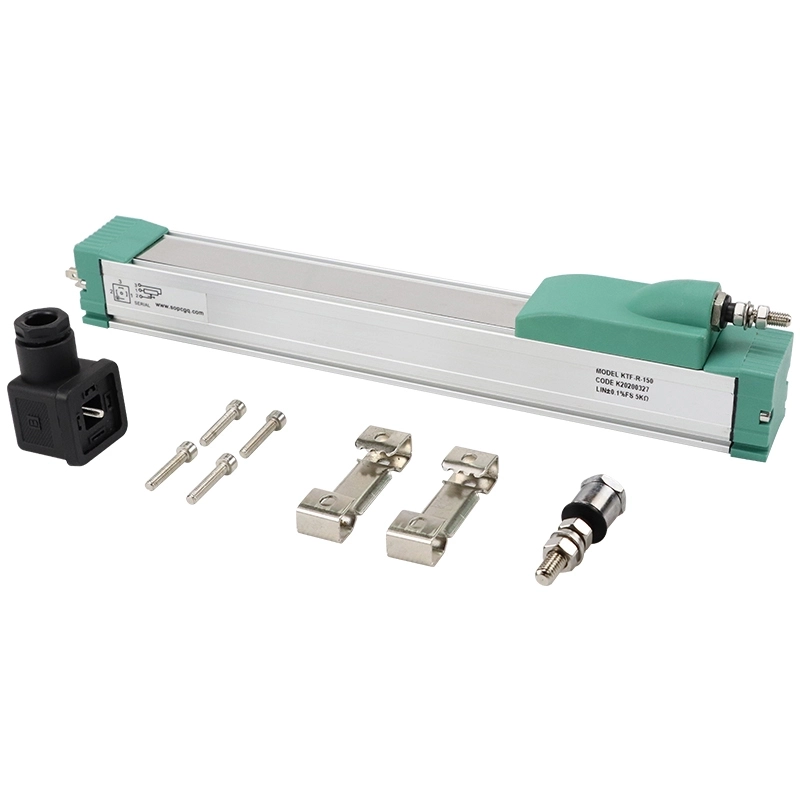
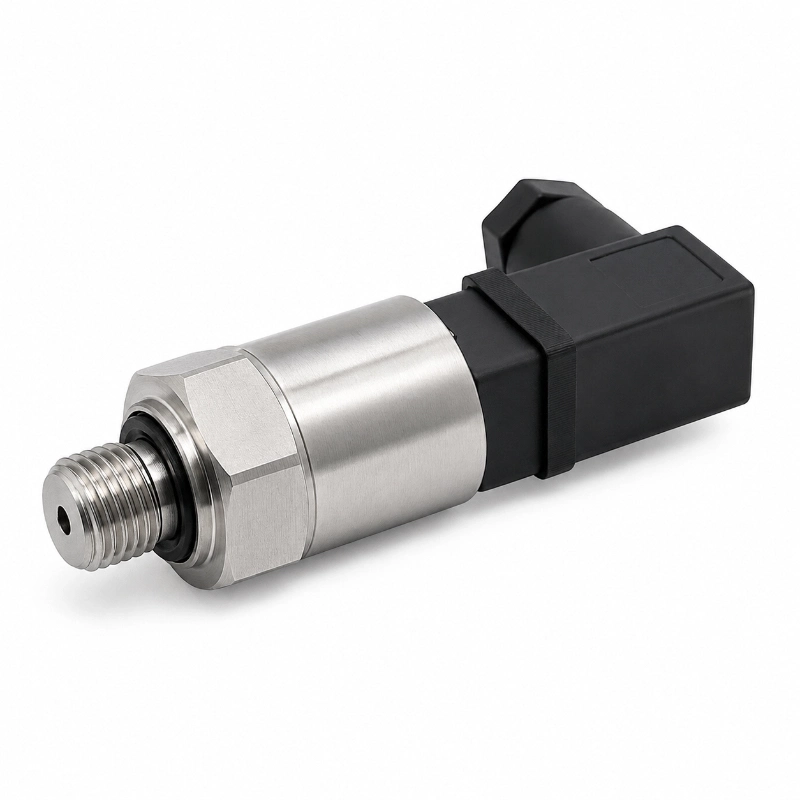
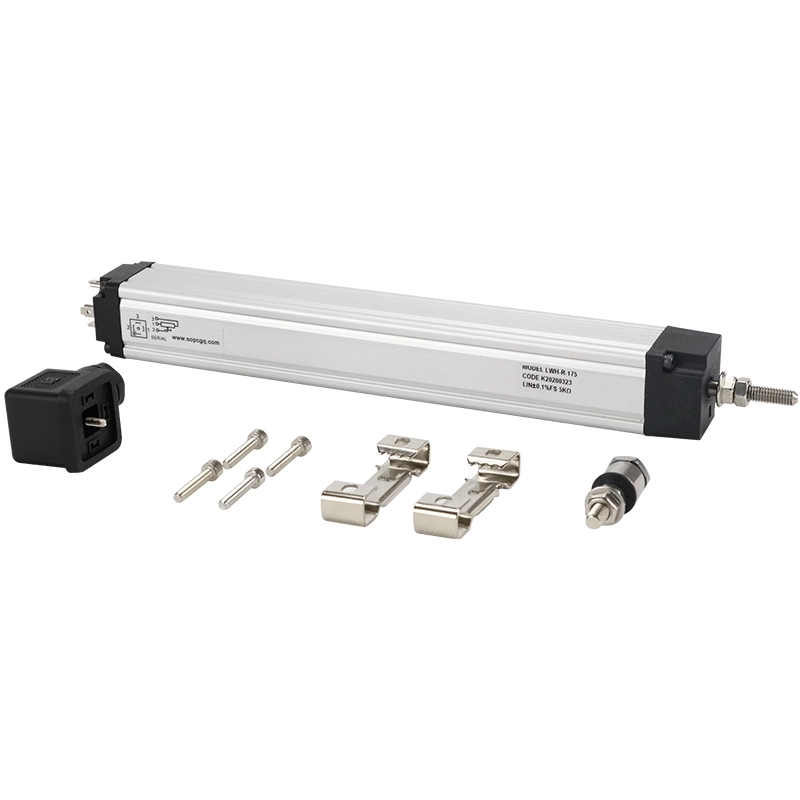
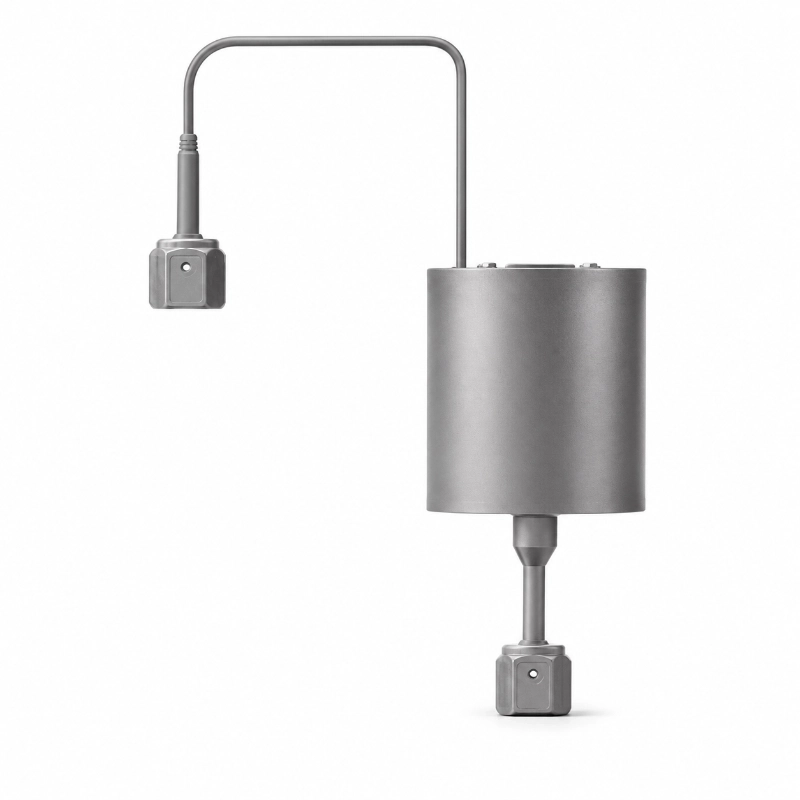
The JW-KTM(S04) Mini Linear Displacement Sensor is a compact rod-type position transducer designed for continuous displacement and stroke measurement in industrial machinery.
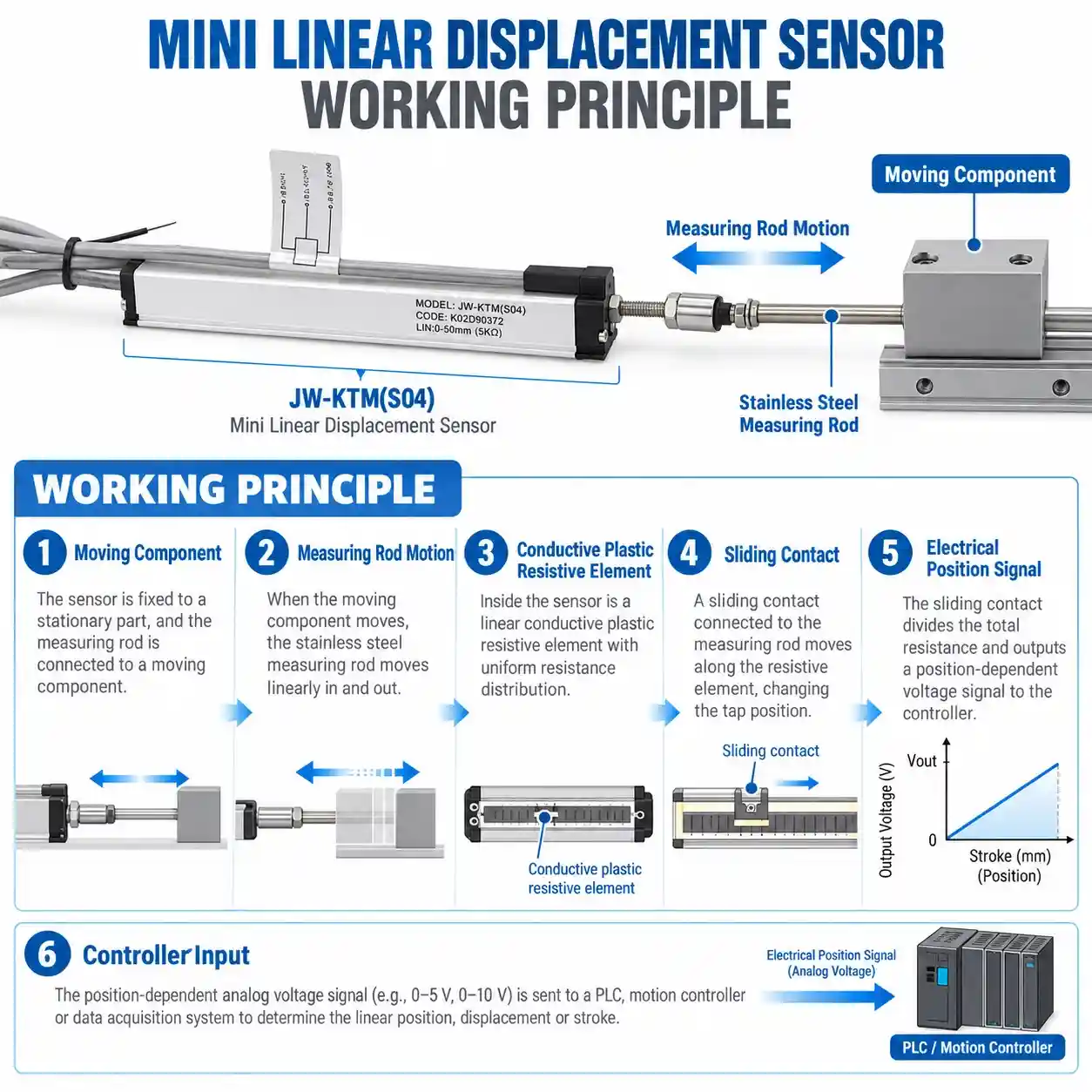
Using a conductive plastic resistive element and a stainless steel measuring rod, the KTM sensor converts linear mechanical movement into a proportional electrical signal.
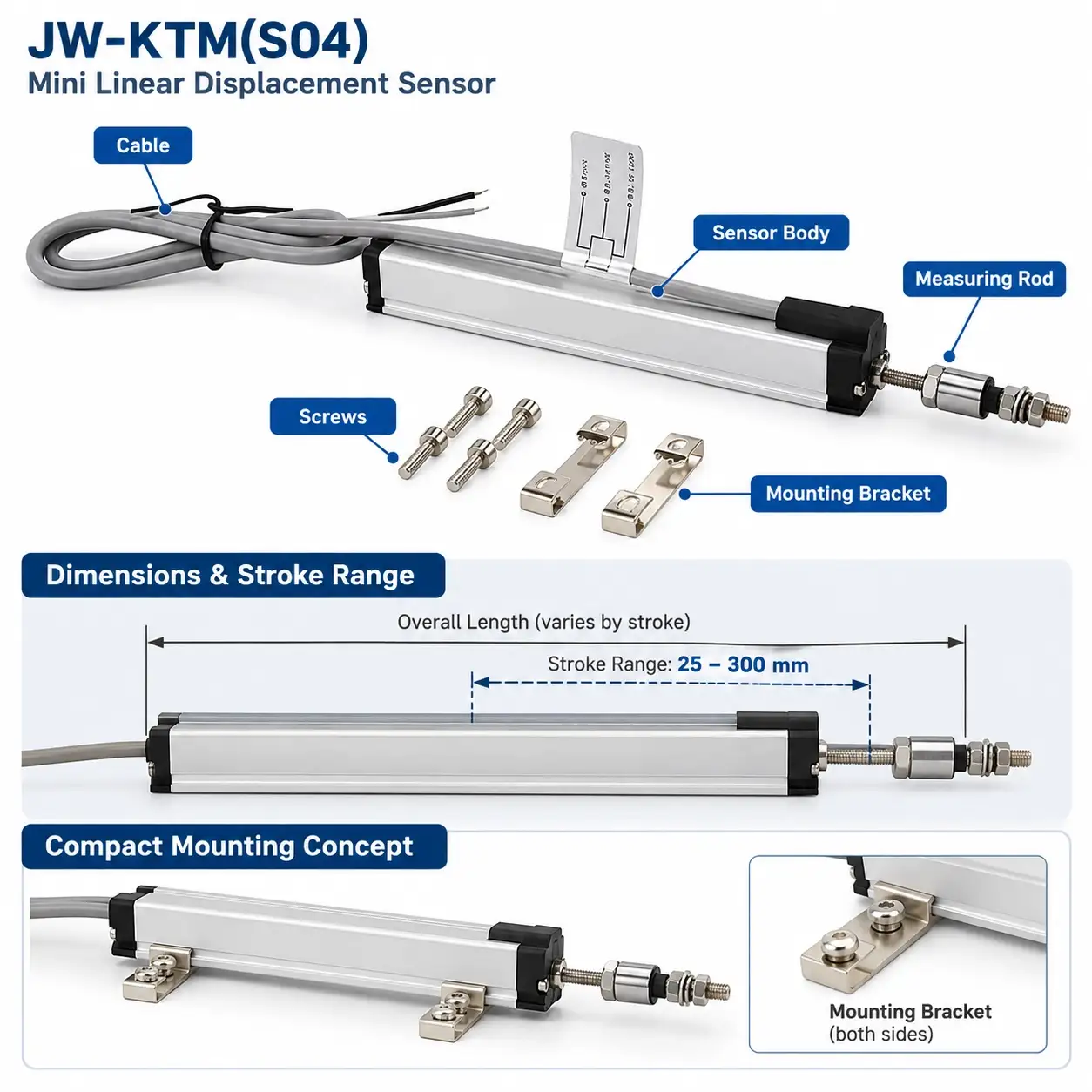
Available with measuring strokes from 25mm to 300mm, it is suitable for packaging machinery, printing equipment, automatic doors, hydraulic mechanisms, testing equipment and small automation systems.
Its compact housing, spherical joint design and DIN43650 connector make it a practical option where installation space is limited and direct mechanical position feedback is required.
1. How Does a Mini Linear Potentiometer Work?
The KTM mini linear displacement sensor operates using a conductive plastic potentiometer.
When a machine component moves, the measuring rod transfers that movement to the internal sliding contact. The contact changes its position along the resistive element, producing an electrical signal related to the measured stroke.
The measurement process is:
Moving Component → Measuring Rod → Resistive Element → Electrical Position Signal → Controller
Unlike a limit switch, which typically detects whether a target has reached a predefined position, a linear potentiometer provides continuous position-related feedback throughout its measuring range.
Advantages of Compact Rod-Type Measurement
A miniature linear potentiometer is particularly useful when:
The measurement distance is relatively short.
The moving component permits direct mechanical coupling.
Installation space is limited.
Continuous analog position feedback is required.
A compact machine-mounted sensor is preferred.
The sensor measures relative movement between its housing and the connected moving component.
2. Technical Specifications
Parameter
Specification
Model
JW-KTM(S04)
Series
KTM
Sensor Type
Mini Rod-Type Linear Potentiometer
Measuring Stroke
25–300mm
Sensing Element
Conductive Plastic
Linearity
0.05–0.3%FS
Resolution
Better than 0.01mm, as listed
Service Life
Up to 30 Million Operations
Measuring Rod
Stainless Steel
Mechanical Connection
Spherical Hinge Design
Resistance Options
5kΩ / 10kΩ
Optional Current Output
4–20mA
Optional Voltage Outputs
0–5V / 0–10V
Wiring Options
2-wire / 3-wire, depending on configuration
Electrical Connector
DIN43650
Protection Rating
IP65
Warranty
1 Year
Technical note: Linearity, resolution and total measurement accuracy are different specifications. Performance and electrical configurations should be confirmed for the selected stroke length before ordering.
3. Output Options and PLC Integration
3.1 Potentiometric Output
The KTM sensor uses a conductive plastic resistive element, with listed resistance options of 5kΩ and 10kΩ.
The electrical output changes with the position of the measuring rod.
For potentiometric configurations, a compatible measurement circuit is required to convert this change into a usable position value.
3.2 Voltage Output
Optional voltage signal-conditioning modules provide:
0–5V
0–10V
These configurations can connect to compatible PLC analog voltage inputs.
3.3 Current Output
An optional 4–20mA output configuration is available for industrial controllers and data acquisition equipment equipped with current-input channels.
Typical integration architecture:
Mini Linear Displacement Sensor → Signal Conditioning → PLC / Controller → Machine HMI
The appropriate electrical configuration must be selected according to the receiving device. Not all output types are available simultaneously.
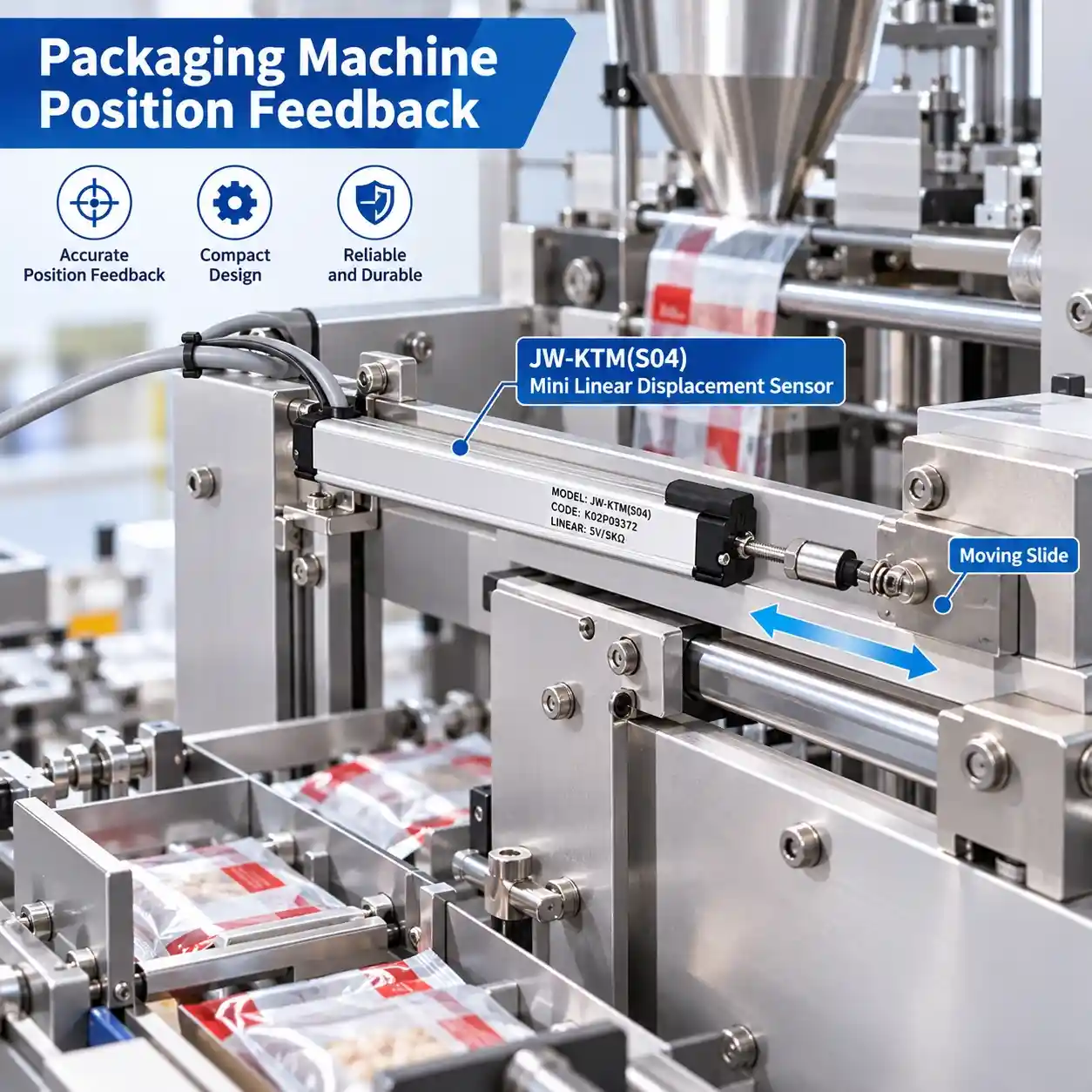
Packaging machinery commonly includes small actuators, adjustable mechanical assemblies and moving components that require position feedback.
The KTM mini linear displacement sensor can measure short mechanical strokes where a suitable direct rod connection is available.
Potential measurement points include machine slides, adjustable components and small positioning mechanisms.
4.2 Printing Machinery
Printing equipment may require displacement measurement for mechanical adjustment and moving machine components.
The compact KTM sensor can be considered for applications requiring continuous analog position feedback within a 25–300mm stroke.
4.3 Automatic Doors and Small Actuators
Compact linear position sensors can monitor mechanical travel in suitable automatic door mechanisms, small actuators and machine-controlled assemblies.
For applications involving personnel access or machinery safety, the position sensor must not be treated as a certified safety device without the appropriate system-level assessment.
4.4 Hydraulic and Pneumatic Equipment
Small hydraulic or pneumatic mechanisms may require external stroke-position feedback.
The KTM sensor can measure movement through a direct mechanical linkage, provided that rod alignment, stroke limits and installation clearances are appropriate.
4.5 Mechanical Testing Equipment
Testing machines and measurement fixtures may require continuous displacement feedback during controlled mechanical movement.
The KTM sensor can provide position-related data to compatible acquisition equipment for test monitoring or machine control.
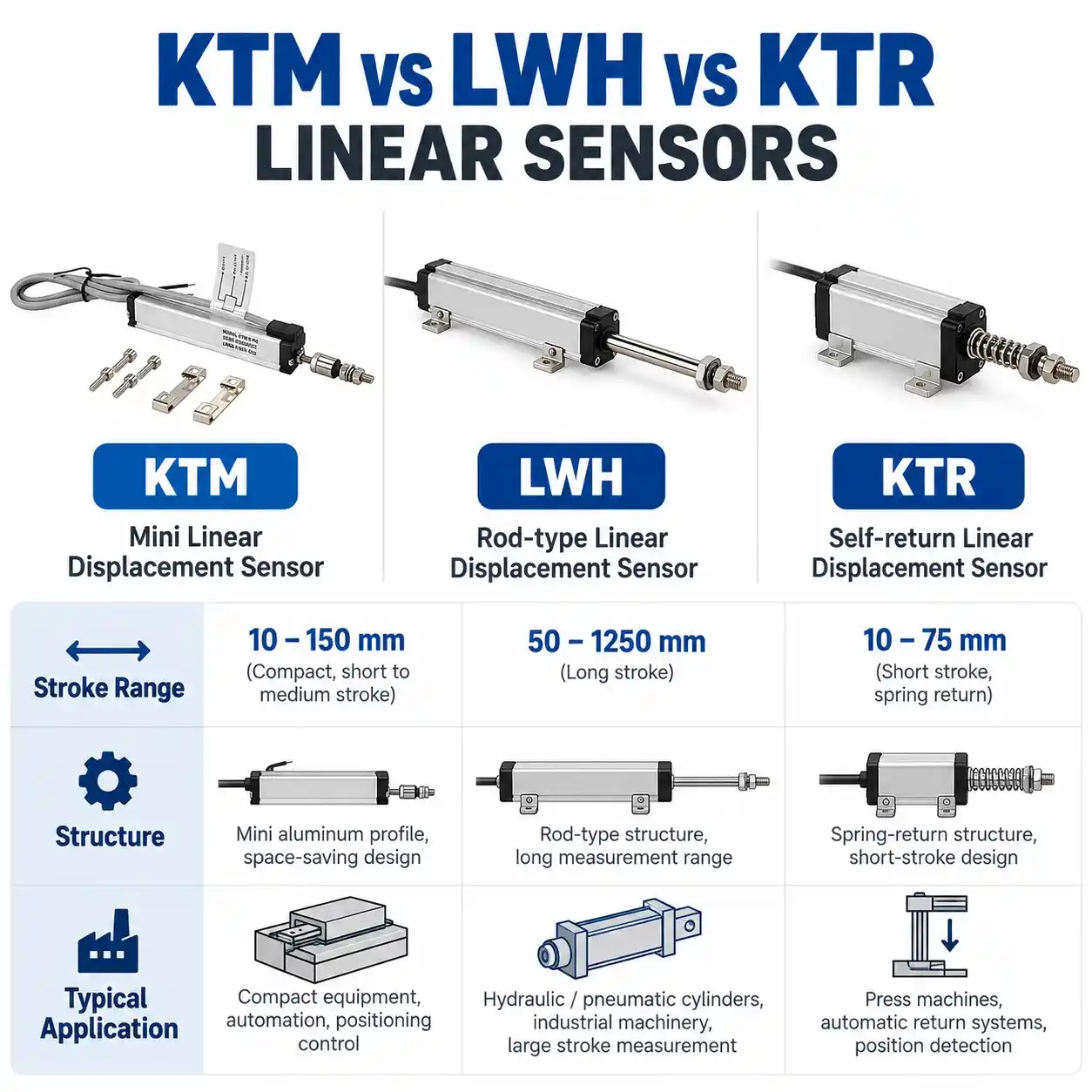
Different sensor structures are appropriate for different mechanical arrangements.
Sensor
Measurement Method
Selection Priority
KTM Mini Linear 25–300mm
Compact Rod-Type Potentiometer
Short machine stroke
LWH Linear 75–1250mm
Longer Rod-Type Potentiometer
Medium to long stroke
KTR Self-Return 5–100mm
Spring-Return Rod
Short contact measurement
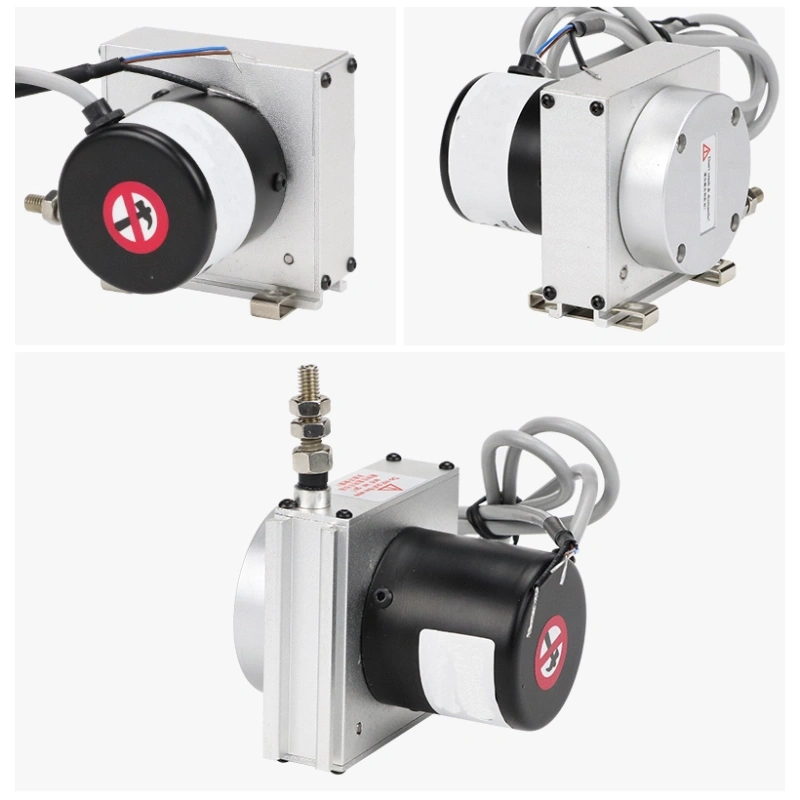
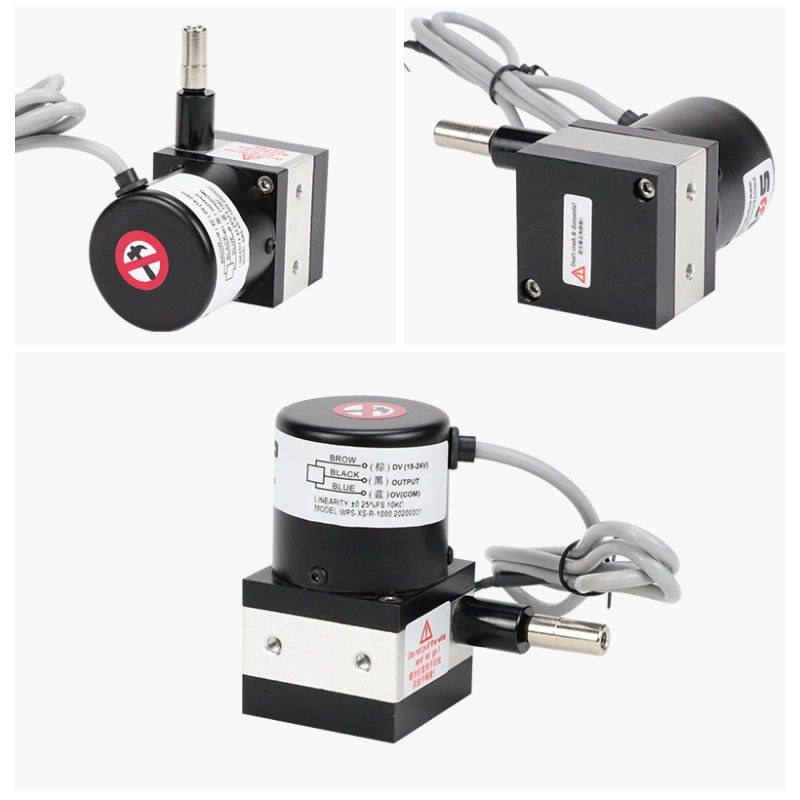
Draw Wire 0–1000mm
Retractable Cable
Cable-connected movement
The KTM is designed for compact direct rod-type measurement. It should not be selected solely because its measuring range overlaps another displacement sensor.
 +86 13520127780
  info@jingelway.com