+86 13520127780
 info@jingelway.com







Benefits of Integrating PV Weather Stations with Data Loggers
Release time: 2026-10-09
Solar photovoltaic power plants depend on accurate environmental data to understand energy production, evaluate performance, and support daily operations. However, measuring solar irradiance, module temperature, and weather conditions is only one part of an effective monitoring system.
The collected information must also be stored, synchronized, transmitted, and made available for analysis.
This is where a PV weather station data logger becomes essential.
A solar data logger connects environmental sensors with SCADA systems, cloud platforms, and other monitoring applications. It helps convert individual measurements into organized datasets that engineers and operators can use to evaluate solar plant performance.
For utility-scale solar farms, commercial rooftop installations, and distributed PV systems, integrating weather stations with suitable data acquisition equipment can improve monitoring continuity, simplify system integration, and support more informed maintenance decisions.
This article explains how PV weather station data loggers work, their key benefits, communication options, and the features to consider when selecting equipment.
1. What Does a PV Weather Station Data Logger Do?
A PV weather station data logger is a device that collects environmental measurements from solar plant sensors, records the information, and makes it available to local or remote monitoring systems.
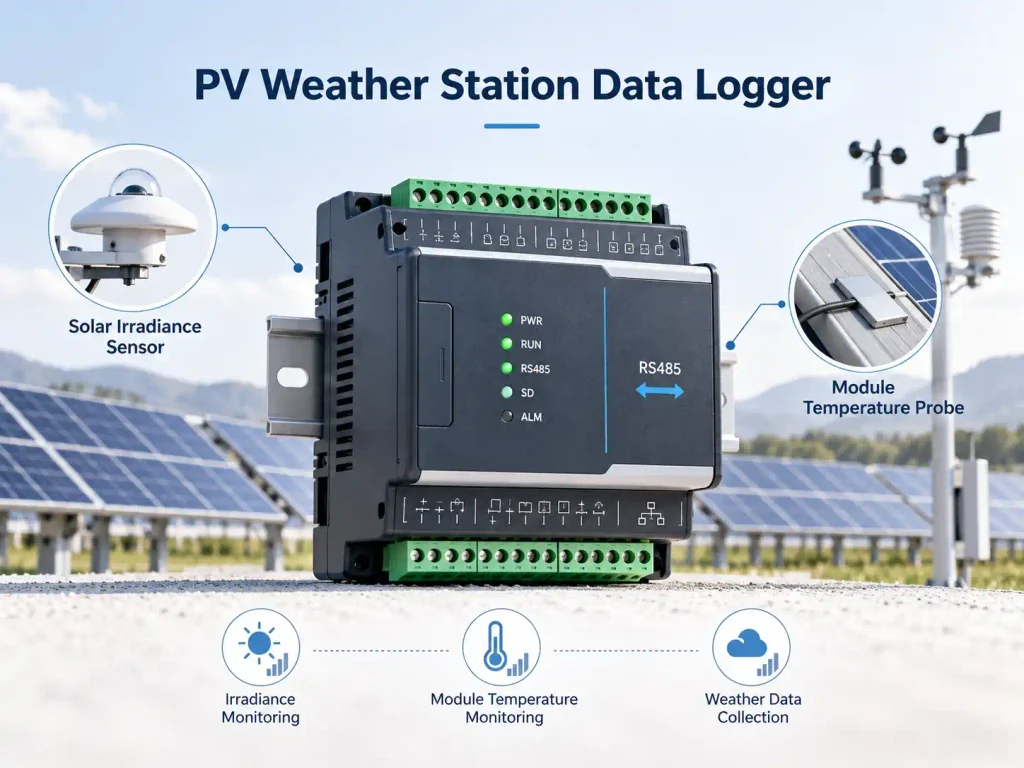
Depending on the hardware configuration, a data logger may perform several functions:
- Collect measurements from multiple weather and solar radiation sensors.
- Communicate with RS485 Modbus RTU and other supported field devices.
- Apply timestamps to acquired measurements.
- Store historical data locally.
- Process measurements into engineering units.
- Transfer records to SCADA systems or cloud servers.
- Monitor sensor communication and equipment status.
- Support remote configuration and maintenance.
The data logger acts as an intermediary between field instrumentation and the higher-level PV monitoring system.
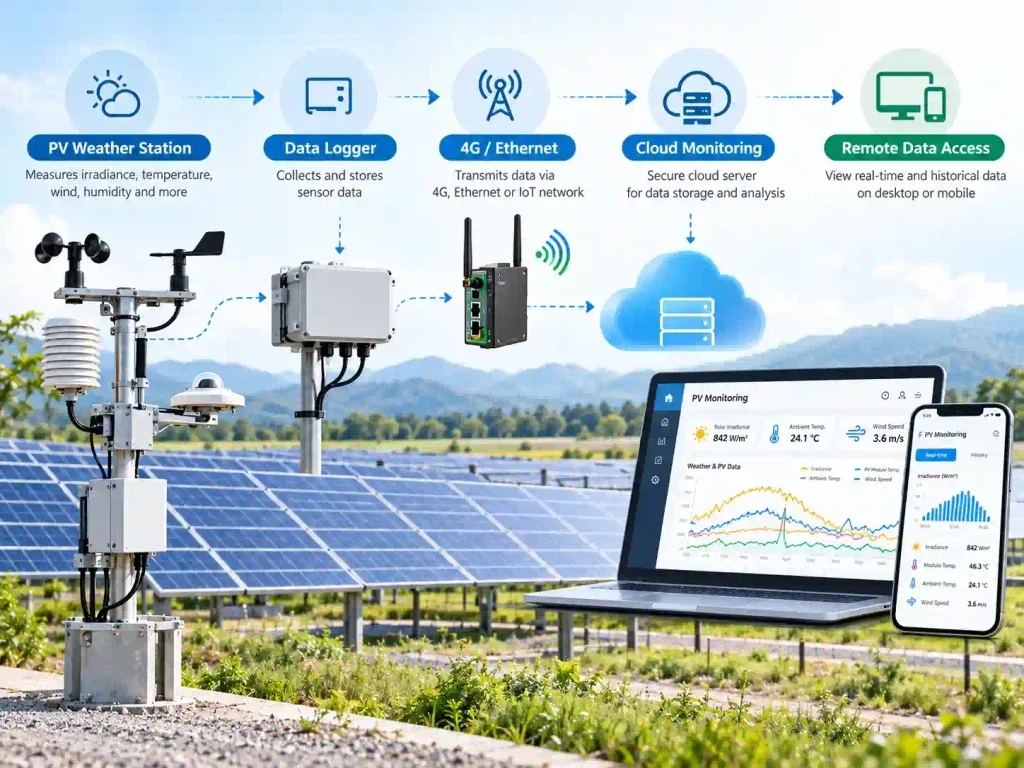
A typical monitoring architecture is:
PV Weather Sensors → Data Logger / RTU → Communication Network → SCADA or Cloud Platform → PV Performance Analysis
Some integrated weather stations include their own data acquisition and communication components, while others require an external logger.
For example, the JW-IoT PV Weather Monitoring Station for Distributed Solar Plants incorporates data acquisition functionality for collecting, storing, and transmitting environmental monitoring data.
For complete system integration, explore the JW-IoT PV Plant Weather Station Solution.
2. Sensor Data Collection and Storage
Collecting Multiple Environmental Parameters
A PV weather station typically monitors environmental conditions that influence photovoltaic energy production.
Depending on the project requirements, measurements may include:
| Monitoring Parameter | Purpose |
| Solar irradiance (GHI / POA) | Measures available solar energy |
| PV module temperature | Supports temperature-related performance analysis |
| Ambient temperature | Provides environmental reference conditions |
| Relative humidity | Supports weather and environmental analysis |
| Wind speed and direction | Provides information about wind and cooling conditions |
| Rainfall | Supports weather event and maintenance analysis |
| Atmospheric pressure | Provides additional meteorological information |
| PV soiling measurements | Supports evaluation of potential soiling losses |
A data logger can organize these measurements into a common acquisition system, reducing the need for separate data collection arrangements.
For instance, the JW-IoT Solar PV Weather Station for Power Plant Monitoring provides solar irradiance, module temperature, and meteorological measurements through an RS485 Modbus RTU interface.
Such data can be integrated with electrical information from inverters and energy meters to support performance analysis.
Why Local Data Storage Matters
Remote PV projects may experience temporary communication interruptions caused by cellular coverage problems, network maintenance, or power disturbances.
A data logger with suitable local storage can continue recording measurements during a network interruption, provided the logger and sensors remain powered and operational.
When the connection is restored, a properly configured system with a store-and-forward function can upload buffered records.
This helps reduce the loss of monitoring information.
However, local storage does not automatically guarantee complete data recovery. Storage capacity, buffering logic, power availability, and reconnection settings should be verified during system design.
Sampling and Recording Intervals
Sampling frequency and recording intervals influence the quality of PV monitoring data.
Rapid changes in solar irradiance can occur when clouds pass across a solar plant. If measurements are collected or recorded too infrequently, important variations may be missed.
The monitoring configuration should distinguish between:
- Sampling interval: How often the logger acquires a sensor measurement.
- Recording interval: How often processed measurements are saved.
- Reporting interval: How often information is transmitted to another system.
These intervals do not necessarily need to be identical.
The required configuration depends on the monitoring objectives, equipment capabilities, and applicable standards.
The internationally recognized IEC 61724-1 standard provides requirements for photovoltaic system performance monitoring, including measurement and data acquisition considerations.
Projects requiring compliance should verify the applicable edition, monitoring classification, and complete system requirements rather than relying on the logger specification alone.
3. Connecting PV Weather Stations to SCADA and Cloud Platforms
One of the main advantages of integrating weather stations with data loggers is the ability to connect field measurements with centralized solar plant monitoring systems.
RS485 Modbus RTU Data Collection
RS485 Modbus RTU is commonly used in industrial monitoring applications.
A compatible Modbus data logger can communicate with multiple sensors on a suitable RS485 network.
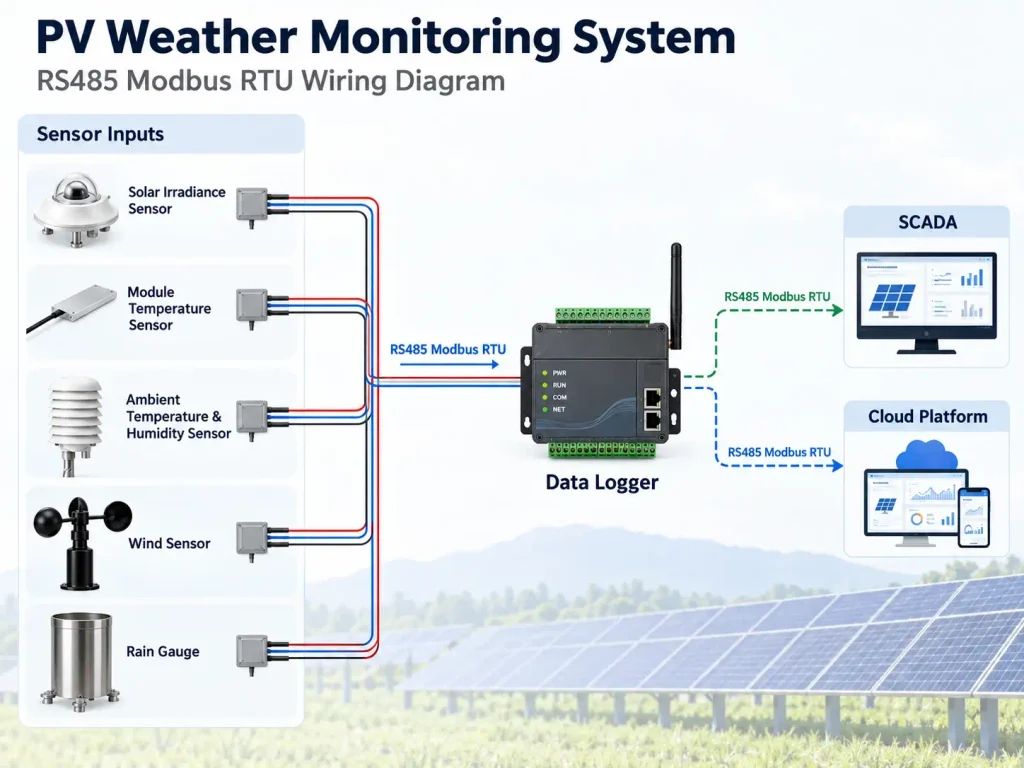
Typical connected devices include:
- Solar irradiance sensors
- PV module temperature sensors
- Ambient temperature and humidity sensors
- Wind sensors
- Rain gauges
- Other supported environmental monitoring instruments
Each Modbus device must be configured with compatible communication parameters and a valid device address.
Important integration details include baud rate, parity, register addresses, data types, scaling factors, and byte order.
For example, JW-IoT’s Class A Pyranometer with RS485 Output can be integrated with compatible data acquisition equipment for solar irradiance monitoring.
Engineering note: RS485 defines the electrical communication interface, while Modbus RTU defines a communication protocol. Matching the physical interface alone does not guarantee complete protocol compatibility.
Communication from Data Logger to SCADA
Once the logger has acquired measurements, it can transmit them to a supervisory monitoring system.
The most suitable communication approach depends on the plant architecture.
| Communication Method | Typical Application |
| Ethernet | Local plant networks and monitoring cabinets |
| 4G LTE | Remote solar farms and distributed PV installations |
| LoRaWAN | Low-power distributed sensor monitoring |
| Modbus TCP | Compatible Ethernet-based industrial systems |
| MQTT | IoT data transmission and platform integration |
| API-based integration | Third-party applications and cloud platforms |
Not every data logger supports all these interfaces. The available features must be confirmed for the selected model and firmware configuration.
Cloud-Based PV Monitoring
With appropriate communication equipment and software, environmental measurements can be transmitted to a centralized cloud platform.
A cloud-connected PV monitoring system may provide:
- Real-time environmental dashboards
- Historical irradiance and temperature trends
- Multi-site weather station management
- Equipment status monitoring
- Alarm notifications
- Data export and reporting
- Integration with other PV monitoring applications
For EPC contractors and system integrators, an important consideration is whether the monitoring equipment can exchange information with the customer’s existing platform.
JW-IoT’s Solar PV Monitoring System with IoT Automation covers data acquisition, environmental sensing, communication, and cloud-based monitoring for different PV applications.
For a more detailed technical discussion, read Integrating PV Weather Stations with SCADA and Cloud Platforms.
4. Remote Configuration and Maintenance
Solar power plants are frequently located in areas where on-site maintenance requires significant travel.
Remote management capabilities can reduce the number of visits needed for routine configuration and troubleshooting.
Depending on the selected data logger, available functions may include:
Remote Device Configuration
Engineers may be able to modify supported settings such as:
- Sensor communication parameters
- Data collection intervals
- Reporting schedules
- Server addresses
- Alarm settings
- Communication network parameters
The availability of these functions depends on the device firmware and remote management software.
Communication Diagnostics
A data logger or monitoring platform can help identify communication problems by tracking device availability and data acquisition status.
For example, if an irradiance sensor stops responding, communication diagnostics can help distinguish a missing sensor reading from a genuine environmental change.
Firmware Updates
Some industrial data loggers support remote firmware upgrades.
This may simplify maintenance, but the update process should include appropriate authorization, version compatibility checks, and recovery procedures.
Remote configuration and firmware updates should also be secured against unauthorized access.
Reduced Maintenance Complexity
Centralized device management can help operators investigate equipment status without immediately visiting each monitoring location.
For large solar farms, this is particularly useful when weather monitoring equipment is distributed across multiple monitoring points.
The JW-IoT PV Plant Weather Station Solution provides examples of distributed sensor monitoring, data acquisition, communication, and centralized management.
5. Why Data Reliability Matters for Solar PV Performance
Accurate sensors are important, but reliable PV monitoring also depends on what happens after the measurements are acquired.
If timestamps are inconsistent, communication failures go undetected, or important records are missing, performance analysis may become misleading.
Understanding Irradiance and Power Generation
Consider a solar plant that generates less electricity than expected.
A reduction in energy production does not necessarily indicate an equipment fault.
Possible explanations include:
- Reduced solar irradiance
- Higher module temperatures
- Cloud cover
- Shading
- Soiling
- Inverter limitations
- Equipment faults
- Grid curtailment
By comparing synchronized environmental and electrical measurements, operators can better understand the factors associated with changes in plant output.
However, a weather station alone cannot identify every cause of lost generation. Electrical measurements, maintenance records, and additional diagnostic information are often necessary.
Supporting Performance Ratio Analysis
Performance ratio (PR) is a commonly used indicator of photovoltaic system performance.
In its basic form, PR compares the final system yield with the reference yield derived from incident solar irradiation.
Reliable irradiance measurements, energy production records, and aligned measurement periods are therefore essential.
A PV weather station data logger supports the acquisition and organization of the environmental data used in these calculations.
For further information, see Solar PV Monitoring Data for Accurate Performance Ratio and Forecasting.
The Importance of Timestamp Synchronization
Solar irradiance and power output may change rapidly during variable weather conditions.
If the irradiance record and inverter data use different timestamps, comparisons can produce misleading results.
A suitable acquisition system should therefore support consistent time settings and synchronization methods.
The precise time synchronization approach depends on the monitoring architecture.
Data Quality and Validation
A well-designed monitoring system should help users recognize:
- Missing measurements
- Invalid sensor responses
- Unexpected values
- Communication interruptions
- Sensor status problems
- Timestamp inconsistencies
Validation rules must consider the measurement type, sensor specification, and operating conditions.
For example, zero irradiance at night is normal, whereas sustained zero irradiance during a clear daytime period may require investigation.
The NREL Solar Resource Data and Tools provide further background on solar radiation measurement and meteorological monitoring.
Reliable PV performance analysis depends on sensor accuracy, acquisition quality, time synchronization, and data availability working together.
6. Recommended Features for a PV Weather Station Data Logger
Selecting a solar data logger should begin with the project architecture rather than a single hardware specification.
The following capabilities are worth evaluating.
| Feature | Selection Consideration |
| Sensor interfaces | Compatibility with required RS485, analog, pulse, or other sensor outputs |
| Modbus support | Register mapping, polling capability, and device compatibility |
| Local storage | Capacity and data buffering during outages |
| Time synchronization | Consistent timestamps for performance analysis |
| Communication | Required Ethernet, cellular, or gateway connectivity |
| Platform integration | Compatibility with SCADA, cloud, or third-party software |
| Power supply | Suitable voltage, consumption, and backup design |
| Environmental protection | Appropriate cabinet and operating temperature |
| Remote maintenance | Supported diagnostics, configuration, and updates |
| Data security | Authentication, access control, and secure communication where supported |
| Expandability | Sufficient interfaces and capacity for future sensors |
Choose Based on Project Requirements
Commercial Rooftop PV
A compact data logger may be suitable for a rooftop installation requiring irradiance, module temperature, and basic weather monitoring.
Integration with an existing inverter monitoring system or building management platform may be a priority.
Utility-Scale Solar Farms
Large solar plants may require multiple environmental monitoring stations.
Important considerations include synchronized data acquisition, reliable communication, system redundancy where appropriate, and integration with plant-level SCADA systems.
Remote Solar Power Stations
Projects in isolated locations may need cellular or other suitable remote communication, local buffering, backup power, and remote diagnostics.
Distributed PV Portfolios
Operators managing multiple installations may prioritize standardized data formats, centralized dashboards, site identification, and integration with existing monitoring software.
JW-IoT provides different PV weather monitoring configurations, including the PV Environmental Monitoring System with Solar Radiation and system-level solutions for distributed or utility-scale projects.
The final equipment configuration should be confirmed against the project specification.
7. Typical PV Weather Station Data Logger Integration Architecture
A practical integration design can be divided into four layers.
Field Sensor Layer
Environmental sensors acquire irradiance, temperature, wind, rainfall, and other required measurements.
Data Acquisition Layer
The data logger or RTU polls connected sensors, processes incoming measurements, assigns timestamps, and stores data according to the configured acquisition schedule.
Communication Layer
A suitable industrial network or gateway transfers data to the SCADA system or cloud infrastructure.
Application Layer
The monitoring platform presents measurements, historical trends, device status, and analytical results.
A representative system is:
Solar Irradiance Sensor + Module Temperature Sensor + Weather Sensors
↓
RS485 Modbus / Supported Field Interfaces
↓
PV Data Logger or RTU
↓
Ethernet / 4G / Compatible IoT Gateway
↓
SCADA System or Cloud Monitoring Platform
↓
PV Performance Monitoring and O&M Analysis
Depending on the equipment, the data acquisition and communication layers may be combined in a single device.
For deployment guidance, see Best Practices for Installing Solar PV Weather Stations.
8. Common Mistakes When Integrating Solar Weather Stations and Data Loggers
Even a correctly selected sensor may produce unusable data if the system is not configured properly.
Common integration problems include:
Incorrect Modbus register configuration
Using the wrong register address, data type, or scaling factor can result in invalid measurements.
Insufficient data storage
A logger with limited storage may overwrite records during extended communication interruptions.
Inconsistent timestamps
Differences between logger and inverter time settings can affect irradiance-to-power comparisons.
Inadequate electrical protection
Improper grounding, cabling, surge protection, or power supply design can reduce monitoring availability.
Missing communication diagnostics
Without device status monitoring, operators may not recognize data acquisition failures promptly.
Assuming protocol compatibility
Devices with the same connector or electrical interface may not use compatible communication protocols.
These issues should be addressed during system design and verified during commissioning.
9. FAQ
What is the difference between a PV weather station and a solar data logger?
A PV weather station measures environmental conditions at a photovoltaic site. A solar data logger collects, processes, stores, and communicates measurements from the weather station or individual sensors. Some weather stations include integrated data logging functions.
Why is a data logger needed in a PV monitoring system?
A data logger helps organize sensor measurements, maintain historical records, and make environmental data available to SCADA or cloud monitoring applications. Its necessity depends on whether equivalent acquisition functions are already built into other equipment.
Can a Modbus data logger connect to multiple solar sensors?
Yes, a compatible Modbus data logger can communicate with multiple devices, subject to network design, device addresses, supported register maps, electrical limitations, and logger capacity.
Can PV weather data be transmitted directly to SCADA?
Yes. Weather stations with compatible communication interfaces may connect directly to SCADA equipment. In other configurations, a data logger, RTU, or protocol gateway provides the required acquisition and communication functions.
What happens when a solar data logger loses its internet connection?
A logger with sufficient local storage and a properly configured buffering function may continue recording while the connection is unavailable. Buffered data may be uploaded after connectivity returns, depending on the device capabilities and configuration.
How does a PV data logger support performance ratio calculations?
It collects and organizes irradiance measurements and other environmental data. When these records are correctly synchronized with electrical production data, they can support PR calculations and broader performance analysis.
Can JW-IoT support third-party PV monitoring system integration?
JW-IoT offers configurable PV monitoring solutions involving RS485 Modbus devices, data acquisition, communication gateways, and platform integration. Compatibility with a specific third-party system should be confirmed using the applicable device specifications, protocols, and integration requirements.
Conclusion: Better PV Monitoring Starts with Reliable Data Acquisition
Integrating PV weather stations with data loggers helps transform environmental measurements into useful information for solar power plant monitoring.
A properly designed data acquisition system supports reliable sensor collection, historical data storage, communication with SCADA or cloud platforms, and analysis of solar plant operating conditions.
For EPC contractors, system integrators, and solar plant operators, selecting the right data logger is therefore an important part of designing a dependable PV monitoring system.
The best configuration depends on the number of sensors, required interfaces, monitoring objectives, communication infrastructure, and operating environment.
Request PV Data Logger Specification
Looking for a PV weather station data logger or a complete solar monitoring solution?
JW-IoT provides configurable solar PV weather monitoring equipment, data acquisition integration, communication solutions, and support for third-party monitoring platforms.
Share your project requirements with our technical team, including:
- Solar plant type and capacity
- Required environmental measurements
- Number of monitoring locations
- Sensor output interfaces
- Data acquisition and storage requirements
- SCADA or cloud integration needs
- Communication network availability
- Power supply and installation conditions
We can help evaluate a suitable PV weather station and data acquisition configuration for your project.
Explore JW-IoT solutions:
PV Plant Weather Station Solution
PV Weather Monitoring Station with Integrated Data Acquisition
CTA: Request PV Data Logger Specification
Contact JW-IoT to discuss your project requirements and request the relevant equipment specifications and integration information.