+86 13520127780
 info@jingelway.com









Smart Rooftop Solar PV Monitoring Solutions for Commercial Buildings
Release time: 2026-10-02
Commercial rooftop solar is now widely deployed on factories, warehouses, offices, shopping centers, campuses, hospitals, logistics facilities, and other commercial buildings.
For these projects, inverter data can show how much electricity a PV system is producing. However, electrical output alone cannot always explain why generation changes.
Was lower production caused by reduced sunlight? Higher PV module temperature? Temporary shading? Local rooftop conditions? Or does the system require further inspection?
This is where rooftop solar PV monitoring becomes valuable.
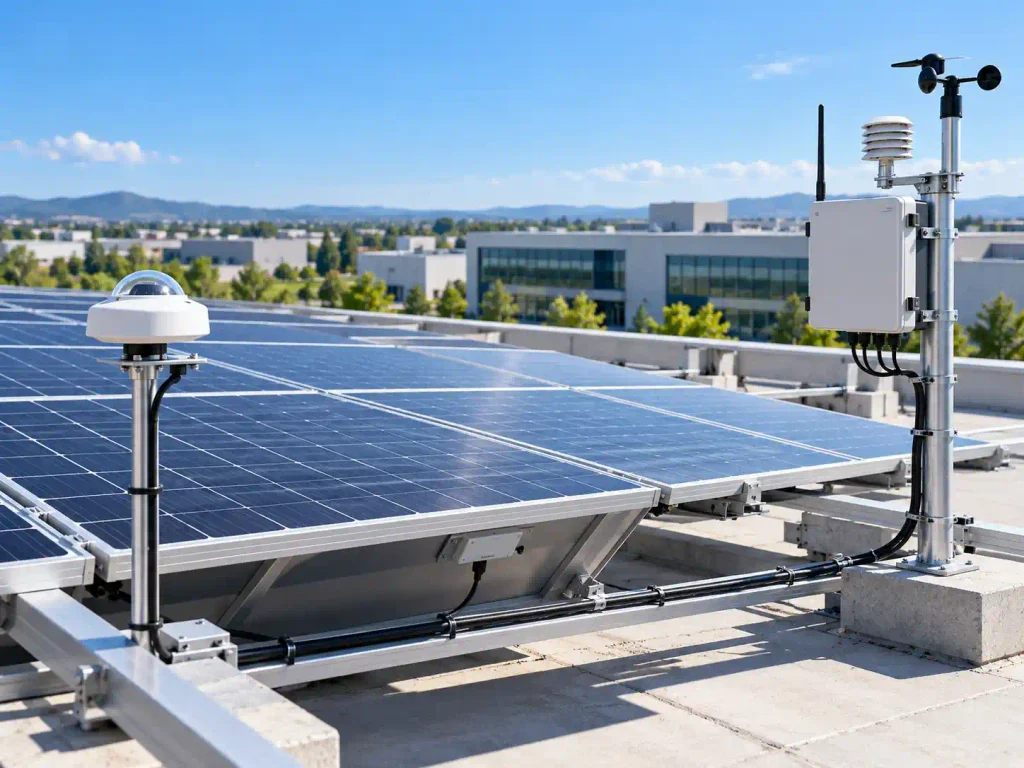
By combining solar irradiance, PV module temperature, selected weather parameters, a data logger, communication equipment, and remote monitoring, commercial building operators can add environmental context to inverter and energy-meter data.
A compact rooftop monitoring system can therefore support performance analysis, remote O&M, multi-site management, and faster investigation of abnormal operating conditions.
JW-IoT provides renewable energy monitoring solutions for rooftop, distributed, and utility-scale photovoltaic projects, with configurable sensors, data acquisition, communication, and platform integration.
1. Why Commercial Rooftops Need Solar PV Monitoring
Commercial rooftop PV systems operate in an environment that can be very different from an open-field solar plant.
A typical commercial roof may contain:
- HVAC equipment
- Parapet walls
- Ventilation outlets
- Antennas
- Skylights
- Equipment rooms
- Different roof elevations
- Adjacent buildings
- Multiple PV orientations
These structures can affect local shading, airflow, and module temperature.
At the same time, roof access may be restricted because of safety procedures, facility operations, or maintenance requirements. For an O&M team managing several commercial sites, frequent manual inspection is neither efficient nor always necessary.
Power Data Answers Only Part of the Question
An inverter normally provides useful electrical information such as power generation, voltage, current, daily yield, and operating status.
That tells the operator:
How much electricity is the PV system producing?
Environmental monitoring helps answer another important question:
What were the solar and environmental conditions when that electricity was produced?
For example, if PV generation decreases at the same time as solar irradiance decreases, the change may simply reflect available sunlight.
If irradiance remains relatively high while PV output falls unexpectedly, the operator has a stronger reason to investigate the system.
Environmental measurements therefore do not replace inverter monitoring. They provide additional context for interpreting it.
For a more detailed explanation, see JW-IoT’s guide to roof-mounted solar PV monitoring kits.
2. Commercial Rooftop PV Monitoring vs. Utility-Scale Solar Monitoring
Commercial rooftop systems and utility-scale PV plants share several core monitoring requirements, especially solar irradiance and module temperature.
However, their system architecture can be different.
Commercial Rooftop PV
A rooftop project normally places greater emphasis on:
- Compact installation
- Limited mounting space
- Representative rather than extensive monitoring points
- Integration with existing building networks
- Remote monitoring
- Simple maintenance
- Connection with inverter or energy-management platforms
A single uniform rooftop array, for example, may only require a small number of representative environmental monitoring points.
Utility-Scale PV Plants
Large solar farms may require:
- Multiple weather stations
- Multiple irradiance measurement points
- Multiple module temperature sensors
- Wind monitoring
- Rainfall monitoring
- Soiling monitoring
- Distributed gateways
- SCADA integration
- Monitoring across different plant zones
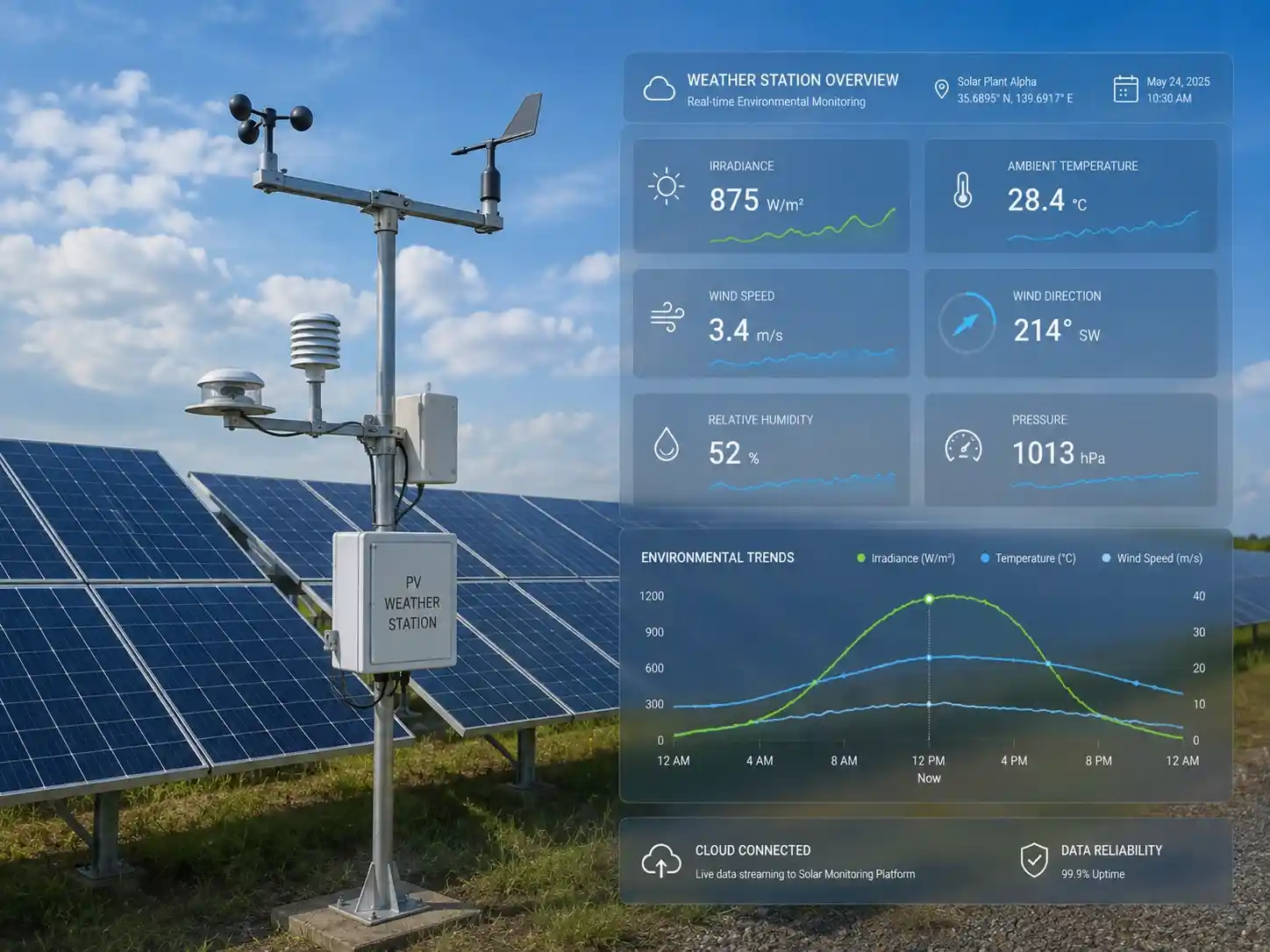
JW-IoT’s PV Plant Weather Station Solution illustrates this more extensive architecture.
For commercial rooftop projects, however, the objective should not be to install every possible environmental sensor.
The better approach is to select the measurements that provide useful information for the actual rooftop layout, performance-analysis objective, and O&M workflow.
3. Recommended Sensors for Rooftop Solar PV Monitoring
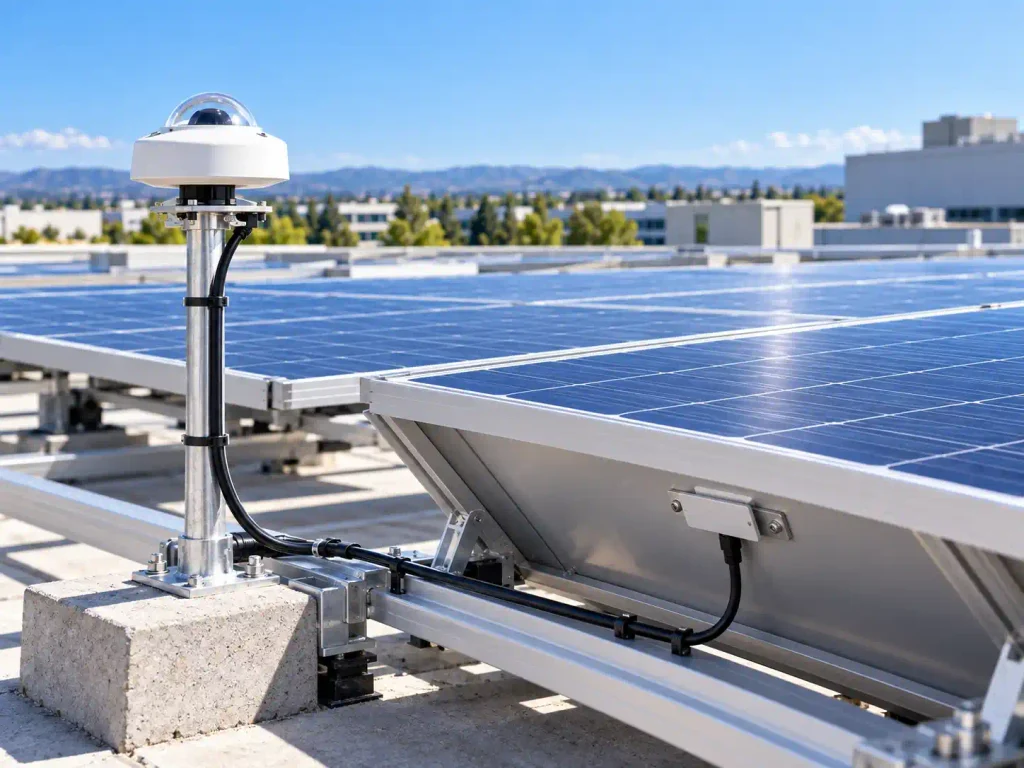
Solar Irradiance Sensor
Solar irradiance is one of the most important environmental measurements in PV monitoring.
It provides a reference for the amount of solar energy available to the photovoltaic array at a particular time.
For rooftop performance monitoring, irradiance data can be compared with inverter or meter data to provide context for changes in generation.
A common approach is plane-of-array (POA) irradiance monitoring, where the irradiance sensor is positioned at approximately the same tilt and orientation as the PV modules.
This makes the measurement more representative of the sunlight reaching the monitored array.
JW-IoT provides a dedicated Solar Irradiance Sensor for PV Monitoring solution for rooftop, distributed, and larger photovoltaic projects.
Depending on project requirements, irradiance monitoring can use different sensor technologies.
For example, a Silicon Irradiance Sensor for PV Performance Monitoring can provide a compact RS485 Modbus measurement option for PV applications.
Projects requiring other levels or types of solar-radiation measurement may also consider pyranometer-based sensors.
PV Module Temperature Sensor
PV module temperature is another essential monitoring parameter.
A module temperature sensor is normally installed on the rear surface of a representative PV module. Its purpose is to measure the actual operating temperature of the panel rather than ambient air temperature.
This distinction matters because a PV module exposed to strong solar radiation may operate substantially above the surrounding air temperature.
Monitoring module temperature can provide context for:
- Temperature-related performance changes
- Comparison between irradiance and power output
- Differences between rooftop zones
- Unusual thermal operating conditions
- Long-term performance analysis
Installation location matters.
A representative module should be selected rather than simply choosing the easiest panel to reach. Modules affected by unusual shading, a nearby ventilation outlet, abnormal roof heat, or unusual airflow may not accurately represent the rest of the array.
More guidance is available in JW-IoT’s article on best practices for installing solar PV weather stations.
Ambient Temperature and Humidity
Ambient air temperature provides useful context when interpreting module temperature.
For example, comparing:
Solar irradiance → ambient temperature → module temperature → PV output
provides a clearer environmental picture than module temperature alone.
Relative humidity can also be included where broader rooftop environmental monitoring is required.
Wind Speed and Direction
Wind monitoring is optional for many commercial rooftop projects, but it can be useful where airflow is relevant to local operating conditions.
Wind can affect module cooling, and rooftop structures can create complex airflow patterns.
However, rooftop wind measurement requires careful sensor placement because:
- Parapet walls
- HVAC equipment
- Adjacent buildings
- Ventilation systems
- Roof structures
can distort airflow.
A wind sensor should therefore be included only when it contributes meaningful information to the monitoring objective.
Optional Soiling Monitoring
Some commercial rooftops may experience significant contamination from:
- Dust
- Industrial emissions
- Pollen
- Bird activity
- Nearby construction
- Local airborne particles
Where contamination is an important operational concern, a soiling monitoring device can provide additional information for maintenance and cleaning decisions.
Soiling monitoring should be treated as an optional extension rather than a mandatory part of every rooftop PV monitoring system.
4. Data Logger and Communication Choices
Sensors only become useful when their measurements can be collected and delivered reliably.
A typical rooftop monitoring architecture may look like this:
Irradiance Sensor + Module Temperature Sensor + Environmental Sensors
↓
Data Logger / IoT Controller
↓
RS485 / Ethernet / LoRaWAN / 4G
↓
Cloud Platform / SCADA / Energy Management System
↓
Remote Monitoring and Analysis
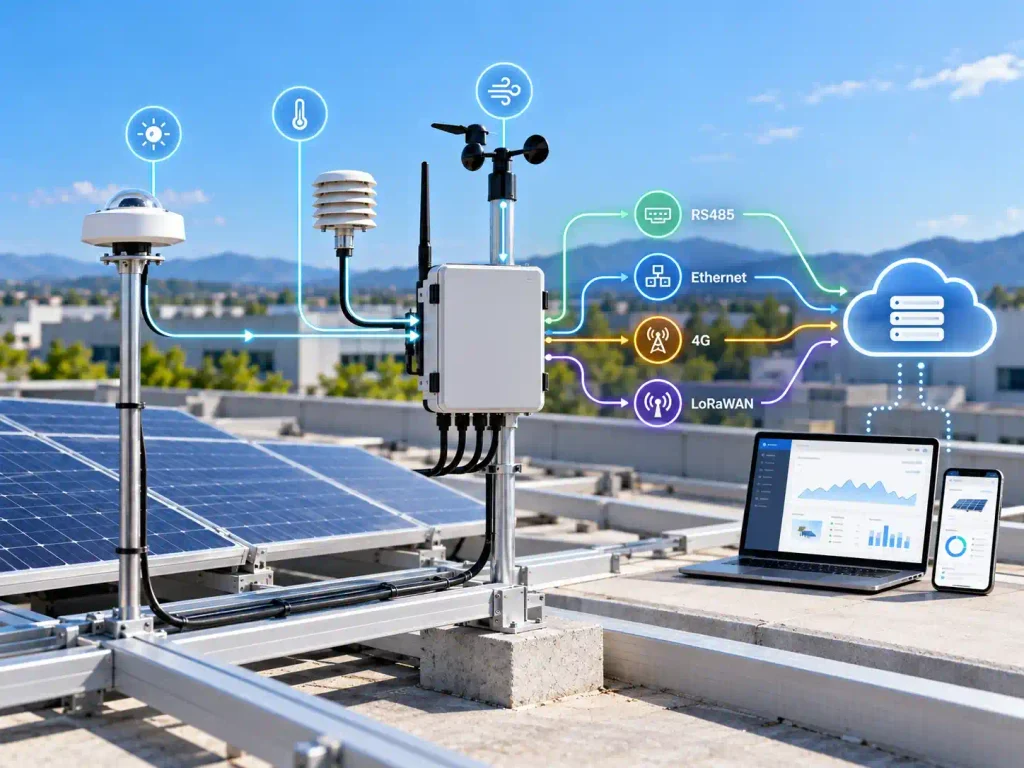
RS485 Modbus
RS485 Modbus is widely used for local industrial sensor communication.
For a commercial rooftop, it can be suitable when sensors are relatively close to a data logger or controller.
A single communication bus can connect several compatible sensors, reducing the need for separate point-to-point interfaces.
The final design should still consider:
- Cable distance
- Cable routing
- Grounding
- Surge protection
- Electrical interference
- Device addressing
- Outdoor cable protection
Ethernet
If the commercial building already has suitable network infrastructure, Ethernet may be a practical option for connecting the rooftop data logger to a local or remote monitoring system.
Before using a building network, the project should confirm IT and cybersecurity requirements with the building owner.
4G LTE
4G can be useful when the rooftop PV monitoring system needs an independent communication path.
Typical situations include:
- No suitable building Ethernet connection
- Third-party ownership of the solar asset
- Independent O&M access
- Remote commercial facilities
- Multi-site portfolios
The actual configuration should depend on cellular coverage and local communication requirements.
LoRaWAN
For campuses, industrial parks, warehouse clusters, or other developments with several distributed buildings, LoRaWAN can provide another architecture.
Monitoring devices installed on different rooftops can transmit low-data-rate sensor information to a shared gateway.
The gateway can then forward the data through Ethernet or cellular communication.
For a detailed comparison, read Choosing PV Monitoring Communication: LoRaWAN vs 4G vs RS485.
5. Remote Platform and Alarm Functions
For commercial PV projects, remote access can be particularly valuable because operators may manage many geographically separated installations.
A remote platform can bring environmental monitoring data together with other operational information.
Depending on system configuration, useful functions can include:
- Real-time irradiance display
- PV module temperature trends
- Historical data records
- Sensor status
- Communication status
- Alarm notifications
- Multi-site monitoring
- Data export
- API integration
JW-IoT solar monitoring solutions can support architectures involving RS485 Modbus, LoRaWAN, 4G LTE, Ethernet, MQTT, cloud platforms, and third-party integration depending on the selected equipment and project configuration.
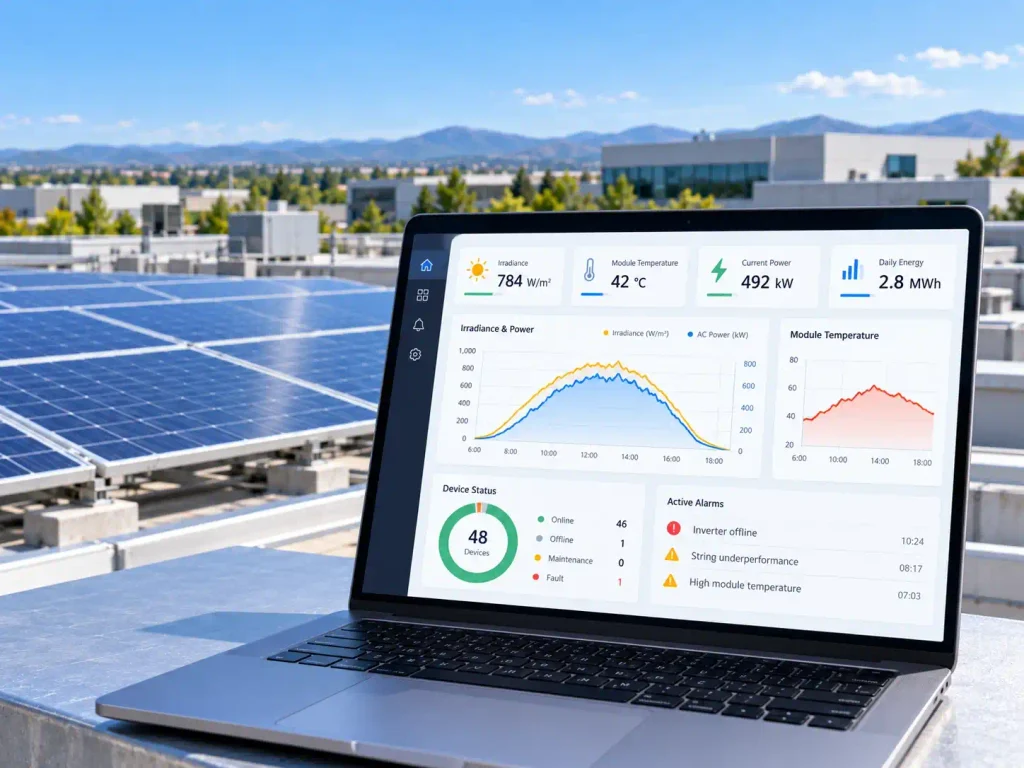
Why Alarm Context Matters
An alarm should not simply create more notifications.
Environmental data can make alarms more informative.
Consider two situations:
Situation A:
PV output decreases while solar irradiance also decreases.
This may correspond to changing weather conditions.
Situation B:
Solar irradiance remains strong while PV output decreases significantly.
This provides a stronger reason for the O&M team to investigate inverter status, shading, contamination, wiring, or other system conditions.
The monitoring platform does not automatically prove the cause of a fault. Instead, it gives technicians additional evidence for deciding what should be checked.
6. A Recommended Rooftop Solar PV Monitoring Kit
There is no single monitoring configuration that fits every commercial rooftop.
The system should be matched to the rooftop layout, number of PV orientations, communication environment, and required monitoring objective.
Basic Rooftop Monitoring Kit
For a relatively uniform commercial rooftop, a practical configuration may include:
- 1 × plane-of-array solar irradiance sensor
- 1 × PV module temperature sensor
- 1 × compact data logger or IoT controller
- RS485 Modbus sensor communication
- Ethernet or 4G remote communication
- Outdoor enclosure
- Mounting accessories
- Remote dashboard or API connection
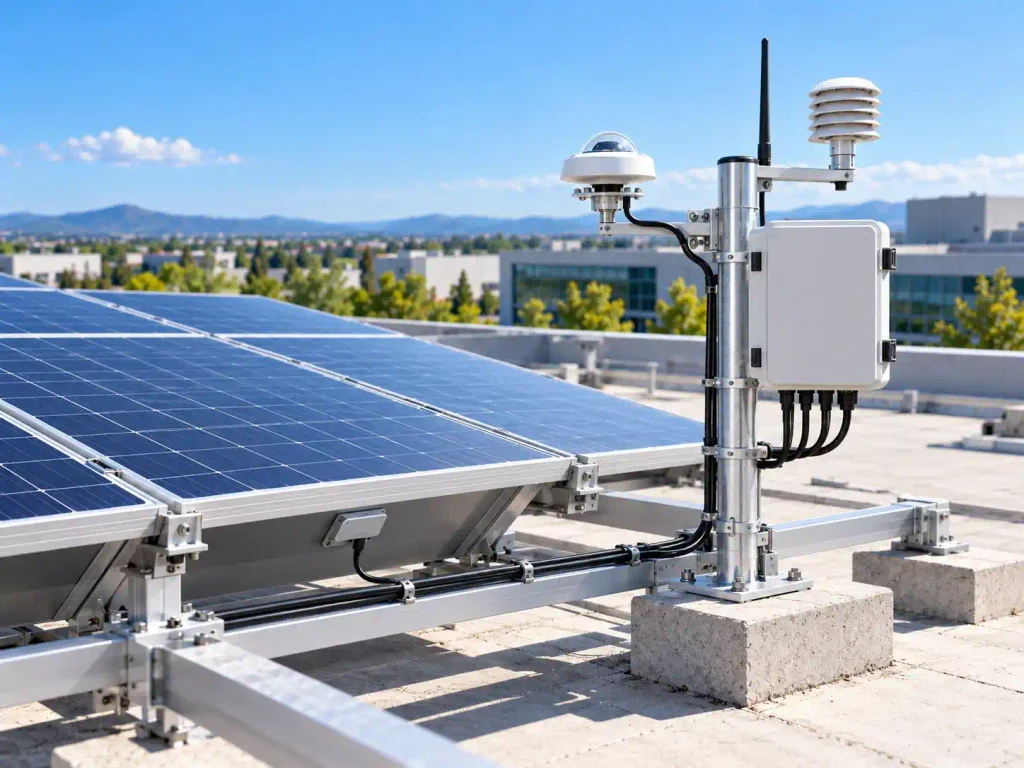
This provides the two most important environmental reference measurements—irradiance and module temperature—without creating an unnecessarily complex installation.
Enhanced Commercial Rooftop Kit
For a larger or more complex site, the monitoring system can be expanded with:
- Multiple irradiance monitoring points
- Multiple module temperature sensors
- Ambient temperature and humidity sensor
- Wind speed and direction sensor
- Multi-channel data logger
- LoRaWAN gateway
- Ethernet or 4G communication
- Cloud platform
- Alarm management
- API or SCADA integration
This type of configuration may be more appropriate when a rooftop has:
- East-west arrays
- Multiple tilt angles
- Separate buildings
- Different roof elevations
- Different shading conditions
- Large distances between monitoring points
- Different module groups or inverter zones
Optional Monitoring Devices
Depending on the application, additional measurements may include:
- Rainfall
- Atmospheric pressure
- Soiling
- Additional temperature points
- More advanced solar radiation measurement
- Independent communication gateways
The goal should always be to collect representative and useful data, rather than simply increasing the number of sensors.
How to Select the Right Monitoring Configuration
Before configuring a commercial rooftop PV monitoring solution, EPC contractors, system integrators, building owners, and O&M companies should identify several basic project conditions.
Important information includes:
- Installed PV capacity
- Number of rooftop areas
- Module orientation and tilt
- Number of inverter zones
- Required environmental measurements
- Number of representative monitoring points
- Distance between sensors and the data logger
- Available power supply
- Preferred communication method
- Existing inverter or energy-management platform
- API or SCADA requirements
- Outdoor installation conditions
The physical layout is particularly important.
A single sensor location may represent a simple, uniform rooftop adequately, while a project with several orientations or separate buildings may require additional monitoring points.
Installation Is as Important as Sensor Selection
Buying accurate sensors does not automatically produce accurate monitoring data.
Installation quality is equally important.
Irradiance Sensor
For plane-of-array monitoring, the irradiance sensor should normally:
- Follow the PV module orientation
- Match the relevant tilt angle
- Avoid permanent or temporary shading
- Avoid obstructions
- Represent the monitored array
- Remain accessible for inspection and cleaning
Module Temperature Sensor
The module temperature sensor should:
- Be attached firmly to the rear surface of a representative module
- Maintain reliable thermal contact
- Avoid abnormal heat sources
- Avoid unrepresentative shaded locations
- Use secure outdoor cable routing
For additional installation guidance, see Best Practices for Installing Solar PV Weather Stations.
Rooftop PV Monitoring for Multi-Site Commercial Portfolios
One of the strongest use cases for smart rooftop monitoring is not a single building, but a group of distributed commercial assets.
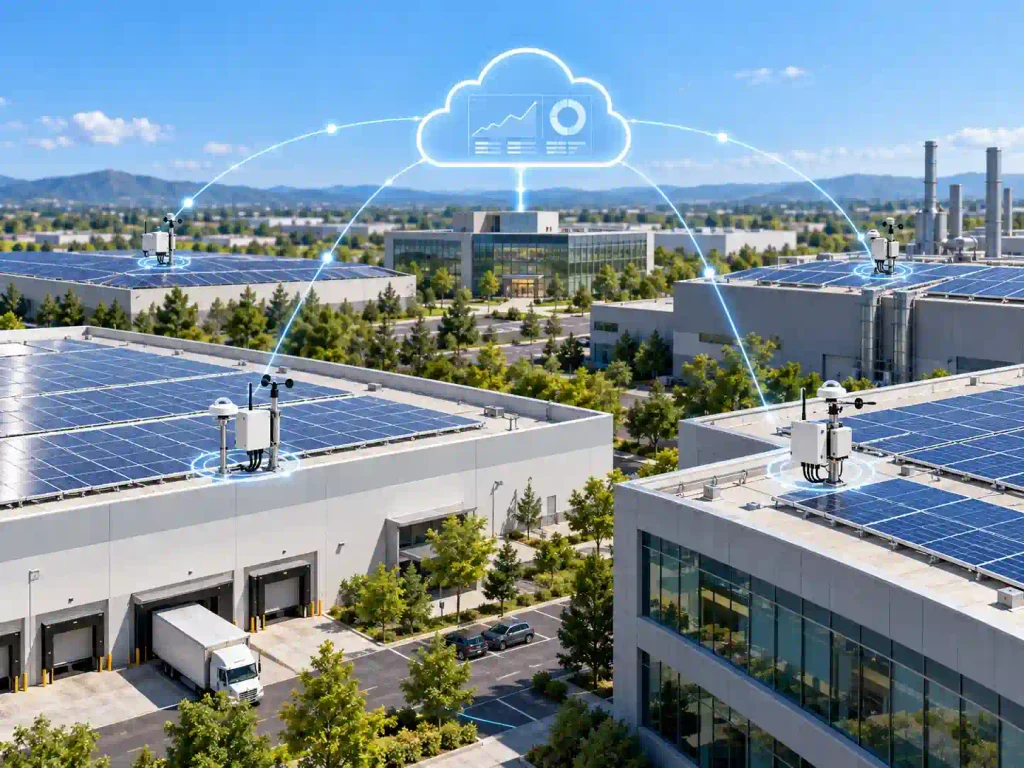
A company may operate PV systems across:
- Warehouses
- Factories
- Retail facilities
- Office campuses
- Logistics centers
- Schools
- Hospitals
- Industrial parks
Without standardized environmental monitoring, comparing performance across sites can be difficult because each rooftop operates under different weather and temperature conditions.
A centralized architecture can combine monitoring data from multiple sites and allow energy managers or O&M providers to review:
- Irradiance
- Module temperature
- Environmental conditions
- Sensor status
- Communication status
- Historical trends
- Alarm records
This creates a more consistent monitoring framework for a distributed commercial PV portfolio.
FAQ
1. What is rooftop solar PV monitoring?
Rooftop solar PV monitoring combines electrical generation data with environmental measurements such as solar irradiance and PV module temperature to provide more context for evaluating photovoltaic system performance.
2. Is inverter monitoring enough?
Inverter monitoring provides important electrical information, but it does not directly measure the sunlight or module temperature experienced by the PV array. Environmental sensors can therefore complement inverter data.
3. What are the most important sensors for a commercial rooftop?
For many rooftop projects, the starting point is:
- Solar irradiance
- PV module temperature
Additional measurements such as ambient temperature, humidity, wind, rainfall, or soiling can be added according to project requirements.
4. Where should an irradiance sensor be installed?
For plane-of-array monitoring, the sensor should normally match the orientation and tilt of the PV array it represents and should be positioned away from shading and obstructions.
5. Do large rooftops need more than one sensor?
Possibly.
Multiple monitoring points may be appropriate where a site contains different orientations, tilt angles, roof sections, elevations, shading patterns, or significantly different local conditions.
6. Can rooftop monitoring connect to an existing SCADA or energy platform?
Yes, depending on the selected data logger, gateway, and interface requirements.
JW-IoT solutions can support options including RS485 Modbus, Ethernet, LoRaWAN, 4G LTE, MQTT, cloud platforms, and API integration.
7. Does a monitoring kit increase panel efficiency?
A monitoring system does not change the physical conversion efficiency of a PV module.
Its role is to provide the data needed to understand operating conditions, identify abnormal performance, support maintenance decisions, and improve visibility into the PV system.
Build a Smarter Commercial Rooftop PV Monitoring System
For commercial buildings, effective solar monitoring is not about installing the largest possible weather station.
It is about selecting the right environmental measurements and connecting them to a reliable data architecture.
A practical rooftop system may start with:
Solar Irradiance Sensor
+
PV Module Temperature Sensor
+
Data Logger
+
Ethernet / 4G / LoRaWAN
+
Remote Monitoring Platform
From there, ambient weather, wind, rainfall, soiling, or additional monitoring points can be added when the rooftop layout or O&M objective requires them.
JW-IoT provides configurable solutions for commercial rooftop PV, distributed solar systems, and larger photovoltaic plants.
Planning a commercial rooftop solar monitoring project?
Send JW-IoT your rooftop layout, PV capacity, array orientation, required monitoring parameters, communication method, and platform-integration requirements. The monitoring architecture can then be configured around the actual project rather than using a one-size-fits-all sensor package.