+86 13520127780
  info@jingelway.com








Integrating PV Weather Stations with SCADA and Cloud Platforms
Release time: 2026-07-02
Introduction
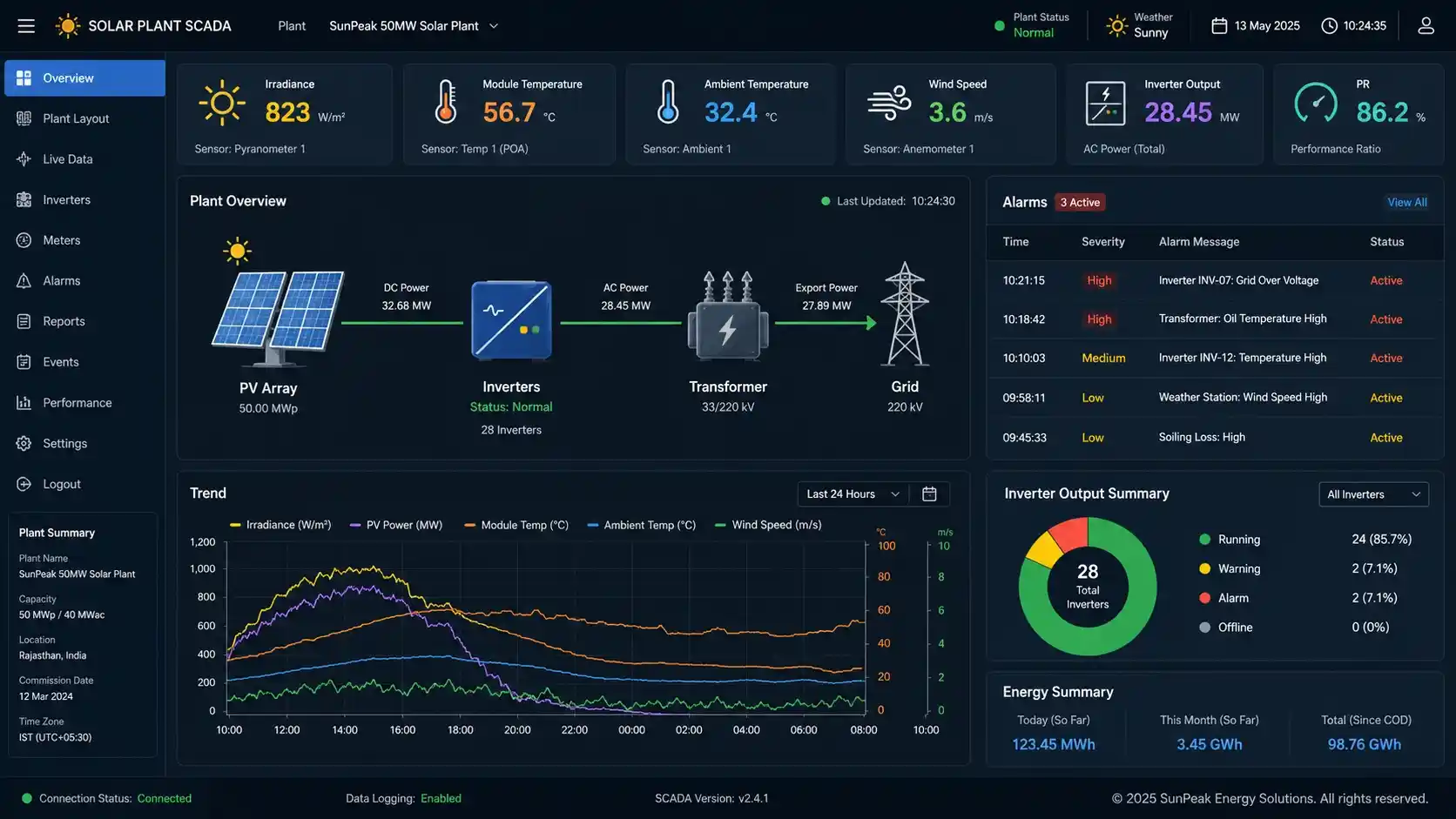
A PV weather station is no longer just a standalone device installed beside solar panels. In modern photovoltaic power plants, it has become a critical data source for SCADA systems, cloud PV monitoring platforms, O&M dashboards, performance ratio analysis, and remote asset management.
For solar plant owners, EPC contractors, system integrators, and O&M teams, the real value of a PV weather station is not only in measuring solar irradiance, wind speed, temperature, humidity, rainfall, or PV module temperature. The real value comes from how reliably this field data is collected, transmitted, integrated, stored, visualized, and used for operational decisions.
This is why PV weather station SCADA integration has become an important technical requirement in utility-scale solar farms, distributed PV projects, rooftop solar systems, floating PV plants, and hybrid renewable energy projects.
A well-integrated PV weather monitoring system can help operators:
- Compare solar irradiance with actual power generation
- Identify abnormal performance losses
- Support performance ratio calculation
- Improve fault diagnosis and O&M response
- Centralize multi-site PV plant monitoring
- Provide long-term environmental data for asset analysis
- Connect field sensors with SCADA, cloud platforms, and third-party software
For projects that require reliable solar performance data, JW-IoT provides PV weather monitoring systems, data loggers, sensors, communication gateways, and cloud-based monitoring solutions designed for flexible integration with local and remote monitoring platforms.
Why Integration Matters in PV Monitoring
In a solar power plant, weather data directly affects power generation analysis. Solar irradiance, ambient temperature, wind conditions, panel temperature, rainfall, and humidity all influence PV module output and system efficiency.
However, collecting the data is only the first step.
If the PV weather station cannot communicate with the plant SCADA system, cloud dashboard, inverter monitoring system, or O&M platform, the data remains isolated. This creates several problems:
- Operators cannot compare weather data with inverter output in real time.
- Performance ratio analysis becomes less accurate.
- Abnormal generation losses are harder to detect.
- Manual data export increases workload.
- Multi-site solar projects become difficult to manage.
- Historical data may be incomplete or inconsistent.
- Third-party software integration becomes more complex.
For example, if solar irradiance is high but actual power output is low, the operator needs to know whether the problem comes from soiling, shading, inverter faults, module temperature loss, grid curtailment, or sensor error. Without integrated data, this analysis becomes slower and less reliable.
A properly integrated PV weather station allows weather data to flow into the same monitoring environment as electrical data. This helps operators make faster and more accurate decisions.
A typical integration workflow looks like this:
PV Sensors → Data Logger → Gateway / RTU → SCADA / Cloud Platform → Dashboard / API / O&M System
This structure makes the PV weather station part of the larger solar plant monitoring architecture instead of a separate measuring device.
Recommended internal link placement:
For readers who need a complete solar monitoring architecture, link to:
Solar PV Monitoring Solution
Common Data Interfaces for PV Weather Stations
Different PV projects may require different communication methods depending on plant size, monitoring architecture, site location, and software platform. The most common interfaces for PV weather stations include:
RS485 Modbus RTU
RS485 Modbus RTU is one of the most widely used interfaces for industrial sensors and PV weather monitoring systems. It is suitable for local wired communication between sensors, data loggers, RTUs, PLCs, and SCADA systems.
It is commonly used for:
- Solar irradiance sensors
- PV module temperature sensors
- Wind speed and wind direction sensors
- Temperature and humidity sensors
- Rain gauges
- Compact weather stations
- Data loggers and RTUs
The advantage of Modbus RTU is that it is stable, industrial, widely supported, and relatively easy for system integrators to connect.
Ethernet
Ethernet is often used when the PV weather station data logger or gateway needs to connect to a local plant network. It can support communication with local servers, SCADA workstations, industrial switches, or edge computing devices.
4G LTE
4G communication is useful for remote solar farms, distributed PV stations, rooftop solar projects, and sites where wired network infrastructure is limited. With 4G, the PV weather station can transmit data directly to a cloud platform.
LoRaWAN
LoRaWAN is suitable for distributed monitoring points across a large solar plant. Multiple sensor nodes can send data wirelessly to a LoRaWAN gateway, reducing wiring complexity for large-area deployments.
MQTT
MQTT is widely used for cloud PV monitoring and IoT platform integration. It supports lightweight message transmission and is suitable for sending real-time field data from gateways or data loggers to cloud servers.
HTTP API / REST API
API integration allows PV weather data to be accessed by third-party platforms, energy management systems, asset management software, or customer-owned dashboards. APIs are often used when the customer needs customized software integration or data exchange between different platforms.
JSON Data Format
Many cloud platforms use JSON as a standard data exchange format. A data logger or gateway can package weather station data into structured JSON payloads for easier cloud-side processing and API integration.
For system integrators, the best interface depends on the project environment. A local SCADA-based power plant may prefer Modbus RTU or Modbus TCP. A remote distributed solar project may prefer 4G, MQTT, and API integration. A large PV plant with multiple measuring points may combine RS485, LoRaWAN, gateway communication, and cloud access.
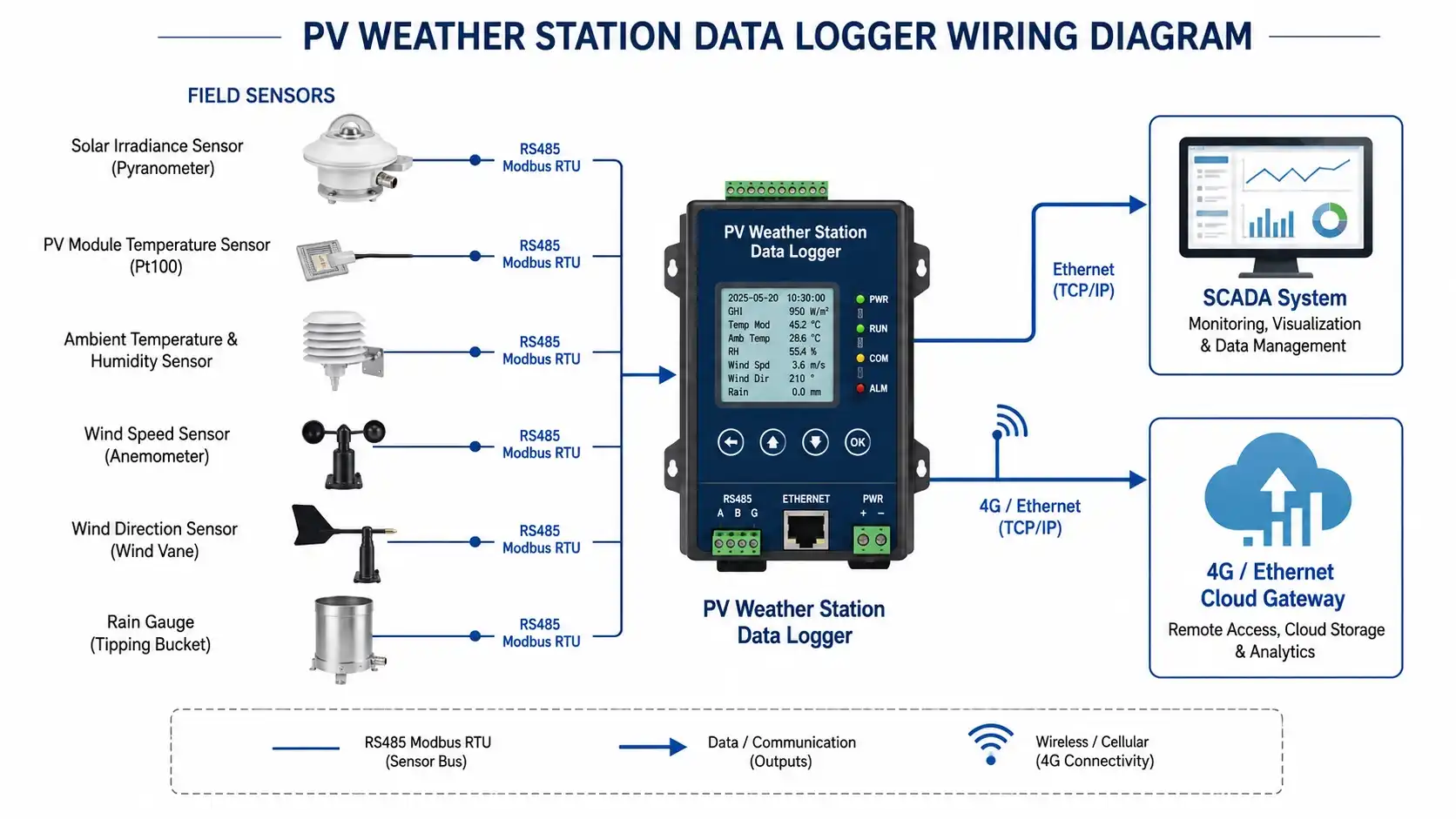
SCADA Integration Through Modbus
SCADA integration is one of the most important requirements for utility-scale PV plants and industrial solar monitoring projects.
In this architecture, the PV weather station sends real-time environmental data to the SCADA system through a data logger, RTU, or PLC. The SCADA system then displays the data together with inverter output, combiner box data, meter data, alarms, and plant operation status.
A typical SCADA integration structure is:
Weather Sensors → RS485 Modbus RTU → Data Logger / RTU → Modbus TCP / Serial Gateway → SCADA System
The data usually includes:
- Global horizontal irradiance
- Plane-of-array irradiance
- PV module temperature
- Ambient temperature
- Relative humidity
- Wind speed
- Wind direction
- Rainfall
- Atmospheric pressure
- Sensor status
- Communication status
- Power supply status
Why Modbus Register Tables Matter
For SCADA integration, the Modbus register table is essential. It tells the system integrator where each data point is located and how to read it correctly.
A complete Modbus register table should include:
- Device address
- Function code
- Register address
- Parameter name
- Data type
- Unit
- Scaling factor
- Decimal place
- Read/write permission
- Communication baud rate
- Parity setting
- Data update interval
Without a clear Modbus register table, SCADA engineers may spend extra time mapping data points, testing communication, and checking abnormal values.
For example, solar irradiance may be stored as a 16-bit integer with a scaling factor. Wind speed may use a different register format. PV module temperature may require signed data interpretation. If these details are not clearly documented, integration errors may occur.
This is why a professional PV weather station supplier should provide not only hardware, but also communication documents, register tables, wiring guidance, and technical support for integration.
Recommended internal link placement:
For readers looking for station-level PV monitoring equipment, link to:
PV Plant Weather Station
Cloud Platform Integration Through MQTT and API
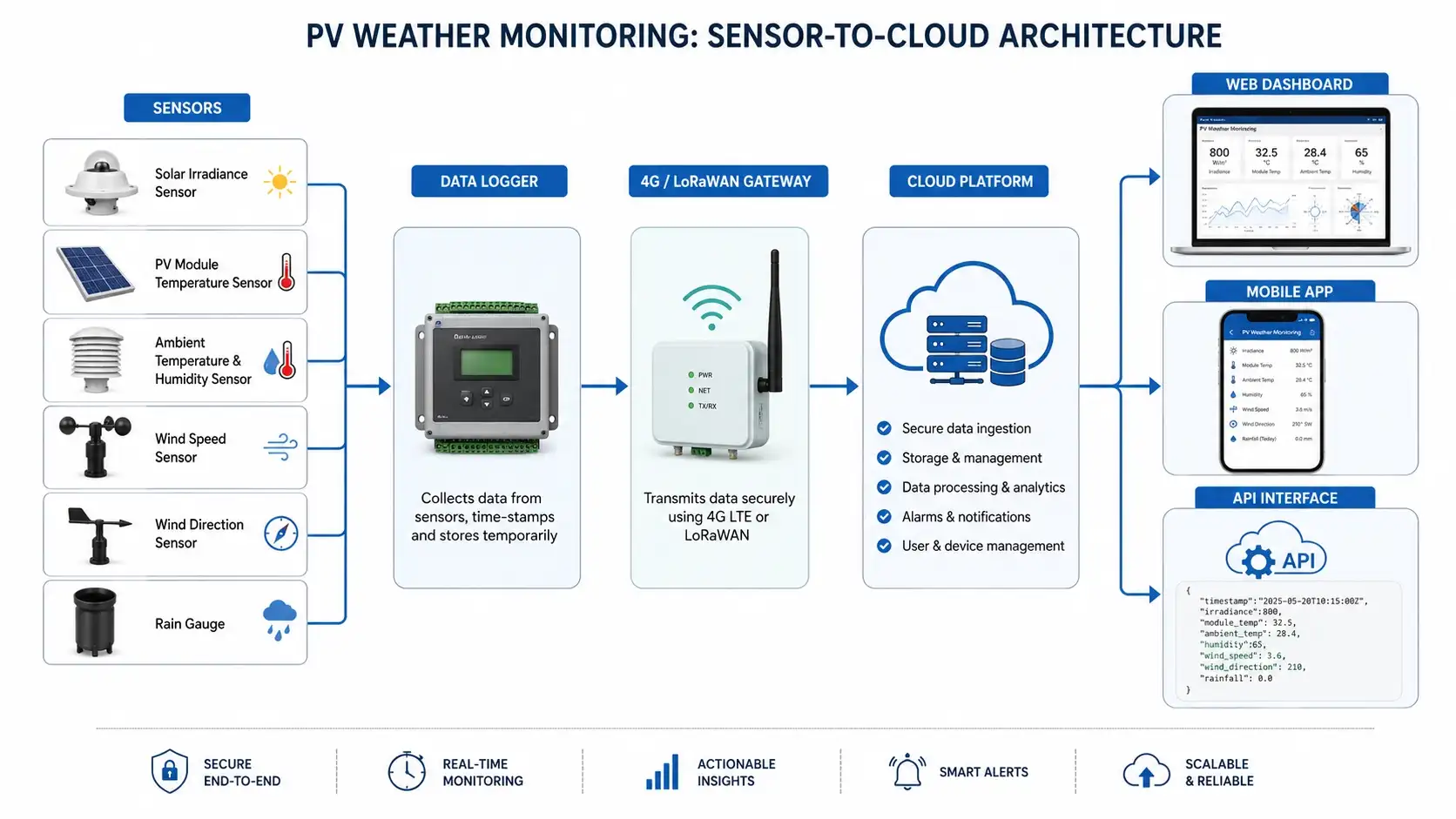
Cloud PV monitoring is becoming increasingly important for solar asset owners, O&M companies, and distributed energy project operators.
Unlike local SCADA systems, cloud platforms allow users to monitor PV plants remotely through web dashboards, mobile apps, alarm systems, and centralized management interfaces.
A typical cloud PV monitoring architecture is:
PV Weather Station → Data Logger / Gateway → 4G / Ethernet / LoRaWAN → MQTT / API → Cloud Platform → Web Dashboard / Mobile App
Cloud platform integration can support:
- Real-time weather data visualization
- Historical trend analysis
- Solar irradiance curves
- PV module temperature tracking
- Alarm notification
- Multi-site project management
- Data export
- API access for third-party platforms
- O&M performance reporting
MQTT for Real-Time PV Data Transmission
MQTT is useful for IoT-based PV weather monitoring because it is lightweight and efficient. A gateway can publish sensor data to the cloud using defined topics. The cloud platform can then subscribe to these topics and process the data in real time.
A simplified MQTT topic structure may look like:
pv/site01/weather/irradiancepv/site01/weather/module-temperaturepv/site01/weather/wind-speedpv/site01/device/status
The message payload may include:
{
  "site_id": "PV_SITE_001",
  "device_id": "PV_WS_01",
  "timestamp": "2026-07-02T10:30:00Z",
  "poa_irradiance": 835.6,
  "module_temperature": 48.2,
  "ambient_temperature": 32.5,
  "wind_speed": 4.8,
  "humidity": 61.3,
  "status": "normal"
}
This structure makes the data easier to read, store, analyze, and integrate with third-party systems.
API Integration for Third-Party Platforms
API integration is especially useful when the customer already has a solar O&M platform, energy management system, digital twin platform, or asset management software.
Through API integration, the platform can request PV weather station data such as:
- Latest real-time values
- Historical data by time range
- Device status
- Alarm records
- Sensor metadata
- Site-level monitoring data
For international solar projects, API integration is often required because customers may use different software systems in different countries. A flexible PV weather station solution should support data access through standard formats and customizable integration methods.
The Role of the Data Logger in PV Monitoring
The data logger is the bridge between field sensors and upper-level monitoring systems.
In many PV weather station projects, the sensors themselves do not connect directly to SCADA or cloud platforms. Instead, they send data to a data logger or IoT gateway first. The data logger then handles data acquisition, processing, storage, protocol conversion, and communication.
A PV weather station data logger usually performs several important functions:
Sensor Data Collection
The data logger collects data from multiple sensors through RS485 Modbus RTU, analog signal, pulse signal, SDI-12, or other interfaces.
Typical connected devices may include:
- Solar irradiance sensor
- Pyranometer
- PV module temperature sensor
- Ambient temperature and humidity sensor
- Wind speed sensor
- Wind direction sensor
- Rain gauge
- Atmospheric pressure sensor
- Soiling sensor
- Cloud cover sensor
- Power supply monitoring module
Local Data Storage
In case of network interruption, the data logger can store data locally and upload it after communication is restored. This helps reduce the risk of data loss in remote PV plants.
Protocol Conversion
The data logger can convert field sensor protocols into formats required by SCADA or cloud systems, such as:
- Modbus RTU to Modbus TCP
- RS485 sensor data to MQTT
- Sensor data to JSON
- Local data to API format
Edge Processing
Some data loggers can perform basic edge processing, such as:
- Data filtering
- Average value calculation
- Maximum and minimum values
- Alarm threshold judgment
- Device status monitoring
- Data quality checking
Communication Management
The data logger may support communication through:
- 4G LTE
- Ethernet
- LoRaWAN gateway
- Wi-Fi
- RS485
- MQTT
- TCP/IP
- HTTP API
For solar plant monitoring, the quality of the data logger directly affects system reliability. A good data logger should be stable, industrial-grade, easy to configure, and compatible with the project’s SCADA or cloud platform requirements.
Recommended internal link placement:
For readers who need data acquisition equipment for PV monitoring projects, link to:
PV Weather Station Data Logger
Best Practices for System Integrators
PV weather station integration is not only about connecting wires or reading data. It requires careful planning across hardware, communication, data structure, software interface, and long-term maintenance.
Below are practical best practices for EPC contractors, SCADA engineers, and system integrators.
1. Confirm the Monitoring Architecture First
Before selecting the PV weather station, confirm whether the project uses:
- Local SCADA only
- Cloud monitoring only
- SCADA plus cloud monitoring
- Third-party O&M platform
- Multi-site centralized dashboard
- Customer-owned private server
- Hybrid communication architecture
This affects the selection of data logger, gateway, communication protocol, and software interface.
2. Define the Required Parameters Clearly
Different PV projects may require different parameters. A basic PV weather station may only include irradiance, ambient temperature, module temperature, wind speed, and wind direction. A more advanced station may include rainfall, humidity, pressure, soiling, cloud cover, and power supply status.
Define the required data points before integration.
3. Request the Modbus Register Table Early
For SCADA integration, request the Modbus register table before installation. This helps the SCADA engineer prepare data mapping in advance and reduce commissioning time.
4. Confirm Communication Distance and Wiring Conditions
RS485 wiring distance, cable type, grounding, surge protection, and electromagnetic interference should be considered, especially in large PV plants with long cable runs.
5. Use Correct Sensor Addressing
When multiple RS485 sensors are connected to the same bus, each device must have a unique address. Duplicate addresses can cause communication failure.
6. Standardize Data Units
Make sure all data units are consistent across the system. For example:
- Irradiance: W/m²
- Temperature: °C
- Wind speed: m/s
- Rainfall: mm
- Humidity: %RH
- Pressure: hPa or kPa
Inconsistent units can cause incorrect analysis in SCADA or cloud dashboards.
7. Set a Reasonable Data Upload Interval
PV weather monitoring does not always require second-level data upload. Depending on the project, a 1-minute, 5-minute, or 10-minute interval may be suitable.
For performance analysis, the upload interval should match the requirements of the inverter monitoring system and O&M platform.
8. Plan for Local Data Backup
Remote PV plants may experience unstable network conditions. A data logger with local storage can help prevent data gaps during communication interruption.
9. Check Time Synchronization
Accurate timestamps are important when comparing weather data with power generation data. Make sure the data logger, SCADA system, and cloud platform use synchronized time settings.
10. Verify Data Quality During Commissioning
After installation, compare the weather station readings with expected environmental conditions. Check for abnormal values, reversed wind direction, incorrect scaling, missing data, and unstable communication.
Recommended System Architecture
A flexible PV weather station integration architecture can be designed as follows:
Field Layer
Solar irradiance sensor, pyranometer, PV module temperature sensor, ambient temperature and humidity sensor, wind speed sensor, wind direction sensor, rain gauge, pressure sensor, soiling sensor, and other environmental sensors.
Data Acquisition Layer
PV weather station data logger, RTU, or IoT gateway collects sensor data through RS485 Modbus RTU, analog input, pulse input, or digital communication.
Communication Layer
Data is transmitted through RS485, Ethernet, 4G LTE, LoRaWAN, MQTT, or TCP/IP depending on site conditions.
Platform Layer
Data is sent to SCADA, cloud PV monitoring platform, private server, or third-party O&M platform.
Application Layer
Operators use dashboards, alarms, reports, APIs, and performance analysis tools to support solar plant operation and maintenance.
This layered architecture makes the PV weather station easier to integrate, expand, troubleshoot, and maintain.
FAQ
1. What is PV weather station SCADA integration?
PV weather station SCADA integration means connecting solar weather monitoring equipment to a SCADA system so that real-time environmental data can be displayed, stored, analyzed, and compared with PV plant operation data.
2. Which protocol is commonly used for PV weather station SCADA integration?
Modbus RTU over RS485 is commonly used for field-level sensor communication. In some projects, Modbus TCP, Ethernet, MQTT, or API integration may also be used depending on the monitoring architecture.
3. Why does a PV weather station need a data logger?
A data logger collects sensor data, stores historical records, manages communication, converts protocols, and sends data to SCADA or cloud platforms. It is the bridge between field sensors and upper-level monitoring systems.
4. Can a PV weather station connect to a cloud platform?
Yes. A PV weather station can connect to a cloud platform through a data logger or gateway using 4G, Ethernet, LoRaWAN, MQTT, HTTP API, or other communication methods.
5. What data can be integrated into a solar monitoring platform?
Common data includes solar irradiance, POA irradiance, PV module temperature, ambient temperature, humidity, wind speed, wind direction, rainfall, pressure, soiling data, device status, and communication status.
6. What documents are needed for SCADA integration?
The most important documents include the Modbus register table, wiring diagram, communication settings, sensor parameter list, data scaling rules, installation guide, and commissioning instructions.
Conclusion
PV weather station integration is a key part of modern solar plant monitoring. For utility-scale PV plants, distributed solar projects, rooftop systems, and floating PV stations, weather data must be connected with SCADA systems, cloud platforms, data loggers, and APIs to support real-time monitoring and long-term performance analysis.
A reliable integration design should consider field sensors, communication interfaces, Modbus register mapping, data logger functions, cloud protocols, data storage, API access, and system maintenance.
With flexible support for RS485 Modbus RTU, data loggers, gateways, MQTT, API integration, and cloud PV monitoring, JW-IoT helps solar project developers, EPC contractors, and system integrators build more connected and data-driven PV monitoring systems.
Need to connect a PV weather station to your SCADA or cloud platform?
Request Modbus Register Table and integration support from JW-IoT for your solar monitoring project.