+86 13520127780
 info@jingelway.com





Radar Flow Meter vs Ultrasonic Flow Meter: Which Is Better for Open Channels?
Release time: 2026-10-12
ecting the right flow measurement technology is essential for reliable monitoring of rivers, irrigation canals, urban drainage networks, and wastewater channels.
Two technologies commonly considered are radar flow meters and ultrasonic flow meters. Both can support open-channel monitoring, but their measurement principles, installation requirements, and limitations differ significantly.
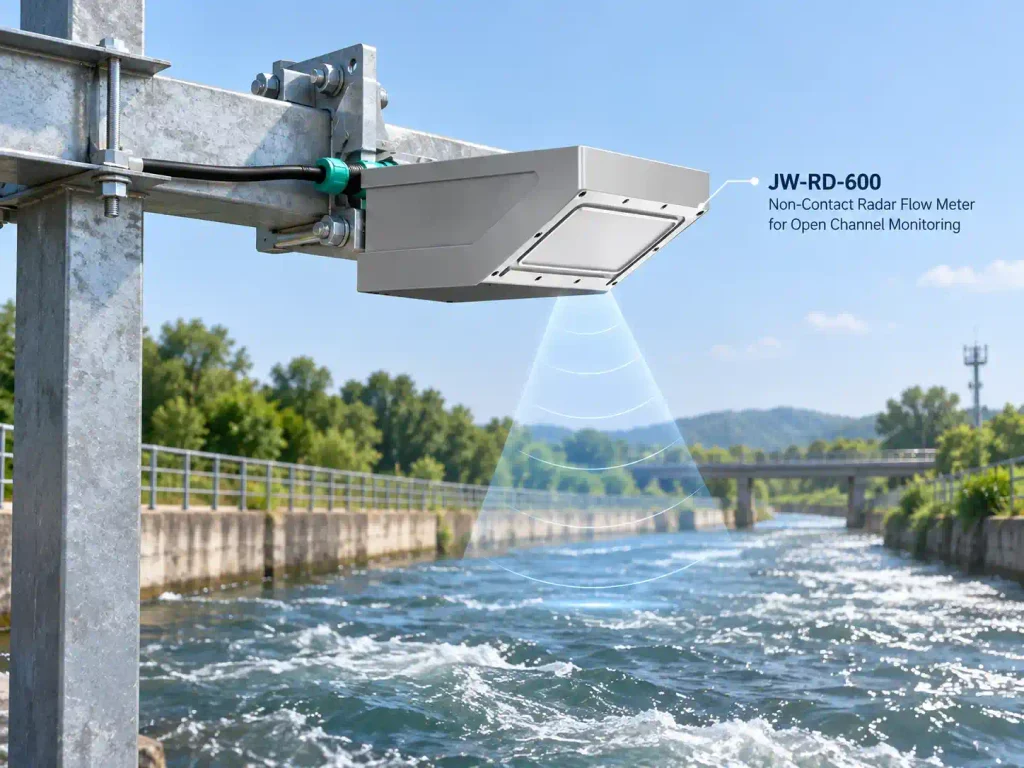
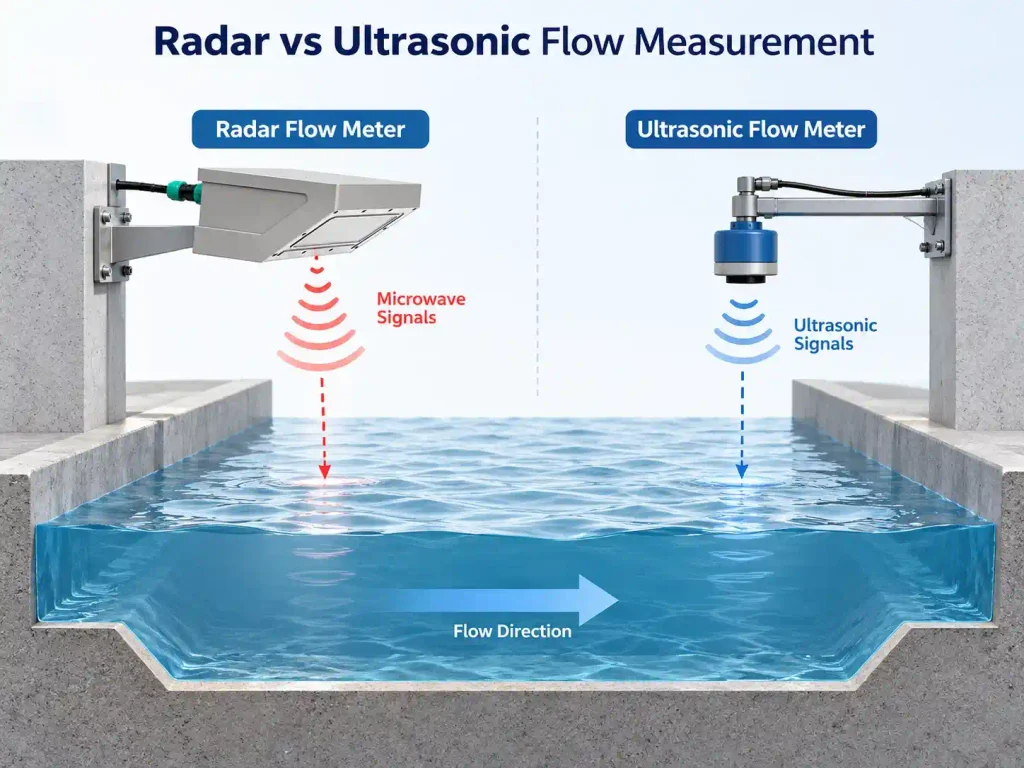
A radar flow meter typically uses microwave signals to measure water surface velocity without contacting the water. When combined with radar water level measurement and channel geometry, it can calculate discharge.
Ultrasonic systems may measure water level, velocity, or both, depending on their design. Some operate above the water surface, while others require submerged transducers.
Which is better? A non-contact radar flow meter can be a strong choice for exposed rivers, flood monitoring stations, and channels where submerged equipment is difficult to maintain. Ultrasonic technology may be more appropriate when established level-to-flow structures or acoustic velocity measurements better suit the site.
This guide explains the differences and how to choose a suitable system.
1. What Is a Radar Flow Meter?
A radar flow meter is an instrument that uses electromagnetic waves to measure one or more parameters associated with moving water.
For open-channel discharge monitoring, an integrated radar system may combine:
- Radar surface velocity measurement: Measures water movement using the Doppler effect.
- Radar water level measurement: Determines the distance to the water surface using radar ranging technology.
- Flow calculation: Estimates discharge using channel geometry and a hydraulic calculation method.
The JW-RD-600(HJ03) Integrated Radar Flow Meter is an example of this approach.
It incorporates Doppler surface velocity measurement, FMCW water level sensing, and a built-in discharge calculation algorithm.
How Doppler Radar Measures Water Velocity
The radar sensor directs microwave signals toward the flowing water surface.
Moving surface features reflect part of the transmitted signal. The reflected frequency changes according to the relative movement between the radar and the water.
By analyzing this Doppler frequency shift, the instrument estimates surface velocity.
Since the sensor is positioned above the water, the velocity measurement does not require physical contact with the flow.
However, the radar must receive a usable reflected signal. Surface conditions, measurement angle, turbulence, and installation location influence the quality of the reading.
How Radar Water Level Measurement Works
An integrated radar flow meter may use Frequency-Modulated Continuous Wave (FMCW) technology to determine water level.
The radar transmits a frequency-modulated signal and processes the returning reflection to determine the distance between the sensor and the water surface.
When the reference elevation or channel-bottom distance is known, the instrument can calculate water depth.
Combining the measured surface velocity with water depth and configured channel parameters enables discharge estimation.
For further technical background, see the U.S. Geological Survey’s research on non-contact radar methods for stream discharge monitoring.
2. What Is an Ultrasonic Flow Meter?
Ultrasonic flow meters use acoustic waves rather than electromagnetic radar signals.
However, the term ultrasonic flow meter covers several different instrument types.
Understanding these differences is important because comparing a radar surface velocity sensor with a conventional ultrasonic pipe meter can be misleading.
A. Non-Contact Ultrasonic Level-Based Flow Measurement
This method uses an ultrasonic level sensor mounted above the water.
The sensor emits acoustic pulses toward the water surface and determines distance from the return time.
Water depth is calculated using the reference height.
Discharge may then be estimated from the water level using a calibrated hydraulic structure, such as a suitable weir or flume, or an established stage-discharge relationship.
This method does not necessarily measure water velocity directly.
It can be suitable for engineered channels where water level and discharge have a known relationship.
B. Submerged Ultrasonic Doppler Area-Velocity Measurement
An ultrasonic Doppler velocity sensor is installed within the water or at the channel boundary.
It emits acoustic signals and analyzes reflections from particles or bubbles moving with the flow.
Combined with water level measurement and channel geometry, the system can calculate discharge.
Such instruments are used in applications including wastewater channels, partially filled conduits, and hydrological measurement stations.
Unlike above-water radar velocity sensing, the acoustic velocity transducer must operate in the water.
C. Ultrasonic Transit-Time Flow Measurement
Transit-time systems compare the travel times of ultrasonic signals moving with and against the flow.
They are widely used in suitable closed-pipe applications. Some specialized acoustic systems also operate in open channels.
Conventional clamp-on transit-time flow meters for full pipes should not automatically be treated as substitutes for open-channel area-velocity meters.
For an independent overview, see Endress+Hauser’s explanation of ultrasonic flow measurement methods.
3. Radar Flow Meter vs Ultrasonic Flow Meter: Key Differences
The following comparison focuses on integrated non-contact radar systems and the ultrasonic technologies commonly used for open-channel monitoring.
| Comparison | Radar Flow Meter | Non-Contact Ultrasonic Level-Based System | Submerged Ultrasonic Area-Velocity System |
| Measurement technology | Microwave radar | Acoustic ranging | Acoustic velocity sensing |
| Sensor placement | Above water | Above water | In or against the wetted channel |
| Velocity measurement | Directly measures surface velocity | Not normally included in level-only systems | Measures velocity within a sampled region |
| Water level measurement | Radar level sensor in integrated systems | Ultrasonic level sensor | Separate or integrated level sensor |
| Discharge calculation | Surface velocity, hydraulic correction and area | Stage-discharge relation or hydraulic structure | Velocity-area relationship |
| Contact with water | No | No | Usually yes |
| Main site considerations | Surface reflections, velocity profile, channel geometry | Sound propagation, water surface, hydraulic calibration | Submergence, acoustic conditions, fouling, velocity profile |
| Typical applications | Rivers, canals, open drainage | Weirs, flumes, engineered channels | Wastewater, drains, channels, partially filled conduits |
Important: No single flow measurement technology delivers the highest accuracy in every environment.
Actual discharge uncertainty depends on the selected instrument, installation conditions, hydraulic model, calibration, and maintenance practices.
4. Measurement Accuracy: Which Technology Is More Reliable?
Accuracy is often the first specification evaluated by engineers and procurement teams.
However, comparing only the accuracy of radar and ultrasonic sensors can lead to the wrong purchasing decision.
Sensor Accuracy Is Not the Same as Flow Accuracy
A radar flow meter may specify a particular velocity accuracy, while an ultrasonic system may specify level or velocity accuracy.
These values represent different measured quantities.
Open-channel discharge is generally expressed as:
Q = A × V
Where:
- Q: Discharge (m³/s)
- A: Wetted cross-sectional area (m²)
- V: Mean cross-sectional velocity (m/s)
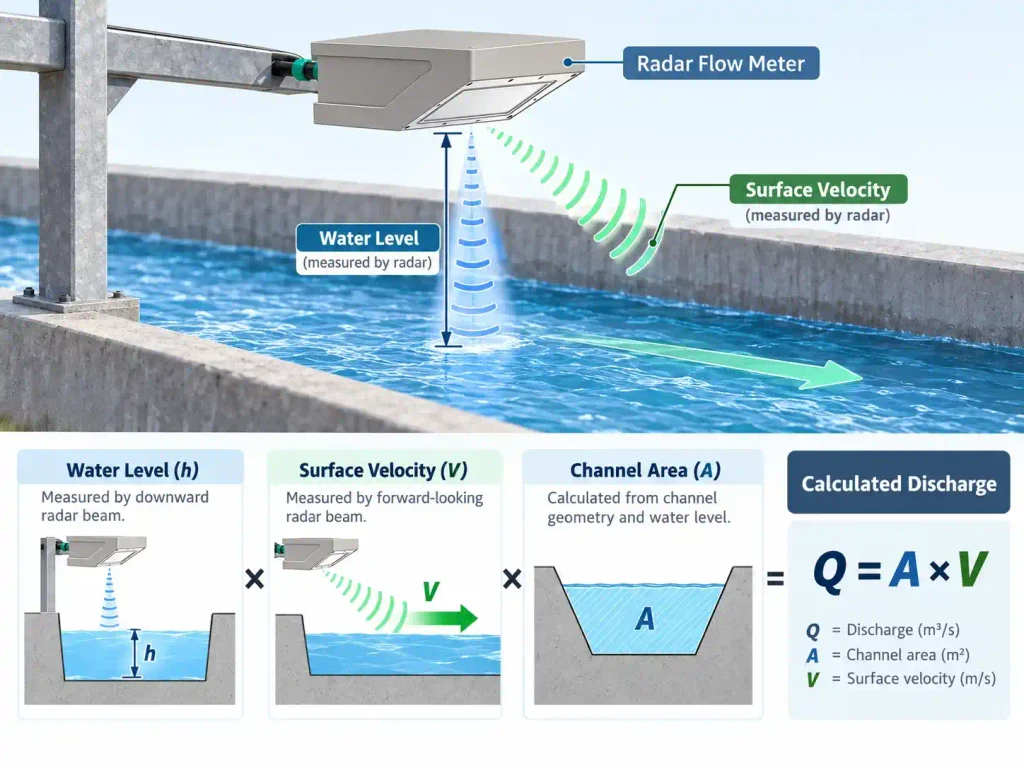
A radar surface velocity sensor does not directly measure the average velocity throughout the entire channel.
Its surface velocity measurement must be converted into a representative mean velocity using appropriate correction methods.
Similarly, ultrasonic area-velocity sensors may sample only part of the flow field, requiring a suitable method to estimate average velocity.
For level-only ultrasonic systems, discharge depends on the hydraulic relationship between water level and flow.
The USGS explains the use of velocity and area relationships in its technical guide, Computing Discharge Using the Index Velocity Method.
Factors Affecting Radar Flow Measurement
Radar measurement performance can be influenced by:
- Surface wave and reflection conditions
- Wind affecting surface movement
- Turbulence and vortices
- Incorrect mounting angle
- Changes in flow direction
- Unrepresentative measurement locations
- Incorrect channel geometry
- Uncertainty in the surface-to-mean velocity conversion
Factors Affecting Ultrasonic Flow Measurement
Depending on the ultrasonic measurement principle, important factors may include:
- Acoustic signal quality
- Air bubbles or suspended solids
- Water temperature and sound propagation conditions
- Sensor submergence
- Sediment or fouling
- Transducer alignment
- Hydraulic structure calibration
- Changes in channel cross-section
A properly designed ultrasonic measurement station can provide reliable discharge information. Likewise, a radar installation requires appropriate site selection and verification.
The better system is the one whose measurement principle matches the actual hydraulic conditions and required uncertainty.
5. Installation and Maintenance Comparison
Installation requirements often influence the long-term cost and practicality of a monitoring project.
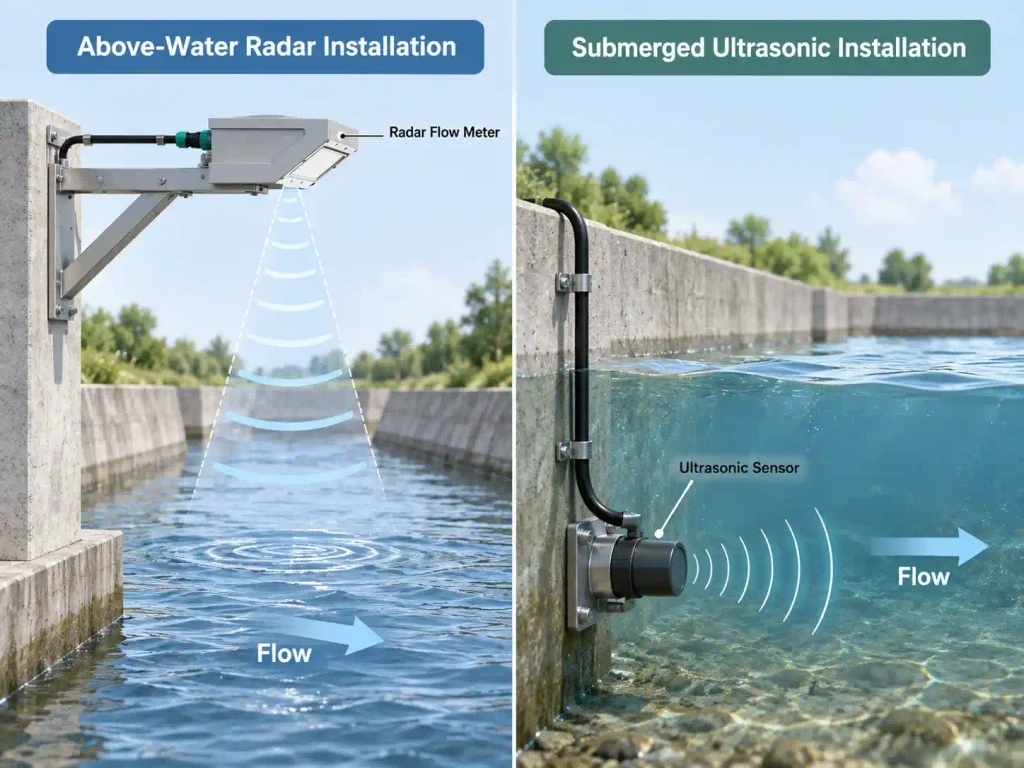
Radar Flow Meter Installation
An integrated radar flow meter is normally mounted above the water surface.
Potential locations include:
- Bridge structures
- Channel crossbars
- Fixed mounting brackets
- Engineered monitoring platforms
The sensor should face an appropriate section of flowing water with stable and representative surface conditions.
The installation point should avoid sharp bends, unstable discharge zones, strong vortices, and severe sediment accumulation.
For a non-contact radar system, technicians do not normally need to enter the water to install or service the sensing head.
This can be especially valuable at sites where water access is hazardous or expensive.
Ultrasonic Flow Meter Installation
Installation depends on the ultrasonic technology.
A non-contact ultrasonic level sensor can also be mounted above the water surface.
A submerged Doppler area-velocity sensor normally requires installation within the channel or at a wetted surface.
This may involve:
- Installing a mounting bracket or sensor support
- Securing and protecting the sensor cable
- Verifying submergence
- Cleaning sediment or fouling
- Inspecting the sensor after unusual flow events
However, submerged acoustic measurement may be beneficial where reliable surface radar measurements are difficult or where a particular hydraulic monitoring method requires in-water velocity observations.
Maintenance Considerations
Radar systems avoid routine cleaning of submerged sensing surfaces because the measurement head stays above the water.
Nevertheless, radar installations still require inspection of mounting structures, electrical connections, power systems, telemetry equipment, and data quality.
Ultrasonic level-only systems also avoid submerged sensor fouling.
Therefore, the maintenance advantage of radar is most relevant when comparing non-contact radar with submerged ultrasonic velocity instruments, rather than every ultrasonic flow meter.
6. Which Is Better for Different Open Channel Applications?
River Flow Monitoring
For river monitoring, a non-contact radar flow meter may be suitable where technicians can install equipment safely above the water and obtain a representative surface velocity signal.
It is useful when direct access to fast-moving water would be difficult.
However, the relationship between surface velocity and total discharge must be assessed.
Submerged acoustic Doppler instruments remain suitable options in locations where their measurement configuration and established site calibration provide reliable data.
Selection consideration: Channel stability, flood conditions, surface velocity characteristics, and maintenance accessibility.
Flood Early Warning Systems
Flood monitoring stations require reliable observations under changing hydraulic conditions.
A non-contact radar system can measure water level and surface velocity from a fixed location above the flow.
These measurements can contribute to monitoring systems that identify rapidly changing water conditions.
The radar flow meter itself does not independently constitute a complete flood early warning system.
Rainfall monitoring, communication equipment, monitoring software, alarm rules, and emergency procedures may also be required.
Agricultural Irrigation Canals
Both radar and ultrasonic technologies can be used in irrigation channels.
A level-based ultrasonic system may be appropriate where a calibrated weir, flume, or other hydraulic structure is available.
A radar flow meter is an alternative where surface velocity and water level are required at a suitable measurement section.
For rectangular and trapezoidal channels, accurate geometric parameters are especially important.
Selection consideration: Channel shape, expected velocity, hydraulic structures, and required monitoring frequency.
Urban Drainage and Stormwater Channels
Urban drainage systems may experience changing water levels, storm-driven debris, and short periods of high flow.
Above-water radar measurement can reduce the need for submerged velocity sensors in suitable open-channel sections.
However, radar is not automatically suitable for every underground drainage pipe.
Fully surcharged pipes, highly turbulent outfalls, or unsuitable surface conditions may require a different measurement method.
Learn more about JW-IoT’s Open Channel Flow Meter for Smart Drainage Monitoring.
Wastewater Flow Monitoring
For open wastewater channels, both radar and ultrasonic systems deserve consideration.
Non-contact radar can limit exposure of the sensing head to wastewater.
Submerged ultrasonic Doppler sensors may provide a suitable velocity measurement where sufficient acoustic reflection and appropriate sensor placement are available.
The selection should consider channel geometry, fouling potential, surface behavior, and maintenance requirements.
7. Integrated Radar Flow Monitoring: JW-RD-600(HJ03)
For projects requiring non-contact measurement of water surface velocity, water level, and calculated discharge, JW-IoT offers the JW-RD-600(HJ03) Integrated Radar Flow Meter.
The product integrates:
Doppler Radar Velocity Measurement + FMCW Radar Water Level Measurement + Hydraulic Discharge Calculation
According to its product manual, the system uses 24 GHz Doppler radar for surface velocity measurement and supports configurable open-channel cross-sections.
Key Technical Characteristics
| Parameter | JW-RD-600(HJ03) Manual Specification |
| Surface velocity measurement | 24 GHz Doppler radar |
| Velocity range | 0.03–20 m/s |
| Velocity accuracy | ±0.01 m/s; ±1% FS |
| Level technology | FMCW radar |
| Level measuring range | A: 0.2–7 m; B: 0.4–40 m |
| Level accuracy | A: ±2 mm; B: ±3 mm |
| Channel configurations | Circular, trapezoidal, U-shaped, and configured rectangular/triangular profiles |
| Communication | RS485 / RS232, Modbus RTU |
| Protection | IP68 |
| Power supply | 7–30 VDC (manual standard configuration) |
Specifications vary between product configurations. Final model selection should be confirmed against the applicable datasheet.
Remote Monitoring and RTU Integration
The radar flow meter supports digital communication for connection to hydrological RTUs, data loggers, and compatible monitoring systems.
Typical architecture:
Radar Flow Meter → RS485/Modbus RTU → Data Logger or RTU → Communication Network → Monitoring Platform
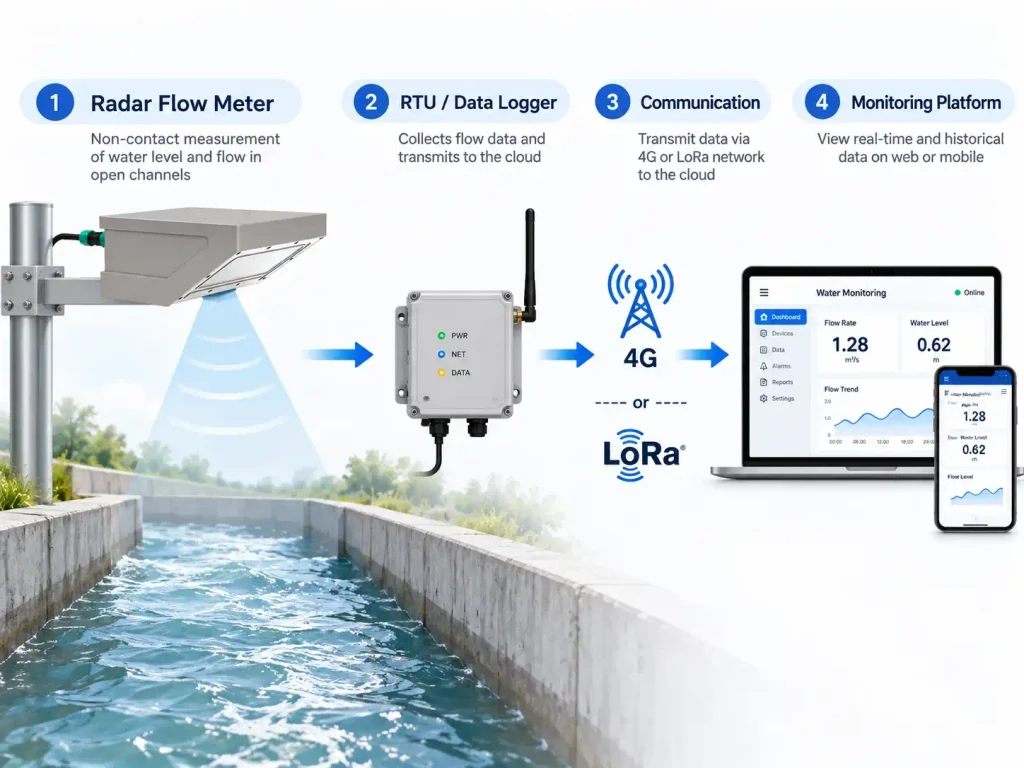
Optional wireless communication configurations are available for project-specific telemetry requirements.
The product can be considered for:
- River hydrological monitoring
- Irrigation canal monitoring
- Flood observation stations
- Urban drainage monitoring
- Water resource management
The main engineering value is the integration of velocity, level, and discharge calculations within one measurement device.
This reduces the need to select separate velocity and level instruments, although the actual complete station configuration depends on power, communication, installation, and platform requirements.
8. How to Choose Between Radar and Ultrasonic Flow Meters
Before selecting a flow measurement system, engineers should answer the following questions.
Is the channel open or pressurized?
A surface radar flow meter is intended for suitable free-surface conditions.
A fully pressurized pipeline generally requires another technology.
Is water level alone sufficient?
If a calibrated hydraulic relationship can accurately convert water level into discharge, a level-based ultrasonic or radar solution may be sufficient.
If velocity measurement is also required, consider radar surface velocity or ultrasonic area-velocity technologies.
Can the sensor be installed above the water?
Where a suitable bridge or mounting structure exists, non-contact measurement may simplify access and reduce exposure to hazardous flow.
Is the channel geometry stable?
Reliable discharge calculations require appropriate channel geometry or hydraulic calibration.
A changing riverbed or unstable cross-section can introduce additional uncertainty.
What are the flow conditions?
Consider low velocities, surface turbulence, sediment, floating debris, wind, and potential reverse flow.
How will the monitoring data be transmitted?
Remote sites may require a data logger or RTU, wireless telemetry, and independent power supply.
Communication compatibility should be checked before procurement.
9. FAQ
9.1 Is radar more accurate than ultrasonic flow measurement?
Not necessarily. Accuracy depends on sensor type, installation quality, hydraulic conditions, and discharge calculation methods. Radar surface velocity accuracy cannot be directly compared with ultrasonic level accuracy or overall system discharge accuracy.
9.2 Can a radar flow meter measure water flow without touching the water?
Yes. A non-contact radar flow meter can measure surface velocity and water level from above the water. Discharge is then calculated using channel geometry and hydraulic correction methods.
9.3 What is the main difference between radar and ultrasonic Doppler flow meters?
Radar Doppler instruments detect microwave reflections associated with movement at the water surface. Submerged ultrasonic Doppler instruments detect acoustic reflections from moving particles or bubbles within the fluid.
9.4 Which technology is suitable for flood monitoring?
Both can be used in properly designed systems. Non-contact radar is attractive when submerged instrument access is hazardous, provided surface reflection and hydraulic conditions are suitable.
9.5 Can radar flow meters monitor partially filled drainage pipes?
Yes, in appropriate free-surface configurations. Performance depends on sufficient space, a suitable measurement footprint, stable flow conditions, and accurate geometry. Fully pressurized pipes require separate consideration.
9.6 Does an integrated radar flow meter need channel dimensions?
Yes. Calculating discharge from surface velocity and water level requires channel cross-section parameters and a suitable method for estimating mean flow velocity.
10. Conclusion: Choose the Measurement Method, Not Just the Sensor
Radar and ultrasonic flow meters are both valuable tools for water monitoring, but they are not interchangeable in every application.
A non-contact radar flow meter may be preferable when surface velocity and water level must be measured above the water, particularly at rivers, open channels, and monitoring stations where submerged sensor maintenance is difficult.
Ultrasonic level-based systems remain practical for calibrated hydraulic structures, while ultrasonic area-velocity instruments can provide suitable measurements in a wide range of wastewater and hydrological applications.
The most reliable decision considers the measurement principle, channel geometry, hydraulic conditions, installation requirements, data integration, and project-specific accuracy needs.
Looking for an Open Channel Flow Monitoring Solution?
JW-IoT provides non-contact radar flow measurement equipment for hydrological monitoring and industrial IoT integration.
Explore the JW-RD-600(HJ03) 3-in-1 Integrated Radar Flow Meter or browse our Water Level and Flow Sensor Range.
For a technical recommendation, share your channel dimensions, flow conditions, measuring range, installation height, and communication requirements.
Contact JW-IoT to discuss your project.
Email: info@jingelway.com