+86 13520127780
  info@jingelway.com








Compact Weather Station for Smart City, Agriculture and Road Monitoring
Release time: 2026-04-14
A compact weather station combines multiple meteorological sensors in one integrated outdoor device. Depending on the selected configuration, it can measure air temperature, relative humidity, atmospheric pressure, wind speed, wind direction, rainfall, solar radiation, illuminance, particulate matter and environmental noise.
Compared with a traditional weather station assembled from several separate sensors, an all-in-one weather station can reduce wiring, installation space and system integration work. It is particularly suitable for distributed monitoring points, smart poles, agricultural fields, roads, photovoltaic plants, industrial parks and remote IoT monitoring projects.
JW-IoT provides configurable compact weather stations for system integrators, environmental engineering companies, agricultural IoT providers, road monitoring contractors and equipment distributors.
Available integration options may include:
- RS485 Modbus RTU
- SDI-12 depending on the model
- 4G communication
- LoRaWAN communication
- Ethernet gateways
- Data loggers and RTUs
- Cloud monitoring platforms
- API integration
- OEM and private-label services
What Is a Compact Weather Station?
A compact weather station is an integrated sensor that measures several weather or environmental parameters through one housing and one communication interface.
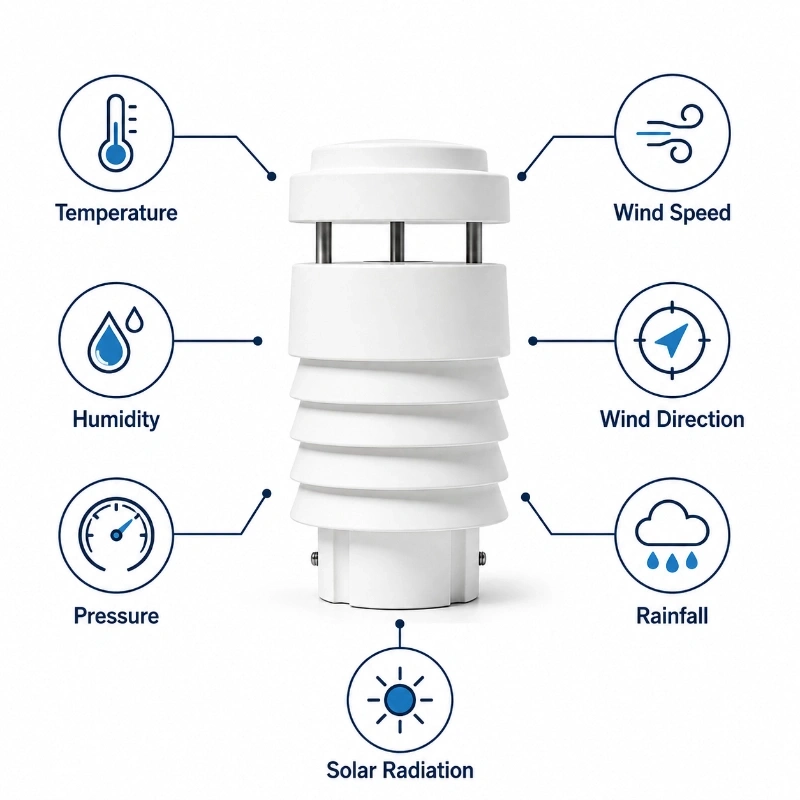
A basic model may measure:
- Air temperature
- Relative humidity
- Atmospheric pressure
- Rainfall
A more complete model may also measure:
- Wind speed
- Wind direction
- Solar radiation
- Illuminance
- PM2.5
- PM10
- TSP
- Environmental noise
- Carbon monoxide
- Sulfur dioxide
- Nitrogen dioxide
- Ozone
- Hydrogen sulfide
- Volatile organic compounds
The exact combination should be selected according to the project rather than simply choosing the model with the largest number of parameters.
For example, an agricultural project may need rainfall, solar radiation and soil monitoring, while a smart city project may require particulate matter and noise. A road weather project may require additional visibility, pavement temperature or road surface condition sensors.
Key Benefits of an All-in-One Weather Station
Compact Integrated Structure
Multiple sensing modules are integrated into one enclosure, helping reduce the number of separate devices installed on the monitoring pole.
This can simplify:
- Mounting
- Cable routing
- Power distribution
- Communication wiring
- Field commissioning
- Maintenance planning
Reduced Installation Time
Traditional weather stations may require separate brackets, cables and installation positions for wind, temperature, humidity, pressure and rainfall sensors.
An integrated weather station allows several parameters to be installed and connected at the same time, which is useful for distributed projects with many monitoring locations.
Easier System Integration
Industrial compact weather stations commonly provide digital communication interfaces such as RS485 Modbus RTU.
They can be connected to:
- RTUs
- Data loggers
- PLCs
- IoT gateways
- Industrial computers
- Local monitoring software
- Cloud monitoring platforms
Suitable for Distributed Monitoring Networks
A single monitoring station cannot represent the conditions of every location in a large farm, city, road network or industrial park.
Compact weather stations are suitable for multi-point monitoring because they require less mounting space and can be connected to wireless communication devices.
Lower Mechanical Maintenance
Models using ultrasonic wind measurement or optical rainfall sensing have no traditional rotating wind cups, wind vanes or tipping buckets.
The absence of moving parts can reduce some mechanical maintenance requirements, although regular cleaning, inspection and calibration checks are still necessary for reliable outdoor monitoring.
What Parameters Can a Compact Weather Station Measure?
Air Temperature
Air temperature data can support:
- Agricultural microclimate monitoring
- Heat-stress evaluation
- Road icing risk analysis
- Urban heat monitoring
- Solar plant performance analysis
- Industrial environmental monitoring
The temperature sensing element should be protected from direct solar radiation by an appropriate radiation shield or housing design.
Relative Humidity
Relative humidity is important for evaluating:
- Crop disease risk
- Greenhouse conditions
- Condensation risk
- Urban comfort
- Industrial storage conditions
- General weather changes
Temperature and humidity are usually measured together because the two parameters are closely related.
Atmospheric Pressure
Atmospheric pressure data can support local weather trend analysis and provide additional environmental information for automatic weather stations.
It can also be used together with temperature, humidity, rainfall and wind data for a more complete understanding of changing site conditions.
Wind Speed and Wind Direction
Wind monitoring is important for:
- Road crosswind warnings
- Agricultural spraying decisions
- Pollution dispersion analysis
- Smart city environmental monitoring
- Solar and wind power sites
- Industrial boundary monitoring
- Outdoor safety management
Compact stations may use ultrasonic wind measurement because it allows wind speed and direction to be measured without conventional rotating parts.
Rainfall
Rainfall monitoring can support:
- Irrigation management
- Flood and waterlogging warning
- Road safety
- Drainage management
- Agricultural production
- Urban environmental monitoring
Compact stations may use optical rainfall sensing, radar rainfall sensing or other integrated rainfall technologies.
Where rainfall accuracy, intensity classification or regulatory compliance is especially important, the project engineer should compare the integrated rainfall module with a dedicated tipping-bucket or professional precipitation sensor.
Solar Radiation
Solar radiation monitoring is useful for:
- Crop growth analysis
- Greenhouse management
- Evapotranspiration estimation
- Photovoltaic performance monitoring
- Environmental research
Depending on the project, global solar radiation, photosynthetically active radiation or illuminance may be required.
Particulate Matter
PM2.5, PM10 and TSP monitoring can be added for:
- Smart city monitoring
- Industrial park monitoring
- Construction dust monitoring
- Factory boundary monitoring
- Roadside air-quality monitoring
- Community environmental monitoring
Meteorological data such as wind speed and wind direction can help users interpret how airborne particles move around the monitoring site.
Environmental Noise
Noise monitoring may be required around:
- Industrial parks
- Factories
- Construction sites
- Roads
- Airports
- Residential boundaries
- Smart city monitoring points
Combining noise and weather parameters in one monitoring node can simplify distributed urban and industrial monitoring projects.
Compact Weather Station Selection Table
| Application | Recommended Parameters | Communication Options | Possible Extensions |
| Smart city monitoring | Temperature, humidity, pressure, wind speed, wind direction and rainfall | RS485, 4G or LoRaWAN | PM2.5, PM10, noise and gas sensors |
| Smart agriculture | Temperature, humidity, pressure, wind, rainfall and solar radiation | RS485, 4G or LoRaWAN | Soil moisture, soil temperature, EC and leaf wetness |
| Road weather monitoring | Temperature, humidity, pressure, wind and rainfall | RS485 and 4G | Visibility, pavement temperature and road surface sensors |
| Solar PV monitoring | Temperature, humidity, pressure, wind, rainfall and solar radiation | RS485, Ethernet or 4G | Module temperature, soiling and back-of-module sensors |
| Industrial park monitoring | Weather, particulate matter and noise | RS485, 4G, LoRaWAN or Ethernet | Toxic gas, combustible gas and boundary monitoring |
| Environmental research | Project-specific weather parameters | RS485, SDI-12 or local data logger | Additional radiation and soil sensors |
| Remote monitoring station | Temperature, humidity, pressure, wind and rainfall | 4G, LoRaWAN or satellite gateway | Solar power system and backup battery |
The final configuration should be determined according to the monitoring objective, required accuracy, local climate, communication distance and maintenance conditions.
Compact Weather Station for Smart City Monitoring
Smart city projects often require environmental data from multiple locations rather than from one conventional weather station.
Typical monitoring locations include:
- Smart light poles
- Main roads
- Public squares
- Schools
- Parks
- Residential communities
- Industrial boundaries
- Transport hubs
- Commercial districts
- Urban heat-island monitoring points
A compact smart city weather station can provide local meteorological data through a single integrated device. The data can be transmitted to a city management platform through an RTU, 4G gateway, LoRaWAN gateway or Ethernet communication device.
Recommended Smart City Parameters
A typical smart city configuration may include:
- Air temperature
- Relative humidity
- Atmospheric pressure
- Wind speed
- Wind direction
- Rainfall
- PM2.5
- PM10
- Environmental noise
Depending on the project, additional gas parameters may also be required.
Smart Pole Integration
Compact weather stations can be mounted on smart poles where available installation space is limited.
Before installation, the system integrator should consider:
- Pole height
- Distance from buildings
- Wind obstruction
- Heat generated by nearby equipment
- Cable routing
- Lightning and surge protection
- Power availability
- Communication coverage
- Maintenance access
The station should be installed where the surrounding structure does not significantly block wind or affect temperature measurement.
You can learn more from:
Air Quality Weather Station for Smart City Monitoring
Compact Weather Station for Smart Agriculture
Weather conditions can vary significantly between fields, orchards, greenhouses and irrigation zones.
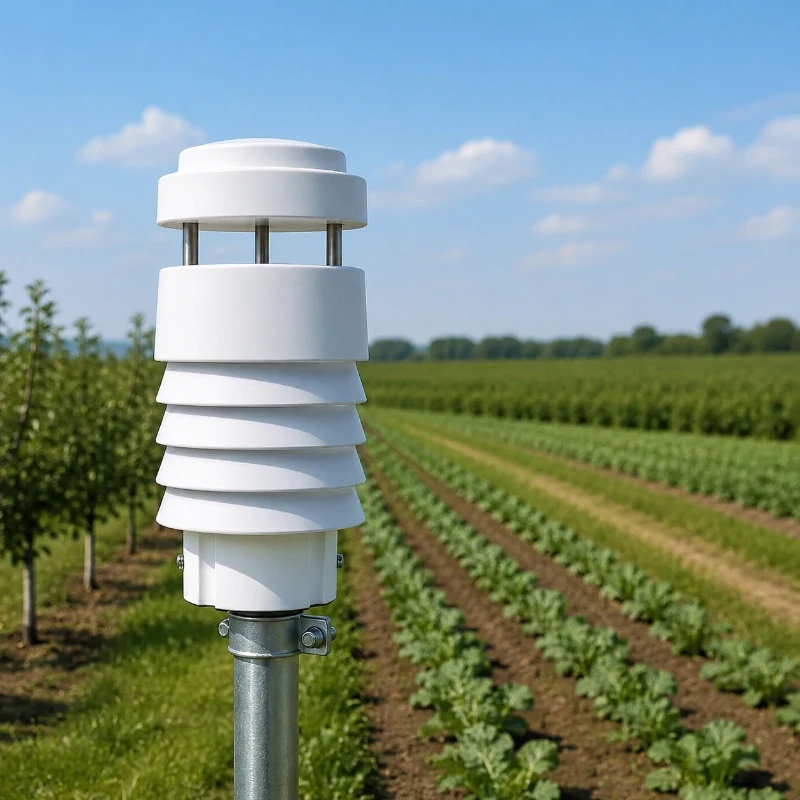
A compact agricultural weather station can help farm managers collect continuous local data for:
- Irrigation planning
- Frost-risk monitoring
- Heat-stress evaluation
- Crop disease analysis
- Spraying decisions
- Rainfall records
- Greenhouse ventilation
- Farm microclimate research
Recommended Agricultural Parameters
A typical configuration may include:
- Air temperature
- Relative humidity
- Atmospheric pressure
- Wind speed
- Wind direction
- Rainfall
- Solar radiation
The weather station can also be combined with:
- Soil moisture sensors
- Soil temperature sensors
- Soil EC sensors
- Soil pH sensors
- Multi-depth soil profile sensors
- Leaf wetness sensors
- PAR sensors
- Irrigation controllers
Multi-Point Farm Monitoring
One monitoring point may not be sufficient for a large farm.
Additional monitoring stations may be needed when the site has:
- Different elevations
- Multiple crop types
- Separate irrigation zones
- Greenhouses and open fields
- Hills or wind barriers
- Large distances between fields
- Different soil conditions
Weather and soil data can be transmitted through RS485, 4G or LoRaWAN networks to support remote monitoring and irrigation management.
You can learn more from:
Smart Agriculture Weather Station for Crop Monitoring
Compact Weather Station for Road Monitoring
Road weather conditions can change rapidly on highways, bridges, mountain roads and tunnel entrances.
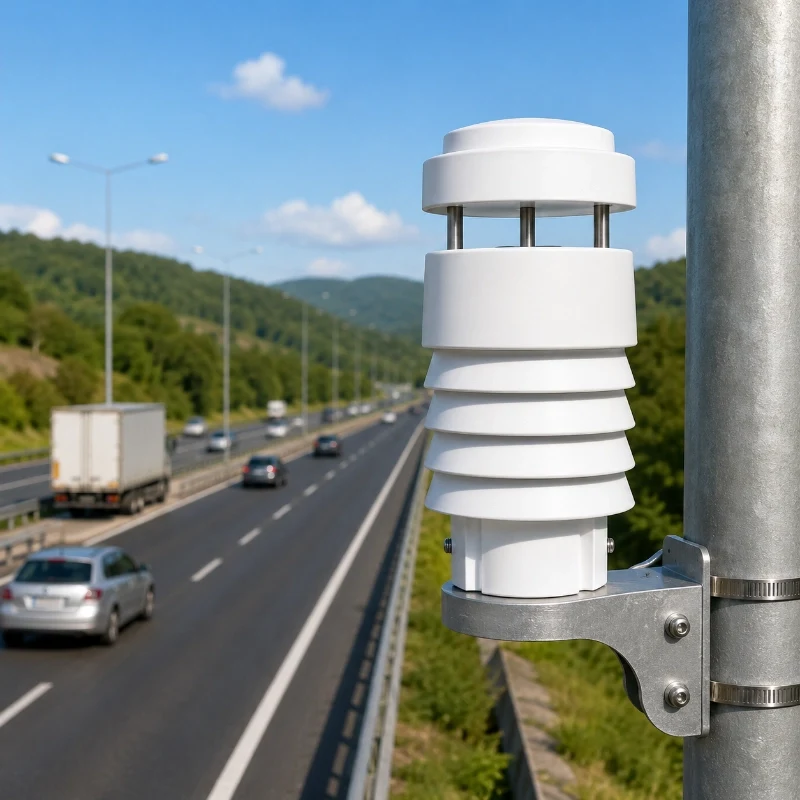
A compact weather station can provide continuous information about:
- Air temperature
- Relative humidity
- Atmospheric pressure
- Wind speed
- Wind direction
- Rainfall
These data can support:
- Crosswind warnings
- Heavy-rain alerts
- Bridge weather monitoring
- Tunnel entrance monitoring
- Mountain road management
- Maintenance planning
- Traffic safety systems
Additional Sensors for Road Weather Projects
A compact weather station provides atmospheric data, but it may not form a complete road weather information system by itself.
Depending on the project, additional sensors may include:
- Road surface temperature sensor
- Pavement condition sensor
- Visibility sensor
- Water-film sensor
- Snow-depth sensor
- Freezing-point sensor
- Flood or waterlogging sensor
- Camera
- Variable message sign controller
The final road monitoring system should be selected according to local safety requirements and the specific hazards at each monitoring point.
You can learn more from:
Road Weather Station for Highway Safety Monitoring
Compact Weather Station for Solar PV Plants
Weather data is necessary for evaluating solar plant operating conditions and comparing environmental conditions with power generation.
A compact PV weather station may measure:
- Ambient temperature
- Relative humidity
- Atmospheric pressure
- Wind speed
- Wind direction
- Rainfall
- Solar radiation
Additional photovoltaic monitoring sensors may include:
- PV module temperature sensor
- Reference cell
- Pyranometer
- Plane-of-array irradiance sensor
- Horizontal irradiance sensor
- PV soiling monitoring sensor
- Back-of-module temperature sensor
The weather station can be connected to a local SCADA system, data logger or remote cloud platform through RS485 Modbus, Ethernet or 4G communication.
You can learn more from:
PV Weather Monitoring Station for Distributed Solar Plants
Compact Weather Station for Industrial and Environmental Monitoring
Factories and industrial parks may require continuous monitoring of meteorological conditions because wind and weather affect how dust, smoke, gases and noise are distributed around a site.
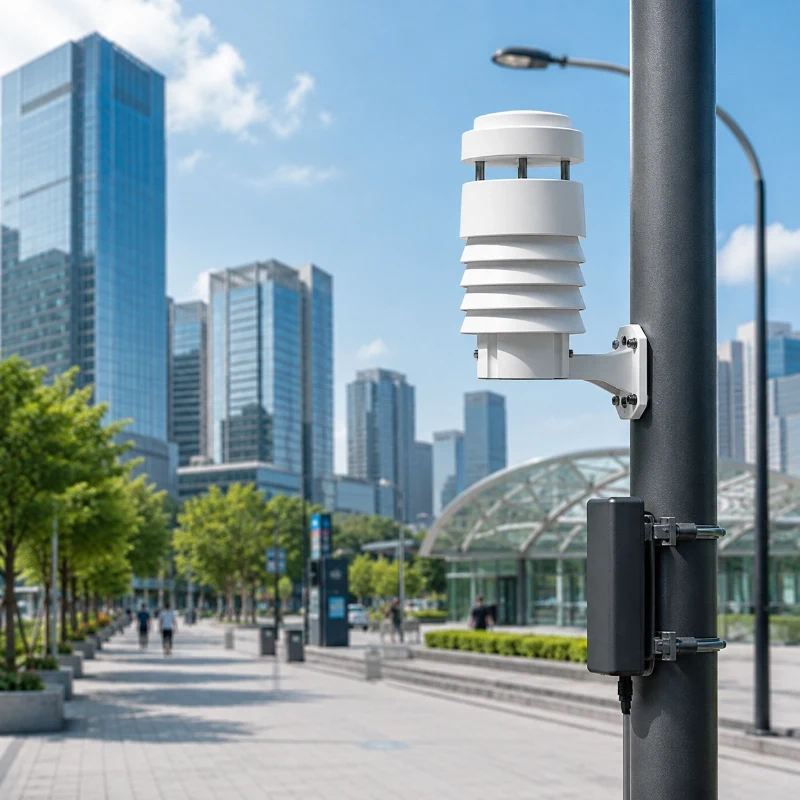
A compact industrial monitoring station may combine:
- Wind speed
- Wind direction
- Temperature
- Humidity
- Pressure
- Rainfall
- PM2.5
- PM10
- TSP
- Environmental noise
- Selected gas parameters
Typical monitoring locations include:
- Upwind site boundary
- Downwind site boundary
- Production-area entrance
- Storage and loading area
- Main logistics road
- Nearby residential boundary
- Wastewater treatment area
- Chemical storage area
Wind speed and wind direction data can help environmental teams interpret where abnormal particulate or gas readings may be coming from.
For larger sites, JW-IoT can support distributed monitoring networks with multiple sensor points, data acquisition devices, wireless communication and centralized software.
Ultrasonic Wind Sensor vs Mechanical Wind Sensor
| Comparison | Ultrasonic Wind Sensor | Mechanical Wind Sensor |
| Measurement structure | Uses ultrasonic signals | Uses rotating cups and wind vane |
| Moving parts | No | Yes |
| Integration | Suitable for compact integrated stations | Usually installed as a separate sensor |
| Mechanical wear | Lower | Periodic inspection may be required |
| Maintenance | Generally lower | Bearings and rotating parts require attention |
| Installation space | Compact | Requires sufficient clearance |
| Typical applications | Smart cities, agriculture, roads and IoT stations | Conventional meteorological stations and dedicated wind monitoring |
Neither technology is automatically suitable for every project.
Selection should be based on:
- Required accuracy
- Wind-speed range
- Starting threshold
- Local icing conditions
- Installation height
- Maintenance availability
- Project standard
- Budget
Optical Rain Gauge vs Tipping-Bucket Rain Gauge
| Comparison | Optical Rain Gauge | Tipping-Bucket Rain Gauge |
| Measurement method | Detects rain through optical signals | Collects rainfall in a tipping mechanism |
| Moving parts | No | Yes |
| Structure | Compact | Requires a collector and bucket mechanism |
| Maintenance | No bucket mechanism, but the optical surface must be kept clean | Collector and tipping mechanism require cleaning |
| Installation | Suitable for compact or mobile stations | Requires stable, level installation |
| Typical use | Distributed, mobile and low-maintenance monitoring | Standard accumulated rainfall monitoring |
| Selection consideration | Performance depends on model and rainfall conditions | Performance depends on bucket resolution and rainfall intensity |
A professional tipping-bucket rain gauge may be more appropriate where rainfall measurement standards or high-accuracy precipitation records are required.
An optical rain gauge may be preferable where compact size, mobility or reduced mechanical maintenance is the priority.
You can learn more from:
Compact Weather Station Sensor With Optical Rain Gauge for Smart Agriculture
Communication Options
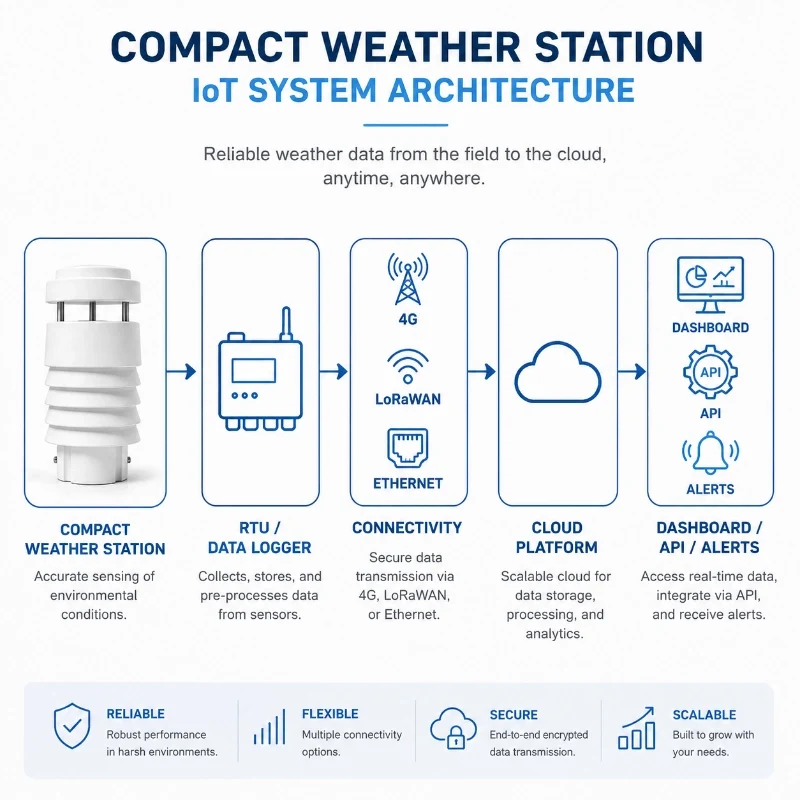
RS485 Modbus RTU
RS485 Modbus RTU is suitable for connecting a compact weather station to:
- RTUs
- PLCs
- Data loggers
- Industrial computers
- IoT gateways
- Local control systems
It is commonly selected for stable wired communication over short or medium distances.
4G Communication
A 4G data logger or gateway can transmit weather data directly to a remote platform where cellular coverage is available.
It is suitable for:
- Roadside stations
- Remote farms
- Solar plants
- Industrial sites
- Standalone monitoring points
LoRaWAN Communication
LoRaWAN can be used where multiple low-power monitoring devices need to transmit data to a local gateway over a relatively large area.
Typical applications include:
- Large farms
- Industrial parks
- Smart city networks
- Campuses
- Distributed environmental stations
Actual communication distance depends on terrain, antenna height, buildings, interference and gateway placement.
Ethernet Communication
Ethernet is suitable for fixed sites with an existing local network, such as industrial plants, control rooms and building monitoring systems.
API and Platform Integration
JW-IoT can support project-based integration with:
- JW-IoT cloud monitoring platforms
- Customer-owned platforms
- Local servers
- SCADA systems
- Third-party IoT platforms
- API-based software systems
Customers should provide the required protocol, data format, reporting interval and server information before integration.
How to Choose the Right Compact Weather Station
Step 1: Define the Monitoring Objective
First determine what decision the data will support.
Examples include:
- Irrigation control
- Road safety
- Pollution dispersion analysis
- Smart city management
- Solar performance analysis
- Industrial compliance
- Research
- Early warning
Step 2: Select the Required Parameters
Do not choose parameters only because they are available.
Each parameter should have a clear purpose in the monitoring system.
Step 3: Confirm Measurement Requirements
Specify:
- Measurement range
- Accuracy
- Resolution
- Sampling interval
- Reporting interval
- Response time
- Calibration requirements
Step 4: Evaluate the Installation Environment
Consider:
- Minimum and maximum temperature
- Rainfall
- Snow and icing
- Salt spray
- Dust
- Corrosive gases
- High wind
- Solar exposure
- Installation height
- Lightning risk
Step 5: Select the Communication Method
Choose RS485, 4G, LoRaWAN, Ethernet or another method according to:
- Distance
- Existing infrastructure
- Data volume
- Number of stations
- Network coverage
- Power conditions
- Platform requirements
Step 6: Plan the Power Supply
Possible power options include:
- DC power
- AC power with an adapter
- Solar panel and battery system
- Local control cabinet power
Solar power should be designed according to sensor consumption, communication frequency, local solar resources and required backup time.
Step 7: Confirm the Platform and API
Before ordering, confirm whether the project needs:
- Local display
- Cloud dashboard
- Historical data
- Alarm thresholds
- User management
- Mobile access
- Data export
- API integration
- Private deployment
Step 8: Select Mounting Accessories
Possible accessories include:
- Monitoring pole
- Mounting sleeve
- Flange
- Cross arm
- Bent mounting plate
- Solar panel bracket
- Equipment cabinet
- Lightning protection
- Grounding accessories
Installation Recommendations
Choose an Open Location
The weather station should be installed away from structures that significantly block wind or generate heat.
Avoid installing it directly beside:
- Exhaust outlets
- Air-conditioning units
- Large walls
- Reflective roofs
- Chimneys
- Dense trees
- Heat-producing equipment
Keep the Station Level and Secure
The pole and bracket should be installed securely to prevent vibration, movement or incorrect orientation.
Rainfall sensors may require specific leveling instructions according to the measurement technology.
Consider Sensor Height
Installation height should be selected according to the project objective and applicable technical requirements.
A smart pole, crop field, roadside station and rooftop monitoring point may require different mounting heights.
Provide Lightning and Surge Protection
Outdoor stations should be properly grounded.
Power and communication lines may require surge protection, especially in exposed locations or areas with frequent thunderstorms.
Maintain Access for Inspection
The installation should allow technicians to:
- Clean the sensor
- Inspect cables
- Check mounting bolts
- Replace communication equipment
- Verify power supply
- Perform calibration or comparison checks
Establish a Maintenance Plan
Although integrated sensors can reduce installation complexity, they still require regular inspection.
Maintenance may include:
- Cleaning the sensor housing
- Removing dust or bird droppings
- Checking drainage
- Inspecting cables and connectors
- Verifying communication
- Checking the power system
- Comparing data with reference instruments
- Reviewing calibration intervals
Recommended JW-IoT Compact Weather Station Configurations
Four-Parameter Compact Weather Station
Recommended for projects requiring:
- Air temperature
- Relative humidity
- Atmospheric pressure
- Optical rainfall
Suitable applications include:
- Smart agriculture
- Distributed weather monitoring
- Mobile monitoring
- Roads
- Solar sites
- Urban microclimate stations
View the Four-Parameter Compact Weather Station
Five-Parameter Compact Weather Station
Recommended for applications requiring a compact wind and basic meteorological sensor combination.
Typical applications include:
- Agriculture
- Solar PV plants
- Road weather monitoring
- Wind farms
- Environmental monitoring
View the Five-Parameter Compact Weather Station
All-in-One Integrated Weather Station
Recommended for multi-parameter outdoor weather monitoring where a compact integrated structure is required.
View the All-in-One Integrated Weather Station
Ten-in-One Environmental Weather Station
Recommended for smart city and industrial environmental projects requiring weather, particulate matter, rainfall and noise monitoring.
View the Ten-in-One Compact Weather Station
Thirteen-in-One Environmental Weather Station
Recommended for projects requiring meteorological data together with particulate and selected gas monitoring parameters.
View the 13-in-1 Compact Weather Station
Request a Compact Weather Station Quote
Selecting a compact weather station requires more than choosing the number of parameters.
The station should match:
- Your monitoring objective
- Required parameters
- Measurement performance
- Installation environment
- Communication network
- Power supply
- Software platform
- Maintenance conditions
Send JW-IoT your project requirements for a preliminary product and system configuration.