+86 13520127780
  info@jingelway.com








JW-IoT Strengthens Product Quality Assurance with Advanced Testing and Calibration Capabilities
Release time: 2026-08-26
Reliable environmental monitoring starts long before a sensor is installed in the field. It begins with measurement standards, calibration, verification and systematic quality control.
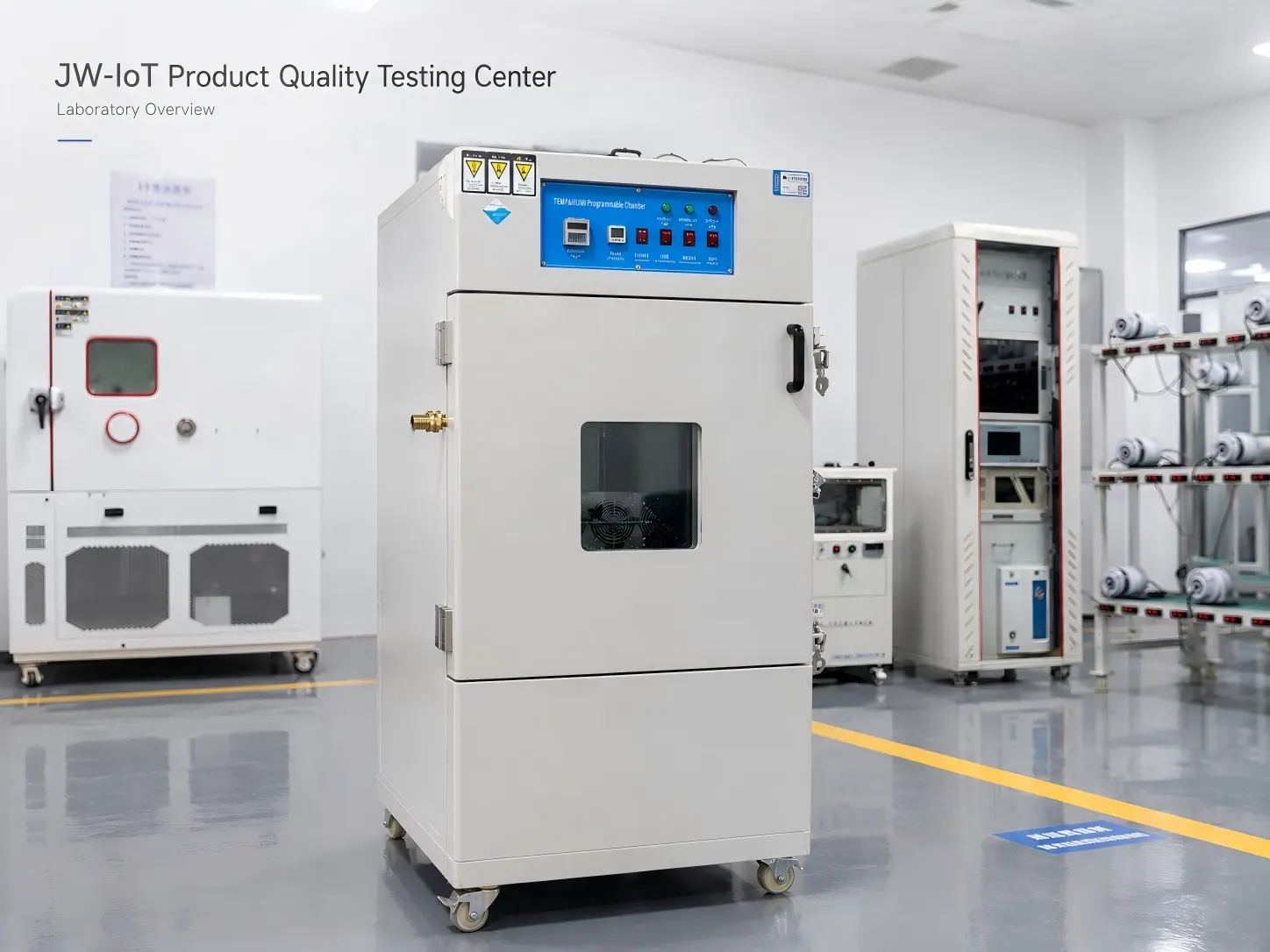
To further strengthen the accuracy, consistency and environmental reliability of sensing products, the Product Quality Testing Center supporting JW-IoT’s sensing and monitoring products has continued to expand its calibration, testing and reliability verification capabilities.
Established on March 20, 2023, the center was planned with a total investment of approximately 1.5 million US dollars, with around 0.84 million US dollars invested during the first phase. Covering more than 1,000 square meters, the facility has been developed around the principles of impartiality, scientific methodology, accuracy and efficiency.
The objective is not simply to inspect finished products. The center is designed to build a systematic quality assurance foundation covering measurement traceability, calibration, product verification, type testing and environmental reliability evaluation.
For customers deploying monitoring equipment in agriculture, meteorology, solar energy, water management, smart cities and industrial environments, this capability helps provide greater confidence in the data generated by sensors operating in real-world conditions.
Building Quality into Environmental Monitoring Products
Environmental sensors are often expected to operate continuously for months or years.
A weather station installed on a farm may experience intense sunlight, rainfall, wind and large temperature variations. A sensor deployed beside a highway may face dust, vibration and rapidly changing weather conditions. Equipment used for solar power plants or water-management projects may need to maintain stable measurements across very different climates.
For this reason, quality control for environmental monitoring equipment cannot depend only on visual inspection or basic functional testing.
A comprehensive process may involve:
- calibration against established measurement standards;
- verification across multiple measurement points;
- accuracy and repeatability testing;
- environmental adaptation testing;
- type testing;
- reliability evaluation;
- product consistency inspection.
By combining these procedures, the testing center helps strengthen the quality foundation behind JW-IoT’s growing portfolio of weather monitoring systems, environmental sensors and IoT monitoring solutions.
Professional Technical and Management Team
A reliable laboratory requires not only advanced equipment but also experienced technical personnel and a structured quality-management system.
The Product Quality Testing Center has established both a comprehensive management office and a calibration laboratory, forming an integrated management and technical framework.
The center currently has a professional team of nine personnel, with professional qualifications and responsibilities including:
- 1 Level I Registered Metrologist
- 2 Level II Registered Metrologists
- 5 testing and calibration technicians
- 3 management-system internal auditors
The combination of metrology specialists, calibration personnel and quality-system auditors supports both technical testing activities and laboratory management.
This organizational structure is particularly important for sensor manufacturers because measurement accuracy must be supported by both technical competence and repeatable processes.
More Than 1,000 m² of Specialized Testing Facilities
The center has developed dedicated laboratories and testing areas for different types of meteorological and environmental instruments.
Closed-Circuit Wind Tunnel Laboratory
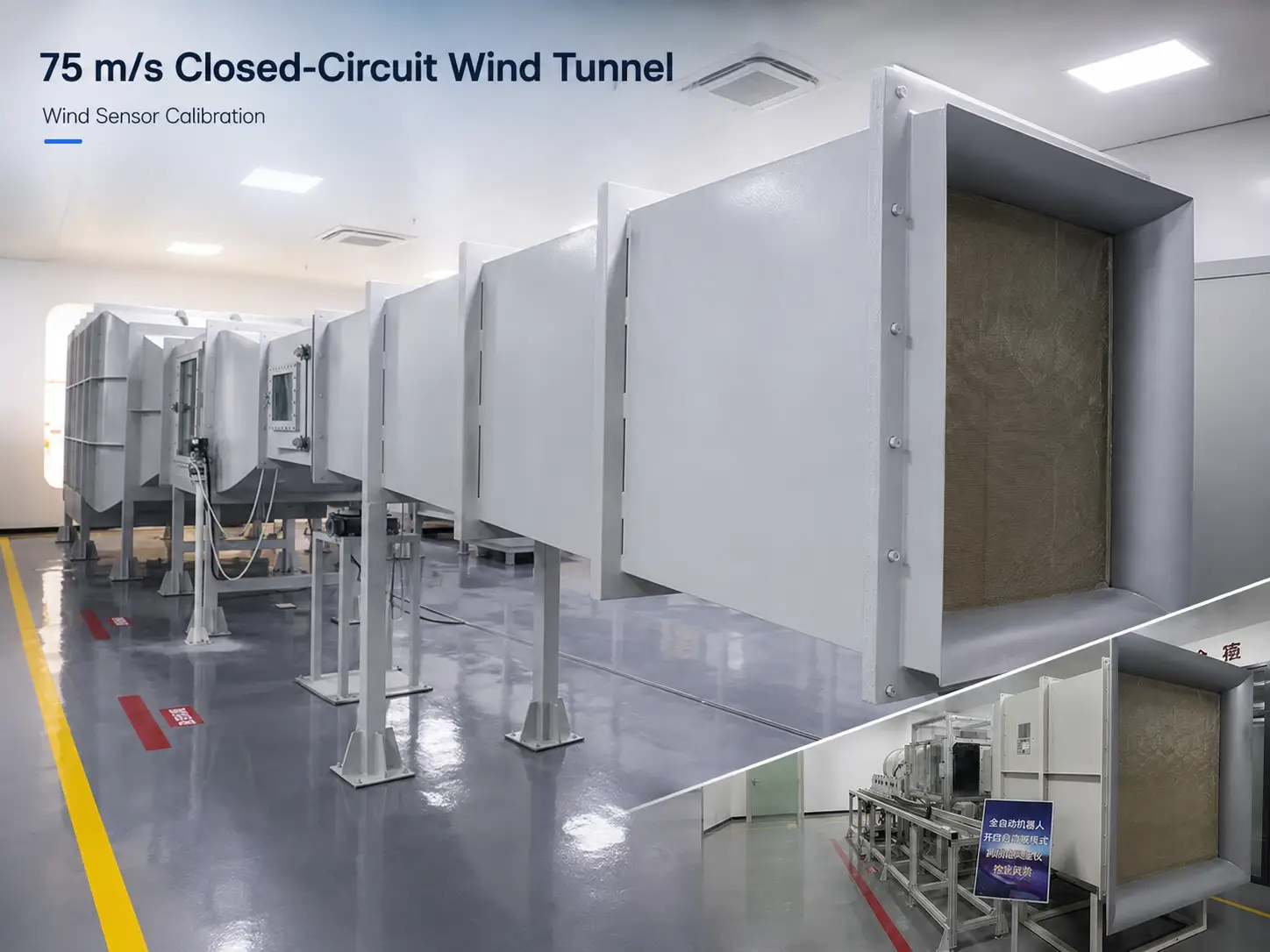
Wind measurement is one of the most challenging aspects of meteorological sensing.
To support the evaluation and calibration of wind sensors, the center operates a closed-circuit wind tunnel laboratory equipped with a 75 m/s dual-test-section closed-circuit wind tunnel.
The facility provides controlled airflow conditions for evaluating wind-measurement equipment across different wind-speed ranges.
This capability is highly relevant to products such as:
- ultrasonic wind sensors;
- mechanical wind speed sensors;
- wind direction sensors;
- multi-parameter weather stations;
- compact meteorological monitoring systems.
Wind measurement accuracy plays an important role in agricultural monitoring, environmental pollution analysis, road weather monitoring, solar power plants and industrial meteorological applications.
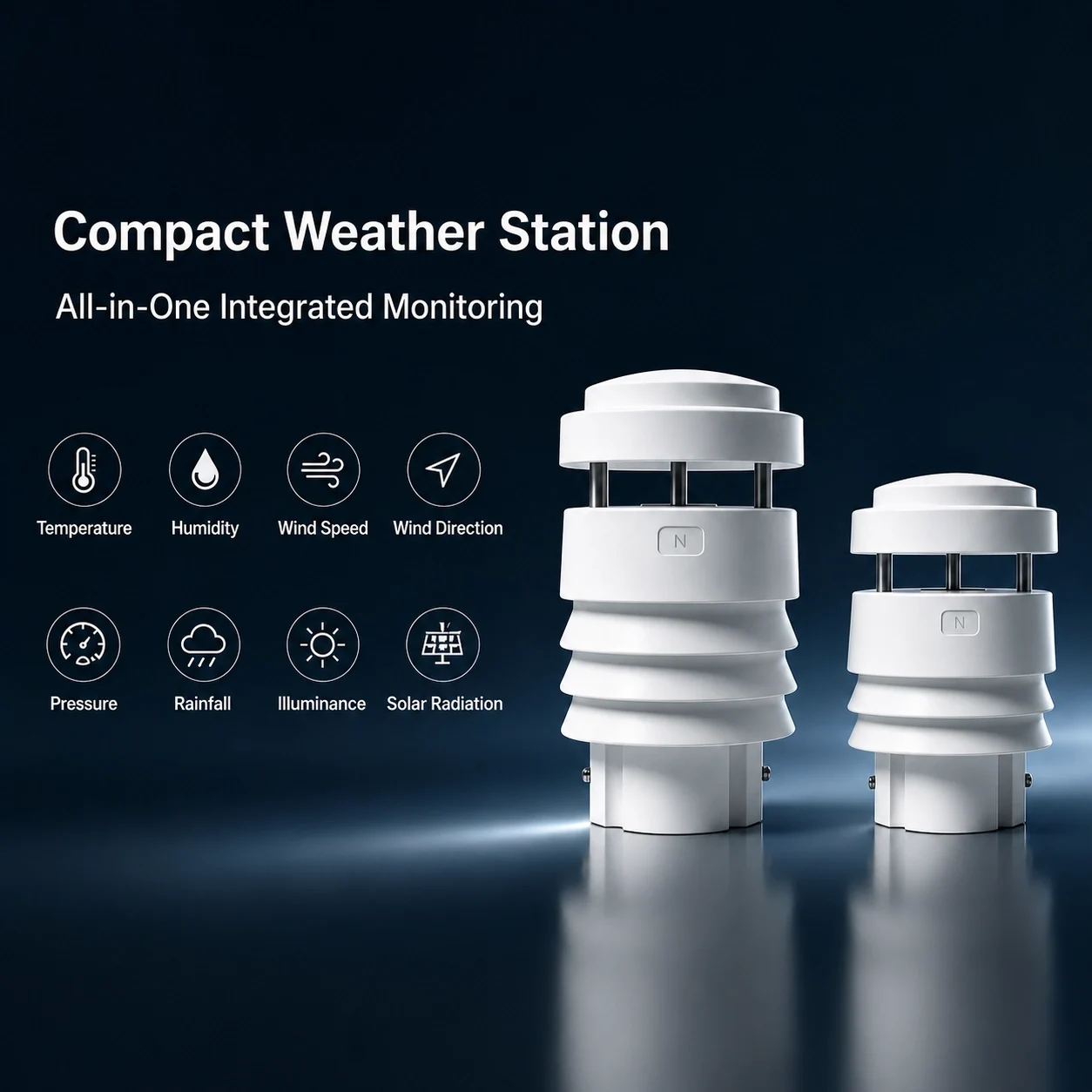
JW-IoT’s Integrated Weather Station portfolio includes systems combining wind speed and wind direction with parameters such as temperature, humidity, atmospheric pressure, rainfall and solar radiation.
Automatic Wind Speed Calibration Laboratory
In addition to the wind tunnel facility, the center has established a fully automatic wind speed calibration laboratory.
Automation helps improve the consistency and repeatability of calibration procedures while reducing unnecessary manual intervention.
For project customers deploying tens or hundreds of monitoring points, sensor-to-sensor consistency can be just as important as the accuracy of an individual instrument.
A distributed monitoring network produces its greatest value when data from different monitoring points can be meaningfully compared.
Temperature and Humidity Calibration Capabilities
Air temperature and relative humidity are fundamental parameters in almost every environmental monitoring system.
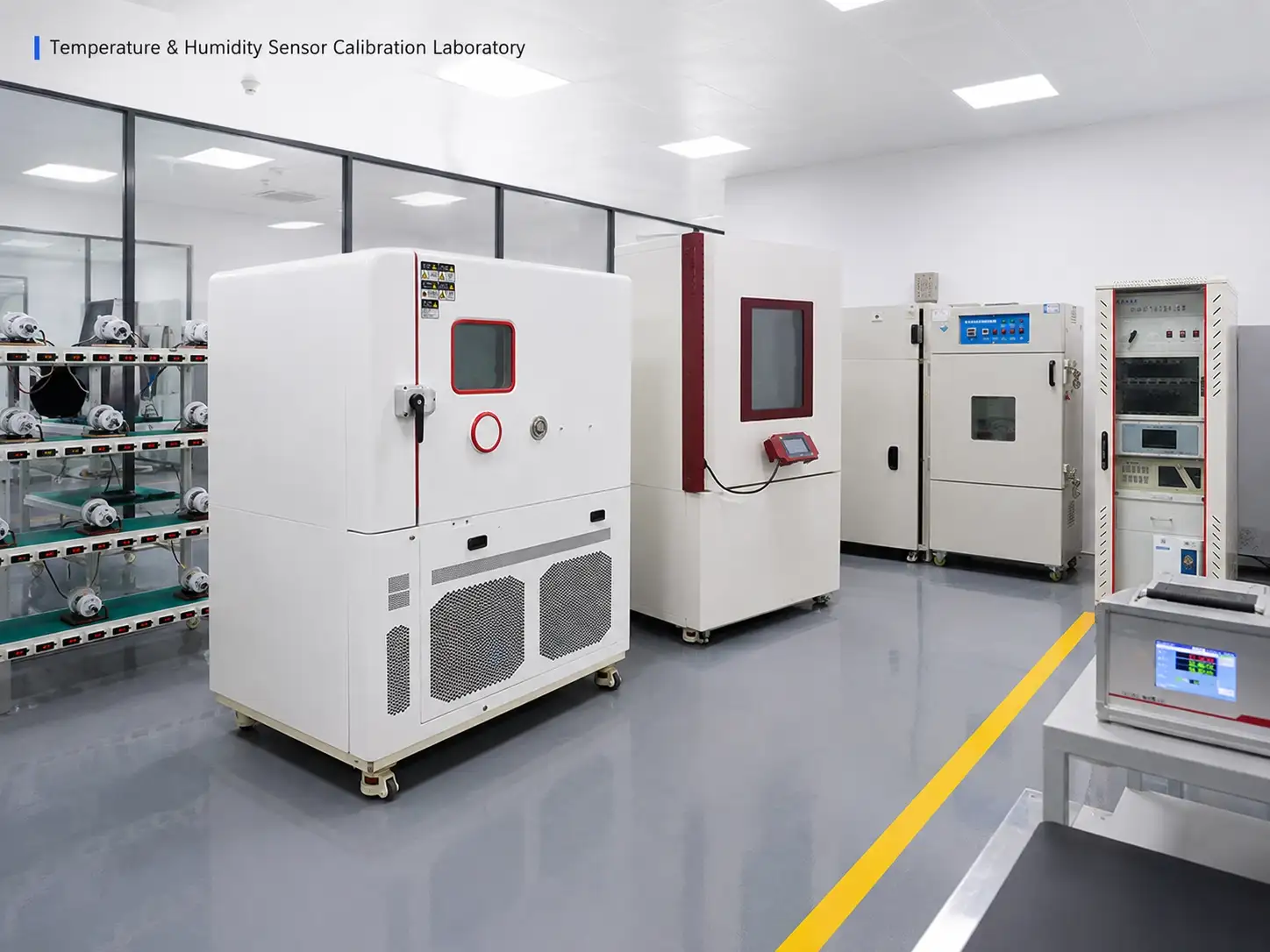
The center has therefore established a dedicated air temperature and humidity calibration area, supported by equipment including intelligent temperature and humidity calibration chambers.
Controlled temperature and humidity environments allow technicians to evaluate sensor response under different operating conditions.
These capabilities support quality verification for temperature and humidity sensing products used in applications such as:
- smart agriculture;
- greenhouse monitoring;
- environmental monitoring;
- weather stations;
- industrial monitoring;
- storage environments;
- smart-city monitoring.
For a compact integrated weather station, accurate temperature and humidity measurement is especially important because these parameters are frequently analyzed together with rainfall, wind and atmospheric pressure.
Optical Darkroom and Radiation Measurement Capability
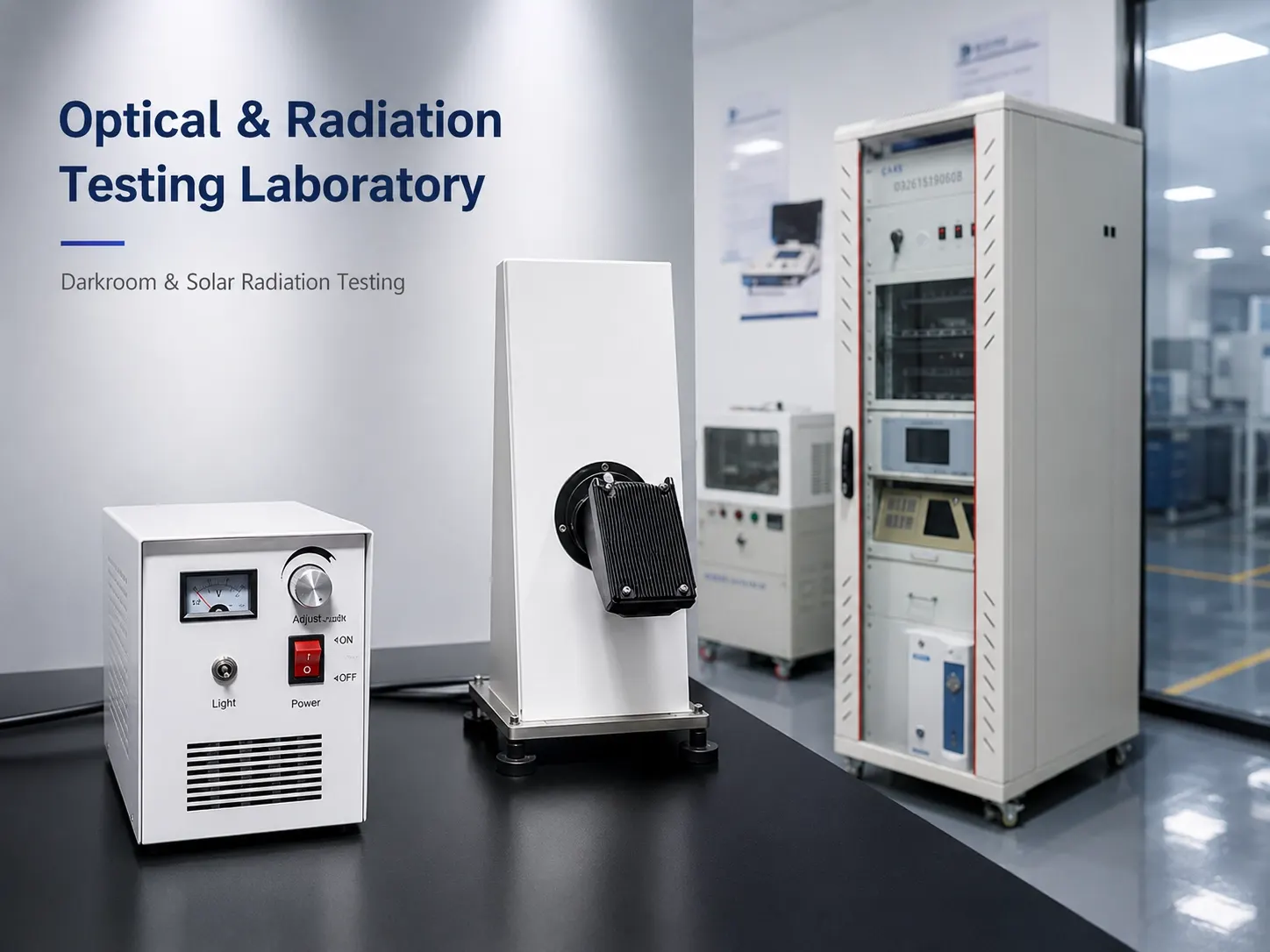
The center has also established an optical darkroom and introduced equipment such as a simulated solar xenon-lamp light source system.
Optical testing capabilities create a foundation for expanding verification and calibration work involving illuminance and radiation-related sensors.
This is increasingly important as environmental monitoring extends beyond traditional temperature, humidity, wind and rainfall measurements.
Solar radiation data, for example, is widely used in:
- solar PV performance monitoring;
- agricultural radiation analysis;
- crop-growth research;
- ecological monitoring;
- meteorological observation.
JW-IoT already offers meteorological systems integrating solar radiation measurement, including multi-parameter stations designed for environmental and photovoltaic applications.
Enterprise Testing Standards Cover Multiple Environmental Parameters
A major focus of the testing center is establishing standardized testing procedures for the parameters used across environmental monitoring systems.
The center has developed enterprise testing standards covering areas including:
Air temperature → Relative humidity → Atmospheric pressure → Wind speed → Wind direction → Rainfall → Illuminance → Solar radiation → Soil moisture
This parameter coverage closely reflects the needs of modern environmental IoT projects.
Rather than relying on a single sensor, many monitoring systems now integrate multiple environmental variables to provide better context for decision-making.
For example, an agricultural monitoring system may analyze soil moisture together with rainfall, temperature, humidity and solar radiation.
A smart-city system may combine temperature, humidity, wind and particulate matter.
A solar PV monitoring system may correlate irradiance, module temperature and meteorological conditions with plant output.
Building testing capabilities across these parameters therefore helps support the development of integrated sensing systems rather than isolated devices.
Type Testing and Environmental Reliability Laboratories
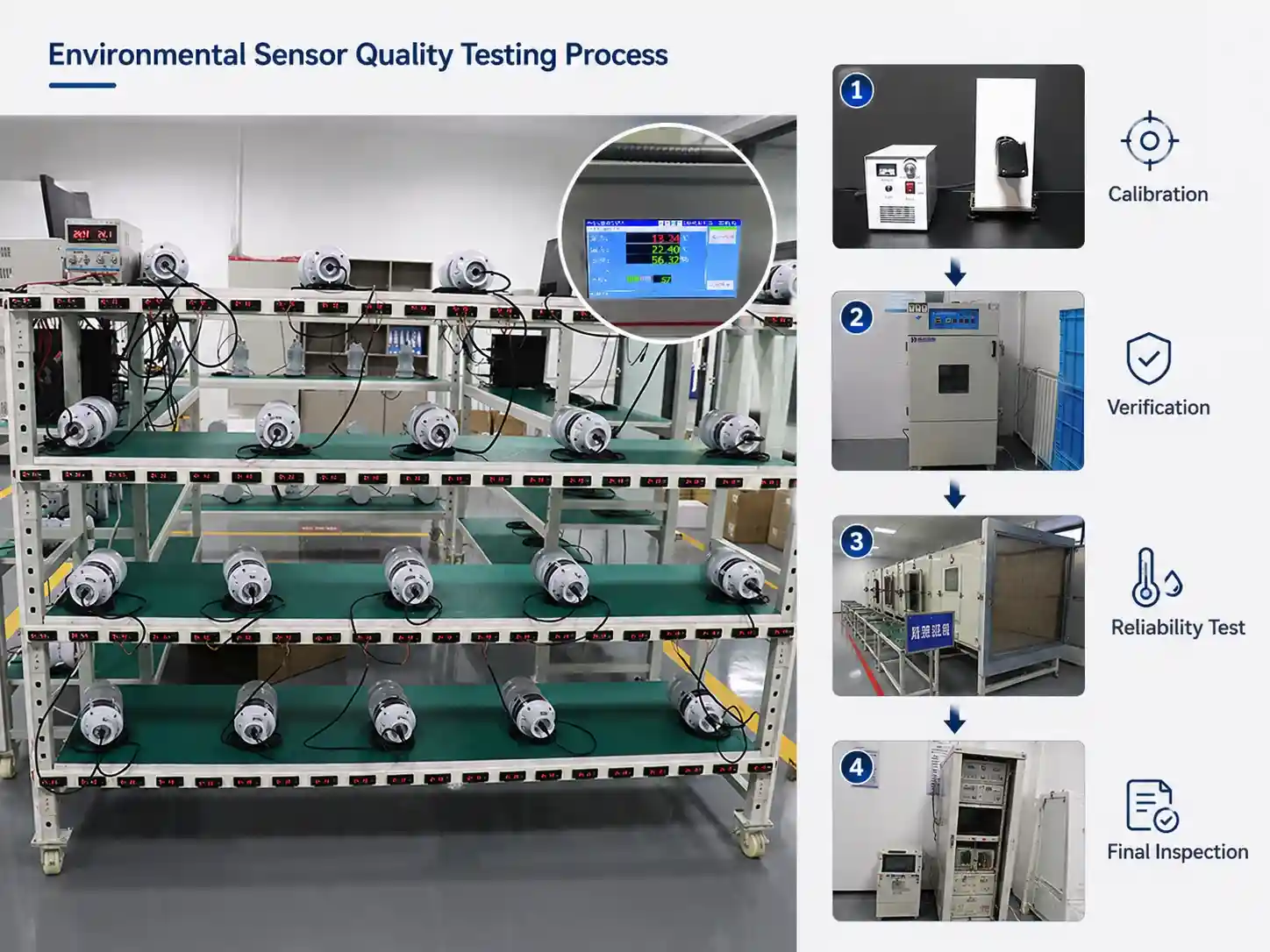
Accuracy under laboratory conditions is only one part of product quality.
Environmental monitoring equipment is frequently installed outdoors and exposed to challenging conditions.
To strengthen evaluation beyond calibration alone, the center has also established a type testing laboratory and an environmental reliability laboratory.
These facilities are intended to help evaluate whether products maintain stable operation under more complex working conditions.
Environmental reliability testing is especially relevant for monitoring equipment deployed in:
- remote agricultural fields;
- highways and bridges;
- solar power plants;
- industrial sites;
- water-management projects;
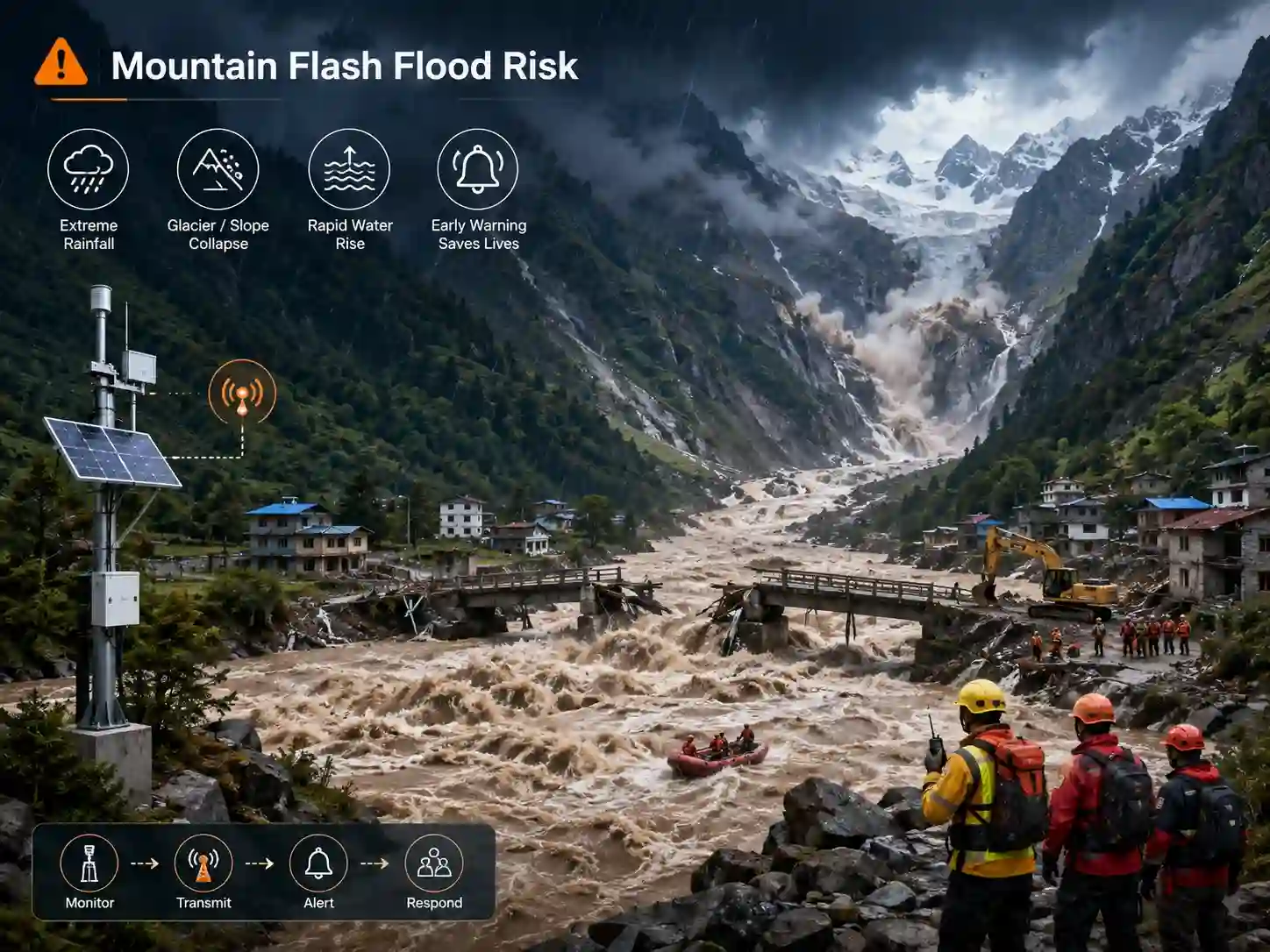
- mountain and flood-monitoring locations;
- outdoor smart-city networks.
For international projects, this is particularly important because a sensor designed for one climate may ultimately be deployed in a desert, tropical region, high-altitude area or cold environment.
Quality assurance must therefore consider not only measurement performance, but also whether the complete product can remain dependable throughout long-term field operation.
Expanding Calibration Capabilities
The center’s current CNAS calibration scope covers several categories of measuring instruments, including:
- ultrasonic wind speed and wind direction instruments;
- mechanical wind speed sensors;
- digital temperature and humidity meters.
The center is continuing to expand its calibration and measurement capabilities.
The expansion roadmap includes additional categories such as:
- rainfall instruments;
- atmospheric pressure instruments;
- multi-parameter micro-weather instruments.
Longer-term development will extend toward areas including:
radiation measurement, optical measurement, soil sensing and other environmental measurement fields.
This expansion is important because modern environmental monitoring increasingly depends on multi-parameter sensing.
A complete monitoring station may contain six, ten or even more sensing elements. Developing testing capability across these parameters helps create a more comprehensive quality-control chain.
What Does This Mean for JW-IoT Customers?
For an engineering company, distributor or system integrator purchasing sensors, product specifications are important—but specifications alone do not guarantee a successful project.
Customers also need to consider:
- How is measurement accuracy verified?
- Can different production batches maintain consistent performance?
- Has the sensor been evaluated under controlled conditions?
- Can the equipment withstand the environment in which it will actually operate?
- Does the manufacturer have the technical infrastructure to investigate measurement or quality issues?
The development of the Product Quality Testing Center strengthens the technical foundation behind these questions.
For JW-IoT customers, this contributes to four important areas.
1. Greater Measurement Confidence
Calibration and controlled testing help verify whether sensors perform within defined measurement requirements.
2. Better Product Consistency
Standardized testing procedures can help identify differences between products and production batches before equipment reaches project sites.
3. Stronger Outdoor Reliability
Type testing and environmental reliability evaluation provide additional information about how equipment performs beyond normal laboratory conditions.
4. Better Support for Customized Projects
Many JW-IoT projects require customized combinations of sensors, communications and system architectures.
Customers may require a configuration such as:
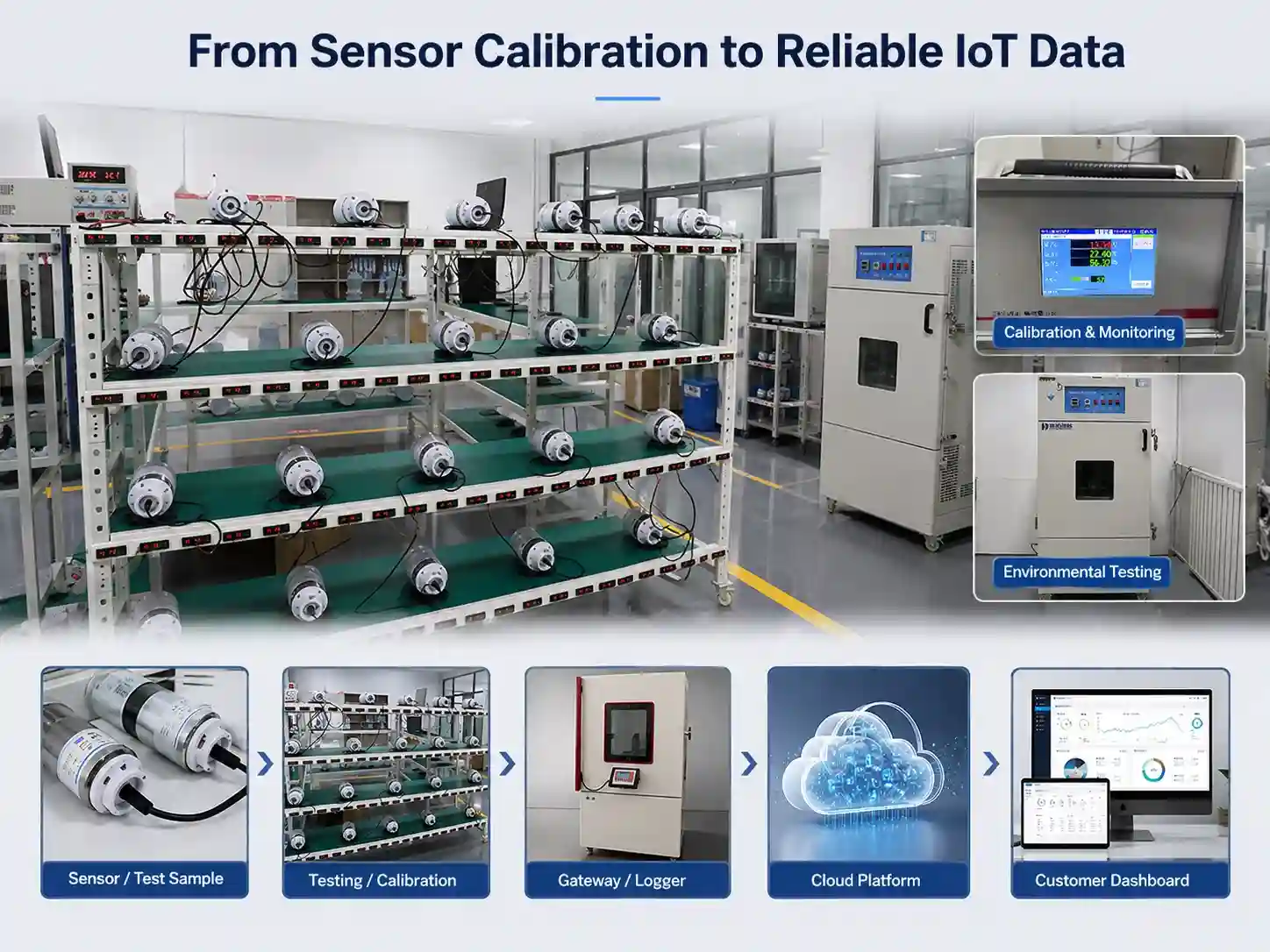
Sensor → RS485 → Data Logger → LoRaWAN/4G → Cloud Platform
Having broader internal testing capability helps support the verification of sensors used within these integrated configurations.
Supporting JW-IoT’s Global Environmental IoT Strategy
JW-IoT focuses on sensing technologies and integrated IoT monitoring systems for applications including smart agriculture, environmental monitoring, water management, renewable energy, industrial IoT and smart cities.
As these projects become increasingly data-driven, the quality of the final decision depends heavily on the quality of the original measurement.
A cloud platform cannot correct unreliable source data.
An AI model cannot compensate for a sensor that has not been properly verified.
A multi-point IoT network cannot provide meaningful comparisons if different instruments produce inconsistent measurements.
That is why JW-IoT views measurement quality as part of the IoT architecture itself.
From sensing and calibration to communication, cloud platforms and system integration, reliable data must remain the foundation of the complete monitoring chain.
Learn more about JW-IoT and our sensing and IoT capabilities.
From Sensor Accuracy to Reliable Project Data
The Product Quality Testing Center represents an ongoing investment in measurement capability, laboratory infrastructure and quality assurance.
With specialized facilities for wind, temperature, humidity, optical measurement, type testing and environmental reliability—and with further expansion planned across rainfall, pressure, micro-meteorology, radiation and soil measurement—the center is building a broader technical foundation for environmental sensor quality control.
For JW-IoT, the objective is clear:
Reliable IoT starts with reliable measurement.
As we continue expanding into international markets and increasingly complex environmental monitoring projects, testing, calibration and reliability verification will remain central to how we develop and deliver sensing solutions.
Whether the application involves a single environmental sensor or a distributed monitoring network with hundreds of measurement points, JW-IoT will continue strengthening the technical capabilities required to deliver accurate, stable and dependable environmental data.
Explore JW-IoT Monitoring Solutions
- Integrated Weather Stations
- Weather Monitoring Systems
- JW-IoT Products
- JW-IoT Technology & Services
- About JW-IoT
FAQ
1. What does the Product Quality Testing Center test?
The center supports calibration, verification, type testing and environmental reliability evaluation for meteorological and environmental sensing equipment. Its testing standards cover parameters including temperature, relative humidity, atmospheric pressure, wind speed, wind direction, rainfall, illuminance, solar radiation and soil moisture.
2. Does the center have wind sensor calibration capability?
Yes. The center has a closed-circuit wind tunnel laboratory and an automatic wind speed calibration laboratory, including a 75 m/s dual-test-section closed-circuit wind tunnel for controlled wind testing.
3. What instruments are currently included in its CNAS calibration scope?
The current scope covers categories including ultrasonic wind speed and wind direction instruments, mechanical wind speed sensors and digital temperature and humidity meters.
4. Why is sensor calibration important for IoT monitoring?
IoT platforms, analytics and automated decisions depend on the accuracy of source data. Calibration and verification help improve measurement confidence and consistency before sensor data is transmitted to gateways, cloud platforms or customer systems.
5. Will the testing center expand its capabilities?
Yes. Planned development includes rainfall instruments, pressure instruments and multi-parameter micro-weather instruments, with longer-term expansion toward radiation, optical and soil measurement capabilities.