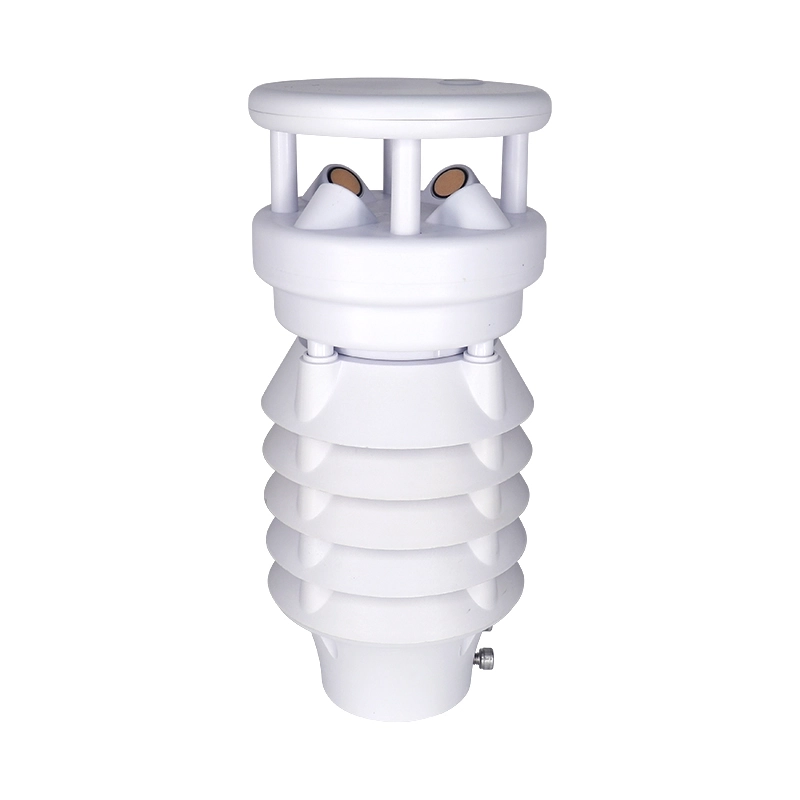
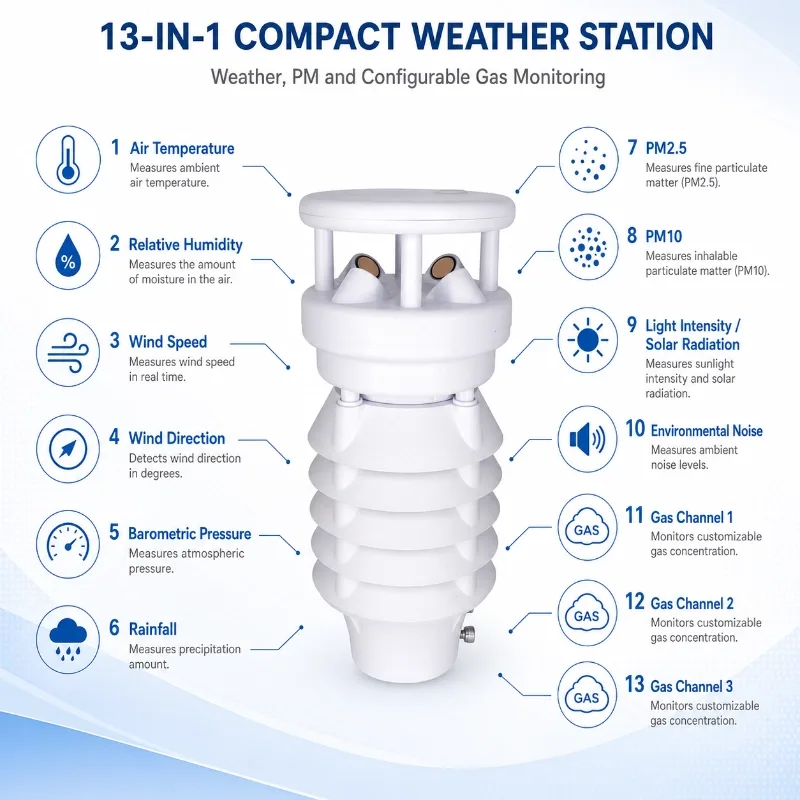
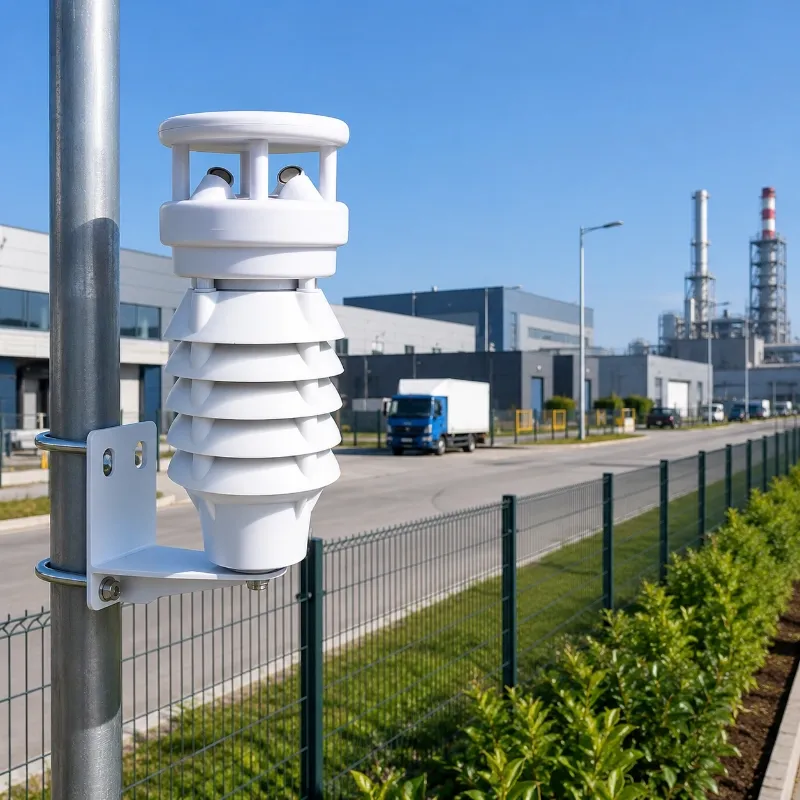
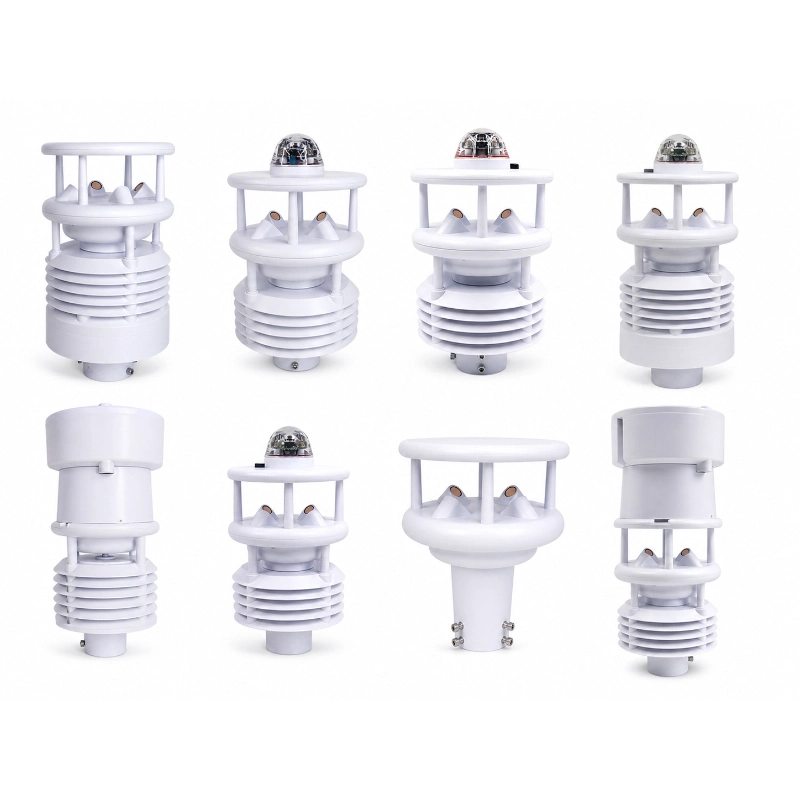
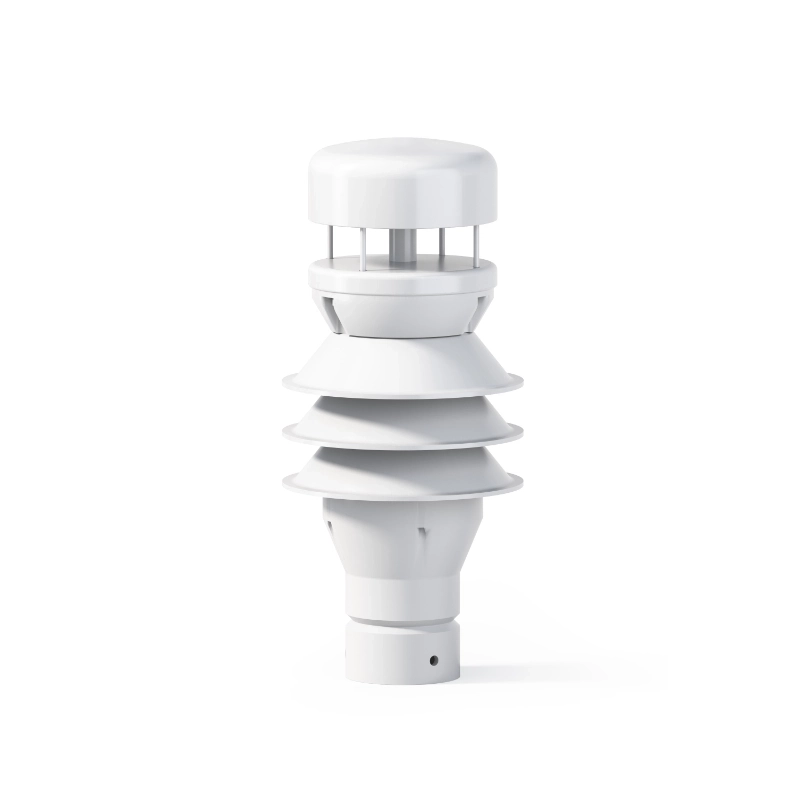
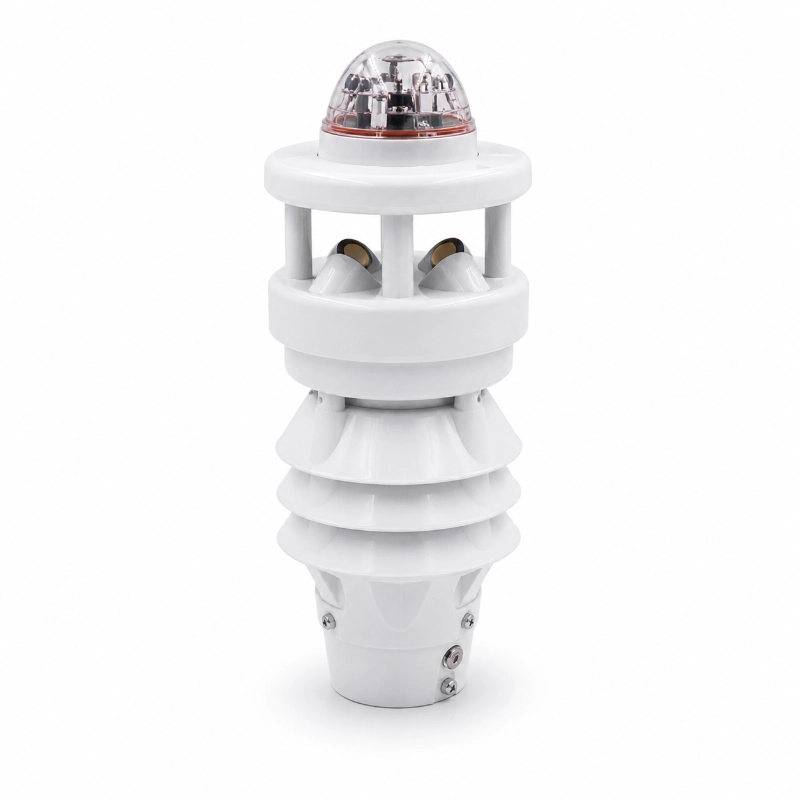
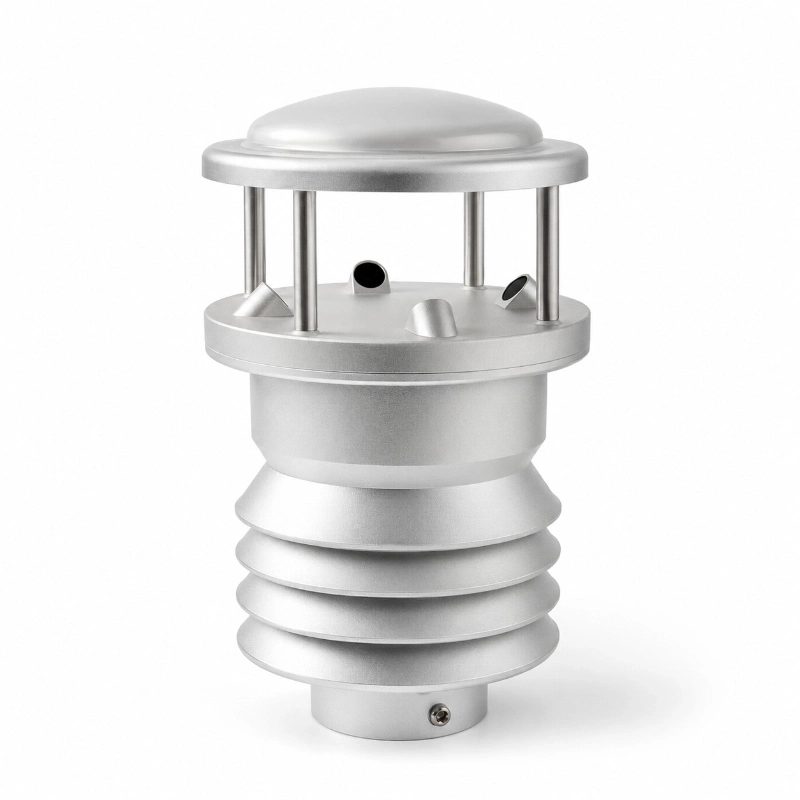
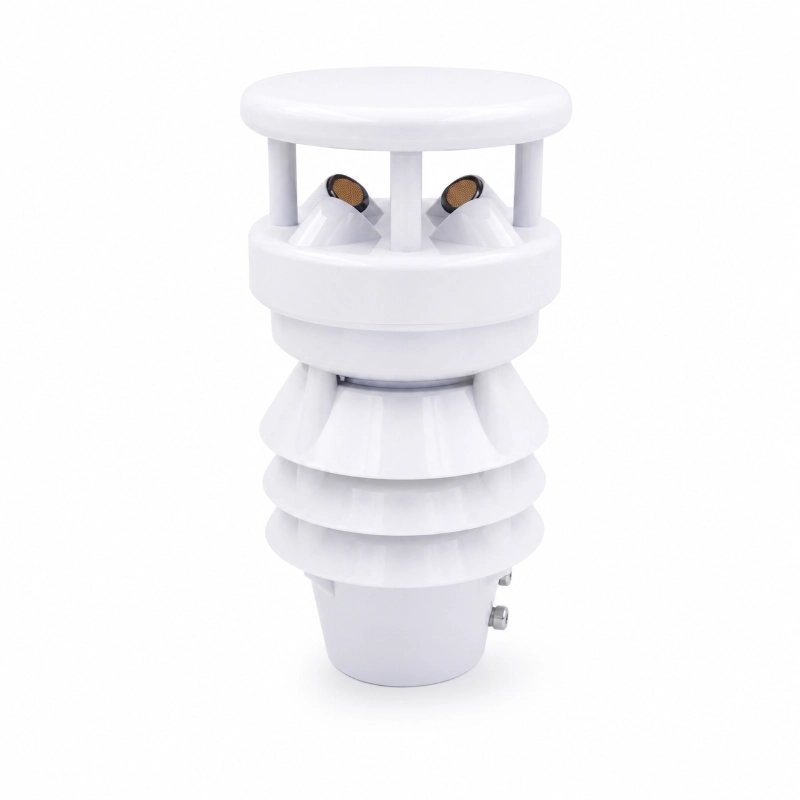
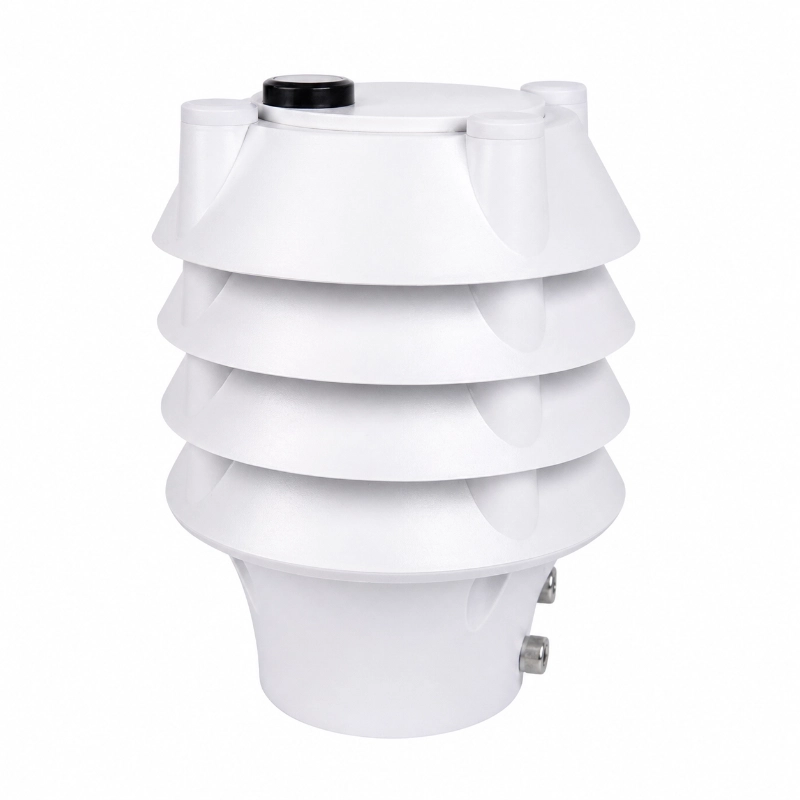
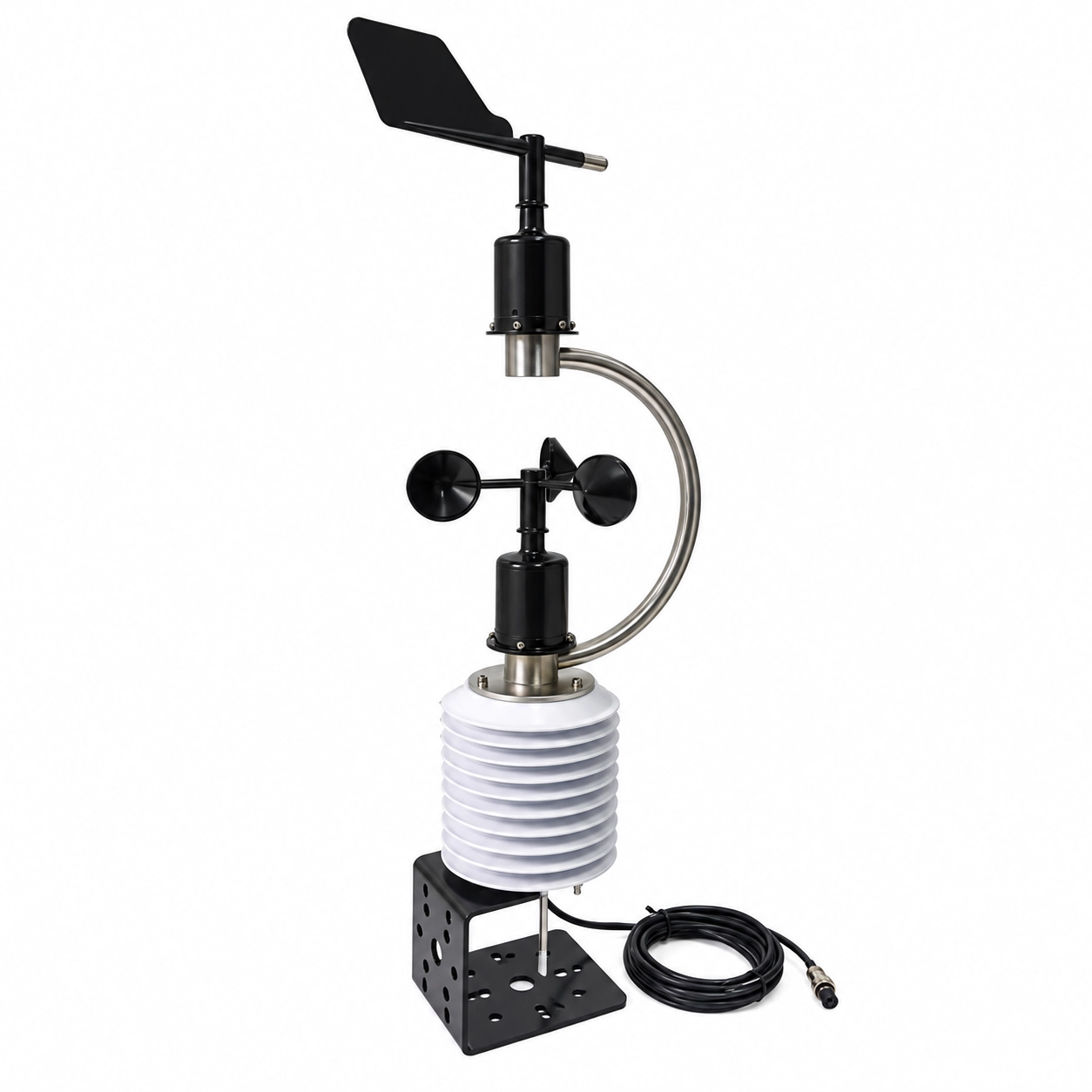
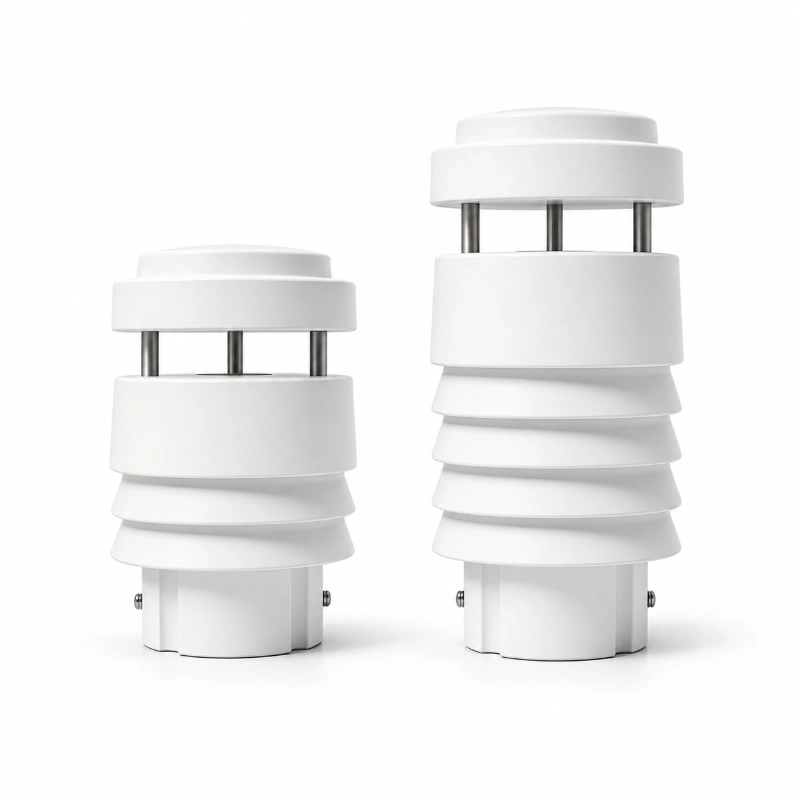
JW-XF1013(YN29) 13-in-1 Compact Weather Station is an integrated outdoor environmental monitoring device designed to measure meteorological conditions, particulate matter and configurable gas parameters from one compact installation point.
Depending on the selected configuration, the station can combine:
Air temperature
Relative humidity
Wind speed
Wind direction
Barometric pressure
Rainfall
PM2.5
PM10
Light intensity or solar radiation
Environmental noise
One or more optional gas parameters
Available gas options can be configured according to the project requirements. Typical options may include gases such as carbon monoxide, sulfur dioxide, nitrogen dioxide, ozone, hydrogen sulfide, combustible gas, carbon dioxide or other supported targets.
The exact gas type, measuring range, sensor technology, accuracy, resolution, expected service life and number of simultaneously installed gas modules must be confirmed before ordering.
With standard industrial communication, the station can connect to a data logger, RTU, PLC, IoT gateway, smart pole controller, SCADA system or cloud environmental monitoring platform.
It is suitable for smart cities, industrial parks, roadside monitoring, factory boundaries, logistics zones, construction areas, campuses, communities and distributed environmental monitoring networks.
What Is a 13-in-1 Compact Weather Station?
A 13-in-1 compact weather station combines multiple meteorological and environmental sensors inside one outdoor monitoring unit.
A conventional compact weather station usually measures basic parameters such as temperature, humidity, wind and pressure. This configuration extends the monitoring capability by adding:
PM2.5
PM10
Gas detection
Rainfall
Light or solar radiation
Environmental noise, depending on the selected version
The purpose is not only to collect more data. It is to measure weather and pollution conditions at the same location and time.
This helps users interpret whether changes in particulate matter or gas concentration may be associated with:
This distinction should be clearly understood before selecting the equipment.
Environmental Monitoring
The 13-in-1 station is suitable for:
Continuous trend monitoring
Distributed environmental networks
Outdoor air pollution assessment
Weather-correlated pollution analysis
Smart city dashboards
Industrial perimeter monitoring
Historical data analysis
Remote IoT monitoring
Personnel Safety Monitoring
A dedicated safety gas detector may be required when the system is used for:
Life-safety alarms
Confined spaces
Toxic-gas exposure protection
Explosive atmospheres
Emergency shutdown
Legally mandated workplace alarms
SIL-related functions
Hazardous-area compliance
The suitability of the compact station depends on the sensor configuration, certification and project requirements.
Why Combine Weather, PM and Gas Data?
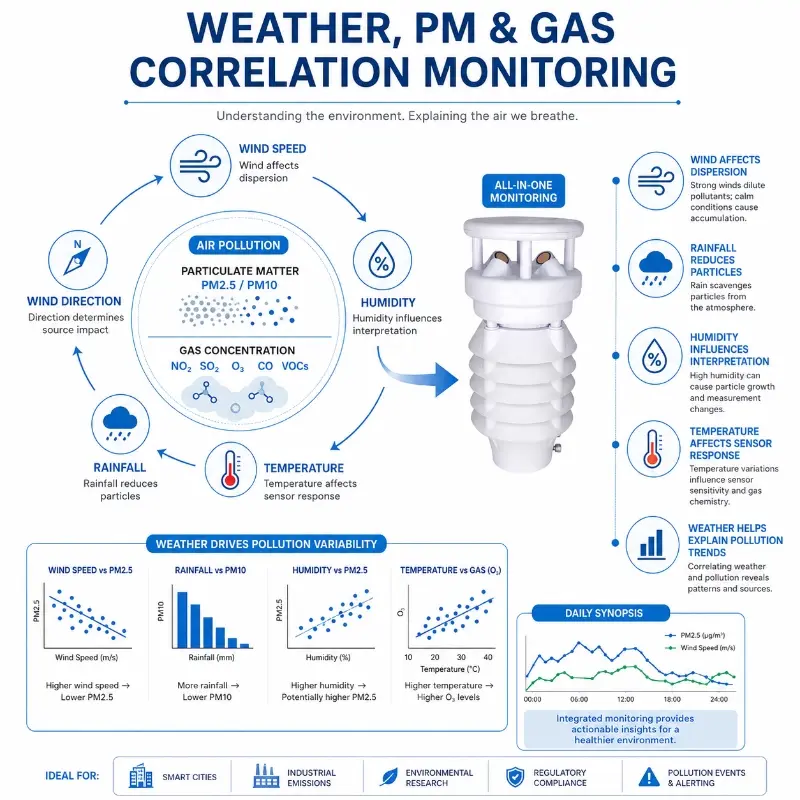
Weather conditions can strongly influence measured pollution levels.
Wind Speed and Dilution
Higher wind speed may disperse locally emitted pollutants.
Low wind conditions can allow PM or gas concentration to accumulate near roads, factory boundaries or enclosed urban areas.
Wind Direction and Source Analysis
Wind direction helps users understand where an observed increase may be coming from.
For example, a monitoring point may compare concentration changes with the direction of:
A factory
A road
A construction site
A storage area
A wastewater facility
A residential zone
A prevailing regional airflow
The station does not automatically prove the pollution source, but the combined data can support investigation.
Rainfall and Particle Removal
Rainfall can reduce suspended dust and wash particulate matter from the atmosphere.
Comparing rainfall with PM2.5 and PM10 trends helps explain why concentrations may fall during or after rain.
Humidity and Sensor Interpretation
High humidity can influence particle growth and may affect the interpretation of optical PM measurements.
Some gas sensors may also show humidity-related response variation.
Recording humidity alongside PM and gas data provides useful context for quality control and trend analysis.
Temperature and Gas Sensor Performance
Temperature can influence:
Sensor baseline
Chemical reaction rate
Diffusion
response time
Zero stability
Sensor compensation
The final sensor should therefore be selected according to the expected outdoor temperature range.
Solar Radiation and Photochemical Processes
Solar radiation can influence atmospheric chemistry, including photochemical reactions associated with certain pollutants.
Selecting the solar-radiation option can provide additional context for environmental research and urban air-quality studies.
Compact Station vs Separate Gas and Weather Sensors
Comparison
13-in-1 Compact Station
Separate Sensor System
Installation space
Lower
Higher
Number of brackets
Fewer
More
Field wiring
Simplified
More complex
Main communication connection
Consolidated
Multiple
Rapid deployment
Suitable
More installation work
Smart pole integration
Suitable
Requires more space
Independent sensor replacement
More limited
More flexible
Gas-module flexibility
Configuration-dependent
Highly flexible
Individual calibration
Centralized configuration
Easier per instrument
High-end regulatory monitoring
Project-dependent
Easier to specify separately
Choose the compact station when the project prioritizes:
Fast deployment
Limited mounting space
Distributed monitoring points
Unified communication
Weather and pollution correlation
Smart city or industrial IoT integration
Choose separate instruments when the project requires:
Different sampling heights
Regulatory reference methods
Independent calibration intervals
Redundant gas sensors
Specialized gas-conditioning systems
Heated sampling lines
Explosion-proof instruments
High-accuracy meteorological sensors
Easy replacement of individual channels
Technical Configuration
Because the exact 13-parameter combination can vary, the original verified specification table should remain on the page.
The following overview can be placed above it.
Parameter
Specification
Product Type
Thirteen parameter compact weather station
Measured Parameters
Temperature humidity pressure wind speed wind direction PM2.5 PM10 CO NO2 SO2 O3 H2S or TVOC noise
Air Temperature Range
-40 to 60°C
Air Temperature Accuracy
±0.3°C at 25°C
Air Temperature Resolution
0.01°C
Air Humidity Range
0 to 100%RH
Humidity Accuracy
±3%RH from 10% to 80%RH non condensing
Humidity Resolution
0.01%RH
Wind Speed Range
0 to 60 m/s
Wind Speed Accuracy
±0.3 plus 0.03V m/s when V ≤ 30 m/s
Wind Direction Range
0 to 359.9°
Wind Direction Accuracy
±3° when wind speed is below 10 m/s
Barometric Pressure Range
500 to 1100 hPa
Barometric Pressure Accuracy
±0.5 hPa at 25°C from 950 to 1100 hPa
PM2.5 Range
0 to 500 μg/m³ expandable to 1000 μg/m³
PM10 Range
0 to 500 μg/m³ expandable to 1000 μg/m³
CO Range
0 to 10 ppm
NO2 Range
0 to 5 ppm
SO2 Range
0 to 5 ppm
O3 Range
0 to 5 ppm
H2S Range
0 to 2 ppm
TVOC Range
0 to 10 ppm
Noise Range
30 to 130 dB
Working Temperature
-30 to 70°C
Standard Output
RS485 Modbus RTU
Optional Output
SDI 12 with additional module
Power Supply
DC 9 to 24V
Protection Rating
IP65
Cable
Standard 3 m cable optional 10 m communication cable
Mounting Method
Sleeve mounting standard flange or bent plate optional
Optional Function
Heating function
Gas Sensor Technologies
Different target gases may require different sensor technologies.
Electrochemical Sensors
Electrochemical modules are commonly used for selected toxic and reactive gases.
Typical characteristics include:
Low power consumption
Compact size
Gas-specific configuration
Limited service life
Possible cross-sensitivity
Need for periodic calibration
Sensitivity to temperature and humidity
NDIR Sensors
Non-dispersive infrared technology may be used for gases that absorb infrared radiation, such as selected carbon dioxide or hydrocarbon measurements.
Typical characteristics include:
Optical measurement
Good long-term stability for suitable gases
Higher power demand than some electrochemical modules
Gas-specific optical configuration
Need for appropriate environmental compensation
Metal-Oxide or Catalytic Sensors
These technologies may be used for selected VOC or combustible-gas applications.
Their suitability depends on:
Target gas
Concentration range
Humidity
Temperature
Selectivity
Power availability
Safety requirements
The final sensor principle should be stated clearly in the technical datasheet.
RS485 and Remote Monitoring Integration
The station can provide one consolidated field-data source for multiple environmental parameters.
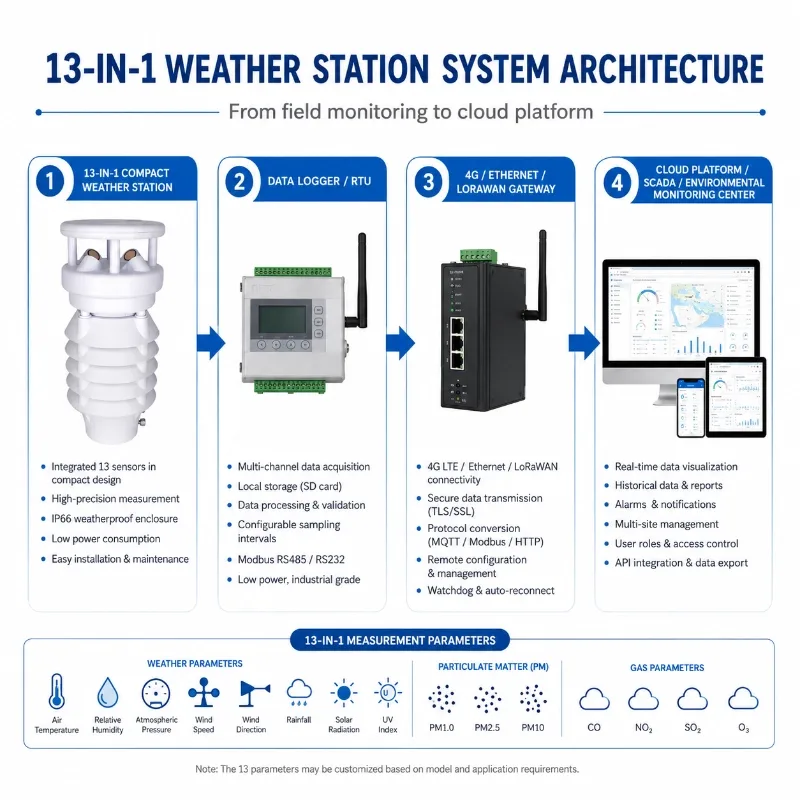
A typical architecture is:
13-in-1 Compact Weather Station
→ RS485 Modbus RTU
→ Data Logger or RTU
→ 4G, Ethernet or LoRaWAN Gateway
→ Cloud Platform, SCADA or Environmental Monitoring Center
Typical receiving equipment includes:
Environmental data loggers
Remote terminal units
PLCs
Smart pole controllers
Industrial gateways
4G communication terminals
LoRaWAN nodes or gateways
Local monitoring cabinets
SCADA systems
Third-party cloud platforms
The platform can be configured to display:
Real-time values
Historical trends
Map-based monitoring points
Threshold alarms
Daily and monthly reports
Gas and weather correlations
PM trend charts
Device communication status
Data export
API data access
Typical Applications
Smart City Air Quality Monitoring
The station can be installed across urban districts to collect local weather, PM and selected gas data.
Industrial parks may install monitoring points around:
Factory boundaries
Production zones
Internal roads
Storage yards
Logistics areas
Waste handling areas
Community interfaces
Dominant downwind locations
The station can help compare gas and particulate trends with wind direction and local weather.
Factory Perimeter Monitoring
Factory-boundary monitoring may focus on:
PM2.5 and PM10
Selected process-related gases
Wind speed
Wind direction
Rainfall
Temperature
Humidity
Monitoring location and sensor range should be selected according to the expected source and prevailing wind.
Roadside and Traffic Monitoring
Traffic monitoring projects may configure:
Carbon monoxide
Nitrogen dioxide
PM2.5
PM10
Noise
Wind
Rainfall
Temperature
Humidity
The station can be mounted on roadside poles, traffic infrastructure or smart light poles, subject to safe installation and representative airflow.
Construction-Site Monitoring
A construction-area station can monitor:
Dust
Noise
Wind speed
Wind direction
Rainfall
Temperature
Humidity
Selected gases where relevant
The installation should avoid placing the sensor immediately beside idling equipment unless source-adjacent measurement is intended.
Wastewater and Waste Facilities
Selected configurations may support monitoring around:
Wastewater treatment plants
Sewage pumping stations
Landfills
Sludge treatment areas
Waste-transfer stations
Composting facilities
Hydrogen sulfide, methane-related indicators or other target gases should be configured according to the actual site risk and measurement objective.
Ports and Logistics Areas
Ports and logistics hubs may require combined monitoring of:
PM
Traffic-related gases
Wind
Rainfall
Noise
Temperature
Humidity
Pressure
The compact structure supports multi-point deployment where mounting and wiring space are limited.
Campuses and Communities
The station can provide environmental data for:
Schools
Universities
Hospitals
Residential communities
Parks
Public facilities
Environmental education
Information displays
Installation Recommendations
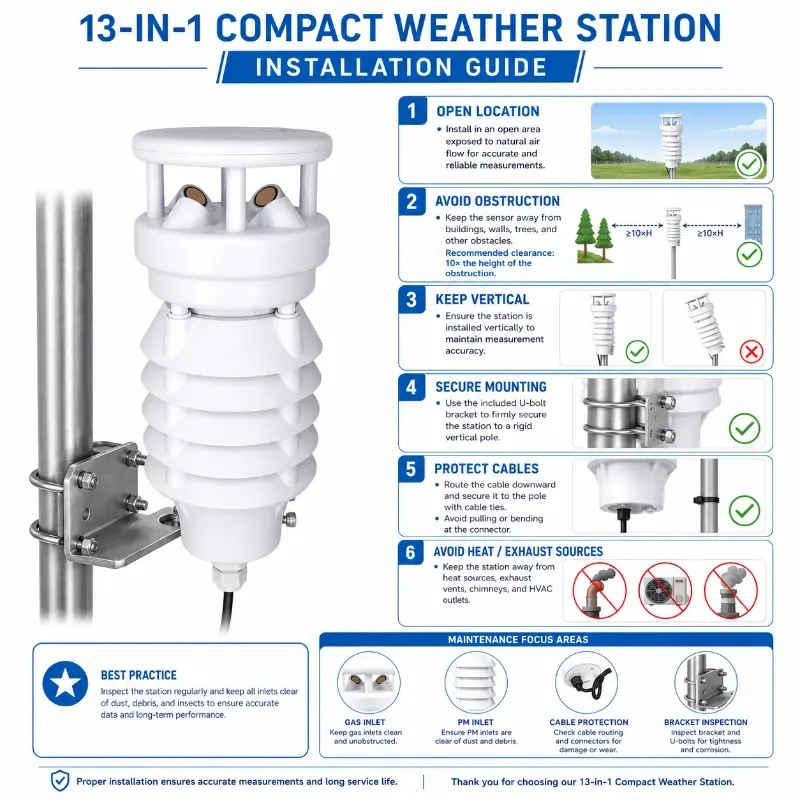
Choose a Representative Location
Install the station where the collected data represents the target environment.
Avoid placing it directly beside a single local source unless the monitoring objective is source-specific.
Maintain Open Airflow
The wind, gas and PM sections require unobstructed airflow.
Avoid installation immediately beside:
Walls
Large signs
Trees
Closed cabinets
Bridge piers
Air-conditioning units
Lamp housings
Decorative pole covers
Keep Gas and PM Inlets Clear
Do not block the sampling path with:
Brackets
Rain shields
Cable loops
Plastic covers
Leaves
Insects
Dust deposits
Paint
Pole-mounted equipment
Avoid Heat and Exhaust Interference
Do not install close to:
Exhaust fans
Chimneys
Vehicle exhaust outlets
Generator exhaust
Cooling vents
Boilers
Hot roofs
Streetlight heat sources
unless the project specifically aims to monitor that source.
Install the Station Vertically
The compact station should normally remain vertical.
A tilted device can affect airflow, optical rainfall detection, drainage and sensor exposure.
Separate the Station from Vibration
Vibration may affect noise data, fittings and long-term installation reliability.
Secure brackets, cables and nearby metal components to prevent rattling.
Protect Cables and Communication Lines
Use:
UV-resistant cable ties
Waterproof connectors
Cable conduit
Drip loops
Shielded RS485 cable
Grounding
Surge protection
Lightning protection
according to site requirements.
Consider Sensor Height
The correct height depends on the project objective.
Roadside, factory-boundary and city-network installations may require different mounting heights. Do not apply one generic height to every project without reviewing the required monitoring method.
Gas Sensor Calibration and Maintenance
Gas modules require more attention than basic weather parameters.
Recommended maintenance may include:
Zero check
Span calibration
Bump test where applicable
Baseline review
Replacement according to sensor life
Cross-sensitivity review
Inlet inspection
Moisture and condensation inspection
Temperature-compensation check
Drift analysis
Comparison with a reference instrument
Calibration frequency depends on:
Gas type
Sensor principle
Concentration range
Local regulations
Required data quality
Environmental conditions
Manufacturer recommendations
Project risk
Particulate Matter Maintenance
PM measurements may be influenced by:
Dust accumulation
Insects
High humidity
Condensation
Salt spray
Sampling obstruction
Internal fan wear
Optical contamination
Inspect the inlet and compare abnormal PM trends with humidity, rainfall and nearby activity.
How to Select the Correct Configuration
Before requesting a quotation, provide:
Project application
Target gas or gases
Expected concentration range
Number of gas channels
Required PM range
Noise requirement
Light or solar radiation requirement
Rainfall requirement
Output protocol
Data logger or RTU model
Communication method
Cloud platform requirement
API or private-server requirement
Number of monitoring points
Installation height
Pole diameter
Available power supply
Solar-power requirement
Minimum and maximum temperature
Heating requirement
Calibration requirement
Required certification
OEM or white-label requirement
When Should You Choose Another Product?
Choose the 10-in-1 Compact Weather Station
Choose the ten-parameter model when the project needs weather, PM, rainfall, light or radiation and noise, but does not need gas detection.
Choose a Gas Detection Weather Station
Choose a gas-focused configuration when gas monitoring is the primary objective and fewer meteorological parameters are required.
Choose separate sensors when the project requires:
Different mounting heights
Independent replacement
Higher sensor grades
Dedicated gas sampling
Specialized calibration
More flexible redundancy
Regulatory reference instruments
Choose a Certified Safety Gas Detector
Use certified fixed gas detectors for life-safety, hazardous-area or emergency-shutdown applications.
Request a 13-in-1 Weather and Gas Monitoring Configuration
Send JW-IoT your target gas types, expected concentration ranges, weather parameters, PM requirements, installation environment, communication method and platform requirements.
Our team will help configure a suitable compact weather, particulate matter and gas monitoring solution.
1. What does the 13-in-1 compact weather station measure?
A
It combines meteorological parameters, PM2.5, PM10 and configurable gas channels. Depending on the selected version, it may also include rainfall, light or solar radiation and environmental noise.
Q
2. Which gases can be monitored?
A
Gas options depend on the selected module. Possible targets may include CO, SO₂, NO₂, O₃, H₂S, CO₂, combustible gas or other supported gases. The final combination must be confirmed before ordering.
Q
3. Does one station measure every gas at the same time?
A
Not necessarily. The number of gas channels depends on the physical configuration, power consumption, communication map and project requirements.
Q
4. Does the station support PM2.5 and PM10?
A
Yes. PM2.5 and PM10 can be integrated with weather and gas measurements.
Q
5. Why are wind speed and wind direction important?
A
Wind data helps users interpret pollutant dispersion and identify the possible direction of a source.
Q
6. Does the station support RS485 Modbus RTU?
A
Yes, an RS485 Modbus RTU configuration can be provided for connection to compatible data loggers, RTUs, PLCs and gateways.
Q
7. Can data be sent through 4G or LoRaWAN?
A
Yes. The station can connect to a compatible external gateway for 4G, Ethernet or LoRaWAN transmission.
Q
8. Can high humidity affect the measurements?
A
High humidity may influence PM interpretation and the response of some gas sensors. Humidity compensation and data-quality checks should be considered.
Q
9. Can the station be solar powered?
A
Yes. A solar panel, battery and power-management system can be configured according to total power consumption and local solar conditions.
 +86 13520127780
  info@jingelway.com