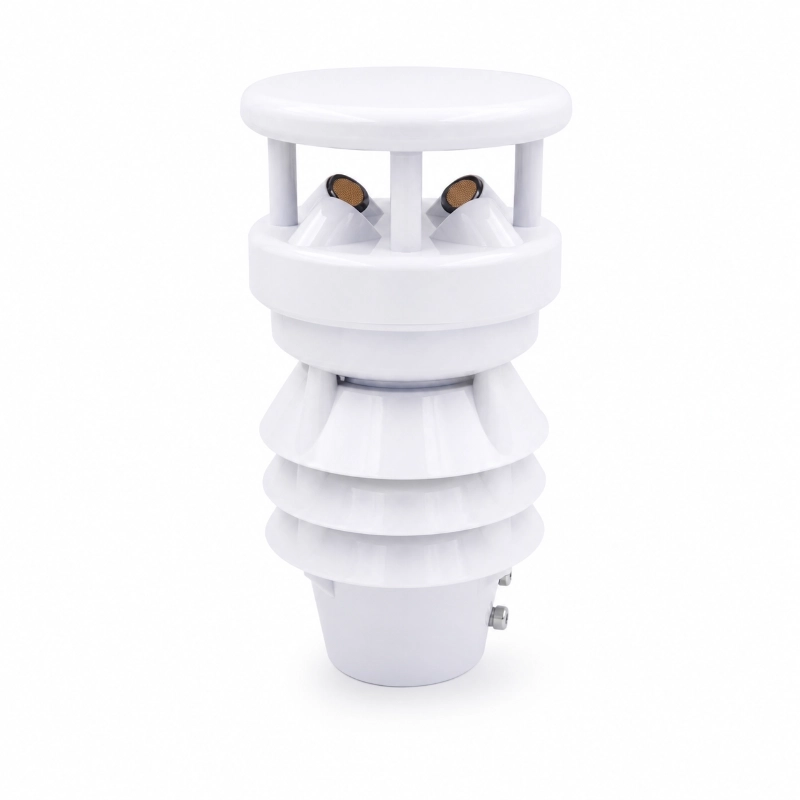
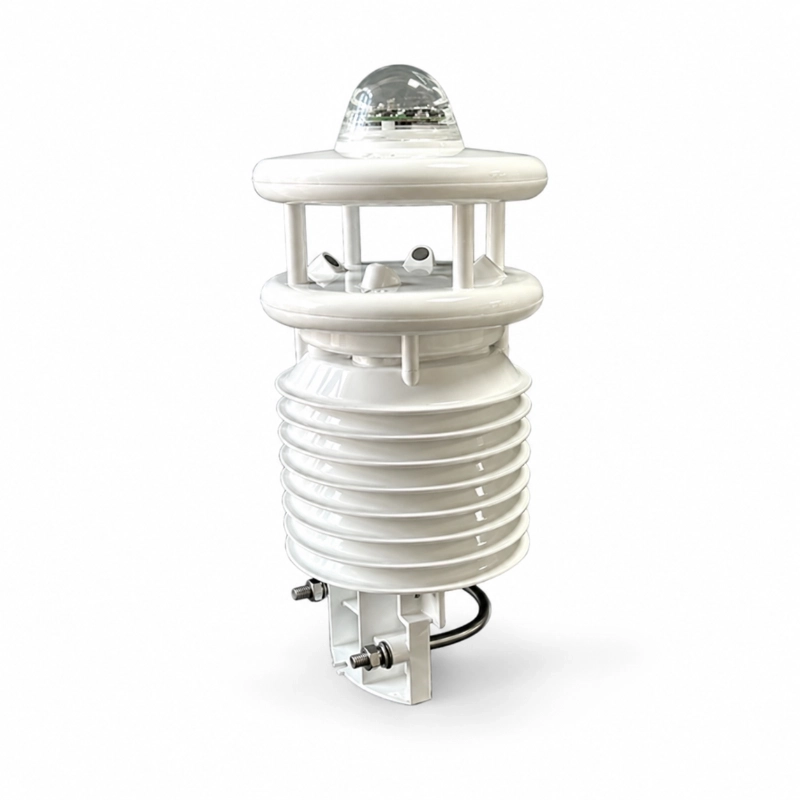
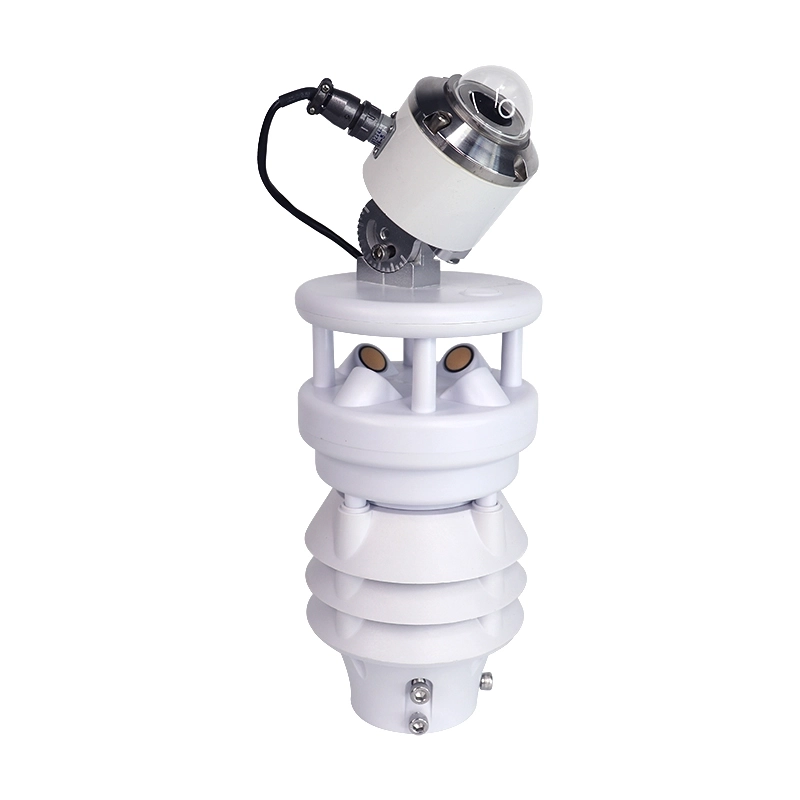
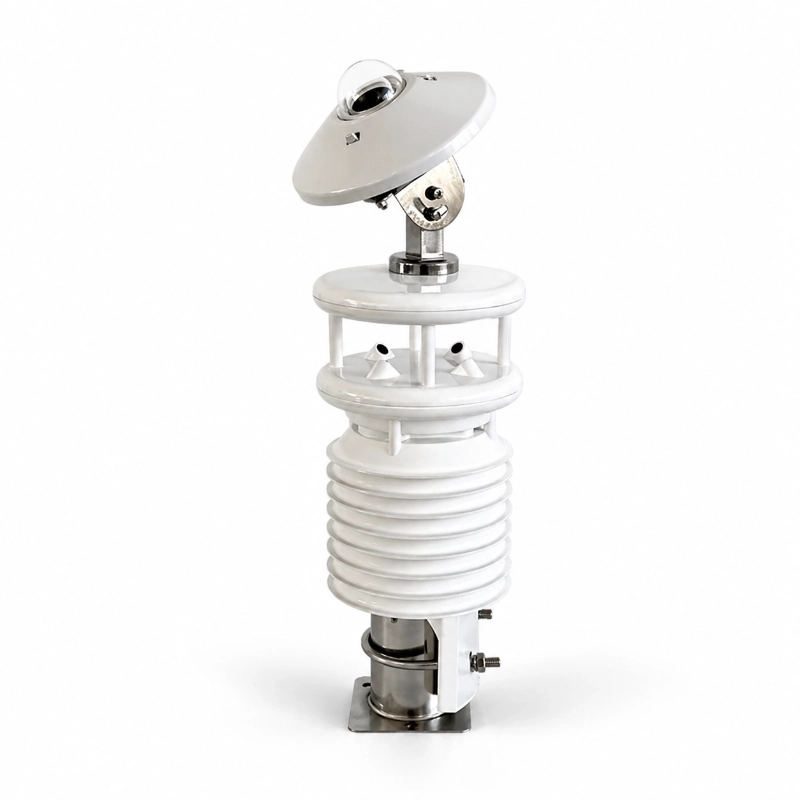
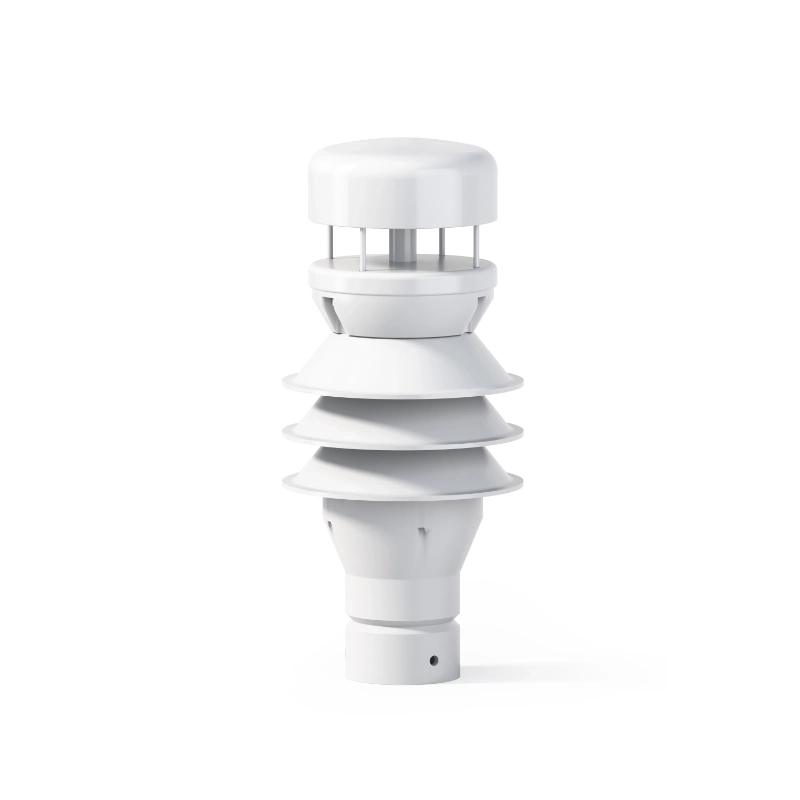
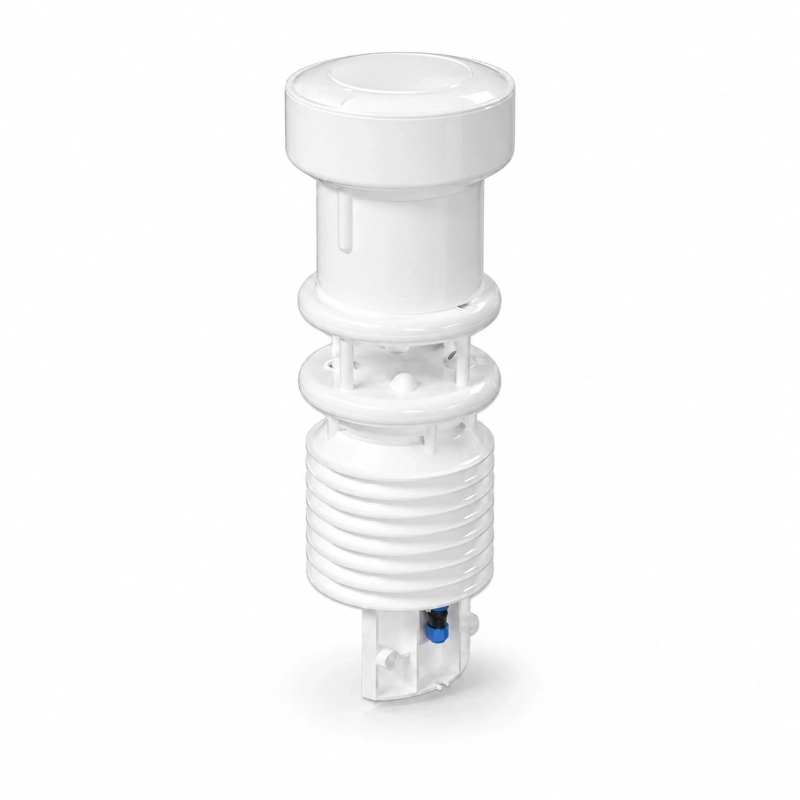
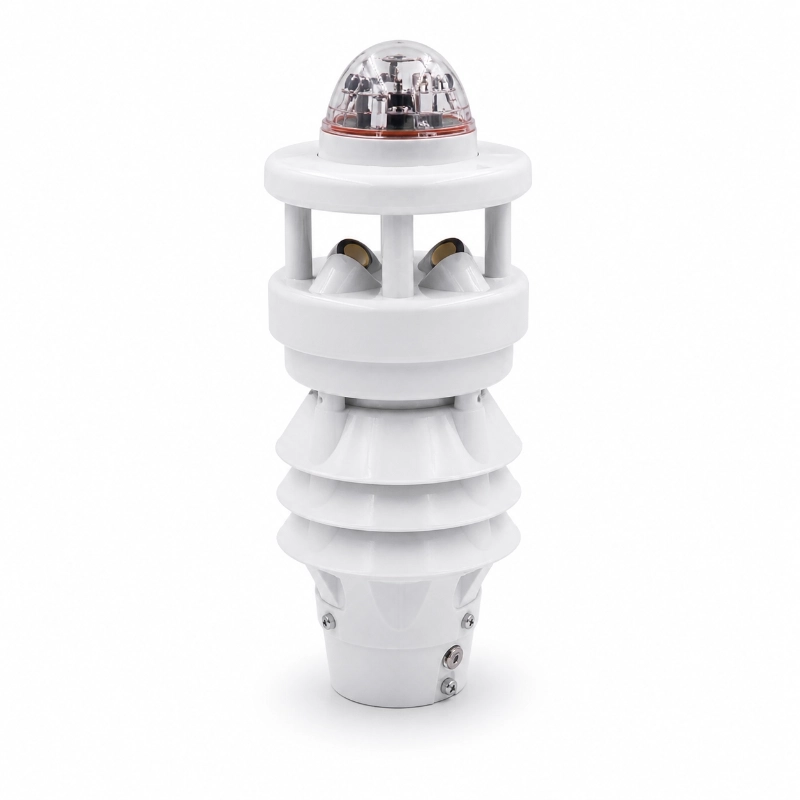
Five Parameter Compact Weather Station with RS485 Modbus RTU
Key Features
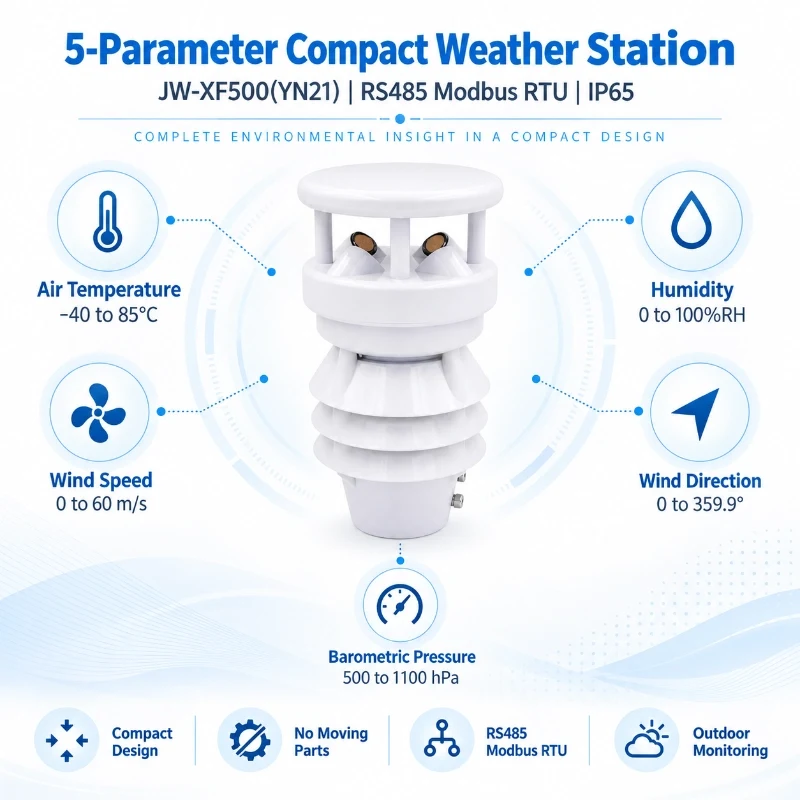
Five weather parameters in one sensor: Measures air temperature relative humidity wind speed wind direction and barometric pressure in a compact integrated unit.
RS485 Modbus RTU output: Standard RS485 interface with Modbus RTU protocol enables easy connection to data loggers RTUs IoT gateways and weather monitoring platforms.
No moving parts for stable outdoor operation: Ultrasonic wind measurement design helps reduce mechanical wear and supports long term field deployment.
Compact and lightweight structure: The small integrated housing is suitable for pole mounting rooftop stations solar farms agricultural fields and traffic monitoring points.
Radiation shield for temperature and humidity sensing: The temperature humidity and pressure module is protected by a multi layer outdoor radiation shield to reduce solar radiation influence.
High frequency wind data response: Wind speed and wind direction support 4 Hz sampling for responsive micro weather monitoring.
DC9–30V power input: Wide voltage input supports common industrial power systems solar powered stations and remote monitoring cabinets.
IP65 weather resistant enclosure: Designed for outdoor installations exposed to rain dust wind and changing environmental conditions.
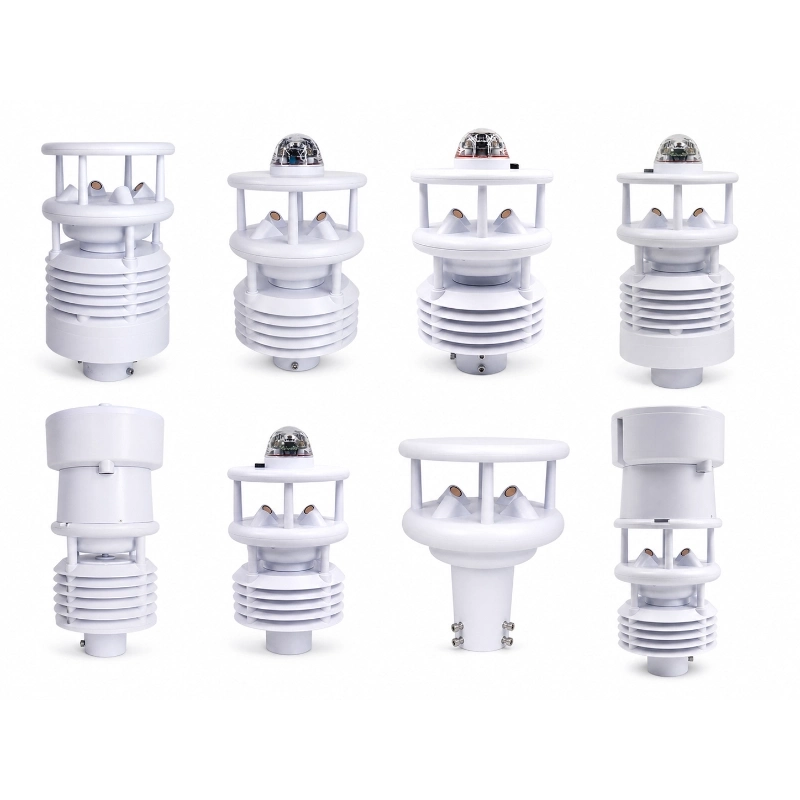
Optional expansion functions: Optional SDI 12 NMEA ASCII CAN electronic compass GPS heating function and built in 4G can be customized for specific projects.
The JW-XF500(YN21) is a five-parameter weather station designed for projects that need continuous measurement of the most commonly used outdoor meteorological variables without adding rainfall, solar radiation or air-quality sensing.
It measures:
Air temperature
Relative humidity
Wind speed
Wind direction
Barometric pressure
The station provides RS485 Modbus RTU as the standard output and supports optional SDI-12, NMEA, ASCII and CAN interfaces.
With a measurement configuration focused on essential weather conditions, the JW-XF500 is suitable for agriculture, greenhouse reference monitoring, solar PV sites, wind farms, roads, urban microclimate networks, campuses, rooftops and remote monitoring projects.
When Is a Five-Parameter Weather Station the Right Choice?
The JW-XF500 is intended for projects where the main question is:
What are the local temperature, humidity, wind and pressure conditions at this monitoring point?
A five-parameter configuration can be appropriate when rainfall, solar radiation, particulate matter or other environmental variables are not required.
This makes the product particularly useful for projects that need a practical meteorological node rather than a full multi-parameter environmental monitoring station.
Typical examples include agricultural fields, solar plant ambient weather points, roadside installations and distributed urban weather networks.
Technical Specifications
Item
Specification
Measured Parameters
Air temperature humidity wind speed wind direction barometric pressure
Air Temperature Range
-40°C to 85°C
Air Temperature Accuracy
±0.3°C at 25°C
Relative Humidity Range
0 to 100%RH
Relative Humidity Accuracy
±3%RH from 10% to 90%RH non condensing
Wind Speed Range
0 to 60 m/s
Wind Direction Range
0 to 359.9°
Barometric Pressure Range
500 to 1100 hPa
Barometric Pressure Accuracy
±0.5 hPa at 25°C 950 to 1100 hPa
Output Signal
RS485 Modbus RTU standard
Optional Output
SDI 12 NMEA ASCII CAN
Power Supply
DC9–30V
Protection Rating
IP65
Standard Cable
3 m cable
Optional Cable
10 m communication cable
Mounting
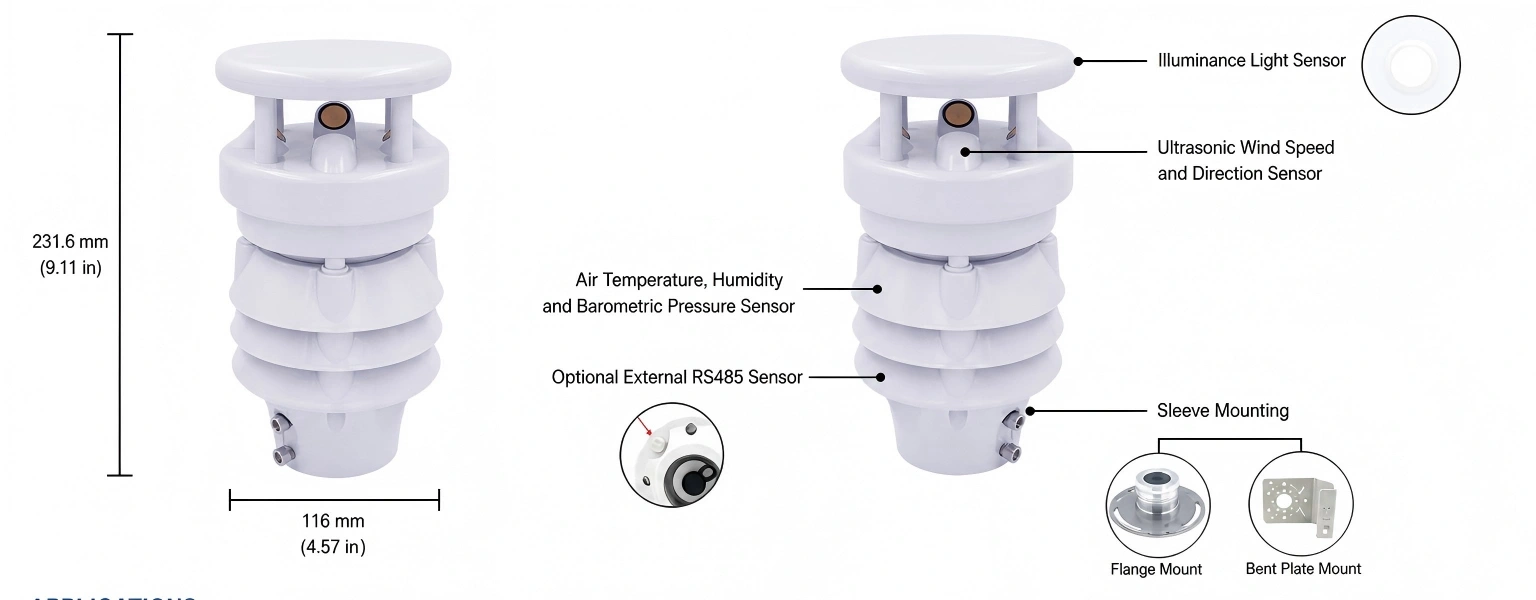
Sleeve mounting standard flange or bent plate optional
Optional Stand
1.5 m or 1.8 m mounting stand
What Information Does the JW-XF500 Provide?
Air Temperature
The sensor measures air temperature from:
-40°C to 85°C
with an accuracy of:
±0.3°C at 25°C
Temperature is one of the first variables required when describing local weather or microclimate conditions.
In agricultural and environmental projects, it provides a direct indication of thermal conditions at the monitoring point.
Relative Humidity
The humidity measurement range is:
0 to 100%RH
with a specified accuracy of:
±3%RH from 10% to 90%RH under non-condensing conditions
Humidity data is commonly evaluated together with air temperature because the two parameters describe different aspects of the local atmospheric environment.
Wind Speed
The wind-speed range is:
0 to 60 m/s
Wind-speed data can help project operators understand airflow conditions around agricultural fields, roads, renewable-energy sites, buildings and other outdoor monitoring locations.
Wind Direction
The wind-direction range is:
0 to 359.9°
Wind direction adds spatial context to wind-speed measurements and allows monitoring systems to identify the direction from which airflow is arriving.
Barometric Pressure
The pressure measurement range is:
500 to 1100 hPa
with a specified accuracy of:
±0.5 hPa at 25°C from 950 to 1100 hPa
Pressure data supplements the other four variables and helps provide a more complete record of local meteorological conditions.
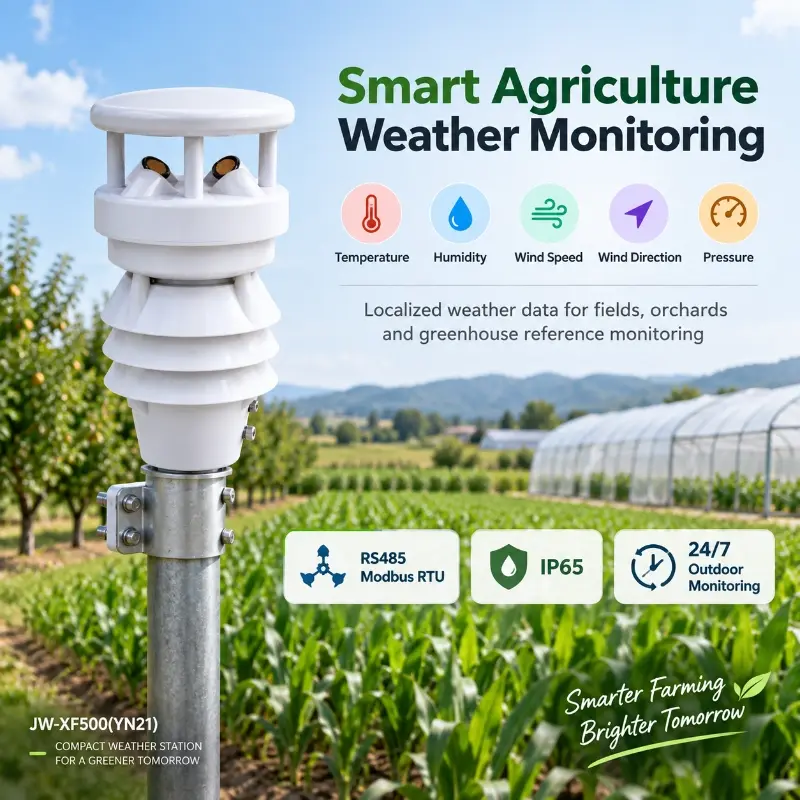
Smart Agriculture Weather Monitoring
Agricultural production is highly dependent on local weather, but conditions measured at a distant public weather station may not always represent the microclimate of an individual field, orchard or greenhouse area.
The JW-XF500 can be installed closer to the agricultural site to provide localized measurements of:
temperature, humidity, wind speed, wind direction and atmospheric pressure.
Potential applications include:
Open-field crop monitoring
Orchard microclimate monitoring
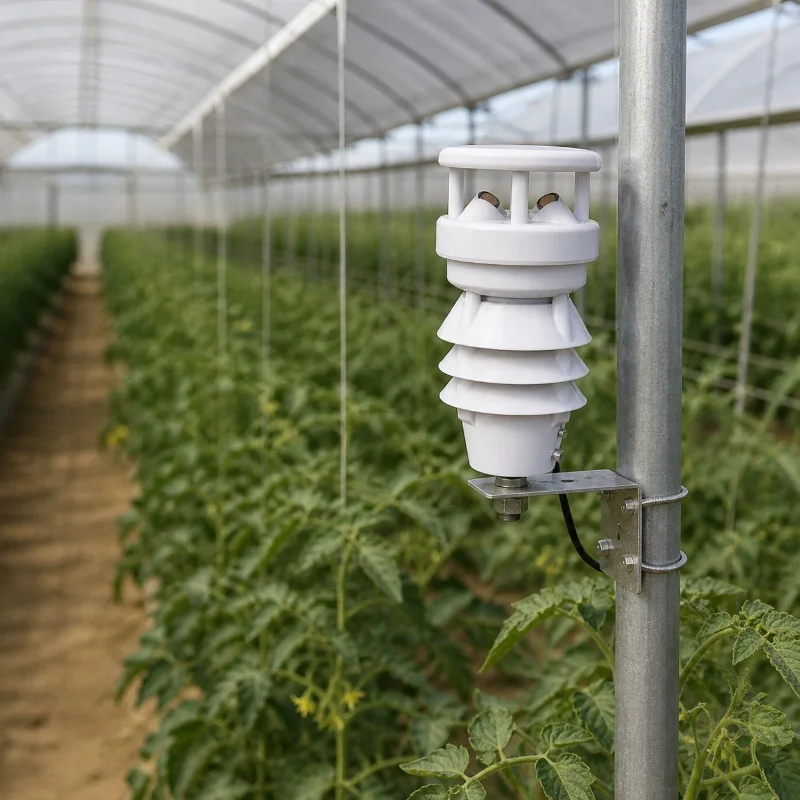
Greenhouse outdoor reference stations
Farm weather networks
Agricultural IoT systems
Irrigation project weather monitoring
The JW-XF500 measures atmospheric conditions only.
If the project also requires soil moisture, soil temperature, soil EC or other below-ground measurements, dedicated soil sensors should be added separately.
Greenhouse Outdoor Reference Monitoring
In greenhouse projects, outdoor weather conditions can provide useful reference data alongside measurements collected inside the growing environment.
For example, the JW-XF500 can be installed outside the greenhouse to record:
ambient temperature, humidity, wind and pressure conditions.
These outdoor measurements can then be compared with indoor environmental data collected by the greenhouse monitoring system.
The weather station itself does not measure crop conditions or soil conditions.
Its role is to provide an external meteorological reference.
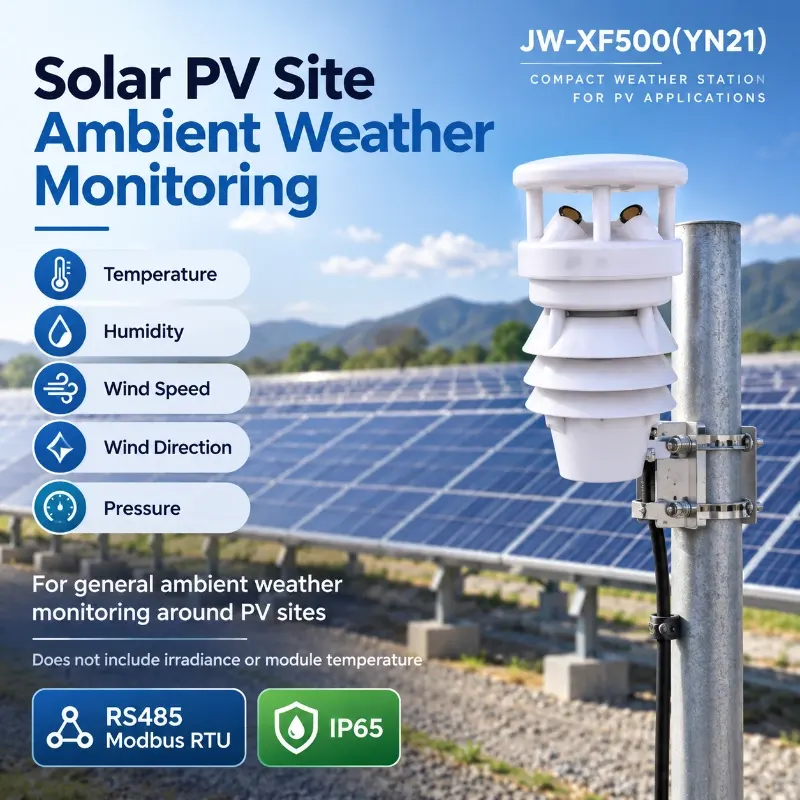
Solar PV Site Ambient Weather Monitoring
The JW-XF500 can be used at photovoltaic sites when the requirement is to monitor the general ambient weather environment.
It can provide:
Ambient air temperature
Relative humidity
Wind speed
Wind direction
Barometric pressure
These data describe the meteorological conditions around the PV site.
However, the JW-XF500 is not a complete PV performance monitoring station.
The five-parameter configuration does not include:
Solar irradiance
Plane-of-array irradiance
PV module temperature
If the monitoring objective includes performance ratio analysis or irradiance-based PV performance evaluation, a dedicated PV weather monitoring configuration should be selected.
This distinction is important because ambient weather monitoring and PV performance monitoring are not the same task.
Wind Farm Meteorological Monitoring
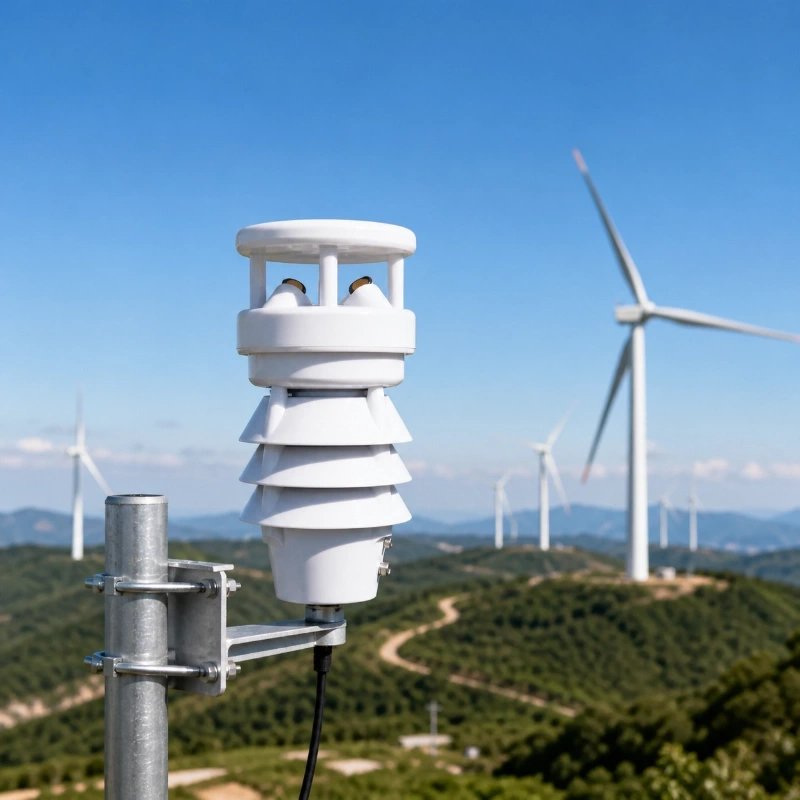
The JW-XF500 can also be used as a compact meteorological observation point at wind-energy sites.
The combination of:
wind speed + wind direction + temperature + humidity + pressure
provides a basic record of local weather conditions.
For applications requiring specialized wind-resource assessment or turbine-specific measurements, project requirements should be evaluated separately before selecting the sensor configuration.
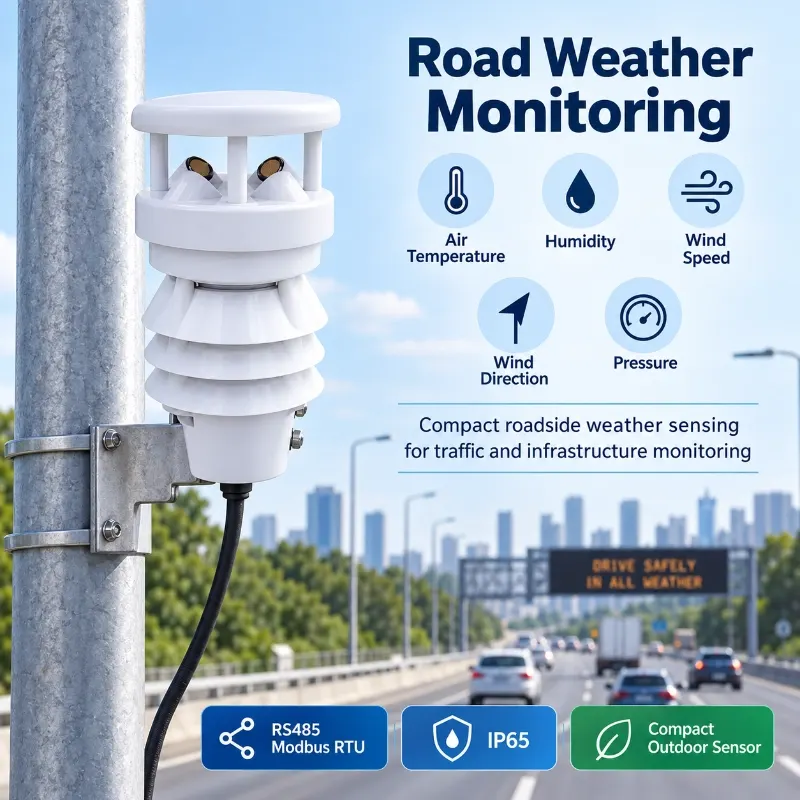
Road and Traffic Weather Monitoring
Road-weather projects often require meteorological information at locations where conditions may differ from nearby weather stations.
The JW-XF500 can provide basic atmospheric measurements at:
Highways
Bridges
Roadside monitoring points
Traffic infrastructure
Remote road sections
Temperature, humidity and wind information can be incorporated into a broader road-weather monitoring system.
If the project also requires road-surface temperature, visibility, precipitation type, snow depth or pavement-condition measurements, those functions require additional dedicated sensors.
Urban Microclimate and Distributed Weather Monitoring
Weather conditions within a city are not always uniform.
Buildings, roads, vegetation and surrounding infrastructure can create local differences between neighborhoods and monitoring points.
The JW-XF500 can therefore be used as a meteorological node in distributed monitoring networks covering locations such as:
Parks
Campuses
Rooftops
Residential areas
Public facilities
Roads
Industrial zones
Instead of relying on one weather station to represent an entire urban area, multiple monitoring points can provide more localized weather information.
Campus and Rooftop Weather Stations
Universities, research facilities and buildings may require local weather data for environmental research, facility monitoring or IoT projects.
The JW-XF500 can be installed on suitable outdoor structures or rooftops to provide continuous measurements of the five standard meteorological variables.
Because all five parameters are collected from one sensing unit, it can also be used where available installation space is limited.
How Does the JW-XF500 Connect to a Monitoring System?
The standard communication output is:
RS485 Modbus RTU
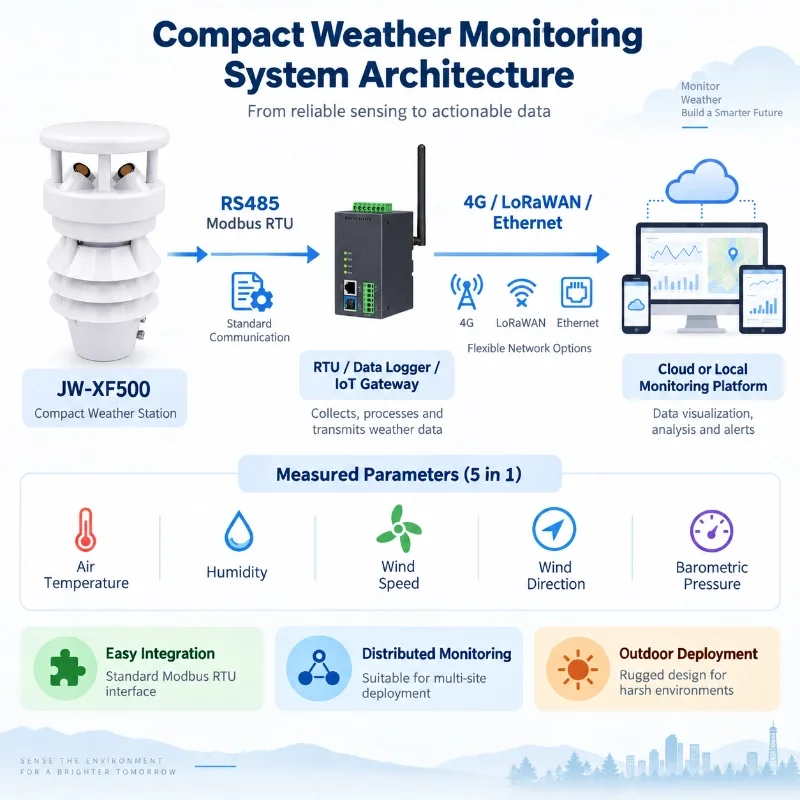
A typical project can therefore use the following architecture:
JW-XF500 → RS485 Modbus RTU → RTU / Data Logger / PLC / IoT Gateway → Communication Network → Local or Cloud Platform
The JW-XF500 performs the meteorological measurement.
Other system components are responsible for:
Data acquisition
Protocol conversion
Remote communication
Data storage
Visualization
This distinction helps system integrators design each layer of the monitoring system independently.
RS485 Modbus RTU is the standard interface for the JW-XF500.
Optional interfaces listed for the product include:
SDI-12, NMEA, ASCII and CAN.
The appropriate interface should be confirmed before ordering because the required protocol depends on the receiving controller or data acquisition system.
For example, a project using an industrial RTU may have different interface requirements from a project using a dedicated weather data logger.
Five Parameters vs More Parameters: How to Choose
The number of parameters should be determined by the monitoring objective rather than by choosing the model with the largest sensor count.
Required Measurement
JW-XF500
Air Temperature
Yes
Relative Humidity
Yes
Wind Speed
Yes
Wind Direction
Yes
Barometric Pressure
Yes
Rainfall
No
Solar Radiation
No
PM2.5 / PM10
No
Environmental Noise
No
Illumination
No
Choose the JW-XF500 when the five meteorological variables above are sufficient.
Choose another configuration when additional measurements are essential to the project.
This avoids unnecessary sensors while also preventing critical parameters from being omitted.
What the JW-XF500 Does Not Measure
Defining product limitations clearly helps avoid incorrect system selection.
The JW-XF500 does not include the following parameters in its standard five-parameter configuration:
Rainfall
Solar radiation
UV radiation
PM2.5
PM10
Environmental noise
Illumination
Soil moisture
Road-surface temperature
These parameters can be monitored using other dedicated sensors or alternative weather-station configurations where required.
Installation and Mounting Options
The standard installation method is:
Sleeve mounting
Optional mounting methods include:
flange mounting and bent plate mounting.
Optional mounting stands are available in:
1.5 m and 1.8 m versions.
The standard cable length is:
3 m
and an optional:
10 m communication cable
is available.
The final mounting method should be selected according to the installation structure, monitoring location and project layout.
Installation Considerations
For reliable monitoring, sensor location should reflect the environment the project intends to measure.
Large buildings, walls, trees and nearby equipment can affect local airflow.
When wind measurements are important, avoid locations where surrounding obstacles may create strongly unrepresentative turbulence or shielding.
Before deployment, confirm:
Installation structure
Mounting method
Power supply
Cable length
RS485 wiring
Communication settings
Data acquisition equipment
Planning these items before field installation can reduce commissioning work.
How to Select the JW-XF500 for a Project
The JW-XF500 is a suitable starting point when all of the following are true:
The project requires temperature, humidity, wind speed, wind direction and pressure.
Rainfall or solar radiation is not required from the same sensor.
RS485 Modbus RTU is compatible with the planned data acquisition system.
The installation requires a compact outdoor weather sensor.
The project operates within the specified measurement and power-supply ranges.
If any required variable falls outside this configuration, another model or an additional sensor should be selected.
Related Weather Monitoring Products
For other integrated parameter combinations, visit:
Before choosing a configuration, send JW-IoT the following project information:
Application + required parameters + installation environment + number of monitoring points + communication interface + data acquisition method + mounting requirements
JW-IoT can then help determine whether the JW-XF500 five-parameter compact weather station is sufficient or whether the project requires additional meteorological or environmental measurements.
Contact JW-IoT for a project-specific weather monitoring configuration.
FAQ
Q
1. What parameters does this compact weather station measure?
A
It measures five key weather parameters including air temperature relative humidity wind speed wind direction and barometric pressure.
Q
2. Does the sensor support RS485 Modbus communication?
A
Yes. The standard version supports RS485 with Modbus RTU protocol for easy integration with data loggers RTUs PLCs and IoT gateways.
Q
3. Can JW-IoT provide this weather station for smart agriculture projects?
A
Yes. JW-IoT can supply this compact weather station for greenhouse monitoring open field farming irrigation control and agricultural microclimate monitoring.
Q
4. Is this product suitable for solar PV weather monitoring?
A
Yes. It can be used in solar PV stations to monitor environmental weather conditions such as wind temperature humidity and pressure.
Q
5. Does the weather station have moving parts?
A
The wind speed and wind direction are measured using ultrasonic technology with no moving parts which helps improve durability and reduce maintenance.
Q
6. Can JW-IoT customize communication protocols or functions?
A
Yes. JW-IoT can support optional functions such as SDI 12 NMEA ASCII CAN GPS electronic compass heating function and built in 4G depending on project requirements.
Q
7. What is the protection rating of the compact weather station?
A
The product has an IP65 protection rating for outdoor environmental monitoring applications.
Q
8. Can this sensor be used in traffic weather monitoring?
A
Yes. It is suitable for road weather monitoring traffic safety systems bridge weather stations and other distributed monitoring points.
Q
9. Does JW-IoT provide mounting accessories for field installation?
A
Yes. JW-IoT can provide optional mounting options such as flange mounting bent plate mounting and 1.5 m or 1.8 m support stands for different installation sites.
 +86 13520127780
 info@jingelway.com