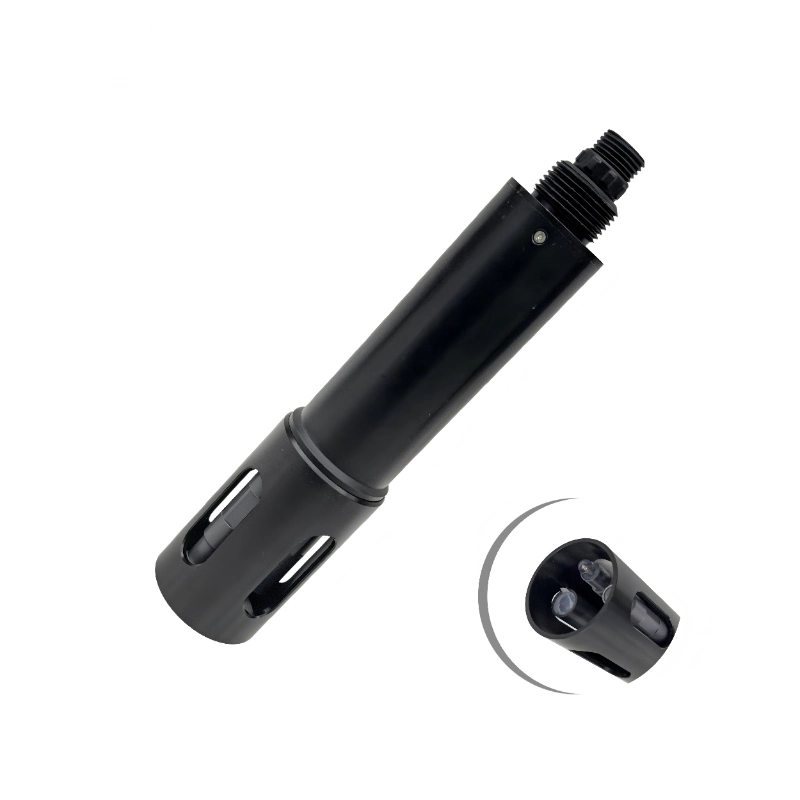
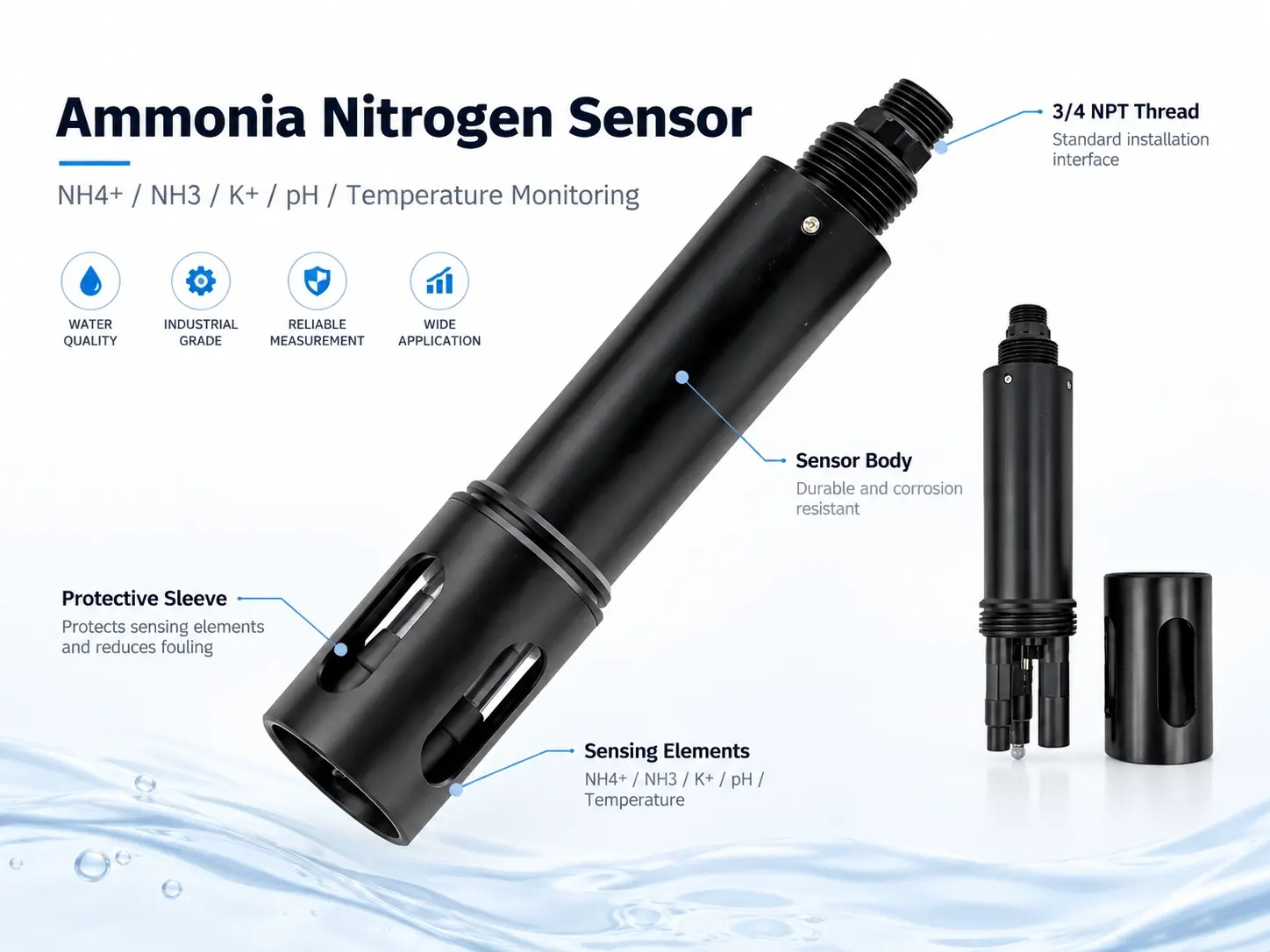
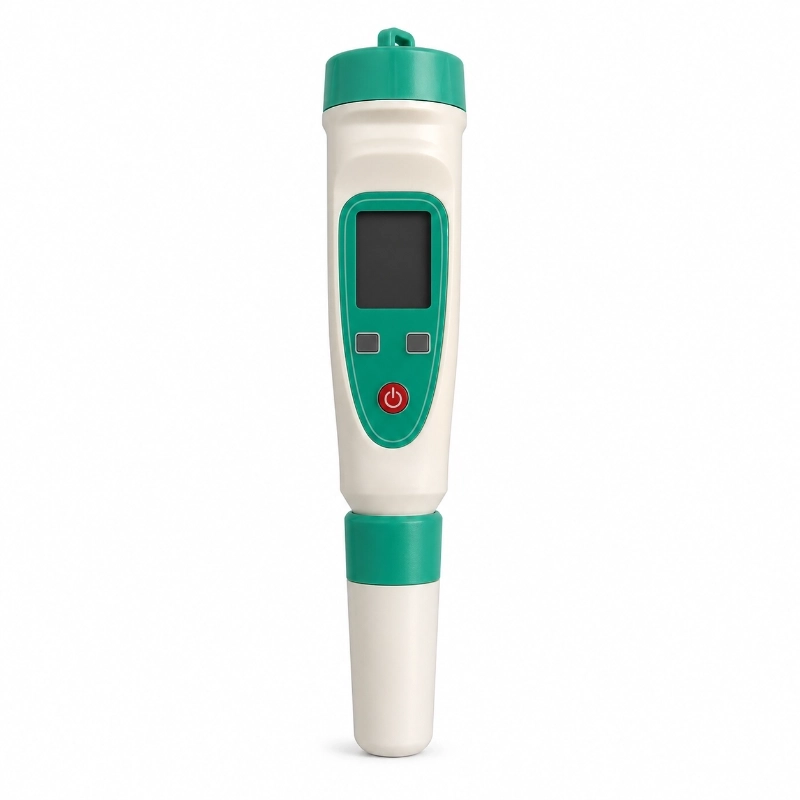
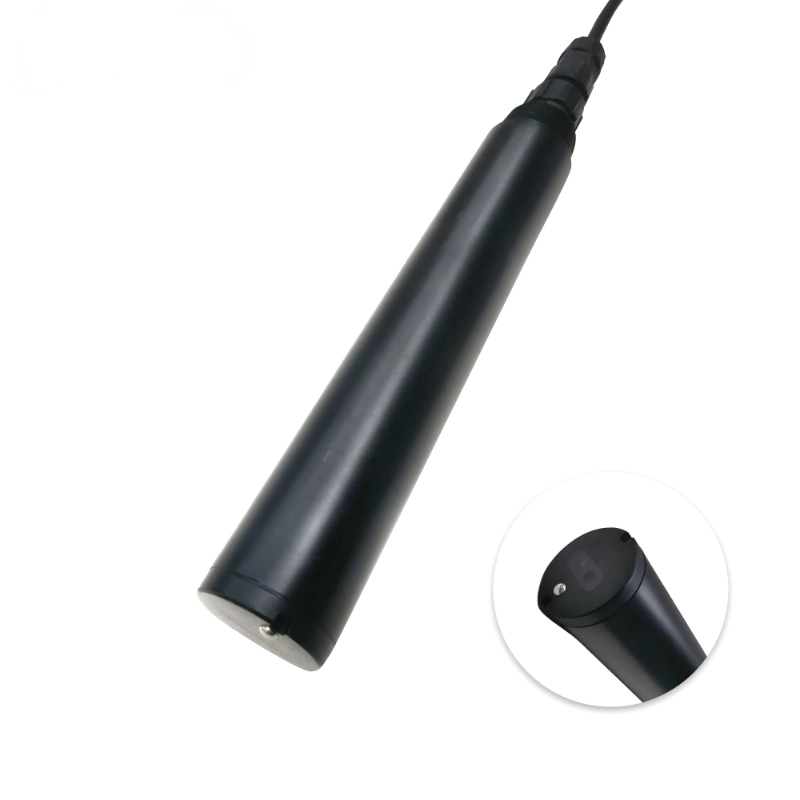
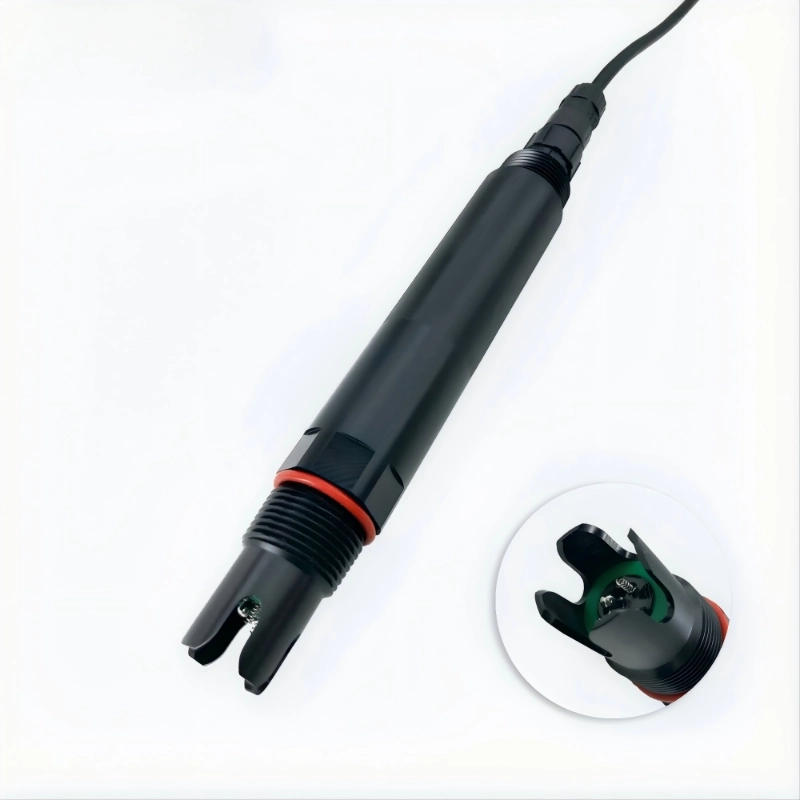
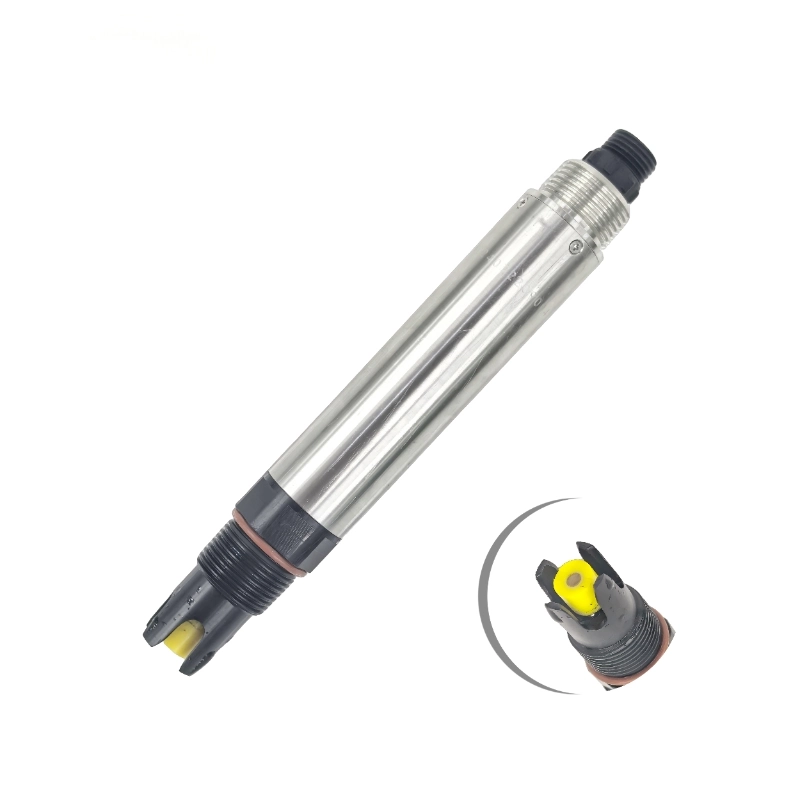
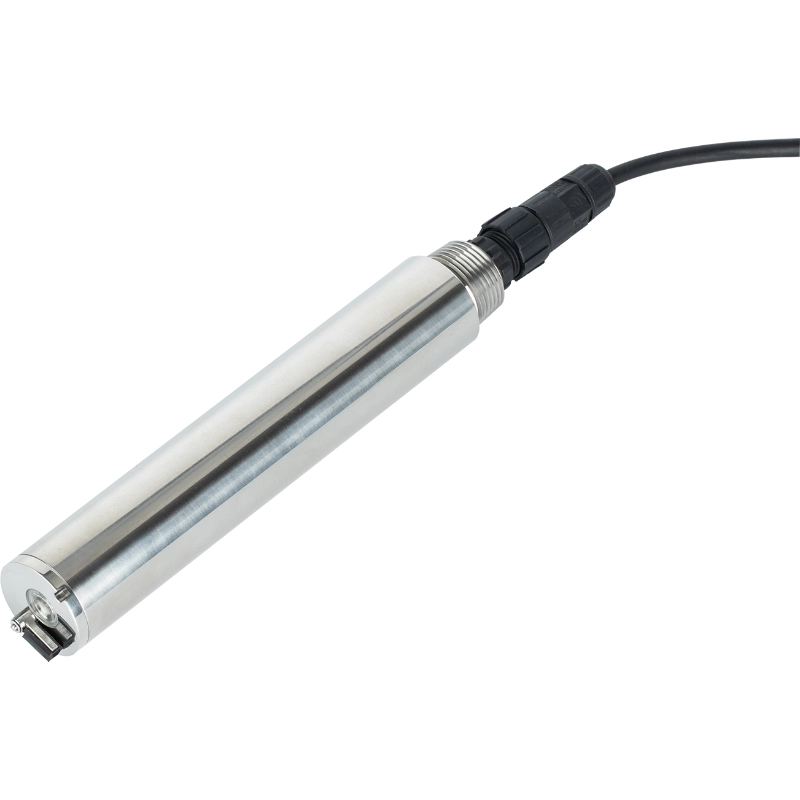
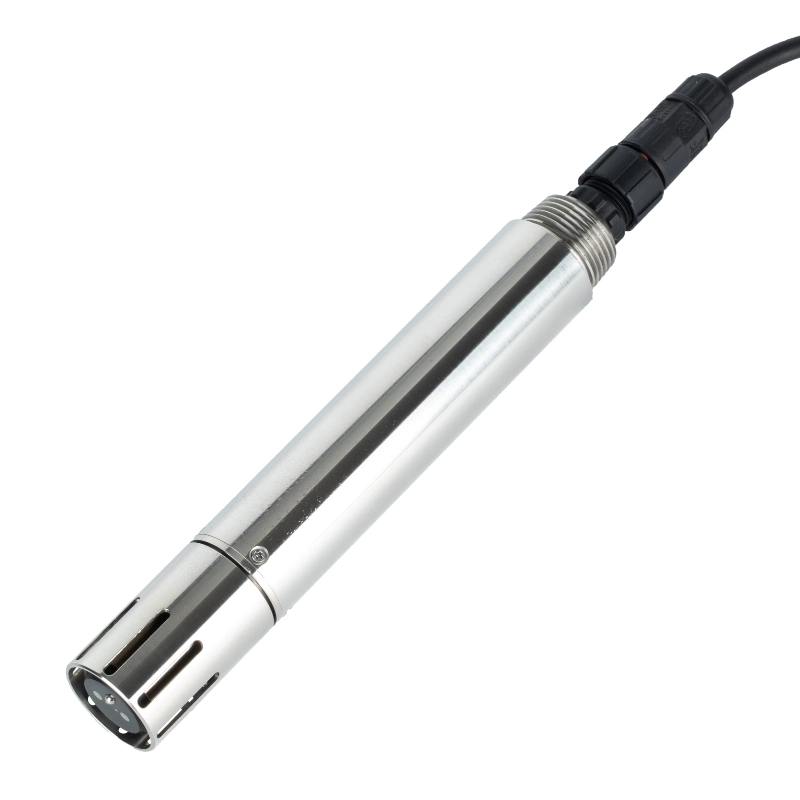
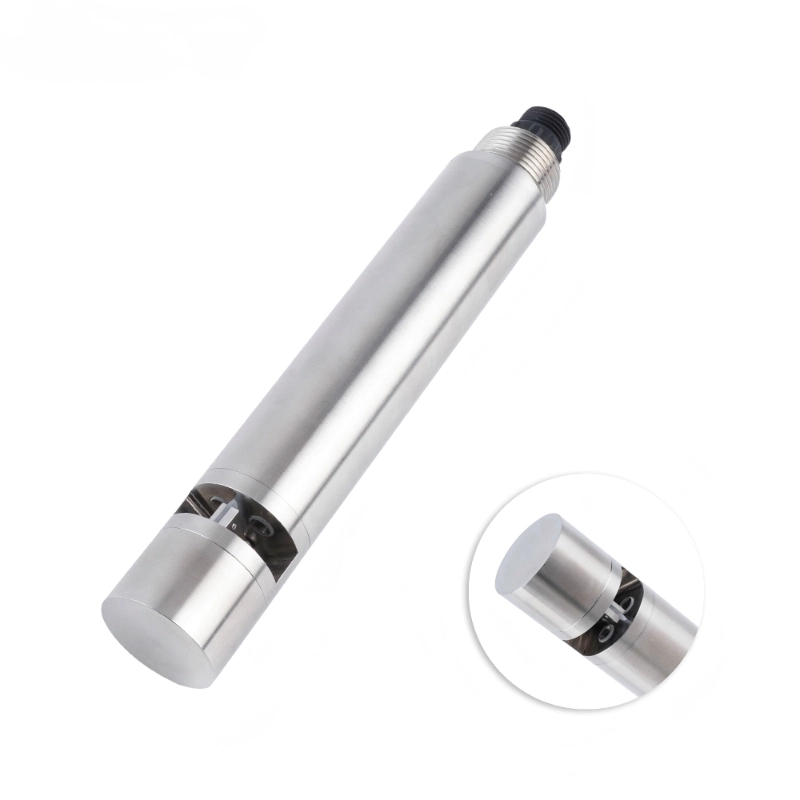
The JW-NHN-302(K16) ammonia nitrogen sensor is designed for continuous online monitoring of NH4+, NH3, K+, pH and temperature in wastewater, aquaculture, environmental water and industrial water applications.
Based on an ion-selective electrode (ISE) measurement method, the sensor directly measures ammonium ions and combines automatic temperature compensation, pH compensation and potassium ion compensation to provide more useful ammonia-related water quality data under changing field conditions.
With RS485 Modbus RTU, IP68 waterproof protection and a 3/4 NPT installation interface, the sensor can be connected to PLCs, RTUs, DCS systems, data loggers, IoT gateways and remote water quality monitoring platforms.
What Is an Ammonia Nitrogen Sensor?
An ammonia nitrogen sensor is an online water quality instrument used to continuously monitor ammonia-related nitrogen conditions in water.
The JW-NHN-302(K16) uses an ammonium ion-selective electrode to measure NH4+ and combines the measurement with NH3, potassium, pH and temperature data.
This multiparameter approach provides additional context for applications where ammonia conditions can change over time, such as wastewater treatment, aquaculture systems, rivers, lakes and industrial water treatment.
Instead of relying only on periodic manual sampling, an online sensor can continuously transmit data to an RTU, PLC, SCADA system or cloud platform for trend analysis, alarms and remote monitoring.
Product Overview
The JW-NHN-302(K16) is a multiparameter online ammonia nitrogen sensor developed for continuous water quality monitoring.
The sensor uses a PVC membrane ammonium ion-selective electrode for NH4+ detection. In addition to ammonium, it monitors:
free ammonia NH3;
potassium ion K+;
pH;
temperature.
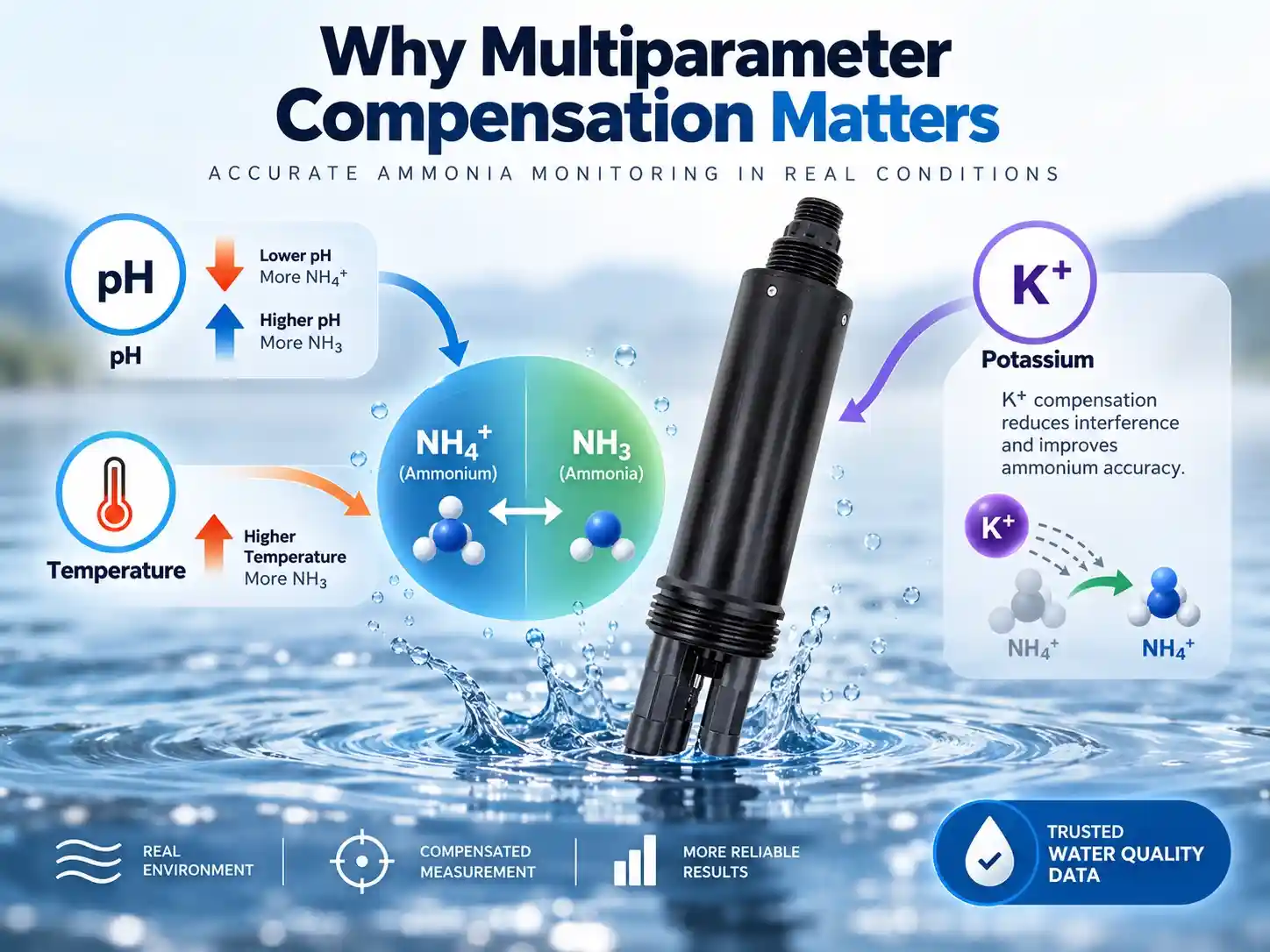
The integrated compensation functions help account for important variables affecting online ammonia measurement.
Automatic Pt1000 temperature compensation is included, together with pH compensation over a range of 4–10 pH and potassium ion compensation from 0–1000 mg/L.
Its RS485 Modbus RTU interface allows the sensor to be connected to industrial and IoT monitoring equipment including:
PLC systems;
DCS systems;
RTUs;
data acquisition units;
industrial computers;
IoT gateways;
online water quality platforms.
The PVC and POM housing, IP68 protection and 3/4 NPT installation interface make the sensor suitable for long-term submerged monitoring when installation and maintenance requirements are correctly followed.
Technical Specifications
Item
Specification
Product Type
Multiparameter Online Ammonia Nitrogen Sensor
Measurement Principle
Ion selective electrode method
NH4+ Range
0 to 100.0 mg/L or 0 to 1000.0 mg/L
NH4+ Resolution
0.1 mg/L
NH3 Range
0 to 15.0 mg/L or 0 to 150.0 mg/L
NH3 Resolution
0.1 mg/L
K+ Range
0 to 1000.0 mg/L
K+ Resolution
0.1 mg/L
pH Range
0 to 14.0 pH
pH Resolution
0.1 pH
Temperature Range
0 to 35.0°C
Temperature Resolution
0.1°C
Accuracy
NH4+ ±5% F.S.
NH3 Accuracy
±5% F.S.
K+ Accuracy
±5% F.S.
pH Accuracy
±0.1 pH
Temperature Accuracy
±0.5°C
Response Time
T90 less than 60 seconds
Minimum Detection Limit
0.9 mg/L for 0 to 1000 mg/L range
Calibration Method
Two-point calibration
Temperature Compensation
Automatic temperature compensation with Pt1000
pH Compensation
4 to 10 pH
K+ Compensation
0 to 1000 mg/L
Output Signal
RS485 Modbus RTU
Storage Temperature
-5 to 65°C
Working Condition
0 to 35°C less than 0.1 MPa
Housing Material
PVC and POM
Installation Method
Immersion installation 3/4 NPT
Power Consumption
0.5W at 12V
Power Supply
12 to 24V DC
Protection Grade
IP68
Why Monitor NH4+, NH3, pH, Temperature and Potassium Together?
Ammonia monitoring is more useful when the sensor system considers the water conditions surrounding the ammonia measurement.
The JW-NHN-302(K16) therefore monitors several related parameters rather than only providing a single NH4+ value.
NH4+ — Ammonium Ion
NH4+ is directly measured by the ion-selective electrode.
Continuous NH4+ data can help operators identify changes in ammonia-related nitrogen conditions over time and compare concentrations between different monitoring points or treatment stages.
NH3 — Free Ammonia
NH3 is the unionized form of ammonia.
NH4+ and NH3 coexist in water, and the balance between them changes with water chemistry. Monitoring NH3 together with NH4+ can provide additional information for aquaculture, wastewater and environmental water applications.
pH
pH is an important variable when evaluating ammonia conditions because changes in pH affect the relationship between ammonium and free ammonia.
The JW-NHN-302(K16) includes pH measurement and supports pH compensation from 4 to 10 pH.
Temperature
Temperature is another important variable affecting ammonia-related water conditions.
The sensor integrates temperature measurement and uses a Pt1000 element for automatic temperature compensation.
Potassium Ion
Potassium can interfere with ammonium ion-selective electrode measurements under some water conditions.
The sensor therefore measures K+ and supports potassium ion compensation from 0–1000 mg/L.
This is particularly useful where water composition changes over time and a simple single-parameter ammonium probe may provide limited measurement context.
How Does the Ammonia Nitrogen Sensor Work?
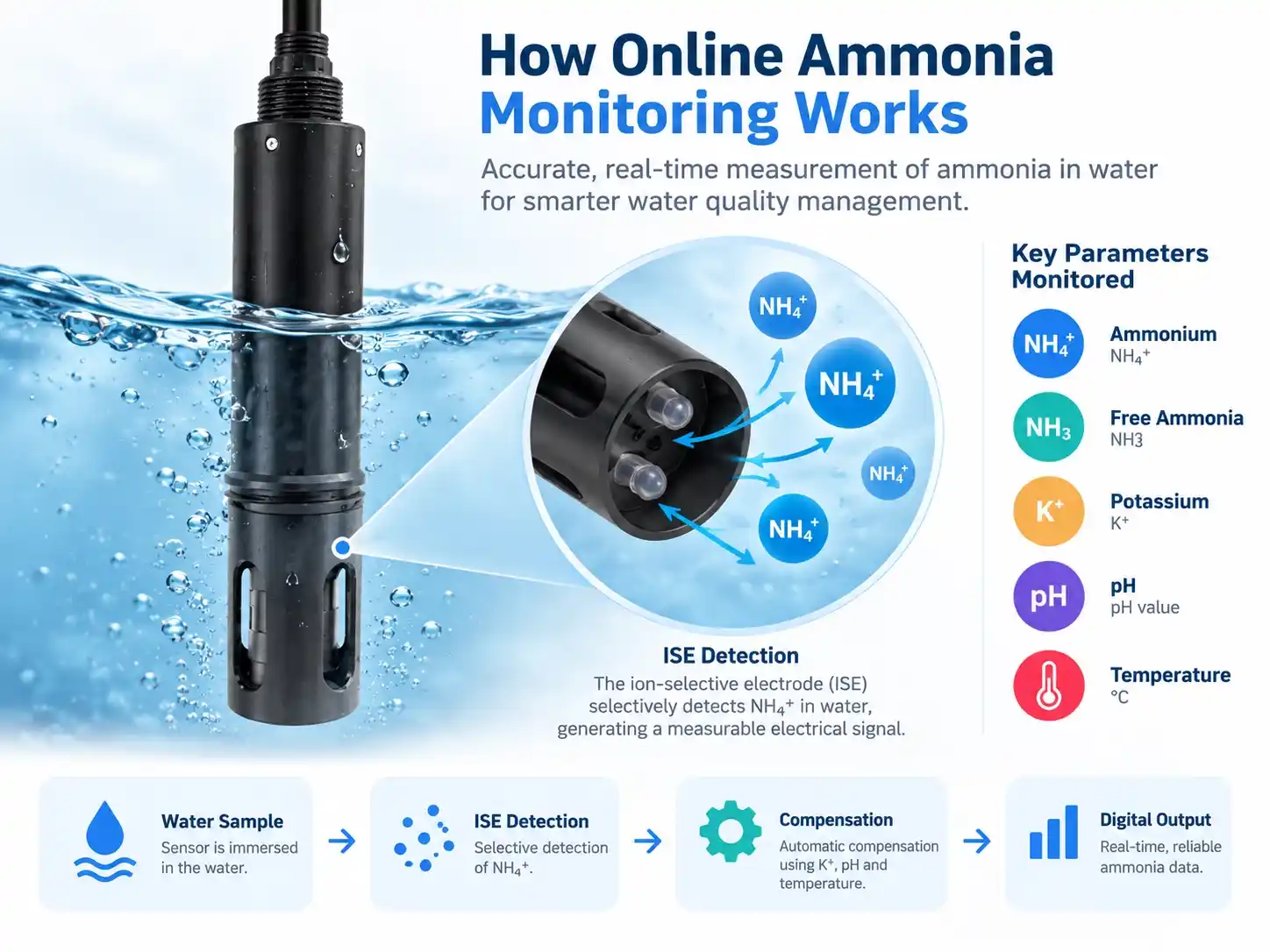
The sensor uses an ion-selective electrode to detect ammonium ions in water.
A simplified measurement process is:
Water → NH4+ Ion-Selective Electrode → Electrical Signal → Temperature / pH / K+ Compensation → Digital Measurement → RS485 Modbus RTU
The sensitive membrane responds to ammonium ion activity in the water.
The signal is processed together with temperature, pH and potassium-related compensation data before the measurement is transmitted to the connected monitoring system.
The resulting data can then be used for:
continuous trend monitoring;
abnormal condition detection;
treatment process observation;
aquaculture water management;
environmental monitoring;
remote alarms;
SCADA visualization;
IoT platform integration.
Online Ammonia Monitoring vs Periodic Laboratory Testing
Online sensing and laboratory testing perform different roles in a water quality monitoring program.
Monitoring Requirement
Online Ammonia Sensor
Laboratory Analysis
Continuous monitoring
Yes
No
High-frequency data
Yes
Depends on sampling frequency
Remote data transmission
Yes
Normally not directly
Trend analysis
Suitable
Limited by sampling interval
Automatic alarms
Can be integrated
Normally unavailable in real time
PLC / SCADA connection
Yes
Usually indirect
Field maintenance
Required
Sample handling and laboratory procedures required
Reference verification
Can support operational monitoring
Often used for verification and analytical testing
An online ammonia nitrogen sensor should therefore not necessarily be viewed as a replacement for all laboratory testing.
Instead, it is particularly valuable where operators need continuous data between laboratory sampling intervals.
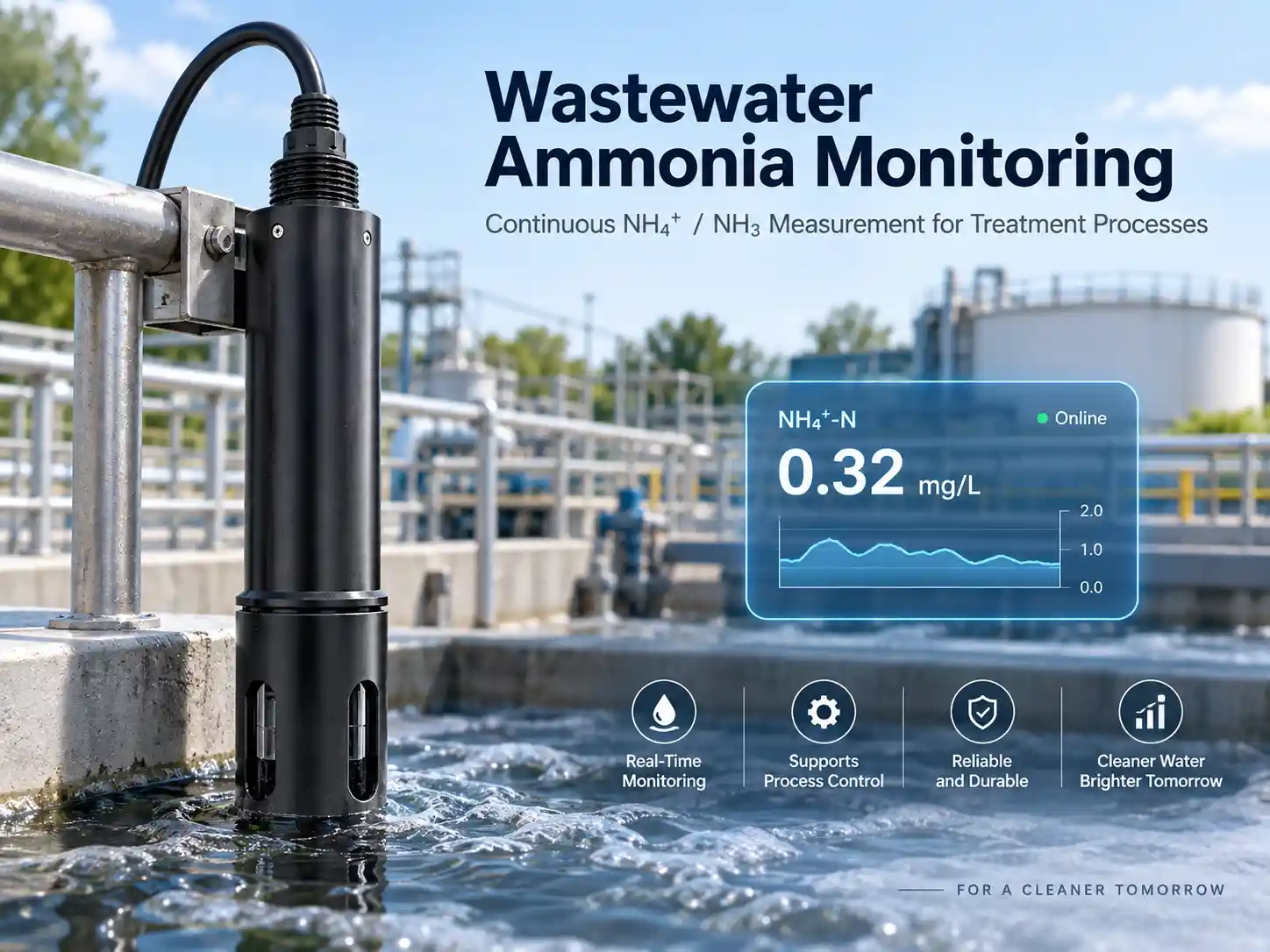
Wastewater Treatment Ammonia Monitoring
Wastewater treatment is one of the primary applications for continuous ammonia nitrogen measurement.
Ammonia concentrations can change at different stages of a treatment process. Periodic manual samples may not capture short-term variations, while an online sensor provides continuous data that can be integrated with plant control and monitoring systems.
Possible installation points include:
wastewater influent monitoring;
biological treatment tanks;
process monitoring points;
treated water outlets;
municipal sewage treatment facilities;
industrial wastewater treatment systems;
discharge monitoring locations.
The sensor can be used together with other water quality parameters such as:
dissolved oxygen;
nitrate;
pH;
conductivity;
turbidity;
salinity;
COD;
temperature.
This makes ammonia data part of a broader wastewater monitoring strategy rather than an isolated measurement.
Ammonia Monitoring in Aquaculture
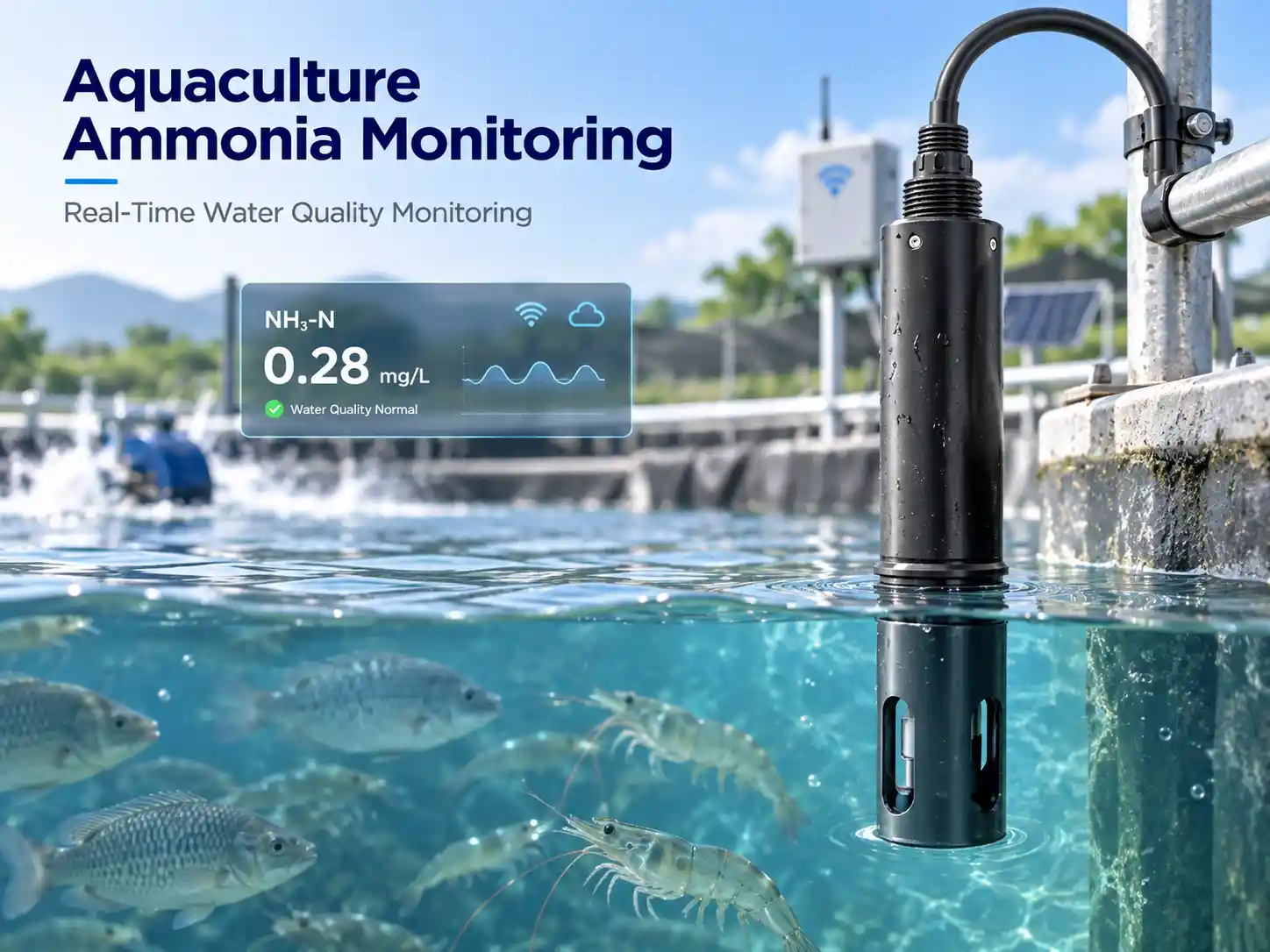
Ammonia is an important parameter in fish ponds, shrimp farms and recirculating aquaculture systems.
Continuous measurement can help operators observe changes in NH4+, NH3, pH and temperature as water conditions change during feeding, biological activity, water exchange and treatment processes.
A typical aquaculture water monitoring configuration may include:
Data from the sensors can be collected by an RTU, controller or IoT gateway and transmitted to a local or cloud-based platform.
This type of architecture is useful for:
fish farming;
shrimp farming;
recirculating aquaculture systems;
pond monitoring;
hatcheries;
aquaculture research projects.
River, Lake and Reservoir Monitoring
The ammonia nitrogen sensor can also be integrated into surface water quality monitoring systems.
Typical applications include:
rivers;
lakes;
reservoirs;
canals;
watershed monitoring;
agricultural runoff monitoring;
environmental protection stations.
For remote monitoring sites, the RS485 sensor can be connected to a data acquisition unit or communication gateway for remote telemetry.
When ammonia monitoring is combined with other parameters such as dissolved oxygen, conductivity, turbidity, pH and temperature, operators can build a more complete picture of changing water conditions.
Explore JW-IoT Water Quality Sensors for additional parameters used in multiparameter water monitoring systems.
Industrial Water and Discharge Monitoring
Industrial facilities may require ammonia monitoring as part of process water, wastewater treatment or discharge monitoring systems.
The sensor can be deployed at suitable monitoring points and connected to industrial automation equipment through RS485 Modbus RTU.
Typical system components can include:
ammonia nitrogen sensor;
data acquisition controller;
PLC;
industrial computer;
HMI;
RTU;
communication gateway;
SCADA platform;
cloud monitoring platform.
The final system configuration should be selected according to the actual water matrix, concentration range, installation conditions, maintenance requirements and communication architecture.
How to Select the Correct Measurement Range
The JW-NHN-302(K16) provides two NH4+ measurement range options:
0–100.0 mg/L
0–1000.0 mg/L
NH3 range options are:
0–15.0 mg/L
0–150.0 mg/L
The highest available range is not automatically the best choice.
Before selecting a sensor configuration, identify the expected normal concentration and possible peak concentration at the monitoring site.
For project evaluation, we recommend confirming:
target water type;
expected NH4+ concentration;
maximum ammonia concentration;
typical pH range;
water temperature;
potassium concentration if available;
installation location;
water pressure;
monitoring depth;
communication interface;
cable distance;
required additional water quality parameters.
Providing representative historical water quality data can help determine which measurement range is more appropriate for the project.
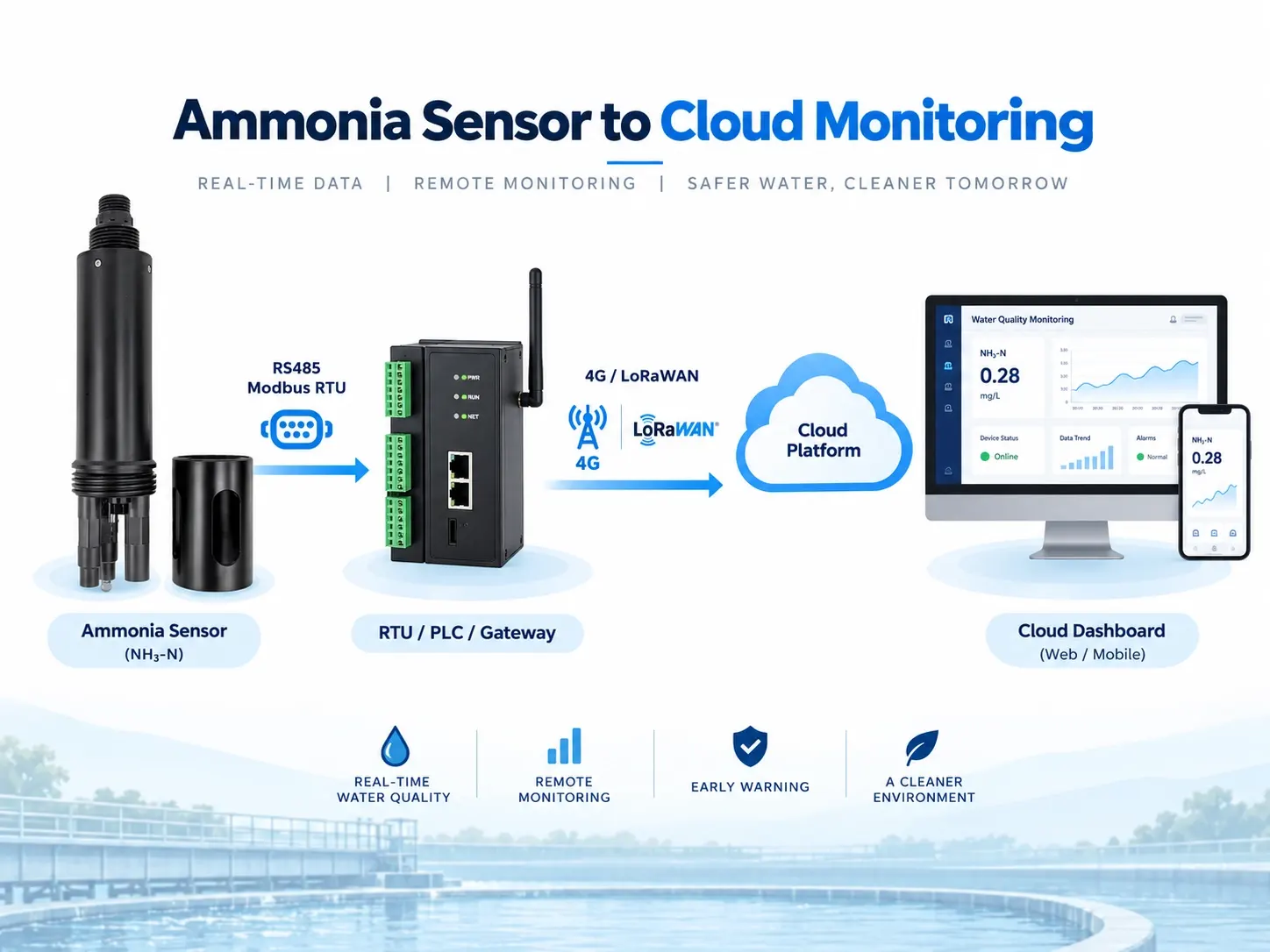
From Sensor to Cloud: Online Ammonia Monitoring Architecture
The ammonia nitrogen sensor can be used as one component of a complete remote water monitoring system.
A typical architecture is:
Ammonia Nitrogen Sensor ↓ RS485 Modbus RTU ↓ PLC / Data Logger / RTU / IoT Gateway ↓ 4G / LoRaWAN / Ethernet or Other Communication Network ↓ Cloud Server / SCADA Platform ↓ Dashboard / API / Alarm System
This allows field ammonia measurements to be collected automatically and combined with data from other water quality sensors.
JW-IoT communication products support technologies including RS485, 4G, LoRaWAN, Ethernet and gateway connectivity for sensor-to-platform applications.
Dedicated Ammonia Sensor or Multiparameter Water Quality Probe?
Different projects require different sensor architectures.
The JW-NHN-302(K16) is suitable when ammonia-related parameters are a primary monitoring requirement and the project needs:
NH4+;
NH3;
K+;
pH;
temperature.
For applications requiring a larger combination of parameters in one integrated instrument, a configurable multiparameter probe may be more appropriate.
JW-IoT also provides a Multiparameter Water Quality Sensor with Self Cleaning that can be configured with parameters including dissolved oxygen, COD, pH, ORP, conductivity, salinity, ammonium, turbidity and temperature.
Selection should be based on:
required parameters;
water quality conditions;
measuring ranges;
monitoring frequency;
installation environment;
maintenance requirements;
communication architecture;
number of monitoring locations.
Installation Guidelines
The sensor supports immersion installation using its 3/4 NPT interface.
For stable operation, installation should follow the sensor requirements below.
Installation Angle
Do not install the sensor upside down or completely horizontally.
The probe should be installed at an inclination angle of at least 15°.
Check the Electrode Before Installation
Before installation, inspect the membrane head for air bubbles.
If bubbles are present:
hold the sensor vertically;
shake it downward toward the membrane protection cap; or
gently tap the outside of the protection cap several times.
This helps release bubbles from the electrode membrane head.
Protect Field Wiring
For long-term operation in water, seawater or humid outdoor environments:
waterproof all wiring joints;
protect cable connections against moisture;
use appropriate corrosion-resistant protection on the user-side cable.
Installation location should also allow representative water contact while making future maintenance and calibration practical.
Electrode Activation Before Use
Before initial measurement, the sensitive membrane should be prepared according to the sensor instructions.
The electrode can be soaked for approximately 2 hours in a mixed solution containing:
10 mg/L ammonium ion standard solution;
10 mg/L potassium ion standard solution.
This activates the sensitive membrane before measurement.
Correct electrode preparation is important for stable ion-selective electrode performance.
Calibration and Maintenance
The sensor supports two-point calibration.
Regular maintenance is important for long-term online ammonia monitoring because the sensing membrane is directly exposed to the water.
Maintenance frequency depends on the application and water conditions.
Wastewater, aquaculture systems and water containing suspended solids or biological growth may require more frequent inspection than relatively clean water.
Recommended checks include:
inspect the membrane surface;
check for deposits;
inspect the sensor housing;
check cables and waterproof connections;
verify measurement stability;
perform calibration as required;
compare online readings with suitable reference measurements.
Storage and Cleaning
If the electrode is stored overnight or for a longer period:
rinse the electrode head with deionized water;
gently absorb surface moisture;
return it to the original protective packaging.
Avoid long-term storage in distilled water or protein-containing solutions.
Avoid contact between the sensitive membrane and silicone grease.
If deposits appear on the PVC membrane during long-term operation, rinse the membrane carefully with distilled or deionized water.
If stable calibration and measurement cannot be restored after proper maintenance, the electrode should be replaced.
Suitable for river, lake, reservoir and environmental monitoring projects.
Multi-Site Water Monitoring Network
Multiple monitoring stations can send data to a centralized platform, allowing operators to compare water quality conditions between different locations.
Compatible Water Quality Parameters
A complete water monitoring station may require more than ammonia measurement.
Depending on project requirements, the ammonia nitrogen sensor can be combined with:
Why Use RS485 Modbus RTU for Online Water Monitoring?
The JW-NHN-302(K16) uses RS485 Modbus RTU for digital communication.
This interface is widely used in industrial automation and environmental monitoring because it allows the sensor to be integrated with different data acquisition and control systems.
Compatible equipment may include:
PLCs;
DCS systems;
RTUs;
industrial computers;
data loggers;
IoT gateways;
monitoring terminals.
For remote projects, the RS485 signal can be collected by a compatible gateway or RTU and transmitted through a wireless or wired communication network.
This helps separate the sensing layer from the communication layer and gives system integrators more flexibility when designing field monitoring networks.
What Information Should You Provide Before Ordering?
To recommend a suitable ammonia nitrogen monitoring configuration, please provide the following project information where possible:
application;
water type;
expected NH4+ range;
maximum NH4+ concentration;
expected pH;
operating temperature;
potassium concentration if known;
monitoring depth;
installation method;
number of monitoring points;
cable length;
available power supply;
PLC or RTU requirements;
wireless communication requirements;
cloud platform requirements;
other water quality parameters required.
Providing these details helps determine whether the standard sensor configuration matches the actual monitoring environment.
Applications
The JW-NHN-302(K16) ammonia nitrogen sensor can be considered for:
1. Wastewater Treatment
Continuous NH4+, NH3, pH, potassium and temperature monitoring in municipal and industrial wastewater systems.
2. Aquaculture
Ammonia-related monitoring for fish ponds, shrimp farms and recirculating aquaculture systems.
3. River Monitoring
Continuous ammonia measurement as part of environmental river water quality stations.
4. Lake and Reservoir Monitoring
Integration with multiparameter surface-water monitoring systems.
5. Industrial Wastewater
Online ammonia monitoring for process water and discharge applications.
6. Agricultural Runoff Monitoring
Monitoring nutrient-related water quality conditions at suitable runoff or drainage locations.
7. Environmental Monitoring Stations
Integration with RTUs, communication systems and centralized water quality platforms.
8. Research and Water Quality Testing
Continuous field measurements and experimental monitoring where online NH4+, NH3, pH, potassium and temperature data are required.
Build an Online Ammonia Monitoring System
Continuous ammonia monitoring becomes more useful when field measurements are connected to data acquisition, communications and monitoring software.
A complete system can include:
Ammonia Nitrogen Sensor + Other Water Quality Sensors + RTU / Controller + Communication Gateway + Cloud / SCADA Platform
Depending on the project, the monitoring network can be designed for:
For local acquisition and system control, explore JW-IoT Controllers.
Request an Ammonia Nitrogen Monitoring Configuration
Selecting an online ammonia sensor should be based on the actual water conditions and system requirements rather than measurement range alone.
When contacting JW-IoT, please provide:
Application + NH4+ Range + Water Conditions + Number of Monitoring Points + Communication Method + Required Additional Parameters
Our team can help evaluate the sensor and monitoring architecture for wastewater, aquaculture, environmental water and industrial monitoring projects.
Contact JW-IoT for product selection, system integration and project-based water quality monitoring requirements.
FAQ
Q
1. What is a multiparameter ammonia nitrogen sensor used for?
A
It is used to continuously monitor ammonium ion, free ammonia, potassium ion, pH, and temperature in wastewater, aquaculture, river, lake, and industrial water quality applications.
Q
2. What parameters can this sensor measure?
A
The sensor measures NH4+, NH3, K+, pH, and temperature, making it suitable for online nutrient and ammonia nitrogen monitoring.
Q
3. Can this sensor connect to a PLC or IoT platform?
A
Yes. It provides RS485 Modbus RTU output and can be integrated with PLCs, DCS systems, RTUs, data loggers, IoT gateways, and cloud monitoring platforms.
Q
4. Is this sensor suitable for aquaculture ammonia monitoring?
A
Yes. It can monitor ammonia nitrogen, pH, potassium ion, and temperature in aquaculture ponds and recirculating aquaculture systems.
Q
5. How does JW-IoT use this sensor in smart water projects?
A
JW-IoT can integrate the ammonia nitrogen sensor with IoT gateways, cloud dashboards, alarm systems, and multi-parameter water quality monitoring platforms.
Q
6. Does the sensor support automatic compensation?
A
Yes. It supports automatic temperature compensation with Pt1000, pH compensation from 4 to 10 pH, and potassium ion compensation from 0 to 1000 mg/L.
Q
7. Can JW-IoT provide complete wastewater monitoring solutions with this sensor?
A
Yes. JW-IoT can combine ammonia nitrogen, nitrate, dissolved oxygen, pH, conductivity, turbidity, and salinity sensors for complete wastewater monitoring solutions.
Q
8. What should be noted during installation?
A
The sensor should not be installed upside down or horizontally. It should be installed at an inclination angle of at least 15 degrees.
Q
9. Can JW-IoT customize the monitoring system for different projects?
A
Yes. JW-IoT can support customized cable length, RS485 Modbus integration, gateway connection, cloud dashboard configuration, and multi-sensor system integration.
 +86 13520127780
  info@jingelway.com