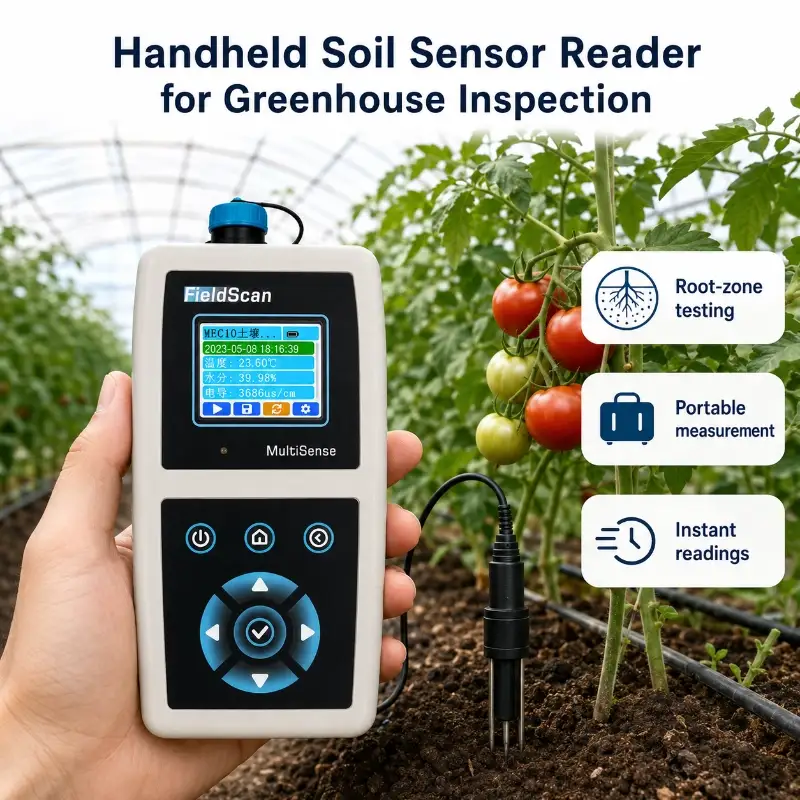
Handheld Sensor Data Logger for Agriculture Field Testing
Key Features
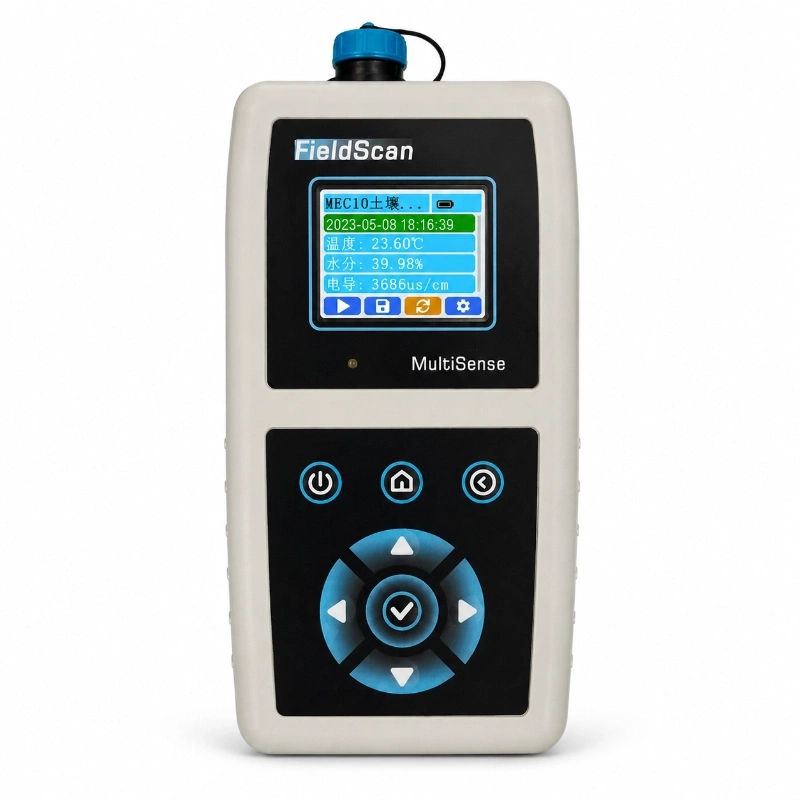
Portable Field Sensor Reading:Designed for quick on-site measurement and field data checking.
Supports Multiple Sensor Types:Compatible with soil moisture sensors, soil EC sensors, substrate sensors, NPK sensors, air temperature and humidity sensors, solar radiation sensors, light sensors, and leaf wetness sensors.
Manual and Automatic Data Logging:Supports single measurement, continuous measurement, manual storage, and automatic recording.
WiFi Data Export to Computer:Stored data can be downloaded through WiFi and exported for further analysis.
Optional Storage Capacity:Available with 256 records or up to 100000 records depending on the selected version.
Color Display with Bilingual Interface:160 × 128 color screen with Chinese and English interface options.
Built In Real Time Clock:Time-stamped data records help support traceability in field testing and research.
Flexible Power Options:Supports 3 AA alkaline batteries or a rechargeable lithium battery, with USB Type C 5V auxiliary power input.
Compact Handheld Design:170 × 80 × 40 mm body size for convenient carrying and field use.
Suitable for Agriculture and Research Applications:Ideal for soil moisture testing, greenhouse monitoring, soilless cultivation, crop research, environmental inspection, and irrigation management.
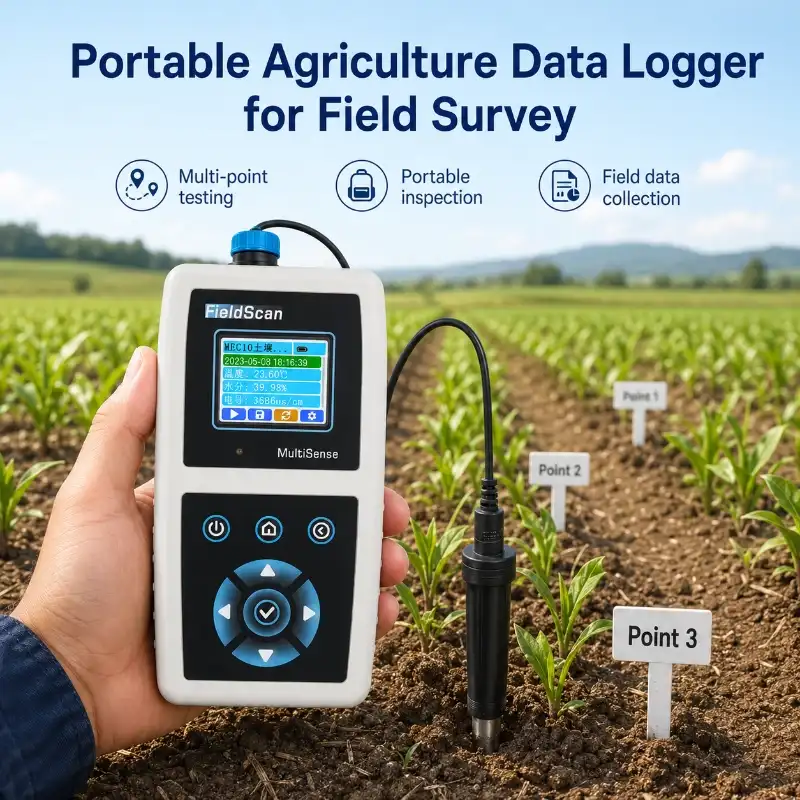
JW-PM(Z13) handheld sensor data logger is a portable field instrument designed for agricultural sensor testing, temporary measurements, installation commissioning and multi-point data collection.
It allows technicians, farmers, agronomists and researchers to connect compatible sensors, view readings directly in the field and record measurement results without installing a permanent monitoring terminal at every test point.
The handheld logger is suitable for applications such as:
Soil moisture field testing
Soil temperature measurement
Soil EC and salinity inspection
NPK trend comparison
Greenhouse root-zone inspection
Irrigation system commissioning
Agricultural research
Sensor troubleshooting
Multi-field surveys
Demonstration and training projects
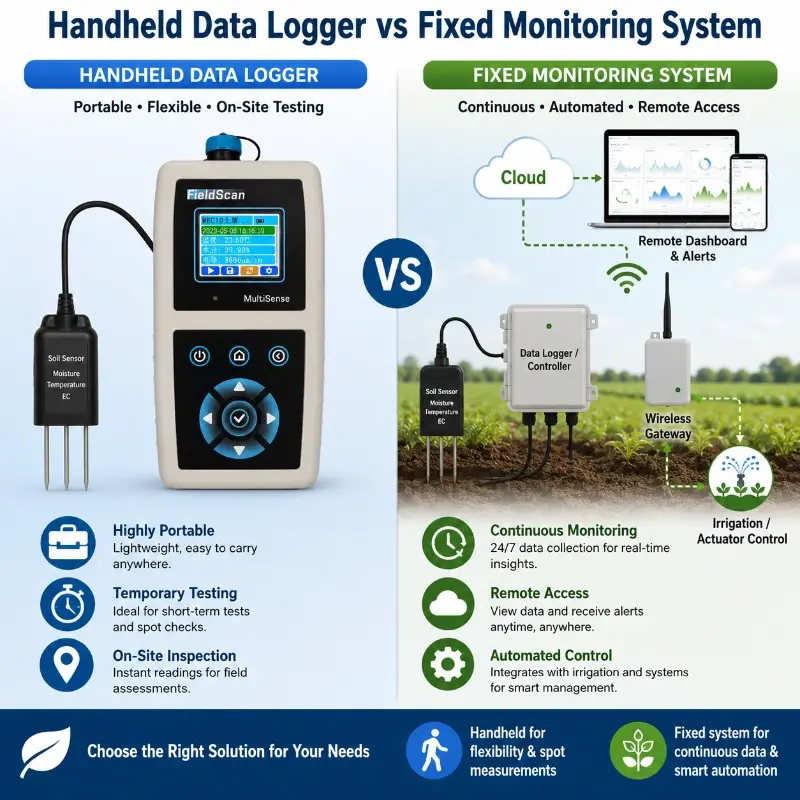
Compared with a permanently installed data logger, a handheld device is easier to carry between fields, greenhouses and experimental plots. It is particularly useful when measurements are required at many temporary locations or when engineers need to verify sensor operation before completing a full IoT monitoring installation.
Product Overview
Agricultural monitoring projects do not always require permanent sensors and wireless gateways at every location.
In many situations, users need to:
Inspect several fields during one visit
Compare soil conditions at multiple locations
Test a sensor before permanent installation
Verify readings after installation
Check whether a sensor is responding correctly
Collect data during short research trials
Demonstrate sensor performance to customers
Diagnose communication or wiring problems
Record measurements from temporary monitoring points
The handheld sensor data logger provides a practical interface between compatible field sensors and the user.
Instead of carrying a laptop, temporary power supply and separate communication converter into the field, the operator can use one portable device to perform routine testing and data collection.
The logger is not intended to replace every fixed IoT monitoring system. Its main value is portability, rapid field verification and flexible use across multiple measurement locations.
Technical Parameters
Item
Parameters
Model No.
JW-PM(Z13)
Product Type
Handheld sensor data logger
Sensor Input
1 channel RS485 interface
Measurement Mode
Manual reading and automatic reading
Data Logging
Manual storage and automatic storage
Storage Options
256 records or 100000 records
Data Export
WiFi data export to computer
Display
160 × 128 color display
Language
Chinese and English interface
Real Time Clock
Built in
Power Supply Option 1
3 AA alkaline batteries
Power Supply Option 2
3.7V rechargeable lithium battery
Auxiliary Power
USB Type C 5V DC input
Operating Environment
-10°C to 50°C
Protection Rating
IP20 NEMA 1
Dimensions
170 × 80 × 40 mm
Software
FieldScanUtility for data download export and firmware update
Typical System Configuration
A typical handheld measurement setup includes:
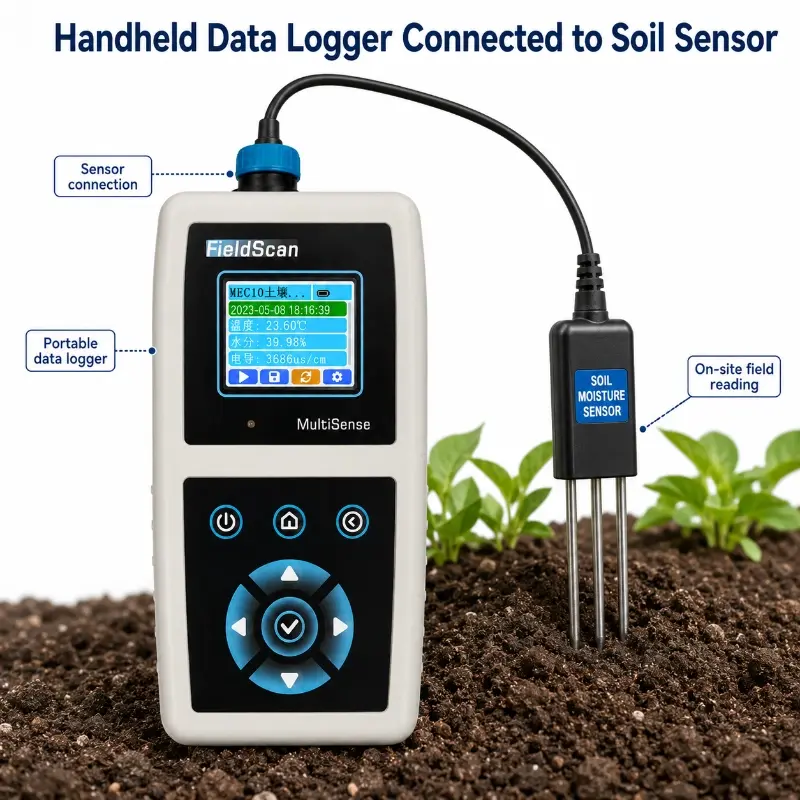
Agricultural sensor → Handheld data logger → On-site display and data recording
Depending on the selected sensor and logger configuration, the system may be used with compatible:
Soil moisture sensors
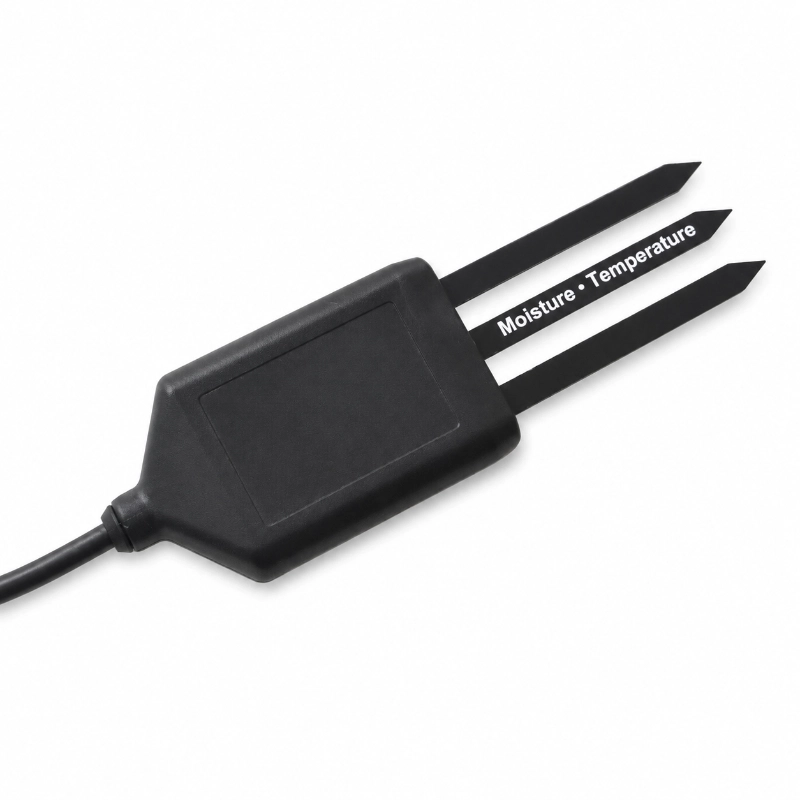
Soil moisture and temperature sensors
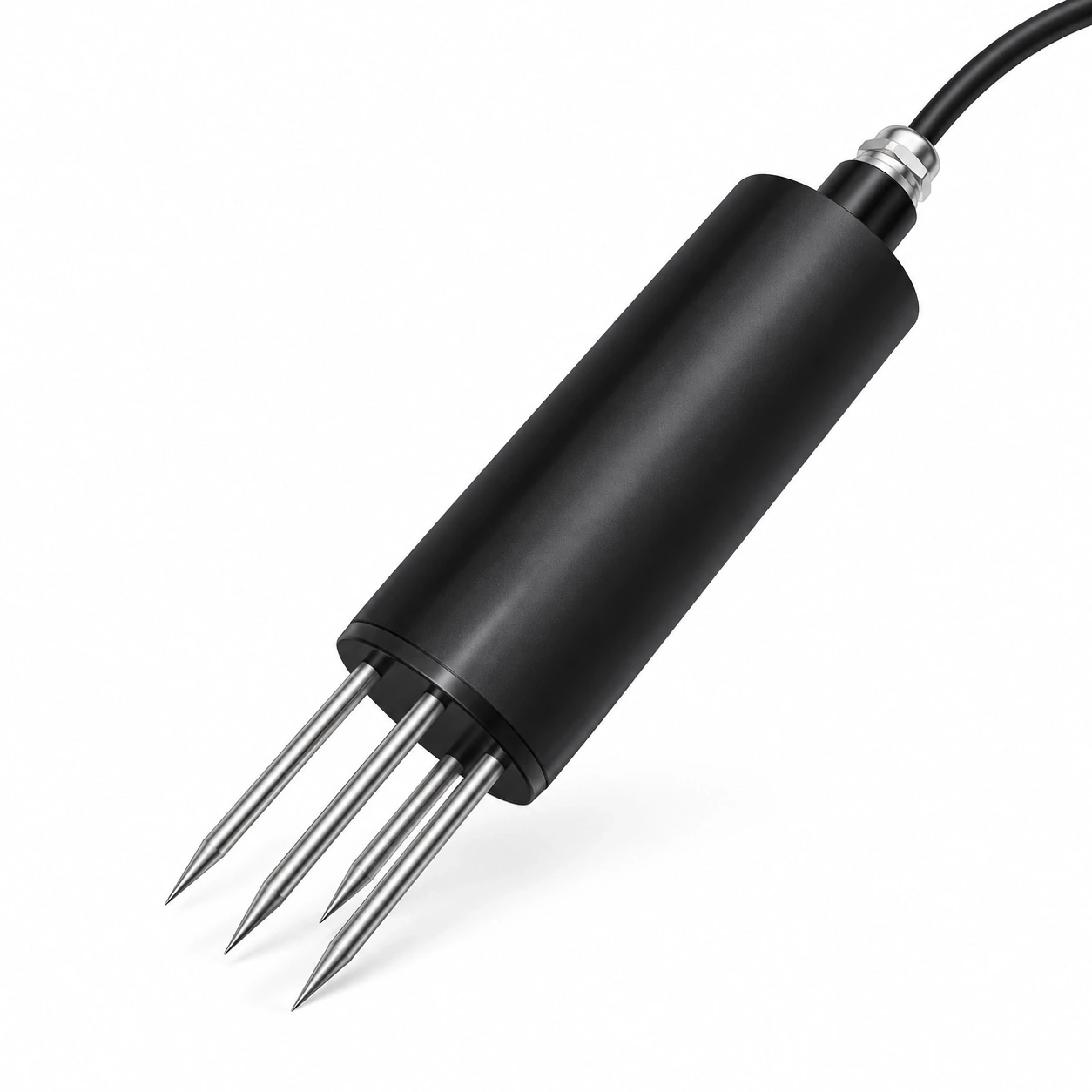
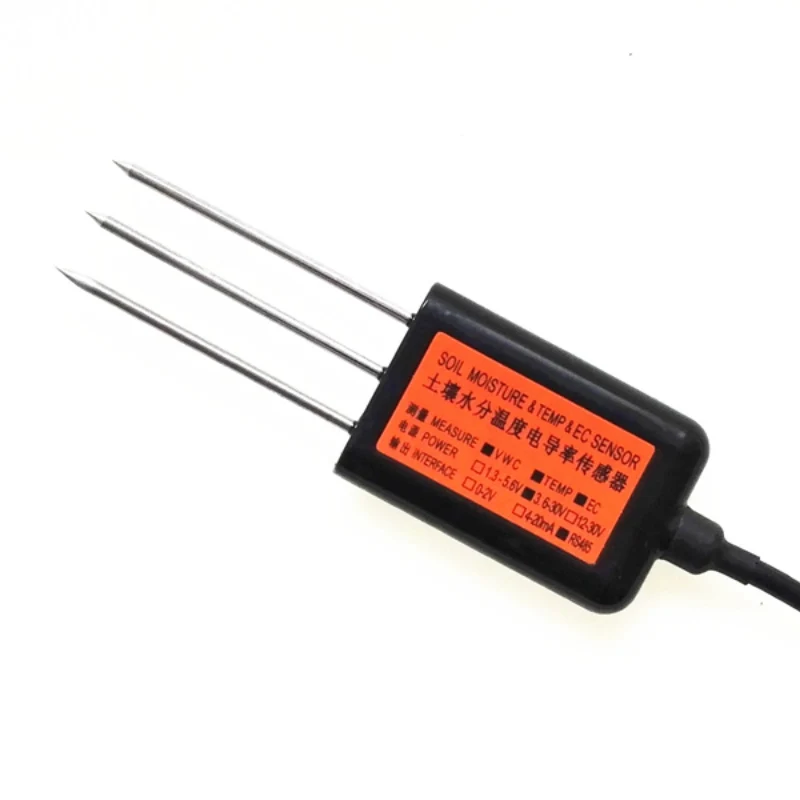
Soil moisture, EC and temperature probes
Soil NPK sensors
Substrate moisture sensors
Substrate EC sensors
Air temperature and humidity sensors
Light sensors
PAR sensors
Leaf wetness sensors
Water quality sensors
Other RS485 or project-specific sensors
Sensor compatibility should be confirmed before ordering. Communication interface, protocol, power requirements and register definitions must match the handheld logger configuration.
Explore the complete range of Soil Sensors for compatible soil and root-zone monitoring options.
Main Agricultural Applications
Soil Moisture Field Surveys
The handheld logger can be used with a compatible soil moisture probe to collect readings from several locations in the same field.
This can help users compare:
Wet and dry areas
Irrigated and non-irrigated zones
Different soil textures
Areas near and far from drip emitters
Different crop rows
Upper and lower slope positions
Areas with suspected drainage problems
A handheld survey is useful during the early stage of a project when the final permanent monitoring locations have not yet been selected.
Greenhouse Root-Zone Inspection
Greenhouses often contain several crop varieties, irrigation zones or planting beds. One fixed sensor may not represent every area.
The portable logger allows technicians to inspect several representative locations and determine where permanent sensors should be installed.
During irrigation system installation, a handheld sensor reader can help verify whether water reaches the intended root zone.
Technicians can measure soil conditions:
Before irrigation
During system testing
After irrigation
At several distances from the emitter
At representative root depths
At the beginning and end of an irrigation line
In different valve-controlled zones
These readings can help identify uneven water distribution, blocked emitters, excessive irrigation or areas where water does not adequately reach the active roots.
For permanent monitoring and control, the logger can support preliminary site assessment before deploying a Wireless Smart Irrigation System.
Agricultural Research and Field Trials
The handheld data logger is suitable for temporary experiments that do not require a permanently installed telemetry station.
Typical research applications include:
Irrigation treatment comparison
Fertilizer trials
Soil drying curve observation
Crop water-use studies
Root-zone temperature comparison
Salinity surveys
Soil spatial variability studies
Sensor calibration comparison
Agricultural teaching
Field demonstration projects
Researchers should use consistent sampling depth, measurement timing and soil contact conditions to improve comparability between test points.
Sensor Installation and Commissioning
Before burying a sensor or completing a monitoring station, the installer can use the handheld logger to confirm:
Correct sensor connection
Stable power supply
Normal sensor response
Correct sensor address
Correct parameter display
Acceptable field readings
No obvious cable damage
No communication failure
This reduces the risk of completing installation around a sensor that has not been properly tested.
Sensor Troubleshooting
If a fixed monitoring system reports abnormal data, the handheld device can help separate sensor problems from communication or platform problems.
A technician may use it to check:
Whether the sensor responds locally
Whether readings change when conditions change
Whether the sensor address is correct
Whether wiring polarity is correct
Whether the cable is damaged
Whether the problem is in the sensor or the remote terminal
Whether the cloud platform value matches the local measurement
Agricultural Equipment Demonstration
Distributors and system integrators can use a handheld data logger to demonstrate compatible sensors without building a complete fixed monitoring station.
It is suitable for:
Customer visits
Agricultural exhibitions
Dealer training
Product demonstrations
Technical workshops
On-site project discussions
Compatible Soil Measurement Options
Soil Moisture and Temperature
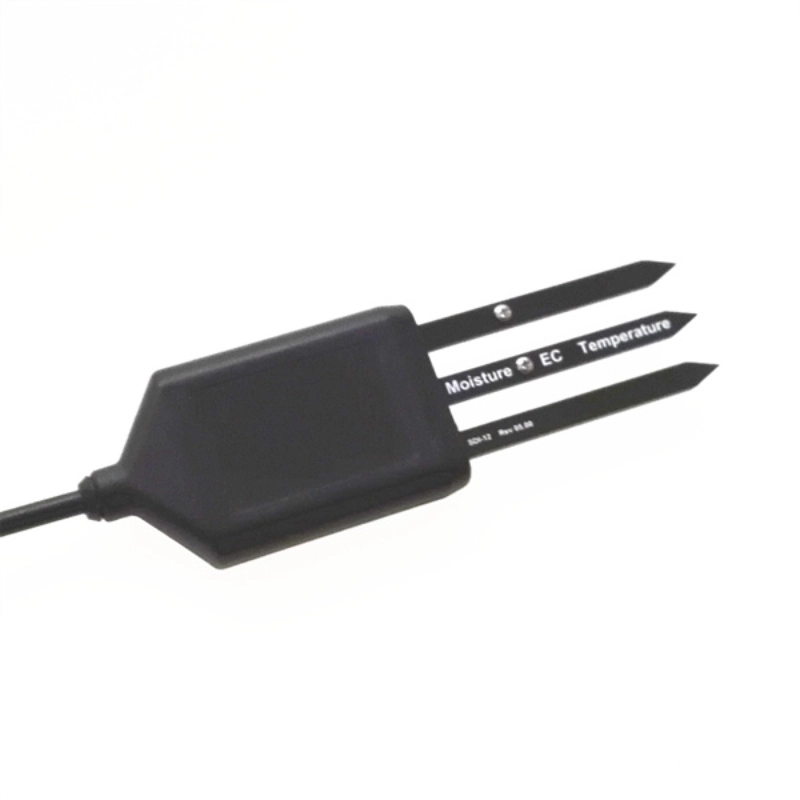
For irrigation and root-zone monitoring, the handheld logger can be paired with a compatible moisture and temperature probe.
The sensor can help users observe whether the soil is:
For rapid field-reference measurements involving nitrogen, phosphorus and potassium, the logger may be configured with a compatible multi-parameter soil sensor.
NPK sensor readings should mainly be used for field comparison and trend monitoring. Formal fertilizer recommendations should also consider laboratory soil testing, local calibration, crop growth stage and professional agronomic advice.
Substrate Monitoring
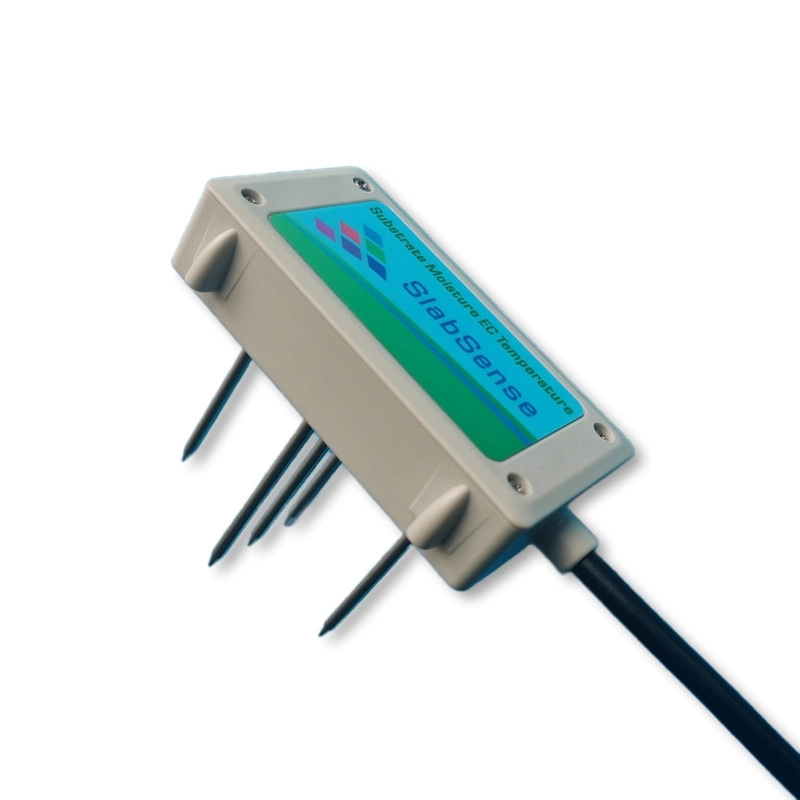
For greenhouse crops grown in coco coir, peat, perlite, rock wool or other growing media, a dedicated substrate sensor may be more appropriate than a general soil sensor.
Avoid testing only beside a road, field edge or irrigation inlet unless those areas are specifically being investigated.
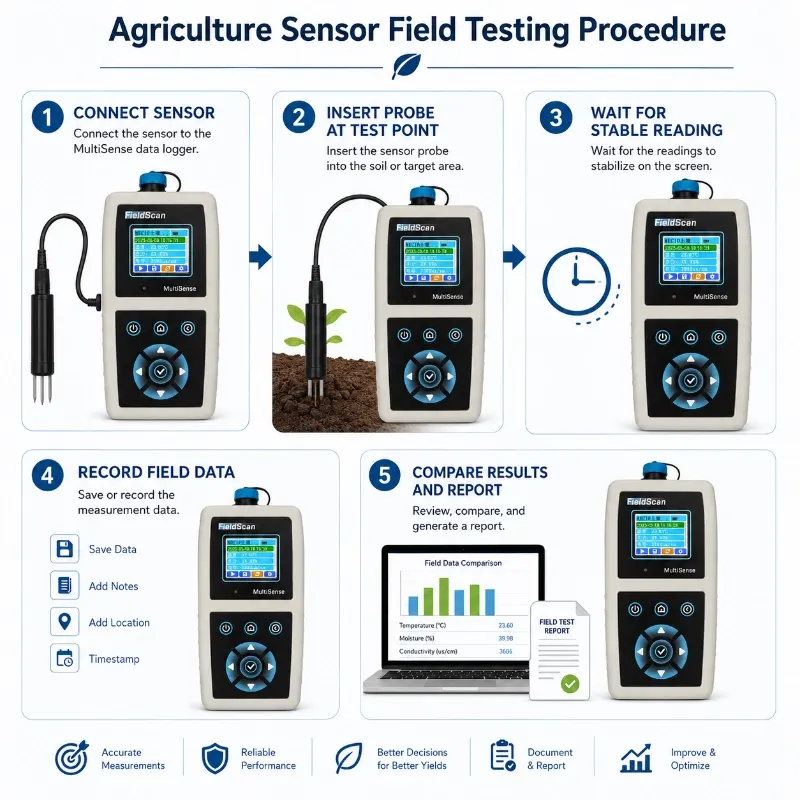
Step 2: Check the Sensor and Logger
Before entering the field:
Confirm that the logger has sufficient power.
Check the sensor cable and connector.
Confirm sensor compatibility.
Verify the selected parameter or communication configuration.
Record the sensor model and test location.
Step 3: Prepare the Measurement Point
Remove:
Large stones
Hard surface crust
Thick plant debris
Large roots
Foreign objects
Do not create an oversized loose hole around the electrodes, because air gaps can affect soil sensor readings.
Step 4: Insert the Sensor Correctly
Insert all sensing electrodes into the measured soil or substrate.
Ensure:
Complete electrode insertion
Close contact with the surrounding medium
Consistent measurement depth
No large air gaps
No direct contact with metal or concrete
No excessive force on the electrodes
Do not hammer a soil probe into hard or stony ground.
Step 5: Allow the Reading to Stabilize
Do not record the first value immediately after insertion.
Wait until the reading becomes stable according to the response characteristics of the connected sensor.
Step 6: Record the Measurement Context
A useful field record should include:
Date and time
Sampling point
GPS or plot reference when available
Crop type
Crop growth stage
Sensor depth
Recent irrigation
Recent rainfall
Fertilizer application
Soil condition
Displayed readings
Operator notes
Without contextual information, a single measurement may be difficult to interpret later.
Step 7: Measure Several Points
One point rarely represents an entire field.
Take several measurements within the target management zone and compare:
Average value
Highest reading
Lowest reading
Spatial variation
Abnormal points
Step 8: Clean the Sensor
After testing:
Remove attached soil
Wipe the probe carefully
Avoid damaging the electrodes
Do not pull the device by the cable
Keep connectors dry
Store the equipment properly
Follow the cleaning requirements of the connected sensor.
How to Improve Measurement Consistency
Portable field measurements are affected by sampling method as well as sensor quality.
For better comparison:
Use the same sensor model
Maintain the same insertion depth
Use similar measurement timing
Measure under comparable moisture conditions
Avoid large air gaps
Allow readings to stabilize
Record irrigation and rainfall events
Measure several points per zone
Avoid comparing disturbed soil directly with undisturbed soil
Clean the probe between locations
Use the same measurement procedure for every operator
A handheld logger provides measurement data, but the sampling plan determines whether the data represents the actual field condition.
Common Field Testing Mistakes
Measuring Only One Point
A single point may be unusually wet, dry, compacted or close to an emitter.
Use multiple representative measurements.
Testing Directly Below a Drip Emitter
This may produce a temporarily saturated reading that does not represent the wider root zone.
Measure within the wetting pattern but not only at the point of direct water discharge.
Inconsistent Measurement Depth
Soil moisture and temperature can vary significantly with depth.
Use a consistent depth when comparing different points.
Poor Soil Contact
Air gaps around the electrodes can result in unstable or unrepresentative data.
Comparing Measurements Taken Under Different Conditions
A recently irrigated location should not be compared directly with a dry location without recording the difference in timing and conditions.
Treating a Field Sensor as a Complete Laboratory Replacement
Portable sensors are valuable for rapid inspection, relative comparison and trend analysis. Laboratory testing may still be required for formal nutrient analysis, regulatory reporting or high-precision research.
Ignoring Sensor Compatibility
A sensor with the correct physical connector may still use a different voltage, protocol, address or register map.
Compatibility must be confirmed before connection.
Selection Guide
Before ordering the handheld data logger, confirm the following information:
Which sensor models will be connected?
What parameters must be displayed?
Does the sensor use RS485, analog output or another interface?
Which Modbus register map is used?
Is data storage required?
Is data export required?
How many measurements will be collected per day?
Will the logger be used indoors, outdoors or both?
Is a customized connector required?
Is the device intended for testing, demonstration or routine inspection?
Is permanent remote monitoring also required?
Are OEM or private-label services needed?
Providing this information helps JW-IoT confirm sensor compatibility and recommend the correct configuration.
System Integration Support
JW-IoT can support portable testing and permanent monitoring within the same agricultural project.
A project may use:
Handheld logger for site surveys
Permanent soil sensors at representative points
Weather station for environmental monitoring
RS485 data logger
LoRaWAN node
4G LTE gateway
Cloud dashboard
Mobile access
Threshold alarms
Irrigation controller
Pump and valve control
API integration
A common deployment process is:
Use the handheld logger to investigate field variability.
Identify representative monitoring zones.
Select suitable permanent sensor locations.
Install fixed sensors and communication equipment.
Compare fixed readings with periodic handheld inspections.
Adjust irrigation thresholds based on observed data.
This approach helps avoid installing permanent equipment at unrepresentative locations.
Request a Compatible Handheld Sensor Testing Kit
Tell us which sensors you need to test, the required parameters, output interface, communication protocol, connector type and data storage requirements.
JW-IoT can help configure a portable field testing kit containing the handheld logger, compatible sensors, connection cables and required accessories.
Contact JW-IoT to request a quotation, compatibility review, technical datasheet or customized agricultural field-testing solution.
FAQ
Q
1. What is this handheld sensor data logger used for?
A
It is used to read, display, and record data from supported field sensors. Common applications include agriculture testing, greenhouse monitoring, soilless cultivation, environmental inspection, and scientific research.
Q
2. Can it connect to soil moisture and EC sensors?
A
Yes. The device supports compatible soil moisture, temperature, EC, NPK, substrate, air, light, solar radiation, and leaf wetness sensors through an RS485 interface.
Q
3. Does the device support automatic data logging?
A
Yes. It supports both manual and automatic data recording. Users can set automatic recording intervals for continuous field observation.
Q
4. Can data be exported to a computer?
A
Yes. Stored data can be downloaded through WiFi and exported using the FieldScanUtility software.
Q
5. What storage capacity is available?
A
Two storage options are available: 256 records or up to 100000 records depending on the selected configuration.
Q
6. Does JW-IoT offer this handheld sensor data logger for greenhouse projects?
A
Yes. JW-IoT can provide this handheld sensor data logger as part of greenhouse monitoring, soil testing, and soilless cultivation measurement solutions.
Q
7. Can JW-IoT customize a sensor package with this device?
A
Yes. JW-IoT can match the handheld data logger with suitable soil moisture sensors, substrate sensors, air sensors, light sensors, or leaf wetness sensors according to the customer’s application.
Q
8. Is this JW-IoT device suitable for agricultural research?
A
Yes. The JW-IoT handheld sensor data logger is suitable for agricultural research, field sampling, crop trials, irrigation testing, and environmental monitoring projects.
Q
9. What power supply does the device use?
A
It supports either 3 AA alkaline batteries or a 3.7V rechargeable lithium battery. It also supports USB Type C 5V auxiliary power input.
Q
10. Does the device support English language operation?
A
Yes. The device supports both Chinese and English interface options.
Q
11. What is the communication interface for sensors?
A
The sensor input channel uses an RS485 interface and supports Modbus RTU communication.
Q
12. How should the sensor be installed for accurate readings?
A
Yes. JW-IoT can provide sensor and logger combinations for distributors, system integrators, greenhouse suppliers, and agricultural monitoring projects.
 +86 13520127780
  info@jingelway.com