+86 13520127780
 info@jingelway.com









Draw Wire vs Linear Potentiometer vs Magnetostrictive Sensor: Which One to Choose?
Release time: 2026-10-26
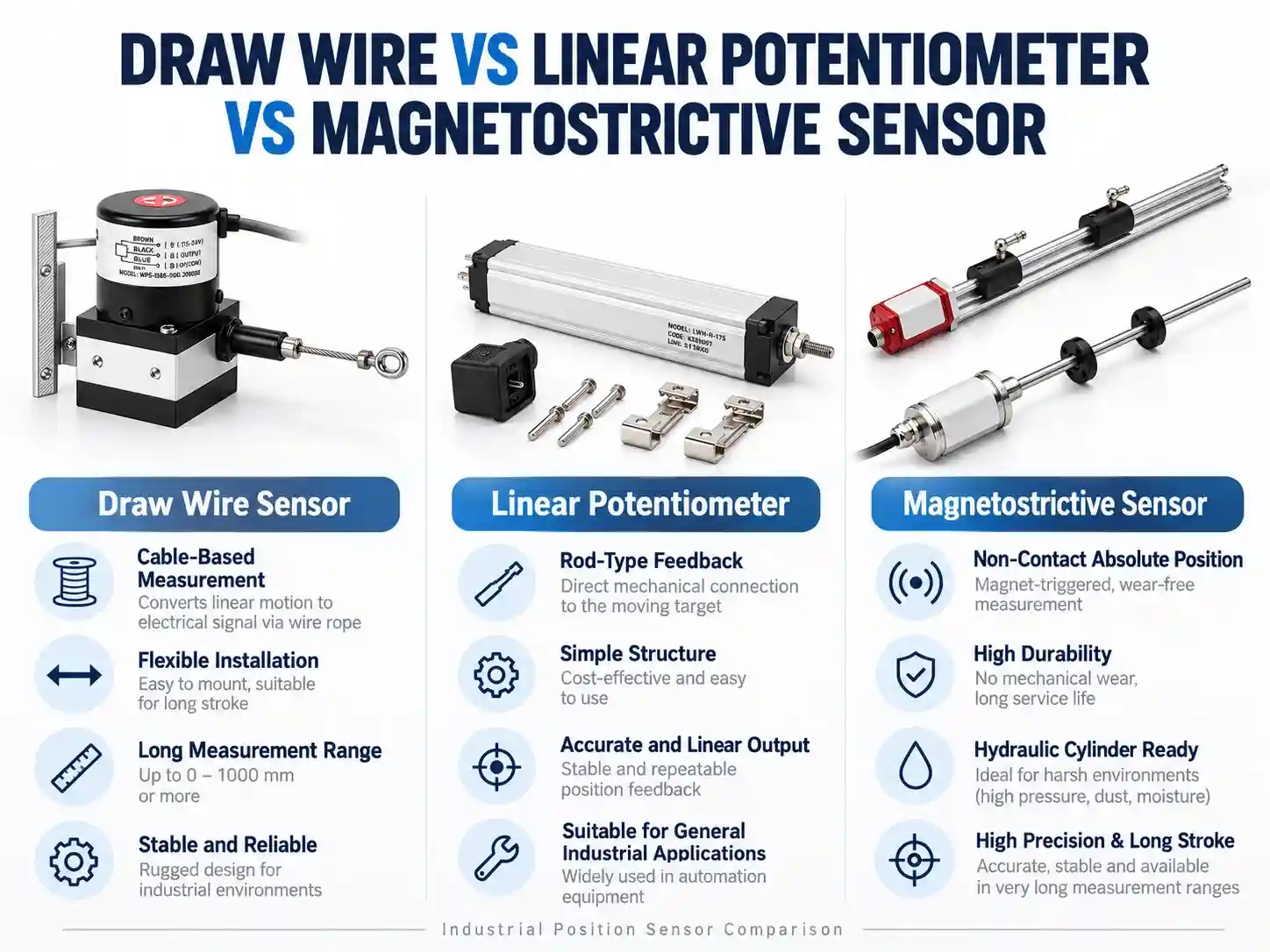
Choosing the right industrial displacement sensor is not simply a matter of selecting the longest measuring range or the highest advertised accuracy.
Draw wire displacement sensors, linear potentiometers, and magnetostrictive position sensors can all measure linear movement, but they use different mechanical arrangements and sensing principles.
A draw wire sensor measures the extension of a cable connected to a moving target. A linear potentiometer measures the movement of a rod or slider through a resistive element. A magnetostrictive sensor determines the position of a magnet without requiring sliding electrical contact.
These differences influence installation space, mechanical wear, measurement performance, signal integration, and long-term maintenance.
This guide compares the three technologies and explains how to choose the right sensor for hydraulic cylinders, industrial machinery, lifting equipment, and linear position monitoring.
1. Quick Comparison: Three Linear Displacement Sensor Technologies
The table below summarizes the main differences.
| Feature | Draw Wire Sensor | Linear Potentiometer | Magnetostrictive Sensor |
| Measuring Principle | Retractable Cable and Spool | Moving Resistive Contact | Magnetostrictive Time-of-Flight |
| Mechanical Connection | Cable Endpoint | Rod or Slider | Moving Position Magnet |
| Measurement Contact | Cable and Mechanical Spool | Sliding Electrical Contact | Non-Contact Sensing Interface |
| Position Feedback | Depends on Internal Encoder or Potentiometer | Direct Analog Position | Absolute Position |
| Installation Priority | Flexible Cable-Based Measurement | Direct Machine Stroke | Compatible Magnet and Probe Arrangement |
| Typical Applications | Lifting Platforms, Machinery Travel, Gates | Injection Molding, Machine Slides, Actuators | Hydraulic Cylinders, Automation, Level Monitoring |
| Maintenance Considerations | Cable, Spring, Spool | Rod Alignment, Wiper Wear | Magnet Alignment, Probe and Connections |
Quick selection rule: Choose draw wire for cable-connected movement, linear potentiometers for direct mechanical stroke feedback, and magnetostrictive sensors when non-contact absolute position measurement is important.
However, the final choice must also account for environmental and electrical requirements.
2. Draw Wire Displacement Sensors: Flexible Cable-Based Measurement
How a Draw Wire Sensor Works
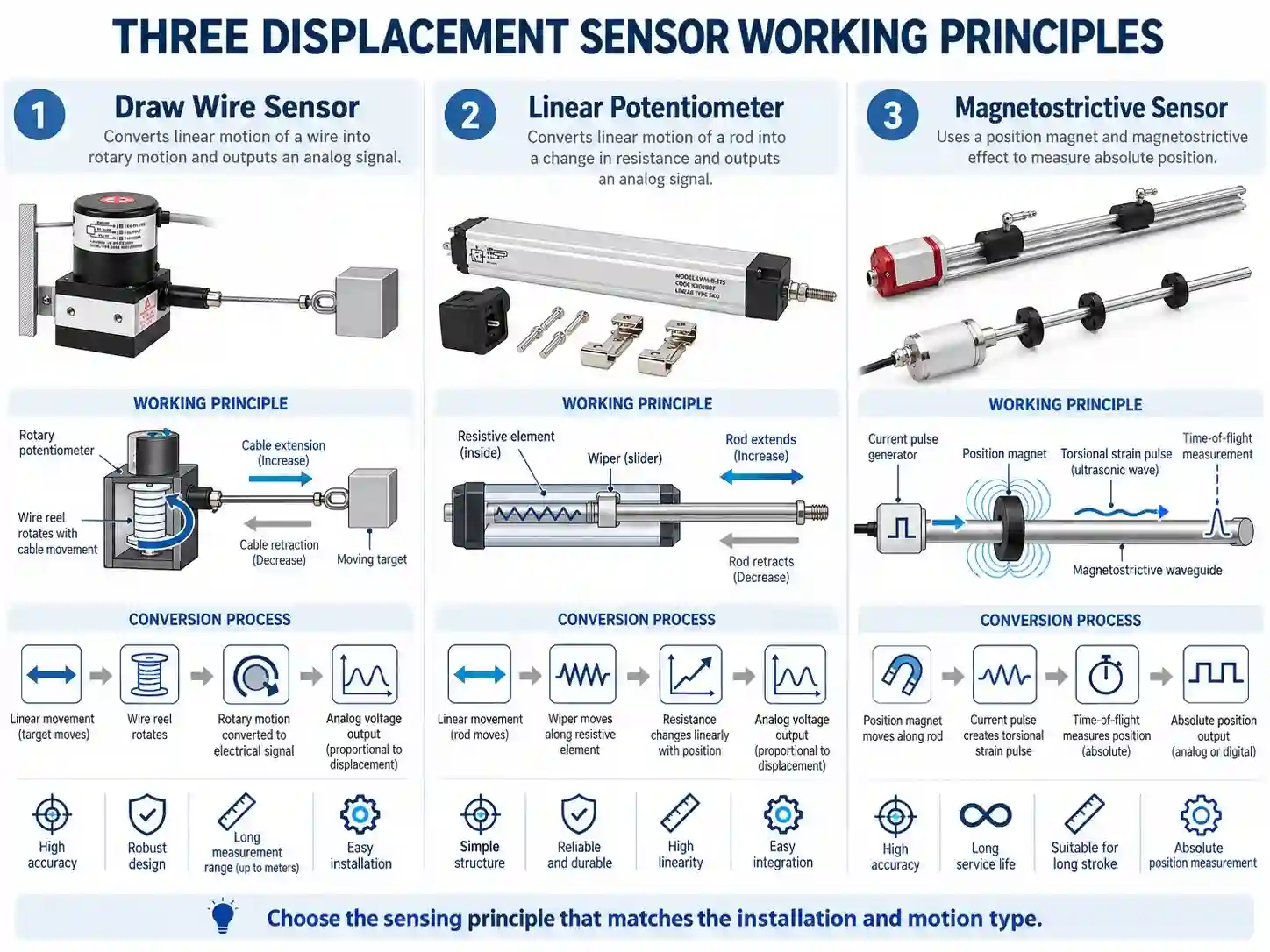
A draw wire displacement sensor, also known as a cable extension sensor, contains a measuring cable wound around a spool.
The sensor housing remains fixed while the cable endpoint attaches to a moving component.
When the target moves, the cable extends or retracts. The resulting spool rotation is converted into an electrical signal by a potentiometer, encoder, or another suitable sensing element.
The basic measurement sequence is:
Linear Movement → Cable Extension → Spool Rotation → Electrical Position Signal
The sensor measures relative movement along the cable direction.
Advantages of Draw Wire Sensors
The primary advantage is their compact mechanical arrangement relative to the measurement stroke.
A draw wire sensor can monitor movement over hundreds or thousands of millimetres without requiring a rigid sensor body of equivalent length.
This makes it useful for:
- Lifting platform travel
- Telescopic equipment extension
- Moving machine components
- Sliding gate position
- Selected structural joint measurements
Limitations to Consider
The measuring cable must remain properly aligned with the target movement.
Excessive side loading, abrasion, sudden retraction, and operation beyond the rated stroke can affect sensor performance or damage the mechanism.
For outdoor installations, the exposed cable and mounting arrangement require additional evaluation.
JW-IoT Draw Wire Sensor Options
The JW-WPS-XS(S10) Draw Wire Displacement Sensor 0–1000mm provides a compact XS-series configuration with IP65 protection and selectable electrical outputs.
For longer movements, the Draw Wire Displacement Sensor 0–2500mm offers another measuring-range option.
Best suited for: Applications where a retractable cable can connect the fixed sensor location to the moving target.
3. Linear Potentiometers: Direct Mechanical Position Feedback
How a Linear Potentiometer Works
A linear potentiometer displacement sensor typically contains a conductive resistive element and a moving electrical contact.
Mechanical movement is transferred through a measuring rod or slider.
As the contact moves along the resistive element, the electrical resistance ratio changes, providing a signal related to the measured position.
The measurement sequence is:
Rod Movement → Sliding Contact → Resistance Ratio Change → Analog Position Signal
Unlike an incremental encoder, a potentiometric sensor provides direct position-related feedback within its measuring stroke.
Advantages of Linear Potentiometers
Linear potentiometers are well suited to machinery where the moving component can be mechanically coupled to a measuring rod.
Their advantages include:
- Continuous analog position feedback
- Direct position measurement
- Straightforward integration with suitable acquisition circuits
- Multiple stroke lengths
- Compact and long-stroke configurations
They are commonly used in injection molding machines, hydraulic presses, packaging machinery, and mechanical positioning systems.
Mechanical Limitations
The measuring rod must move along its intended sensing axis.
Excessive bending, lateral loading, poor alignment, or unsuitable operating speed may affect measurement consistency and accelerate wear.
The internal sliding contact also introduces a mechanical wear mechanism that differs from non-contact sensing technologies.
JW-IoT Linear Potentiometer Options
The JW-LWM(S02) Linear Displacement Sensor 75–1250mm uses a conductive plastic resistive element, stainless steel measuring rod, and long bearing support.
The product offers potentiometric output and optional conditioned voltage or current signals, depending on configuration.
For smaller machines, the JW-KTM(S04) Mini Linear Displacement Sensor 25–300mm provides a compact alternative.
Best suited for: Industrial equipment requiring direct rod-type position feedback with an appropriate mechanical connection.
4. Magnetostrictive Sensors: Non-Contact Absolute Position Measurement
How a Magnetostrictive Sensor Works
A magnetostrictive displacement sensor determines the position of a moving magnet along a sensing probe or profile.
An electrical excitation pulse interacts with the magnetic field of the position magnet and produces a torsional wave within a magnetostrictive waveguide.
The sensor electronics measure the wave travel time and calculate the magnet’s position.
The measurement sequence is:
Moving Magnet → Magnetostrictive Interaction → Torsional Wave → Time Measurement → Absolute Position
This allows position measurement without a sliding electrical contact between the position magnet and sensing element.
Advantages of Magnetostrictive Technology
A key advantage is absolute position feedback.
After power restoration, the sensor can determine the position of the magnet without relying on incremental pulse counting or a mechanical homing sequence.
Other advantages include:
- Non-contact sensing
- High repeatability in suitable configurations
- Long-stroke position measurement
- Analog and digital interface options
- Compatibility with specially designed hydraulic cylinders
- Suitable configurations for liquid-level measurement
Installation and Selection Limitations
Magnetostrictive sensors require a compatible position magnet, correct probe alignment, and sufficient mechanical clearance.
Hydraulic cylinder installations may also require pressure-rated probe construction, suitable sealing, and appropriate piston magnet design.
Non-contact sensing does not mean that the entire instrument is maintenance-free.
JW-IoT Magnetostrictive Sensor
The JW-MDS(S09) Magnetostrictive Displacement Sensor 50–20000mm provides selectable measuring ranges and configurations including 4–20mA, voltage, Modbus RS485, SSI, and START/STOP outputs.
The actual interface, probe construction, and environmental ratings depend on the selected configuration.
Best suited for: Hydraulic cylinders, long-stroke industrial equipment, and applications where non-contact absolute position feedback is required.
5. Which Sensor Is More Accurate?
Accuracy cannot be compared reliably using measurement technology alone.
The relevant specifications include:
- Linearity
- Repeatability
- Resolution
- Hysteresis
- Temperature effects
- Total measurement uncertainty
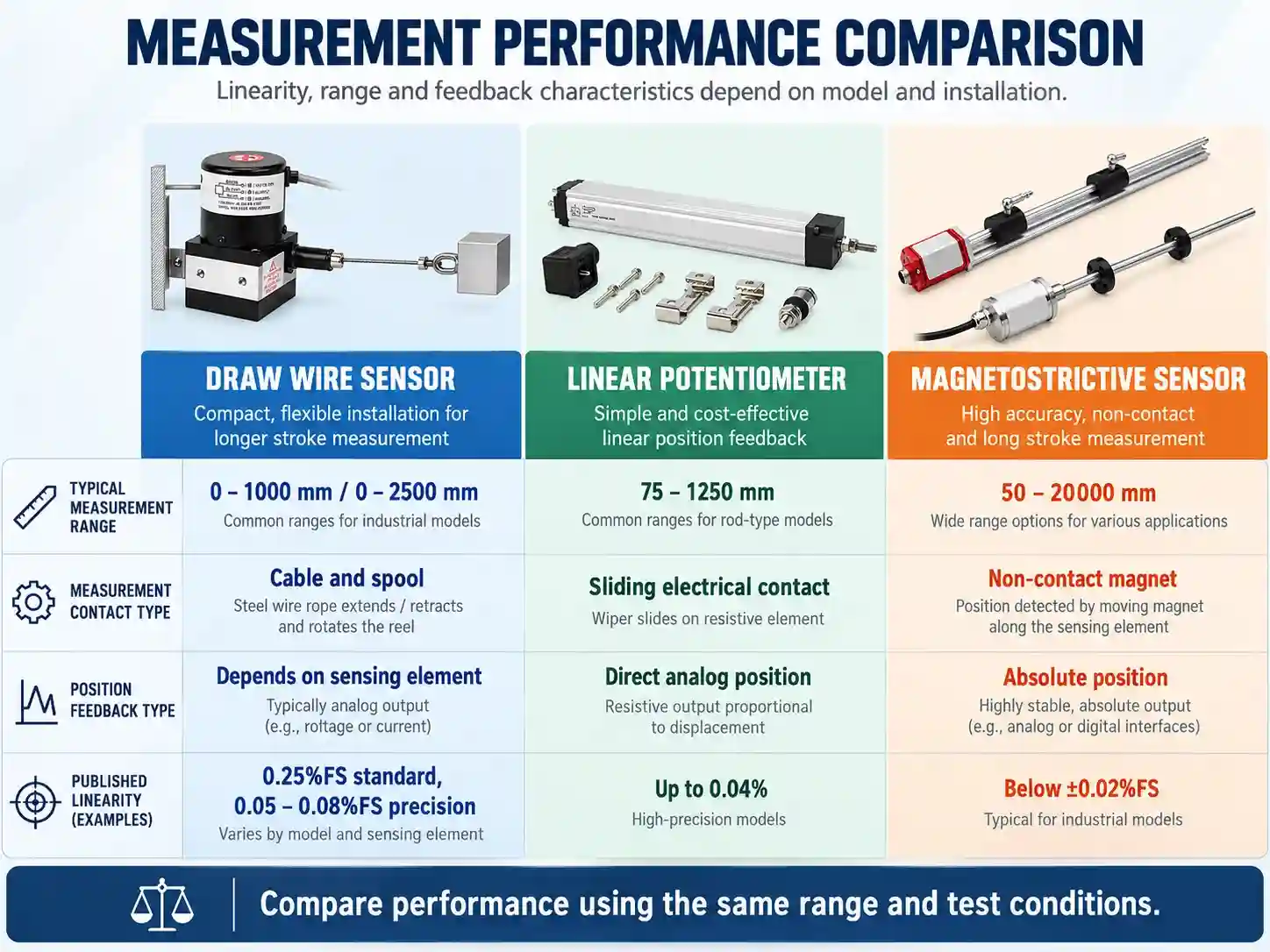
For example, JW-IoT product documentation lists the following configuration-dependent linearity characteristics:
| Product | Published Linearity Information |
| WPS-XS Draw Wire | Standard 0.25%FS; precision 0.05–0.08%FS |
| LWH Linear Potentiometer | Up to 0.04%, depending on configuration |
| MDS Magnetostrictive | Non-linearity below ±0.02%FS, subject to minimum limits |
These figures are not directly interchangeable guarantees of total measurement accuracy. They refer to different specifications and potentially different measuring spans and conditions.
Why Full Scale Matters
Consider two sensors with different stroke lengths.
A 1000mm sensor with ±0.1%FS linearity corresponds to a linearity deviation of ±1mm.
A 100mm sensor with the same percentage corresponds to ±0.1mm.
Therefore, compare performance at the actual required measuring range, not merely by looking at the percentage.
For additional measurement-system guidance, consult the NIST Engineering Statistics Handbook.
6. Which Technology Is Better for Different Applications?
6.1 Hydraulic Cylinder Position Measurement
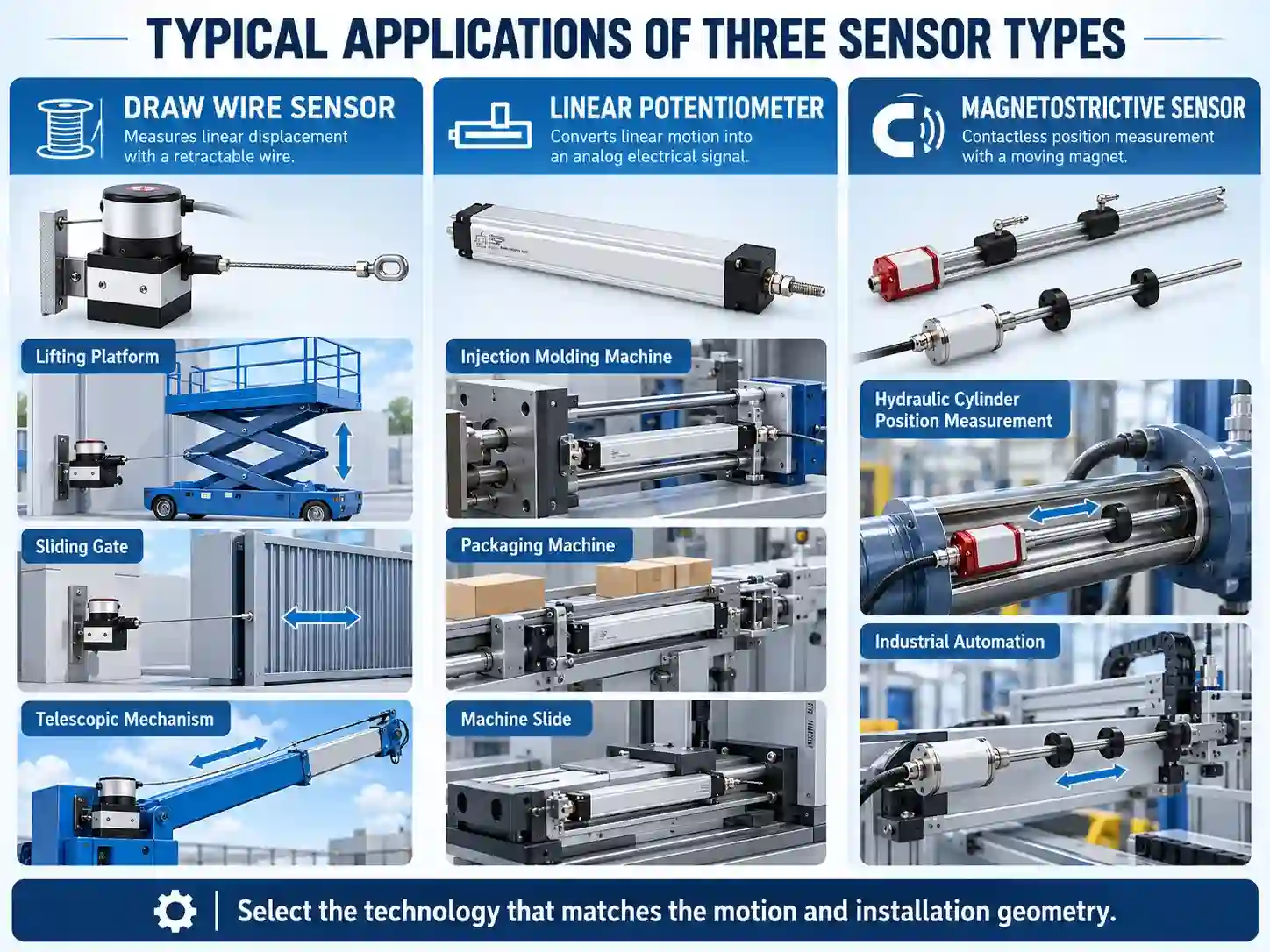
For internally integrated hydraulic cylinder position feedback, a compatible magnetostrictive sensor is often a strong candidate.
It allows a magnet attached to the piston to move along the probe without sliding contact at the sensing interface.
Where external measurement is preferred, a rod-type linear potentiometer or draw wire sensor may be appropriate, depending on the mechanical arrangement.
Recommended starting point: JW-MDS(S09) Magnetostrictive Position Sensor.
6.2 Injection Molding and Packaging Machinery
Injection molding equipment, die casting machines, and packaging machinery often require direct stroke-position feedback.
A linear potentiometer can be a practical choice where the measuring rod can be aligned and connected to the moving component.
For these applications, consider the LWH series for longer strokes or the KTM series for compact installations.
6.3 Lifting Platforms and Telescopic Mechanisms
Where a rigid measuring rod cannot fit alongside the full travel, a draw wire sensor provides an alternative.
The compact housing can remain at a fixed reference point while the measuring cable follows the moving target.
Cable alignment, operating speed, and mechanical travel limits must be evaluated.
6.4 Gate Position and Structural Movement Monitoring
Draw wire sensors can measure relative movement between suitable fixed and moving reference points.
Potential applications include sliding gates and selected structural expansion joints.
However, the measurement reflects displacement along the cable direction and does not independently determine structural stability.
For integrated infrastructure projects, explore the JW-IoT Structural Health Monitoring System.
7. Electrical Outputs: Which Sensor Is Easier to Integrate?
All three technologies can be integrated with industrial controllers when suitable output versions are selected.
| Output | Typical Integration | Key Selection Requirement |
| Potentiometric Resistance | Measuring Circuit / PLC Module | Excitation and Input Loading |
| 0–5V / 0–10V | Analog Voltage Input | Voltage Range and Wiring |
| 4–20mA | PLC / RTU Current Input | Loop Supply and Input Compatibility |
| RS485 | Compatible Digital Controller | Protocol and Communication Settings |
| SSI | Digital Position Interface | Clock, Timing and Electrical Compatibility |
| ABZ Encoder | High-Speed Counter | Pulse Resolution and Referencing |
An RS485 interface does not automatically imply Modbus RTU support.
Likewise, multiple outputs listed for a product family are normally configuration choices, not necessarily simultaneous outputs from one device.
For remote monitoring, an external PLC, RTU, or data logger can forward acquired measurements to compatible monitoring software.
Explore Industrial IoT Monitoring Solutions for related architectures.
8. How to Choose: A Practical Engineering Checklist
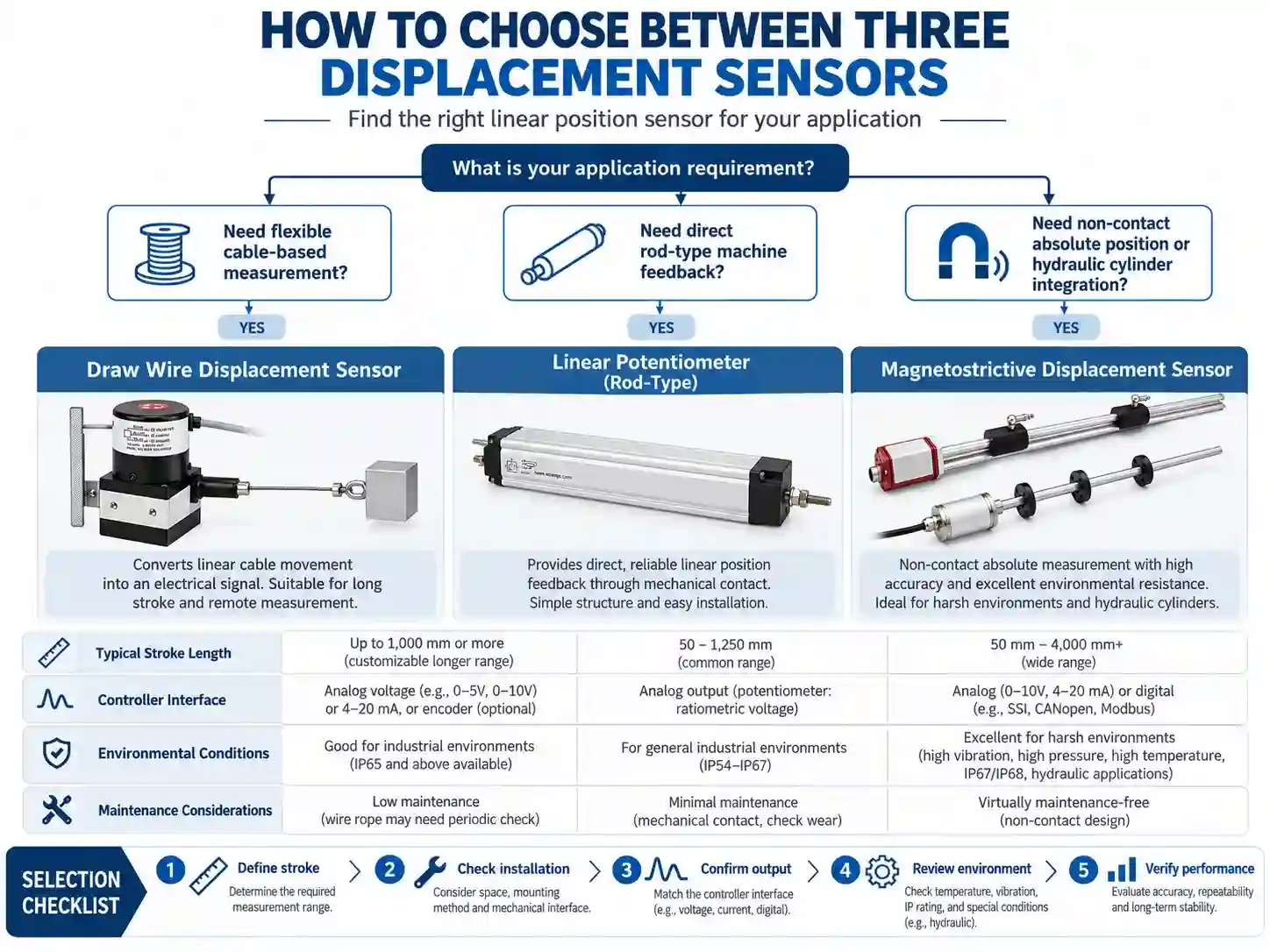
Before requesting a quotation, answer the following questions.
Step 1: What Is the Required Stroke?
Calculate the full expected movement, including installation offset and required travel allowance.
Avoid selecting a measuring range that leaves insufficient clearance near the sensor’s mechanical limits.
Step 2: How Will the Sensor Connect to the Target?
Use a cable-based mechanism where direct rod coupling is impractical.
Choose a rod-type sensor when the machine provides stable, properly aligned mechanical movement.
Consider magnetostrictive technology when a suitable moving magnet and probe installation are possible.
Step 3: Is Absolute Position Recovery Important?
If the system requires direct position information after power restoration, verify the selected sensor’s position reporting behavior.
Magnetostrictive sensors provide absolute position feedback, while incremental encoders generally depend on position referencing or retention.
Step 4: What Measurement Performance Is Needed?
Specify the required error limits in millimetres and clarify the required repeatability, linearity, and response time.
Step 5: Which Controller Interface Is Available?
Identify the available analog or digital input channels and the required power supply.
Step 6: What Environmental Conditions Apply?
Check temperature, ingress protection, vibration, cable exposure, mechanical life, and any pressure or hazardous-area requirements.
9. Frequently Asked Questions
Is a draw wire sensor the same as a linear potentiometer?
Not necessarily. A draw wire sensor describes the cable-and-spool mechanism. Some draw wire sensors use an internal potentiometer, while others use an encoder.
Which displacement sensor has the longest measuring range?
All three technologies are available in different ranges. The JW-IoT product families discussed here include long-travel draw wire and magnetostrictive options. Installation requirements matter as much as maximum stroke.
Are magnetostrictive sensors more accurate than potentiometers?
Not in every situation. Actual measurement performance depends on the selected model, stroke, calibration, environment, and system installation.
Which sensor is suitable for injection molding machines?
A rod-type linear potentiometer is often suitable for compatible machine stroke measurements. A magnetostrictive sensor may also be appropriate when its installation and performance characteristics better match the equipment.
Can a draw wire sensor provide absolute position?
Yes, depending on its internal sensing technology. Potentiometric and absolute encoder configurations differ from incremental pulse-output versions.
Which type requires less mechanical maintenance?
Magnetostrictive sensing avoids sliding electrical contact at the position measurement interface. However, total maintenance depends on the complete sensor assembly and installation conditions.
10. Conclusion: Select by Application, Not Technology Alone
Each displacement sensor technology offers distinct advantages.
Choose a draw wire sensor when movement is best measured through a retractable cable and a compact fixed housing.
Choose a linear potentiometer when direct mechanical rod movement provides a suitable and straightforward position measurement arrangement.
Choose a magnetostrictive sensor when non-contact absolute position feedback, compatible hydraulic cylinder integration, or specialized long-stroke measurement is required.
The most reliable selection process considers mechanical geometry, measuring range, environmental conditions, electrical interface, and actual measurement performance together.
JW-IoT offers draw wire, linear potentiometer, and magnetostrictive displacement sensors for industrial equipment and monitoring applications.
Explore the Industrial Automatic Sensors portfolio or contact JW-IoT with your application, required stroke, output signal, and installation conditions for configuration assistance.