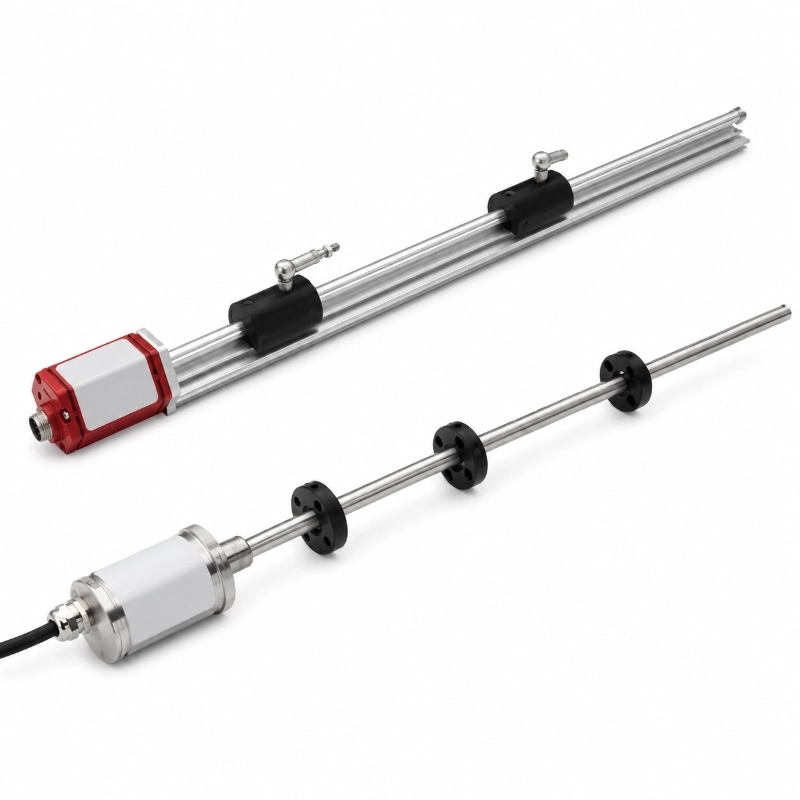
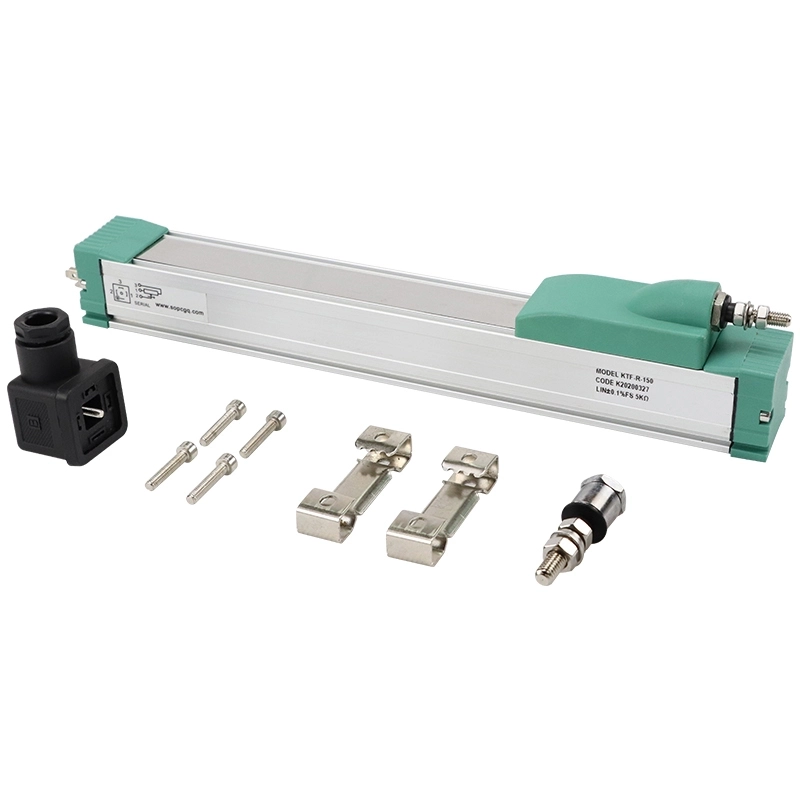
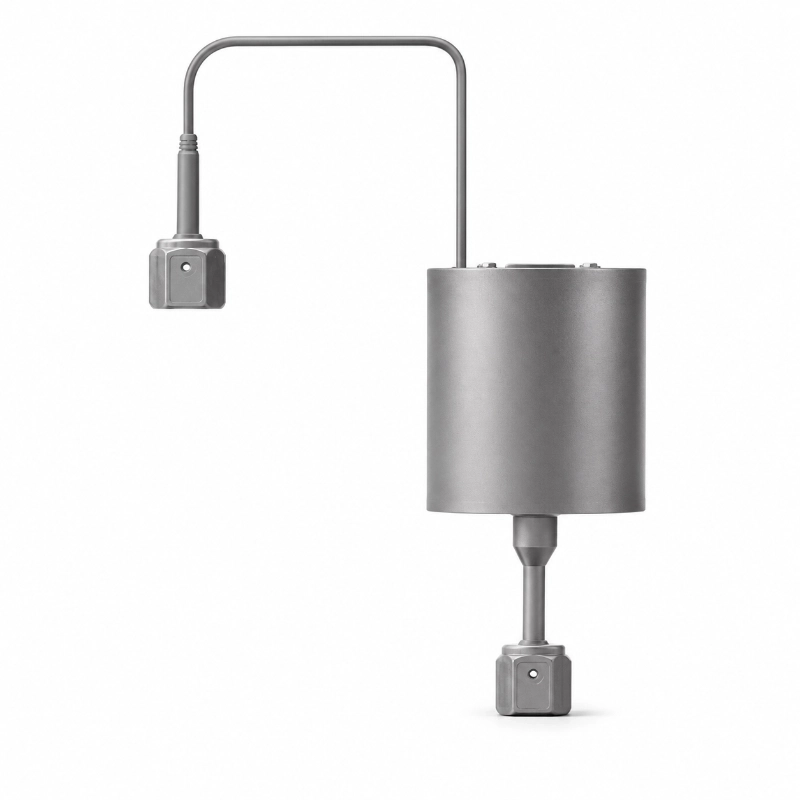
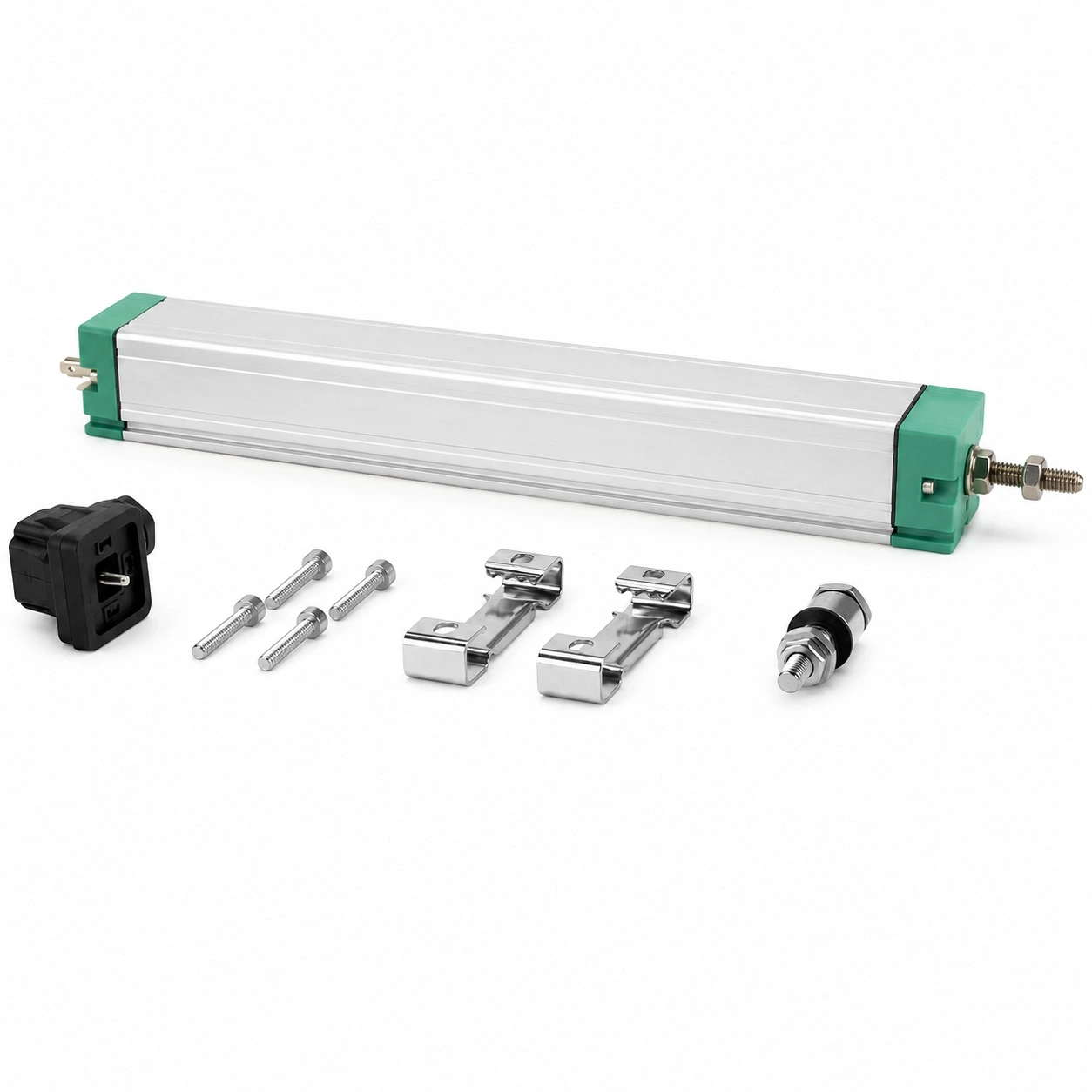
The JW-MDS(S09) Magnetostrictive Displacement Sensor is a high-precision, non-contact linear position transducer designed for absolute displacement measurement and industrial liquid level monitoring.
Based on magnetostrictive sensing technology, it measures the position of a moving magnet without mechanical contact between the magnet and the sensing element.
With selectable measuring ranges from 50mm to 20000mm, fast response, high repeatability, and multiple analog and digital output options, the sensor is suitable for hydraulic cylinders, industrial machinery, automation equipment, metallurgy, and storage tank applications.
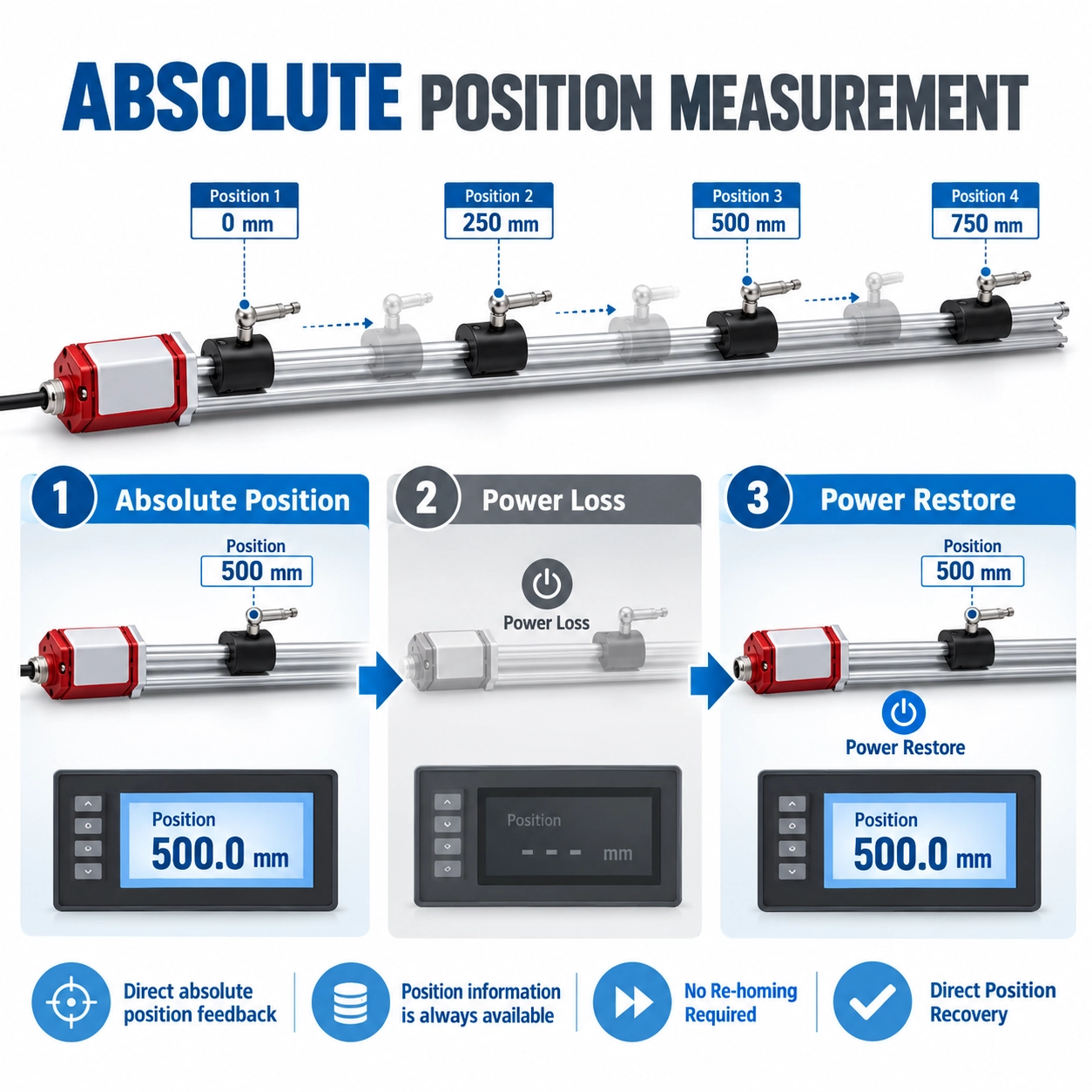
Its absolute position measurement principle allows the sensor to recover position information after power restoration without performing an incremental homing sequence.
1. How Does a Magnetostrictive Displacement Sensor Work?
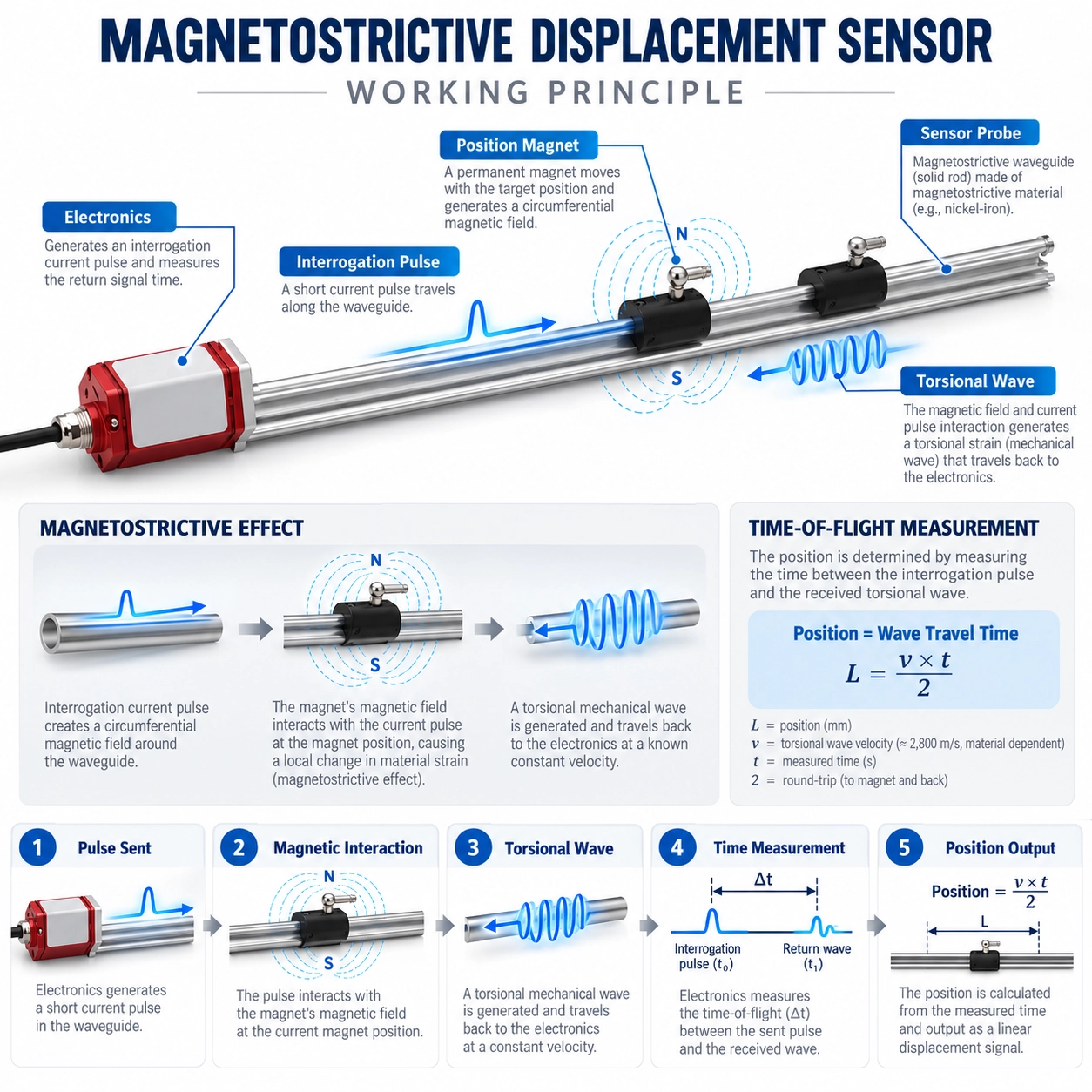
A magnetostrictive position sensor measures the location of a magnetic position marker along a sensing probe.
The sensor contains a magnetostrictive waveguide. A magnetic field generated by a position magnet interacts with an electrical excitation pulse, producing a torsional strain wave inside the waveguide.
The sensor electronics detect the returning wave and measure its travel time.
Because this travel time is related to the magnet’s position, the electronics can calculate its location along the measuring axis.
Position Magnet → Magnetostrictive Wave → Time-of-Flight Measurement → Absolute Position Output
Advantages of Non-Contact Measurement
Unlike a conventional potentiometric displacement sensor, the position magnet does not require sliding electrical contact with the sensing element.
This can reduce wear at the measurement interface and is particularly useful in applications involving frequent mechanical movement.
The sensor still requires correct installation, protection of electrical connections, and appropriate maintenance for its operating environment.
2. Technical Specifications
Electrical Specifications
Parameter
Specification
Model
JW-MDS(S09)
Measuring Range
50–20000mm, selectable
Operating Voltage
24V DC ±10%
Operating Current
Below 70mA, depending on stroke
Analog Outputs
4–20mA, 0–20mA, 0–5V, 0–10V, ±10V
Digital Outputs
Modbus RS485, SSI, START/STOP
Current Output Load
Maximum 600Ω
Voltage Output Load
Maximum 2mA, as specified
Overvoltage Protection
Maximum 36V DC
Electronics Temperature
-40°C to +85°C
Probe Temperature
-40°C to +105°C
Storage Temperature
-40°C to +100°C
Measurement Performance
Item
Specification
Non-linearity
< ±0.02% F.S minimum ±50 μm
Repeatability
< ±0.002% F.S minimum ±1 μm
Resolution
16 bit D A or 0.0015% of full scale minimum 1 μm
Hysteresis
< 0.002% F.S or minimum 2 μm
Temperature Coefficient
< 0.007% F.S per °C
Zero Adjustment Range
100% F.S optional
Response Time
0.2 to 5 ms
Mechanical Specifications
Item
Specification
Probe Material
304 stainless steel 316L stainless steel aluminum
Electronics Housing Material
304 stainless steel aluminum
Thread Connections
M18×1.5 M20×1.5 3/4-16UNF
Cable Outlet Options
Aviation connector direct cable terminal block
Explosion-proof Grade
Ex d IIB T5 / Ex ia IIB T5
Protection Grade
IP65 to IP69
Outer Tube Pressure
34 MPa continuous 69 MPa peak
Technical note: Performance, pressure ratings, protection grades, and explosion-protection configurations must be confirmed against the selected product specification and applicable certification documents. The stated resolution and linearity are not guarantees of total system accuracy.
3. Absolute Position Measurement
One important advantage of magnetostrictive technology is its ability to provide absolute position feedback.
An incremental encoder tracks movement by counting pulses. After certain power interruptions, a system may need to establish a reference position again.
The JW-MDS(S09) measures the position magnet directly along its calibrated sensing range.
This makes the sensor suitable for machinery where reliable position recovery is important.
Typical applications include hydraulic cylinders, automatic production machinery, lifting systems, and industrial process equipment.
4. Output Signals and Industrial Integration
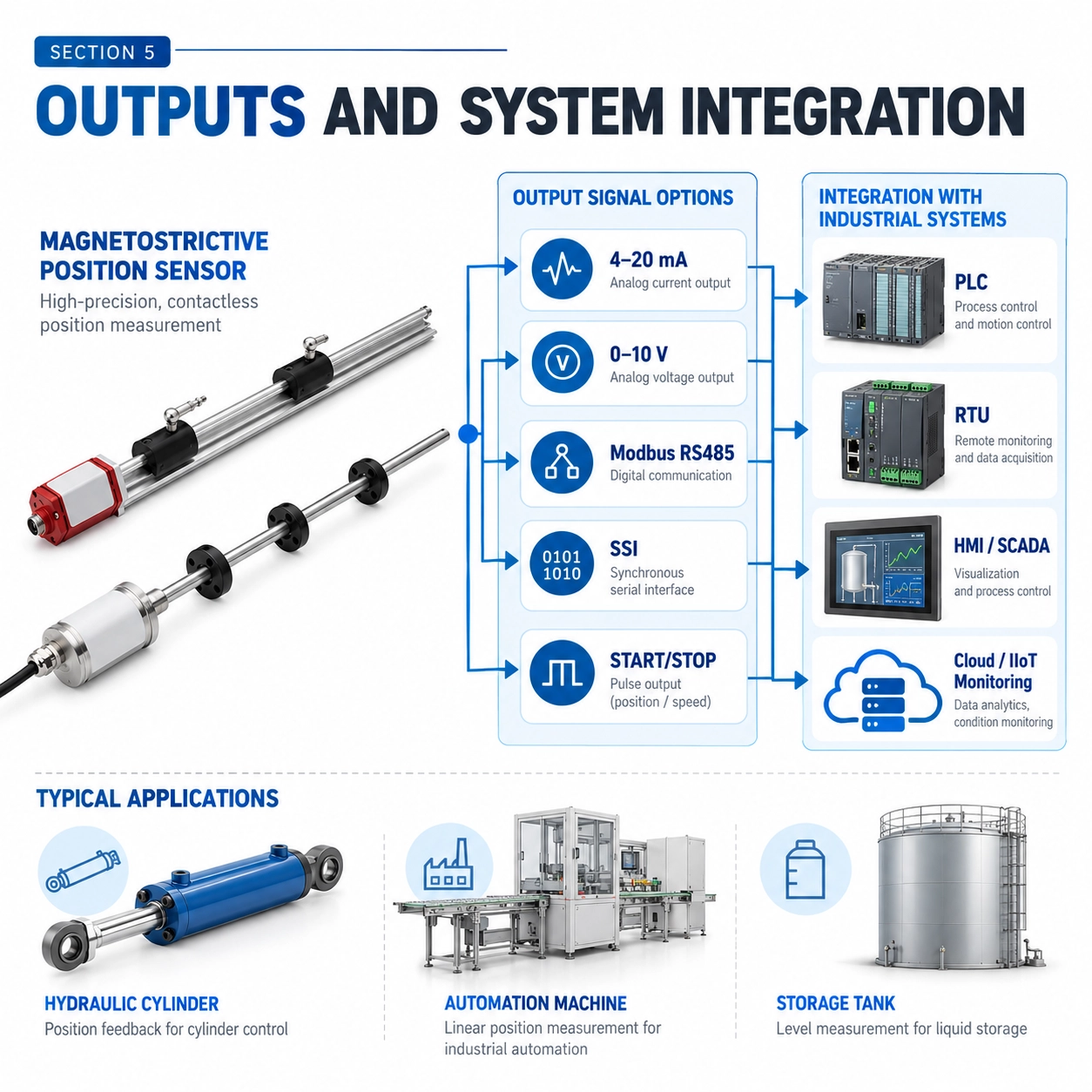
The sensor supports multiple signal interfaces for industrial controllers and measurement systems.
4.1 Analog Outputs
Available options include:
4–20mA
0–20mA
0–5V
0–10V
±10V
Analog configurations can connect to compatible PLC analog input modules or industrial data acquisition equipment.
4.2 Digital Outputs
Available options include:
Modbus RS485
SSI
START/STOP
Digital interfaces support position data acquisition using compatible communication equipment.
For Modbus RS485, the register map, communication settings, and supported functions should be confirmed before integration.
4.3 PLC and Monitoring System Integration
A typical system architecture is:
Position Magnet → Magnetostrictive Sensor → PLC / RTU → HMI or Industrial Monitoring System
The PLC can use the measured position for machine feedback, process monitoring, and configured control functions.
Remote data transmission requires suitable external communication equipment.
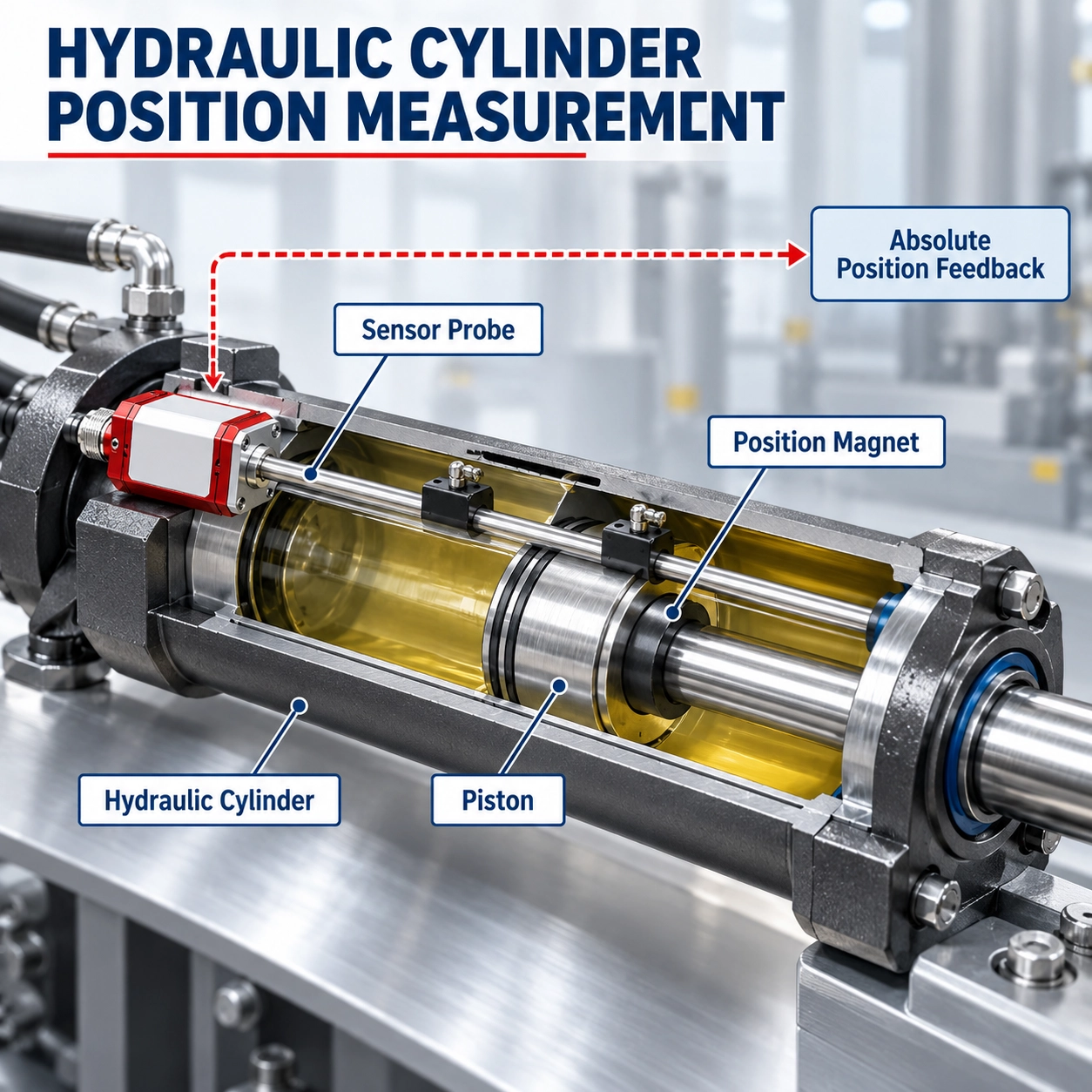
Hydraulic cylinder position feedback is a key application of magnetostrictive linear position sensors.
A compatible probe can be installed as part of a properly designed hydraulic cylinder assembly, while a position magnet follows the movement of the piston.
The sensor provides absolute stroke-position data without requiring mechanical contact between the magnet and waveguide.
System design must account for available installation space, pressure requirements, sealing, and mechanical compatibility.
5.2 Industrial Automation
Automated machinery requires continuous position information for moving components.
Magnetostrictive position sensors can provide feedback for compatible motion platforms, heavy machinery, and automated production equipment.
High repeatability and fast response support applications requiring frequent position updates.
5.3 Metallurgical Equipment
Steel production and metal-processing machinery operate under demanding mechanical and environmental conditions.
The JW-MDS(S09) can be considered for suitable linear position measurement points in metallurgical equipment.
Probe material, mounting arrangement, and electronics temperature limits must be checked against actual operating conditions.
5.4 Storage Tank Liquid Level Measurement
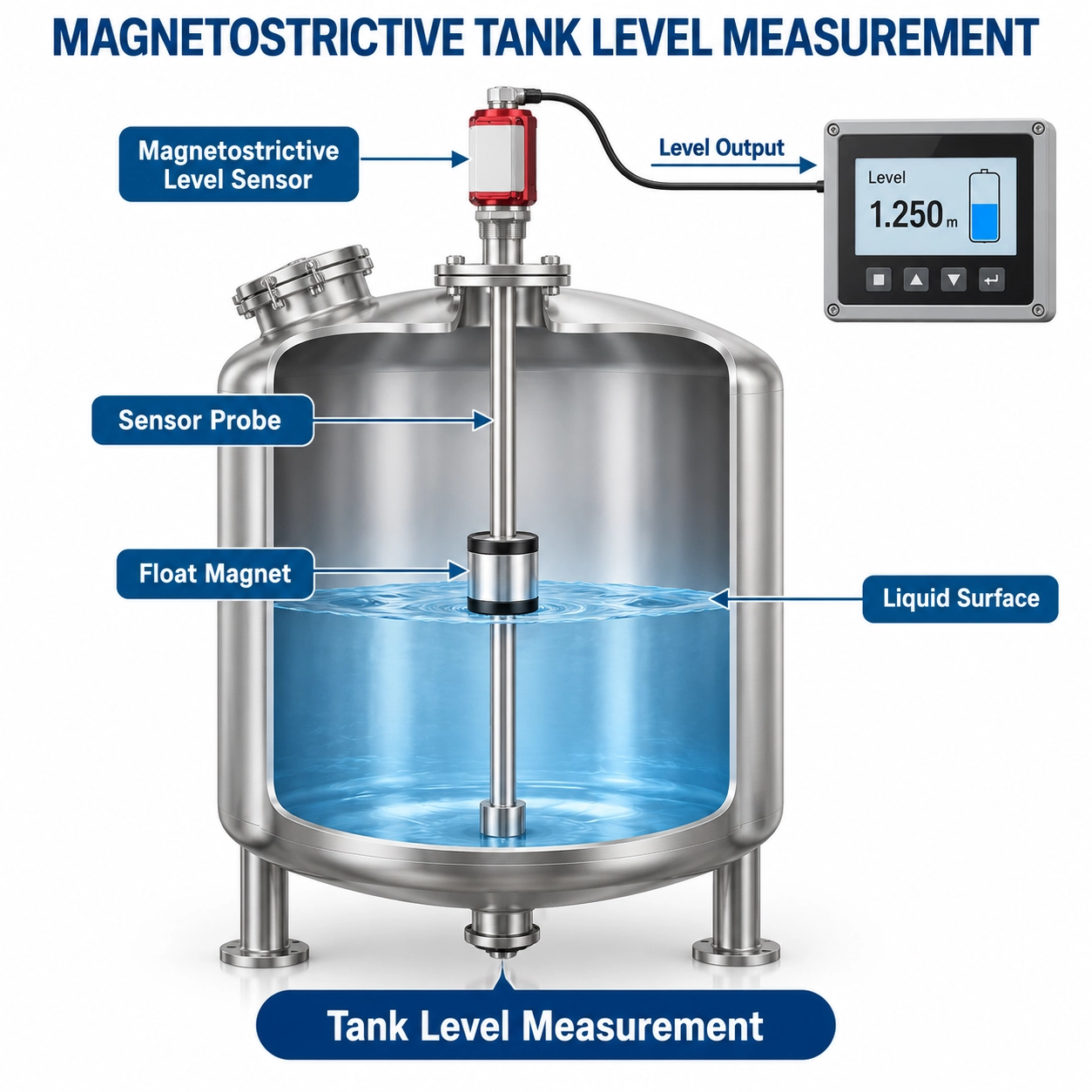
Magnetostrictive technology can also be used for liquid level measurement using a suitable floating magnet arrangement.
As the float moves with the liquid surface, the sensor measures the magnet’s position along the probe.
For liquid level applications, confirm float compatibility, liquid density, probe length, process connection, and vessel conditions.
5.5 Chemical and Process Industries
Industrial processing equipment may require accurate position or level measurement in environments involving moisture, dust, or corrosive media.
Different probe materials and protection configurations allow selection according to the application’s environmental requirements.
Chemical compatibility and hazardous-area certification must be verified before installation.
5.6 Structural Position Measurement
For suitable installations, the sensor may provide linear position data for structural or mechanical movement monitoring.
Such applications require a suitable mechanical coupling arrangement and engineering assessment of the measuring reference.
Before selecting the sensor, consider the following:
Measuring range: Choose a range covering the complete expected magnet travel.
Magnet arrangement: Verify position magnet type and mechanical movement.
Probe dimensions: Confirm available installation length and mounting clearances.
Output signal: Match the sensor interface to the receiving controller.
Power supply: Confirm 24V DC ±10% compatibility.
Process pressure: Check tube pressure limits for pressurized installations.
Environmental conditions: Select appropriate materials and protection grade.
Electrical installation: Follow the wiring and grounding requirements for the selected output version.
For hydraulic cylinders, the probe must be protected against mechanical damage, incorrect magnet alignment, and unsuitable mounting loads.
For long-stroke applications, verify full probe dimensions and installation constraints before ordering.
8. Request Technical Specifications and Quotation
Looking for a magnetostrictive linear position sensor for hydraulic cylinders, industrial automation, or liquid level measurement?
JW-IoT can assist with sensor selection and configuration.
Please provide:
Required measuring range
Application and installation method
Output interface
Probe material and process connection
Operating temperature and pressure
Position magnet requirements
Purchase quantity
Contact JW-IoT for technical specifications and quotation support.
FAQ
Q
1. What is a magnetostrictive displacement sensor?
A
It is a non-contact position sensor that uses magnetostrictive wave propagation to measure a magnet's position along a sensing probe.
Q
2. What is the measuring range of JW-MDS(S09)?
A
The available selectable measuring range extends from 50mm to 20000mm.
Q
3. Does the sensor provide absolute position feedback?
A
Yes. It measures absolute magnet position within its calibrated measuring range, without requiring incremental pulse counting.
Q
4. Is the sensor suitable for hydraulic cylinders?
A
Yes. It can be used for compatible hydraulic cylinder position measurement applications when the probe, pressure rating, magnet arrangement, and installation are correctly selected.
Q
5. Does it support Modbus RS485?
A
Yes. Modbus RS485 is listed among the available digital output configurations.
Q
6. What is the difference between magnetostrictive and potentiometric sensors?
A
Magnetostrictive sensors measure magnet position without sliding sensing contact. Potentiometric sensors use a moving electrical contact along a resistive element.
Q
7. Can this sensor measure tank liquid level?
A
Yes, in suitable configurations using a compatible magnetic float and correctly designed tank installation.
Q
8. Does it require re-zeroing after power loss?
A
Its absolute measurement principle allows position recovery after power restoration without an incremental homing sequence, provided the system is correctly configured.
Q
9. Can measuring range and output be customized?
A
The product documentation lists configurable measuring ranges, output signals, process connections, and selected construction options. Confirm availability for the required project.
 +86 13520127780
 info@jingelway.com