+86 13520127780
 info@jingelway.com









How Solar PV Monitoring Helps with Desert Dust Challenges
Release time: 2026-09-20
Desert regions offer excellent conditions for large-scale photovoltaic development because of their abundant solar resource and available land.
However, high solar irradiation does not automatically guarantee high energy yield.
For solar farms operating in deserts and other arid environments, dust accumulation, airborne sand, high module temperatures, limited rainfall and changing wind conditions can all influence the relationship between available sunlight and actual power generation.
This creates a particular challenge for plant operators:
When power output decreases, is the problem caused by lower solar irradiance, high temperature, dust accumulation, weather conditions, or an equipment issue?
A well-designed desert solar PV monitoring system helps answer this question by combining environmental and PV-related measurements instead of relying on power output alone.
For desert solar plants, monitoring is therefore not only about recording weather. It can also provide valuable data for soiling analysis, cleaning decisions and long-term O&M planning.
1. Why Desert PV Projects Face Greater Dust and Soiling Risks
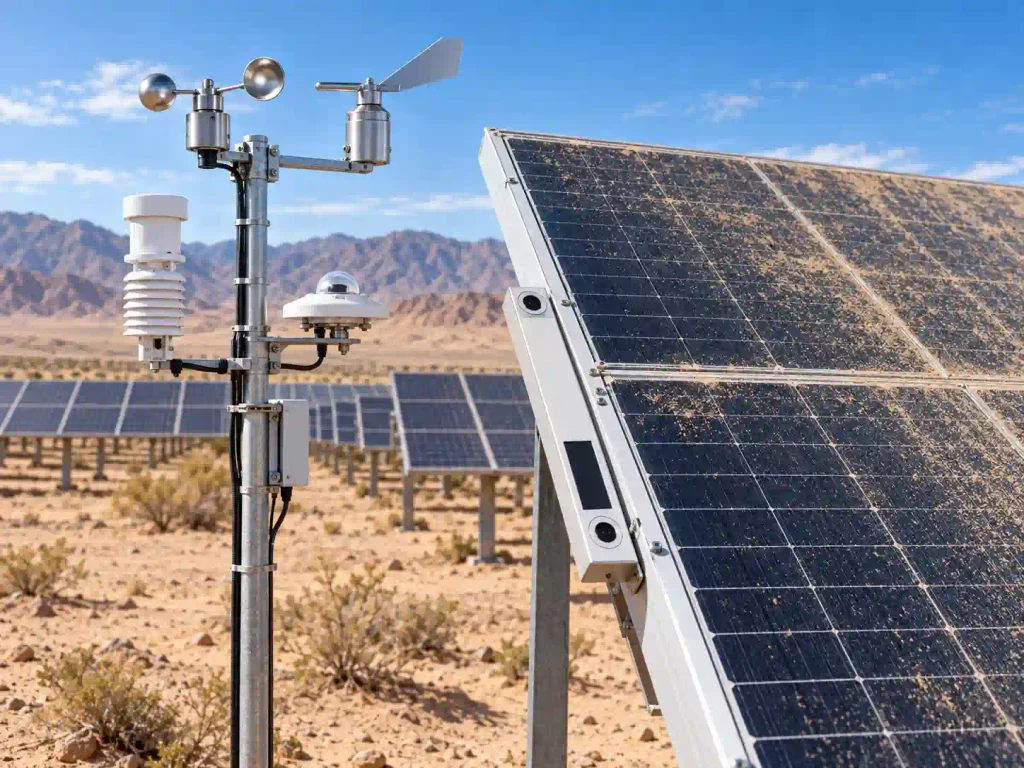
Dust affects solar plants in many climates, but the operating environment of a desert PV project makes the problem especially important.
Typical conditions may include:
- Frequent airborne dust
- Dry soil surrounding the PV array
- Long periods without meaningful rainfall
- Sand transported by changing wind conditions
- High daytime temperature
- Large temperature changes between day and night
- Large solar fields covering different terrain conditions
Dust and other particles can gradually settle on the front surface of PV modules.
As this layer becomes thicker or unevenly distributed, less solar radiation may reach the PV cells.
The challenge is that soiling does not necessarily occur at the same rate across an entire solar farm.
Rows close to unpaved roads, exposed boundaries or disturbed ground may experience different conditions from modules in another part of the site.
Similarly, one dust event may produce rapid deposition, while during another period the accumulation may develop slowly.
This is why desert PV operation should not treat dust simply as a calendar-based maintenance issue.
It is a measurable environmental variable.
2. How Dust Can Affect Solar PV Power Output
A PV plant needs sunlight to generate electricity.
When a layer of dust or sand reduces the radiation reaching the module surface, the available solar energy for conversion can decrease.
However, a drop in plant output alone does not prove that dust is responsible.
Power generation can also change because of:
- Changing irradiance
- Higher module temperature
- Cloud cover
- Inverter operating conditions
- Partial shading
- Grid limitations
- Equipment faults
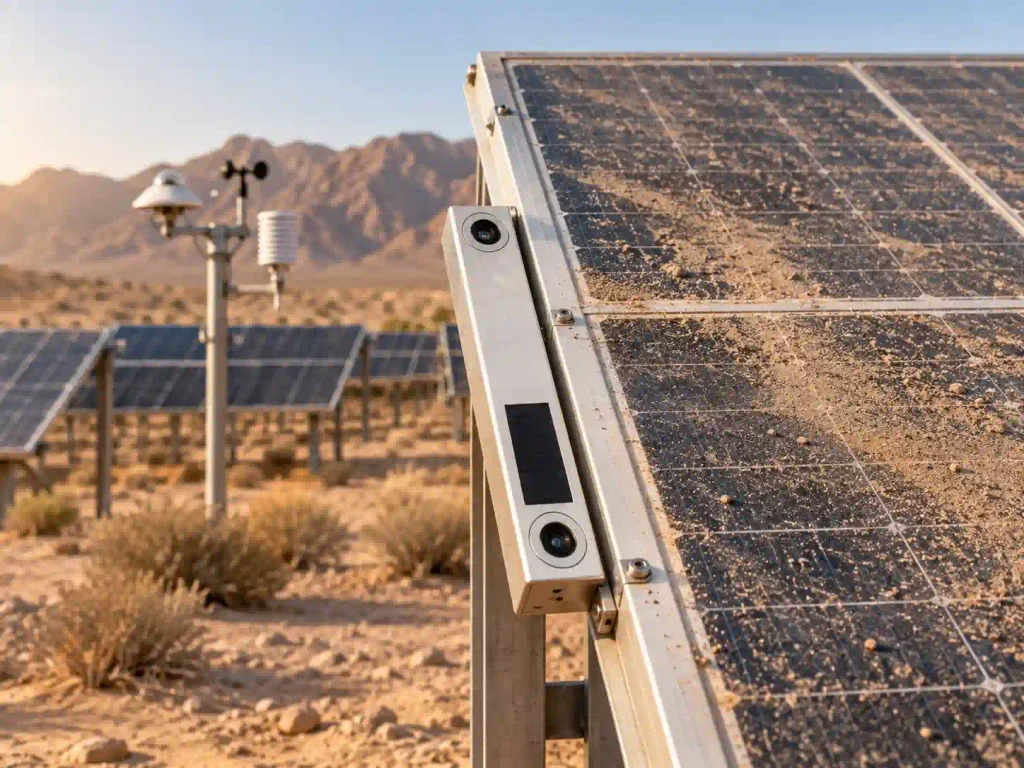
For that reason, desert solar operators need environmental reference data.
Consider two simplified situations.
Situation A: Irradiance decreases and power output also decreases
If incoming solar irradiance falls at the same time as generation, lower output may simply reflect changing solar conditions.
Cleaning the modules would not solve the underlying cause.
Situation B: Irradiance remains strong but normalized PV output gradually deteriorates
If available sunlight remains relatively strong while plant performance declines over a longer period, operators may investigate soiling, temperature or equipment-related causes.
This is where PV soiling monitoring, irradiance measurements and module temperature data become much more useful when analyzed together.
The objective is not to make a diagnosis from a single sensor.
The objective is to give the O&M team enough field information to determine which explanation should be investigated first.
3. Key Sensors for Desert Solar PV Monitoring
A desert monitoring system should normally be configured according to the plant layout, O&M strategy and required performance analysis.
Instead of installing every possible environmental sensor, it is more useful to define which data is needed to answer the project’s operational questions.
For desert dust management, several measurements are particularly valuable.
PV Soiling Measurement
A dedicated soiling measurement system provides a more direct reference for how contamination on a PV-like surface may affect incoming solar radiation.
This is useful when operators want to track:
- Soiling development over time
- Relative cleanliness of the monitored surface
- Changes before and after cleaning
- Differences between monitoring periods
- Whether contamination is accumulating faster than expected
JW-IoT provides PV soiling monitoring equipment that can be incorporated into a broader solar monitoring architecture.
For projects where dust accumulation is one of the main O&M concerns, dedicated soiling monitoring is more useful than trying to infer all dust-related effects from power generation alone.
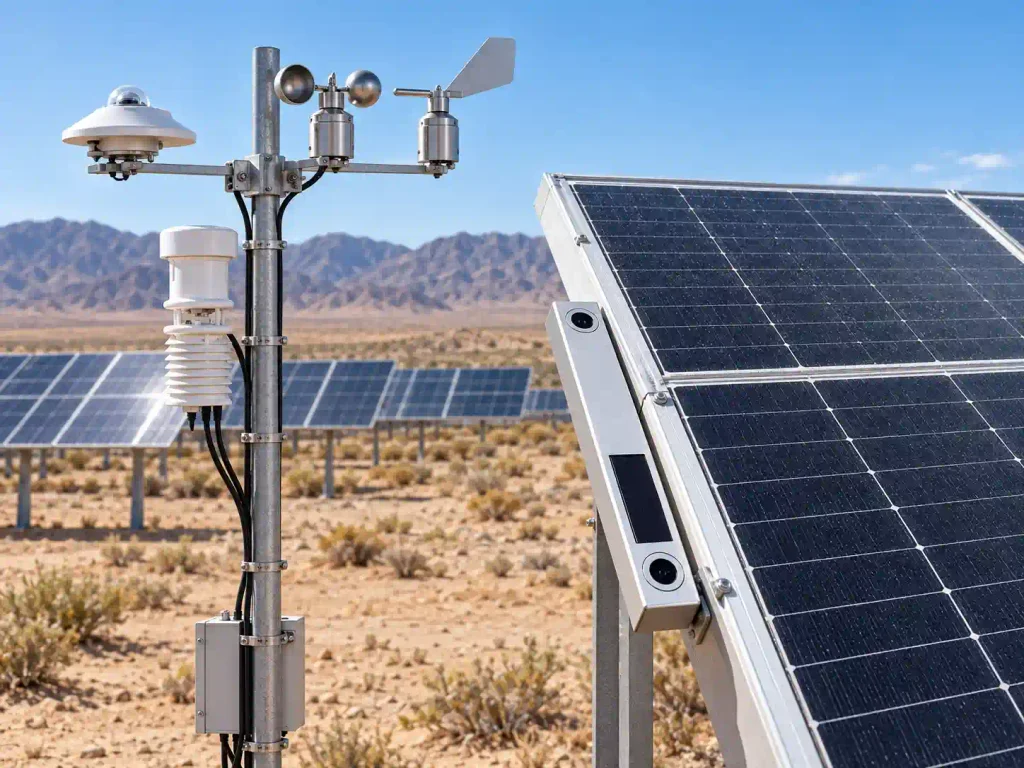
Solar Irradiance Monitoring
Irradiance provides the reference for the solar energy available to the PV array.
Depending on project requirements, monitoring may include measurements such as:
- Plane-of-array irradiance
- Global solar irradiance
- Site-level solar radiation trends
For desert solar farms, irradiance data is particularly important because it helps operators avoid confusing a natural change in solar resource with an environmental or equipment-related performance loss.
JW-IoT provides solar irradiance sensors and PV monitoring solutions for utility-scale and distributed solar applications.
Related solution:
Explore JW-IoT Solar PV Monitoring System
PV Module Temperature
Desert PV projects frequently experience high module temperatures during strong solar conditions.
Module temperature should therefore be considered when interpreting power-generation trends.
Without temperature data, an operator may see high irradiance together with lower-than-expected power output and incorrectly attribute the difference entirely to dust.
By adding module temperature measurement, the monitoring system provides another environmental reference for performance analysis.
Learn more:
PV Module Temperature Sensors for Solar Plant Monitoring
Wind Speed and Wind Direction
Wind is particularly relevant in desert environments because it can influence both dust transport and dust redistribution.
However, wind should not be treated as a simple indicator that panels will become either cleaner or dirtier.
Different conditions may produce different results.
Wind may:
- Carry loose dust toward the solar field
- Redistribute deposited particles
- Create localized deposition patterns
- Indicate the timing of a dust or sand event
- Help explain sudden changes in soiling measurements
This makes wind data useful as contextual information.
For example, a rapid increase in soiling following a period of strong wind from a particular direction may justify additional inspection of exposed zones.
The monitoring system does not need to assume the cause automatically. It provides the data needed to investigate the relationship.
Rainfall Monitoring
Rainfall is another important parameter, but its effect should not be oversimplified.
A rain event does not automatically mean the PV array has returned to a completely clean condition.
The cleaning effect can depend on factors including:
- Rainfall amount
- Rain intensity
- Existing dust composition
- Module tilt
- Surface condition
- Previous duration of contamination
For this reason, rainfall data becomes much more useful when it is analyzed together with a soiling measurement before and after the event.
Instead of asking:
“Did it rain?”
the O&M team can ask:
“Did the measured soiling condition improve after the rain?”
That difference turns a weather record into an operational input.
4. The Role of Wind and Rain in Understanding Dust Events
One of the biggest advantages of desert dust monitoring is the ability to reconstruct what happened before a performance change.
Consider a simple sequence.
Stage 1: Normal conditions
Irradiance and PV output follow their expected relationship while the soiling indicator remains relatively stable.
Stage 2: Strong wind event
Wind speed increases and the soiling measurement begins to change.
This does not automatically prove that wind caused the change, but it creates a useful environmental correlation.
Stage 3: Continued dry period
With little or no effective rainfall, contamination may remain on the module surface or continue to accumulate.
Stage 4: Rainfall event
Rainfall is recorded.
The operator can then compare the soiling indicator before and after the rainfall event.
If the monitored condition improves significantly, natural cleaning may have occurred.
If little change is observed, additional cleaning may still need to be considered.
This type of event-based analysis is more informative than looking at one parameter in isolation.
5. From Fixed Cleaning Schedules to Data-Supported Cleaning Decisions
Cleaning is necessary for many desert solar projects, but cleaning also has a cost.
Depending on the site and cleaning method, operators may need to consider:
- Labor
- Cleaning equipment
- Water availability
- Vehicle access
- Robotic cleaning systems
- Night-time work windows
- Maintenance logistics
- Size of the area to be cleaned
For this reason, the most useful question is not simply:
“How often should solar panels be cleaned in the desert?”
There is no universal interval that is appropriate for every plant.
A better question is:
“At what point does measured soiling justify cleaning at this site?”
A monitoring-based workflow can support this decision.
Step 1 — Establish the clean reference
After a confirmed cleaning event, record the monitored baseline.
Step 2 — Track soiling over time
Observe whether contamination is increasing gradually or rapidly.
Step 3 — Compare with irradiance and temperature
Determine whether lower performance can reasonably be explained by reduced solar radiation or high module temperature.
Step 4 — Review recent wind and rainfall
Check whether the site recently experienced dust-producing wind or a potentially cleaning rainfall event.
Step 5 — Compare before and after cleaning
After cleaning, review whether the soiling indicator and plant performance return toward their previous clean condition.
Over time, this creates a site-specific operating history.
The result is a cleaning strategy based less on assumptions and more on measured local conditions.
6. Why One Monitoring Point May Not Represent a Large Desert Solar Farm
Large utility-scale PV plants can cover substantial areas.
Dust exposure may vary between:
- Plant boundaries
- Internal array zones
- Access roads
- Different terrain
- Different tracker blocks
- Areas exposed to prevailing wind
- Sections near construction or vehicle activity
This means a single environmental monitoring point may not always describe conditions across an entire site.
The appropriate number and distribution of monitoring points should therefore be determined from the actual project layout.
For larger desert projects, a distributed monitoring architecture can be considered.
A typical concept may look like:
Soiling Sensor / Irradiance Sensor / Module Temperature Sensor / Weather Sensor
↓
Data Logger or IoT Acquisition Unit
↓
RS485 / LoRaWAN / 4G / Ethernet
↓
Cloud Platform or Existing PV SCADA System
↓
Historical Analysis and O&M Decision Support
JW-IoT solar monitoring systems can support different communication methods according to the project architecture, including local sensor communication and remote data transmission.
7. A Practical Desert Solar Monitoring Configuration
There is no single configuration that fits every desert PV project.
However, a monitoring system designed around dust and cleaning analysis commonly needs several types of information.
| Monitoring Parameter | Operational Purpose |
| PV soiling condition | Track contamination development and cleaning effect |
| Solar irradiance | Provide the available solar resource reference |
| Module temperature | Separate thermal effects from other performance changes |
| Ambient temperature | Provide environmental context |
| Wind speed | Identify periods of strong airflow and possible dust transport |
| Wind direction | Help investigate where dust exposure may originate |
| Rainfall | Evaluate whether natural cleaning may have occurred |
| PV generation / inverter data | Compare environmental conditions with actual output |
These parameters should not be considered independent data channels.
Their value increases when the plant can compare them on the same timeline.
For example:
High irradiance + normal temperature + increasing soiling + declining normalized output
may justify an investigation into contamination.
Meanwhile:
Lower irradiance + stable soiling + proportional output reduction
suggests that cleaning may not be the immediate priority.
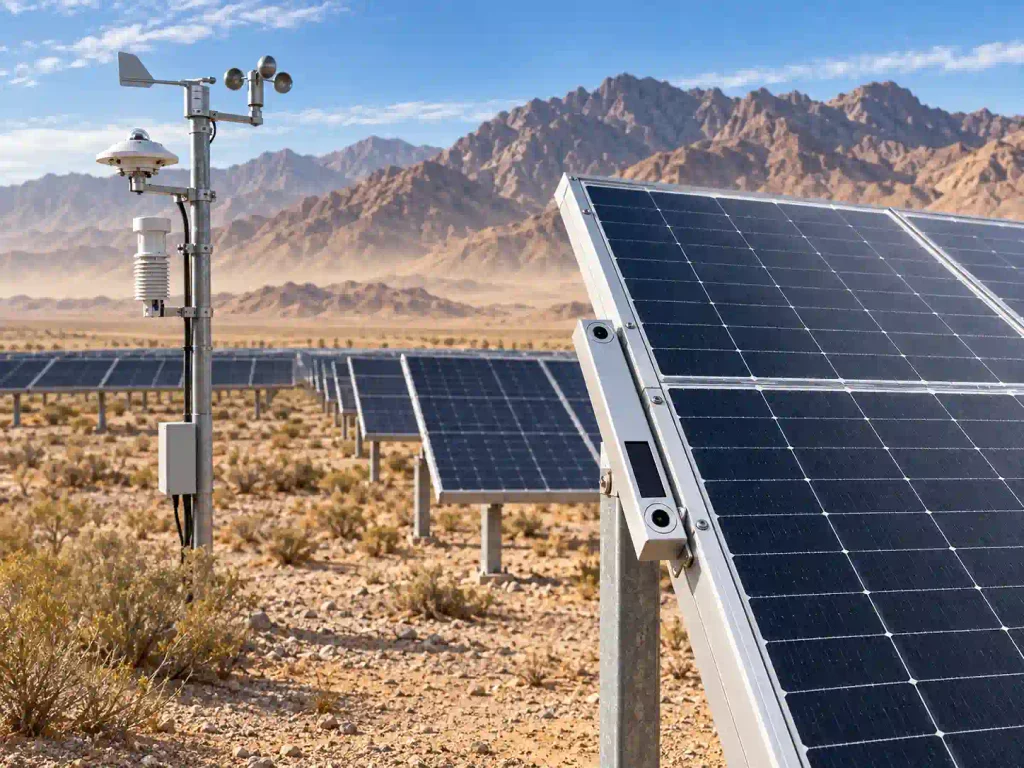
This multi-parameter approach is one of the main advantages of harsh climate PV monitoring.
8. Recommended JW-IoT Monitoring Approach for Desert PV Plants
For desert and arid-region solar projects, JW-IoT recommends designing the monitoring system around three objectives.
Objective 1: Measure the available solar resource
Use appropriate irradiance measurement to establish the environmental reference for PV generation.
Objective 2: Quantify environmental conditions related to performance
Depending on project requirements, integrate:
- PV soiling monitoring
- Module temperature
- Ambient temperature and humidity
- Wind speed
- Wind direction
- Rainfall
Objective 3: Connect the data to the plant’s operating system
Environmental sensors are most valuable when their data can be integrated with the systems already used by the operator.
Depending on the project architecture, JW-IoT monitoring solutions can support technologies including:
- RS485 Modbus
- LoRaWAN
- 4G LTE
- Ethernet
- MQTT
- API-based platform integration
This allows environmental measurements to be combined with inverter, meter or SCADA data rather than remaining isolated in a separate weather station.
Explore the complete architecture:
Solar PV Monitoring System with IoT Automation
9. How Should a Desert Solar Farm Decide When to Clean Panels?
The best cleaning threshold depends on the individual project.
It should consider both technical and economic factors.
Operators may evaluate:
- Current measured soiling condition
- Rate of contamination increase
- Energy value of the expected recovered output
- Cleaning cost
- Water availability
- Labor and equipment requirements
- Upcoming weather conditions
- Accessibility of the affected array
- Whether the contamination is localized or plant-wide
This is why a monitoring system should not simply issue the generic message:
“Dust detected — clean panels.”
A better system provides the measurements needed for the plant operator to determine whether cleaning is operationally and economically justified.
10. FAQ
10.1 What is desert solar PV monitoring?
Desert solar PV monitoring is the collection and analysis of solar irradiance, PV module temperature, soiling, wind, rainfall and other environmental data at photovoltaic plants operating in desert or arid conditions.
The purpose is to understand how the local environment affects PV performance and to support O&M decisions.
10.2 What is the most important sensor for monitoring desert dust on solar panels?
If the objective is to quantify contamination directly, a dedicated PV soiling measurement system is particularly useful.
However, soiling data is usually more valuable when combined with irradiance, module temperature, weather and plant power-generation data.
10.3 Can a weather station alone detect PV soiling?
A weather station can provide useful environmental context such as wind, rain, temperature and solar radiation.
However, these parameters do not directly measure the cleanliness of the PV module surface.
For projects where dust loss is important, dedicated soiling measurement can provide a more direct reference.
10.4 Does rainfall always clean desert solar panels?
Not necessarily.
The result depends on rainfall characteristics, the type and amount of contamination, module tilt and other local conditions.
Comparing soiling measurements before and after rainfall provides better evidence of whether effective natural cleaning occurred.
10.5 Why monitor wind direction at a desert solar farm?
Wind direction can help operators investigate the possible source and movement of airborne dust.
When combined with soiling trends and wind speed, it may help identify which parts of a large solar farm are more exposed to dust events.
10.6 How often should desert solar panels be cleaned?
There is no universal cleaning interval.
The appropriate schedule depends on local soiling rates, cleaning costs, water availability, energy value and site conditions.
Using measured soiling and performance data can support a more site-specific cleaning strategy.
Conclusion
Dust management at a desert solar farm should not depend only on visual inspection or a fixed cleaning calendar.
The more useful approach is to understand what is happening at the site and why.
By combining:
- PV soiling measurements
- Solar irradiance
- Module temperature
- Wind speed and direction
- Rainfall
- Plant generation data
operators can distinguish environmental changes from possible performance problems more effectively.
More importantly, they can begin to build a site-specific history showing how quickly panels become contaminated, what weather events influence that process and when cleaning produces a meaningful recovery.
For utility-scale plants operating in dusty, hot and water-constrained environments, this turns desert solar PV monitoring from a weather-recording function into an O&M decision-support system.
Request Desert PV Monitoring Solution
Planning a solar farm in the Middle East, North Africa or another arid region?
JW-IoT can help configure a monitoring package according to your:
- PV plant size
- Required environmental parameters
- Number of monitoring zones
- Existing SCADA or monitoring platform
- Communication requirements
- Cleaning management strategy
Contact JW-IoT to request a Desert PV Monitoring Solution and sensor configuration recommendation.