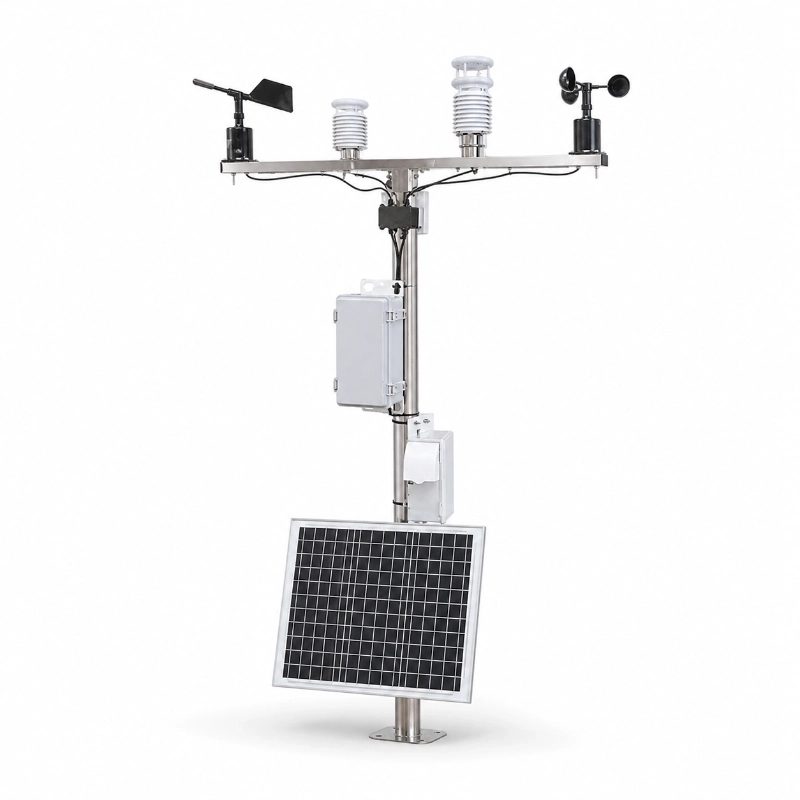
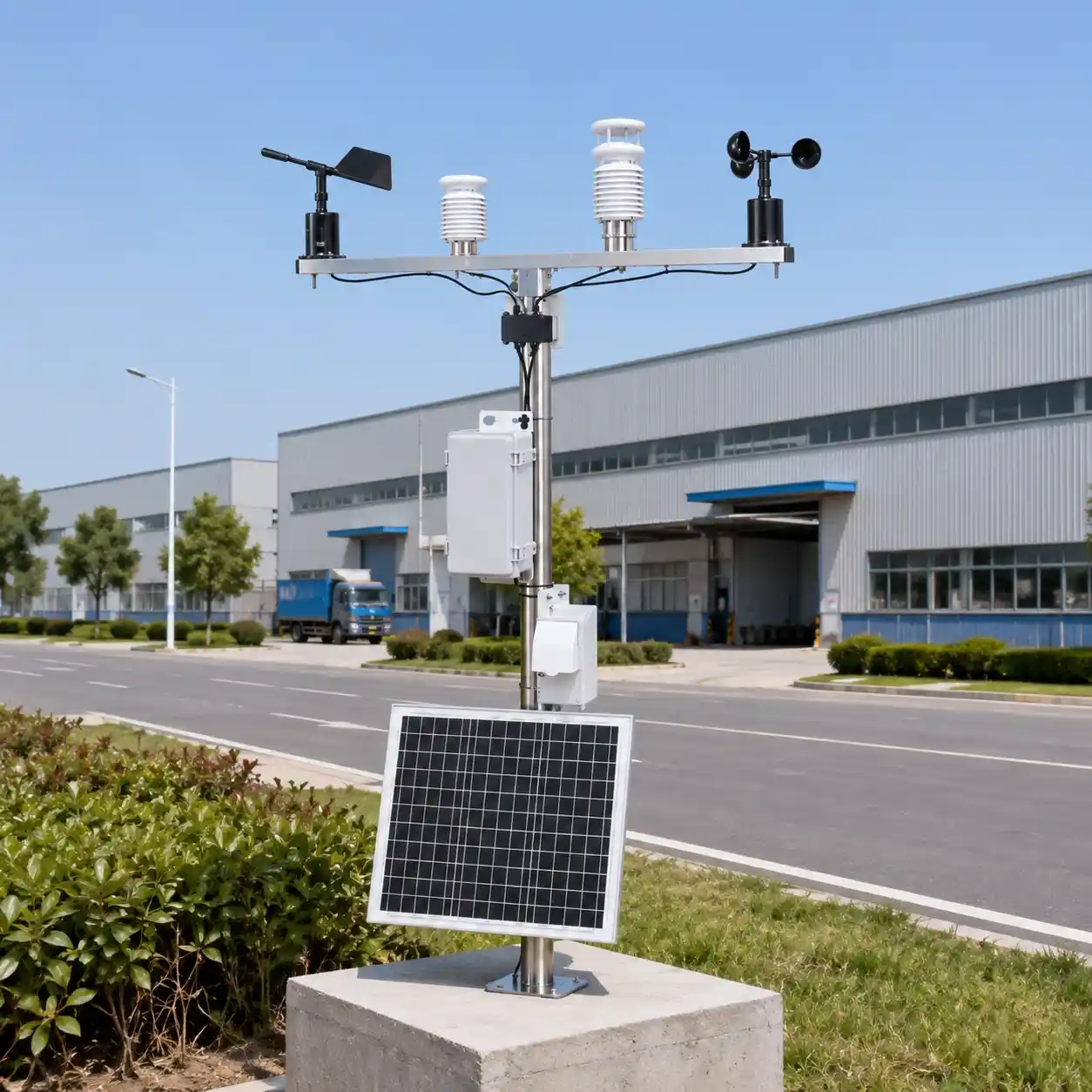
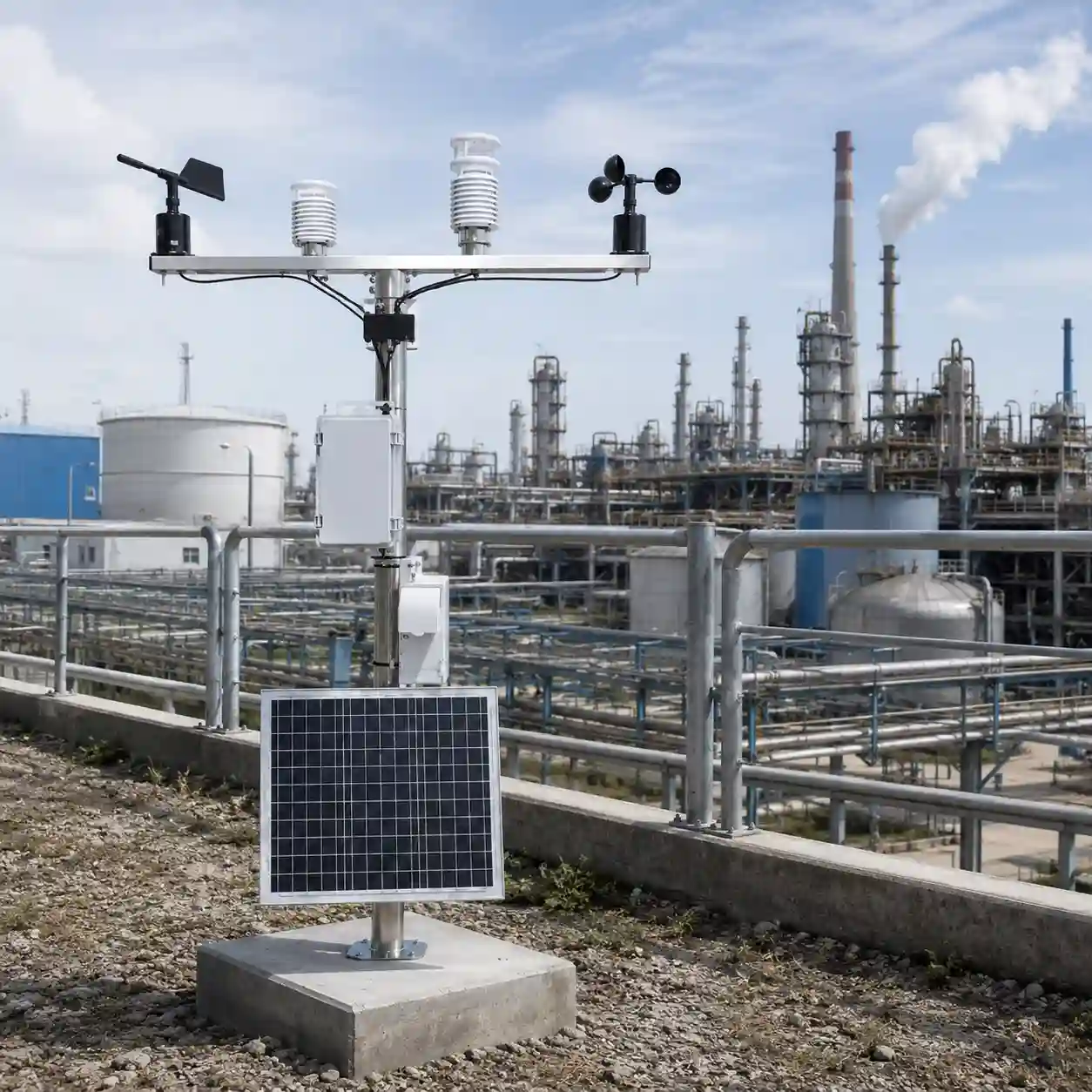
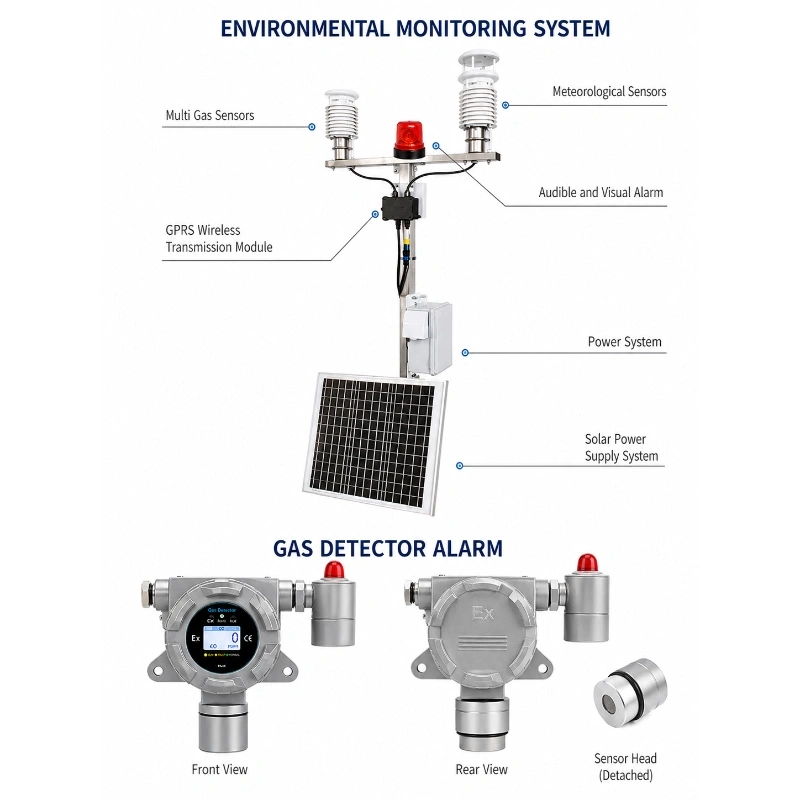
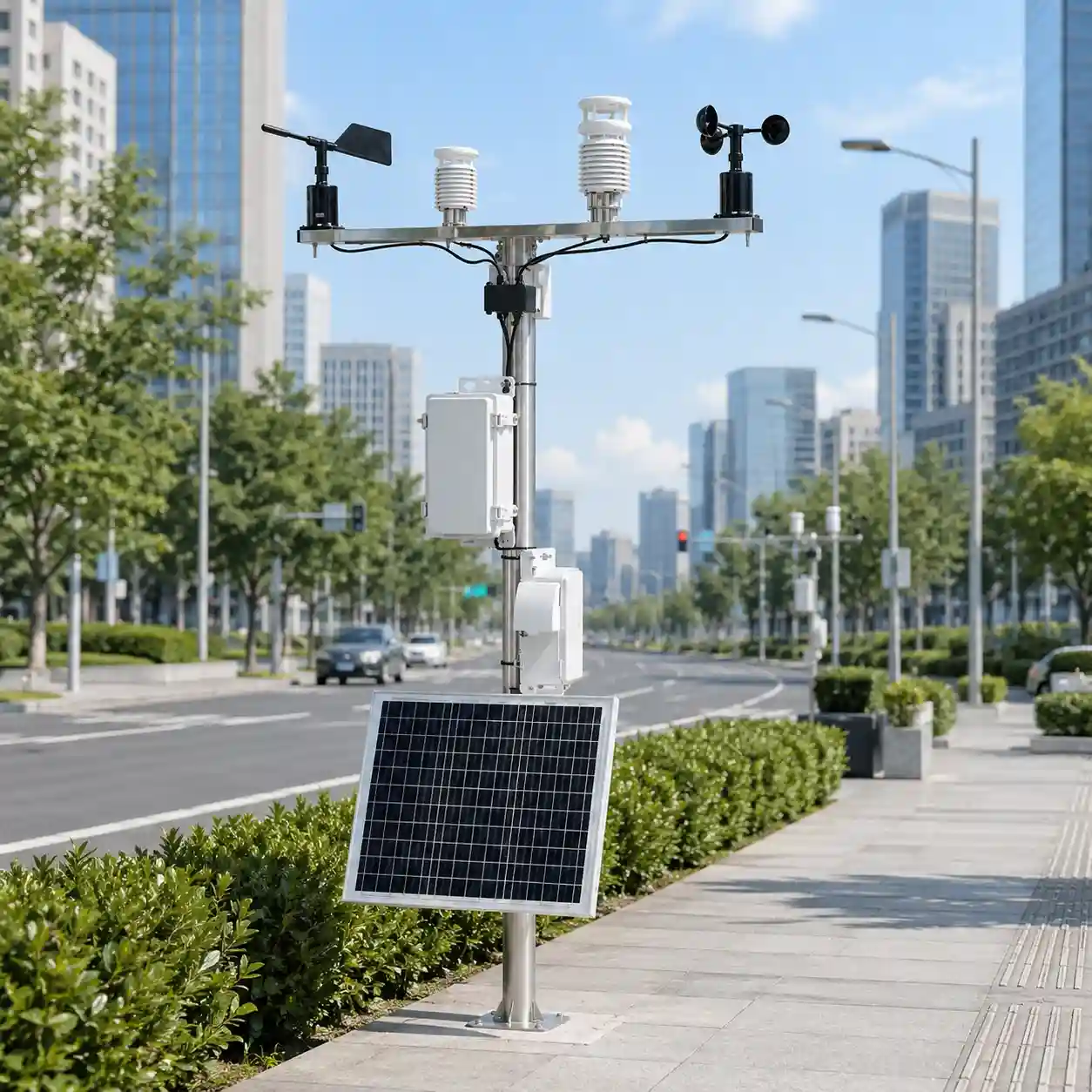
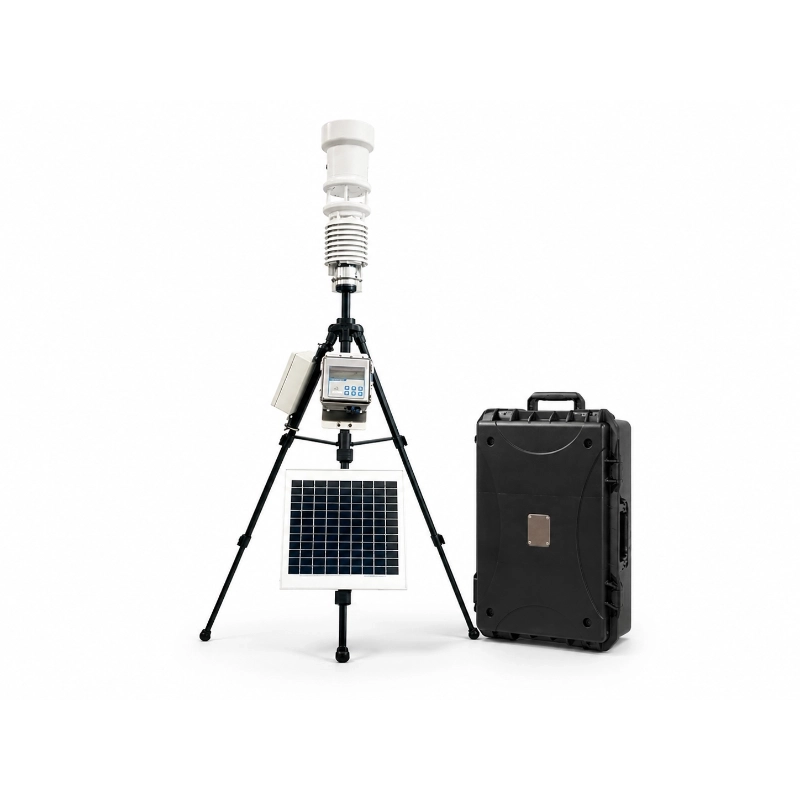
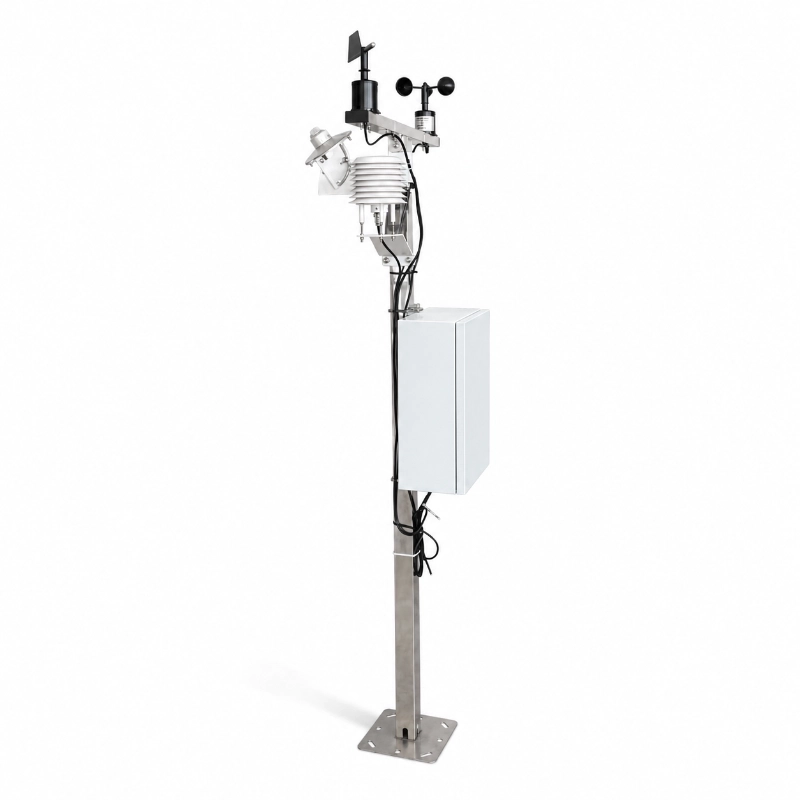
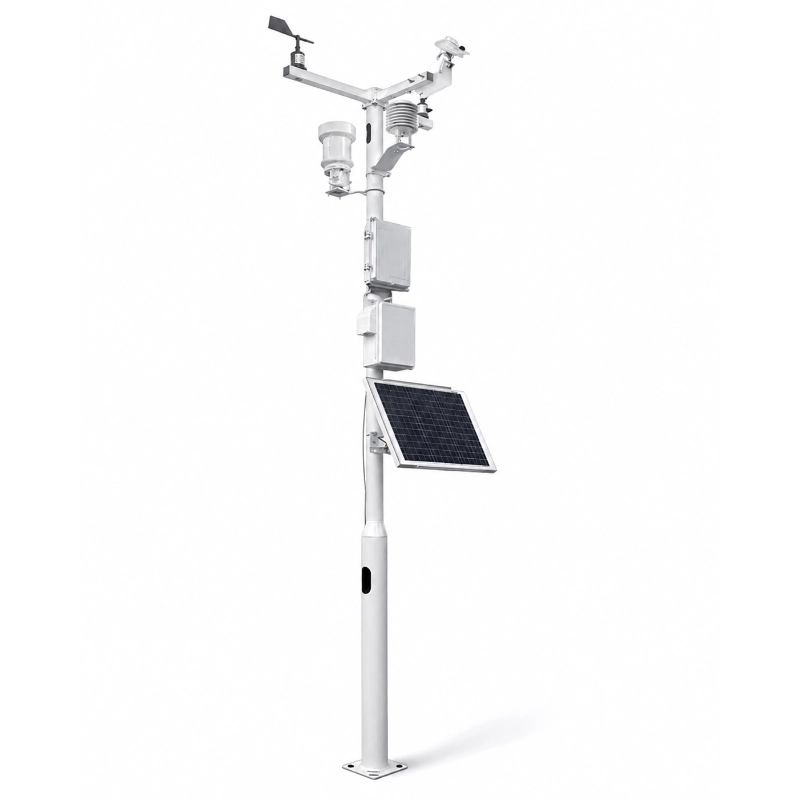
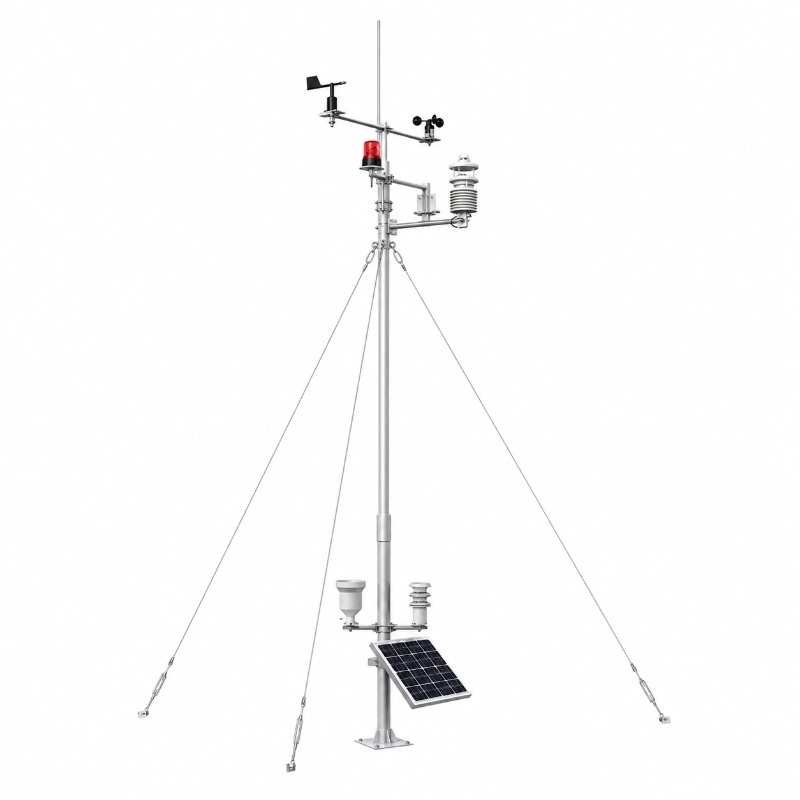
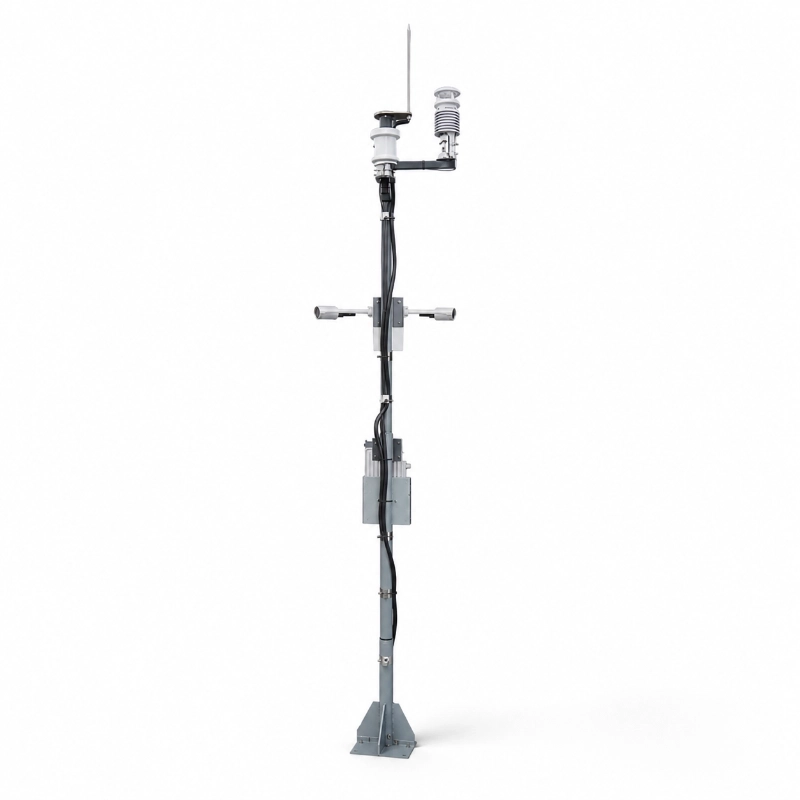
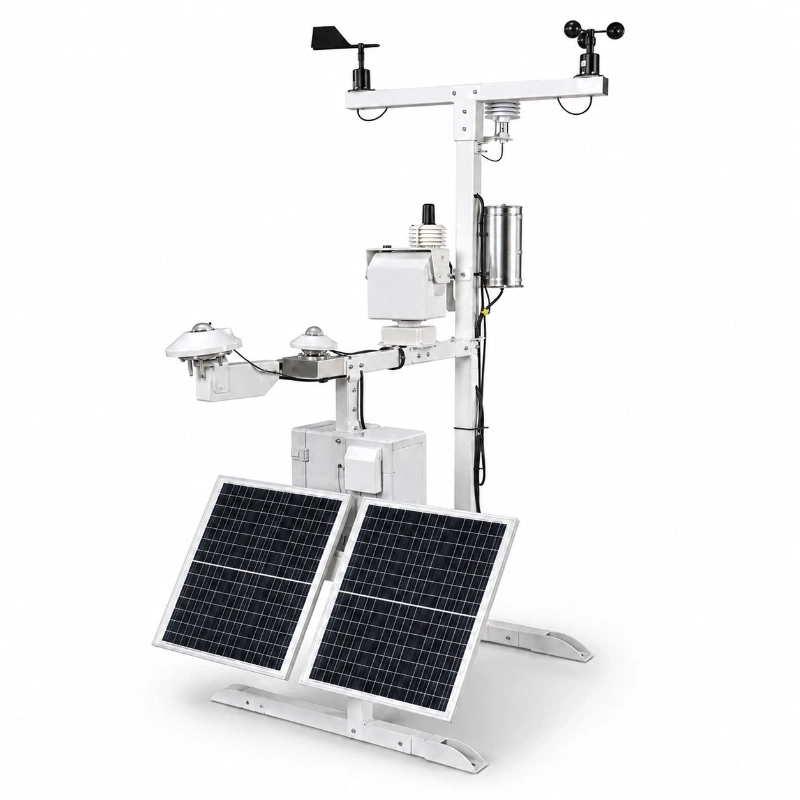
The JW-SWS-AQ(LC36) Gas Detection Weather Station is an integrated environmental monitoring system designed to measure outdoor air pollutants, selected gases and meteorological conditions at the same monitoring location.
Unlike a conventional weather station that measures only wind, temperature, humidity, rainfall and atmospheric pressure, this system can combine meteorological sensors with configurable gas and air quality monitoring modules. The resulting data helps users evaluate not only the concentration of pollutants, but also the weather conditions that may influence their movement, dilution, accumulation and potential source direction.
The station is suitable for urban air quality monitoring, industrial perimeter monitoring, construction sites, environmental research, transportation infrastructure, ports, mining areas, waste treatment facilities and distributed environmental IoT projects.
What Is a Gas Detection Weather Station?
A gas detection weather station is an environmental monitoring system that combines gas or air pollutant sensors with meteorological instruments.
It can collect gas concentration data together with parameters such as:
Wind speed
Wind direction
Air temperature
Relative humidity
Atmospheric pressure
Rainfall
Solar radiation
This combined information is more useful than isolated gas measurements because outdoor pollutant concentrations are strongly affected by local weather conditions.
For example, an increase in gas concentration during a stable low-wind period may indicate pollutant accumulation. A concentration increase associated with a particular wind direction may help project operators investigate a possible emission source.
The JW-SWS-AQ(LC36) is designed to support this type of continuous environmental observation and data correlation.
Technicial Specification
Parameter
Measurement Range
Resolution
Accuracy
Ambient Temperature
-50 to 90°C
0.1°C
±0.3°C
Ambient Humidity
0 to 100%RH
1%RH
±3%RH
Dew Point
-50 to 50°C
0.1°C
±0.3°C
Wind Direction
0 to 359°
1°
±3°
Wind Speed
0 to 60 m/s
0.1 m/s
± 0.3 plus 0.03V
Atmospheric Pressure
300 to 1100 hPa
0.1 hPa
±0.3 hPa
Rainfall
0 to 999.9 mm
0.1 0.2 0.5 mm optional
±4%
Illuminance
0 to 200000 Lux
1 Lux
≤5%
Sunshine Duration
0 to 24 h
0.1 h
±0.1 h
Carbon Dioxide
0 to 2000 ppm
1 ppm
±20 ppm
Noise
20 to 130 dB
0.1 dB
±5 dB
PM1 PM2.5 PM10
0 to 1000 μg/m³
0.01 mS/cm
±0.5%
Other Parameters
Expandable
Customizable
Customizable
Environmental Gas Monitoring Technologies
Outdoor gas monitoring systems may use different sensing principles depending on the target gas.
Electrochemical Gas Sensors
Electrochemical sensors are commonly used for gases such as CO, SO₂, NO₂, H₂S, NH₃ and O₃.
They can provide compact and relatively low-power monitoring, but their performance may be influenced by temperature, humidity, sensor aging and cross-sensitive gases.
Regular calibration and appropriate environmental compensation are important.
NDIR Gas Sensors
Non-dispersive infrared technology is commonly used for gases such as CO₂ and certain hydrocarbon measurements.
NDIR sensors can offer good selectivity for specific gases, but the selected measurement range and optical design must match the application.
Photoionization Detection
PID technology may be used for broad VOC monitoring.
A PID typically indicates the total response to ionizable volatile compounds rather than identifying every individual chemical. The response factor can vary between compounds.
Metal Oxide Gas Sensors
Metal oxide sensors may be used for trend monitoring and broad gas response applications.
They can be affected by humidity, temperature and multiple interfering gases, so they should not automatically be treated as reference-grade analytical instruments.
Particulate Matter Sensors
Optical particle sensors can estimate PM1.0, PM2.5 and PM10 concentrations by measuring light scattered by airborne particles.
Particle composition, humidity, fog and aerosol characteristics may affect the relationship between optical readings and reference mass concentration.
Typical Monitoring Architecture
A complete outdoor air pollution monitoring system may use the following architecture:
Gas Sensors + Air Quality Sensors + Weather Sensors → RS485 Modbus → Data Logger or RTU → 4G LTE or LoRaWAN → Cloud Platform
The station collects environmental data at the monitoring site. A data logger or RTU processes and stores the readings before transmitting them to a cloud platform or customer server.
Cities can deploy multiple stations across residential areas, roads, parks, schools and public facilities to observe local variations in weather and air quality.
A distributed network can provide more spatial information than a single central monitoring point.
The system can support broader Urban Environmental Monitoring System projects that combine air quality, weather, noise and other environmental indicators. JW-IoT describes its urban environmental solution as supporting the monitoring of air quality, noise, weather and other indicators for city management.
Industrial Perimeter Monitoring
Factories, chemical plants, refineries, power plants and industrial parks may install monitoring points around the facility boundary.
Wind direction and gas concentration data can help operators evaluate whether detected pollution may be associated with internal operations, surrounding sources or changing regional conditions.
The station can support:
Facility boundary monitoring
Process area observation
Environmental compliance support
Complaint investigation
Emission event review
Historical trend analysis
The system does not replace certified stack emission monitoring equipment or regulatory reference stations when those instruments are legally required.
Wastewater Treatment and Waste Facilities
Wastewater plants, landfills, composting sites and waste transfer facilities may generate odor-related or process-related gases.
Typical parameters may include:
Hydrogen sulfide
Ammonia
VOC
Wind speed
Wind direction
Temperature
Humidity
Monitoring gas and wind conditions together can support odor investigation and operational management.
Construction and Demolition Sites
Construction projects may monitor:
PM2.5
PM10
Wind speed
Wind direction
Noise
Temperature
Humidity
Wind information can help users understand whether increased particulate readings may be related to on-site activities or external dust transport.
Mining and Quarry Monitoring
Mines, quarries and material handling facilities can use distributed monitoring points for dust, weather and selected gas observation.
Applications may include:
Mine boundary monitoring
Haul road dust monitoring
Crushing and screening areas
Stockpile areas
Coal handling facilities
Port loading areas
Roadside and Transportation Monitoring
Roadside stations can combine traffic-related pollutants with meteorological conditions.
Possible monitoring parameters include:
CO
NO₂
O₃
PM2.5
PM10
Wind speed
Wind direction
Temperature
Humidity
The station may be installed near roads, logistics centers, tunnels, ports, airports and transportation hubs according to project requirements.
Ports and Coastal Industrial Areas
Ports may experience pollution from ships, cargo handling, vehicles, storage areas and nearby industrial operations.
Weather and wind data are particularly important in coastal areas because sea breezes and changing wind directions can alter pollutant transport patterns.
Campus and Research Projects
Universities and research institutions can use the system for:
Air quality research
Urban microclimate studies
Pollutant dispersion studies
Environmental education
Sensor comparison
Distributed sensing experiments
Raw data access, Modbus registers and API integration can be configured according to project requirements.
Environmental Monitoring vs Safety Gas Detection
The JW-SWS-AQ(LC36) is designed primarily for environmental monitoring, outdoor trend analysis and IoT data collection.
It should not automatically be treated as:
A personal gas detector
A confined-space alarm
A fire and gas safety system
An occupational exposure alarm
A life-safety instrument
An explosion protection device
A legally certified emergency warning system
Where personnel safety, explosion risk or legally mandated gas alarms are involved, the complete system must use appropriately certified sensors, alarm controllers, installation methods and safety procedures.
The environmental monitoring station must not be used as the sole life-safety or emergency alarm device unless the selected configuration and complete system have been specifically evaluated and certified for that purpose.
Environmental Monitoring Station vs Reference Air Quality Station
Item
Environmental IoT Station
Regulatory Reference Station
Main purpose
Distributed monitoring and trend analysis
Regulatory and reference measurement
Deployment scale
Suitable for multiple points
Usually fewer, larger stations
Installation
Relatively compact
Complex controlled installation
Power requirement
Can support low-power architecture
Usually higher
Communication
RS485, 4G, LoRaWAN, IoT platform
Specialized data systems
Maintenance
Periodic field calibration
Strict certified procedures
Cost structure
Suitable for dense networks
Higher equipment and operating cost
Data use
Screening, trends and operational analysis
Compliance and regulatory reporting
A distributed environmental station can complement reference monitoring networks by adding spatial coverage. It should not be presented as a direct replacement for a regulatory reference station unless its complete measurement method has been formally approved for that purpose.
Gas Detection Weather Station vs Standard Weather Station
Comparison Item
Gas Detection Weather Station
Standard Weather Station
Weather parameters
Yes
Yes
Gas monitoring
Configurable
Normally not included
Particulate monitoring
Optional
Normally not included
Pollution dispersion analysis
Supported through combined data
Limited
Industrial perimeter use
Suitable
Weather data only
Urban air quality projects
Suitable
Meteorological support only
Sensor maintenance
Weather and gas sensor maintenance
Mainly weather sensor maintenance
Calibration complexity
Higher
Usually lower
View more Split Type Weather Stations for projects that require individually positioned environmental sensors. The product is currently discoverable through this JW-IoT category.
Installation Recommendations
Select a Representative Location
Install the station where the readings represent the intended monitoring area.
Avoid locations directly beside:
Exhaust outlets
Air-conditioning outlets
Walls
Large heat sources
Localized dust piles
Frequently opened doors
Obstructions that block airflow
An intentionally source-oriented monitoring point may be installed near a suspected source, but it should be identified as such in the monitoring plan.
Avoid Airflow Obstruction
Wind sensors should be installed in an open position with minimal interference from buildings, trees, poles and other instruments.
Incorrect wind sensor placement can make pollutant source analysis unreliable.
Use Appropriate Sampling Height
The sampling height should be selected according to:
Monitoring objective
Local standards
Pollutant source height
Human exposure requirements
Roadside or industrial conditions
Surrounding obstacles
There is no single mounting height suitable for every application.
Protect the Gas Inlet
The gas sampling inlet should be protected from direct rain, insects, debris and standing water without excessively restricting airflow.
Do not cover the inlet with an unapproved filter or enclosure.
Separate Heat Sources
Solar panels, communication cabinets and equipment that generate heat should not directly influence temperature or gas sensor measurements.
Provide Stable Power
Outdoor systems may use:
Grid power
DC power
Solar panel and battery
Hybrid power supply
Solar system sizing should consider sensor consumption, communication frequency, local solar radiation, battery reserve days and seasonal conditions.
Use Proper Grounding and Surge Protection
Long outdoor cables, metal poles and exposed installations may be vulnerable to lightning and electrical surges.
Grounding, surge protection and local electrical practices should be included in the project design.
Calibration and Maintenance
Gas sensors require more maintenance than standard meteorological sensors.
A maintenance plan may include:
Visual inspection
Inlet cleaning
Zero check
Span check
Calibration
Sensor replacement
Filter replacement
Weather sensor cleaning
Cable inspection
Solar panel cleaning
Battery inspection
Time synchronization
Data comparison
Remote communication testing
The appropriate calibration interval depends on:
Sensor principle
Target gas
Environmental conditions
Required data quality
Manufacturer recommendations
Local regulations
A fixed calibration interval should not be promised without considering these factors.
Factors That Affect Gas Sensor Data
Outdoor gas readings may be influenced by:
Temperature
Humidity
Cross-sensitive gases
Sensor aging
Zero drift
Calibration history
Airflow
Sensor location
Rain and condensation
Dust contamination
Electrical interference
Data averaging method
Sampling interval
For higher-quality projects, data processing may include:
Temperature compensation
Humidity compensation
Zero correction
Span calibration
Moving averages
Outlier identification
Sensor status flags
Reference instrument comparison
Wind-sector analysis
How to Select the Right Gas Monitoring Configuration
Before ordering, define the project purpose clearly.
Step 1: Identify the Possible Pollution Source
Examples include:
Vehicle emissions
Combustion
Wastewater
Waste decomposition
Chemical processing
Fertilizer storage
Livestock operations
Mining
Coal handling
Solvent use
Fuel storage
Step 2: Select the Target Pollutants
Do not choose every available gas module without a reason.
Select gases that are technically related to the expected source and required by the monitoring plan.
Step 3: Confirm the Expected Range
A sensor intended for low-level ambient monitoring may not be suitable for high-concentration process areas.
Likewise, an industrial safety-range sensor may not provide sufficient resolution for low-level ambient monitoring.
Step 4: Confirm the Intended Data Use
Determine whether the data will be used for:
Trend monitoring
Source screening
Operational control
Public information
Research
Environmental assessment
Regulatory reporting
Safety alarm
These purposes require different levels of sensor performance and validation.
Step 5: Confirm Communication and Power
Specify:
RS485 cable distance
4G coverage
LoRaWAN coverage
Reporting interval
Solar power requirements
Local storage period
Cloud platform requirements
API integration requirements
Typical System Components
A complete system may include:
Gas detection sensors
Particulate matter sensor
Wind speed sensor
Wind direction sensor
Temperature and humidity sensor
Atmospheric pressure sensor
Rainfall sensor
Solar radiation sensor
Data logger or RTU
4G LTE or LoRaWAN communication device
Solar panel and rechargeable battery
Outdoor control cabinet
Mounting pole and brackets
Cloud monitoring platform
API or MQTT interface
The exact equipment list should be determined from the project requirements rather than using one standard configuration for every site.
RS485 Modbus and Platform Integration
The station can be integrated into a monitoring system through the output interfaces provided by the selected sensors and data acquisition equipment.
RS485 Modbus is suitable for connecting multiple field sensors to:
Data loggers
RTUs
PLCs
Industrial gateways
Edge computers
Local control systems
The data logger can then transmit information through 4G LTE, LoRaWAN, Ethernet or another supported communication method.
JW-IoT’s broader ambient sensor category includes devices for air temperature, humidity, pressure, CO₂, light and air quality monitoring across environmental and other applications.
Data Visualization and Alerts
The cloud platform can be configured to display:
Current gas concentrations
Weather conditions
Historical trend charts
Daily maximum and minimum values
Wind direction and wind speed
Threshold events
Sensor status
Communication status
Battery voltage
Site location
Multi-site comparison
Threshold notifications may be delivered according to platform configuration.
Environmental threshold notifications should not be described as certified emergency safety alarms unless the complete system meets the required safety standards.
OEM and Project Integration Support
JW-IoT supports environmental monitoring partners, contractors, distributors and system integrators with:
Sensor selection
Gas module configuration
Weather station configuration
RS485 Modbus integration
Data logger selection
4G LTE and LoRaWAN communication
Solar power design support
Cloud platform integration
MQTT and API support
OEM branding
White-label platform options
Private deployment
Project documentation
Remote technical support
The system can be configured according to the target country, local communication frequency, pollutant type and monitoring objectives.
FAQ
Q
1. What is an environmental weather station used for?
A
An environmental weather station is used to monitor weather conditions, air quality, particulate matter, noise and gas concentration in outdoor environments. It is commonly used in industrial parks, factories, cities, chemical zones and environmental protection projects.
Q
2. What parameters can this station measure?
A
It can measure temperature, humidity, dew point, wind speed, wind direction, atmospheric pressure, rainfall, illuminance, sunshine duration, CO2, noise, PM1, PM2.5, PM10 and other expandable gas parameters.
Q
3. Can JW-IoT environmental weather station support gas detection?
A
Yes. JW-IoT environmental weather station can be configured with gas sensors for combustible gases, toxic gases, VOCs and other customized gas monitoring requirements.
Q
4. Is the system suitable for factory emission monitoring?
A
Yes. The station is suitable for factory emission supervision, industrial park environmental monitoring, chemical plant safety monitoring and environmental compliance projects.
Q
5. Can the station work with solar power?
A
Yes. The system can be equipped with a solar power supply system, making it suitable for outdoor locations where grid power is unavailable or inconvenient.
Q
6. Does JW-IoT provide a data platform for this station?
A
Yes. JW-IoT can provide a visual data platform for real-time monitoring, data storage, trend analysis, node management and remote device supervision.
Q
7. Can the station provide local alarms?
A
Yes. The system can be equipped with audible and visual alarm devices. When the monitored parameter exceeds the preset threshold, the alarm can remind on-site personnel in time.
Q
8. Can this environmental station be customized?
A
Yes. Sensor parameters, communication methods, power supply, alarm functions, installation structure and data platform functions can be customized according to project requirements.
Q
9. What industries can use JW-IoT environmental weather station?
A
JW-IoT environmental weather station is suitable for environmental protection, chemical industry, manufacturing, urban management, water conservancy projects, scenic areas, communication base stations and smart city projects.
Q
10. Can the data be displayed on LED screens or mobile devices?
A
Yes. Data can be displayed through LED screens, PC terminals, web platforms, tablets and mobile devices depending on the system configuration.
Q
11. Does the system support API integration?
A
Yes. The monitoring data can be integrated with third-party platforms through API interfaces or customized data protocols.
JW-IoT environmental weather station provides flexible sensor configuration, reliable outdoor monitoring, solar power options, wireless transmission, alarm functions and visual data management for environmental monitoring projects.
 +86 13520127780
  info@jingelway.com