+86 13520127780
  info@jingelway.com








Smart Industrial Water Quality Monitoring Helps Factories Meet Wastewater Discharge Standards
Release time: 2026-05-13
As environmental regulations become increasingly strict, industrial wastewater discharge compliance has become a key requirement for factories pursuing sustainable and responsible growth. Traditional water quality inspection methods often depend on manual sampling and delayed analysis, which may make it difficult for enterprises to identify abnormal conditions in time or respond efficiently to changing treatment conditions.
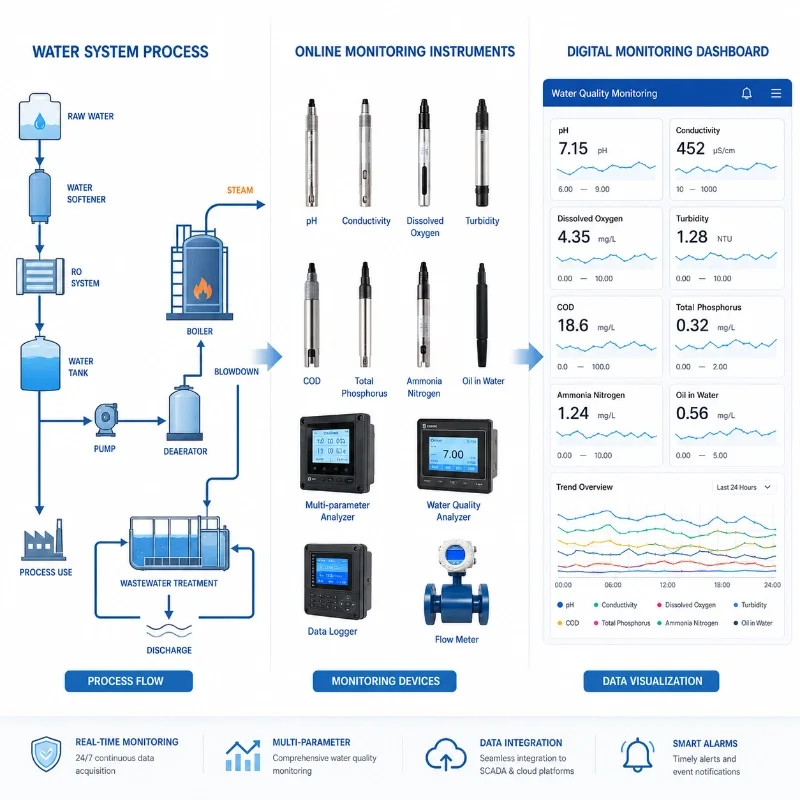
To address these challenges, industrial water quality monitoring systems are moving toward digitalization, automation, and intelligent analysis. By integrating sensing technology, IoT communication, cloud platforms, and data analytics, modern monitoring solutions help enterprises build a more complete wastewater supervision process from data collection to operational decision-making.These components form a complete smart water quality monitoring system for continuous data collection, abnormal condition detection, historical analysis, and remote management.
Real-Time Monitoring Strengthens Wastewater Compliance
A smart industrial monitoring system can continuously track important water quality indicators in factory discharge and treatment processes. Typical parameters may include:
- Ions and conductivity-related indicators
- Heavy metals such as lead and cadmium
- Total phosphorus
- Total nitrogen
- COD
- BOD
- Turbidity
- Dissolved oxygen
Compared with periodic manual inspection, online monitoring provides faster visibility into wastewater conditions and supports timely identification of abnormal trends. This helps factories reduce the risk of delayed response and improve daily compliance management.
Intelligent Systems Improve Monitoring Accuracy and Stability
Industrial sites often involve complex operating environments, fluctuating pollutant concentrations, and long-term continuous operation requirements. Modern monitoring equipment therefore needs both measurement accuracy and stable field performance.
The referenced solution highlights the use of high-sensitivity sensing modules and anti-interference algorithms to improve monitoring reliability. It is designed for long-term continuous operation and aims to reduce equipment downtime in demanding industrial scenarios.
Modular Design Supports More Application Scenarios
Different industries produce different wastewater characteristics. A modular monitoring architecture allows users to expand or adjust measurement parameters according to actual project needs.
This type of design is suitable for applications such as:
- Cement production
- Printing and dyeing
- Food and beverage processing
- Chemical manufacturing
- Industrial park wastewater supervision
By configuring different monitoring modules, enterprises can build systems that better match their specific treatment processes and compliance priorities.
Visualized Operation Enhances Daily Management
In addition to sensing performance, industrial users increasingly value simplified operation and efficient data management. A smart monitoring terminal can display:
- Real-time measurement curves
- Alarm status
- Historical data
- Device operating conditions
The referenced content also mentions functions such as local data export and relay-based linkage control, which can help operators quickly access records and connect alarms with external equipment when needed.
Cloud Analysis Supports Process Optimization
Beyond basic monitoring, cloud-based analytics are becoming an important part of industrial wastewater management. Once data is uploaded to a centralized platform, operators can review long-term trends, compare abnormal events, and evaluate treatment performance more systematically.
With intelligent analysis, enterprises can better:
- Locate possible causes of wastewater exceedance
- Optimize treatment processes
- Reduce unnecessary operating costs
- Improve environmental management efficiency
This shift from simple data collection to data-driven process optimization is becoming a major direction in industrial water quality management.
Industry Outlook
As factories face higher environmental requirements and stronger demands for refined operation, smart wastewater monitoring systems are expected to play a broader role in industrial compliance management. Future solutions will likely continue to develop toward:
- More comprehensive parameter integration
- Higher remote management capability
- Faster early warning response
- Stronger cloud and AI-based analysis
- Better compatibility with plant automation systems
Explore the JW-IoT industrial water quality monitoring solution for sensor selection, communication design, cloud integration, and project deployment.
Conclusion
Industrial water quality monitoring is becoming an essential tool for factories aiming to achieve stable wastewater discharge compliance. By combining real-time sensing, modular design, visualized operation, and cloud-based analysis, smart monitoring systems help enterprises improve supervision efficiency, reduce operational risk, and support greener industrial development.