+86 13520127780
  info@jingelway.com








How Solar Irradiance Sensors Improve PV Performance Monitoring
Release time: 2026-06-21
Introduction
In solar power projects, accurate irradiance data is one of the most important inputs for evaluating whether a PV plant is performing as expected. A photovoltaic system may show lower power generation because of cloud cover, dust accumulation, module temperature, shading, inverter issues, or panel degradation. Without reliable solar irradiance measurement, it is difficult to know whether the problem comes from the solar resource itself or from the PV system.
This is why a solar irradiance sensor is widely used in PV performance monitoring systems. It measures the amount of solar radiation reaching the installation site and provides real-time data for performance ratio analysis, power generation comparison, O&M decision-making, and long-term solar resource evaluation.
For solar farms, rooftop PV systems, floating solar plants, and desert PV projects, irradiance data helps operators turn sunlight conditions into measurable performance indicators.
Learn more about JW-IoT radiation monitoring products here: Radiation Sensors
What Is a Solar Irradiance Sensor?
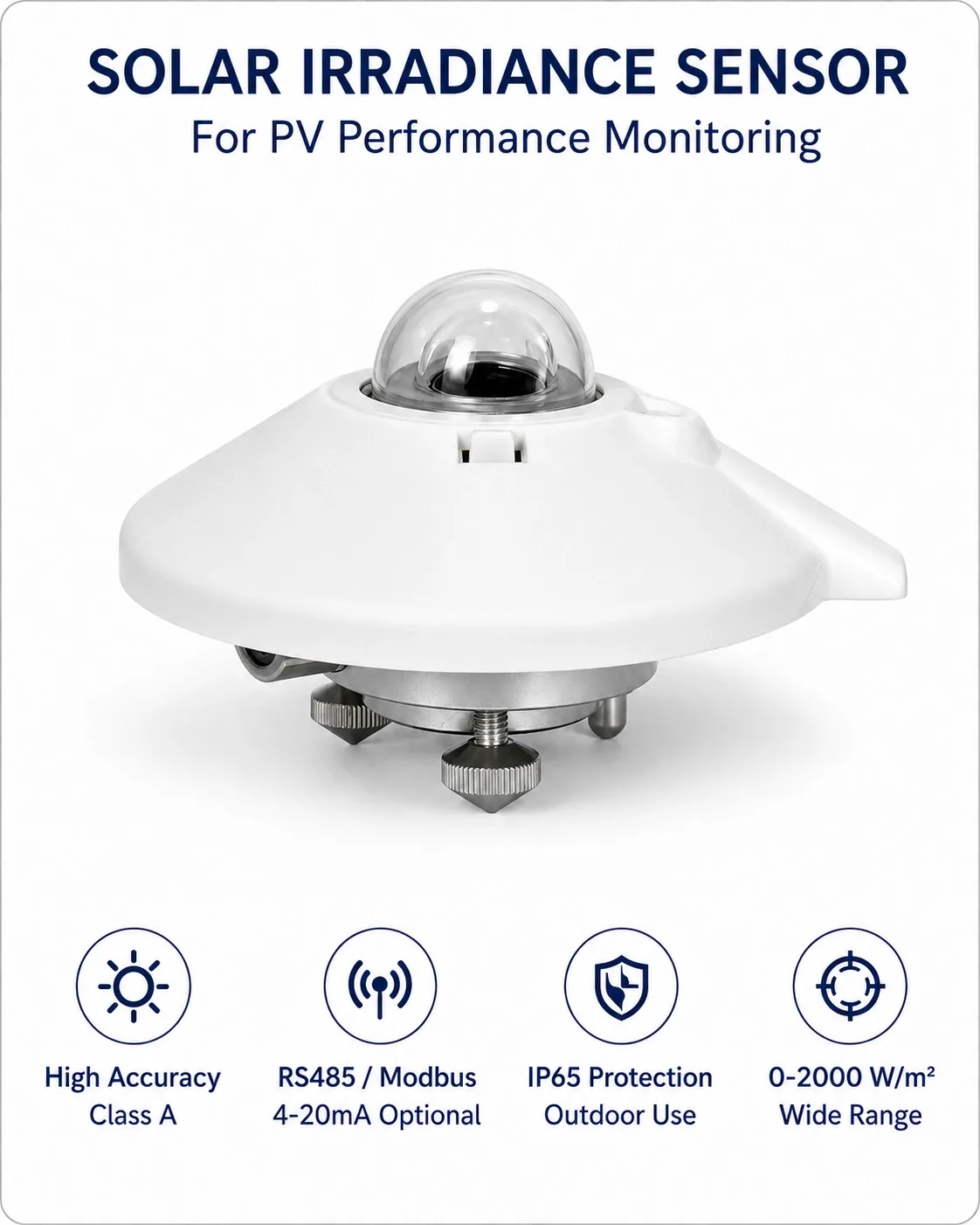
A solar irradiance sensor is a device used to measure solar radiation intensity, usually expressed in watts per square meter. In PV monitoring applications, it helps determine how much sunlight is available for photovoltaic modules to convert into electricity.
Depending on the project requirement, a solar irradiance sensor may be installed near PV arrays, on the same tilt plane as the solar modules, or at a horizontal reference position. The sensor continuously collects irradiance data and sends it to a data logger, weather station, RTU, PLC, IoT gateway, or cloud-based PV monitoring platform.
Common types of irradiance measurement devices include:
- Solar radiation sensor
- Pyranometer
- Plane of array irradiance sensor
- Total solar radiation sensor
- Reference irradiance sensor for PV monitoring
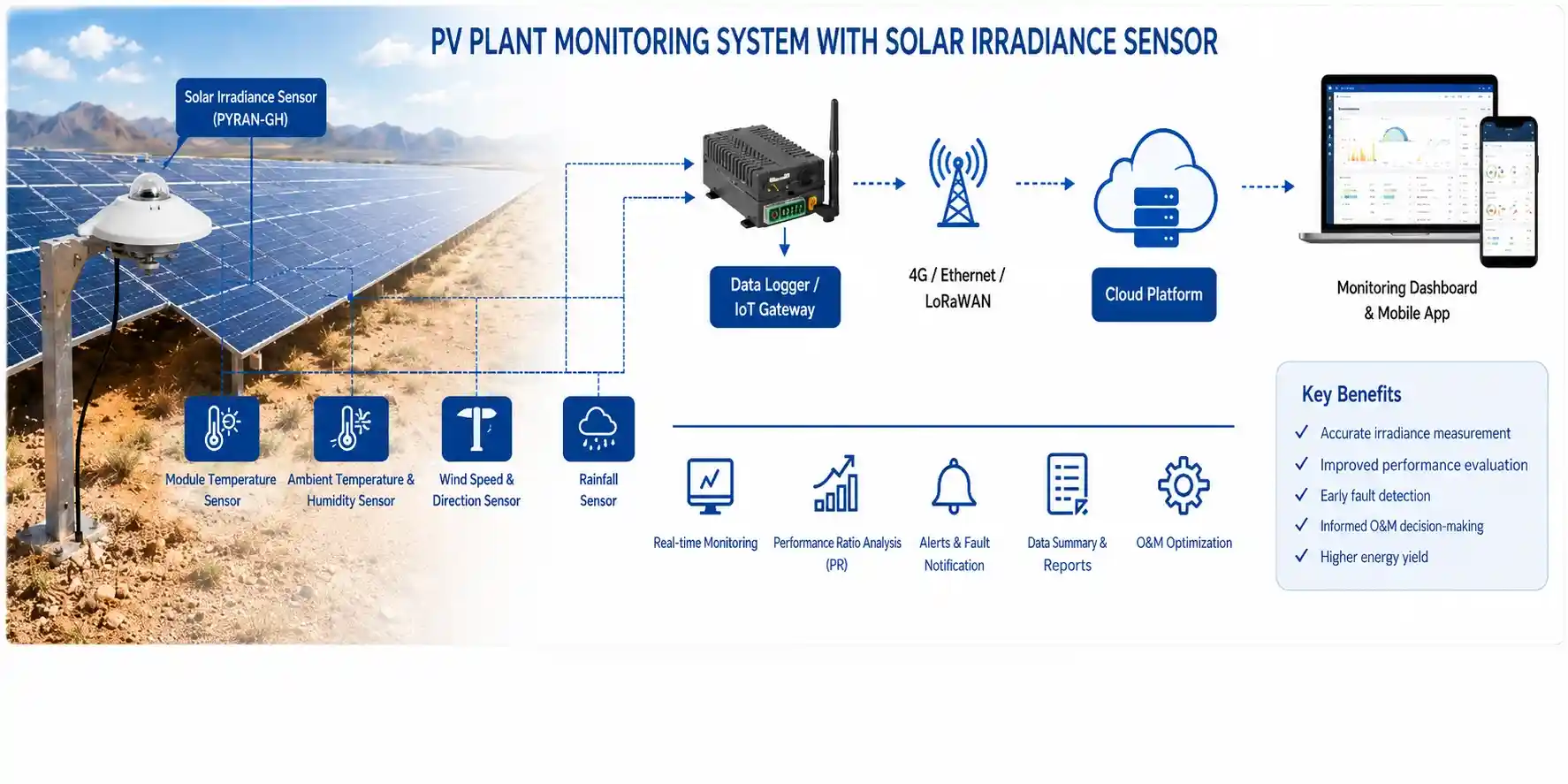
In practical solar projects, the sensor is often integrated with module temperature sensors, ambient temperature and humidity sensors, wind speed and direction sensors, rainfall sensors, and communication gateways to build a complete PV plant monitoring system.
Recommended product page: Solar Irradiance Sensor for PV Monitoring
Why Irradiance Data Matters in PV Plants
PV output is directly affected by the amount of sunlight received by the modules. When irradiance increases, the potential power output of the PV array usually increases. When irradiance drops because of clouds, dust, haze, shading, or bad weather, the PV output will also decline.
However, generation data alone cannot explain whether a PV plant is operating normally. For example, if the power output drops by 20%, the operator needs to know whether the drop is caused by lower sunlight or by equipment problems.
This is where irradiance measurement becomes valuable.
A solar irradiance sensor helps PV operators:
- Compare actual power generation with available solar radiation
- Identify abnormal performance loss
- Evaluate PV performance ratio
- Support cleaning and maintenance decisions
- Detect shading or soiling impact
- Improve solar resource assessment
- Support O&M reporting and long-term trend analysis
For large solar plants, accurate irradiance data can also help compare the performance of different zones, inverter groups, and module arrays. This makes it easier to identify underperforming sections and prioritize field inspection.
Related solution category: Renewable Energy Solutions
GHI vs POA Irradiance: What Is the Difference?
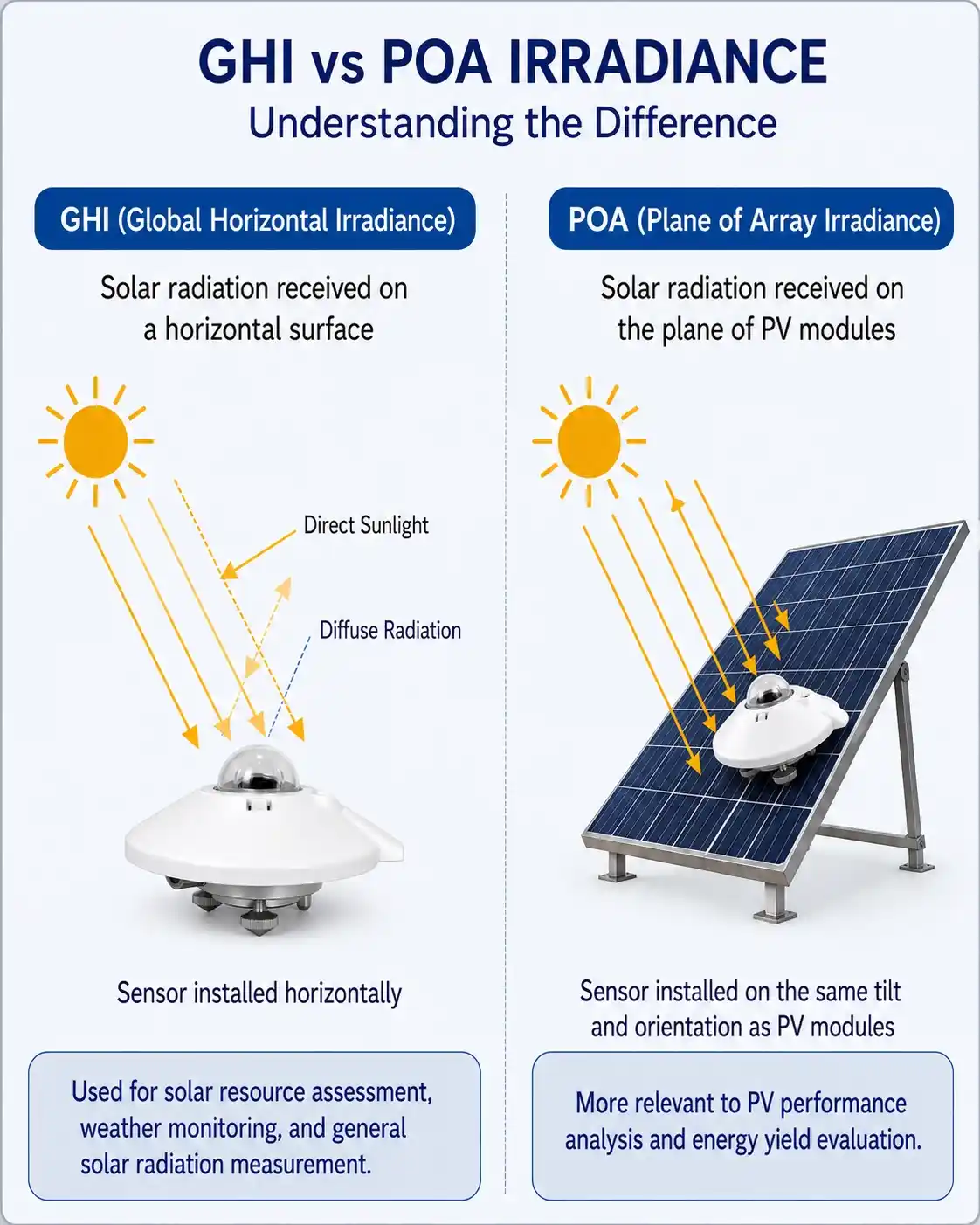
In PV performance monitoring, two common irradiance concepts are GHI and POA irradiance.
GHI: Global Horizontal Irradiance
GHI refers to the total solar radiation received on a horizontal surface. It includes direct sunlight and diffuse sky radiation. GHI is commonly used in weather stations, solar resource assessment, and regional solar energy analysis.
A horizontally installed solar radiation sensor can provide GHI data for general site-level irradiance monitoring.
POA: Plane of Array Irradiance
POA irradiance refers to the solar radiation received on the same tilted plane as the PV modules. Since PV panels are installed at a certain angle, POA irradiance is often more directly related to actual module energy generation.
For PV performance analysis, POA irradiance is especially important because it reflects the sunlight that actually reaches the module surface.
Which One Should a PV Project Use?
For simple solar resource monitoring, GHI data may be enough. For PV performance ratio analysis and power generation comparison, POA irradiance is usually more useful.
In many professional PV monitoring projects, both GHI and POA sensors can be deployed:
- GHI sensor: for site-level solar resource reference
- POA sensor: for PV array performance evaluation
- Module temperature sensor: for temperature correction
- Weather station: for environmental context
This combination helps operators understand not only how much sunlight is available, but also how much energy the PV system should reasonably produce under current conditions.
Common Output Signals: RS485 Modbus and 4–20mA
When selecting a solar irradiance sensor for PV monitoring, output signal compatibility is a key factor. Different solar farms and industrial monitoring systems may use different data acquisition architectures.
Common output signals include:
RS485 Modbus
RS485 is widely used in industrial and IoT monitoring projects because it supports stable digital communication over longer distances. For PV plant monitoring, an RS485 solar irradiance sensor can be connected to a data logger, RTU, PLC, or 4G/LoRaWAN gateway.
RS485 output is suitable for:
- Solar PV monitoring platforms
- Weather station integration
- Multi-sensor field deployment
- Modbus-based data acquisition
- Remote monitoring systems
4–20mA
The 4–20mA signal is a common industrial analog output. It is often used where strong anti-interference capability and simple integration with PLC or industrial controllers are required.
4–20mA output is suitable for:
- Industrial PV monitoring systems
- Long-distance signal transmission
- Existing PLC-based systems
- Harsh outdoor environments
mV Output
Some pyranometers or solar radiation sensors provide low-level mV output. This type of signal may require a compatible data logger or signal conditioning module.
For overseas PV projects, RS485 Modbus is often the preferred option because it is easier to integrate into IoT gateways and cloud platforms.
Recommended product category: Radiation Sensors
Installation Tips for PV Monitoring
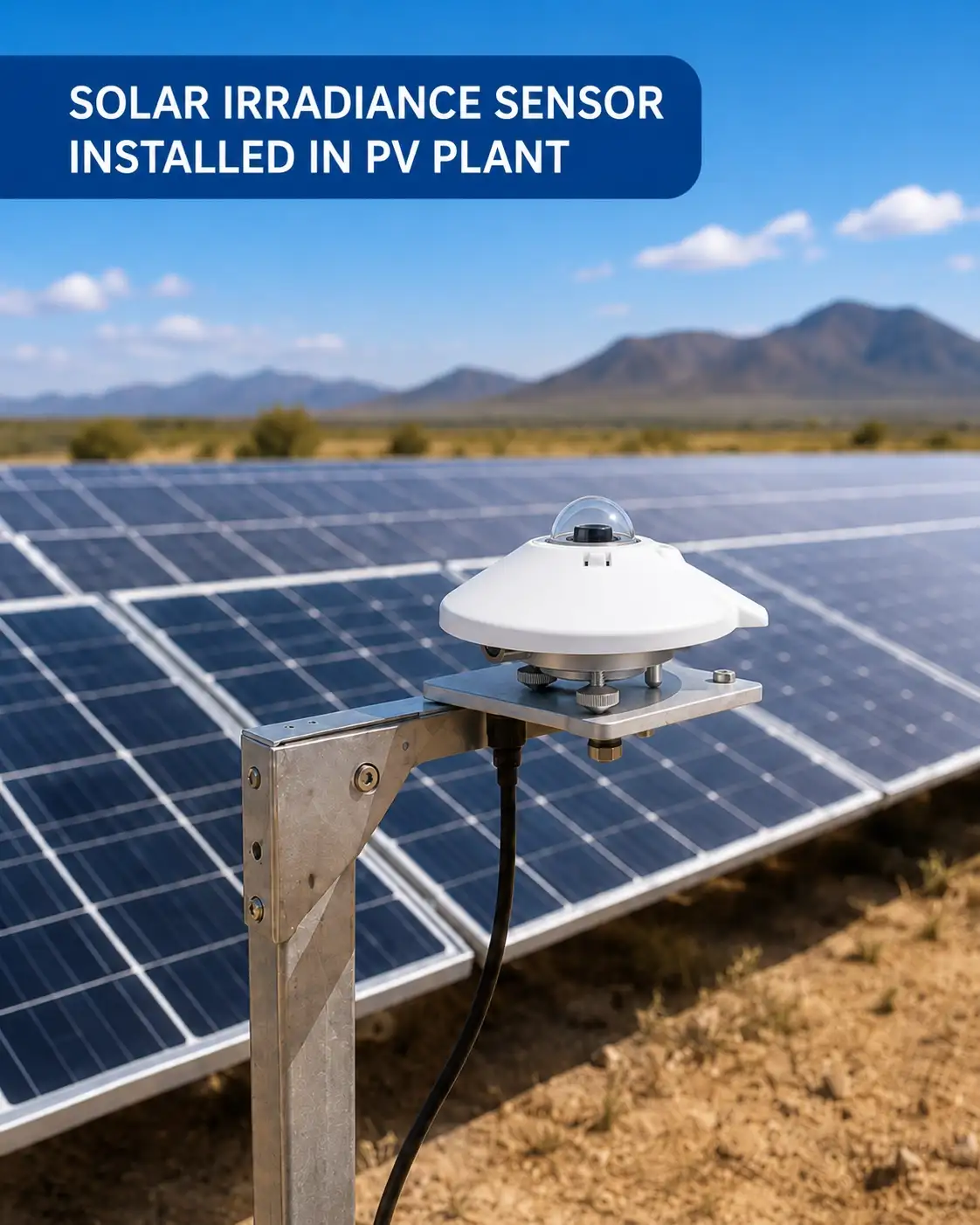
Correct installation is essential for accurate irradiance measurement. Even a high-quality solar irradiance sensor may produce misleading data if it is installed in the wrong position or not maintained properly.
1. Install the Sensor Near the PV Array
The sensor should be installed in a location that represents the same solar conditions as the PV modules. Avoid areas affected by buildings, trees, poles, fences, or other shading sources.
2. Match the Tilt Angle for POA Measurement
For POA irradiance monitoring, the sensor should be installed at the same tilt angle and orientation as the PV modules. This helps measure the actual solar radiation reaching the module plane.
3. Keep the Sensor Surface Clean
Dust, bird droppings, sand, pollen, and water stains can reduce sensor accuracy. In desert PV plants and dusty environments, regular cleaning is especially important.
4. Avoid Reflections and Obstructions
The sensor should not be placed too close to reflective surfaces or objects that may block sunlight at certain times of the day.
5. Ensure Stable Mounting
Outdoor PV sites may experience strong wind, vibration, rain, snow, and high temperatures. The mounting bracket should be stable, corrosion-resistant, and suitable for long-term outdoor installation.
6. Connect to a Reliable Data Acquisition System
The solar irradiance sensor should be connected to a weather station, data logger, RTU, IoT gateway, or PV monitoring platform. For remote sites, 4G, LoRaWAN, Ethernet, or other communication methods can be selected according to project conditions.
Related solution page: PV Plant Weather Station
How Irradiance Data Supports PR Analysis
Performance Ratio, often called PR, is a key indicator used to evaluate the quality and efficiency of a PV plant. It compares the actual energy output of a PV system with the theoretical energy output based on available solar irradiance.
In simple terms, PR helps answer one important question:
Is the PV plant generating the amount of electricity it should generate under the current sunlight conditions?
To calculate or evaluate PR accurately, operators usually need:
- Solar irradiance data
- PV power generation data
- Module temperature data
- System capacity information
- Time-based monitoring data
A solar irradiance sensor provides the solar resource input needed for PR analysis. When combined with power generation data from inverters or meters, the monitoring platform can identify whether the PV plant is performing normally.
For example:
- If irradiance is high but power output is low, there may be an equipment or soiling issue.
- If irradiance is low and power output is also low, the reduced generation may be caused by weather conditions.
- If one PV zone performs worse than another under similar irradiance, that area may need inspection.
This makes irradiance monitoring useful not only for reporting, but also for daily operation and maintenance.
Explore complete monitoring solutions: Solar PV Monitoring Solution
Solar Irradiance Sensor Applications in PV Projects
Solar irradiance sensors can be used in different types of solar energy projects.
Utility-Scale Solar Farms
Large solar farms need accurate irradiance data for performance ratio tracking, inverter zone comparison, and O&M optimization. Multiple sensors may be deployed across different zones to reflect site-level variation.
Commercial and Industrial Rooftop PV
For rooftop PV systems, irradiance sensors help building owners and energy service companies compare solar generation with rooftop sunlight conditions.
Floating Solar Plants
Floating PV systems are affected by water surface reflection, humidity, module temperature, and changing environmental conditions. Irradiance monitoring supports more accurate performance evaluation.
Desert Solar PV Plants
In desert and arid regions, dust and sand can significantly affect solar module performance. Irradiance data helps distinguish natural sunlight changes from soiling-related power loss.
Solar Resource Assessment
Before or during project development, solar radiation sensors can help collect local solar resource data for site evaluation and system design.
How to Choose a Solar Irradiance Sensor for PV Monitoring
When selecting a solar irradiance sensor, project owners and system integrators should consider both measurement performance and system integration requirements.
Key selection factors include:
- Measurement range, such as 0–2000 W/m²
- Sensor type and accuracy class
- Spectral response range
- Output signal such as RS485, Modbus, 4–20mA, or mV
- Operating temperature range
- Outdoor protection and long-term stability
- Mounting method
- Compatibility with data loggers and IoT gateways
- Integration with cloud monitoring platforms
For PV monitoring projects, the sensor should not be selected as an isolated device. It should be considered as part of the complete monitoring architecture, including power supply, communication, data storage, dashboard visualization, alarms, and maintenance reports.
JW-IoT provides solar radiation sensors and IoT monitoring components that can be integrated into PV plant weather stations and solar monitoring systems.
Product category: Radiation Sensors
Solution category: Renewable Energy Solutions
Conclusion
A solar irradiance sensor is a critical device for accurate PV performance monitoring. By measuring real-time solar radiation, it helps PV plant operators understand available sunlight, evaluate performance ratio, detect abnormal power loss, and improve O&M decisions.
For solar farms, rooftop PV systems, floating solar plants, and desert PV projects, irradiance data provides the foundation for reliable performance analysis. When combined with module temperature, weather data, inverter data, and cloud monitoring platforms, it becomes a key part of a complete solar PV monitoring solution.
JW-IoT offers solar radiation sensors, PV weather monitoring components, and IoT-based monitoring solutions for global solar energy projects.
Contact JW-IoT to get the solar irradiance sensor datasheet, technical parameters, output options, and integration recommendations for your PV monitoring project.