+86 13520127780
  info@jingelway.com








Choosing PV Monitoring Communication: LoRaWAN vs 4G vs RS485
Release time: 2026-07-12
A solar monitoring system is only useful when its data reaches the right platform reliably.
Solar irradiance sensors, PV module temperature sensors, weather stations, inverters, electricity meters, and soiling monitoring devices may all work correctly at the field level. However, if communication is unstable, delayed, or poorly designed, operators can still face missing records, incomplete performance analysis, delayed alarms, and unnecessary maintenance visits.
Choosing the right PV monitoring communication method therefore affects much more than data transmission. It influences installation cost, system reliability, future expansion, maintenance workload, cloud integration, and the quality of performance ratio analysis.
So which option should a solar project use: LoRaWAN, 4G, or RS485?
The practical answer is:
- RS485 is usually best for connecting nearby sensors to a local data logger or controller.
- LoRaWAN is well suited to distributed, low-data monitoring points spread across a solar farm.
- 4G is commonly used to send data from a remote PV site to a cloud platform or control center.
- For many commercial and utility-scale projects, a hybrid architecture combining all three provides the most reliable and scalable solution.
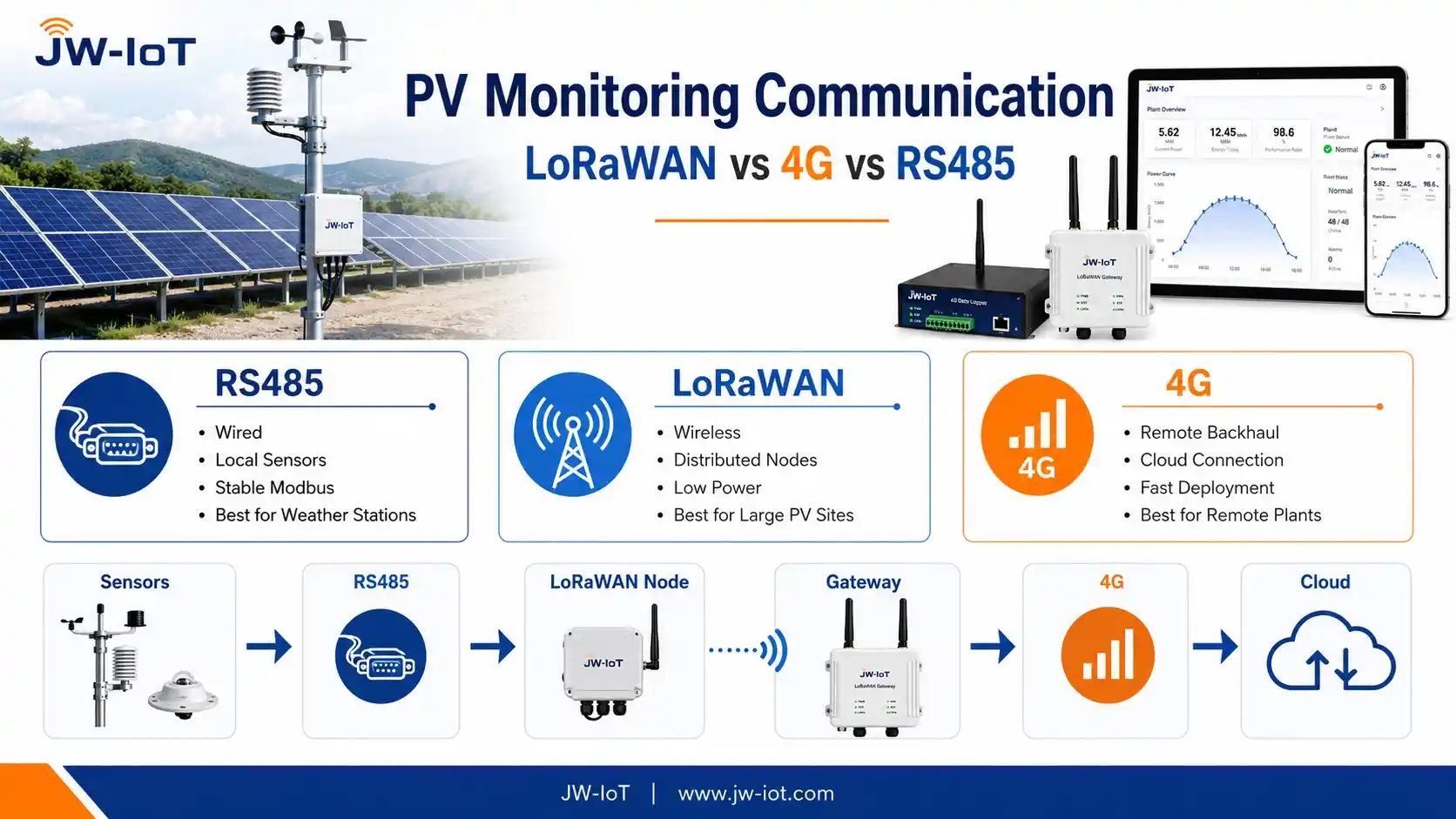
LoRaWAN vs 4G vs RS485 at a Glance
| Comparison Point | RS485 Modbus | LoRaWAN | 4G Cellular |
| Primary role | Local sensor connection | Site-wide wireless transmission | Remote cloud backhaul |
| Connection type | Wired | Wireless | Wireless cellular |
| Best distance | Sensors within the same monitoring area | Distributed points across a solar site | Remote plant to cloud server |
| Power consumption | Low | Very low | Higher |
| Cabling requirement | Communication cable required | Minimal field cabling | No site-wide data cable |
| Recurring network cost | Usually none | Usually none for a private network | SIM card and data plan required |
| Data capacity | Suitable for frequent sensor polling | Suitable for small sensor packets | Suitable for larger data volumes |
| Typical devices | Irradiance sensors, temperature sensors, weather sensors | Wireless sensor nodes and DTUs | Data loggers, RTUs, routers, gateways |
| Main limitation | Wiring and surge protection requirements | Gateway coverage and payload limitations | Cellular coverage and operating cost |
| Best PV application | Local weather station sensor network | Distributed solar farm monitoring nodes | Remote PV station connection |
These technologies are not direct substitutes in every situation. They often operate at different levels of the same solar farm IoT architecture.
Why Communication Matters in PV Monitoring
A complete solar PV monitoring system may collect information from:
- Global horizontal irradiance sensors
- Plane-of-array irradiance sensors
- PV module temperature sensors
- Ambient temperature and humidity sensors
- Wind speed and direction sensors
- Rain gauges
- Soiling monitoring devices
- Inverters and electricity meters
- String monitoring units
- Local weather stations
The communication system determines whether this data can be collected continuously, stored correctly, and delivered to the monitoring platform without significant gaps.
A well-designed communication architecture should support five basic objectives.
Reliable Data Collection
Sensors must be polled at the required interval without communication conflicts or frequent packet loss. Missing irradiance or module temperature records can make performance analysis less accurate.
Timely Alarm Transmission
Abnormal module temperature, communication failure, extreme wind, sensor malfunction, or unexpected power loss should be reported quickly enough for operators to respond.
Offline Data Protection
Remote solar plants may temporarily lose internet connectivity. A suitable data logger should keep collecting and storing local data before uploading it after the connection is restored.
System Expansion
The communication network should allow additional weather stations, sensors, or PV zones to be added without rebuilding the entire infrastructure.
Platform Integration
Data may need to reach a cloud dashboard, SCADA system, energy management platform, or customer-owned server through protocols such as Modbus, MQTT, TCP/IP, or API interfaces.
JW-IoT’s Solar PV Monitoring System with IoT Automation combines environmental sensors, data acquisition devices, communication gateways, cloud monitoring, alarms, and platform integration for different types of PV projects.
RS485 for Wired PV Sensor Networks
RS485 is one of the most widely used communication interfaces in industrial sensing and automation.
In PV monitoring, RS485 is commonly used to connect solar radiation sensors, module temperature sensors, weather sensors, electricity meters, and other Modbus devices to a data logger, RTU, PLC, or edge gateway.
How RS485 Works in a PV Monitoring System
Multiple RS485 Modbus sensors can share the same communication bus. Each device is assigned a unique address, allowing the data logger to request measurements from individual sensors.
A typical connection may look like this:
PV sensors → RS485 Modbus bus → data logger or RTU
The data logger then stores, processes, or forwards the collected data through Ethernet, LoRaWAN, 4G, or another uplink.
Advantages of RS485
Stable local communication
A correctly installed wired connection is generally stable and less affected by wireless coverage conditions.
Broad industrial compatibility
Many PV weather sensors, inverters, meters, PLCs, and data loggers support Modbus RTU over RS485.
No cellular subscription
RS485 itself does not require a SIM card, network subscription, or cloud communication fee.
Suitable for frequent polling
The data logger can collect measurements from nearby sensors at relatively short intervals, making RS485 useful for weather stations and local equipment rooms.
Easy integration with control systems
RS485 Modbus devices can be integrated into SCADA systems, RTUs, industrial gateways, and local monitoring cabinets.
For example, a PV Weather Monitoring Station for Distributed Solar Plants can collect irradiance, module temperature, wind, humidity, pressure, and other environmental data through an integrated acquisition unit.
Limitations of RS485
RS485 requires physical communication cables. In a large solar farm, trenching and long cable routes can increase installation costs.
Outdoor wiring must also be designed carefully. Common risks include:
- Lightning and surge damage
- Ground potential differences
- Incorrect termination
- Cable shielding problems
- Reversed polarity
- Excessive network branches
- Water entering junction boxes
- Communication conflicts caused by duplicate device addresses
RS485 is therefore usually most effective inside a defined monitoring zone rather than as the only communication method across an entire utility-scale solar farm.
When Should a PV Project Use RS485?
RS485 is a strong choice when:
- Sensors are installed near the same weather station or cabinet.
- Existing cable routes are available.
- The project requires direct Modbus integration.
- Cellular or wireless coverage is unnecessary at the sensor level.
- Frequent and predictable sensor polling is required.
- The system needs to connect with an inverter, PLC, SCADA, or local data logger.
4G for Remote Solar Plants
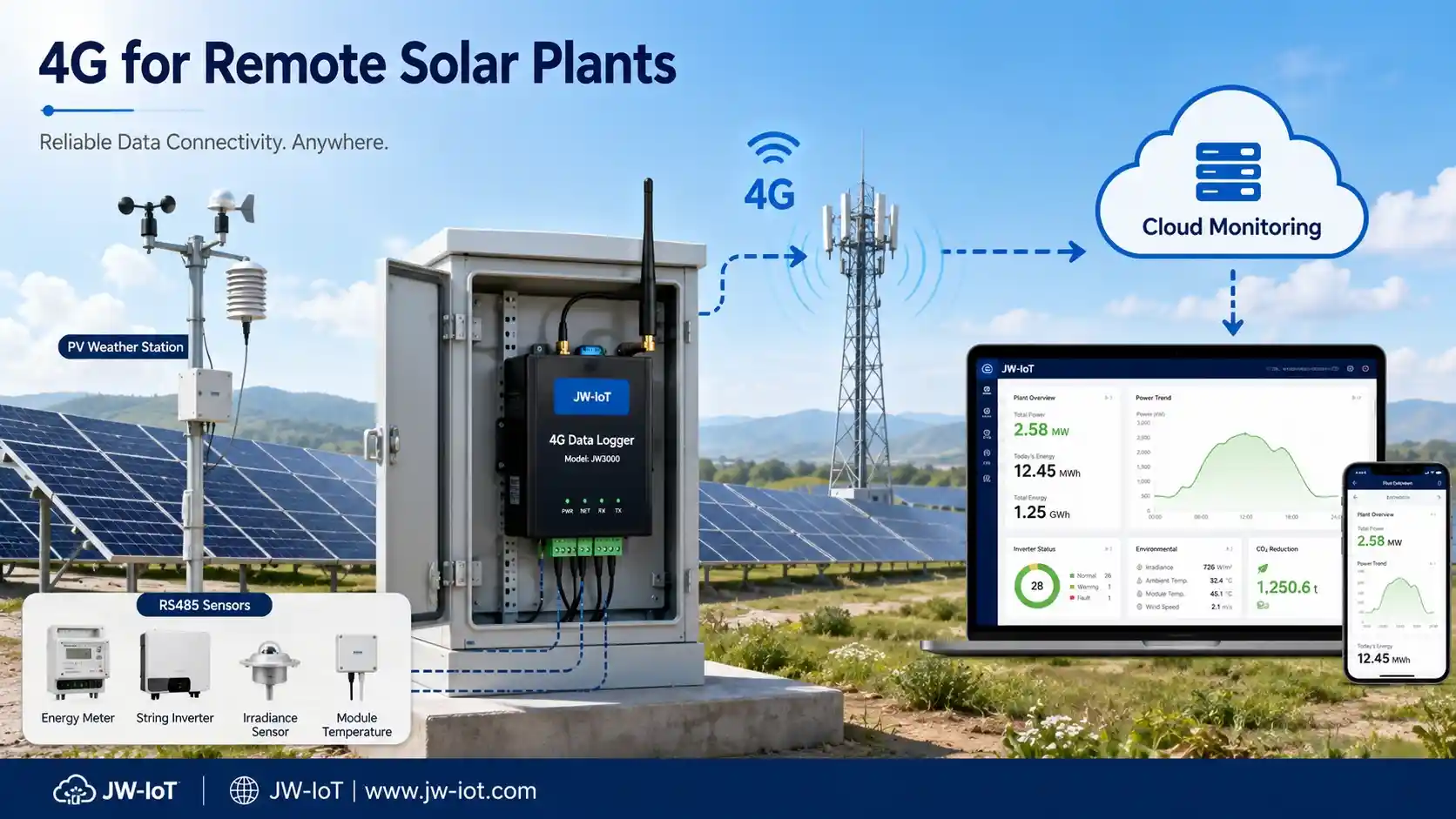
Many solar power plants are built in remote areas where fixed broadband, fiber, or local network infrastructure is unavailable.
In these projects, 4G provides a practical way to connect the PV station to a cloud server, monitoring center, or remote O&M platform.
How 4G Works in PV Monitoring
A local data logger or 4G DTU collects data from field sensors and sends it through the mobile network.
A typical structure is:
Sensors → RS485 data logger or RTU → 4G network → cloud platform
A 4G device may support TCP, UDP, HTTP, MQTT, Modbus gateway functions, or transparent serial transmission depending on the equipment and platform requirements.
The 4G CAT1 DTU Serial Device Server with RS232 and RS485 can connect serial field devices to cellular networks and transmit monitoring data to a remote server.
Advantages of 4G
Suitable for remote PV sites
A 4G connection can be deployed wherever a suitable cellular signal is available, without installing long-distance communication cables.
Direct connection to cloud platforms
Data loggers can upload information directly to a public cloud, private server, SCADA gateway, or third-party solar O&M platform.
Faster project deployment
A solar monitoring station with a SIM card can often be commissioned more quickly than a station that depends on new wired internet infrastructure.
Supports larger data volumes
Compared with low-power wireless sensor networks, 4G is more appropriate for frequent uploads, configuration files, remote maintenance, and other data-intensive tasks.
Remote device management
Depending on the hardware, operators may be able to change parameters, restart equipment, update firmware, or diagnose communication problems remotely.
Limitations of 4G
The main limitation is dependency on the local mobile network.
Before selecting a 4G data logger, the project team should confirm:
- Cellular signal strength at the installation point
- Available network operators
- Supported frequency bands
- SIM card management
- Monthly data requirements
- Antenna position
- Power consumption
- Network security requirements
- Whether a public or private APN is needed
A remote solar site may also experience temporary network interruption. Local storage and automatic data retransmission are therefore important functions for a reliable 4G monitoring system.
When Should a PV Project Use 4G?
4G is suitable when:
- The plant is far from the control center.
- Ethernet or fiber is not available.
- Data must be sent to a cloud platform.
- The site needs remote diagnostics or maintenance.
- The data volume is greater than a low-power network should handle.
- One gateway must aggregate data from several local devices.
- The project operates multiple geographically separated PV sites.
An industrial 4G router may also be used when the PV monitoring cabinet contains several Ethernet, serial, or local network devices.
LoRaWAN for Distributed PV Monitoring Nodes
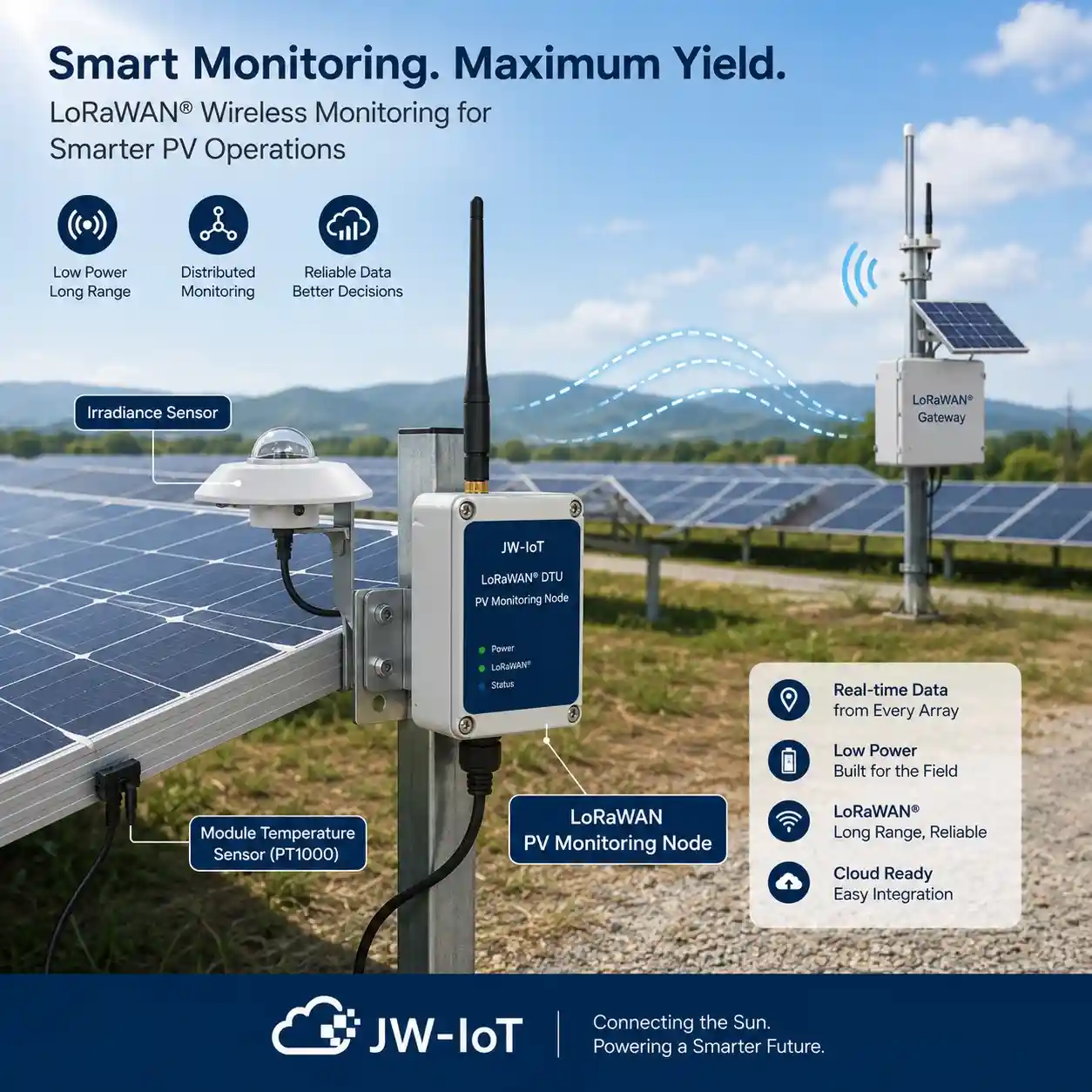
Utility-scale and distributed PV projects may require monitoring points across a large area.
Running communication cable from every irradiance sensor, module temperature sensor, or weather monitoring node back to a central cabinet may be expensive and difficult. LoRaWAN provides an alternative for transmitting small packets of sensor data over a private wireless network.
How LoRaWAN Works in a Solar Farm
Field sensors connect to LoRaWAN nodes or wireless DTUs. These nodes transmit data to one or more LoRaWAN gateways.
The gateway then forwards the data to a network server or cloud platform through 4G, Ethernet, Wi-Fi, or another internet connection.
A typical architecture is:
RS485 sensor → LoRaWAN node → LoRaWAN gateway → 4G or Ethernet → cloud platform
This is an important distinction: LoRaWAN normally handles communication across the solar site, while 4G often handles communication from the site to the cloud.
Advantages of LoRaWAN
Reduced field cabling
Distributed monitoring nodes can transmit data wirelessly, reducing the need for long communication cable routes.
Low power consumption
LoRaWAN is suitable for solar-powered or battery-powered monitoring devices that transmit small amounts of data at scheduled intervals.
One gateway can receive multiple nodes
A properly planned LoRaWAN network can collect data from many distributed monitoring points.
Suitable for large outdoor areas
LoRaWAN can be useful for utility-scale solar farms, floating PV sites, mountainous projects, and distributed monitoring networks.
Flexible expansion
Additional nodes can often be added without extending a wired communication bus back to the main cabinet.
JW-IoT provides a battery-powered LoRaWAN DTU with RS485 and RS232 interfaces for connecting serial sensors to a LoRaWAN network.
An outdoor LoRaWAN gateway can then collect field data and forward it through 4G, Ethernet, Wi-Fi, or other available backhaul connections.
Limitations of LoRaWAN
LoRaWAN is designed primarily for small sensor packets rather than high-bandwidth applications.
It is not normally the right choice for:
- Live video
- Large files
- High-frequency waveform data
- Continuous camera transmission
- Very large firmware downloads
- Applications requiring constant real-time control
Coverage also depends on antenna height, terrain, PV array layout, nearby structures, radio interference, gateway placement, and regional frequency regulations.
A field coverage assessment is therefore recommended before finalizing the number and position of gateways.
When Should a PV Project Use LoRaWAN?
LoRaWAN PV monitoring is suitable when:
- Monitoring points are distributed across a large site.
- Each node sends relatively small data packets.
- Long communication cables would be expensive.
- Devices need low-power operation.
- Several monitoring zones must share one gateway.
- Additional monitoring points may be added later.
- The project needs a private wireless network without one SIM card per node.
How to Choose Based on Project Size
The most suitable architecture depends on more than the installed PV capacity. Site layout, monitoring density, available power, communication infrastructure, terrain, and platform requirements must also be considered.
Small Rooftop PV System
A small commercial rooftop may have one environmental monitoring point located near the inverter or communication cabinet.
A practical configuration is:
Weather and PV sensors → RS485 → data logger → Ethernet or 4G → cloud
RS485 keeps local integration simple, while Ethernet or 4G provides the remote uplink.
LoRaWAN may not be necessary unless sensors are installed on separate rooftops or buildings.
Distributed Commercial PV Project
A distributed project may include several rooftops, industrial buildings, or geographically separated installations.
A suitable design may use:
Sensors → RS485 → local data logger → 4G → centralized cloud platform
Each site can use an independent 4G data logger, allowing the operator to monitor all locations through one platform.
Medium or Large Solar Farm
A larger ground-mounted solar farm may contain several weather monitoring zones.
One recommended architecture is:
Local sensors → RS485 → LoRaWAN node → LoRaWAN gateway → 4G or Ethernet → cloud
This approach uses RS485 for reliable local sensor collection and LoRaWAN for communication across the site.
Utility-Scale Solar Plant
A utility-scale plant may require multiple weather stations, irradiance points, module temperature sensors, soiling stations, inverter rooms, and substations.
The communication network may include:
- RS485 within each local monitoring zone
- Multiple LoRaWAN gateways for site coverage
- Fiber or industrial Ethernet where infrastructure is available
- 4G as the primary or backup wide-area connection
- Edge data storage in each data logger
- API or SCADA integration at the platform layer
Redundant communication paths may be appropriate for critical monitoring data.
Floating or Desert Solar Farm
Floating and desert PV projects often have challenging cable routes and difficult maintenance conditions.
LoRaWAN can reduce the need for long communication cables, while 4G can provide remote cloud connectivity. Local RS485 remains useful for connecting sensors within each floating platform, shore station, or environmental monitoring point.
Recommended Hybrid Communication Architecture
For many solar projects, the best solution is not to choose only one communication method.
A layered architecture provides better reliability and makes future expansion easier.
Layer 1: Sensor Communication
Use RS485 Modbus to connect nearby devices such as:
- Pyranometers
- PV module temperature sensors
- Compact weather sensors
- Wind sensors
- Rain gauges
- Soiling monitoring devices
- Energy meters
Layer 2: Data Acquisition
A local data logger, RTU, or LoRaWAN DTU should:
- Poll sensors
- Assign timestamps
- Validate readings
- Store data locally
- Manage sensor addresses
- Detect communication faults
- Buffer data during network interruption
Layer 3: Site-Wide Communication
Use LoRaWAN when monitoring nodes are spread across the solar plant and long communication cables are impractical.
Use industrial Ethernet or fiber where existing plant infrastructure already provides reliable coverage.
Layer 4: Wide-Area Backhaul
Use 4G, Ethernet, or fiber to connect the site gateway with the remote cloud platform, SCADA system, or control center.
A backup 4G connection may also be used when the primary Ethernet or fiber network is interrupted.
Layer 5: Monitoring Platform
The platform should provide:
- Real-time data dashboards
- Historical trend analysis
- Alarm notification
- Device status monitoring
- Multi-site management
- Data export
- API access
- SCADA or energy management integration
A typical recommended architecture is:
PV sensors → RS485 data acquisition → LoRaWAN field network → LoRaWAN gateway → 4G or Ethernet → cloud platform or SCADA
JW-IoT’s PV Plant Weather Station Solution can be configured with RS485, LoRaWAN, 4G, gateway connectivity, cloud dashboards, alarms, and API integration according to project requirements.
Communication Design Checklist
Before selecting the communication configuration, confirm the following project information:
- How many monitoring points will be installed?
- What is the distance between the monitoring points?
- Which sensors support RS485 Modbus?
- Is power available at every monitoring point?
- Is there reliable 4G coverage at the site?
- Is Ethernet or fiber already available?
- Does the site require a private LoRaWAN network?
- How frequently should data be collected and uploaded?
- Does the project require local data storage?
- Will the data connect to a cloud platform, SCADA system, or customer server?
- Are remote configuration and firmware updates required?
- Does the project require communication redundancy?
- Which LoRaWAN frequency band and cellular bands are required in the target country?
- What cybersecurity or private deployment requirements apply?
These questions should be answered before hardware selection. Choosing a communication device first and designing the network later often leads to unnecessary costs or integration problems.
LoRaWAN vs 4G vs RS485: Which Is Best?
There is no single communication technology that is best for every PV project.
Choose RS485 for stable wired communication between nearby sensors and data acquisition devices.
Choose LoRaWAN for low-power, distributed environmental monitoring nodes across a large PV site.
Choose 4G when a remote solar plant needs to send data directly to a cloud platform or central monitoring system.
For many medium and large PV projects, the most practical design is:
RS485 at the sensor level + LoRaWAN across the solar site + 4G for cloud transmission.
This layered approach balances local reliability, installation flexibility, low-power wireless coverage, and remote connectivity.
FAQ
1. What is the best communication method for PV monitoring?
The best method depends on the role of the connection. RS485 is generally suitable for local sensor networks, LoRaWAN for distributed monitoring nodes, and 4G for transmitting data from a remote plant to the cloud. Many projects use a combination of these technologies.
2. Can LoRaWAN replace RS485 in a PV weather station?
Not always. Many weather and PV sensors use RS485 Modbus as their physical output. A LoRaWAN DTU can collect the RS485 data and transmit it wirelessly, meaning the two technologies work together rather than directly replacing each other.
3. Can one 4G data logger connect to several RS485 sensors?
Yes. A suitable 4G data logger or DTU can poll multiple RS485 Modbus sensors, store their data, and upload it to a remote server. The exact configuration depends on device addresses, polling intervals, protocol compatibility, and power availability.
4. Does every LoRaWAN monitoring node need a SIM card?
No. Field nodes communicate with the LoRaWAN gateway and normally do not need individual SIM cards. The gateway may use one 4G connection to forward data from multiple nodes to the cloud.
5. How many LoRaWAN gateways does a solar farm need?
The number depends on the site area, terrain, antenna height, equipment layout, required redundancy, node position, and local radio conditions. A coverage survey or field test should be completed before the final gateway quantity is confirmed.
6. Is 4G reliable enough for an unattended solar plant?
It can be, provided that the site has stable cellular coverage and the system includes a suitable antenna, local data storage, automatic reconnection, offline buffering, and data retransmission. Critical projects may also use a secondary network or wired backup connection.
7. Can JW-IoT integrate PV monitoring data with an existing SCADA platform?
Yes. JW-IoT can provide sensors, data loggers, LoRaWAN devices, 4G communication equipment, cloud platforms, and integration support. The final interface may use Modbus, MQTT, TCP/IP, API, or another protocol based on the customer’s SCADA or platform requirements.
8. What information is required to design a PV communication system?
JW-IoT normally needs the site layout, monitoring point quantity, sensor list, distance between points, available power, local cellular coverage, required data interval, target platform, communication protocols, deployment country, and any redundancy or cybersecurity requirements.
Ask for a PV Communication Configuration
The most effective communication design starts with the site layout and monitoring objective—not with a single gateway or data logger.
JW-IoT can help configure a complete solar farm IoT system combining:
- RS485 Modbus PV sensors
- LoRaWAN monitoring nodes
- Outdoor LoRaWAN gateways
- 4G data loggers and industrial routers
- Local data storage
- Cloud monitoring dashboards
- Alarm management
- MQTT and API integration
- SCADA and customer platform connectivity
Contact JW-IoT with your PV plant layout, sensor quantity, communication distance, country, and platform requirements to receive a recommended communication architecture.