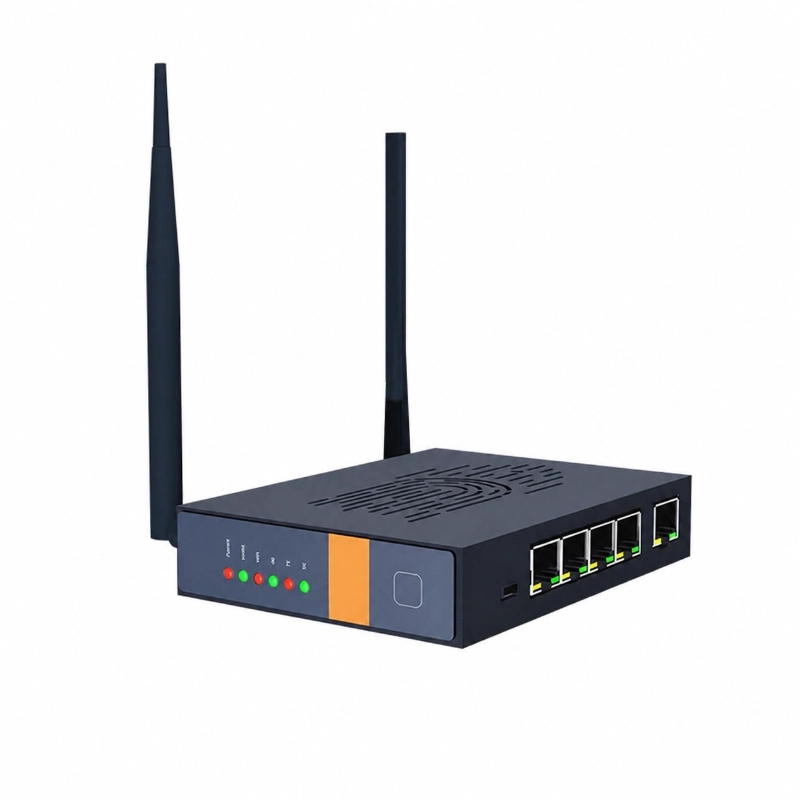
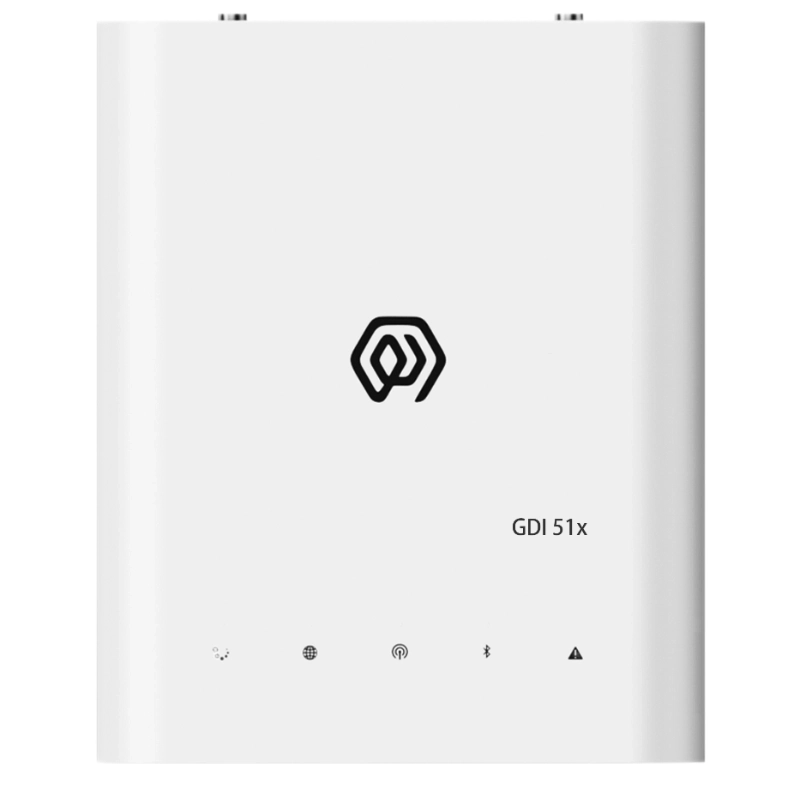
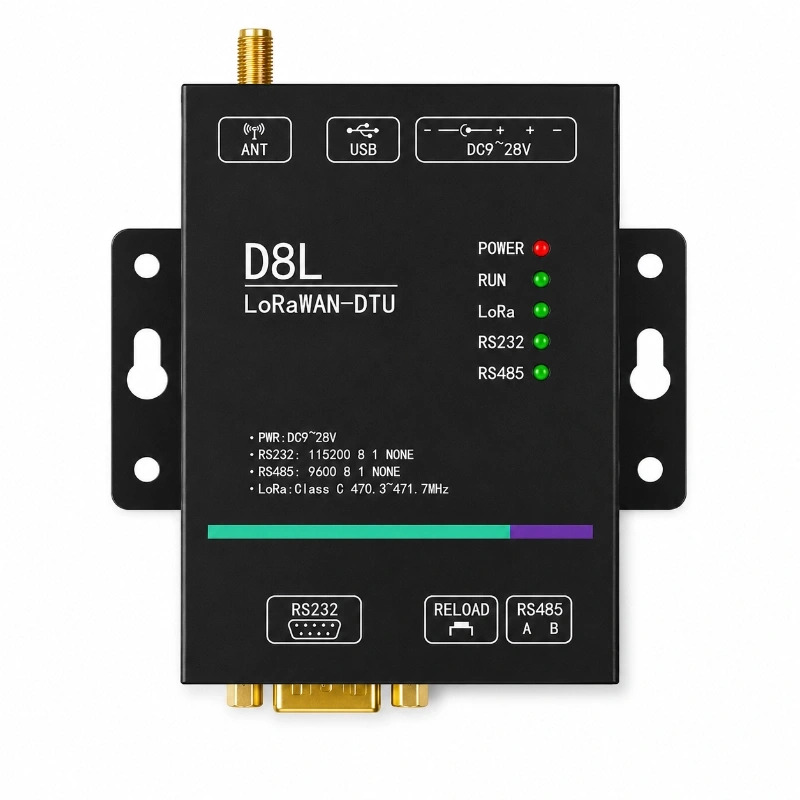
The JW-R545(H03) Industrial 4G Router Five Port is a multi-network industrial LTE router designed for remote equipment connectivity, industrial Ethernet networking, and reliable data transmission across distributed IoT systems.
Equipped with five 10/100 Mbps RJ45 Ethernet ports, 4G LTE CAT4 connectivity, 2.4 GHz WiFi, and an RS232 or RS485 serial interface, the router connects industrial controllers, field monitoring terminals, and network-enabled equipment to local networks or remote monitoring platforms.
Unlike basic cellular modems or serial-only data terminals, the JW-R545(H03) combines five-port Ethernet networking, configurable WAN/LAN functions, cellular backup, firewall rules, and Modbus communication in one industrial networking device.
It is suitable for industrial automation, utility monitoring, remote environmental stations, transportation infrastructure, and distributed equipment management.
1. What Is an Industrial 4G LTE Router with Five Ethernet Ports?
An industrial 4G LTE router provides network connectivity between industrial equipment and remote communication infrastructure using a cellular network.
A five-port industrial router additionally allows multiple Ethernet devices to connect through a common networking unit.
The JW-R545(H03) integrates three network access technologies:
4G LTE: Provides cellular communication for locations where wired internet is unavailable or requires backup connectivity.
Ethernet: Connects compatible industrial controllers, communication terminals, network instruments, and other IP-enabled devices.
WiFi: Supports 2.4 GHz wireless networking through AP, STA, and AP+STA modes.
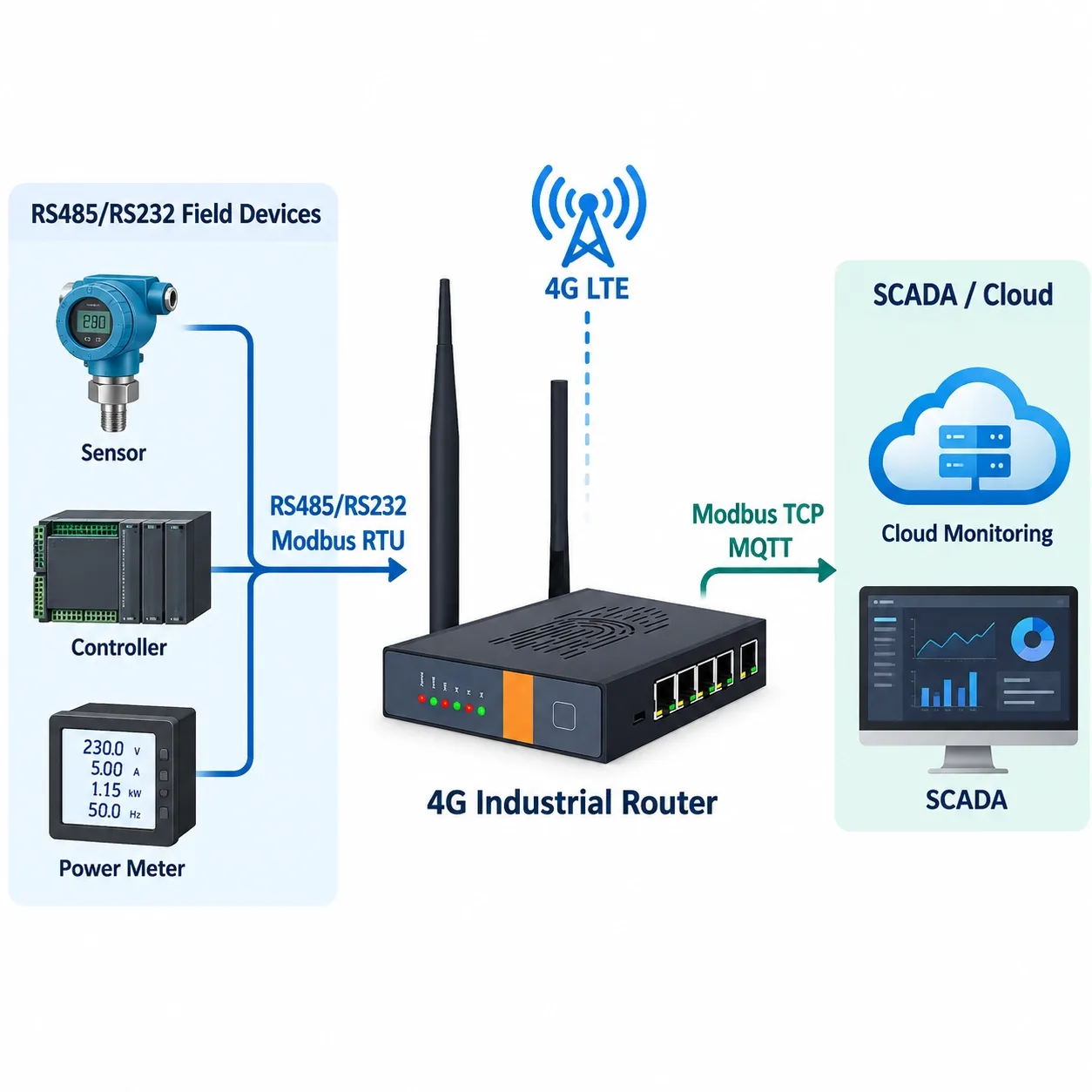
A typical industrial network architecture is:
PLC / Industrial PC / Ethernet Monitoring Terminal → JW-R545(H03) → Ethernet WAN or 4G LTE → Remote Monitoring Server
For compatible serial equipment, an alternative architecture is:
RS485 Modbus Device → JW-R545(H03) → Modbus TCP or Configured Data Transmission → Industrial Monitoring Platform
The correct communication path depends on the connected device, router configuration, and destination system.
2. Five-Port Ethernet Networking for Industrial Equipment
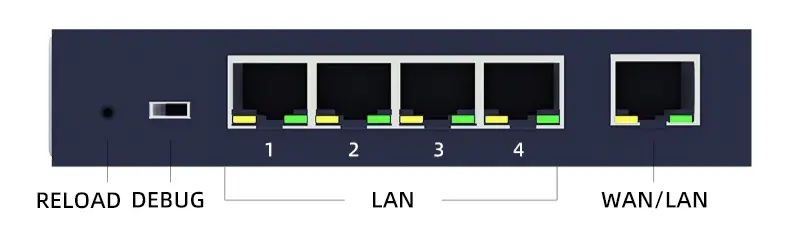
One of the main advantages of the JW-R545(H03) is its five RJ45 Ethernet interfaces.
Each port supports adaptive 10/100 Mbps Ethernet communication, allowing the router to serve as a central network connection point inside an industrial cabinet or monitoring installation.
Why Are Five Ethernet Ports Useful?
Many remote industrial installations contain multiple Ethernet-enabled devices, including:
PLCs and industrial controllers
Remote monitoring terminals
Industrial computers
Ethernet-based measurement instruments
Network-connected data acquisition equipment
An industrial 4G router with multiple Ethernet ports can simplify network architecture where several local devices require access to a common upstream connection.
The JW-R545(H03) also supports configurable WAN/LAN functions, allowing the network architecture to be adapted to project requirements.
Important: The available LAN port count depends on the WAN/LAN configuration. The five interfaces should not automatically be interpreted as five simultaneously available LAN ports in every configuration.
For systems requiring more Ethernet connections, an additional industrial Ethernet switch may be necessary.
3. 4G LTE, Ethernet WAN, and WiFi Network Failover
Remote industrial communication systems can be affected by wired-network interruptions, unstable cellular coverage, or local infrastructure problems.
The JW-R545(H03) supports multiple network access methods and configurable priority switching.
Multi-WAN Connectivity
Supported network access methods include:
4G LTE cellular network
Wired Ethernet WAN
2.4 GHz WiFi
For wired WAN connections, supported methods include DHCP, static IP configuration, and PPPoE.
Automatic Network Switching
Network priority can be configured so that an alternative available connection is used when the preferred network becomes unavailable.
For example, a remote industrial cabinet may use a wired Ethernet connection as its preferred communication path and 4G LTE as a backup.
This architecture can improve network availability for distributed installations.
However, actual recovery time and service continuity depend on network conditions, carrier availability, connection settings, and the connected applications. Automatic failover does not guarantee uninterrupted communication.
Remote Network Management
The router supports:
Network keep-alive functions
Scheduled reboot
Dual watchdog protection
Web-based parameter configuration
Firmware upgrade
Serial AT and network AT commands
These functions help system integrators maintain industrial networking equipment at remote sites.
4. RS485/RS232 and Modbus TCP/RTU Integration
Although Ethernet networking is a major feature, many industrial monitoring devices still communicate through serial interfaces.
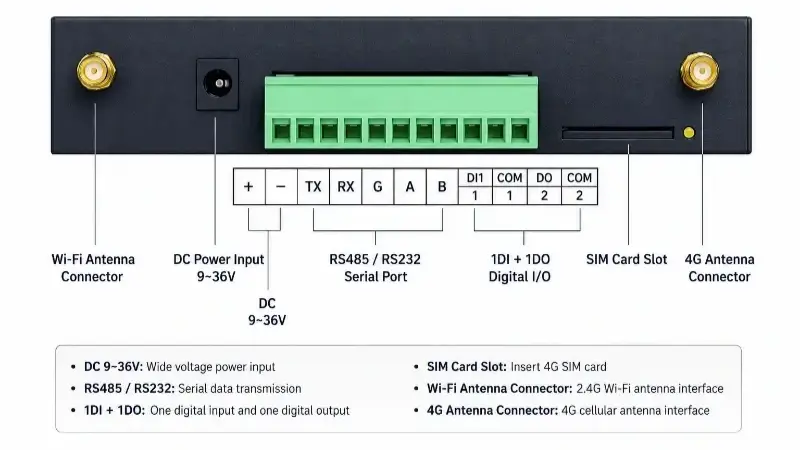
The JW-R545(H03) provides one RS232 or RS485 serial interface, depending on the selected configuration.
This allows compatible serial equipment to exchange data with network-based monitoring systems.
Supported Communication Functions
The router supports:
TCP Client and TCP Server
UDP Client and UDP Server
MQTT transparent transmission
Modbus RTU/TCP conversion
Modbus polling
Socket-to-Socket transparent transmission
The supported serial baud rate ranges from 1200 to 230400 bps.
Modbus Gateway Application
A typical Modbus architecture is:
RS485 Modbus RTU Meter → JW-R545(H03) → Ethernet or 4G Network → Modbus TCP Client
This can be useful for connecting compatible industrial meters, transmitters, and controllers to IP-based monitoring networks.
Before deployment, verify serial interface selection, register mapping, device addresses, communication parameters, and the capabilities of the receiving platform.
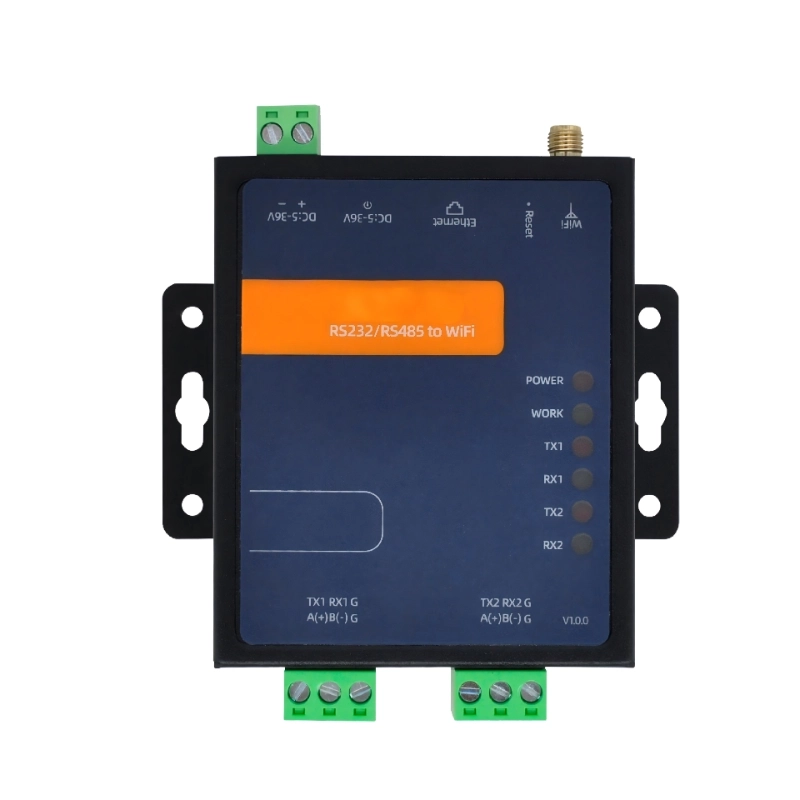
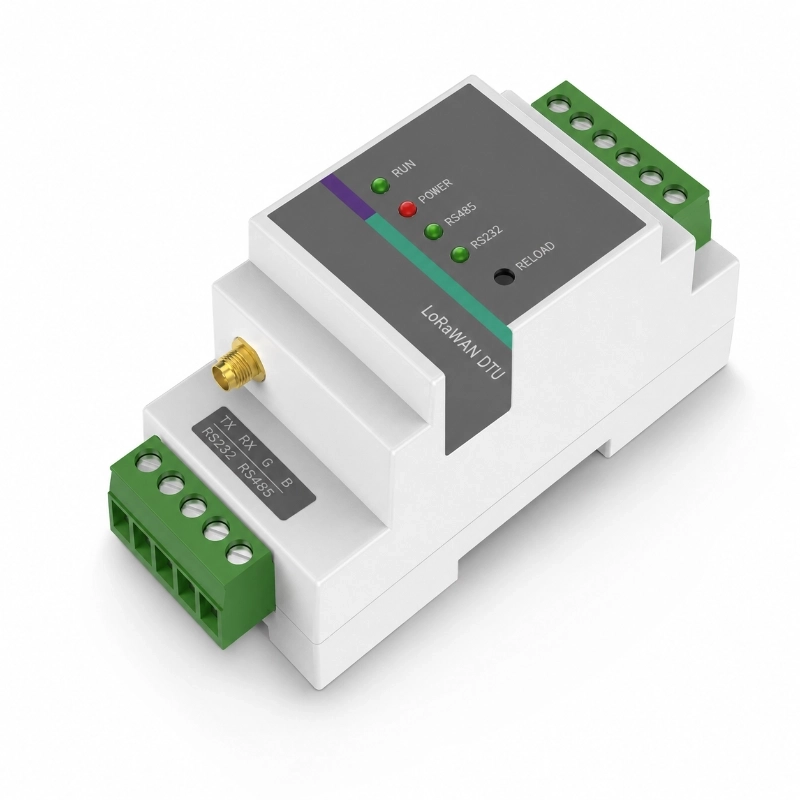
For projects focused exclusively on serial data transmission rather than multi-port routing, the 4G CAT1 DTU Serial Device Server may be another option.
5. Industrial Network Security and Traffic Management
Industrial connectivity requires more than simply establishing an internet connection.
Network administrators must consider traffic control, device access, and the separation of field equipment from external networks.
The JW-R545(H03) supports:
Network Function
Supported Capability
Firewall
iptables Filter rules
Network Address Translation
NAT rules
Static Routing
Supported
Static ARP
Supported
WAN Configuration
DHCP, Static IP, PPPoE
Time Synchronization
NTP Client and Server
Network Protocols
DHCP, DNS, TCP, UDP, HTTP, ICMP
Configuration
Web interface and AT commands
These functions provide a foundation for managing industrial network traffic.
For deployments connecting operational technology to external networks, appropriate firewall rules, strong administrator credentials, restricted management access, and additional security controls should be implemented.
VPN protocols, encryption features, and cybersecurity certifications should be confirmed separately if required by the project.
6. Industrial Applications
6.1 Industrial Automation and PLC Networking
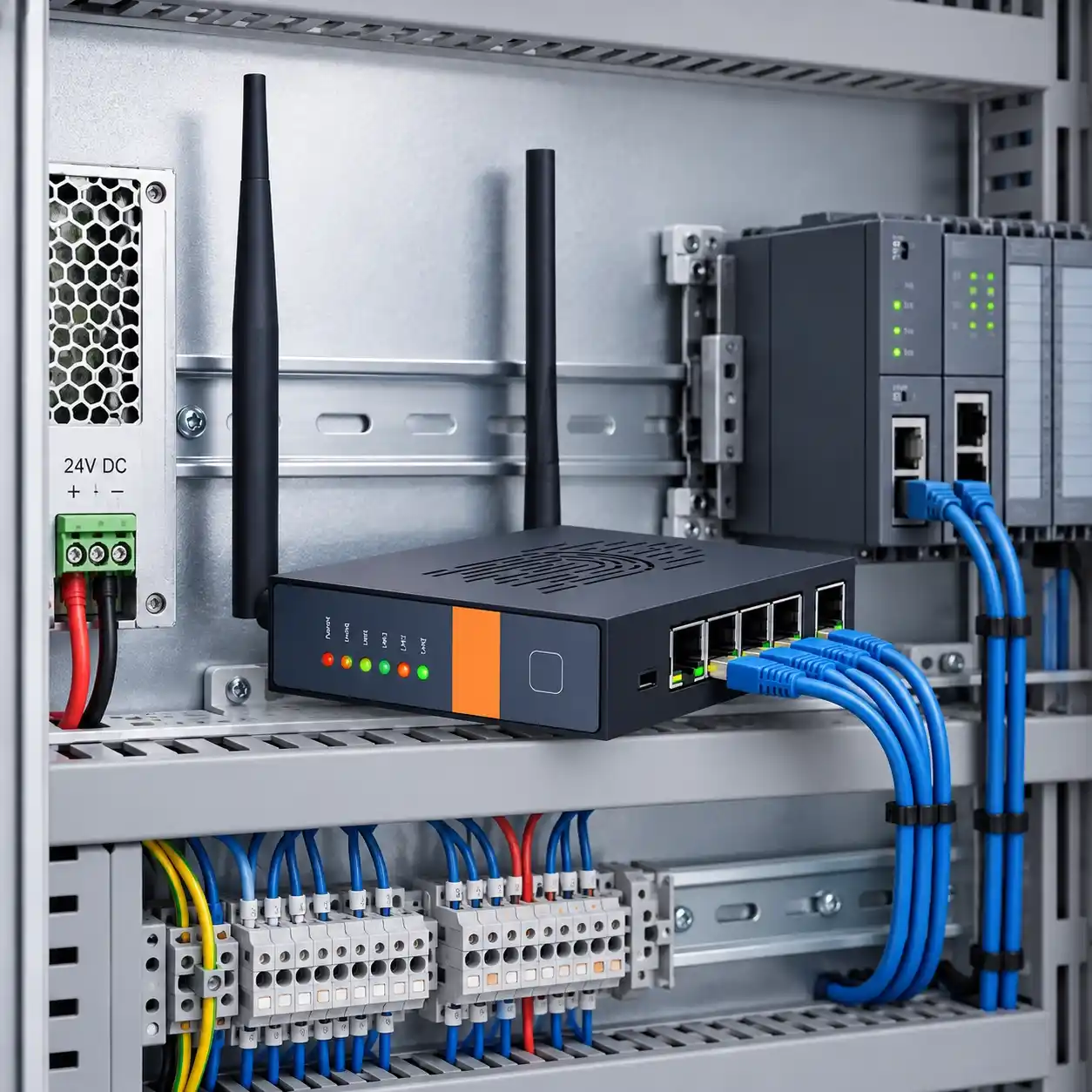
Industrial production and equipment monitoring systems often require connectivity between local controllers and centralized management infrastructure.
The JW-R545(H03) can connect compatible Ethernet devices to a local industrial network while providing an Ethernet WAN or cellular communication path.
Potential applications include distributed machine monitoring, industrial data collection, and remote equipment status reporting.
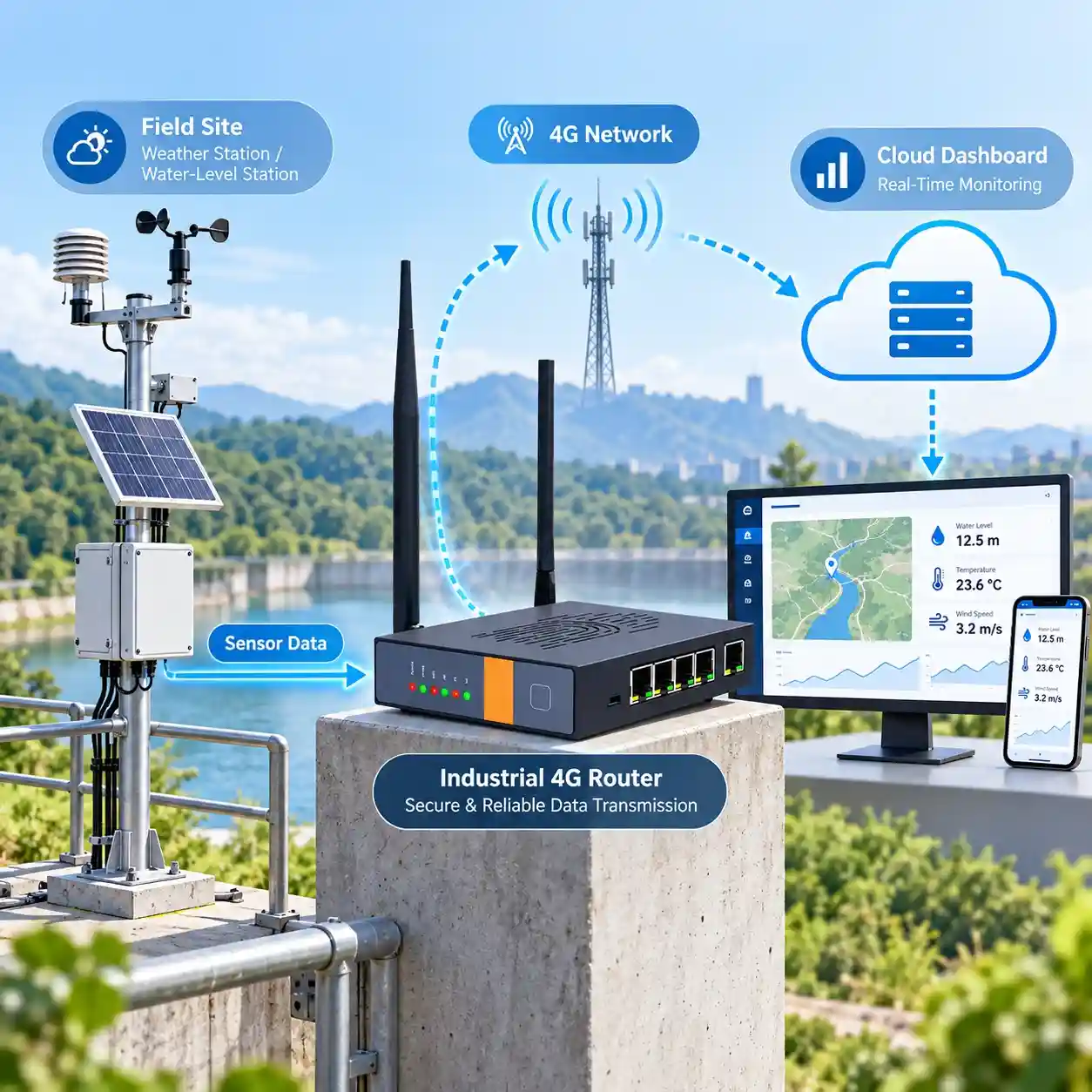
Environmental monitoring projects may include weather stations, water quality monitoring systems, hydrological instruments, and distributed field terminals.
Where monitoring equipment provides Ethernet or compatible serial communication, the router can help establish communication with remote data systems.
Its five-port Ethernet design can be useful when multiple IP-enabled monitoring devices are installed inside a single equipment enclosure.
Distributed energy installations can require remote communication between local monitoring terminals and centralized systems.
The router can provide connectivity for compatible Ethernet-based monitoring devices used in power distribution, energy metering, and remote infrastructure management.
The combination of Ethernet WAN access and cellular backup is particularly relevant where a secondary network connection is required.
6.4 Smart Agriculture and Irrigation Control
Greenhouse facilities and agricultural monitoring sites may include irrigation controllers, environmental monitoring equipment, and connected control systems.
The JW-R545(H03) can provide Ethernet and cellular networking for compatible local devices.
For larger agricultural deployments, network topology, power availability, and mobile carrier coverage should be evaluated before installation.
6.5 Transportation and Remote Infrastructure
Distributed roadside equipment and remote infrastructure monitoring systems may require network access where fixed communication infrastructure is limited.
The router provides cellular and wired networking options for compatible field equipment.
Actual suitability depends on communication bandwidth, installation conditions, and application requirements.
7. Technical Specifications
Parameter
Specification
Product
Industrial 4G Router Five Port
Model
JW-R545(H03)
Hardware Model Reference
HY R545
Cellular Network
4G LTE CAT4
Ethernet
5 × RJ45, 10/100 Mbps
WiFi
2.4 GHz, AP / STA / AP+STA
WAN Connection
DHCP / Static IP / PPPoE
WAN/LAN Switching
Supported
Network Backup
4G / WAN / WiFi priority switching
LTE FDD Bands
B1 / B3 / B5 / B8
LTE TDD Bands
B34 / B38 / B39 / B40 / B41
WCDMA Bands
B1 / B8
GSM Bands
900 / 1800 MHz
Serial Port
1 × RS485 or RS232
Baud Rate
1200–230400 bps
Data Bits
7/8
Stop Bits
1/2
Parity
None / Odd / Even
Digital I/O
1 × DI, 1 × DO
Network Protocols
DHCP / DNS / TCP / UDP / HTTP / ICMP
Transparent Transmission
TCP / UDP / MQTT / ALI
Modbus
RTU/TCP Conversion, Modbus Polling
Firewall
Filter / NAT Rules
NTP
Client and Server
Static Routing / ARP
Supported
Management
Web Configuration / AT Commands
Power Input
DC 9–36V
Average Current
150 mA at 12V
Maximum Current
200 mA at 12V
Operating Temperature
-35°C to +75°C
Operating Humidity
5%–95% RH
Dimensions
125 × 91.5 × 26.2 mm
Cellular compatibility notice: LTE frequency bands must be checked against the selected mobile operator and deployment country. The listed bands should not be interpreted as universal compatibility with every LTE network.
8. Industrial 4G Router vs 4G DTU vs WiFi Serial Device Server
Different communication devices serve different integration requirements.
Equipment
Primary Purpose
Suitable Situation
JW-R545(H03) Industrial 4G Router
Multi-port Ethernet networking with cellular access
9. Selection Guide: How to Choose the Right Industrial LTE Router
Before selecting an industrial 4G LTE router, consider five important questions.
How many Ethernet devices must be connected?
Identify the number of local Ethernet devices and determine whether the intended WAN/LAN configuration provides enough available LAN ports.
Which cellular bands are required?
Confirm carrier frequency bands and the regional cellular module configuration before ordering.
Is redundant internet connectivity necessary?
Determine whether the application requires automatic switching between Ethernet WAN, WiFi, and cellular networks.
Are serial devices included?
Confirm whether RS232 or RS485 is required and whether Modbus conversion or transparent communication will be used.
What are the installation conditions?
Review power supply requirements, enclosure design, ventilation, operating temperature, and expected network availability.
These considerations help avoid selecting an industrial router based solely on the number of Ethernet ports or advertised cellular technology.
10. Industrial Networking Support from JW-IoT
JW-IoT provides industrial communication devices and monitoring equipment for projects requiring reliable connections between field instruments, controllers, and remote management systems.
The JW-R545(H03) is particularly suitable for projects requiring multiple Ethernet connections, cellular network access, configurable communication backup, and serial-device integration.
For project selection, contact JW-IoT with the following information:
Deployment country and mobile operator
Number of Ethernet devices
Required RS232 or RS485 interface
Modbus or MQTT communication requirements
Primary and backup network configuration
Power supply and installation conditions
Our team can review the communication requirements and help identify an appropriate networking configuration.
A five-port industrial 4G router combines cellular connectivity with five Ethernet interfaces, allowing compatible local network devices to communicate through a shared industrial routing device.
Q
2. Does the JW-R545(H03) support 4G LTE CAT4?
A
Yes. The published product specification identifies LTE CAT4 support. Actual data transmission speed depends on network conditions and carrier capability.
Q
3. Can the router automatically switch from Ethernet to 4G?
A
Yes. It supports configurable network priority and automatic switching between supported network connections.
Q
4. Does it support Modbus TCP and Modbus RTU?
A
Yes. Modbus RTU/TCP conversion and Modbus polling are supported for compatible industrial communication applications.
Q
5. Does the router have five LAN ports?
A
It has five RJ45 Ethernet ports with configurable WAN/LAN functions. The number of available LAN ports depends on the selected configuration.
Q
6. Can the router connect to an MQTT platform?
A
The product supports MQTT transparent transmission. Specific broker connectivity, authentication methods, and payload requirements should be checked during system integration.
Q
7. Is this industrial 4G router suitable for outdoor installation?
A
The router supports a wide operating temperature range, but outdoor deployment requires an appropriately selected protective enclosure. Outdoor enclosure protection ratings are not specified for the router itself.
Q
8. Is the JW-R545(H03) suitable for use in the USA or Europe?
A
Suitability depends on the LTE bands supported by the selected hardware variant and the target mobile operator. Confirm regional frequency compatibility and applicable certification requirements before deployment.
 +86 13520127780
 info@jingelway.com