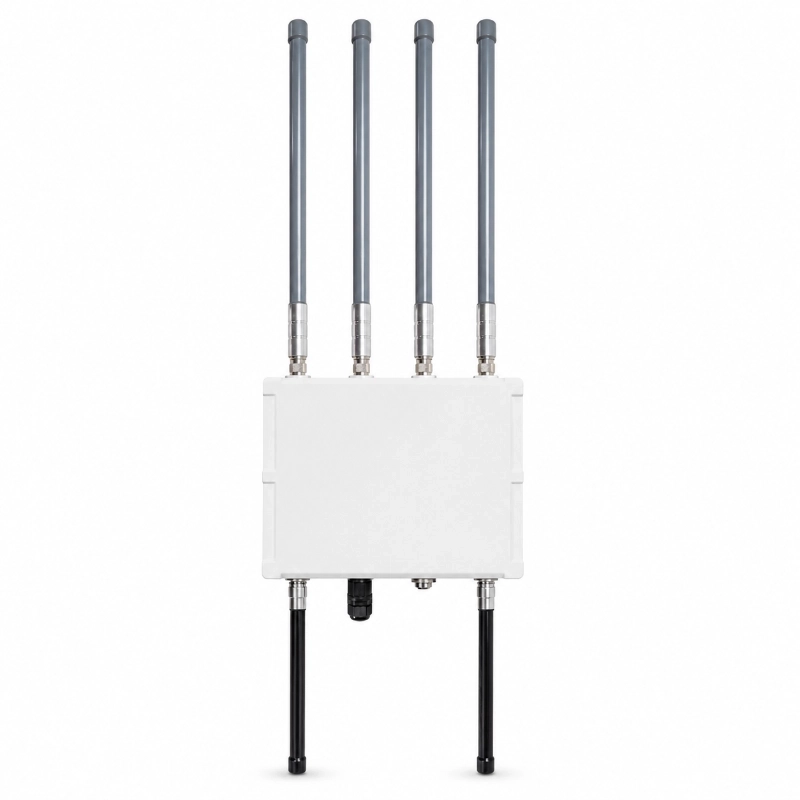
Product Overview
JW-
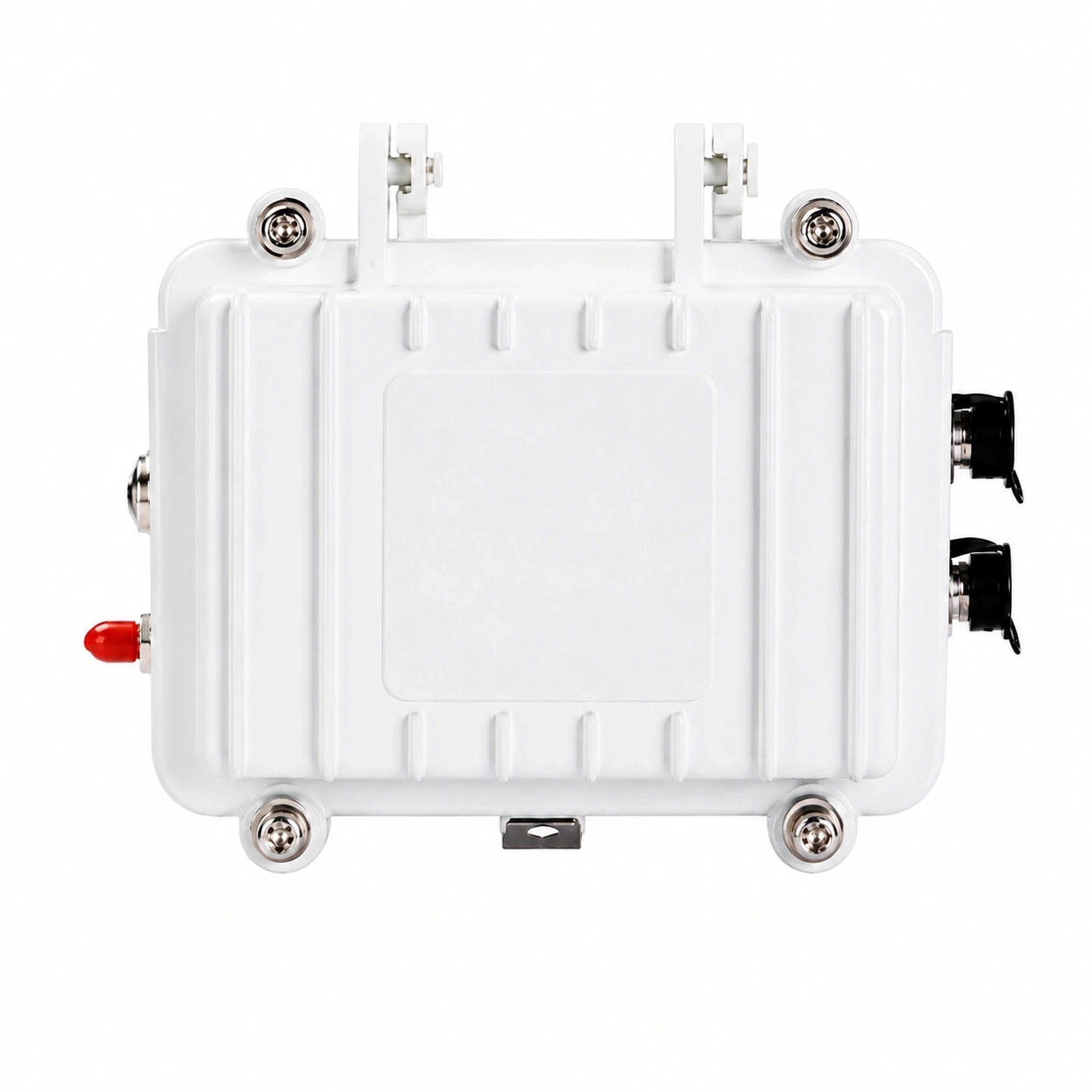
The device converts wired serial communication from field sensors, meters and industrial equipment into wireless LoRaWAN data transmission.
It is designed for remote monitoring applications where:
Power supply is limited
Cable installation is difficult
Long-distance communication is required
Multiple distributed sensors need centralized monitoring
Typical applications include:
Smart agriculture monitoring
Water resource monitoring
Weather stations
Industrial telemetry
Environmental monitoring
Smart city infrastructure
The terminal supports:
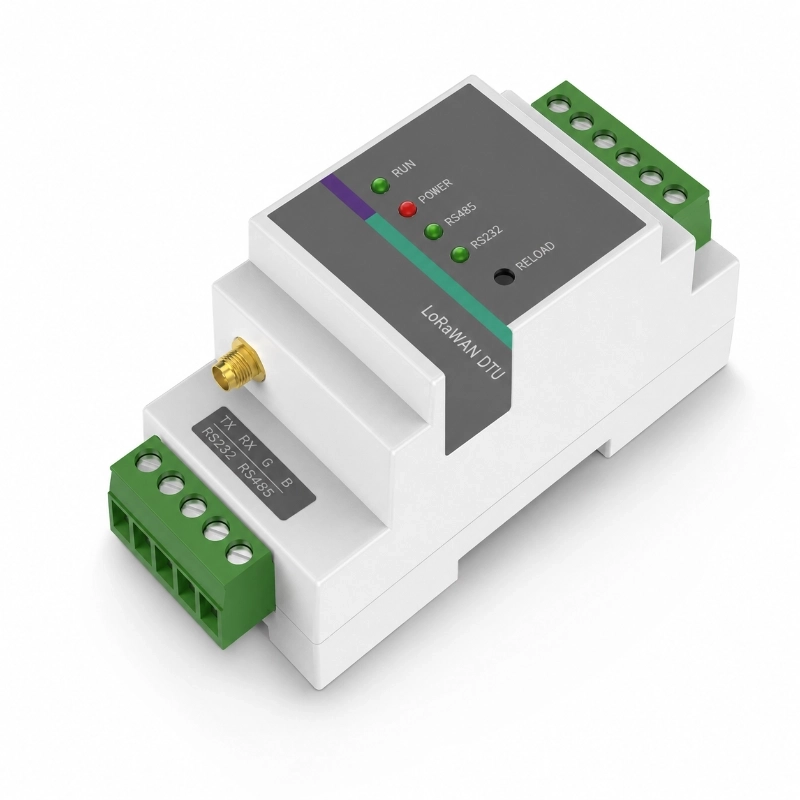
RS485 / RS232 serial interfaces
Modbus-RTU communication
LoRaWAN 1.0.4 protocol
OTAA and ABP joining
Class A operation
Low-power battery operation
Cloud platform integration
Related communication products:
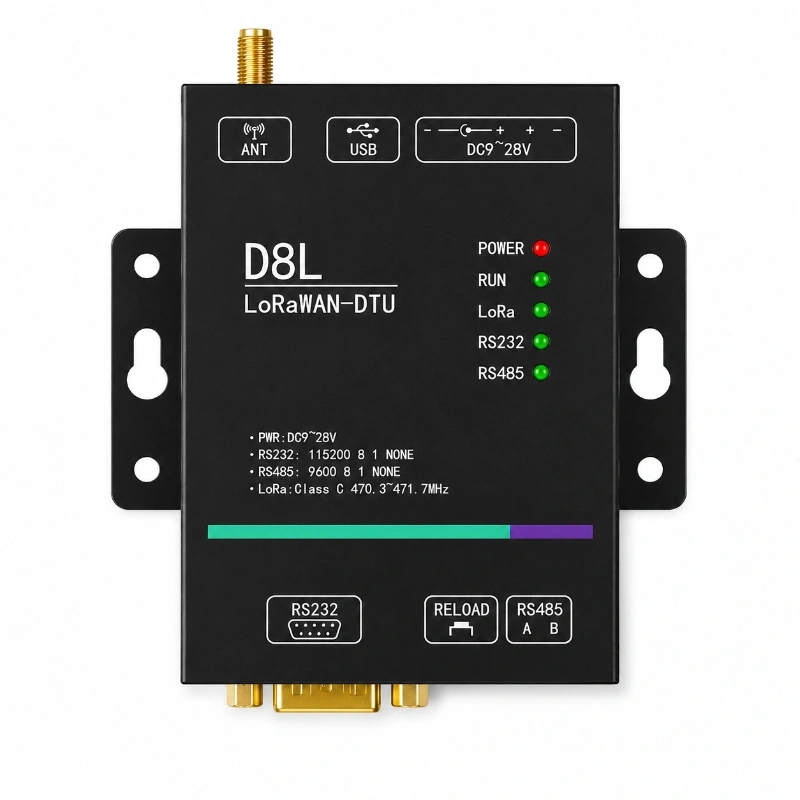
Industrial LoRaWAN DTU D8L Series
Industrial LoRaWAN RS485 Data Logger
What Is a Battery Powered LoRaWAN DTU?
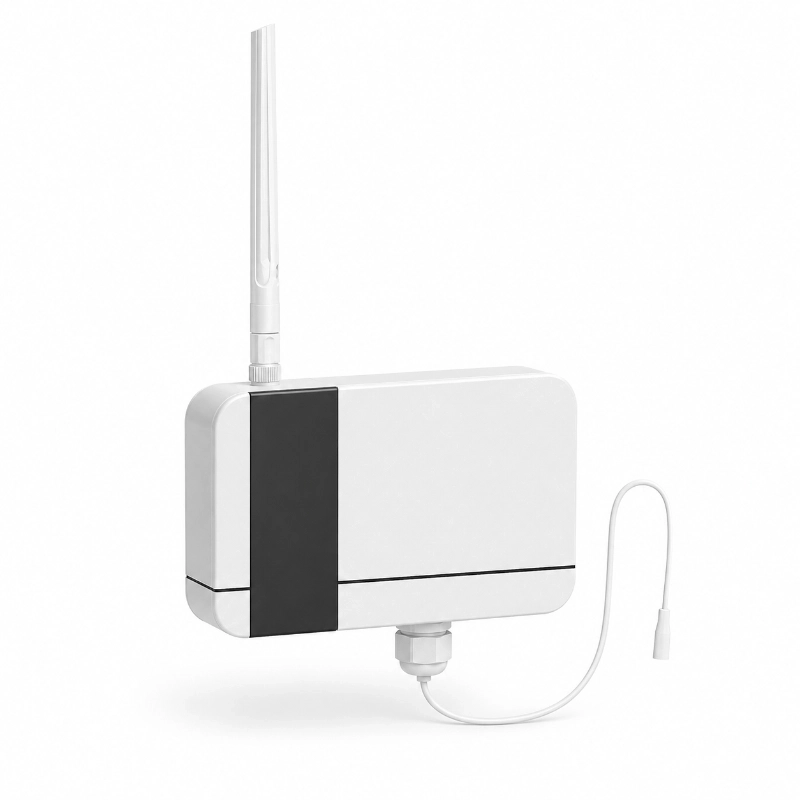
A LoRaWAN DTU (Data Transmission Unit) is a communication device that connects traditional serial devices to a LoRaWAN wireless network.
Many industrial sensors already use:
communication interfaces.
However, these sensors usually require wired communication cables.
A LoRaWAN DTU solves this problem by converting serial data into wireless IoT communication.
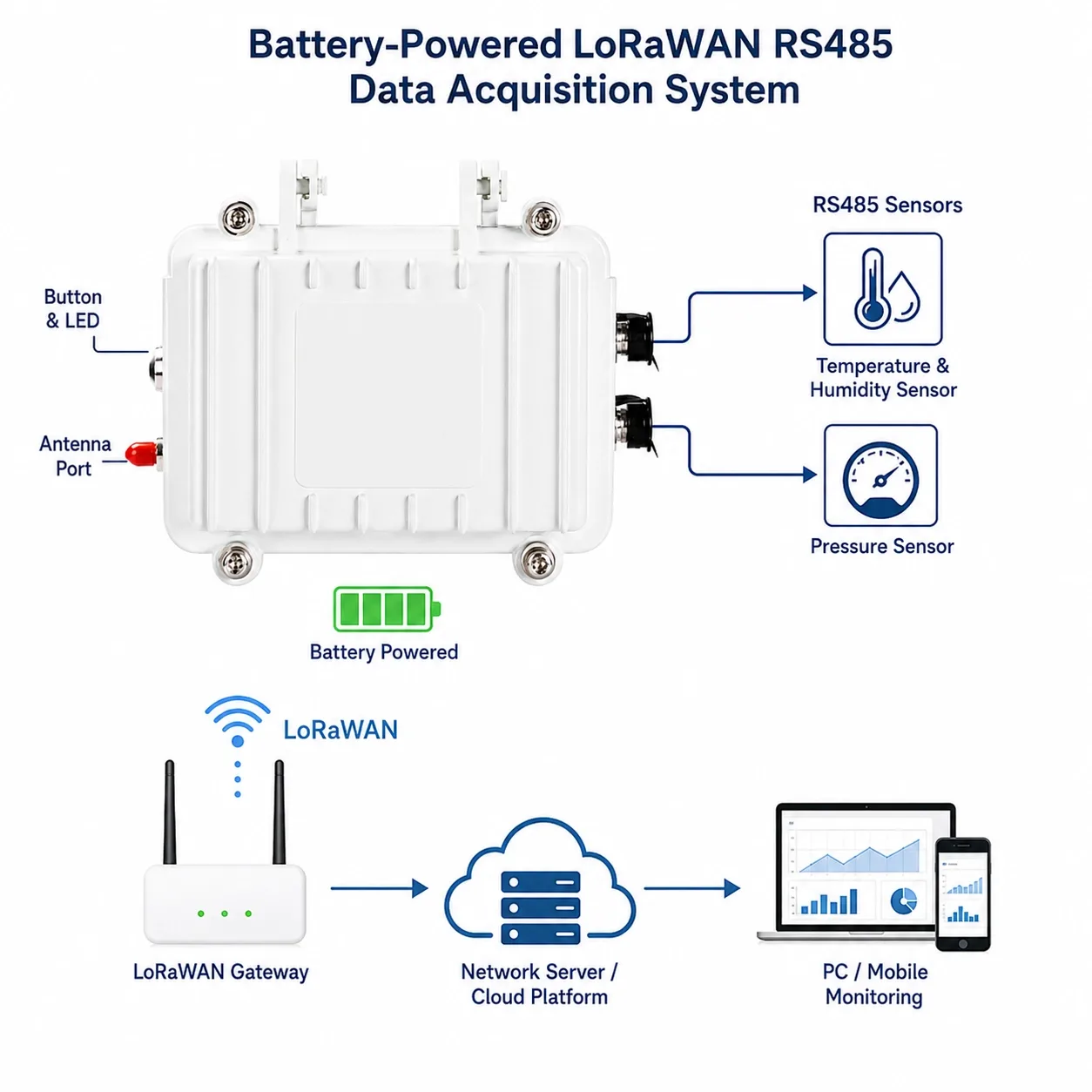
The basic architecture is:
RS485 / RS232 Sensor

↓

LoRaWAN DTU

↓

LoRaWAN Gateway

↓

IoT Cloud Platform

↓

Remote Monitoring System
This allows existing sensors to become part of a wireless IoT monitoring network without replacing the original equipment.
Technical Specification
Parameter D10L D10P
Transmit Power
-1~22dBm
-1~27dBm
Frequency Range
EU433, CN470, CN779, EU868, AS923, AU915, KR920
Bandwidth
125kHz Fixed
Spreading Factor
SF7~SF12 adjustable (6 levels)
Receiver Sensitivity
-135dBm @ SF12 BW125kHz
RS485 Isolation
Full, 15KV ESD, Max 16 connections
RS485 Baud Rate
2400–57600bps, default 9600bps
DC12V Output
±5%, max total 100mA, active only during collection
Battery
ER34615M 14000mAh, Sleep current ≤15µA
Dimensions
174 × 160 × 75 mm
Weight
~1.5kg
Waterproof Rating
IP67
Operating Temp
-40~85°C
Operating Humidity
0~95% (non-condensing)
Mounting
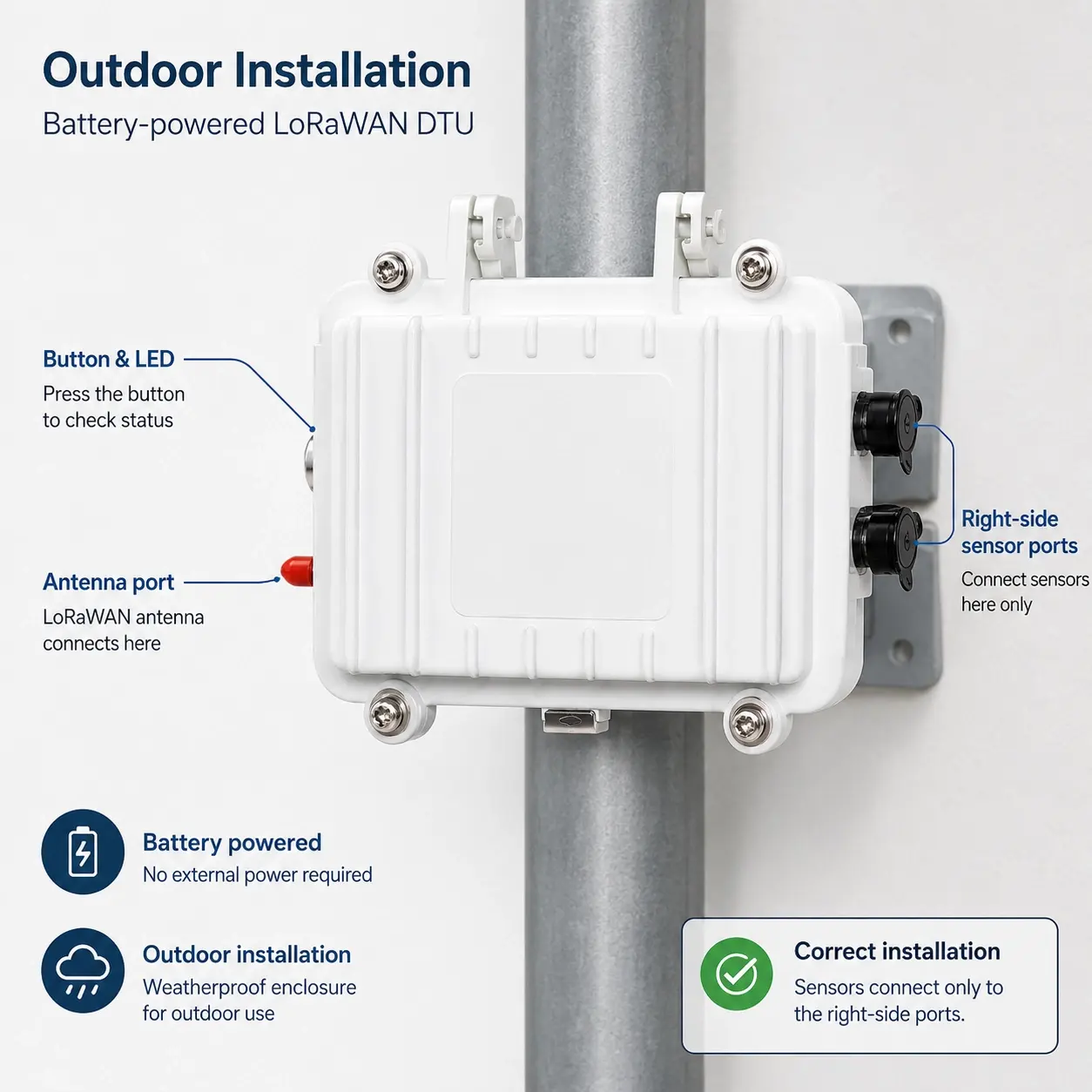
Wall, pole, or floor installation
Material
ABS+PC, aviation waterproof connectors
How Does the LoRaWAN RS485 Terminal Work?
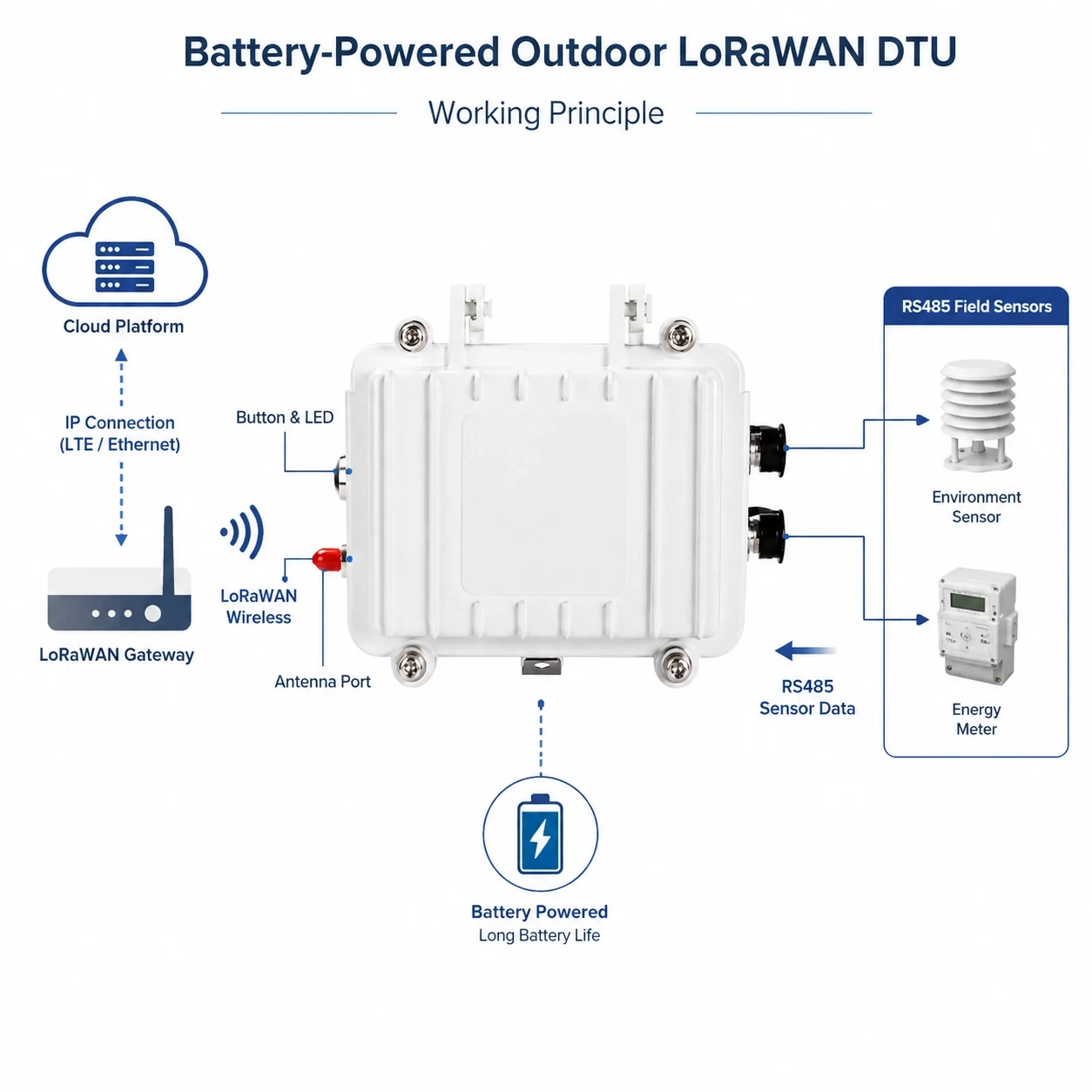
The working process includes:
1. Sensor Data Collection
The DTU collects data from connected RS485 or RS232 devices.
Examples:
Water level sensors
Weather sensors
Soil sensors
Energy meters
Industrial instruments
2. Data Processing
The internal controller processes serial data according to configured rules.
Supported functions include:
Timed acquisition
Command-based polling
Heartbeat packets
Custom communication tasks
3. LoRaWAN Wireless Transmission
Processed data is transmitted through LoRaWAN communication.
The data can then be forwarded through a LoRaWAN gateway to:
Cloud platforms
Monitoring software
IoT applications
Application Scenarios
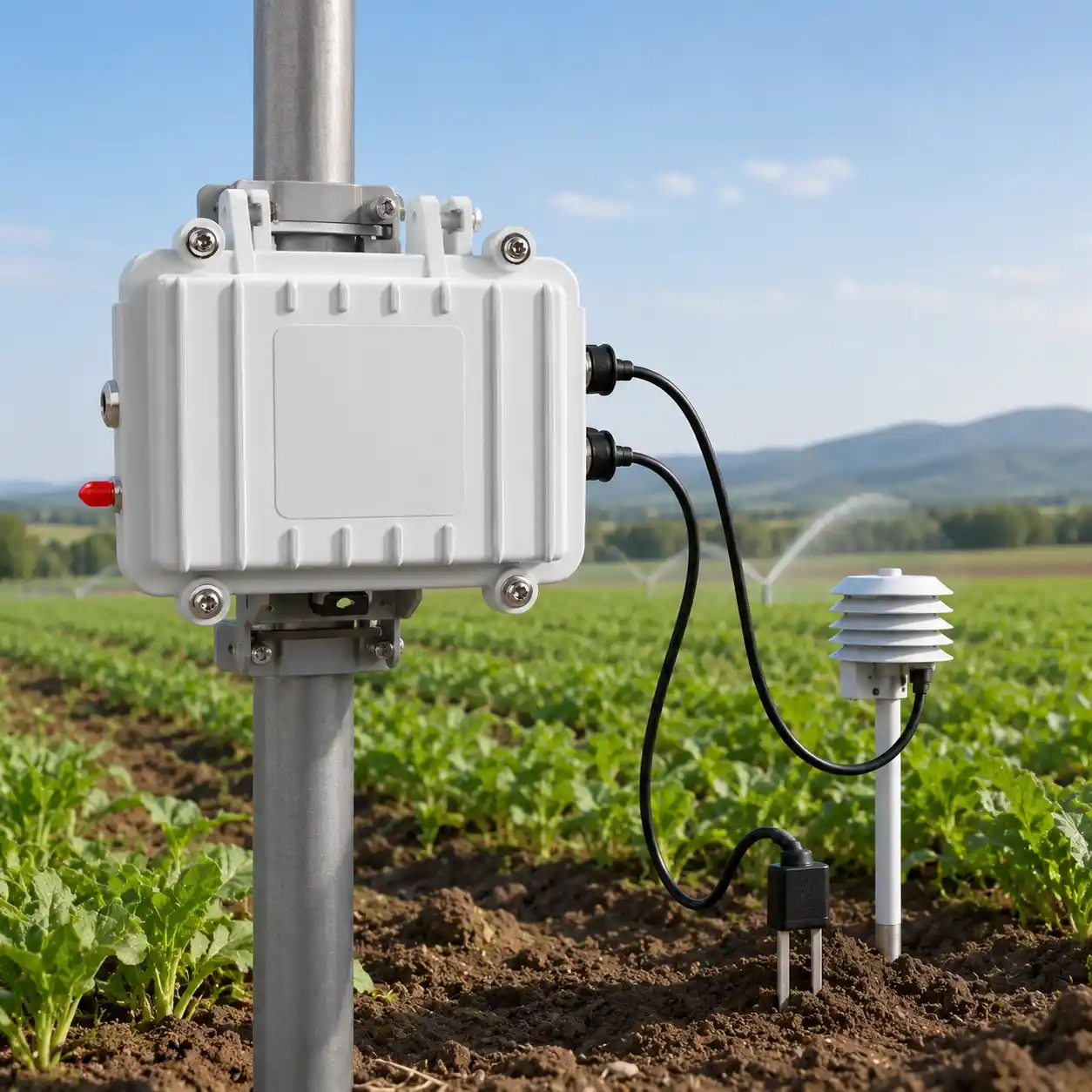
Smart Agriculture Monitoring
Large farms often require distributed monitoring points.
Examples:
Soil moisture sensors
Weather stations
Irrigation monitoring
Greenhouse sensors
A battery-powered LoRaWAN DTU allows sensors to be deployed without power cables.
Water and Environmental Monitoring
Remote water monitoring sites often have limited infrastructure.
Applications:
River level monitoring
Rainfall monitoring
Water quality monitoring
Hydrological stations
The DTU transfers field sensor data wirelessly to the monitoring center.
Industrial IoT Data Acquisition
Industrial facilities may contain many RS485 devices.
The LoRaWAN DTU can connect:
Sensors
Meters
Controllers
Monitoring instruments
Applications:
Factory monitoring
Energy management
Equipment status monitoring
Smart City Infrastructure Monitoring
Smart city projects require many distributed sensing points.
The terminal can support:
Environmental monitoring
Public infrastructure monitoring
Remote equipment monitoring
Battery LoRaWAN DTU vs Traditional Wired Data Transmission
Wired RS485 System Battery LoRaWAN DTU
Cable Requirement
High
Low
Installation Cost
Higher
Lower
Remote Deployment
Limited
Excellent
Power Requirement
External power
Battery operation
Expansion
Difficult
Easy
Battery LoRaWAN DTU Industrial LoRaWAN DTU
Power
Battery
External power
Application
Remote monitoring
Industrial equipment
Maintenance
Low
Medium
Sampling Frequency
Low/Medium
High
Deployment
Outdoor distributed sites
Factory environments
Integration Architecture
Architecture:
RS485 Sensor

↓

Battery LoRaWAN DTU

↓

LoRaWAN Gateway

↓

Network Server

↓

Cloud Platform

↓

User Application
Installation Guidelines
Select Suitable Communication Location
Consider:
LoRaWAN coverage
Antenna position
Environmental conditions
Reduce Communication Interference
Avoid installation near:
Large metal structures
Strong electromagnetic interference sources
Configure Data Collection Parameters
Before deployment configure:
Sampling interval
Upload interval
Serial parameters
Modbus commands
How to Select a LoRaWAN DTU?
Before selecting a model:
1. Interface Type
Confirm:
2. Power Requirement
Choose:
Battery powered
External power
3. Communication Distance
Evaluate:
Site size
Gateway location
Network coverage
4. Data Frequency
Low-frequency monitoring:
Battery DTU
High-frequency industrial acquisition:
Industrial DTU
Request LoRaWAN DTU Solution
JW-IoT provides wireless communication solutions for:
System integrators
IoT solution providers
Environmental monitoring companies
Smart agriculture companies
Please provide:
Connected sensor type
Communication distance
Sampling frequency
LoRaWAN region
Quantity requirement
Contact:
https://www.jw-iot.com/contact-us
 +86 13520127780
  info@jingelway.com