+86 13520127780
  info@jingelway.com








What Should Be Monitored in a Vertical Farm?
Release time: 2026-07-13
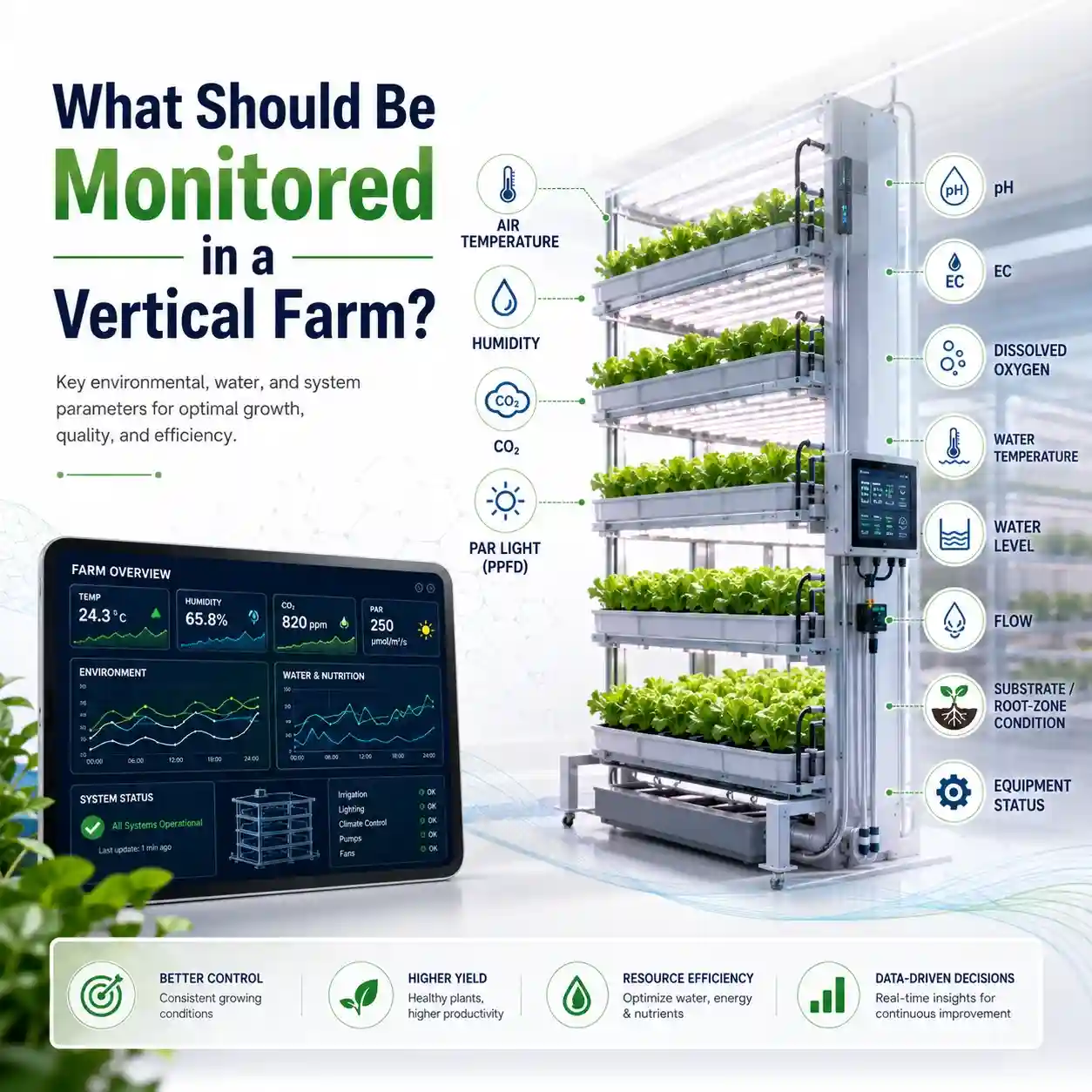
Vertical farms rely on controlled lighting, irrigation, ventilation and nutrient delivery. However, conditions can still vary between shelves, growing zones and crop stages.
A reliable vertical farming IoT solution helps operators monitor these changes in real time, detect equipment problems earlier and maintain more consistent crop conditions.
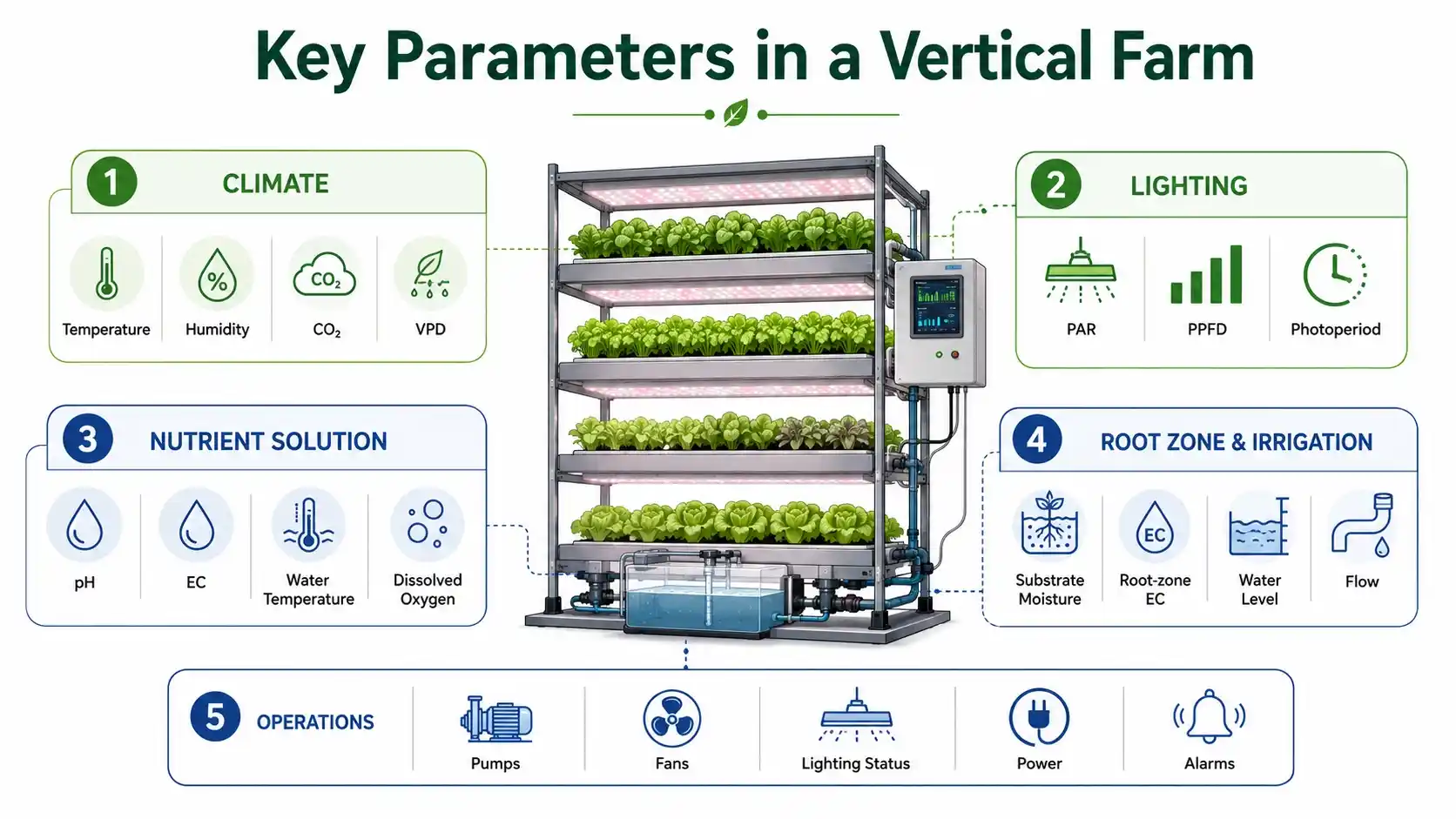
The most important parameters to monitor in a vertical farm include:
- Air temperature and humidity
- CO₂ concentration
- PAR, PPFD and photoperiod
- Nutrient solution pH and EC
- Water temperature and dissolved oxygen
- Water level and irrigation flow
- Substrate moisture and root-zone EC
- Pump, fan, lighting and dosing status
Why Is Vertical Farm Monitoring Important?
Vertical farms depend heavily on mechanical and electrical systems. If a pump, fan, dosing unit or lighting circuit fails, crop conditions may change quickly.
Continuous monitoring helps growers:
- Maintain stable growing conditions
- Detect abnormal changes earlier
- Reduce manual inspection
- Improve irrigation and nutrient management
- Compare different shelves and growing zones
- Receive alarms when equipment stops working
- Record data for future crop optimization
The goal is not simply to collect data. The goal is to turn sensor readings into faster and more reliable decisions.
1. Air Temperature and Humidity
Temperature and humidity directly affect plant growth, transpiration and disease risk.
In a multi-layer farm, upper shelves may be warmer because of lighting, while lower or denser crop areas may retain more humidity. One room-level sensor is often not enough.
Sensors should be placed near representative crop canopies and at different rack heights. They should not be installed directly beside lights, doors, air outlets or irrigation nozzles.
Temperature and humidity data can also be used to calculate vapor pressure deficit, or VPD, which provides a more useful indication of plant transpiration conditions.
For projects that also include climate control, the design principles used in a greenhouse monitoring system can also be applied to indoor growing environments.
2. Carbon Dioxide
Plants consume CO₂ during the lighting period. In enclosed growing rooms, CO₂ levels may fall if ventilation or supplementation is not properly managed.
CO₂ monitoring helps operators:
- Control CO₂ injection
- Avoid unnecessary supplementation
- Compare conditions between zones
- Coordinate ventilation and lighting
- Detect poor air distribution
CO₂ sensors should be installed near crop level but away from direct gas outlets and strong airflow.
3. PAR, PPFD and Photoperiod
Lighting is one of the most important inputs in vertical farming.
Lux meters are designed for human vision, while PAR and PPFD are more relevant to plant photosynthesis. A photosynthetically active radiation sensor can help measure how much plant-usable light reaches the crop canopy.
Monitoring should include:
- PAR and PPFD
- Light uniformity between shelves
- Lamp operating status
- Photoperiod
- Daily light integral
This helps identify weak lighting zones, aging fixtures, incorrect lamp height and lighting schedule faults.
4. Nutrient Solution pH and EC
In hydroponic vertical farms, pH and EC are two of the most important nutrient-management parameters.
pH affects nutrient availability, while EC provides an indication of the total concentration of dissolved ions.
Changes may occur because of:
- Plant water and nutrient uptake
- Evaporation
- Fertilizer dosing
- Freshwater addition
- Leakage
- Poor mixing
A complete hydroponics monitoring system can monitor pH and EC together with water temperature, dissolved oxygen, level and flow.
EC cannot identify individual nutrients, so it should be used as an operational indicator rather than a complete nutrient analysis.
5. Water Temperature and Dissolved Oxygen
Water temperature affects root activity and dissolved oxygen availability.
As water temperature rises, dissolved oxygen may decrease. This can become a problem in deep-water culture and recirculating hydroponic systems.
Dissolved oxygen monitoring can help detect:
- Failed aeration equipment
- Poor circulation
- High water temperature
- Blocked air lines
- Increasing root density
Water temperature and dissolved oxygen should therefore be evaluated together.
6. Water Level and Irrigation Flow
A running pump does not always mean that crops are receiving enough water.
Blocked pipes, closed valves, air locks and pump wear can reduce irrigation performance.
Water-level and flow monitoring can detect:
- Low nutrient tank levels
- Overflow risk
- Pipe leakage
- Blocked irrigation lines
- Pump performance loss
- Unexpected water consumption
These measurements can also support automatic refill and low-level pump protection.
7. Substrate Moisture and Root-Zone EC
Not all vertical farms use bare-root hydroponics. Many use coco coir, rock wool or other substrates.
In these systems, tank measurements may not accurately reflect conditions around the roots.
A substrate EC sensor can help monitor salinity close to the root zone. A substrate moisture EC sensor can combine moisture, temperature and EC measurements.
These readings help growers adjust:
- Irrigation timing
- Irrigation duration
- Nutrient concentration
- Drainage management
- Flushing schedules
Sensors should be installed in the active root zone rather than directly beside the irrigation emitter.
8. Equipment Status
Vertical farm monitoring should also include the equipment that maintains the growing environment.
Important equipment includes:
- Irrigation pumps
- Nutrient dosing pumps
- Fans
- Air-conditioning units
- Dehumidifiers
- Valves
- Lighting circuits
- Aeration systems
- IoT gateways and controllers
Combining sensor readings with equipment status makes alarms more useful.
For example, a high-humidity alarm should ideally show whether the circulation fan or dehumidifier has stopped.
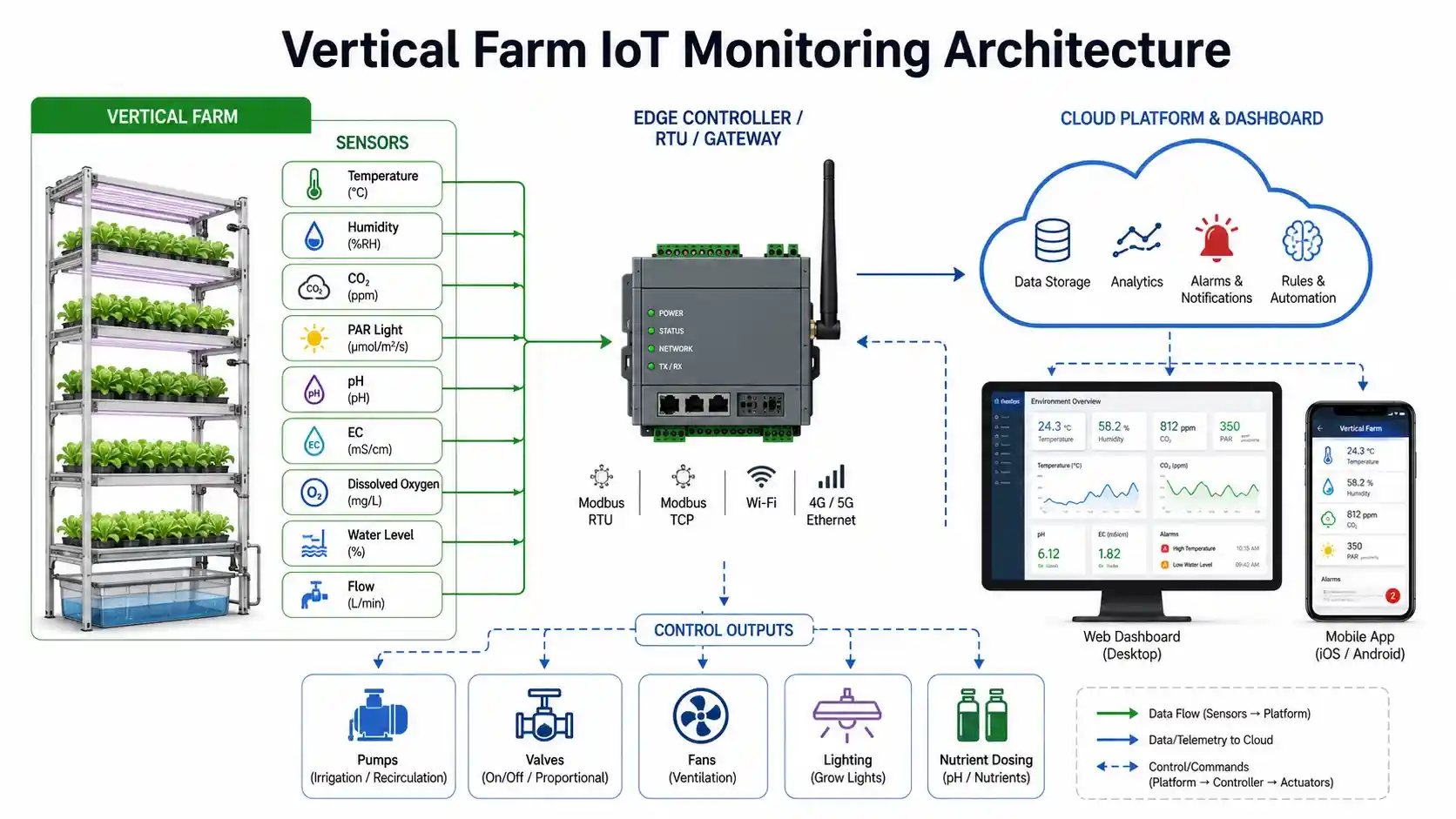
Recommended Vertical Farm Monitoring Architecture
A typical vertical farm monitoring system includes four layers.
1. Sensing Layer
This includes temperature, humidity, CO₂, PAR, pH, EC, dissolved oxygen, water level, flow and substrate sensors.
2. Communication Layer
Sensors connect to a controller, RTU, data logger or gateway through methods such as:
- RS485 Modbus
- Analog signals
- LoRaWAN
- Ethernet
- Wi-Fi
- 4G
- MQTT
- API integration
3. Platform Layer
The platform provides:
- Real-time dashboards
- Historical trends
- Multi-zone comparison
- Alarm notifications
- Data export
- Remote access
- API integration
4. Control Layer
Monitoring data can be connected to:
- Pumps
- Valves
- Fans
- Lighting
- CO₂ equipment
- Nutrient dosing systems
- Dehumidifiers
JW-IoT’s smart agriculture IoT solutions combine sensors, communication devices, cloud platforms and control equipment for vertical farming, hydroponics and controlled-environment agriculture.
Which Parameters Should Be Prioritized?
For a basic leafy-green vertical farm, the first priorities are usually:
- Temperature and humidity
- PAR and lighting schedule
- Nutrient solution pH and EC
- Water temperature
- Water level and flow
- Pump and power status
More advanced systems may also require CO₂, VPD, dissolved oxygen, root-zone EC, energy monitoring and automated nutrient control.
The final configuration should depend on:
- Crop type
- Growing method
- Number of racks
- Irrigation design
- Lighting system
- Automation requirements
- Communication infrastructure
Common Monitoring Mistakes
1. Using Too Few Sensors
One sensor cannot represent every shelf in a large vertical farm.
2. Poor Sensor Placement
Sensors placed beside lights, vents or nutrient outlets may give unrepresentative readings.
3. Monitoring the Tank but Not the Roots
Tank pH and EC may appear normal while root-zone moisture or salinity becomes unsuitable.
4. Collecting Data Without Alarms
A dashboard is not enough if nobody is watching it continuously.
5. Automating Without Safety Limits
Pumps and dosing systems should include maximum operating times, delay periods and manual override.
6. Ignoring Calibration
pH, EC and dissolved oxygen sensors require regular cleaning and calibration.
How JW-IoT Supports Vertical Farm Monitoring
JW-IoT provides sensor-to-platform solutions for vertical farms, hydroponic systems, greenhouses and other controlled-environment agriculture projects.
A complete system can integrate:
- Air temperature and humidity sensors
- CO₂ sensors
- PAR sensors
- Water pH and EC sensors
- Dissolved oxygen sensors
- Water temperature, level and flow sensors
- Substrate moisture and EC sensors
- RS485 Modbus devices
- LoRaWAN or 4G gateways
- Cloud dashboards and alarms
- Irrigation and environmental controls
The JW-IoT vertical farming monitoring system can be configured according to the crop type, growing method, number of zones and required level of automation.
Conclusion
A vertical farm should monitor more than temperature and humidity.
The most effective systems combine climate, lighting, nutrient solution, root-zone, irrigation and equipment data in one platform.
At a minimum, most farms should monitor:
- Temperature and humidity
- PAR and lighting schedule
- pH and EC
- Water temperature
- Water level and flow
- Pump and equipment status
Advanced farms should also consider CO₂, VPD, dissolved oxygen, root-zone conditions and energy use.
Reliable data from the right locations helps growers maintain stable conditions, detect failures earlier and improve the consistency of crop production.
To plan a suitable sensor, gateway and monitoring platform configuration, contact JW-IoT with your crop type, growing method, number of racks and required parameters.
Frequently Asked Questions
1. What are the most important vertical farm monitoring parameters?
The main parameters are temperature, humidity, CO₂, PAR, pH, EC, water temperature, dissolved oxygen, water level, irrigation flow and equipment status.
2. How many sensors does a vertical farm need?
The number depends on the farm size, rack height, airflow, crop type and irrigation zones. Large facilities usually require sensors at several shelf levels.
3. Why should vertical farms monitor PAR instead of lux?
PAR and PPFD measure plant-usable light, while lux is based on human visual sensitivity.
4. Are pH and EC enough for nutrient monitoring?
They are essential operational indicators, but EC does not show the concentration of each individual nutrient.
5. Does every vertical farm need dissolved oxygen monitoring?
It is especially important in deep-water culture and recirculating hydroponic systems.
6. Can vertical farm monitoring be automated?
Yes. Sensor data can control pumps, valves, lights, fans, CO₂ systems and nutrient dosing equipment.
7. Can JW-IoT sensors connect to an existing controller?
JW-IoT devices can support interfaces such as RS485 Modbus, analog signals, LoRaWAN, 4G, MQTT and API integration.
8. Does JW-IoT provide complete vertical farm monitoring systems?
Yes. JW-IoT can provide sensors, gateways, data loggers, cloud-platform integration, alarms and control components.