+86 13520127780
  info@jingelway.com







Are IoT Rain Gauges Accurate Enough for Agriculture?
Release time: 2026-07-08
IoT rain gauges can help with:
* Irrigation scheduling
* Rainfall-triggered irrigation suspension
* Drainage management
* Orchard monitoring
* Greenhouse outdoor-weather verification
* Crop-disease risk monitoring
* Farm fertilizer application planning
* Pesticide application planning
* Farm microclimate recording
Table of Contents
Most farms and agricultural enterprises don’ t need laboratory-grade rain gauges. Instead, what you’ ll need is dependable measurement while installed outside. Low power usage, wireless communication, easy maintenance, historical rainfall records, alarms, and compatibility with other sensors are also important.
Rainfall can change a lot over just a few kilometers. One properly installed rain gauge on-site could provide more beneficial information for agricultural irrigation than what you’ d receive from a public weather station miles away.
If you farm a large area with hills or varied terrain, you may need more than one rainfall monitoring station.
Are IoT Rain Gauges Accurate for Weather Monitoring?
IoT rain gauges are perfectly suitable for weather stations, flood alarm systems, water-resource monitoring, urban drainage projects, or environmental recording. The type of rain gauge and weather sensor you choose should be based on how the data will be used.
- Automatic weather stations and irrigation controls
Operation controls that rely on rain alarms, irrigation controls, or drainage management typically need a properly installed and calibrated industrial-grade rain gauge.
- Flood and runoff monitoring
Networks for flood monitoring or runoff recording should have rain gauges that support high-quality data logging. Event timing, rainfall intensity tracking, and rain amount are critical for flood warning applications. Instruments should record accurate rainfall amounts and the system should provide a way to access the data even during communication outages.
- Professional meteorology applications
Long-term climate records require following best practices for installation, calibration, maintenance, and quality control.
- Research studies
Research-grade rain monitoring normally includes reference instruments, traceable calibration, uncertainty analysis, redundant measurements, and post-processing rain amount corrections.
Don’ t trust any rain gauge manufacturer that claims “research grade” quality due to their sensor having IoT capabilities or a high resolution.
How to Get More Accuracy From Your IoT Rain Gauge
- Choose the right sensor
Sensor selection should start with what you need the data for:
* Tipping bucket rain gauges are ideal for automatic rainfall monitoring and event detection.
* Weighing gauges are good choices for high-quality accumulated precipitation records or research applications.
* Optical or piezoelectric sensors are better when size constraints and low maintenance are priorities.
- Confirm accuracy at different rainfall intensities
Low rainfall intensity accuracy is great, but how does the rain gauge perform during higher rainfalls? Ask for the tested accuracy range and make sure you know what rainfall intensities were used when the sensor was accuracy-tested.
- Check installation best practices
Rain gauge installations should be:
* Level
* Placed in an open area with minimal obstructions
* At the correct mounting height
* On a stable mounting surface
* Protect against lightning strikes and power surges if needed
- Set up a maintenance routine
Maintenance includes cleaning the rain collector and funnel. Remove insects, bugs, leaves, or other debris that could block the rain path. Regular calibration ensures the sensor provides accurate information and hasn’ t developed any errors.
- Use data quality control checks
Having a data collection platform with data-quality rules helps identify:
* Rainfall that is being recorded during known dry conditions
* Extended periods of zero rainfall when storm conditions are present
* Sudden rain amount spikes that aren’ t realistic
* Repeated identical rainfall amounts
* Gaps in recorded data caused by communication issues
* Comparing rainfall amounts at nearby stations
Look for outliers, not just replace defective sensors. It’ s nearly impossible to build a rain gauge that won’ t need occasional calibration or maintenance.
How to Select an IoT Rain Gauge?
Step 1: Know your application. Is this project for agricultural monitoring, meteorology, hydrology, flood warning, or urban drainage management?
Step 2: Know your monitoring goals. Do you need to know how much rain fell? Rainfall intensity? Or are you just detecting rain for automatic controls?
Step 3: Know what you’ ll be measuring. What rain intensities are expected at the monitoring site?
Step 4: How much resolution and error is needed? Are you concerned about delay between when rain falls and registration by the rain gauge? Step 5: Site exposure. Will dust, insects, snow, salt water spray, or strong winds impact the rain gauge?
Step 6: Choose the correct output. Do you need pulse output, RS485 Modbus, SDI-12, or something else?
Step 7: Power requirements – is solar power needed for your IoT rain gauge?
Step 8: Which wireless network is available onsite? NB-IoT, LoRaWAN, or something else?
Step 9. Does the system need local data storage?
Step 10: Inspections and maintenance. How often can you inspect and maintain the rain gauge?
Tip: There isn’ t always a perfect match. But if you know the accuracy of each sensor under actual field conditions, you can quickly rule-out rain gauges that don’ t meet your requirements.
JW-IoT Rainfall Monitoring Systems
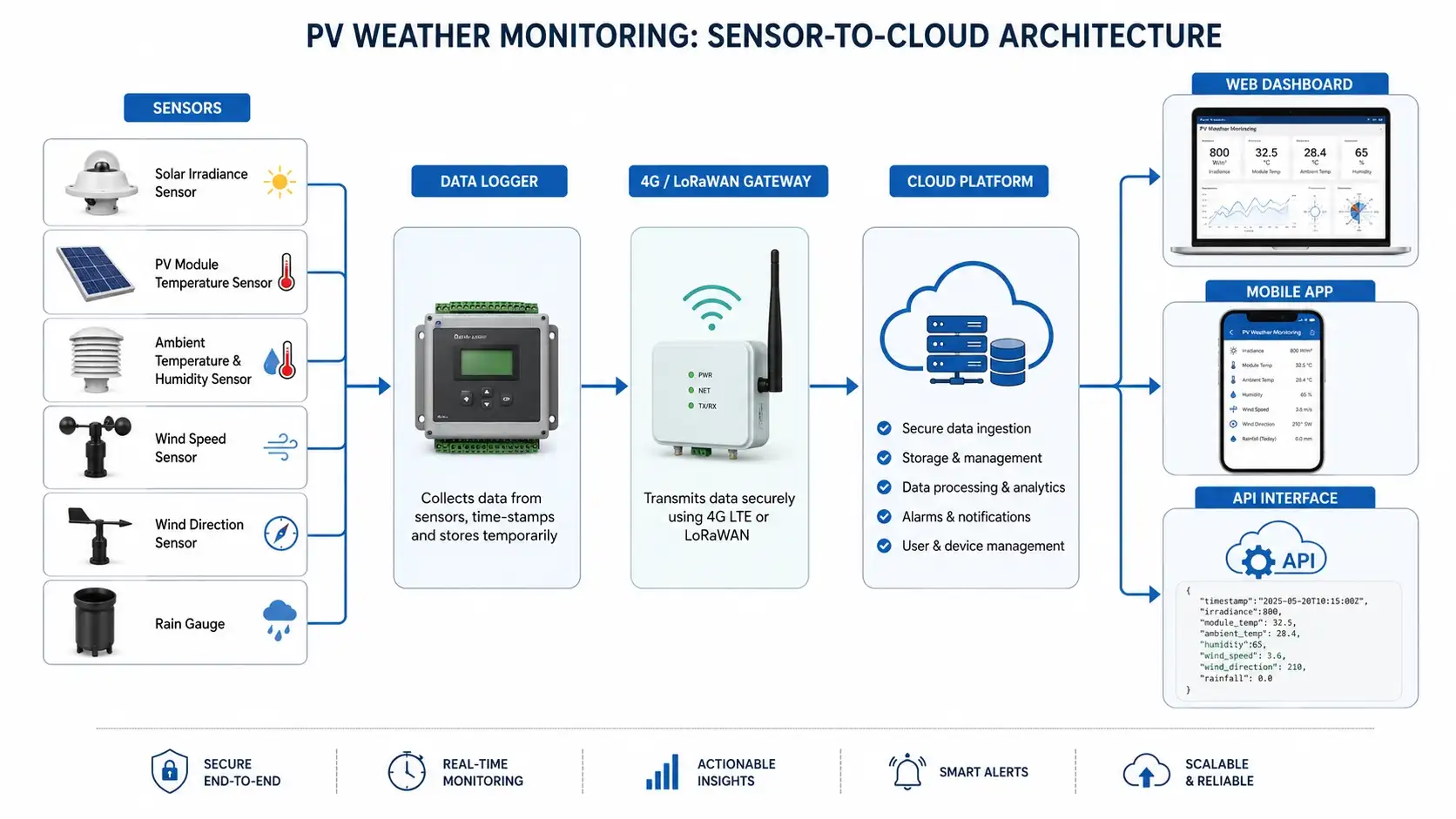
Rainfall sensors and IoT monitoring solutions are used by JW-IoT for agriculture, automatic weather stations, hydrology, flood alarm systems, and smart-city drainage networks.
JW- IoT can provide tipping bucket, optical, and piezoelectric rainfall sensors. These can connect to data loggers, communication devices, solar power systems, integrated weather stations, and IoT platforms.
Rainfall can also be monitored with air temperature, humidity, wind speed, wind direction, solar radiation, soil moisture, soil temperature, and other environmental sensors. Check out JW- IoT smart agriculture weather stations with configurable sensors and remote monitoring features. Our agriculture IoT sensors are used to monitor crops and control irrigation schedules.
FAQ
1. How accurate is an IoT rain gauge?
Its accuracy depends on the sensor technology, rain intensity, calibration routine, installation environment, wind, maintenance procedures, and how the data is calculated and used. Applying IoT capabilities to rainfall monitoring doesn’ t make the sensor more accurate by itself.
2. Is resolution and accuracy the same?
No, they’ re not the same thing. A resolution of 0.2 mm means the gauge detects and records rainfall in 0.2 mm increments. Overall accuracy is a separate specification that can change with rainfall intensity.
3. Which rain gauge should I use for smart agriculture?
Tipping bucket gauges work well for agriculture because they provide an easy way to monitor rainfall amounts and precipitation events. Optical and piezoelectric sensors are good choices when installation space is limited or you want to minimize mechanical failures.
4. Can rainfall sensor automatically control irrigation?
Yes. Combined with other sensors, rainfall monitoring can be used to automatically adjust irrigation systems. Rainfall isn’ t the only consideration, but it’ s an important part of irrigation scheduling and controlling when farmers suspend watering.
5. How often should I clean a rain gauge?
Yearly is sufficient for some sites. Other projects may need to inspect and clean rainfall sensors every season or every month. Sites with insects, trees, airborne dust, birds, or debris from agricultural activities will need more frequent inspections. Clean the rain gauge after severe storms too.
6. Can a tipping bucket rain gauge measure heavy rain?
Yes. Double-check that the measurement range includes your expected rainfall intensities. Some systems may require dynamic calibration or rainfall intensity correction for heavy rain events.
7. Will an IoT rain gauge record when the network goes down?
If the system has local data storage. Many data loggers and RTUs can record data on-site. The unit can store information when communication is lost then send the stored records after the connection is restored.
8. Does JW- IoT sell complete rainfall monitoring systems?
Yes! From rain sensors, weather stations, and data acquisition units up to communication systems, solar panels, and IoT platform configuration, JW- IoT works with customers to design and deploy systems that meet project requirements.
Conclusion
Optical IoT rain gauges can supply accurate rainfall data for agricultural decisions, weather monitoring, flood detection, hydrology, and environmental recording. Don’ t fall into the trap of thinking accuracy is based on resolution or “how smart” the gadget is.
Sensor technology, rain intensity, calibration, installation, environment, maintenance, and data-management practices all affect accuracy. Define the purpose of the monitoring project first. Then decide which sensor type, rain gauge accuracy range, wireless standard, environmental protection, maintenance needs, and supporting software best meets your project requirements.
CTA: Get an IoT Rainfall Monitoring Solution Recommendation
Let JW- IoT know your application, expected rainfall intensity, desired resolution, output requirements, communication protocol, available power options, installation environment, and preferred platform. We can recommend an IoT rain gauge and complete rainfall monitoring solution for your project.