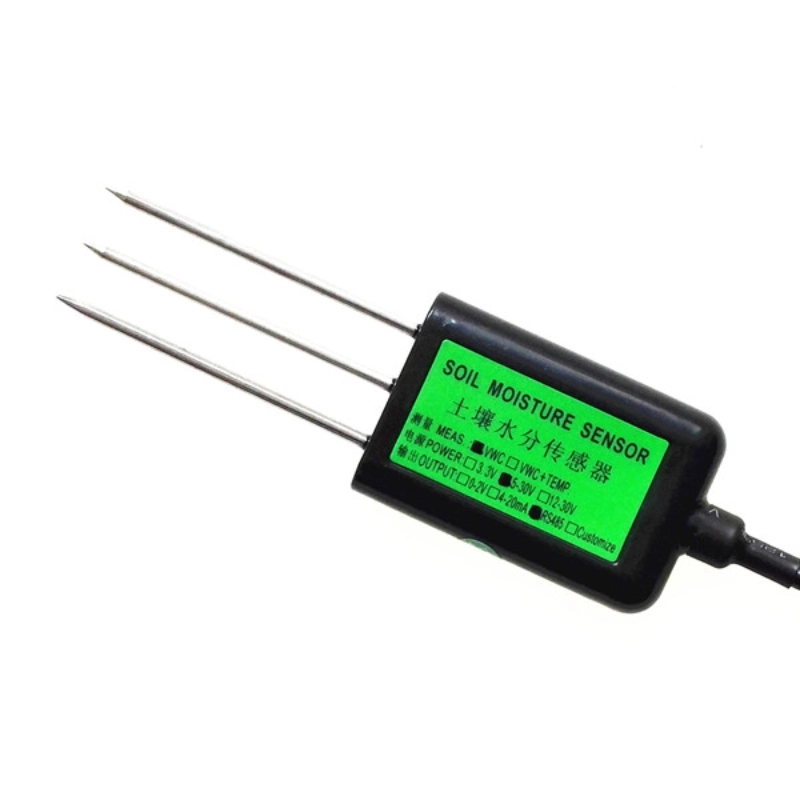
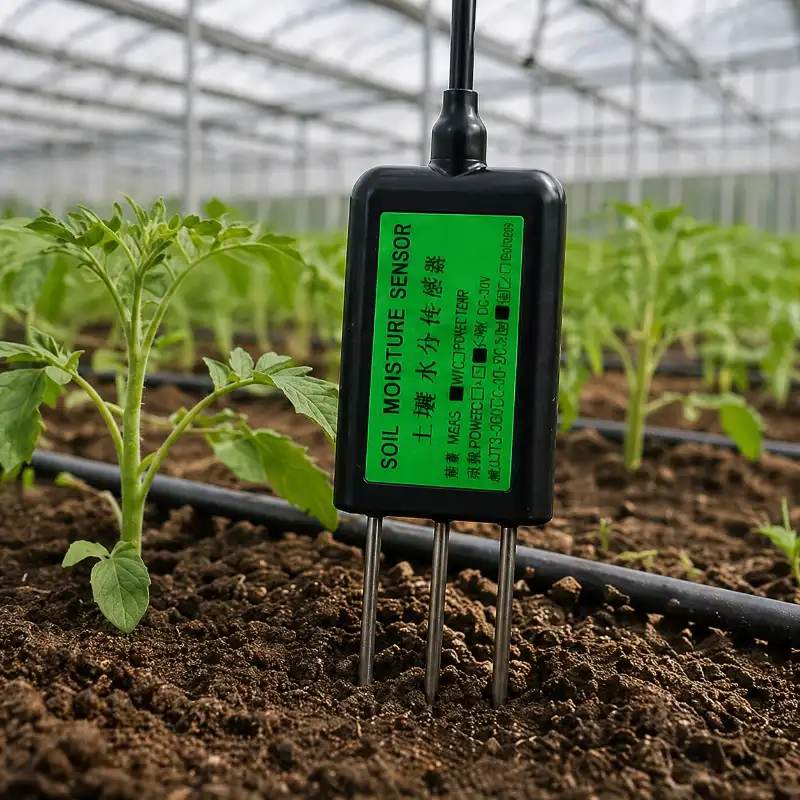
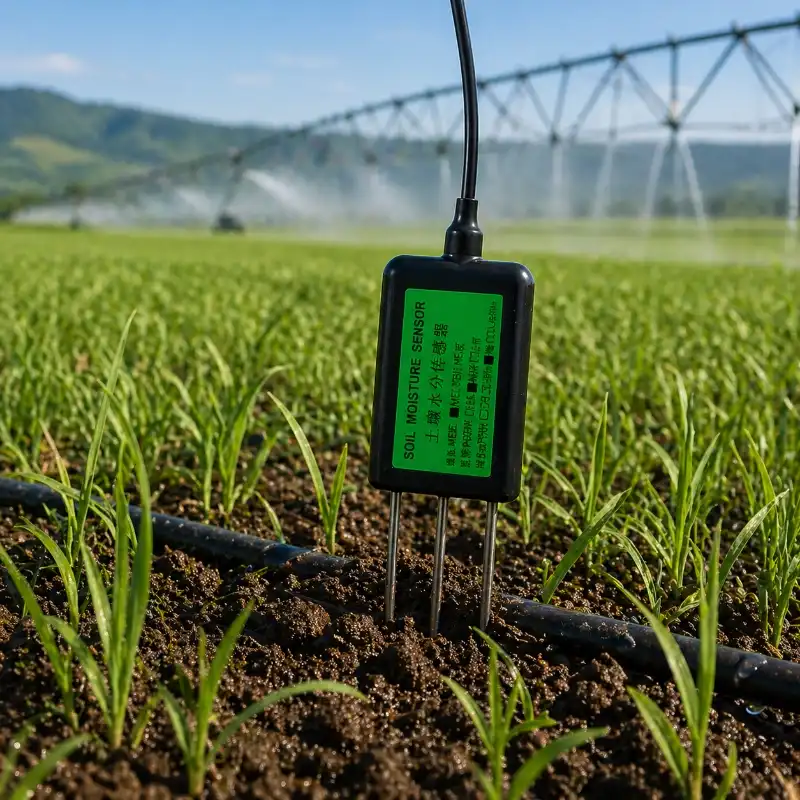
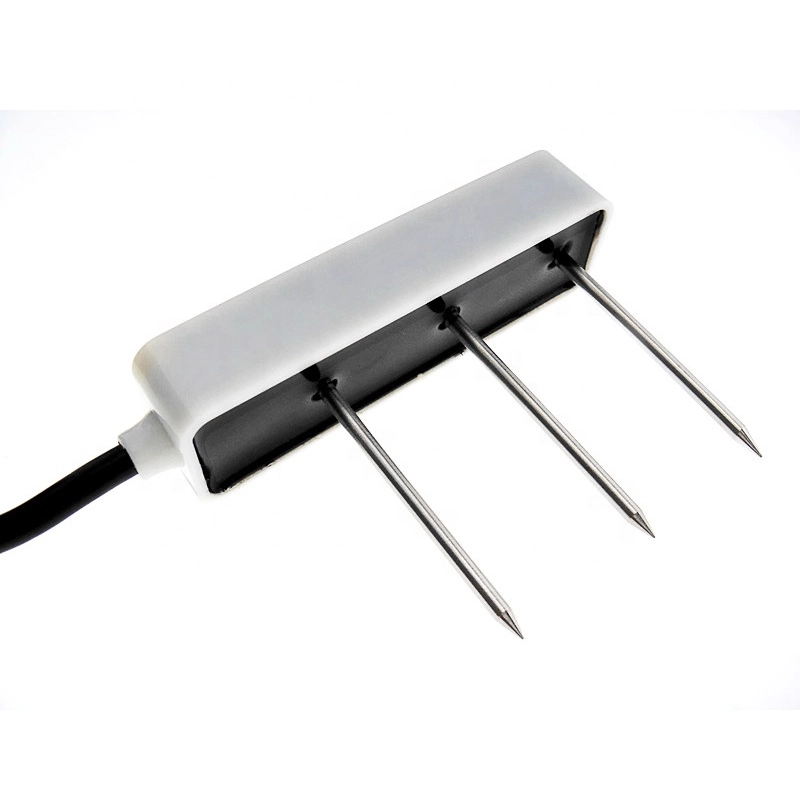
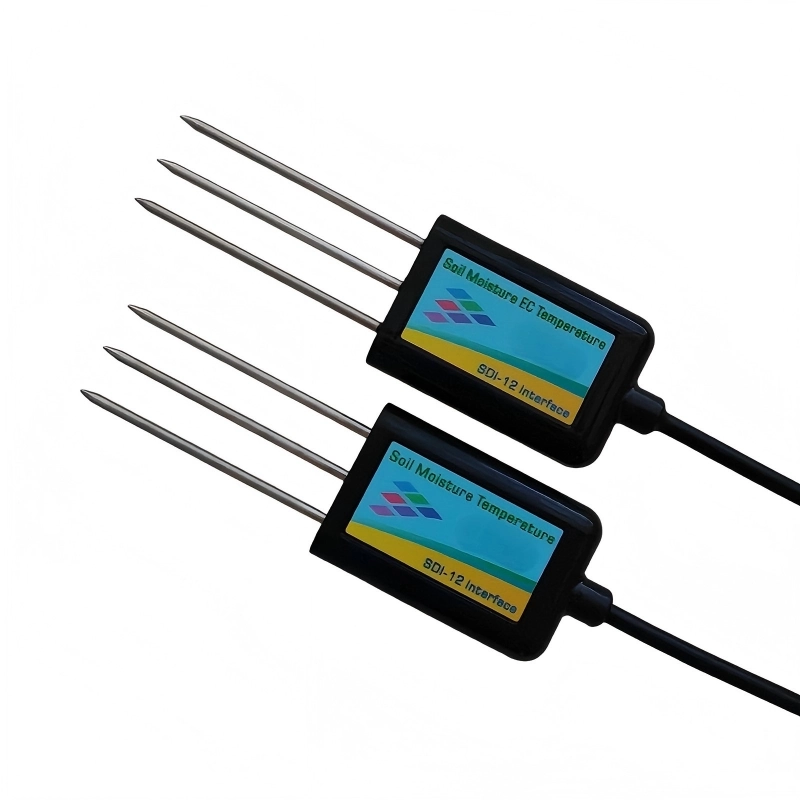
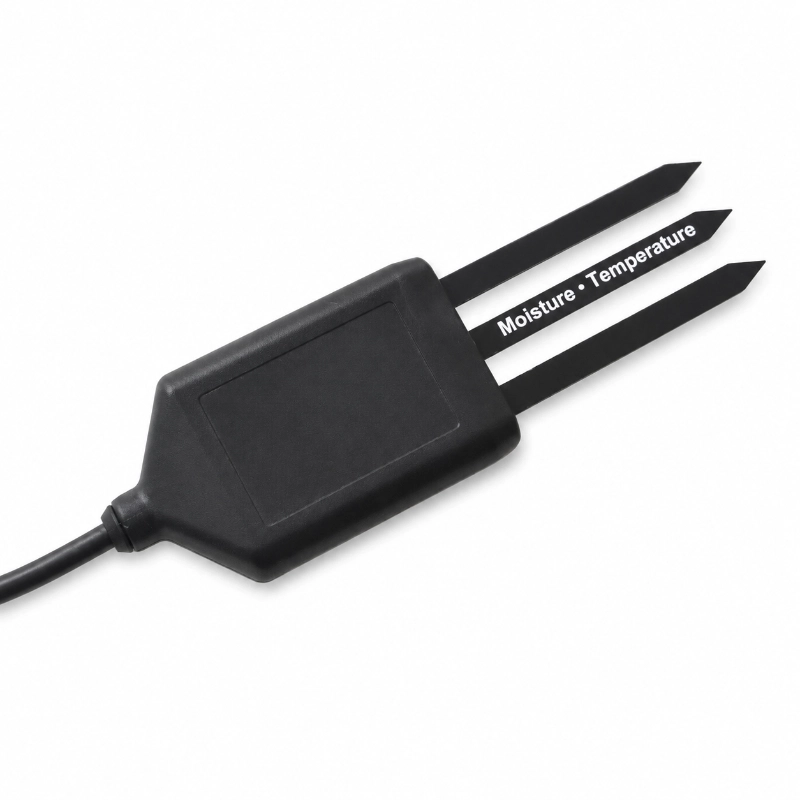
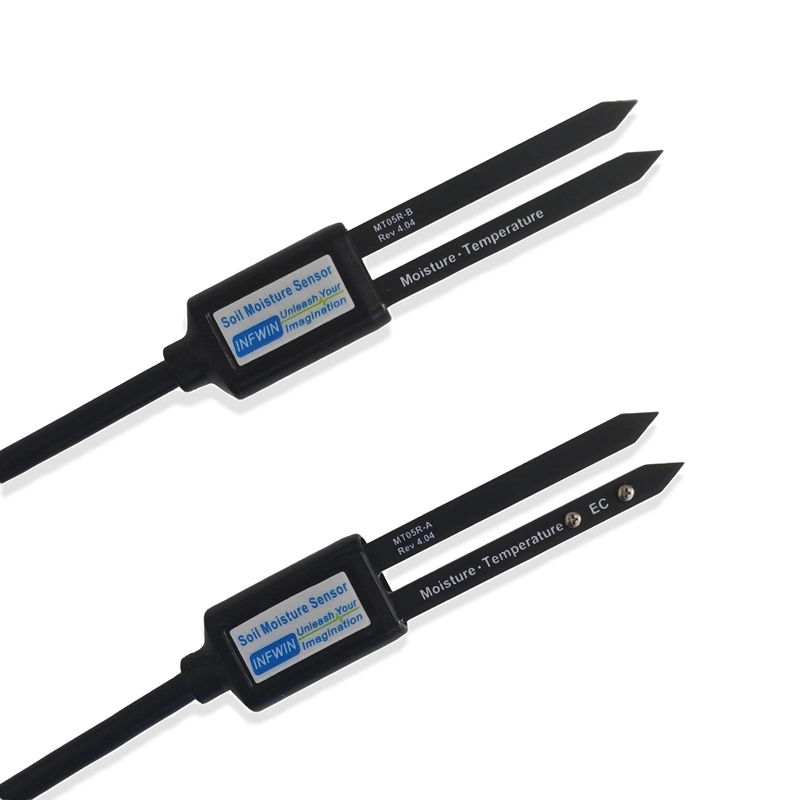
JW-S2S(Z12) Soil Moisture Temperature Sensor is designed for accurate monitoring of volumetric water content and soil temperature. Based on FDR measurement technology, it provides stable soil moisture data for irrigation scheduling, greenhouse control, soil moisture monitoring, scientific research, and precision agriculture. With optional 0–2V voltage output, 4–20mA current output, or RS485 Modbus-RTU communication, the sensor is suitable for both simple analog acquisition systems and smart agriculture IoT platforms.
2. Product Overview
The Soil Moisture Temperature Sensor is a high accuracy probe designed to measure volumetric soil water content and soil temperature. By measuring the dielectric constant of soil, it can directly and stably reflect the real moisture condition of different soil types.
Soil moisture is a key factor affecting plant growth, photosynthesis, root development, nutrient absorption, seed germination, and crop yield. By providing real time soil water content data, this sensor helps farmers and system integrators optimize irrigation timing, improve water use efficiency, and reduce the risk of drought stress or over irrigation.
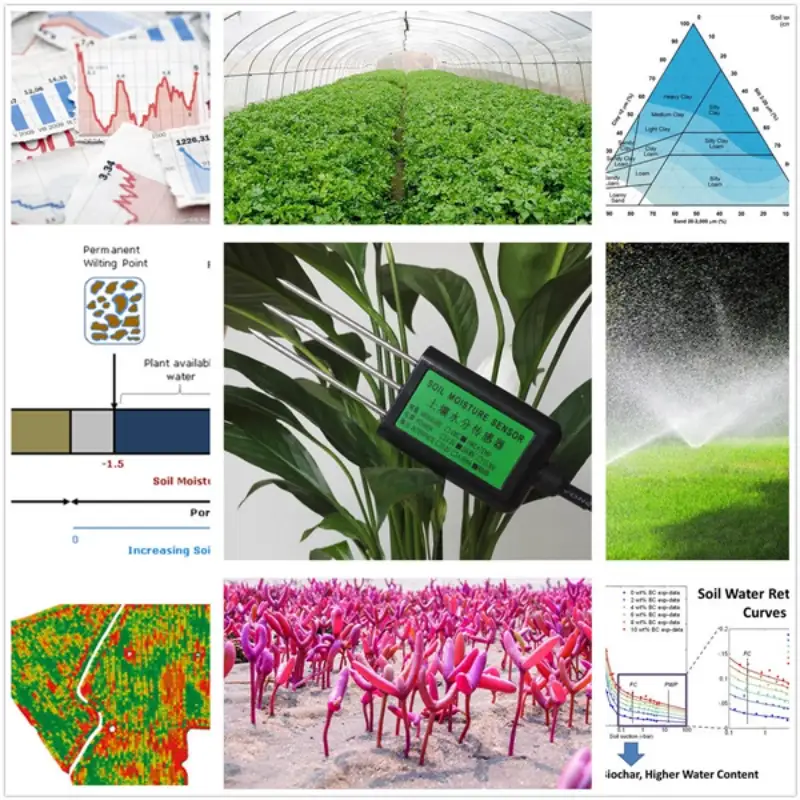
The sensor is suitable for soil moisture monitoring, scientific experiments, water saving irrigation, greenhouse cultivation, flowers and vegetables, pasture monitoring, soil quick testing, plant cultivation, grain storage, greenhouse control, precision agriculture, water conservancy, meteorology, and moisture measurement of granular materials.
Parameter
Model No.
JW-S2S(Z12)
Product Type
Soil moisture temperature sensor
Measurement Parameters
Soil volumetric water content and temperature
Measurement Principle
FDR soil moisture measurement
Output Options
0–2V, 4–20mA, RS485 Modbus-RTU
Voltage Output Power Supply
3.6–30V DC
Current Output Power Supply
12–30V DC
RS485 Power Supply
3.6–30V DC
Voltage Output Power Consumption
6 mA at 24V DC
Current Output Power Consumption
50 mA at 24V DC when both current channels are 20 mA
RS485 Power Consumption
6 mA at 24V DC
Soil Moisture Range
Optional 0–50% or 0–100%
Moisture Resolution
0.03% from 0–50%, 1% from 50–100%
Moisture Accuracy
±2% from 0–50%, ±3% from 50–100%
Measurement Volume
Cylindrical area around center probe, 7 cm diameter and 7 cm height
Response Time
Less than 1 second
Temperature Range
-40–80°C
Temperature Resolution
0.1°C
Temperature Accuracy
±0.5°C
Operating Environment
-40–85°C
Protection Rating
IP68
Probe Material
Corrosion resistant special electrode
Sealing Material
Black flame retardant epoxy resin
Installation Method
Fully buried or probes fully inserted into measured medium
Standard Cable Length
2 m
Cable Customization
Available on request
Connection Method
Pre installed cold pressed terminal
Dimensions
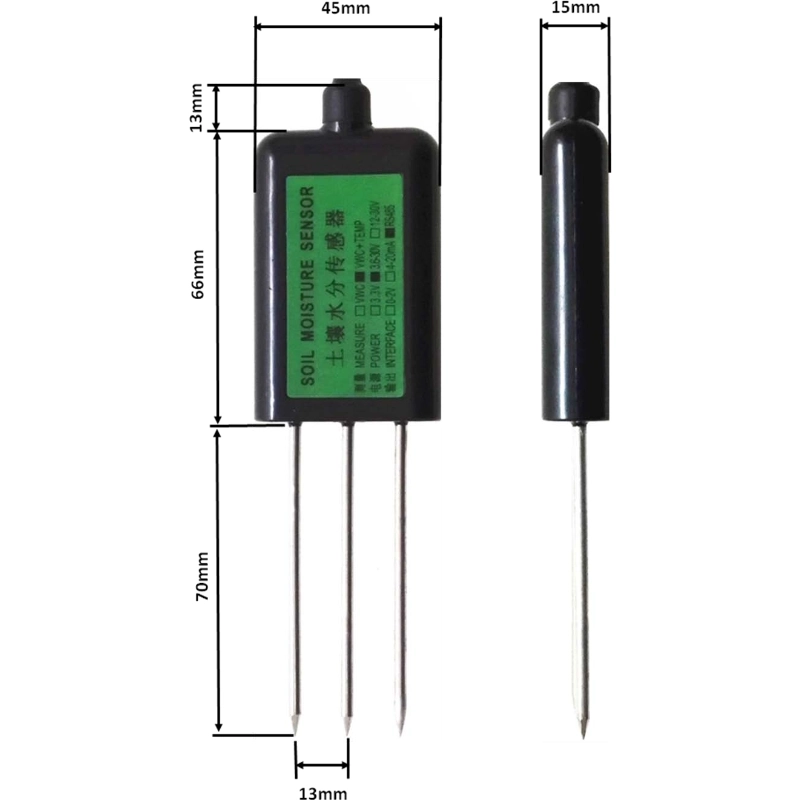
45 × 15 × 145 mm
Electrode Length
70 mm
3. Dimension
4. Output Options and Communication
The Soil Moisture Temperature Sensor supports multiple output options for different monitoring and control systems, including 0–2V analog voltage output, 4–20mA current output, and RS485 Modbus-RTU digital communication. This makes it suitable for simple local acquisition, industrial control, and IoT-based smart agriculture platforms.
5. Application Scenarios
Smart Irrigation
The sensor provides real time soil moisture and temperature data to help determine irrigation timing, irrigation amount, and soil water availability.
Greenhouse Control
Suitable for greenhouse vegetables, flowers, seedlings, herbs, potted plants, and controlled environment agriculture.
Soil Moisture Monitoring
Used for long term soil water content monitoring in farmland, orchards, nurseries, pastures, and research plots.
Water Saving Irrigation
Helps reduce unnecessary irrigation by providing accurate soil moisture feedback.
Scientific Research
Suitable for soil water dynamics, plant growth experiments, irrigation research, and agricultural environmental monitoring.
Grain Storage and Granular Material Moisture Measurement
Can be used for moisture measurement of grain storage environments and other granular materials.
Water Conservancy and Meteorology
Suitable for soil moisture observation in hydrology, meteorology, drought monitoring, and environmental research projects.
6.Installation and Measurement
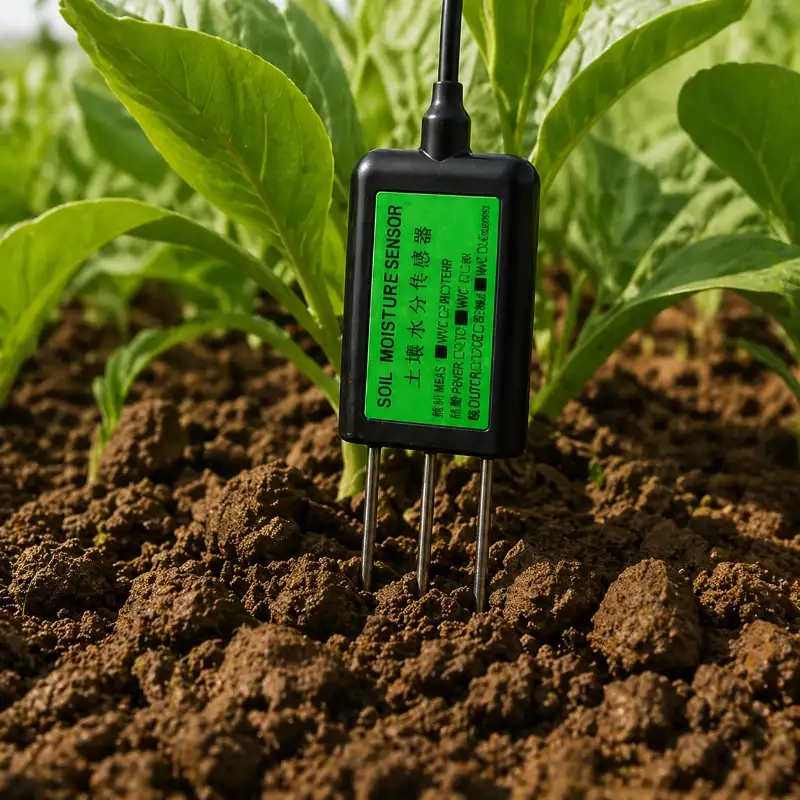
For quick measurement, select a suitable location, avoid stones and hard objects, and insert the probe vertically into the soil at the required depth. Do not shake the sensor during insertion, and make sure the electrodes are in close contact with the soil. It is recommended to measure multiple points in a small area and use the average value.
For buried installation, dig a vertical pit according to the required depth, insert the probes horizontally into the pit wall, refill and compact the soil, and allow the sensor to stabilize before continuous monitoring.
In hard soil, pre-drilling is recommended before inserting the probe. Avoid strong vibration, impact, or hitting the sensor with hard tools. When used in strong sunlight, shading protection is recommended to reduce the influence of rapid sensor housing temperature rise on temperature measurement.
FAQ
Q
1. What does this soil sensor measure?
A
It measures volumetric soil water content and soil temperature. The RS485 version can also output dielectric constant and raw VWC AD value.
Q
2. What measurement principle does it use?
A
The sensor uses FDR soil moisture measurement technology to detect the dielectric properties of soil and calculate volumetric water content.
Q
3. What output options are available?
A
The sensor supports 0–2V voltage output, 4–20mA current output, and RS485 Modbus-RTU communication.
Q
4. Can JW-IoT integrate this sensor into a smart irrigation system?
A
Yes. JW-IoT can integrate this soil moisture temperature sensor with RTUs, irrigation controllers, LoRaWAN nodes, 4G gateways, cloud dashboards, and mobile apps for smart irrigation projects.
Q
5. Is this sensor waterproof?
A
Yes. The sensor has an IP68 protection rating and can be fully buried in soil or used in wet environments for long term monitoring.
Q
6. What is the soil moisture measurement range?
A
The sensor supports optional 0–50% and 0–100% volumetric water content ranges.
Q
7. What is the temperature measurement range?
A
The soil temperature measurement range is -40°C to 80°C, with 0.1°C resolution and ±0.5°C accuracy.
Q
8. Can JW-IoT provide customized cable length?
A
Yes. JW-IoT can provide customized cable lengths according to greenhouse, field, orchard, or research project installation requirements.
Q
9. Can it be used with PLC or RTU systems?
A
Yes. The 4–20mA output version is suitable for PLC and industrial controllers, while the RS485 Modbus version is suitable for RTUs, data loggers, and IoT gateways.
Q
10. Can JW-IoT connect this sensor to a cloud platform?
A
Yes. JW-IoT can connect the RS485 version to gateways and upload soil moisture and temperature data to a cloud platform for remote monitoring, alarms, and irrigation analysis.
Q
11. Where can this sensor be used?
A
It can be used in farmland, greenhouses, orchards, nurseries, pastures, scientific research plots, water conservancy, meteorology, grain storage, and precision agriculture projects.
Q
12. How should the sensor be installed for accurate readings?
A
The probes should be fully inserted into the soil and maintain close contact with the soil. Avoid stones, air gaps, shaking during insertion, and strong impact.
 +86 13520127780
  info@jingelway.com