+86 13520127780
  info@jingelway.com








How Roof Mounted Solar PV Monitoring Kits Enhance Efficiency
Release time: 2026-07-28
Commercial rooftop solar systems are increasingly used on factories, warehouses, office buildings, shopping centers, schools, hospitals, and logistics facilities. These installations can reduce grid electricity consumption and support long-term sustainability goals, but installing PV modules alone does not guarantee consistent performance.
Solar generation changes continuously with irradiance, module temperature, cloud cover, shading, dust, ventilation, and equipment condition. Inverter data shows how much electricity the system produces, but it does not always explain why production rises or falls.
A rooftop solar PV monitoring kit provides the environmental reference data needed to interpret system output. By measuring solar irradiance, PV module temperature, ambient conditions, and other selected parameters, the kit helps building owners, EPC contractors, energy managers, and O&M teams evaluate whether a rooftop PV system is operating as expected.
For commercial buildings with limited installation space, the monitoring solution should also be compact, easy to install, remotely accessible, and compatible with the existing energy management or inverter platform.
Explore the JW-IoT Rooftop Solar Monitoring Kit
What Is a Rooftop Solar PV Monitoring Kit?
A rooftop solar PV monitoring kit is a compact system used to collect environmental and operational reference data from a rooftop photovoltaic installation.
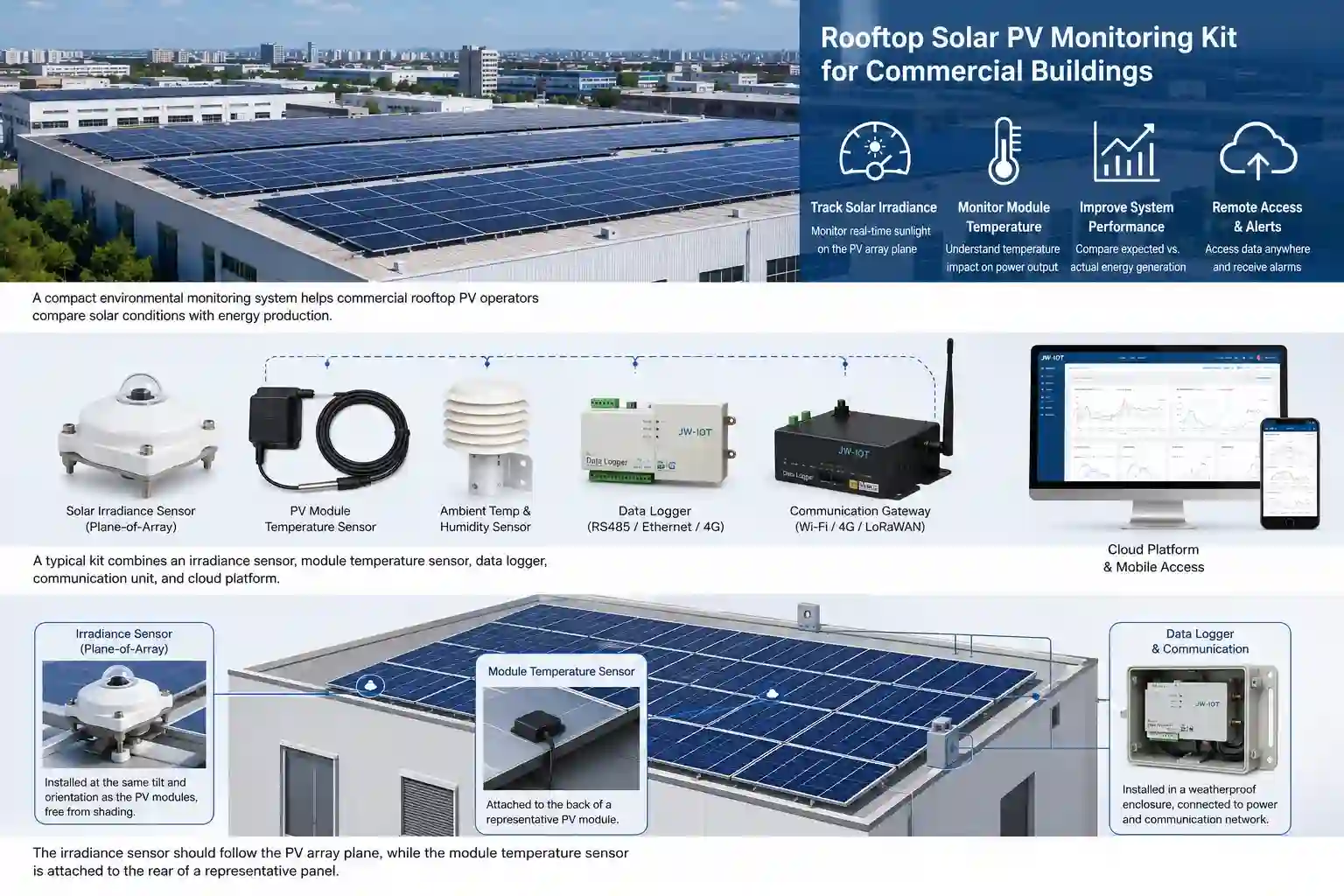
A typical kit may include:
- A solar irradiance sensor
- One or more PV module temperature sensors
- An ambient temperature and humidity sensor
- A compact data logger or IoT monitoring terminal
- RS485, Ethernet, LoRaWAN, Wi-Fi, or 4G communication
- A mounting bracket and outdoor enclosure
- A cloud platform or API connection
The kit does not replace the inverter monitoring system. Instead, it adds the environmental context required to interpret inverter and energy meter data more accurately.
For example, a reduction in power output may be normal when solar irradiance decreases. However, if irradiance remains high while power output falls, the system may require further inspection for shading, soiling, cable problems, inverter limitations, module mismatch, or equipment faults.
1. Why Rooftop PV Systems Need Environmental Monitoring
Power Data Alone Does Not Explain Performance
Most commercial solar installations already collect inverter output, daily energy yield, voltage, current, and operating status. This information is important, but it answers only one question:
How much energy did the system produce?
Environmental monitoring helps answer a second question:
How much energy should the system have been capable of producing under the actual site conditions?
By comparing irradiance, module temperature, and power generation over the same time period, operators gain a clearer view of system performance.
Rooftop Conditions Can Change Quickly
Commercial rooftops create operating conditions that are different from those at open-field solar farms. Nearby structures, ventilation outlets, parapet walls, HVAC equipment, antennas, and adjacent buildings can create localized shading or airflow differences.
Roofing materials can also retain heat and increase the temperature around the PV array. Different sections of the same rooftop may therefore experience different module temperatures or irradiance conditions.
A local monitoring kit captures conditions at the installation itself instead of relying only on a regional weather service.
Module Temperature Affects Energy Output
PV modules often operate at temperatures significantly above ambient air temperature, especially during periods of strong sunlight and weak ventilation.
As module temperature increases, electrical conversion efficiency generally decreases. A system may therefore produce less power on a very hot afternoon than expected from irradiance data alone.
A properly installed PV module temperature sensor helps operators distinguish normal temperature-related losses from abnormal performance problems.
Public Weather Data May Not Represent the Roof
Public weather stations may be several kilometers away and may measure irradiance on a horizontal surface under different local conditions. Their data may not reflect:
- The tilt angle of the rooftop PV array
- Local cloud movement
- Partial shading from nearby buildings
- Rooftop heat accumulation
- Dust or pollution around the site
- Different wind and ventilation conditions
On-site sensors provide more relevant reference data for commercial rooftop solar monitoring.
2. Rooftop Monitoring vs. Utility-Scale PV Monitoring
Rooftop and utility-scale PV projects require many of the same core measurements, but the monitoring architecture is usually different.
| Monitoring Factor | Commercial Rooftop PV | Utility-Scale Solar Plant |
| Installation area | Compact and structurally constrained | Large open area |
| Number of monitoring points | Usually one or several representative points | Multiple zones across the site |
| Mounting method | Roof, rail, module frame, or compact mast | Dedicated weather station mast |
| Communication | RS485, Ethernet, Wi-Fi, LoRaWAN, or 4G | RS485, fiber, LoRaWAN, 4G, or SCADA network |
| Power supply | Building power, DC supply, or solar backup | Mains, DC, or independent solar power |
| Typical parameters | Irradiance, module temperature, ambient temperature | Irradiance, module temperature, wind, rain, pressure, soiling and more |
| Main users | Building owner, facility manager, EPC and O&M provider | Plant owner, asset manager, control center and O&M team |
| System priority | Compact installation and easy integration | Multi-point coverage and centralized control |
A utility-scale PV plant may require several weather stations, redundant irradiance sensors, wind measurement, rainfall monitoring, soiling stations, and multiple communication gateways.
A rooftop installation usually benefits from a smaller, modular system focused on the most decision-relevant parameters. The objective is not to install every possible sensor. It is to collect enough representative data to explain performance without adding unnecessary installation complexity.
3. Key Sensors for Commercial Rooftop Solar Monitoring
Solar Irradiance Sensor
The solar irradiance sensor is the central measurement device in a rooftop monitoring kit. It measures the amount of solar radiation reaching the PV array, normally expressed in watts per square meter.
For performance evaluation, the sensor is commonly installed in the same plane and at a similar tilt angle as the PV modules. This is known as plane-of-array irradiance monitoring.
The irradiance data can be used to:
- Compare available sunlight with actual power generation
- Identify output reductions that cannot be explained by weather
- Support performance ratio analysis
- Evaluate the impact of clouds and shading
- Compare different rooftop zones
- Support long-term generation reporting
JW-IoT provides several types of solar irradiance sensors for PV monitoring, including compact silicon reference-cell sensors and pyranometer-based measurement options.
For commercial rooftop projects, a compact silicon irradiance sensor can be a practical choice when the objective is to compare irradiance conditions with photovoltaic output. Pyranometers may be selected when broader spectral measurement or higher meteorological measurement performance is required.
Recommended product:
Silicon Irradiance Sensor for PV Performance Monitoring
PV Module Temperature Sensor
A PV module temperature sensor is normally attached to the rear surface of a representative solar panel. It measures the actual operating temperature of the module rather than the surrounding air temperature.
This data helps users:
- Evaluate temperature-related power loss
- Compare module temperature with irradiance
- Identify unusually hot modules or rooftop areas
- Assess ventilation conditions
- Improve expected power calculations
- Support fault investigation
For large or divided rooftops, more than one module temperature sensor may be necessary. Separate monitoring points may be useful when arrays have different orientations, tilt angles, roof surfaces, or ventilation conditions.
Ambient Temperature and Humidity Sensor
Ambient temperature provides additional context for module temperature and rooftop operating conditions. Relative humidity may also be useful for long-term environmental assessment, condensation risk evaluation, and site condition analysis.
A compact temperature and humidity sensor is particularly relevant for:
- Industrial buildings
- Coastal installations
- Humid or tropical regions
- Rooftops with restricted airflow
- Sites requiring environmental records
Optional Wind Sensor
Wind affects module cooling and can explain differences between ambient temperature and module temperature. A compact wind sensor may be added where rooftop airflow has a significant influence on performance or where site safety requires local wind monitoring.
However, wind measurement on a rooftop requires careful siting. Parapets, equipment rooms, air outlets, and nearby structures can create turbulence. The sensor should be positioned where it can collect representative data without interfering with rooftop operations.
Optional Soiling or Dust Monitoring
Dust, pollen, industrial emissions, bird droppings, and other deposits may reduce the amount of sunlight reaching the module surface.
For sites with high cleaning costs, significant airborne pollution, or frequent dust accumulation, a PV soiling monitoring device can help determine whether a production decrease is associated with surface contamination.
This can support condition-based cleaning rather than relying only on a fixed maintenance schedule.
4. Compact Data Logger and Communication Options
Sensors are only one part of the monitoring system. Their readings must be collected, stored, transmitted, displayed, and compared with PV production data.
Compact Data Logger
The data logger acts as the local collection point for the rooftop monitoring kit. Depending on the configuration, it may:
- Collect RS485 Modbus sensor data
- Apply sensor addresses and polling intervals
- Store data during communication interruptions
- Convert field data into MQTT, TCP, or HTTP messages
- Send data to a cloud platform
- Connect with an energy management system
- Support remote parameter configuration
- Generate threshold alarms
For rooftop installations, the logger should fit inside a compact weatherproof enclosure and support the available building power supply.
RS485 Modbus
RS485 Modbus is suitable when sensors are installed relatively close to the data logger and a wired connection can be routed safely across the roof.
Advantages include:
- Stable local communication
- Easy integration with industrial controllers
- Support for several sensors on one bus
- Compatibility with many PLCs, RTUs, and gateways
Cable routing, lightning protection, grounding, and electrical isolation should be considered during installation.
Ethernet or Building Network
Ethernet may be used when the data logger can connect to the building’s existing network infrastructure. This can provide reliable communication without requiring a separate mobile data plan.
The building owner should confirm cybersecurity, network access, firewall, and data transmission requirements before connecting the monitoring device.
4G LTE
4G is useful when:
- The building network is unavailable
- The solar asset is managed by a third party
- Independent remote access is preferred
- The monitoring system must be separated from the facility network
- Several rooftop sites need direct cloud connectivity
A 4G-enabled data logger can transmit monitoring data directly to a remote platform, subject to local cellular coverage and SIM availability.
LoRaWAN
LoRaWAN may be suitable for industrial parks, campuses, warehouse clusters, and multi-building projects with several distributed rooftop monitoring points.
Low-power sensor nodes can send data to a central LoRaWAN gateway, which then forwards the information to the cloud through Ethernet or 4G.
API and Platform Integration
Commercial users may already operate:
- An inverter portal
- A building management system
- An energy management system
- A SCADA platform
- A sustainability reporting dashboard
- A third-party O&M platform
The rooftop monitoring kit should therefore support practical integration methods such as MQTT, Modbus, TCP/IP, or a cloud API.
JW-IoT can configure sensor, data logger, gateway, and platform combinations according to the required communication architecture.
5. How Monitoring Improves Rooftop PV Maintenance
Faster Identification of Abnormal Output
Suppose a rooftop system produces less electricity than expected.
Without environmental data, the O&M team may need to inspect the inverter, modules, cables, and roof immediately. With irradiance and module temperature data, the team can first determine whether the reduction corresponds to lower sunlight or unusually high operating temperature.
When irradiance remains strong but production drops, the system can prioritize further investigation.
Better Separation of Weather and Equipment Factors
A monitoring kit helps distinguish among several common situations:
- Low irradiance and low output: Often a normal weather-related reduction
- High irradiance and high module temperature: Possible normal thermal loss
- High irradiance and unexpectedly low output: Possible shading, soiling, inverter limitation, cable issue, or module fault
- Normal irradiance and abnormal temperature: Possible ventilation, attachment, or localized heating problem
- Different performance between roof zones: Possible orientation, shading, contamination, or equipment differences
This does not replace professional diagnostics, but it helps maintenance teams identify where to look first.
Improved Cleaning Decisions
A decline in energy yield does not always mean that modules require cleaning. Cloud cover, seasonal sun angle, and temperature can produce similar changes.
By reviewing irradiance, output, and historical trends together, operators can make better-informed cleaning decisions. When a soiling sensor is included, the system can provide a more direct indication of contamination-related loss.
Reduced Unnecessary Roof Visits
Commercial rooftops may have restricted access, safety requirements, and operational limitations. Every inspection can involve permits, fall protection procedures, building coordination, and labor costs.
Remote PV monitoring allows many initial checks to be performed from a web dashboard before personnel are sent to the roof.
Better Multi-Site Management
Companies with solar installations on several factories, warehouses, or retail buildings need a consistent way to compare performance.
A centralized monitoring platform can display:
- Current irradiance
- Module temperature
- Ambient conditions
- Sensor status
- Historical trends
- Communication status
- Alarm records
- Site-to-site comparisons
This gives energy managers and service providers a more unified view of distributed solar assets.
6. Recommended Rooftop Solar PV Monitoring Kit
A practical commercial rooftop configuration can be built around the following components.
Standard Configuration
- One plane-of-array solar irradiance sensor
- One PV module temperature sensor
- One compact RS485 data logger
- Ethernet or 4G communication
- Outdoor-rated control enclosure
- Mounting brackets and cables
- Cloud dashboard or API access
This configuration is suitable for a relatively uniform rooftop array with one main orientation.
Enhanced Configuration
- One or two plane-of-array irradiance sensors
- Two or more PV module temperature sensors
- Ambient temperature and humidity monitoring
- Compact wind monitoring
- Multi-channel data logger
- LoRaWAN, Ethernet, or 4G gateway
- Cloud dashboard, alarm management, and API
- Optional inverter or electricity meter integration
The enhanced configuration is more suitable for:
- Multiple roof sections
- East-west PV arrays
- Different tilt angles
- Large industrial rooftops
- Multi-building commercial sites
- Sites with complex shading
- Projects requiring centralized performance analysis
Optional Components
Depending on the project, the kit can also include:
- Rainfall sensor
- Barometric pressure sensor
- PV soiling measurement device
- Additional module temperature points
- Independent solar power supply
- Surge protection
- Edge data storage
- Custom protocol conversion
- Private cloud deployment
- OEM or white-label enclosure and branding
How to Select the Right Rooftop Monitoring Configuration
Before requesting a monitoring kit, prepare the following project information:
- Total installed PV capacity
- Roof dimensions and number of roof sections
- Module orientation and tilt angle
- Number and type of inverters
- Required environmental parameters
- Distance between sensors and data logger
- Available power supply
- Preferred communication method
- Existing monitoring platform or API requirements
- Local outdoor protection and compliance requirements
The number of monitoring points should be based on the physical layout of the rooftop rather than only on total installed capacity.
A single monitoring point may be sufficient for a small, uniform array. A large site with different orientations, elevations, shading conditions, or roofing materials may require multiple representative sensors.
Installation Considerations
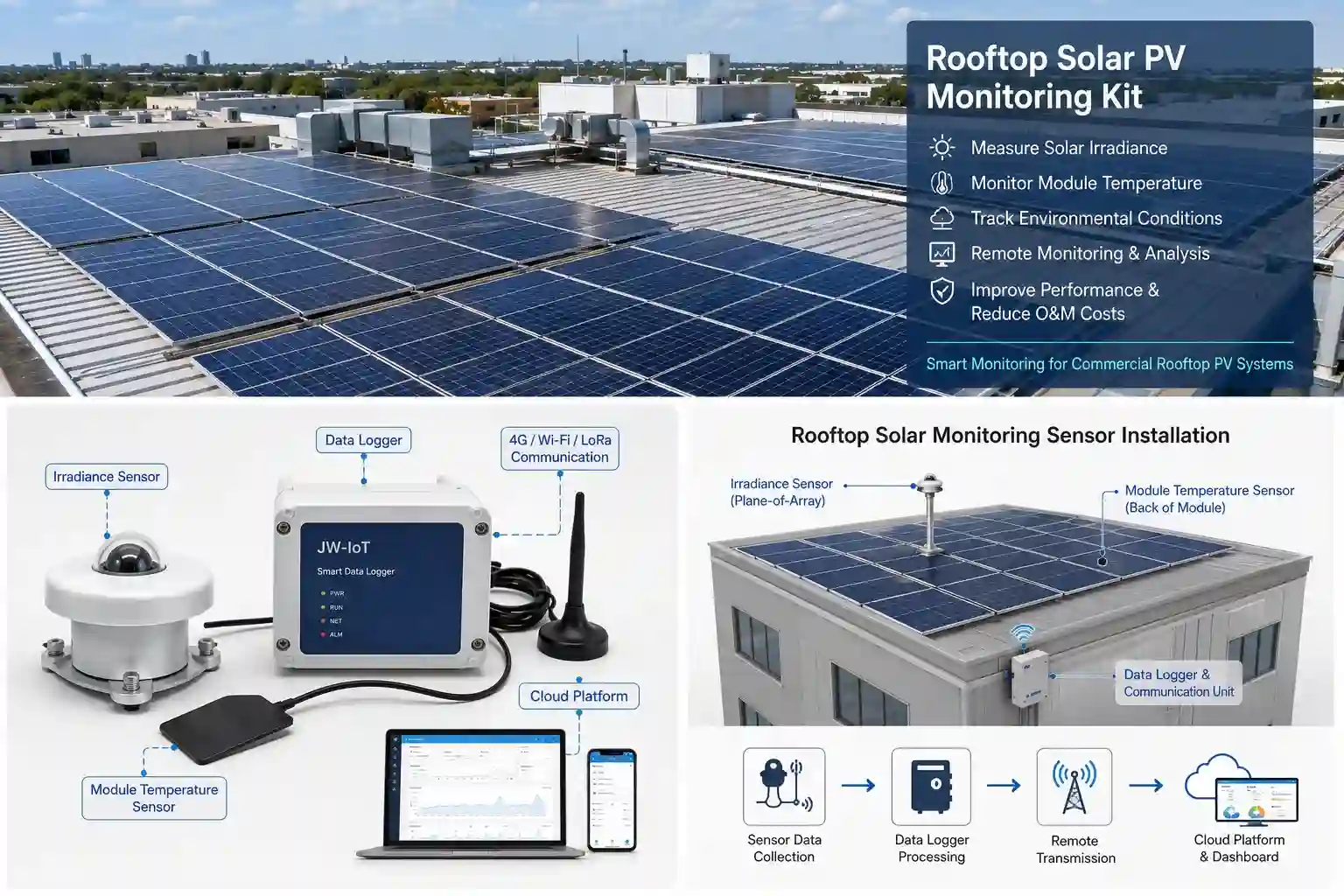
Accurate data depends on correct sensor installation.
Irradiance Sensor Installation
The plane-of-array irradiance sensor should:
- Match the tilt and orientation of the monitored PV modules
- Avoid shading from frames, walls, cables, and nearby equipment
- Be installed in a representative location
- Remain accessible for cleaning and inspection
- Use a stable bracket that does not change angle
Module Temperature Sensor Installation
The temperature probe should:
- Be attached securely to the rear surface of a representative module
- Maintain reliable thermal contact
- Avoid junction boxes and module edges unless required by the installation specification
- Use weather-resistant cable routing
- Represent the operating conditions of the monitored array
Data Logger Installation
The logger and enclosure should:
- Be protected against rain, dust, and direct heat where possible
- Allow safe maintenance access
- Include appropriate grounding and surge protection
- Use labeled communication and sensor cables
- Maintain reliable network or cellular signal
- Store data locally during temporary communication failures when required
For additional guidance, read:
Best Practices for Installing Solar PV Weather Stations
Frequently Asked Questions
What does a rooftop solar PV monitoring kit measure?
A rooftop solar PV monitoring kit typically measures solar irradiance and PV module temperature. It may also monitor ambient temperature, humidity, wind, rainfall, soiling, and other site conditions depending on the project.
Is inverter monitoring enough for a commercial rooftop solar system?
Inverter monitoring provides power and electrical operating data, but it may not explain whether an output change is caused by sunlight, temperature, shading, soiling, or equipment condition. Environmental sensors provide the reference data needed for more complete performance analysis.
Where should the solar irradiance sensor be installed?
For plane-of-array monitoring, the irradiance sensor should normally be installed at the same orientation and tilt angle as the PV modules. It should remain free from shading and represent the conditions experienced by the array.
How many module temperature sensors are required?
A small, uniform rooftop may require only one representative sensor. Multiple sensors are recommended when the rooftop has different orientations, module types, roof levels, ventilation conditions, or shading zones.
Can the monitoring kit connect to an existing platform?
Yes. Depending on the selected data logger and gateway, the system can support RS485 Modbus, Ethernet, MQTT, TCP/IP, LoRaWAN, 4G, and API-based integration.
Can JW-IoT provide a complete rooftop monitoring system?
Yes. JW-IoT can configure solar irradiance sensors, PV module temperature sensors, ambient sensors, data loggers, communication devices, mounting accessories, cloud platforms, and API integration according to the rooftop layout and project requirements.
Is the kit suitable for factories and warehouses?
Yes. Compact rooftop monitoring kits are suitable for factories, warehouses, office buildings, shopping centers, campuses, hospitals, schools, logistics facilities, and other commercial or industrial buildings with distributed solar installations.
Does rooftop monitoring directly increase solar panel efficiency?
The monitoring system does not change the physical conversion efficiency of the PV modules. It helps operators identify abnormal losses, improve maintenance timing, evaluate environmental effects, and maintain the system closer to its expected operating condition.
Conclusion
A rooftop solar PV monitoring kit gives commercial building owners more than another stream of sensor data. It provides the environmental context required to understand solar generation.
By combining solar irradiance, module temperature, compact data acquisition, wireless or wired communication, and remote platform access, the system helps users:
- Evaluate PV output against actual sunlight
- Identify abnormal performance more efficiently
- Understand temperature-related losses
- Improve cleaning and maintenance decisions
- Reduce unnecessary rooftop inspections
- Manage multiple commercial solar sites centrally
- Integrate environmental data with existing energy platforms
The most effective configuration depends on the rooftop layout, number of array orientations, communication environment, required parameters, and integration objectives.
Request a Rooftop PV Monitoring Kit
JW-IoT provides configurable rooftop solar monitoring solutions for commercial buildings, industrial facilities, warehouses, campuses, and distributed PV projects.
Send us your:
- PV system capacity
- Rooftop layout
- Module orientation
- Required monitoring parameters
- Communication preference
- Platform integration requirements
Our team will recommend a suitable sensor, data logger, communication, and platform configuration for your project.