+86 13520127780
  info@jingelway.com








PV Weather Stations for Utility-Scale Solar Farms: 5 Key Benefits
Release time: 2026-07-05
Introduction
For a utility scale solar farm, power generation is not only determined by the number of PV modules installed. Real operating performance is also affected by solar irradiance, module temperature, wind speed, wind direction, rainfall, humidity, dust, and other environmental conditions.
This is why a PV weather station is becoming an essential part of modern solar farm infrastructure.
A PV weather station collects real-time environmental data from the solar plant site and helps operators understand whether the power plant is performing as expected under actual field conditions. For large ground-mounted solar farms, this data is especially important for performance analysis, O&M planning, fault diagnosis, cleaning decisions, and forecasting support.A complete Solar PV Monitoring System can combine PV weather stations, solar irradiance sensors, module temperature sensors, data loggers, gateways, and cloud platforms to support centralized monitoring across multiple zones of a solar farm.
Why Utility Scale Solar Farms Need Weather Monitoring?
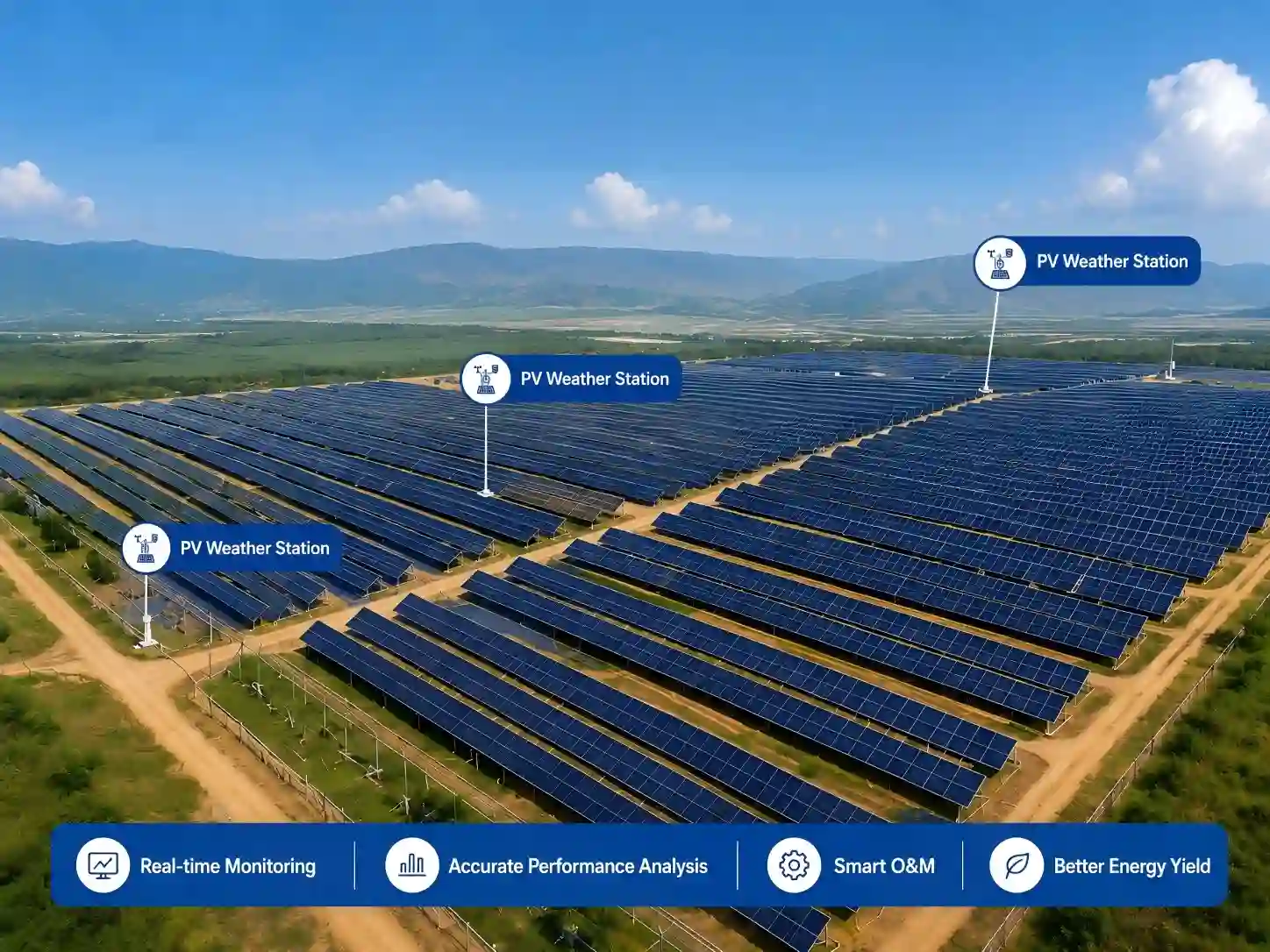
Utility scale solar farms usually cover large land areas. Environmental conditions may vary across different zones due to terrain, module orientation, local wind patterns, dust accumulation, shading, and microclimate differences.
Without accurate weather monitoring, operators may only see changes in power output but may not understand the real cause behind those changes.
For example:
- Is lower output caused by low irradiance?
- Is high temperature reducing module efficiency?
- Is dust accumulation affecting sunlight transmission?
- Is rainfall helping natural cleaning?
- Is strong wind creating safety or structural risks?
- Are different PV zones performing differently under the same weather conditions?
A solar farm weather station helps answer these questions by collecting field-level environmental data directly from the PV plant.
Typical monitoring parameters include:
|
Parameter |
Monitoring Purpose |
|
Solar irradiance |
Measures available sunlight for PV generation |
|
Plane-of-array irradiance |
Supports PV performance analysis based on module angle |
|
Ambient temperature |
Helps evaluate site weather conditions |
|
PV module temperature |
Supports temperature loss analysis and PR calculation |
|
Wind speed and direction |
Supports cooling analysis and safety monitoring |
|
Rainfall |
Supports cleaning and weather impact analysis |
|
Humidity |
Helps evaluate environmental conditions |
|
Air pressure |
Supports complete weather monitoring |
|
Sunshine duration |
Supports solar resource assessment |
|
Data logger status |
Ensures reliable data acquisition |
For large PV sites, a PV Plant Weather Station Solution can provide real-time solar radiation, weather, and module temperature monitoring to support plant performance evaluation and maintenance decisions.
Benefit 1: Accurate Performance Analysis
The first and most important benefit of a PV weather station is accurate solar plant performance analysis.
Power output alone does not tell the full story. A solar farm may generate less electricity because of cloudy weather, high module temperature, dust accumulation, equipment faults, inverter issues, or partial shading. To identify the real reason, operators need to compare power generation data with environmental data.
A PV weather station provides the key reference data needed for this comparison.
How Weather Data Supports Performance Analysis
By collecting solar irradiance, module temperature, ambient temperature, and wind data, operators can compare expected output with actual output under real site conditions.
For example:
- If irradiance is low, reduced generation may be normal.
- If irradiance is high but output is low, the system may have performance loss.
- If module temperature is high, part of the loss may be caused by heat.
- If only one zone performs poorly under similar weather, the problem may be local.
- If wind speed is low, module cooling may be weaker and temperature loss may increase.
This type of comparison is essential for PV plant monitoring and performance ratio analysis.
A Solar Irradiance Sensor for PV Monitoring can be integrated with PV module temperature sensors and data loggers to provide real-time irradiance and temperature data for solar performance analysis.
Benefit 2: Better O&M Planning
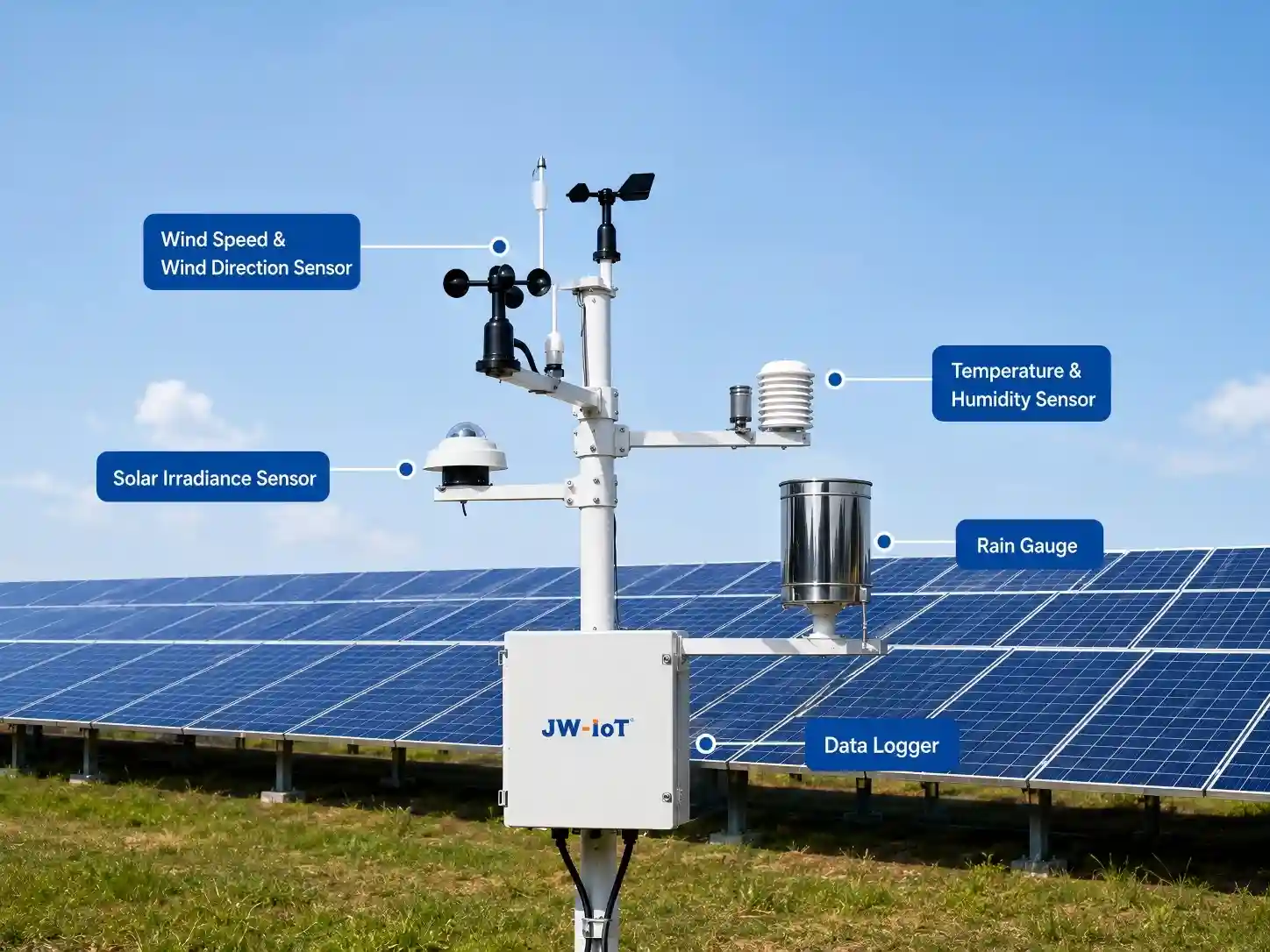
For utility scale solar farms, operation and maintenance teams need to manage a large number of PV arrays, inverters, cables, combiner boxes, monitoring points, and field devices. Without reliable environmental data, O&M planning can easily become reactive.
A PV weather station helps O&M teams move from fixed schedules to data-driven maintenance.
How PV Weather Stations Improve O&M
With real-time weather and environmental data, operators can better plan:
- Site inspections
- Cleaning schedules
- Electrical maintenance
- Sensor calibration
- Inverter inspection
- Safety checks before extreme weather
- Performance comparison between PV zones
For example, if a period of strong wind, high temperature, or heavy rainfall is expected, the O&M team can adjust inspection plans and reduce unnecessary field visits. If the cloud platform detects abnormal environmental data or device faults, the team can respond faster.
In large solar farms, multiple monitoring points may be needed to reflect differences between zones. A PV Weather Monitoring Station for Distributed Solar Plants can monitor solar irradiance, ambient temperature, humidity, wind speed, wind direction, air pressure, module temperature, and sunshine duration for distributed PV monitoring applications.
Benefit 3: Early Fault Detection
A PV weather station can also support early fault detection by helping operators distinguish environmental causes from equipment-related issues.
When output decreases, the first question is whether the drop is caused by weather or by a technical problem. Without environmental monitoring, the operator may need to rely on manual inspection or incomplete assumptions.
With PV weather data, abnormal performance can be identified more quickly.
Common Fault Detection Scenarios
A solar farm weather station can support early detection of:
- Abnormal output under high irradiance
- High module temperature in specific PV zones
- Possible hot spots or poor ventilation
- Sensor failure or data interruption
- Weather-related performance loss
- Inverter output mismatch
- Local shading or soiling problems
- Communication failure from field devices
For example, if two PV zones receive similar irradiance but one zone has lower output and higher module temperature, the operator may need to inspect module condition, ventilation, wiring, or local shading.
If irradiance and module temperature are normal but output suddenly drops, the issue may be related to inverter operation, DC-side faults, communication problems, or electrical components.
This is why environmental data is not only useful for weather monitoring. It is also a key part of solar farm fault diagnosis.
Benefit 4: Cleaning and Maintenance Optimization
Dust, sand, pollen, bird droppings, and industrial particles can reduce the amount of sunlight reaching PV modules. For utility scale solar farms, cleaning is often one of the largest recurring maintenance activities.
However, fixed cleaning schedules may not always be efficient. Cleaning too often increases labor and water costs. Cleaning too late may cause unnecessary power loss.
A PV weather station helps optimize cleaning decisions by combining irradiance, rainfall, dust, and power output data.
How Weather Data Supports Cleaning Decisions
Operators can use PV weather station data to understand:
- Whether rainfall has helped natural cleaning
- Whether output loss is related to soiling
- Whether irradiance is strong but generation is lower than expected
- Whether dust-prone weather has occurred recently
- Whether cleaning should be prioritized in specific zones
For desert solar farms, cleaning optimization is especially important because dust accumulation can happen quickly. In tropical or rainy regions, natural rainfall may reduce cleaning frequency during certain seasons.
When combined with solar irradiance data and module temperature data, cleaning decisions become more accurate and less dependent on guesswork.
For projects that require detailed solar resource and performance data, JW-IoT can provide irradiance monitoring devices such as the Class A Pyranometer Solar Radiation Sensor RS485 Output or the Silicon Irradiance Sensor for PV Performance Monitoring, depending on project accuracy requirements and budget.
Benefit 5: Data Support for Forecasting
Solar power generation forecasting depends heavily on environmental data. For utility scale solar farms connected to the grid, forecasting support can help improve power dispatch, grid coordination, and operational planning.
A PV weather station provides real-time and historical data that can support forecasting models and plant-level analysis.
How PV Weather Data Supports Forecasting
Useful forecasting-related data includes:
- Solar irradiance trend
- Cloud impact on irradiance
- Ambient temperature trend
- PV module temperature trend
- Wind speed and direction
- Rainfall events
- Historical daily generation comparison
- Multi-zone environmental data
By comparing historical weather data with actual power output, operators can improve generation forecasting and better understand how local environmental conditions affect plant performance.
For large plants, field data from multiple PV weather stations can also support more accurate site-level forecasting than relying only on regional weather data.
In floating solar or hybrid hydro-solar projects, environmental monitoring may also include water level and water surface conditions. JW-IoT’s Floating Solar Monitoring Station Solution is designed for real-time solar irradiance, PV module temperature, weather, and water-related monitoring in floating PV applications.
Recommended PV Weather Station Configuration
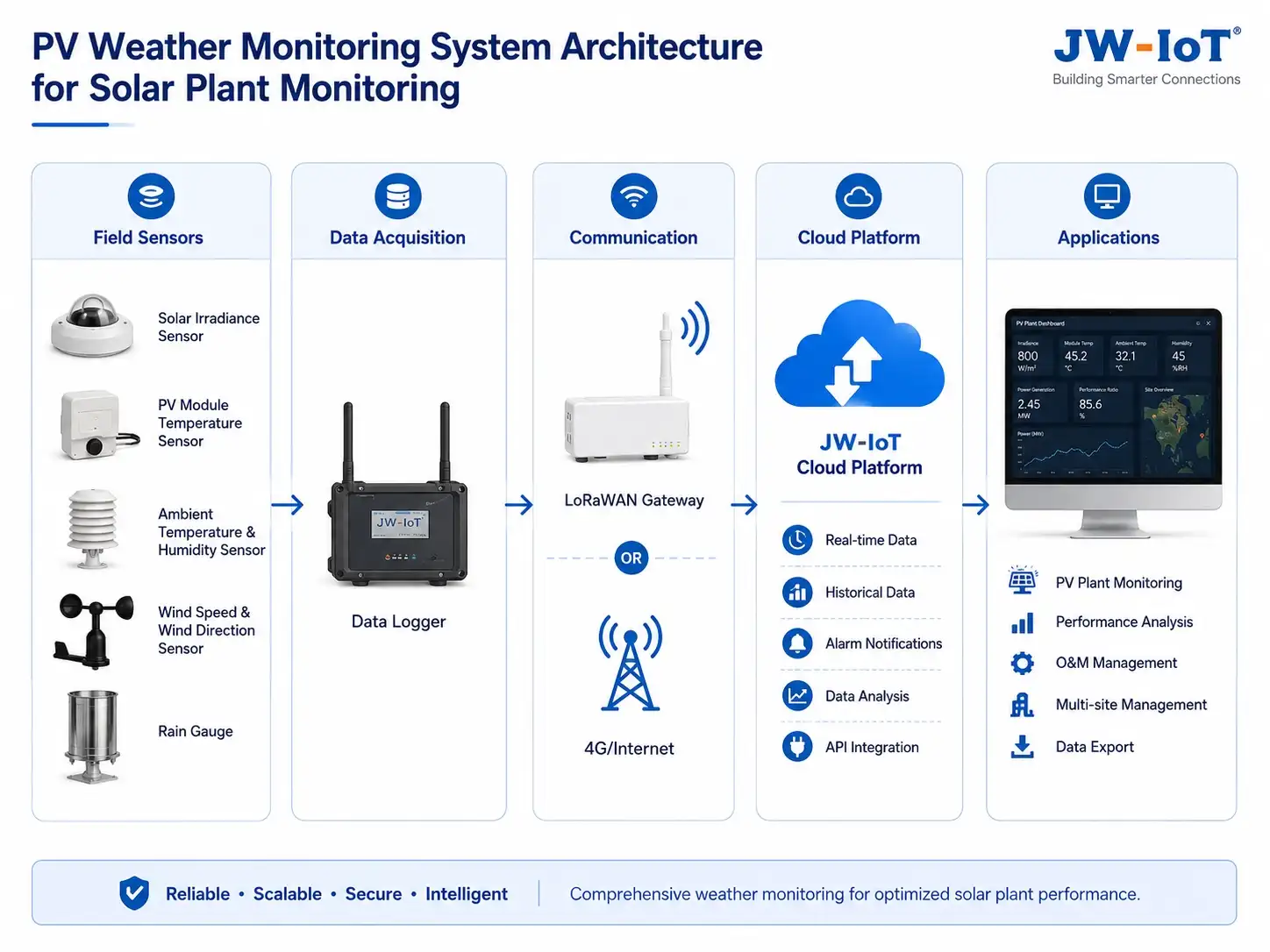
The configuration of a PV weather station should match the project type, site environment, monitoring requirements, and communication conditions.
For a utility scale solar farm, a typical configuration may include:
Field Sensors
- Solar irradiance sensor
- Plane-of-array irradiance sensor
- PV module temperature sensor
- Ambient temperature and humidity sensor
- Wind speed and wind direction sensor
- Rainfall sensor
- Air pressure sensor
- Sunshine duration sensor
- Optional dust or soiling sensor
Data Acquisition Layer
- Data logger
- RTU
- RS485 Modbus interface
- Analog input interface
- Local data storage
- Alarm threshold settings
- Device status monitoring
Communication Layer
- 4G LTE gateway
- LoRaWAN gateway
- Ethernet communication
- MQTT API
- SCADA integration
- Cloud data transmission
Cloud Platform
- Real-time dashboard
- Historical data query
- Trend curve analysis
- Multi-site management
- Alarm notification
- Data export
- API integration
- PV performance analysis
A complete PV weather station system can be customized based on whether the project is a ground-mounted solar farm, rooftop PV system, distributed PV plant, desert solar farm, floating PV plant, or hybrid renewable energy project.
FAQ
1. What is a PV weather station?
A PV weather station is an environmental monitoring system designed for solar PV plants. It collects solar irradiance, temperature, wind, rainfall, humidity, module temperature, and other data to support PV plant monitoring and performance analysis.
2. Why does a utility scale solar farm need a PV weather station?
A utility scale solar farm needs a PV weather station to understand how local weather and environmental conditions affect power generation, performance ratio, O&M planning, cleaning, and forecasting.
3. What parameters should a solar farm weather station monitor?
A typical solar farm weather station should monitor solar irradiance, module temperature, ambient temperature, humidity, wind speed, wind direction, rainfall, air pressure, and sunshine duration. Some projects may also require dust or soiling monitoring.
4. Can JW-IoT provide a complete PV weather station system?
Yes. JW-IoT can provide PV weather stations, solar irradiance sensors, module temperature sensors, data loggers, communication gateways, and cloud-based monitoring platforms for solar PV monitoring projects.
5. How does a PV weather station support performance analysis?
It provides real-time environmental data that can be compared with power generation data. This helps operators identify whether output changes are caused by irradiance, temperature, weather, soiling, or equipment issues.
6. Can PV weather stations help reduce cleaning costs?
Yes. By combining irradiance, rainfall, soiling, and generation data, operators can optimize cleaning schedules and avoid unnecessary cleaning while reducing power loss from dust accumulation.
7. What communication methods can be used for PV weather monitoring?
Common communication methods include RS485 Modbus, LoRaWAN, 4G LTE, Ethernet, MQTT API, and SCADA integration. The best option depends on site distance, network coverage, and system architecture.
8. How many PV weather stations are needed for a large solar farm?
The number depends on plant size, terrain, layout, module orientation, and monitoring accuracy requirements. Large utility scale solar farms usually need multiple monitoring points across different zones.
9. Can JW-IoT PV weather stations support cloud monitoring?
Yes. JW-IoT PV monitoring systems can support cloud dashboards, historical data query, alarm notification, data export, API integration, and multi-site project management.
Conclusion
A PV weather station is not just a weather monitoring device. For a utility scale solar farm, it is a critical data foundation for performance analysis, O&M planning, early fault detection, cleaning optimization, and forecasting support.
By monitoring solar irradiance, wind, rainfall, temperature, module temperature, and environmental conditions, operators can better understand how the solar farm performs under real field conditions.
For large PV plants, a well-designed solar environmental monitoring system helps reduce uncertainty, improve operational efficiency, and support long-term power generation performance.
Need a PV weather station for a utility scale solar farm? Contact JW-IoT to get a suitable PV weather station configuration based on your project size, monitoring parameters, communication method, and platform integration requirements.