+86 13520127780
  info@jingelway.com








How to Build a City Noise Monitoring Network
Release time: 2026-07-29
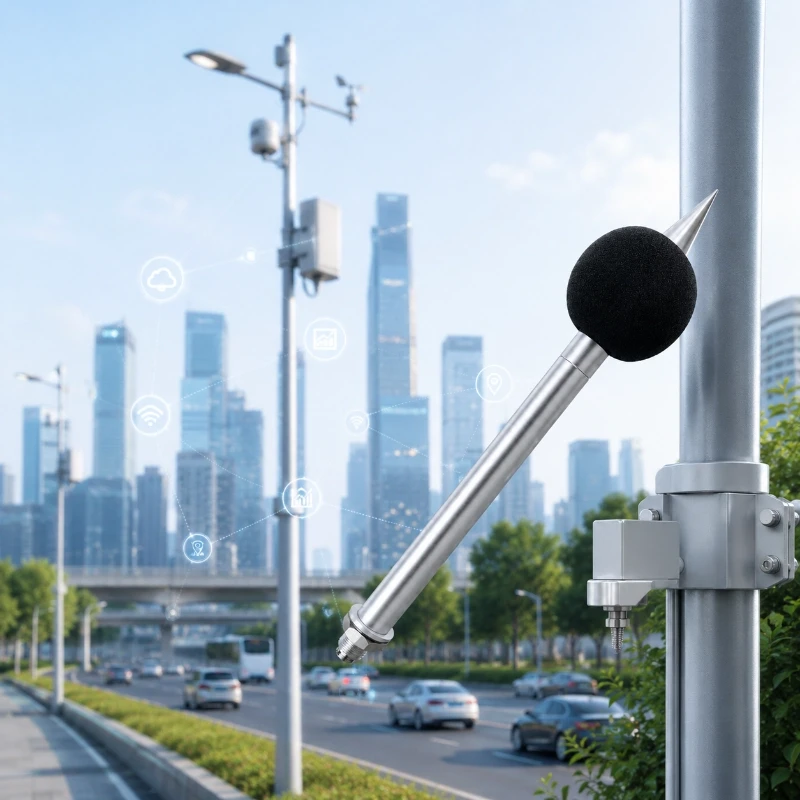
Urban noise is no longer only a temporary inconvenience. Road traffic, railways, airports, construction projects, industrial facilities, commercial districts and public events can create constantly changing sound environments across a city.
A single handheld sound level meter can help investigate one location, but it cannot explain how noise changes across different districts, hours or seasons. A city noise monitoring network uses multiple connected monitoring points to collect continuous sound-level data and provide a broader picture of the urban acoustic environment.
This guide explains how municipalities, environmental agencies, smart city contractors and system integrators can plan and build a scalable city noise monitoring network.
What Is a City Noise Monitoring Network?
A city noise monitoring network is a distributed system consisting of outdoor noise sensors, data acquisition equipment, communication devices, power supplies and a central software platform.
Each monitoring point measures environmental sound levels at a selected location. The measured data is then transmitted to a central platform through wired or wireless communication.
A typical network may include:
- Outdoor environmental noise sensors
- RS485 data loggers or IoT gateways
- LoRaWAN, 4G LTE, Ethernet or NB-IoT communication
- Solar or mains power systems
- GPS or fixed location information
- Cloud-based monitoring software
- Real-time alarm functions
- Historical trend analysis
- Noise maps and reporting tools
Unlike a short-term noise survey, a permanent or semi-permanent monitoring network can identify daily patterns, recurring exceedances, unusual events and long-term changes.
Why Do Cities Need Continuous Noise Monitoring?
Environmental noise can affect sleep, concentration, comfort and public health. Major urban noise sources include road traffic, railways, aircraft, construction sites and industrial activity. The World Health Organization identifies transportation and construction activity among the important sources of environmental noise exposure.
Continuous noise monitoring can help city authorities:
- Identify persistent noise hotspots
- Compare daytime and nighttime sound levels
- Evaluate traffic-management measures
- Monitor construction and industrial activity
- Investigate public noise complaints
- Assess quiet zones around schools and hospitals
- Support urban planning and zoning
- Measure the results of noise-control projects
- Publish environmental information to the public
- Develop evidence-based noise action plans
The European Environmental Noise Directive, for example, emphasizes determining environmental noise exposure, informing the public, preventing and reducing harmful noise, and preserving areas with good acoustic quality.
A well-designed monitoring network therefore provides more than raw decibel readings. It creates a reliable data foundation for environmental management.
Step 1: Define the Monitoring Objectives
The first step is to determine what decisions the network must support.
Different objectives require different sensor density, installation locations, data intervals and reporting functions.
Citywide Environmental Assessment
A citywide network focuses on understanding spatial and temporal noise patterns across residential, commercial, industrial and transportation zones.
Monitoring points should represent different urban land-use types rather than being concentrated in only the busiest areas.
Traffic Noise Monitoring
Traffic monitoring points are normally installed near:
- Major roads
- Intersections
- Expressways
- Bus terminals
- Railway corridors
- Bridges and tunnels
- Airport access routes
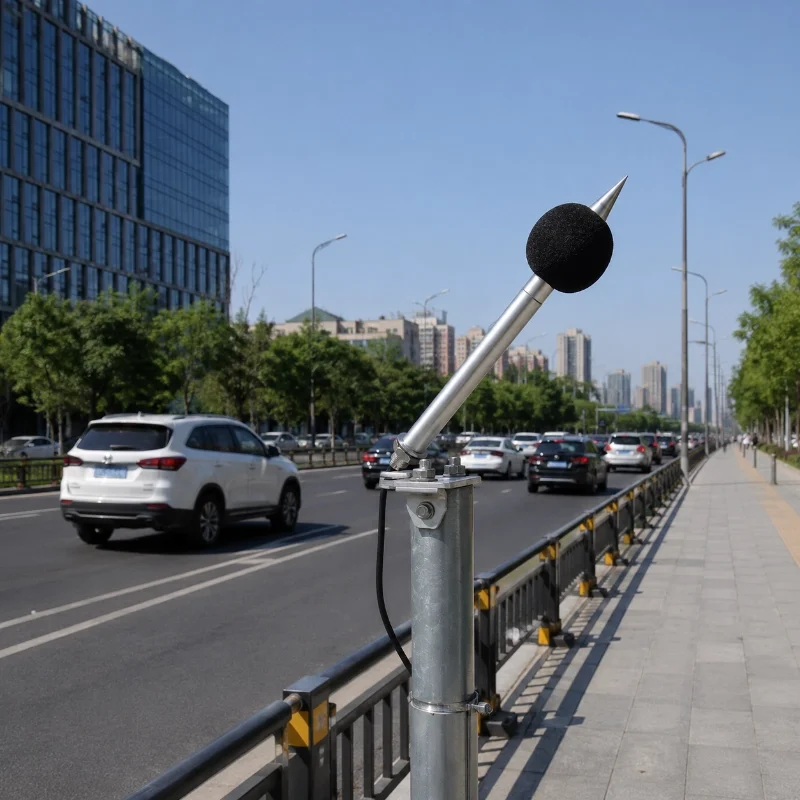
The system can compare noise levels with traffic volume, vehicle type, congestion and time of day.
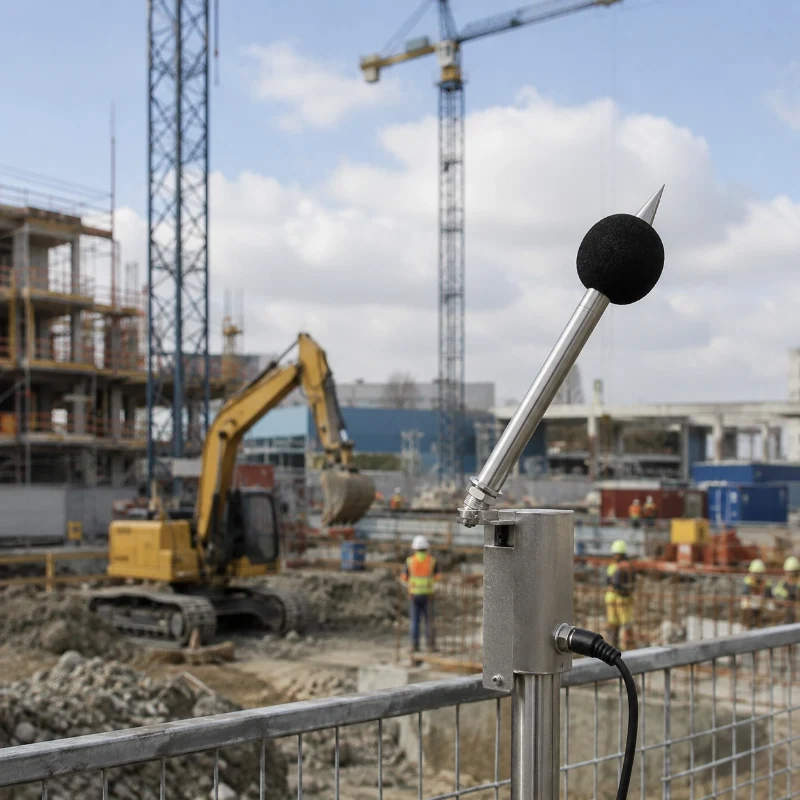
Construction Noise Monitoring
Temporary or mobile monitoring stations can be installed around major construction projects.
The platform may provide:
- Real-time threshold alarms
- Contractor performance records
- Day and night comparisons
- Automatic compliance reports
- Public complaint verification
Industrial Boundary Monitoring
Noise sensors can be installed along the boundaries of factories, logistics parks, power facilities, mines and industrial zones.
These networks help distinguish recurring operational noise from temporary events and surrounding traffic.
Sensitive-Area Monitoring
Schools, hospitals, residential communities, libraries, parks and protected quiet areas may require dedicated monitoring points.
For these locations, nighttime and long-duration average indicators may be more important than individual short noise peaks.
Step 2: Select the Right Noise Indicators
A city monitoring network should not store only instantaneous decibel values. It should calculate indicators that describe both the average acoustic environment and short-duration events.
Common noise indicators include:
LAeq
LAeq is the A-weighted equivalent continuous sound level measured over a defined period.
It represents the average acoustic energy during that period and is widely used for environmental noise assessment.
Typical reporting intervals include:
- LAeq,1min
- LAeq,5min
- LAeq,15min
- LAeq,1h
- Daily LAeq
Lmax and Lmin
Lmax records the highest sound level measured during an interval, while Lmin records the lowest.
These values are useful for identifying sudden events, quiet periods and extreme peaks.
Statistical Noise Levels
Indicators such as L10, L50 and L90 describe the sound levels exceeded during a certain percentage of the measurement period.
For example:
- L10 can help represent intermittent or traffic-related noise
- L50 represents a median acoustic condition
- L90 is often used as an indication of background noise
Day, Evening and Night Indicators
For long-term urban assessment, cities may also calculate day, evening and night indicators according to local regulations.
WHO guidance describes indicators such as Lnight and A-weighted equivalent continuous sound levels as useful for environmental noise monitoring and exposure assessment.
The exact indicators and calculation periods should be selected according to applicable national or municipal regulations.
Step 3: Design the Monitoring-Point Layout
Sensor placement has a major influence on data quality.
Installing many sensors does not automatically produce a useful network. Each location should represent a clearly defined acoustic environment.
Divide the City into Monitoring Zones
A practical approach is to classify the city into zones such as:
- Residential areas
- Commercial centers
- Industrial districts
- Main road corridors
- Railway areas
- Airport influence zones
- Construction-intensive areas
- Schools and hospitals
- Parks and quiet zones
- Mixed-use neighborhoods
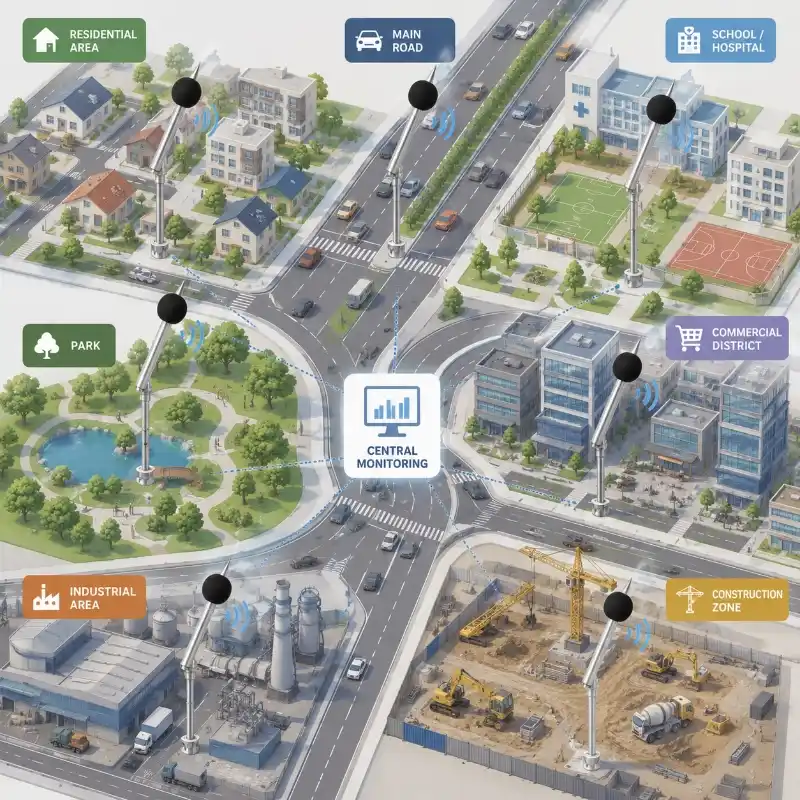
At least one representative monitoring point can be selected for each important zone. Larger or more acoustically complex areas may require several points.
Use Fixed and Mobile Monitoring Together
Fixed stations provide stable, long-term trend data.
Mobile stations can be moved between locations to:
- Investigate complaints
- Validate noise models
- Evaluate temporary events
- Compare candidate permanent sites
- Increase coverage without installing a permanent sensor everywhere
A hybrid network often provides better cost efficiency than relying entirely on fixed stations.
Avoid Unrepresentative Locations
Monitoring points should generally avoid:
- Locations immediately behind large walls
- Positions directly beside ventilation outlets
- Areas affected by local mechanical equipment
- Enclosed corners that create strong reflections
- Tree branches or structures that touch the sensor
- Locations vulnerable to deliberate interference
The installation position, height, distance from facades and surrounding surfaces should follow the project method and applicable local standards.
Step 4: Choose Suitable Outdoor Noise Sensors
A city noise sensor should be designed for continuous unattended operation.
Important selection criteria include:
Measurement Range
A range of approximately 30 to 130 dB can cover many urban, construction and industrial monitoring applications.
JW-IoT provides an Industrial Noise Sensor with a 30–130 dB measurement range. It supports RS485 and other signal outputs for integration with data loggers, RTUs, gateways and remote monitoring platforms.
Measurement Accuracy and Resolution
Accuracy requirements depend on whether the system is used for:
- General environmental awareness
- Operational supervision
- Screening and hotspot detection
- Regulatory reporting
- Acoustic research
For regulatory applications, verify that the complete measurement chain, calibration process and installation method meet the required local standard.
Frequency Weighting
A-weighted sound levels are commonly used because they approximate the sensitivity of human hearing across different frequencies.
Projects may also require C-weighting, Z-weighting, octave-band analysis or audio-event classification. These functions should be confirmed during system design.
Time Weighting
Fast, slow and impulse time weightings may be relevant for specific applications.
A city network should define these settings consistently so data from different monitoring points can be compared.
Outdoor Protection
Long-term outdoor sensors should consider:
- IP protection level
- Wind protection
- Rain resistance
- UV-resistant housing
- Temperature range
- Humidity resistance
- Corrosion resistance
- Insect protection
- Cable and connector protection
An IP rating alone does not guarantee measurement quality. The microphone, windscreen, housing and installation structure must work together under outdoor conditions.
Step 5: Decide Whether to Use a Dedicated or Multi-Parameter Sensor
Some projects require only noise data. Others benefit from measuring noise together with additional environmental parameters.
Dedicated Noise Sensor
A dedicated noise sensor is suitable when:
- Noise accuracy is the main priority
- The project already has separate weather equipment
- Industrial or construction monitoring is required
- The sensor must connect to an existing PLC or RTU
- Flexible signal outputs are needed
Multi-Parameter Environmental Sensor
A multi-parameter sensor can reduce wiring and installation work in dense smart city networks.
The JW-IoT 6-in-1 Air Quality Sensor measures noise, PM2.5, PM10, air temperature, relative humidity and light intensity. It supports RS485 Modbus RTU and is suitable for smart poles, roads, construction sites and distributed environmental monitoring points.
Another option is the Environmental Sensor for Smart City Air Quality, which combines environmental noise with particulate matter, temperature, humidity and illumination monitoring in a compact IP65 structure.
Combining noise with weather and air-quality data can help operators interpret why sound levels change. For example, wind, rainfall, traffic conditions, construction dust and human activity may influence the observed data.
Step 6: Select the Communication Architecture
Communication technology should be selected according to sensor density, distance, power availability, network coverage and data frequency.
RS485 Modbus
RS485 Modbus is suitable for connecting sensors to a nearby data logger, PLC, RTU or gateway.
Advantages include:
- Stable wired communication
- Simple multi-sensor integration
- Wide industrial compatibility
- Low communication cost
- Suitability for monitoring cabinets and smart poles
RS485 normally forms the local connection between a sensor and an IoT gateway rather than the complete citywide transmission network.
LoRaWAN
LoRaWAN is suitable for distributed low-power monitoring points where a city or district can deploy gateways.
It is often considered when:
- Many monitoring nodes are installed
- Data packets are relatively small
- Battery or solar power is required
- Public or private LoRaWAN coverage is available
- Low operating power is important
Network planners should conduct a coverage survey before final deployment, especially in dense urban areas with tall buildings.
4G LTE
4G is suitable for independent monitoring stations that need direct internet access.
It can be useful for:
- Construction sites
- Industrial boundaries
- Mobile monitoring stations
- Remote roads
- Temporary projects
- Locations without LoRaWAN infrastructure
Each station normally requires a SIM card and data plan.
Ethernet or Fiber
Ethernet is suitable for smart poles, public buildings, traffic infrastructure and monitoring cabinets with existing network access.
It can provide high reliability and support more frequent data transmission.
Hybrid Communication
Large city networks may combine several communication methods.
For example:
- Noise sensors connect to a local gateway through RS485.
- The gateway uploads data through 4G, Ethernet or LoRaWAN.
- MQTT or an API sends the data to a city platform.
- A central database stores and processes the measurements.
JW-IoT provides communication devices supporting technologies such as LoRaWAN, 4G, Ethernet, RS485 and MQTT for remote monitoring systems.
Step 7: Design the Power Supply
Noise monitoring stations require continuous and stable power.
Mains Power
Mains power is appropriate for:
- Smart light poles
- Public buildings
- Traffic cabinets
- Industrial facilities
- Permanent monitoring stations
Backup power should be considered when data continuity is important.
Solar Power
Solar power can be used for roadside, construction, park or remote monitoring points without convenient electrical access.
A solar system should be sized according to:
- Sensor consumption
- Gateway consumption
- Data-transmission frequency
- Solar radiation conditions
- Battery capacity
- Required backup days
- Seasonal weather
- Panel orientation
- Equipment aging
The design should be based on the complete station load, not only the sensor power consumption.
Battery Power
Battery-only designs may be suitable for short-term surveys or low-power LoRaWAN nodes.
Maintenance intervals and cold-weather battery performance must be considered before large-scale deployment.
Step 8: Build the Cloud Monitoring Platform
The platform converts sensor readings into information that city managers can use.
A city noise monitoring dashboard should ideally provide:
- GIS map display
- Real-time sound levels
- Monitoring-point status
- Historical trend charts
- Day and night comparisons
- Threshold alarms
- Device offline alarms
- Battery and power status
- Data download
- Automatic reports
- User permission management
- API access
- Maintenance records
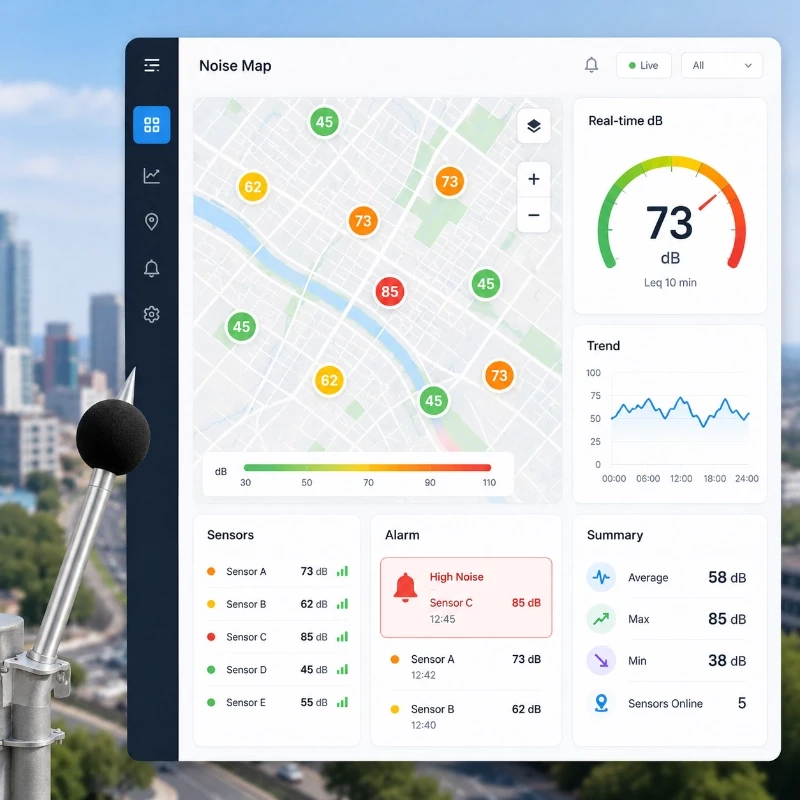
GIS-Based Visualization
Each monitoring station should have accurate coordinates.
A GIS map can display:
- Current noise levels
- Color-coded monitoring status
- Active alarms
- Device health
- Nearby roads or facilities
- Historical noise hotspots
Alarm Management
The platform should allow different thresholds for different locations and time periods.
For example, a residential station may use different daytime and nighttime alarm rules, while a construction station may follow working-hour restrictions.
To reduce false alarms, the system can require that a threshold be exceeded for a defined duration before sending a notification.
Data Quality Flags
Not every measurement should automatically be treated as valid.
The platform should flag data affected by:
- Sensor failure
- Communication interruption
- Power loss
- Calibration periods
- Extreme weather
- Maintenance activity
- Known local interference
Maintaining both the original measurement and its quality flag improves auditability.
Step 9: Create an Urban Noise Map
Monitoring stations provide direct measurements at specific locations. Noise maps estimate the acoustic environment across a wider area.
A city can combine monitoring data with:
- Road and railway locations
- Traffic volume
- Vehicle classifications
- Building geometry
- Land-use information
- Population distribution
- Industrial sources
- Terrain information
- Weather data
Continuous sensors can help validate and update modelled maps.
The result may show:
- Long-term noise exposure
- Day and night differences
- Traffic-noise corridors
- Industrial influence zones
- Quiet areas
- Population exposure
- Priority mitigation zones
Noise maps should support decisions rather than merely provide attractive visualizations. The European Commission describes noise mapping and action planning as important tools for identifying and reducing environmental noise exposure.
Step 10: Establish Calibration and Maintenance Procedures
Long-term monitoring quality depends on maintenance.
A practical maintenance plan should cover:
- Initial commissioning
- Field calibration checks
- Periodic laboratory calibration where required
- Windscreen inspection
- Microphone cleaning
- Cable inspection
- Solar-panel cleaning
- Battery testing
- Communication testing
- Firmware updates
- Time synchronization
- GPS or coordinate verification
- Comparison with a reference instrument
The system should record calibration and maintenance activities for every monitoring station.
It is also useful to configure automatic device-health alarms for:
- Missing data
- Constant or frozen readings
- Abnormal value ranges
- Repeated communication failures
- Low battery voltage
- Enclosure opening
- Clock drift
Common Mistakes When Building a City Noise Network
Installing Sensors Only Where Noise Is Already High
A useful network also needs representative residential, background and quiet-area locations. Otherwise, the data cannot describe the city as a whole.
Using Different Settings at Different Stations
Different averaging intervals, time weightings or reporting methods make cross-site comparison difficult.
A standard measurement configuration should be applied across the network.
Ignoring Meteorological Conditions
Wind, rainfall and extreme weather can affect outdoor noise measurements.
Weather information and quality-control rules should be incorporated into data analysis.
Treating IoT Sensors as Regulatory Instruments Automatically
An IoT noise sensor can provide valuable continuous trend data, hotspot identification and operational alerts. However, legal enforcement may require specific certified instruments, calibration procedures and measurement methods.
The city should clearly define which data is used for operational management and which data is used for formal regulatory assessment.
Building a Dashboard Without an Action Process
Data alone does not reduce noise.
The city should define:
- Who receives alarms
- Who verifies the event
- How complaints are handled
- When field inspection is required
- How recurring hotspots are escalated
- How mitigation results are evaluated
Example City Noise Monitoring Architecture
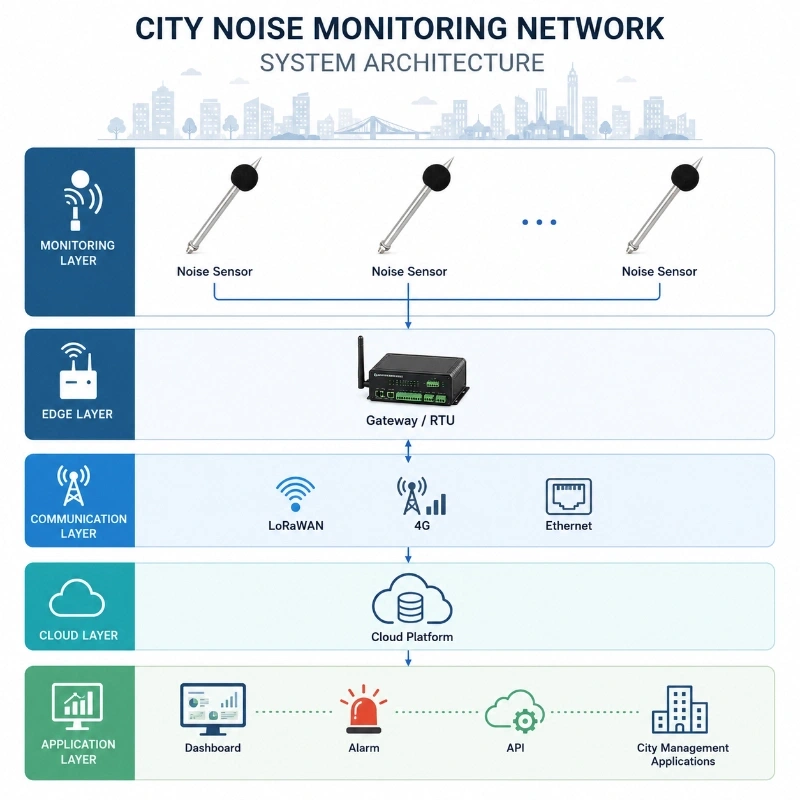
A practical distributed architecture may include:
Monitoring layer
- Dedicated noise sensors
- Multi-parameter environmental sensors
- Optional weather sensors
Edge layer
- RS485 data logger
- RTU or IoT gateway
- Local data storage
- Basic threshold processing
Communication layer
- LoRaWAN
- 4G LTE
- Ethernet
- NB-IoT
- MQTT or HTTPS
Platform layer
- Cloud database
- GIS dashboard
- Alarm engine
- Reporting module
- API interface
- Device-management system
Application layer
- City environmental department
- Traffic management
- Construction supervision
- Industrial park management
- Public information portal
- Research institutions
This modular architecture allows the city to begin with a pilot area and expand the network gradually.
How Many Noise Monitoring Stations Does a City Need?
There is no universal number.
The required number depends on:
- City size
- Population density
- Road network
- Land-use complexity
- Number of industrial sources
- Topography
- Monitoring objectives
- Available budget
- Required spatial resolution
- Use of mobile stations
- Existing environmental infrastructure
A practical rollout may begin with a pilot network in one district.
The pilot should include several contrasting locations, such as:
- A major road
- A residential neighborhood
- A construction area
- A commercial district
- A school or hospital
- A park or quiet zone
- An industrial boundary
After several months of operation, the city can review data quality, communication reliability, maintenance workload and site representativeness before expanding.
How JW-IoT Supports Urban Noise Monitoring Projects
JW-IoT provides configurable hardware and system-integration options for smart city and environmental monitoring projects.
A project configuration may include:
- Outdoor noise sensors
- Multi-parameter PM and noise sensors
- RS485 Modbus integration
- IoT data loggers
- LoRaWAN or 4G communication
- Solar-powered monitoring cabinets
- Cloud-platform connection
- API or MQTT data integration
- Dashboard customization
- OEM and white-label services
Explore the JW-IoT Smart Water and Environmental Monitoring solutions for broader city environmental monitoring applications.
For projects requiring custom communication, dashboards or third-party integration, review the JW-IoT IoT integration services.
Conclusion
Building a city noise monitoring network requires more than installing microphones around a city.
A reliable system begins with clear objectives, representative monitoring locations, suitable outdoor sensors, consistent measurement indicators, stable communication, dependable power and a platform that converts data into practical actions.
The most effective approach is usually to begin with a representative pilot network, validate the complete sensor-to-platform workflow and then expand according to measured results.
By combining fixed sensors, mobile monitoring, GIS visualization, alarms, noise maps and structured maintenance, cities can move from occasional noise surveys toward continuous and evidence-based acoustic environment management.
Plan Your City Noise Monitoring Network
JW-IoT can help configure noise sensors, multi-parameter environmental monitoring devices, communication gateways, power systems and cloud integration according to your project requirements.
Contact JW-IoT to discuss:
- Monitoring objectives
- Number of monitoring points
- Noise parameters
- Installation environments
- Communication method
- Power availability
- Platform or API requirements
- OEM and system-integration needs
Send us your city map, proposed monitoring locations, required noise indicators and preferred communication method to receive a project-specific system recommendation.
Frequently Asked Questions
What is a city noise monitoring network?
A city noise monitoring network is a group of connected sound-level monitoring stations installed across urban areas. The stations continuously collect noise data and transmit it to a central platform for mapping, alarms, trend analysis and reporting.
Which sensors are used for urban noise monitoring?
Cities may use dedicated outdoor noise sensors or multi-parameter environmental sensors that combine noise with PM2.5, PM10, temperature, humidity and other indicators. The selection depends on accuracy requirements and project objectives.
Can noise sensors transmit data through LoRaWAN or 4G?
Yes. Noise sensors can connect to RS485 data loggers or IoT gateways, which then transmit data through LoRaWAN, 4G LTE, Ethernet or NB-IoT.
Where should city noise sensors be installed?
Common locations include major roads, residential communities, construction sites, industrial boundaries, schools, hospitals, commercial districts, parks and transportation hubs.
Can a noise monitoring network generate automatic alarms?
Yes. The platform can issue alarms when noise exceeds a configured threshold for a defined period. Different thresholds can be applied by location, time of day or land-use zone.
Can noise data be displayed on a GIS map?
Yes. Each station can be linked to geographic coordinates so current readings, alarms, trends and device status can be displayed on a city map.
Is an IoT noise sensor suitable for legal enforcement?
It depends on local regulations. IoT sensors are effective for continuous trends, hotspot detection and operational alerts, but formal enforcement may require certified sound-level meters and prescribed calibration and measurement procedures.
Can noise monitoring be combined with air-quality monitoring?
Yes. Noise can be monitored together with PM2.5, PM10, gases, weather and illumination. A combined network can provide a more complete understanding of the urban environment.
Can JW-IoT customize a city noise monitoring system?
Yes. JW-IoT can configure sensors, RS485 data acquisition, LoRaWAN or 4G communication, solar power, cloud dashboards, APIs and OEM solutions according to project requirements.