+86 13520127780
  info@jingelway.com








How Online Sludge Concentration Monitoring Improves Wastewater Treatment Process Control
Release time: 2026-08-19
Wastewater treatment performance depends heavily on what is happening inside the biological treatment process—not simply on the quality of the final effluent.
One of the most important parameters is sludge concentration, often monitored as mixed liquor suspended solids (MLSS) in activated sludge systems.
If sludge concentration becomes too low, biological treatment capacity may decline. If it becomes too high, oxygen demand, sludge settling behavior, energy consumption, and solids handling can all be affected.
For this reason, many municipal and industrial wastewater treatment systems are moving from periodic manual sampling toward online sludge concentration monitoring.
An online sludge concentration sensor provides continuous information about suspended solids inside aeration tanks, biological reactors, return activated sludge lines, and sludge treatment processes. When combined with dissolved oxygen, pH, turbidity, flow, and other process data, MLSS monitoring becomes an important part of intelligent wastewater treatment control.
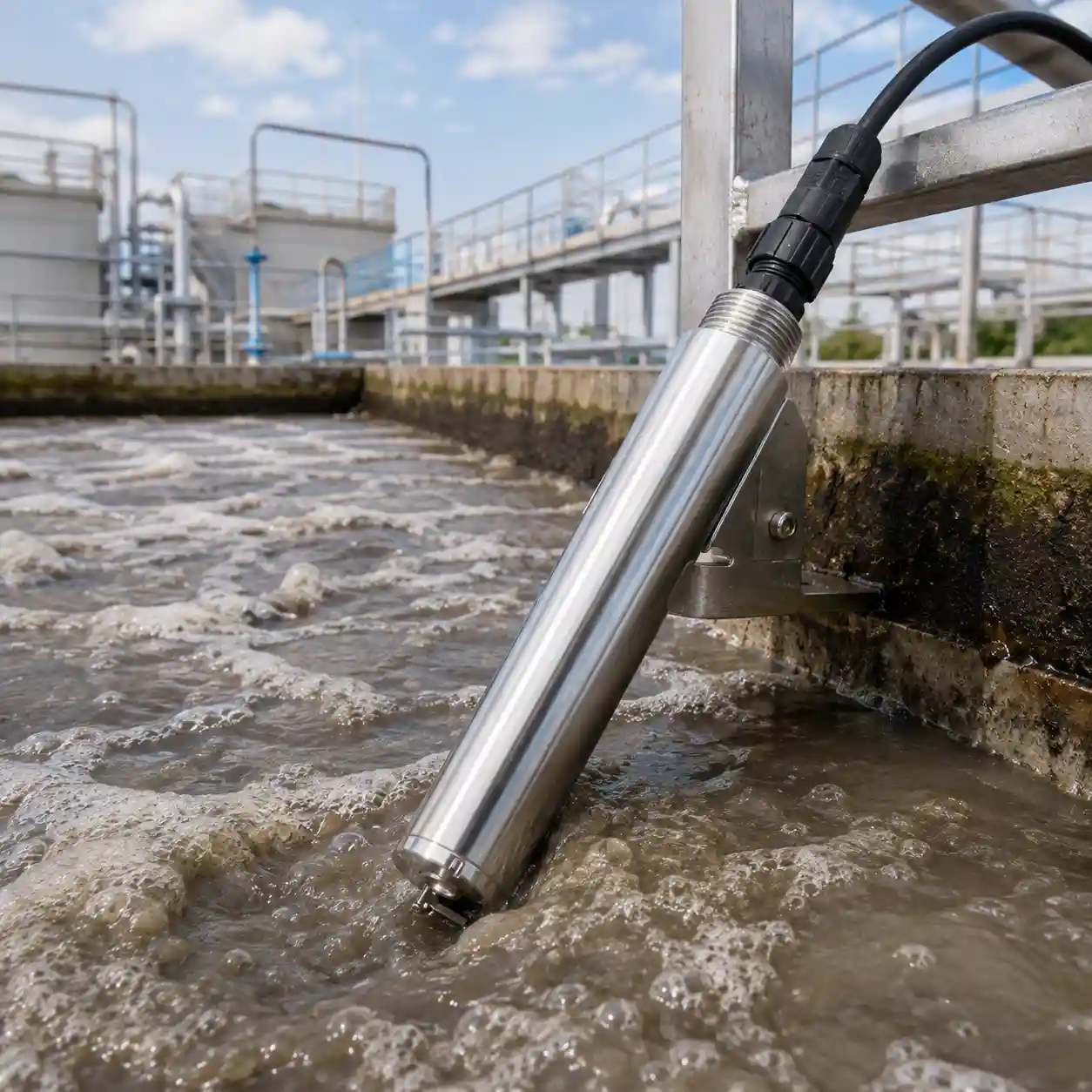
What Is Sludge Concentration in Wastewater Treatment?
Sludge concentration refers to the amount of suspended biological and solid material present in a wastewater treatment process.
In activated sludge systems, one of the most commonly used indicators is MLSS—Mixed Liquor Suspended Solids.
MLSS represents the suspended solids contained in the mixed liquor inside an aeration tank or biological reactor.
These solids may include:
- Active microorganisms
- Organic particles
- Inorganic suspended material
- Biological flocs
- Other suspended solids
Maintaining an appropriate sludge concentration helps operators keep sufficient biomass in the biological treatment process while avoiding excessive solids accumulation.
Because MLSS conditions can change continuously with influent load, sludge recycling, aeration, temperature, and process operation, periodic laboratory measurements alone may not show short-term changes.
This is where an online MLSS sensor becomes useful.
Why Is MLSS Monitoring Important in Activated Sludge Treatment?
Activated sludge treatment depends on microorganisms to remove biodegradable pollutants from wastewater.
The biomass concentration therefore has a direct relationship with process operation.
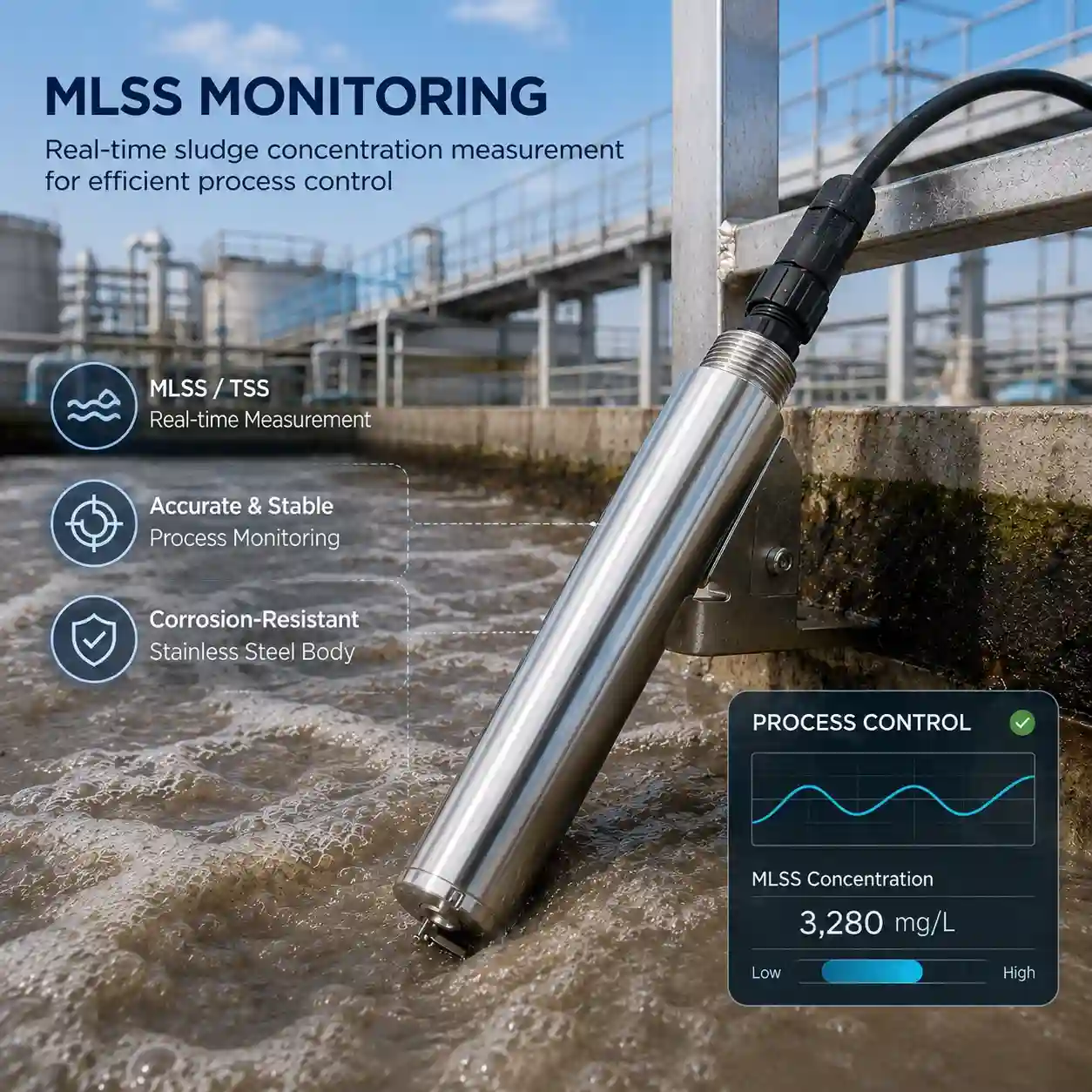
1. Maintaining Sufficient Biomass
If the sludge concentration becomes too low, the biological reactor may contain insufficient active biomass to efficiently process the incoming organic load.
Possible consequences include:
- Reduced biological treatment efficiency
- Lower process stability
- Greater sensitivity to hydraulic or organic load changes
- Difficulty maintaining the desired sludge retention condition
Continuous MLSS monitoring helps operators identify these changes earlier.
2. Preventing Excessive Sludge Accumulation
Higher sludge concentration does not always mean better treatment.
Excessive solids inside the aeration tank can contribute to:
- Increased oxygen demand
- Higher aeration energy consumption
- Poor mixing
- Settling problems
- Increased return sludge load
- Greater sludge handling requirements
Online sludge concentration monitoring allows operators to observe whether solids are gradually accumulating rather than waiting for periodic laboratory results.
3. Supporting Sludge Wasting Control
Waste activated sludge removal is an important operational variable in biological wastewater treatment.
If too little sludge is removed, MLSS may continue to rise.
If too much is removed, biological solids may decrease below the desired operating level.
An online MLSS measurement therefore provides useful process information for adjusting sludge wasting strategies.
4. Improving Process Stability
Industrial wastewater treatment plants can experience rapidly changing influent conditions.
Production schedules, cleaning processes, batch discharges, chemical use, and changes in raw materials can all influence wastewater composition.
Continuous sludge concentration monitoring makes it easier to identify how the biological process responds to these changes.
For a broader factory monitoring architecture, see the JW-IoT Industrial Wastewater Monitoring Solution
Where Should a Sludge Concentration Sensor Be Installed?
There is no single installation point suitable for every wastewater treatment plant.
The correct monitoring location depends on the process design and the information the operator needs.
Several locations are commonly considered.
Aeration Tank
The aeration tank is one of the most important locations for MLSS monitoring.
Here, operators can continuously track the concentration of suspended biological solids involved in wastewater treatment.
Monitoring MLSS together with dissolved oxygen can provide a more complete picture of biological reactor conditions.
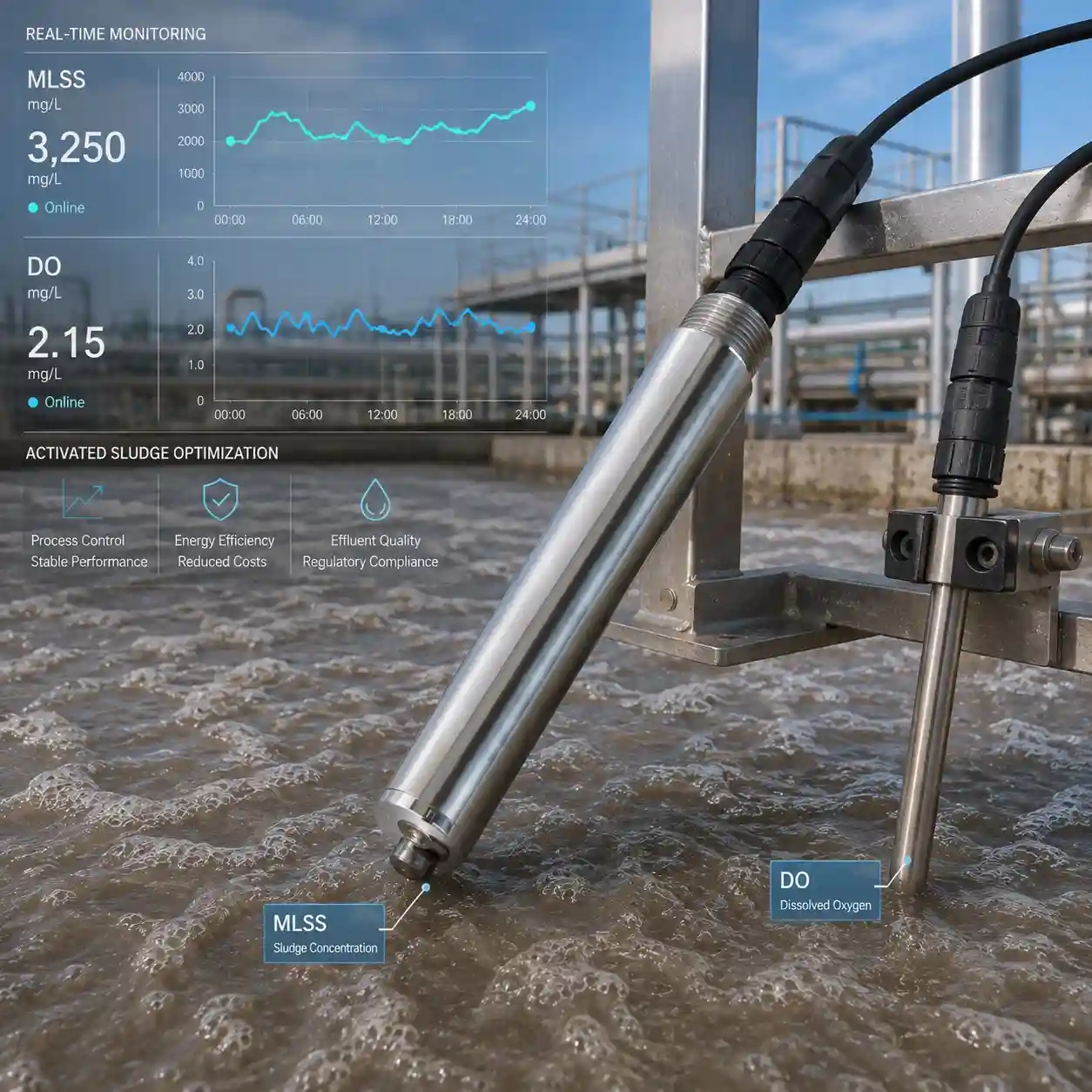
Typical parameters:
- MLSS
- Dissolved oxygen
- Temperature
- pH
- ORP
Related JW-IoT sensor:
Optical Dissolved Oxygen Sensor for Online Water Monitoring
Return Activated Sludge
Return activated sludge typically has a significantly higher solids concentration than mixed liquor in the aeration basin.
Monitoring sludge concentration in return streams can help operators evaluate sludge recirculation conditions.
When selecting a sensor, always confirm whether its measurement range is suitable for the expected solids concentration at the specific installation point.
Sludge Treatment Process
Sludge concentration measurement may also be useful during:
- Sludge thickening
- Sludge conditioning
- Sludge storage
- Dewatering preparation
- Industrial solids handling
The objective here may differ from aeration tank MLSS monitoring.
Instead of controlling biomass concentration, the system may be used to monitor changes in sludge solids during treatment or transfer.
How Does an Online Sludge Concentration Sensor Work?
Many online sludge concentration sensors use an optical measurement principle.
The sensor emits light into the wastewater or sludge mixture.
Suspended particles interact with the optical signal through scattering or attenuation. The sensor analyzes this response and converts it into a sludge or suspended solids concentration value according to its calibration.
This approach allows continuous measurement without requiring operators to manually collect samples every time a process reading is needed.
A typical monitoring architecture is:
Sludge Concentration Sensor → RS485 / Controller → RTU or Data Logger → IoT Gateway → Cloud Platform
The resulting data can then be used for:
- Real-time monitoring
- Historical trend analysis
- Alarm generation
- Process comparison
- Remote plant management
Online MLSS Monitoring vs Laboratory Measurement
Laboratory suspended solids measurement remains important for verification and reference.
However, laboratory and online measurement serve different purposes.
| Measurement Method | Laboratory Testing | Online MLSS Sensor |
| Measurement type | Periodic | Continuous |
| Response to process changes | Delayed | Near real time |
| Manual sampling | Required | Reduced |
| Historical trend | Limited sampling points | Continuous trend |
| Remote monitoring | No | Yes |
| Alarm capability | No | Yes |
| Process automation | Limited | Suitable for integration |
The two methods should not necessarily be considered replacements for one another.
A practical strategy is often to use laboratory analysis for verification and calibration while using online sensors for continuous process monitoring.
MLSS Sensor vs Turbidity Sensor: What Is the Difference?
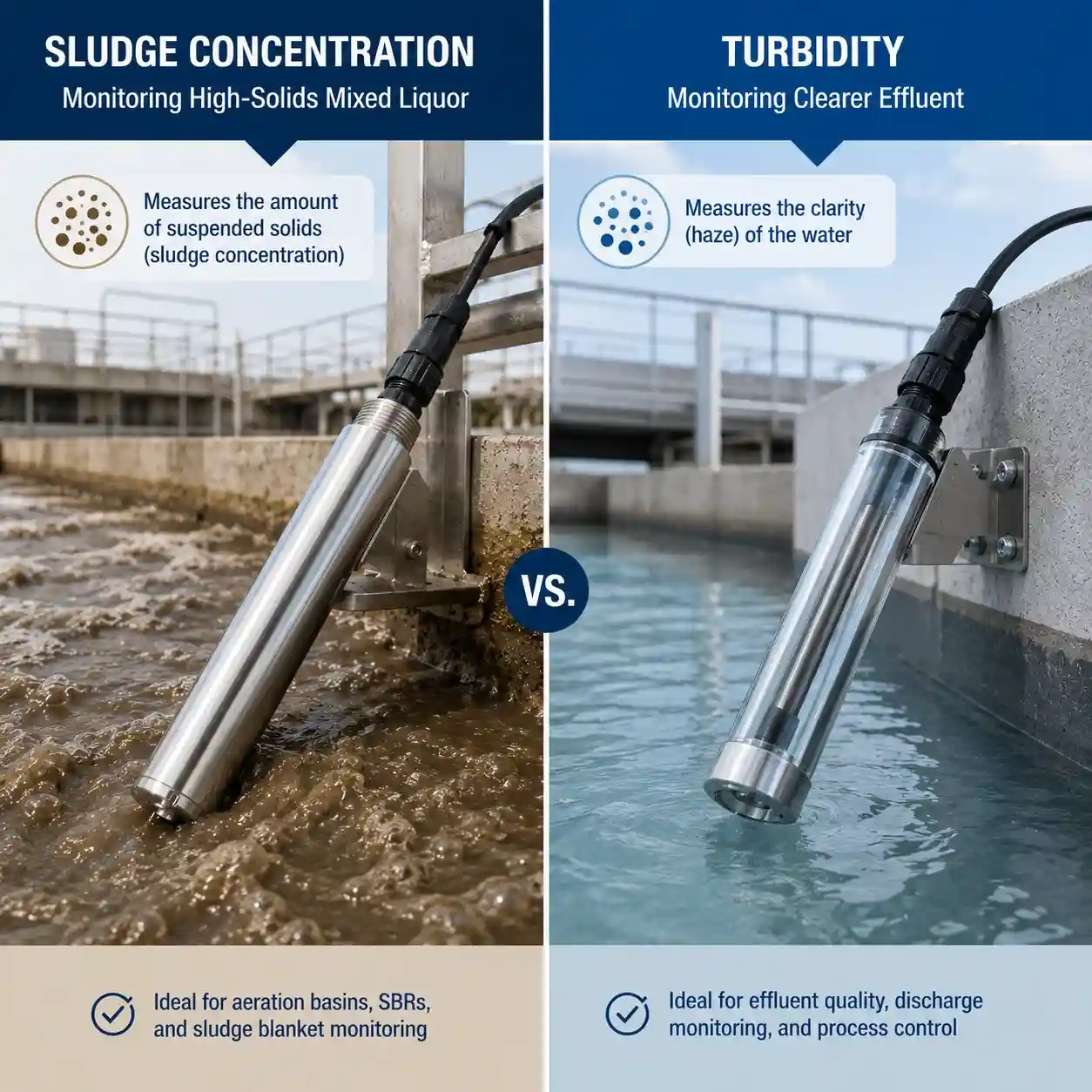
This is an important distinction in wastewater monitoring.
A turbidity sensor measures how suspended material affects the optical clarity of water.
A sludge concentration or suspended solids sensor is designed specifically to estimate the amount of suspended solids in higher-solids applications.
Although both may use optical principles, their intended measurement ranges and calibration models can be different.
Turbidity sensors are commonly used for:
- Treated wastewater
- Clarifier outlet
- Surface water
- Drinking water
- Industrial water
- Effluent monitoring
Sludge concentration sensors are more suitable for:
- Aeration tanks
- Activated sludge
- Biological reactors
- Return sludge
- Sludge treatment processes
JW-IoT also provides an online turbidity sensor for wastewater treatment applications.
Selecting between turbidity and sludge concentration monitoring should therefore begin with the expected solids concentration and process objective, rather than simply choosing whichever optical sensor is available.
What Parameters Should Be Monitored Together With MLSS?
MLSS becomes more valuable when interpreted together with other wastewater process parameters.
Dissolved Oxygen
Dissolved oxygen indicates whether sufficient oxygen is available for aerobic microorganisms.
Looking at DO + MLSS together gives operators better information than either value alone.
For example, increasing MLSS without corresponding oxygen capacity may increase aeration demand.
Related sensor: https://www.jw-iot.com/optical-dissolved-oxygen-sensor/
pH
Biological wastewater treatment generally performs best within an appropriate pH range.
Rapid pH changes may indicate:
- Chemical discharge
- Production changes
- Dosing problems
- Abnormal influent conditions
JW-IoT provides RS485 Modbus pH sensors for continuous industrial water and wastewater monitoring.
ORP
Oxidation-reduction potential can provide additional information about aerobic, anoxic, and anaerobic process conditions.
It is particularly useful in biological nutrient removal processes.
Related JW-IoT product:https://www.jw-iot.com/orp-water-quality-sensor-for-industrial-monitoring/
Turbidity and Suspended Solids
Monitoring solids downstream of clarification can help operators understand whether solids are escaping from the treatment process.
For this reason, a complete plant may use:
- MLSS monitoring in the aeration tank
- Sludge concentration monitoring in sludge streams
- Turbidity or suspended solids monitoring in final effluent
Ammonia Nitrogen
Ammonia nitrogen monitoring provides additional information about nitrification performance.
When ammonia, DO, temperature, pH, and MLSS are analyzed together, operators obtain a more complete picture of the biological process.
Related product: https://www.jw-iot.com/online-ammonia-nitrogen-sensor-for-water-monitoring/
Building an IoT Wastewater Monitoring System
A modern wastewater monitoring project usually extends beyond individual sensors.
The complete system may contain four layers.
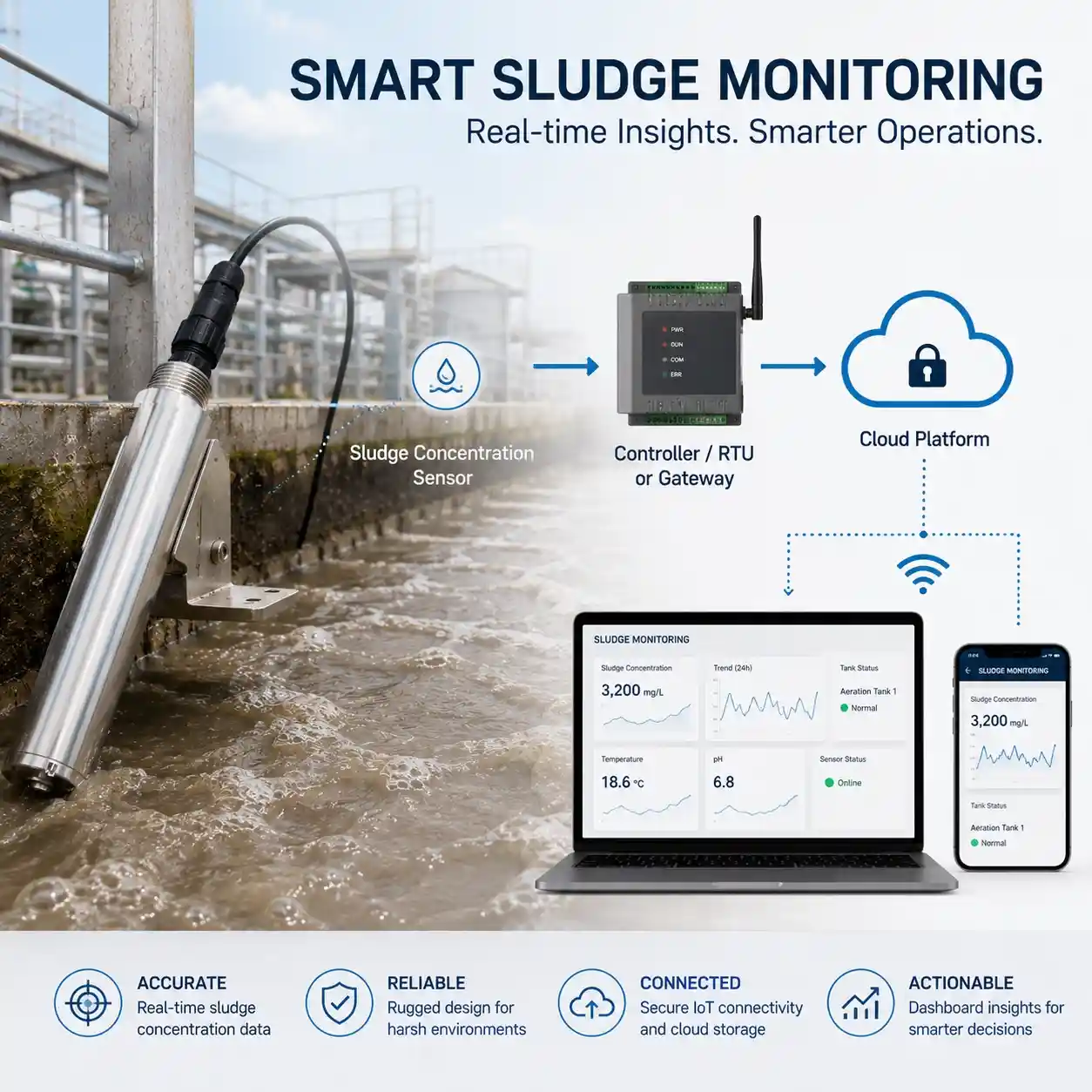
Layer 1: Field Sensors
Depending on the process, sensors may measure:
- MLSS / sludge concentration
- Dissolved oxygen
- pH
- ORP
- Conductivity
- Turbidity
- Ammonia nitrogen
- Nitrate nitrogen
- Temperature
- Water level
- Flow
JW-IoT’s water sensor portfolio covers water quality, level, and flow measurement for wastewater and environmental applications.
Explore the complete Water Sensors category:
https://www.jw-iot.com/category/products/water-sensors
Layer 2: Data Acquisition
Sensors can be connected to:
- PLC
- DCS
- RTU
- Data logger
- Industrial controller
RS485 Modbus RTU is particularly useful for multi-sensor industrial monitoring because multiple instruments can be integrated into a common data acquisition architecture.
Layer 3: Communication
Depending on site conditions, data can be transmitted using:
- Ethernet
- 4G LTE
- LoRaWAN
- NB-IoT
- Wi-Fi
- Existing industrial networks
The correct communication method depends on plant layout, number of monitoring points, existing infrastructure, and whether remote cloud monitoring is required.
Layer 4: Cloud or SCADA Platform
Once data reaches the monitoring platform, operators can use it for:
- Real-time dashboards
- Historical curves
- Multi-point comparison
- Threshold alarms
- Mobile access
- Data export
- API integration
- Maintenance planning
A typical architecture may look like:
MLSS + DO + pH + ORP + Turbidity → RTU / PLC → Gateway → Cloud / SCADA → Operator
This approach turns individual wastewater sensors into a complete process monitoring system.
Why Multi-Parameter Monitoring Is Better Than One-Sensor Monitoring
Wastewater treatment is a dynamic process.
One abnormal parameter rarely explains the entire situation.
For example, a change in sludge concentration may be related to:
- Influent load
- Aeration
- Sludge return rate
- Sludge wasting
- Temperature
- pH
- Hydraulic conditions
- Biological activity
For this reason, wastewater projects increasingly combine several sensors rather than relying on a single instrument.
JW-IoT also offers integrated multi-parameter water quality sensors capable of combining parameters such as DO, pH, conductivity, ORP, turbidity, and temperature, with RS485 Modbus RTU communication and optional self-cleaning for long-term monitoring.
For highly contaminated industrial wastewater, separate specialized probes may still be preferable when different sensors require different installation points or maintenance frequencies.
Common Industrial Applications for Sludge Concentration Monitoring
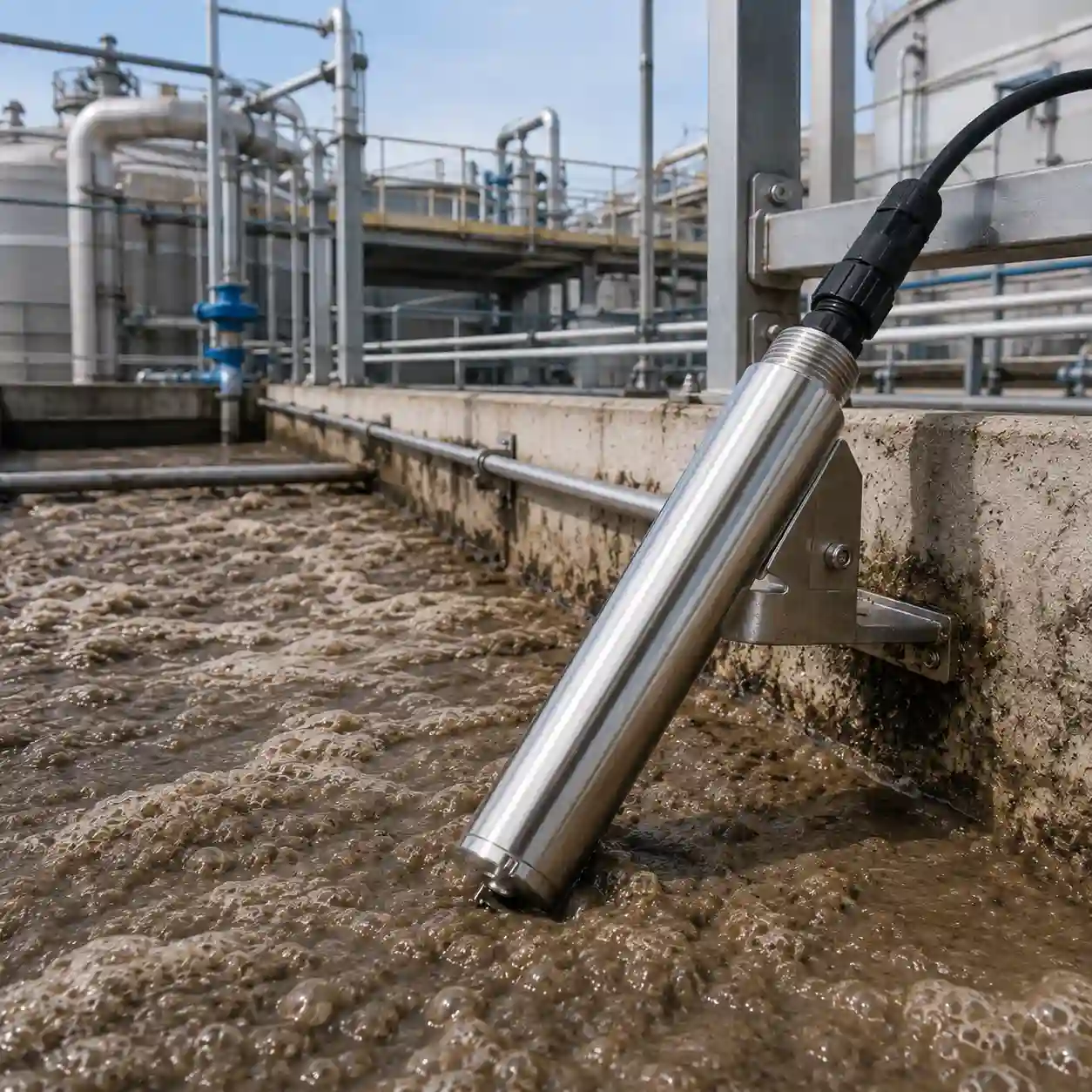
Online sludge concentration monitoring can be applied across many wastewater treatment industries.
Municipal Wastewater Treatment
Used for activated sludge process optimization, aeration basin monitoring, sludge recycling, and sludge handling.
Food and Beverage Wastewater
Organic loading can fluctuate significantly with production cycles, making continuous process monitoring valuable.
Chemical Manufacturing
Wastewater composition may change quickly depending on production and cleaning operations.
Pulp and Paper
High suspended solids and organic loads make solids monitoring an important part of process control.
Textile and Dyeing
Variable wastewater characteristics require close monitoring of biological treatment performance.
Pharmaceutical Manufacturing
Batch operations can cause rapidly changing wastewater loads and treatment conditions.
Electronics and Manufacturing Plants
Industrial facilities may need centralized wastewater monitoring before internal reuse or discharge.
For a broader overview of factory wastewater monitoring architecture, see:Industrial Wastewater Monitoring Solutions for Manufacturing
Installation Considerations for Sludge Concentration Sensors
Correct sensor selection alone does not guarantee reliable data.
Installation has a major influence on online measurement quality.
Avoid Dead Zones
Install the sensor where sludge is representative of the process rather than in stagnant areas where solids can settle.
Avoid Excessive Air Bubbles
In aeration tanks, bubbles may interfere with optical measurements if the sensor is installed directly in extremely turbulent aeration zones.
The sensor should monitor representative mixed liquor while avoiding unnecessary bubble interference where possible.
Keep the Optical Surface Clean
Wastewater contains:
- Biological growth
- Grease
- Suspended solids
- Fibers
- Inorganic deposits
These materials can accumulate on optical surfaces.
Routine inspection and cleaning schedules should therefore be established according to actual wastewater conditions.
Ensure Safe Access
Sensors should be positioned so operators can remove them for:
- Cleaning
- Calibration
- Inspection
- Replacement
without unnecessarily disrupting treatment operations.
Calibration and Maintenance
Online sludge concentration sensors require periodic verification.
A practical maintenance program can include:
- Visual inspection of the sensing surface
- Regular cleaning
- Comparison with laboratory suspended solids results
- Calibration adjustment when necessary
- Inspection of cables and connectors
- Review of abnormal historical trends
Calibration frequency depends on:
- Wastewater characteristics
- Solids concentration
- Fouling rate
- Installation environment
- Required measurement accuracy
Facilities with highly variable industrial wastewater may require more frequent verification than relatively stable municipal treatment systems.
How to Choose an Online Sludge Concentration Sensor
Before purchasing a sensor, prepare the following information.
1. Expected Measurement Range
An aeration tank and a return sludge line can have very different solids concentrations.
Make sure the sensor range matches the actual installation point.
2. Installation Location
Specify whether the sensor will be installed in:
- Aeration tank
- SBR
- MBR
- Return sludge line
- Sludge thickener
- Industrial treatment tank
3. Communication Requirements
Typical options may include:
- RS485 Modbus RTU
- Analog output
- PLC integration
- IoT gateway connection
4. Maintenance Conditions
Consider:
- Fouling
- Cleaning frequency
- Accessibility
- Sensor mounting method
5. System Integration
For a complete IoT project, also confirm:
- Number of monitoring points
- Communication network
- Cloud platform requirement
- API integration
- Alarm logic
- Power supply
This information allows the supplier to recommend a configuration based on the process rather than simply selecting a sensor by model number.
JW-IoT Sludge Concentration Monitoring Solution
JW-IoT provides online sensors and IoT monitoring solutions for municipal and industrial wastewater applications.
The JW-MLSS-406(K25) sludge concentration sensor is designed for continuous monitoring of suspended solids concentration in wastewater treatment and sludge processes.
It can be integrated into monitoring systems together with:
- Dissolved oxygen sensors
- pH sensors
- ORP sensors
- Turbidity sensors
- Conductivity sensors
- Ammonia nitrogen sensors
- Water level sensors
- Flow meters
- RTUs
- IoT gateways
- Cloud platforms
Recommended Product
Sludge Concentration Sensor for Online Wastewater Monitoring
For projects based on the existing product page, you may also link to:
FAQ
1. What is an MLSS sensor?
An MLSS sensor is an online instrument used to continuously estimate mixed liquor suspended solids concentration in biological wastewater treatment processes such as aeration tanks and activated sludge systems.
2. Why is MLSS important in wastewater treatment?
MLSS indicates the concentration of suspended biological solids in the treatment reactor. Maintaining an appropriate concentration helps support biological treatment efficiency and stable process operation.
3. Where should a sludge concentration sensor be installed?
Typical locations include aeration tanks, biological reactors, return activated sludge systems, SBR tanks, MBR processes, sludge thickeners, and industrial sludge treatment systems.
4. Is a sludge concentration sensor the same as a turbidity sensor?
No. Although both can use optical measurement principles, turbidity sensors are primarily used to measure water clarity or suspended-particle effects, while sludge concentration sensors are designed for higher suspended-solids applications such as activated sludge and sludge treatment.
5. Can MLSS sensors connect to PLC systems?
Yes. Industrial online sludge concentration sensors with outputs such as RS485 Modbus RTU can be integrated with PLCs, RTUs, data loggers, industrial controllers, gateways, and monitoring platforms.
6. What parameters should be monitored with MLSS?
Common complementary parameters include dissolved oxygen, pH, ORP, temperature, turbidity, ammonia nitrogen, nitrate nitrogen, water level, and flow.
7. Can sludge concentration monitoring be used in industrial wastewater?
Yes. It is useful in industrial biological wastewater treatment systems where organic load and process conditions may vary with production activity.
8. Can JW-IoT provide a complete wastewater monitoring system?
Yes. JW-IoT can combine water quality sensors, data acquisition equipment, communication devices, and cloud monitoring platforms according to project requirements.
9. How often should an online MLSS sensor be cleaned?
There is no universal interval. Cleaning frequency depends on solids concentration, biofouling, grease, fibers, and other characteristics of the wastewater. Maintenance should be based on site conditions and comparison with laboratory reference measurements.
Conclusion
Effective wastewater treatment requires more than measuring the final discharge.
Operators also need visibility into what is happening inside the biological process.
Online sludge concentration monitoring provides continuous MLSS and suspended solids data that can help wastewater treatment teams understand biomass conditions, identify process changes, optimize sludge handling, and improve operational decisions.
Its real value becomes even greater when MLSS data is combined with dissolved oxygen, pH, ORP, turbidity, ammonia, flow, and other process parameters.
By connecting these sensors to PLCs, RTUs, IoT gateways, or cloud platforms, municipal utilities and industrial facilities can move from isolated measurements toward a more complete smart wastewater monitoring system.
For wastewater plants, engineering companies, EPC contractors, and system integrators planning an online monitoring project, JW-IoT can help configure sensors, communication methods, data acquisition, and monitoring platforms according to actual treatment processes and site conditions.
Send your treatment process, monitoring parameters, expected ranges, number of monitoring points, and communication requirements to JW-IoT for a recommended configuration.