+86 13520127780
  info@jingelway.com








Understanding Solar Irradiance Sensors for Accurate PV Performance
Release time: 2026-06-14
Introduction
Solar power generation depends directly on sunlight. For PV plants, knowing how much solar energy reaches the solar panels is essential for evaluating system efficiency, identifying performance losses, and improving operation and maintenance decisions. This is why the solar irradiance sensor has become one of the most important devices in modern PV performance monitoring systems.
A solar irradiance sensor measures solar radiation intensity in real time and provides reliable data for PV plant monitoring, performance ratio analysis, and solar power forecasting. Whether used in a utility-scale solar farm, rooftop PV system, or distributed solar project, accurate irradiance measurement helps operators understand whether a PV system is generating power as expected.
What Is a Solar Irradiance Sensor?
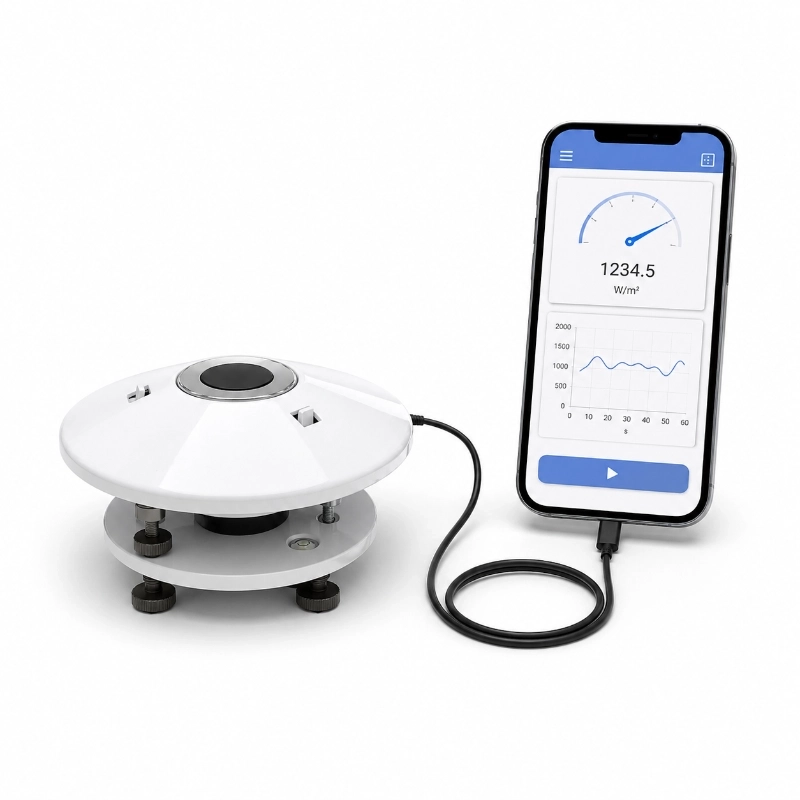
A solar irradiance sensor is a monitoring device used to measure the intensity of sunlight received on a specific surface. In PV monitoring applications, it is commonly installed near solar panels or on the same plane as the PV modules to measure the solar radiation available for power generation.
The sensor converts solar radiation into an electrical signal or digital data output. This data can then be transmitted to a data logger, weather station, SCADA system, or cloud-based PV monitoring platform.
In solar PV projects, a solar irradiance sensor is often used together with other environmental monitoring devices, such as:
Solar data loggers or IoT gateways
PV module temperature sensors
Ambient temperature and humidity sensors
Wind speed and wind direction sensors
Rain gauges
PV plant weather stations
By combining irradiance data with environmental and power generation data, PV plant operators can gain a clearer understanding of real field performance.
Why Irradiance Data Matters in PV Plants
Irradiance data is one of the key references for evaluating PV system output. If sunlight intensity is high but power generation is lower than expected, the system may have problems such as module soiling, shading, inverter issues, wiring faults, or module degradation.
Accurate irradiance measurement supports PV plant monitoring in several important ways:
First, it helps compare the available solar resource with the actual power output of the PV system. This allows operators to determine whether low generation is caused by weak sunlight or by system performance problems.
Second, it supports performance ratio calculation. Performance ratio, or PR, is an important indicator used to evaluate how efficiently a PV plant converts available solar energy into electricity.
Third, irradiance data helps improve operation and maintenance decisions. For example, if irradiance is normal but output continues to decline, the maintenance team can check for dust accumulation, shading, damaged modules, or inverter abnormalities.
Finally, long-term irradiance data helps project owners analyze solar resource trends, optimize system design, and improve future PV project planning.
GHI vs POA Irradiance
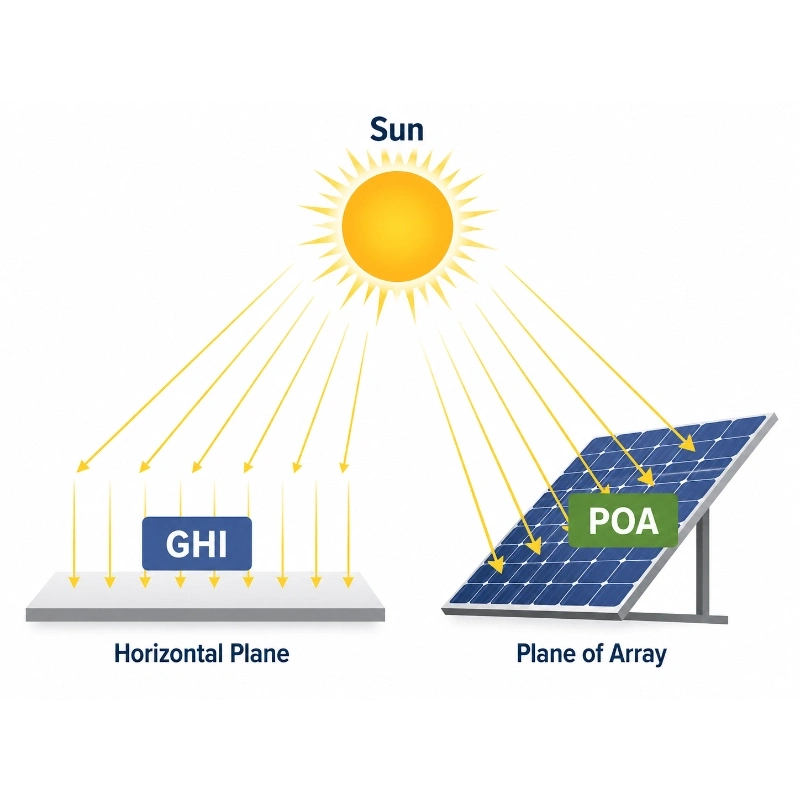
In PV performance monitoring, two common irradiance measurement types are GHI and POA.
GHI, or Global Horizontal Irradiance, refers to the total solar radiation received on a horizontal surface. It is commonly used for solar resource assessment, meteorological monitoring, and general solar radiation measurement.
POA, or Plane of Array irradiance, refers to the solar radiation received on the same tilted plane as the PV modules. Because PV panels are usually installed at a specific tilt angle, POA irradiance is more directly related to the actual solar energy available to the modules.
For PV plant performance analysis, POA irradiance is often more useful because it reflects the sunlight that reaches the surface of the solar panels. GHI is also valuable, especially when evaluating the overall solar resource of a site or comparing multiple locations.
In many professional PV plant monitoring systems, both GHI and POA data may be collected to support more detailed solar performance evaluation.
Common Output Signals RS485 Modbus and 4–20mA
A solar irradiance sensor can support different output signals depending on the monitoring system requirements. The most common output types include RS485, Modbus, and 4–20mA.
RS485 is widely used in industrial monitoring systems because it supports long-distance communication and stable data transmission. It is suitable for PV plants where sensors may be installed far from the data acquisition unit.
Modbus is a common communication protocol used in solar monitoring systems, weather stations, data loggers, and SCADA platforms. A solar radiation sensor with Modbus output can be easily integrated into many existing PV monitoring platforms.
4–20mA is an analog signal commonly used in industrial automation. It is suitable for systems that require simple and stable signal transmission, especially in harsh outdoor environments.
When selecting a solar irradiance sensor, PV project owners should consider the communication interface, platform compatibility, cable distance, power supply, environmental protection level, and installation method.
Installation Tips for PV Monitoring
Correct installation is essential for accurate irradiance measurement. Even a high-quality solar irradiance sensor may provide inaccurate data if it is installed in the wrong position or angle.
For PV performance monitoring, the sensor should be installed in an open area without shading from nearby modules, buildings, poles, cables, or vegetation. Any shadow on the sensor surface can affect the accuracy of the irradiance data.
If the sensor is used for POA irradiance measurement, it should be installed at the same tilt angle and orientation as the PV modules. This allows the sensor to measure the solar radiation received by the actual panel surface.
If the sensor is used for GHI measurement, it should be installed horizontally and kept level. This is commonly used for general solar radiation monitoring and site weather observation.
The sensor surface should be kept clean. Dust, bird droppings, leaves, snow, or water stains can reduce the measured irradiance value and lead to incorrect PV performance analysis.
For large-scale solar farms, it is recommended to install multiple irradiance monitoring points across different zones. This helps operators compare solar conditions between different areas and identify local shading or soiling problems.
How Irradiance Data Supports PR Analysis
Performance ratio is one of the most important indicators for evaluating PV plant efficiency. It compares the actual energy output of a PV system with the theoretical energy output based on available solar radiation.
A solar irradiance sensor provides the basic irradiance data needed for PR analysis. When combined with PV module temperature, inverter output, and energy generation data, it helps operators calculate whether the PV system is performing normally.
For example, if irradiance is high but the PV plant output is lower than expected, the PR value may decrease. This could indicate problems such as dust accumulation, module mismatch, inverter derating, cable losses, or equipment failure.
If irradiance is low due to cloudy weather, lower power generation may be normal. In this case, irradiance data helps avoid incorrect fault judgment.
By continuously monitoring irradiance and PV output, operators can track performance changes over time and make more accurate maintenance decisions.
Solar Irradiance Sensors in PV Plant Monitoring Systems
In a complete PV plant monitoring system, the solar irradiance sensor is often part of a larger environmental monitoring solution. It may be integrated with a PV plant weather station, solar monitoring gateway, or cloud-based IoT platform.
A typical PV monitoring system may include:
- Solar irradiance sensor for sunlight intensity measurement
- PV module temperature sensor for panel surface temperature monitoring
- Ambient temperature and humidity sensor for environmental monitoring
- Wind speed and direction sensor for weather condition analysis
- Rain gauge for rainfall monitoring
- Data logger or IoT gateway for data transmission
- Cloud platform for real-time monitoring and alarm management
This type of integrated monitoring system helps PV plant owners improve visibility, reduce manual inspection workload, and support long-term solar asset management.
Conclusion
A solar irradiance sensor is essential for accurate PV performance monitoring. By measuring sunlight intensity in real time, it helps PV plant operators evaluate power generation, calculate performance ratio, identify abnormal losses, and improve maintenance decisions.
For solar farms, rooftop PV systems, and distributed PV projects, reliable irradiance measurement provides the data foundation for smarter PV plant monitoring. When combined with module temperature sensors, weather sensors, data loggers, and cloud platforms, solar irradiance sensors help build a more accurate and efficient solar monitoring system.
Learn more about JW-IoT’s complete solution here:
Solar PV Monitoring System with IoT Automation