+86 13520127780
  info@jingelway.com








How Solar PV Soiling Monitoring Saves Maintenance Costs
Release time: 2026-08-20
Introduction
Dust, sand, pollen, bird droppings, industrial particles, and other contaminants can gradually accumulate on photovoltaic modules.
This phenomenon is known as PV soiling.
Although a thin layer of dust may appear harmless, it can reduce the amount of sunlight reaching the solar cells and create measurable power-generation losses. For large solar farms, especially in desert, semi-arid, agricultural, mining, and industrial regions, soiling can become an important operational issue.
The challenge for PV operators is not simply deciding whether panels should be cleaned.
The more important question is:
When does the expected energy recovery from cleaning justify the cost of cleaning?
Cleaning too late can allow avoidable generation losses to continue. Cleaning too frequently can increase labor, vehicle, equipment, and water costs without delivering a corresponding financial benefit.
This is where solar PV soiling monitoring becomes valuable.
By continuously tracking module cleanliness or soiling-related performance loss, operators can move from fixed cleaning intervals toward a more data-driven maintenance strategy.
A complete PV monitoring system can combine soiling data with solar irradiance, module temperature, weather conditions, and power-generation data to help O&M teams identify when cleaning is actually required.
For a broader plant-level monitoring architecture, see the
JW-IoT Solar PV Monitoring System with IoT Automation.
1. What Is Solar PV Soiling?
Solar PV soiling refers to the accumulation of material on the surface of photovoltaic modules that reduces the amount of usable solar radiation reaching the cells.
Common sources include:
- Wind-blown dust
- Sand
- Pollen
- Agricultural particles
- Industrial emissions
- Vehicle-generated dust
- Bird droppings
- Leaves and organic debris
- Salt deposits in coastal environments
The rate of soiling is highly site-specific.
Two solar farms located in different environments may experience very different accumulation patterns even if they use similar PV modules.
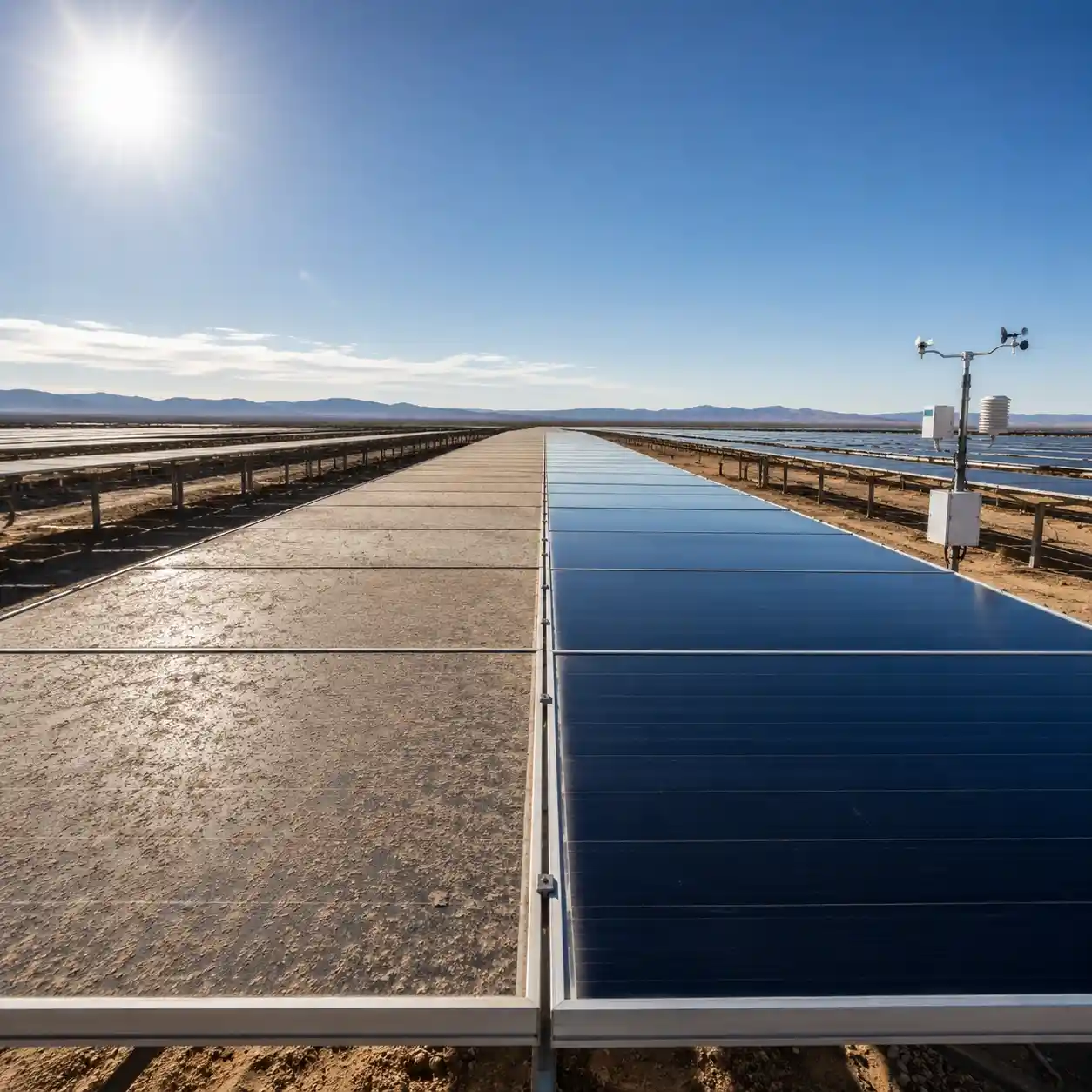
For example, a desert solar project may experience persistent dust and sand deposition, while an agricultural PV site may be more strongly affected by soil particles, pollen, or seasonal farming activities.
Rain can sometimes remove part of the accumulated material, but the effectiveness of natural cleaning depends on rainfall intensity, module angle, contaminant type, and local environmental conditions.
For this reason, operators should avoid assuming that either a fixed cleaning schedule or rainfall alone will always maintain acceptable module cleanliness.
2. How Soiling Increases Solar Farm Maintenance Costs
Soiling creates two different categories of cost.
The first is lost energy production.
The second is the cost of cleaning the modules.
Effective O&M therefore requires balancing both.
Energy Loss from Dirty Modules
When contaminants cover part of a PV module, less solar radiation reaches the cells.
As a result, actual power output may become lower than expected under the available irradiance conditions.
This loss may be gradual and difficult to identify from inverter power data alone because PV generation also changes with:
- Cloud cover
- Solar irradiance
- Module temperature
- Wind
- Seasonal sun angle
- Equipment condition
- Shading
- Grid conditions
This is why soiling analysis is more useful when it is integrated with broader PV environmental monitoring.
For example, operators can compare actual output with on-site solar radiation data from a Solar Irradiance Sensor for PV Monitoring to better understand whether lower production is related to reduced sunlight or plant-side performance loss.
Unnecessary Cleaning Costs
Cleaning itself is not free.
Depending on the project, cleaning may require:
- Maintenance personnel
- Cleaning vehicles
- Robotic cleaning systems
- Water
- Pumps and water transport
- Cleaning equipment
- Site supervision
- Access coordination
- Temporary operational restrictions
At utility-scale sites, these costs can become significant when multiplied across thousands or millions of modules.
A fixed schedule such as “clean every two weeks” may therefore be inefficient.
If modules remain relatively clean, an early cleaning operation can waste resources.
If soiling accumulates faster than expected, a fixed schedule may also respond too slowly.
The purpose of PV cleaning optimization is therefore not simply to clean less often.
It is to clean at the most economically appropriate time.
3. What Data Does Solar PV Soiling Monitoring Provide?
A solar PV soiling monitoring system provides data that helps operators understand how contamination is affecting module performance.
Depending on the measurement method and selected equipment, useful parameters may include:
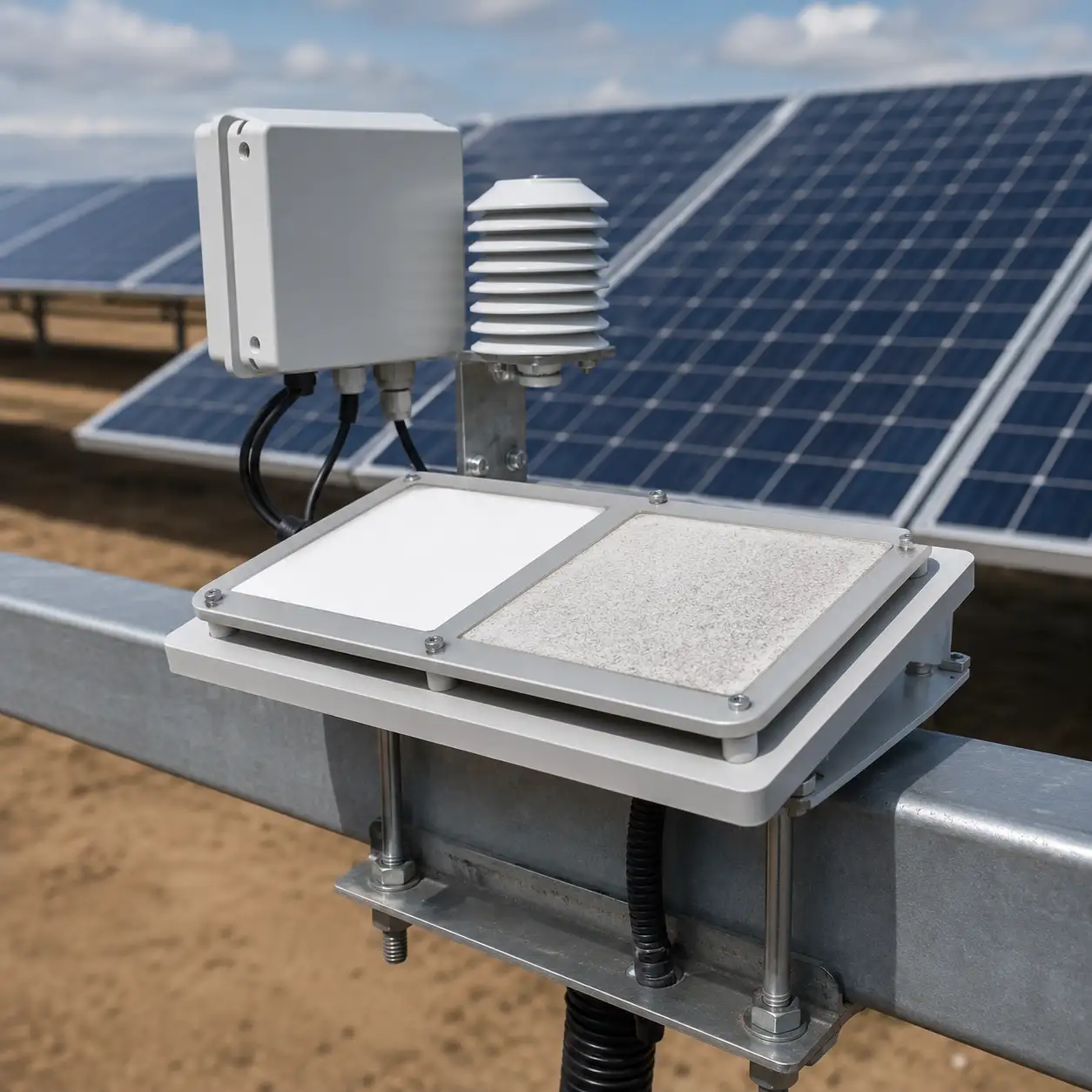
Soiling Ratio
A soiling ratio represents the relative performance or irradiance relationship between a clean reference condition and a naturally soiled condition.
A lower ratio generally indicates greater soiling impact.
The exact calculation method depends on the monitoring device and project design, so operators should use the definition supplied by the selected monitoring system rather than assuming that every sensor calculates the indicator in the same way.
Irradiance Difference
Comparing a clean reference surface with an exposed surface can indicate how much incoming solar radiation is being blocked by accumulated material.
This allows O&M teams to evaluate soiling independently from normal changes in sunlight.
Soiling Trend
The absolute value at one moment is useful, but the trend is often more valuable.
A continuously declining cleanliness indicator can show how rapidly contamination is accumulating.
This helps operators understand whether the site is experiencing:
- Gradual seasonal accumulation
- Rapid dust events
- Post-storm contamination
- Temporary pollution episodes
- Recovery after rainfall or cleaning
Module Temperature
Temperature is another important input when evaluating PV performance.
Modules operating at different temperatures can produce different output even under similar irradiance conditions.
Combining soiling monitoring with module temperature data therefore improves the interpretation of PV performance changes.
Meteorological Data
Typical supporting parameters include:
- Ambient temperature
- Relative humidity
- Wind speed
- Wind direction
- Rainfall
- Atmospheric pressure
- Solar irradiance
JW-IoT’s existing PV Plant Weather Station Solution supports solar radiation, ambient temperature, humidity, wind, rainfall, pressure, and module-temperature monitoring for PV projects.
Using environmental data together with soiling information provides better context for maintenance decisions than relying on the soiling value alone.
4. How Solar PV Soiling Monitoring Optimizes Cleaning Schedules
The main operational value of solar PV soiling monitoring is that it helps replace purely calendar-based cleaning with condition-based cleaning.
Instead of asking:
“Is it time to clean because three weeks have passed?”
operators can ask:
“Has the measured soiling loss reached a level where cleaning is economically justified?”
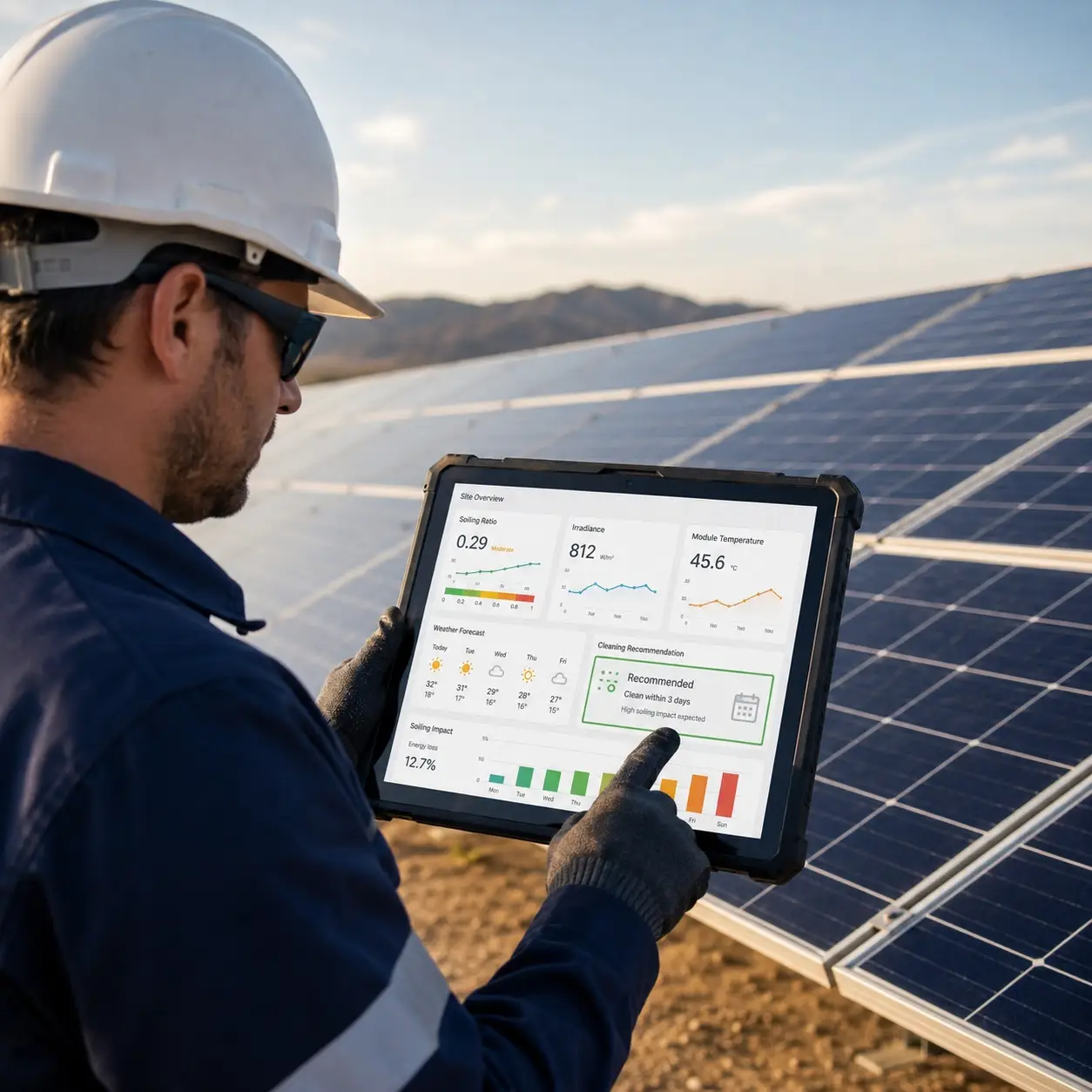
Step 1: Establish a Clean Baseline
After installation or cleaning, the monitoring system should establish a representative clean reference condition.
This becomes the baseline for evaluating subsequent contamination.
Step 2: Monitor Soiling Accumulation
The monitoring system continuously tracks the change in cleanliness or relative irradiance.
Operators can then observe how rapidly soiling develops under local environmental conditions.
Step 3: Compare Soiling Loss with Power and Irradiance
Soiling data becomes more useful when combined with:
- Plane-of-array irradiance
- PV module temperature
- Inverter output
- Smart meter data
- Local weather data
For accurate irradiance reference measurements, a professional pyranometer may be included depending on project requirements.
For example, the JW-IoT Class A Pyranometer Solar Radiation Sensor can be integrated into PV monitoring networks through available analog or RS485 configurations.
Step 4: Define a Cleaning Trigger
The appropriate cleaning threshold should not be copied blindly from another plant.
It should be determined according to the project’s own economics.
Factors include:
- Electricity value
- Expected energy loss
- Cleaning cost
- Water availability
- Labor cost
- Site accessibility
- Weather forecast
- Expected natural rainfall
- Seasonal dust conditions
- Plant size
For example, an operator may decide to delay cleaning when rainfall is expected soon, provided the resulting energy loss remains acceptable.
In another situation, rapidly increasing soiling during a high-irradiance season may justify earlier cleaning.
Step 5: Verify Cleaning Effectiveness
Monitoring should continue after cleaning.
If the soiling indicator returns close to the clean reference level, the O&M team gains objective confirmation that the cleaning operation was effective.
If the expected recovery does not occur, operators can investigate other causes such as:
- Remaining contamination
- Shading
- Module degradation
- Sensor contamination
- Electrical faults
- Inverter problems
This turns soiling monitoring into a maintenance verification tool rather than simply a dust detector.
5. How Soiling Monitoring Helps Reduce O&M Costs
Solar PV soiling monitoring does not automatically reduce costs simply by being installed.
Its value comes from how the data is used in maintenance planning.
Reduce Unnecessary Cleaning
When measured soiling remains low, operators may be able to postpone cleaning instead of following an overly conservative fixed schedule.
This can reduce:
- Labor hours
- Vehicle use
- Water consumption
- Cleaning equipment operation
- Contractor visits
Avoid Excessive Energy Loss
The opposite is also important.
If soiling is increasing quickly, monitoring can help operators identify the problem before the next scheduled inspection.
Cleaning can then be prioritized where the expected production recovery justifies the intervention.
Improve Maintenance Resource Allocation
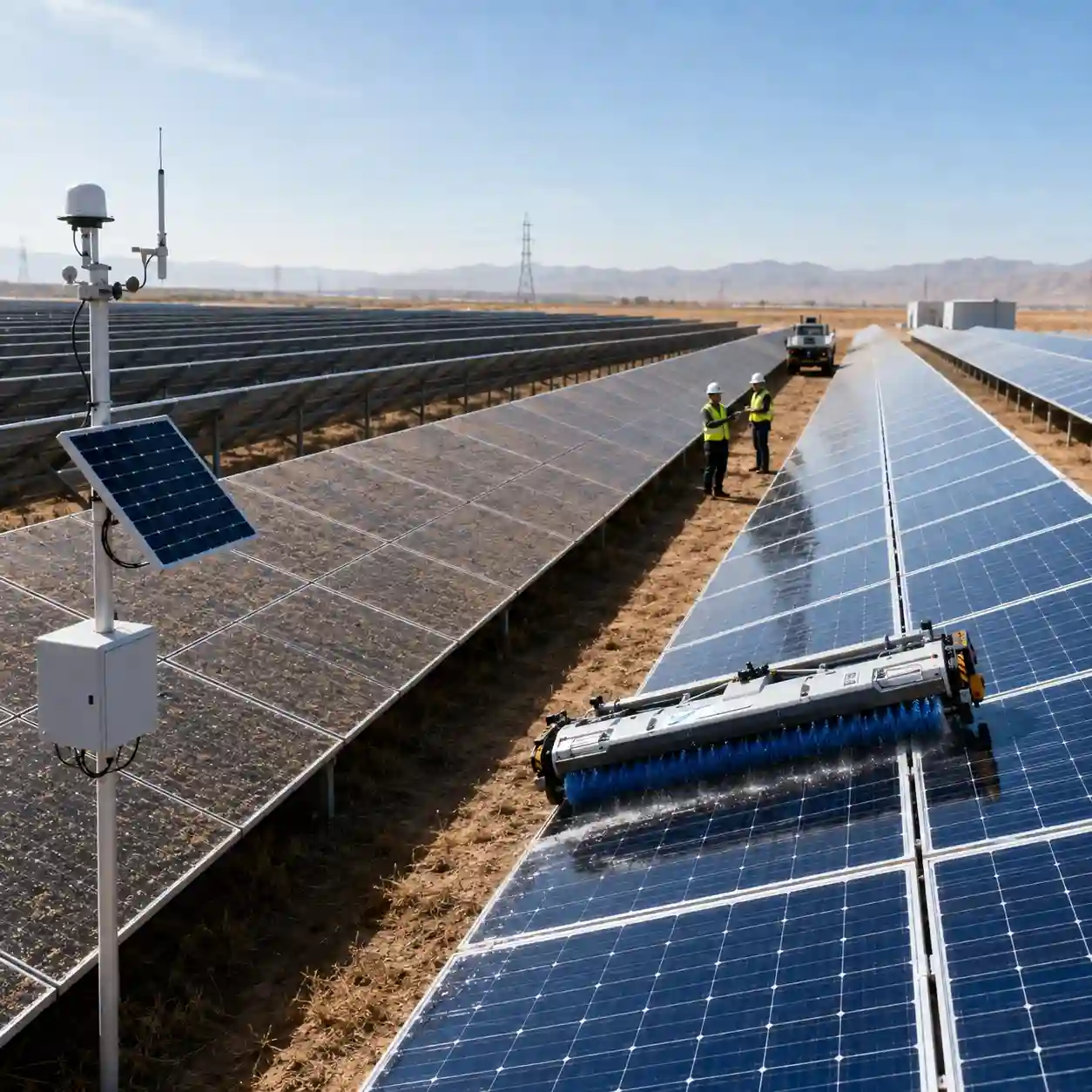
Large solar farms may have different contamination levels across the site.
For example:
- Modules near access roads may accumulate more dust
- Areas close to bare soil may soil faster
- Upwind and downwind zones may behave differently
- Rows near agricultural or industrial activity may experience different particulate exposure
With multiple monitoring locations, operators can identify differences between zones and avoid treating the entire site as though every array experiences identical conditions.
Support Water-Conscious Cleaning Strategies
Water availability is an important issue for solar farms in many arid regions.
If cleaning decisions are based on actual soiling conditions, available water can be directed toward locations where cleaning provides the greatest operational benefit.
This is particularly relevant for desert PV plants where large-scale cleaning may consume significant logistical resources.
6. Best Applications for Solar PV Soiling Monitoring
Although soiling monitoring can be useful in many solar projects, its value is particularly high where contamination is frequent, uneven, or expensive to manage.
Desert and Arid Solar Farms
Desert projects commonly experience:
- Wind-blown sand
- Fine dust
- Long dry periods
- Limited natural cleaning
- High water-transport costs
For these sites, soiling monitoring can help operators understand the relationship between dust accumulation and generation loss.
JW-IoT’s renewable-energy monitoring portfolio includes solutions for desert solar soiling applications, along with irradiance, module-temperature, weather, communication, and cloud-monitoring components.
Solar Farms Near Mining or Quarry Operations
Mining and material handling activities can generate airborne particulates.
PV arrays located nearby may experience higher and less predictable dust deposition.
Soiling monitoring helps quantify the impact instead of relying only on visual inspection.
Agricultural PV Projects
Plowing, harvesting, unpaved roads, and seasonal pollen can affect module cleanliness.
Because these conditions vary during the year, seasonal monitoring can help operators adapt the cleaning schedule.
Industrial Areas
Industrial dust, combustion particles, and local traffic can contribute to surface contamination.
Monitoring can help distinguish long-term soiling trends from weather-related production fluctuations.
Coastal Solar Installations
Coastal environments may experience salt deposition combined with dust and humidity.
Cleaning requirements can therefore differ from those at inland sites.
Large Utility-Scale PV Plants
At very large sites, inspection and cleaning logistics are expensive.
Distributed monitoring points can provide localized data that helps operators identify where field intervention should be prioritized.
7. Recommended Solar PV Soiling Monitoring System Configuration
A complete solar PV soiling monitoring system should be selected according to project scale, site environment, communication infrastructure, and required integration level.
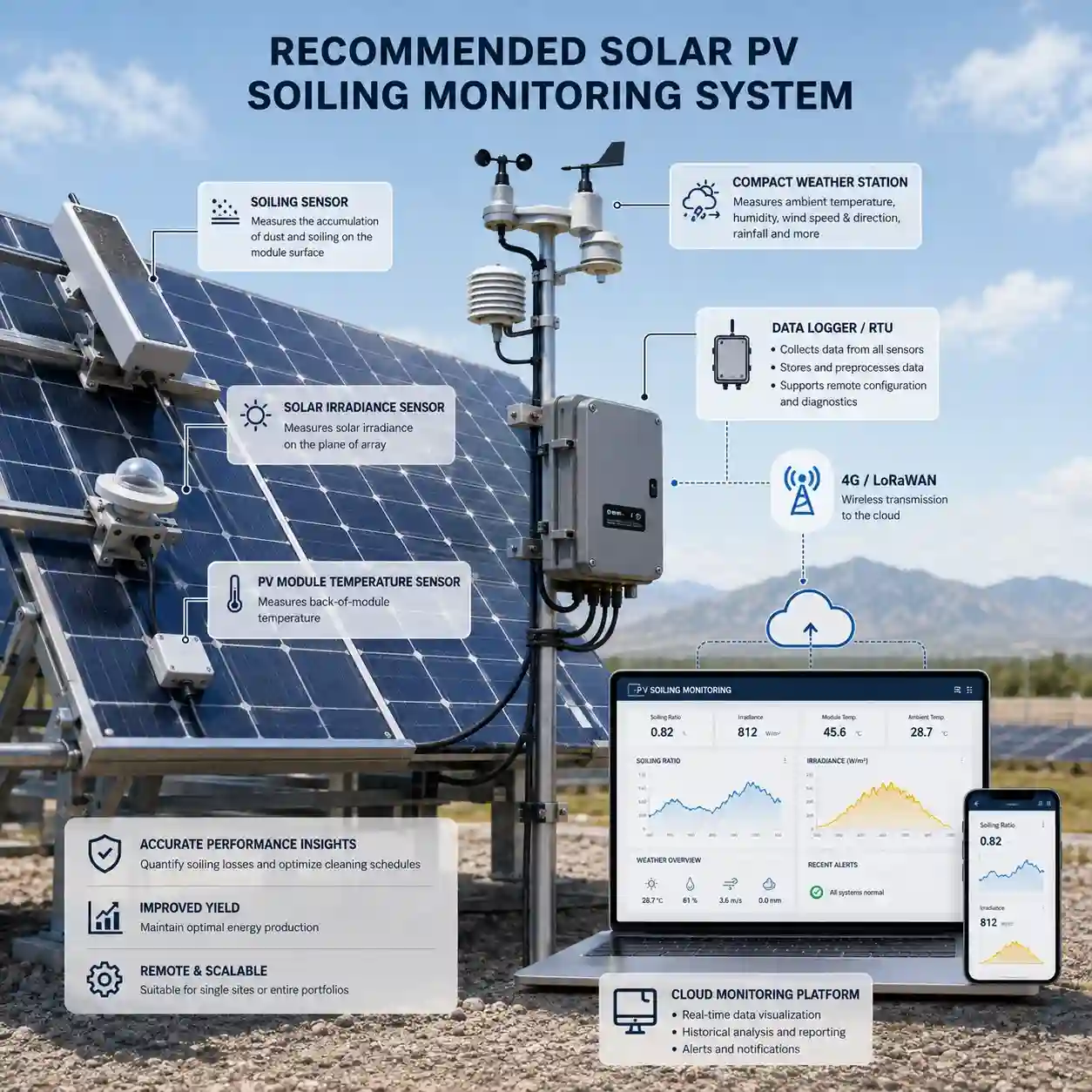
A typical architecture may include:
PV Soiling Sensor / Reference Device
↓
Solar Irradiance Sensor
↓
PV Module Temperature Sensor
↓
Weather Sensors
↓
Data Logger / RTU / IoT Controller
↓
RS485 / LoRaWAN / 4G / Ethernet
↓
Cloud Monitoring Platform or Existing SCADA / EMS
↓
Cleaning and O&M Decision
Recommended Monitoring Parameters
| Parameter | Why It Matters |
| Soiling ratio / cleanliness indicator | Indicates contamination-related performance impact |
| Plane-of-array irradiance | Represents solar radiation reaching the module plane |
| Module temperature | Helps normalize PV performance analysis |
| Ambient temperature | Provides environmental context |
| Relative humidity | Helps interpret dust adhesion and weather conditions |
| Wind speed | Helps assess dust transport conditions |
| Wind direction | Helps identify potential dust sources |
| Rainfall | Helps evaluate natural cleaning events |
| PV power output | Enables comparison between environmental conditions and generation |
For a more complete plant-level architecture, the JW-IoT Solar PV Monitoring System can combine environmental sensors, power-generation data, data acquisition, LoRaWAN or 4G communication, cloud dashboards, alarms, and API integration.
8. Communication Options for Remote Soiling Monitoring
Communication design is especially important for large solar farms.
RS485 Modbus
Suitable when sensors are connected locally to:
- Data loggers
- RTUs
- PLCs
- Weather station controllers
RS485 is widely used for industrial field-device integration.
LoRaWAN
LoRaWAN can be useful for distributed monitoring points across large PV plants where long sensor cables would be difficult or expensive to install.
4G LTE
4G can provide direct remote communication for isolated solar farms where an existing plant network is unavailable.
Ethernet
Ethernet is suitable where plant-level network infrastructure is already available and stable wired communication is preferred.
JW-IoT’s current PV monitoring architecture supports RS485 Modbus, LoRaWAN, 4G LTE, Ethernet, MQTT, and API-based integration according to project requirements.
9. Soiling Monitoring vs. Fixed Cleaning Schedules
| Cleaning Method | Main Advantage | Main Limitation |
| Fixed calendar cleaning | Simple to manage | May clean too early or too late |
| Visual inspection | Low equipment requirement | Subjective and labor-intensive |
| Power-output monitoring only | Uses existing operational data | Difficult to isolate soiling from weather or equipment effects |
| Soiling monitoring | Provides dedicated cleanliness information | Requires correct installation and maintenance |
| Integrated PV monitoring | Combines soiling, irradiance, weather, temperature, and power | More system components are required |
For larger PV projects, the most useful approach is often not to use one indicator alone.
Instead, operators can combine:
Soiling + Irradiance + Module Temperature + Weather + Power Output
to build a more reliable basis for cleaning decisions.
10. How to Select a PV Soiling Monitoring Solution
Before selecting equipment, solar developers and O&M contractors should define the following requirements.
Project Environment
Is the plant located in:
- Desert terrain?
- Agricultural land?
- Mining regions?
- Industrial areas?
- Coastal regions?
Different environmental conditions create different contamination patterns.
Number of Monitoring Zones
A single monitoring point may not represent a very large or geographically diverse PV plant.
Projects with different terrain, wind exposure, or land-cover conditions may require multiple monitoring locations.
Required Parameters
Determine whether the project needs only soiling data or an integrated system including:
- Solar irradiance
- Module temperature
- Weather data
- Power generation
- Inverter data
- Energy meters
Communication Method
Select communication according to site conditions:
- RS485
- LoRaWAN
- 4G
- Ethernet
Platform Integration
For existing SCADA, EMS, or O&M platforms, confirm requirements for:
- Modbus
- MQTT
- API
- Cloud data export
- Custom protocol integration
Maintenance Strategy
The monitoring system should ultimately support a clear maintenance decision.
Before deployment, define how the O&M team will use the data to:
- Trigger cleaning
- Compare site zones
- Verify cleaning results
- Analyze seasonal trends
- Review long-term O&M performance
Frequently Asked Questions
1. What is solar PV soiling monitoring?
Solar PV soiling monitoring measures or estimates the effect of dust and other surface contamination on photovoltaic modules. The data can be used to evaluate soiling trends and support cleaning decisions.
2. Why is soiling monitoring important for solar farms?
Soiling can reduce the amount of solar radiation reaching PV cells. Monitoring helps operators determine whether cleaning is necessary instead of relying only on visual inspection or fixed cleaning intervals.
3. Can a soiling sensor determine exactly when panels should be cleaned?
A sensor provides important data, but the final cleaning decision should also consider electricity value, cleaning cost, water availability, weather conditions, expected rainfall, and plant operating strategy.
4. What parameters should be monitored together with soiling?
Typical supporting parameters include plane-of-array irradiance, module temperature, ambient temperature, humidity, wind speed, wind direction, rainfall, and PV power output.
5. Is solar PV soiling monitoring useful in desert solar farms?
Yes. Desert and arid PV plants are among the most relevant applications because dust and sand accumulation can be frequent while water and cleaning logistics may be expensive.
6. Can soiling monitoring reduce water consumption?
It can support more targeted cleaning decisions. Rather than cleaning only according to a fixed calendar, operators can use measured conditions to determine where and when cleaning is justified.
7. Can soiling monitoring integrate with an existing PV SCADA system?
Depending on the equipment configuration, sensors and data loggers can be integrated through interfaces such as RS485 Modbus, Ethernet, MQTT, or API. The final interface should be confirmed according to the project’s existing SCADA or EMS architecture.
8. How many soiling monitoring points does a solar farm need?
There is no universal number. The quantity should be determined by site size, terrain, dust distribution, environmental variation, array layout, and required spatial representation.
Conclusion
Solar PV soiling is both an energy-performance issue and an O&M management issue.
Cleaning too infrequently can allow unnecessary generation losses to continue, while cleaning too frequently can increase labor, water, equipment, and logistics costs.
Solar PV soiling monitoring provides the data needed to balance these two costs.
By combining soiling information with solar irradiance, module temperature, weather conditions, and actual PV generation, operators can move toward a more condition-based cleaning strategy.
For utility-scale solar farms, desert PV projects, industrial solar plants, and other dust-prone installations, this approach can provide a stronger technical basis for:
- PV cleaning optimization
- O&M cost control
- Cleaning-priority decisions
- Water-management planning
- Performance-loss analysis
- Maintenance verification
JW-IoT provides solar irradiance sensors, PV weather monitoring equipment, IoT communication devices, data acquisition hardware, and cloud-based solar PV monitoring solutions that can be configured according to project scale and site conditions.
Request a Solar PV Soiling Monitoring Solution
Planning a solar farm in a desert, dusty, agricultural, mining, or industrial environment?
Send JW-IoT the following information:
- Project country and location
- PV plant capacity
- Number of monitoring zones
- Required monitoring parameters
- Communication method
- Existing SCADA or monitoring platform
- Power-supply conditions
- Preferred cloud or API requirements
Request Soiling Monitoring Solution →