+86 13520127780
 info@jingelway.com









PV Module Temperature Monitoring in Extreme Heat Regions
Release time: 2026-10-22
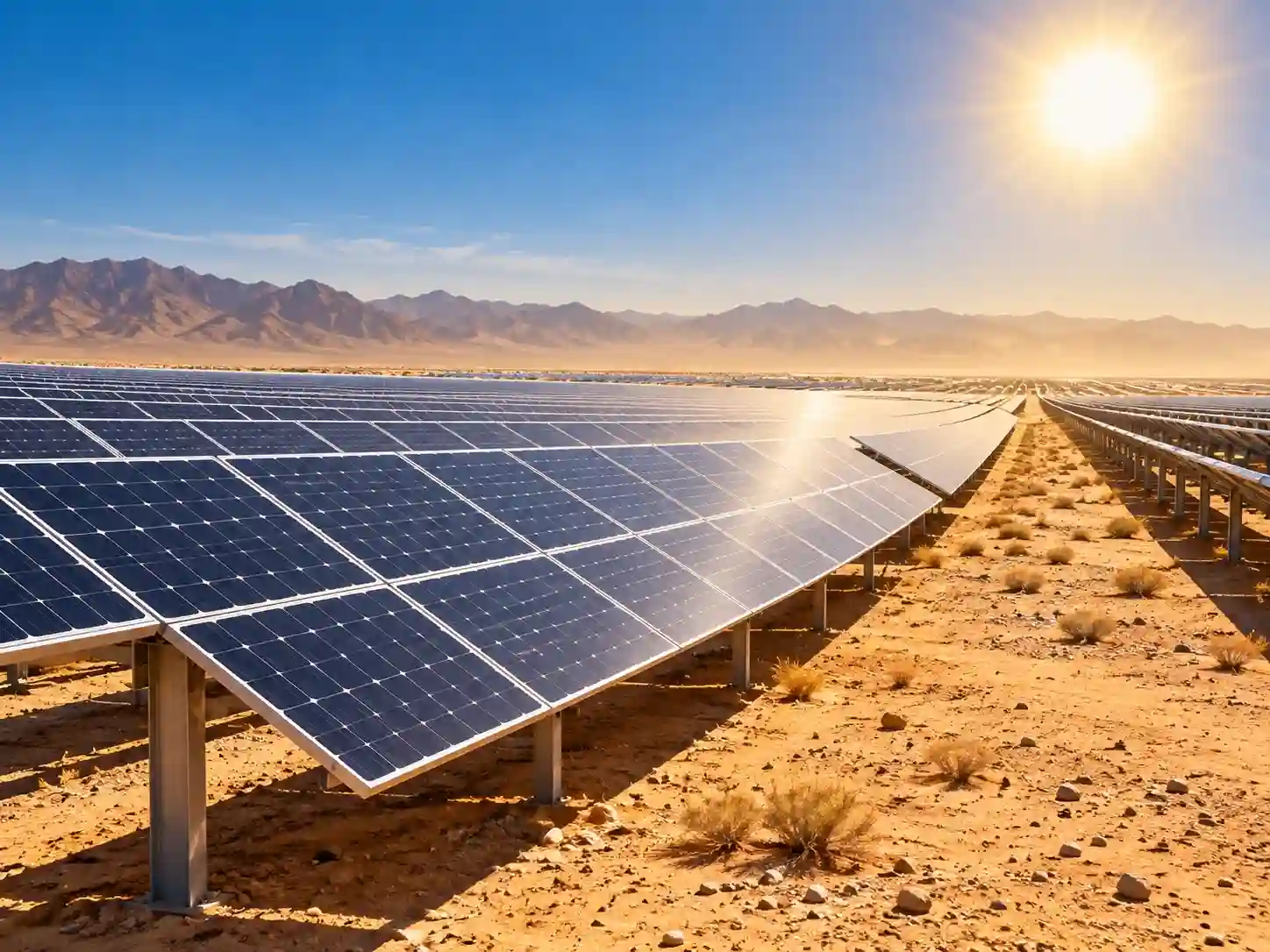
Solar power plants in the Middle East, India, Africa, and Australia often operate under intense sunlight and elevated ambient temperatures. While abundant solar radiation creates favorable conditions for electricity generation, excessive heat can also reduce photovoltaic (PV) module efficiency.
For solar farm developers, EPC contractors, and operation and maintenance (O&M) teams, PV module temperature monitoring is essential for understanding thermal losses and assessing actual plant performance.
A well-designed monitoring system combines module temperature, solar irradiance, ambient temperature, and wind measurements to provide a clearer picture of operating conditions.
This article explores the challenges of monitoring PV modules in hot climates, practical sensor installation methods, and recommended monitoring configurations for desert and high-temperature solar projects.
1. Why High Temperatures Affect Solar PV Performance
1.1 The Relationship Between Module Temperature and Power Output
Solar PV modules convert sunlight into electrical energy. However, not all absorbed solar radiation is converted into electricity. A portion becomes heat, increasing the module’s operating temperature.
For most conventional crystalline silicon PV modules, increasing cell temperature causes a reduction in maximum electrical power.
The degree of reduction depends on the module’s power temperature coefficient, normally specified in the manufacturer’s datasheet.
A simplified calculation is:
Temperature-Related Power Change (%) ≈ Temperature Difference (°C) × Power Temperature Coefficient (%/°C)
Consider an illustrative PV module with:
- Reference cell temperature: 25°C
- Operating cell temperature: 65°C
- Power temperature coefficient: −0.35%/°C
The estimated change in power is:
(65 − 25) × (−0.35%) = −14%
Under otherwise equivalent conditions, the module’s maximum power would be approximately 14% lower than its reference-temperature value.
This is an illustrative calculation, not a measured plant loss. Actual performance depends on module technology, irradiance, cooling conditions, and other system factors. Furthermore, a rear-surface temperature measurement is not necessarily identical to cell temperature.
The NREL System Advisor Model documentation explains how PV performance models incorporate temperature coefficients and operating conditions.
1.2 Why Ambient Temperature Alone Is Insufficient
A common limitation in solar plant monitoring is relying on ambient air temperature to estimate module operating conditions.
However, PV module temperature can be substantially higher than ambient temperature during periods of strong irradiation.
Module temperature is influenced by:
- Solar irradiance intensity
- Ambient air temperature
- Wind speed and convective cooling
- Module mounting structure and ventilation
- Module construction and thermal properties
- Local installation conditions
Two PV arrays experiencing the same ambient temperature may operate at different module temperatures because of differences in wind exposure, mounting geometry, or solar radiation.
Direct solar panel temperature monitoring provides more useful information for evaluating temperature-related performance variations.
2. PV Module Temperature Monitoring in Major Hot-Climate Regions
Different geographical regions present specific challenges for solar plant temperature monitoring.
2.1 Middle East: Desert Solar Power Plants
Solar projects in Saudi Arabia, the United Arab Emirates, Oman, and other Middle Eastern markets commonly face strong solar irradiance, high summer temperatures, and dust exposure.
Monitoring requirements should consider:
- High daytime module temperatures
- Dust and sand accumulation
- Large temperature variations between day and night
- Sensor cable exposure to sunlight and heat
- Limited accessibility at remote solar farms
For desert installations, combining back-of-module temperature sensors, plane-of-array irradiance sensors, and local weather monitoring helps operators evaluate how heat and environmental conditions influence power generation.
Dust-related losses should be assessed separately where possible, since temperature measurements alone cannot quantify soiling losses.
2.2 India: High-Temperature Utility and Rooftop Solar
India includes several climatic zones with different monitoring challenges.
Solar installations in Rajasthan and Gujarat may experience hot, dry conditions, while other regions face combinations of heat, humidity, seasonal rainfall, and airborne pollutants.
For utility-scale solar farms, module temperature monitoring supports comparisons across different array blocks.
For industrial rooftop solar systems, particular attention should be given to mounting clearance and natural ventilation.
A module installed close to a roof surface may operate differently from an equivalent module mounted on an open ground structure.
2.3 Africa: Remote Solar Plants and Variable Site Conditions
Solar developments in North Africa and southern African markets can experience high irradiance, elevated temperatures, and dusty operating environments.
Monitoring system design should account for:
- Representative sensor placement
- Reliable outdoor cable protection
- Long-term temperature data recording
- Remote communication infrastructure
- Maintenance access and environmental exposure
Temperature sensors integrated with data loggers and remote monitoring systems can support ongoing performance assessments without requiring continuous on-site observation.
2.4 Australia: High Irradiance and Extreme Summer Conditions
Australian solar farms in inland and arid regions may experience intense solar radiation, hot weather, and substantial differences between daytime and nighttime temperatures.
Wind conditions also influence module cooling.
For large installations, temperature measurements from representative array sections can help identify variations between different mounting structures, orientations, and exposure conditions.
The purpose is not simply to record the highest temperature. It is to understand how changing thermal conditions correspond with solar resource availability and power generation.
3. How PV Module Temperature Sensors Work
A PV module temperature sensor measures the temperature of a solar module, commonly through direct contact with its rear surface.
Depending on the device design, temperature-sensitive elements may use resistance-based or semiconductor measurement principles.
The sensor converts temperature changes into an electrical signal that can be processed by compatible monitoring equipment.
Typical integration devices include:
- PV weather monitoring stations
- Data loggers and RTUs
- Industrial controllers
- SCADA systems
- Remote IoT monitoring platforms
Sensor output formats and measurement specifications vary by model and should be confirmed against the selected product datasheet.
Back-of-Module Temperature vs. Cell Temperature
These two parameters are closely related but should not be treated as identical.
A rear-mounted sensor measures the module’s back-surface temperature. The internal photovoltaic cells may operate at a different temperature because of heat transfer through the module materials.
For temperature-corrected performance modeling, the relationship between measured module temperature and estimated cell temperature should be handled using an appropriate method.
For additional sensor fundamentals, read PV Module Temperature Sensors for Solar Plant Monitoring.
4. Best Practices for Installing Module Temperature Sensors in Extreme Heat
Reliable temperature monitoring begins with proper installation.
The international standard IEC 61724-1:2021 provides guidance for photovoltaic performance monitoring, including module temperature measurements.
4.1 Select a Representative Module
Temperature sensors should be installed on PV modules that represent the operating conditions being evaluated.
A suitable installation location is generally:
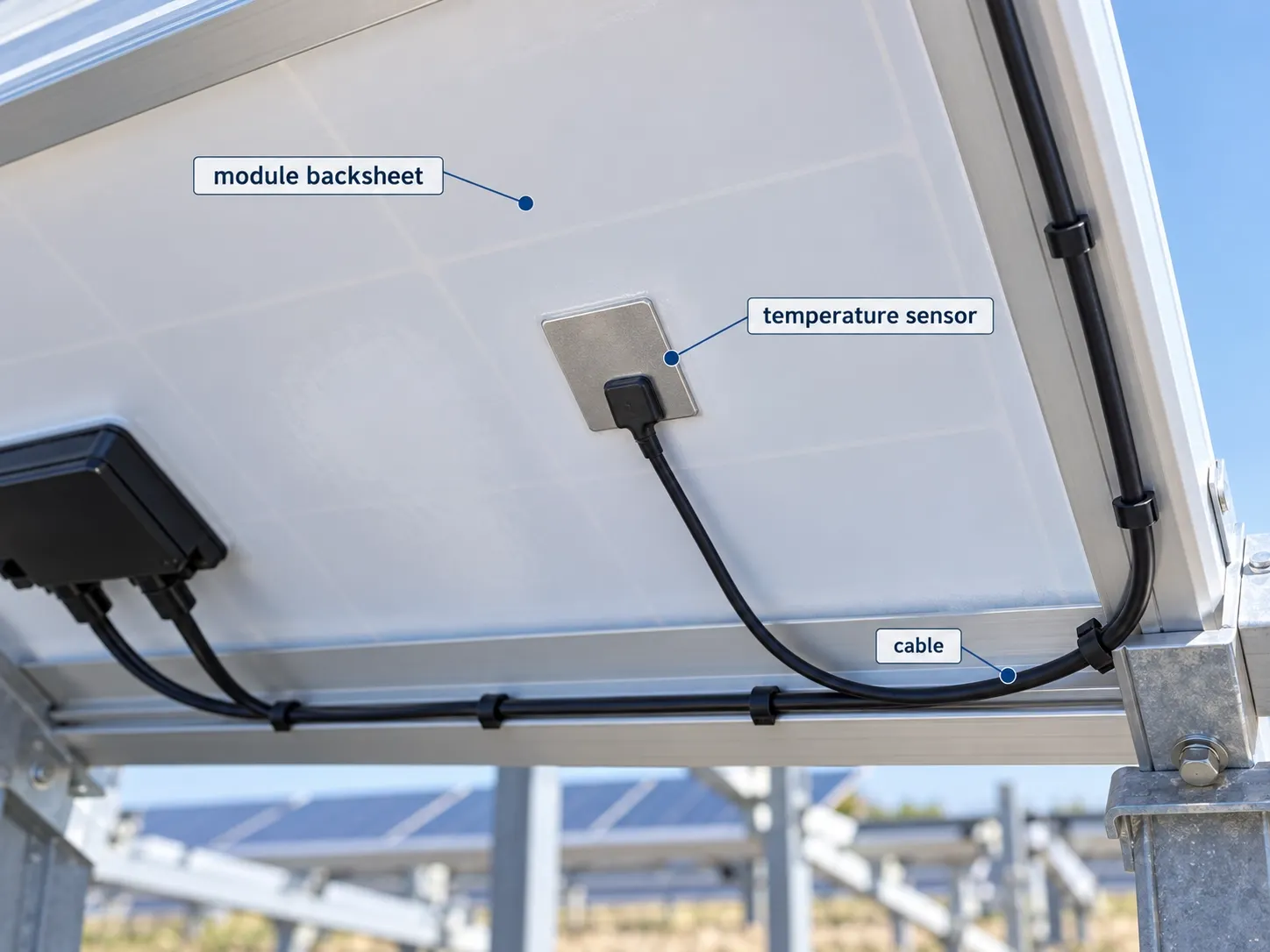
- On the rear surface of the PV module
- Near the center of a cell close to the module center
- Away from junction boxes and frame edges
- On an undamaged, representative module
- Accessible for inspection when practical
For large installations, multiple monitoring points may be necessary because temperature varies across the array.
4.2 Ensure Proper Thermal Contact
Poor contact between the sensor and module surface can introduce measurement errors.
Before installation, the mounting surface should be cleaned according to the sensor and module manufacturers’ instructions.
Use a suitable thermally conductive adhesive or approved mounting method.
The attachment material must be compatible with the module’s rear surface and capable of maintaining reliable contact under local environmental conditions.
4.3 Protect Wiring from High Temperature and UV Exposure
Desert installations require particular attention to sensor wiring and connectors.
Good installation practices include:
- Selecting cables suitable for expected temperatures and sunlight exposure
- Securing wiring to prevent movement and abrasion
- Providing appropriate cable strain relief
- Protecting exposed connectors from environmental damage
- Avoiding unnecessary contact with sharp module-frame edges
For bifacial modules, rear-side sensor placement and cable routing should also minimize obstruction of light reaching the rear cells.
4.4 Verify Sensor Performance
Sensor inspection and verification should form part of routine PV monitoring maintenance.
O&M teams should check sensor attachment, cable condition, communication stability, and measurement consistency.
A sudden difference between neighboring temperature sensors does not automatically indicate a defective PV module. Installation problems, sensor faults, different local conditions, and genuine thermal differences should all be considered.
5. Integrating Module Temperature with Irradiance and Weather Data
Temperature monitoring becomes significantly more useful when combined with other solar plant measurements.
5.1 Essential Parameters
| Parameter | Monitoring Purpose |
| PV module temperature | Evaluate module thermal conditions |
| Plane-of-array irradiance | Measure sunlight received in the module plane |
| Ambient temperature | Compare module and surrounding air conditions |
| Wind speed | Understand convective cooling conditions |
| Wind direction | Provide additional site-specific cooling context |
| Power output | Compare electrical generation with environmental conditions |
| Soiling measurements | Help distinguish dust-related effects from other losses |
5.2 Understanding Temperature-Related Performance Losses
Consider a hot-climate PV plant recording high plane-of-array irradiance but lower-than-expected electrical output.
An operator can investigate the event through a structured process:
Step 1: Verify irradiance measurements.
Check whether the irradiance data accurately represents the PV array conditions.
Step 2: Examine module temperature.
Compare the measured temperature with expectations under the observed irradiance and ambient conditions.
Step 3: Review wind data.
Evaluate whether low wind speed or restricted ventilation may have contributed to higher module temperature.
Step 4: Compare temperature-adjusted expected output with actual generation.
Use the appropriate PV model and module temperature coefficient.
Step 5: Investigate remaining performance differences.
Review possible soiling, shading, inverter limitations, electrical faults, and curtailment.
This approach helps avoid attributing every reduction in generation to high temperature.
5.3 Temperature Data and Performance Ratio Analysis
Performance Ratio (PR) is used to evaluate PV system performance relative to the available solar resource.
Conventional PR is affected by operating temperature, making temperature data particularly useful when comparing plant performance across seasons or different climatic conditions.
Temperature-corrected PR methods can help account for predictable thermal effects.
However, temperature monitoring alone is not sufficient to calculate PR. Reliable energy-generation and irradiance measurements are also required.
JW-IoT provides a PV Plant Weather Station Solution that integrates solar radiation, module temperature, meteorological measurements, and data acquisition for PV monitoring applications.
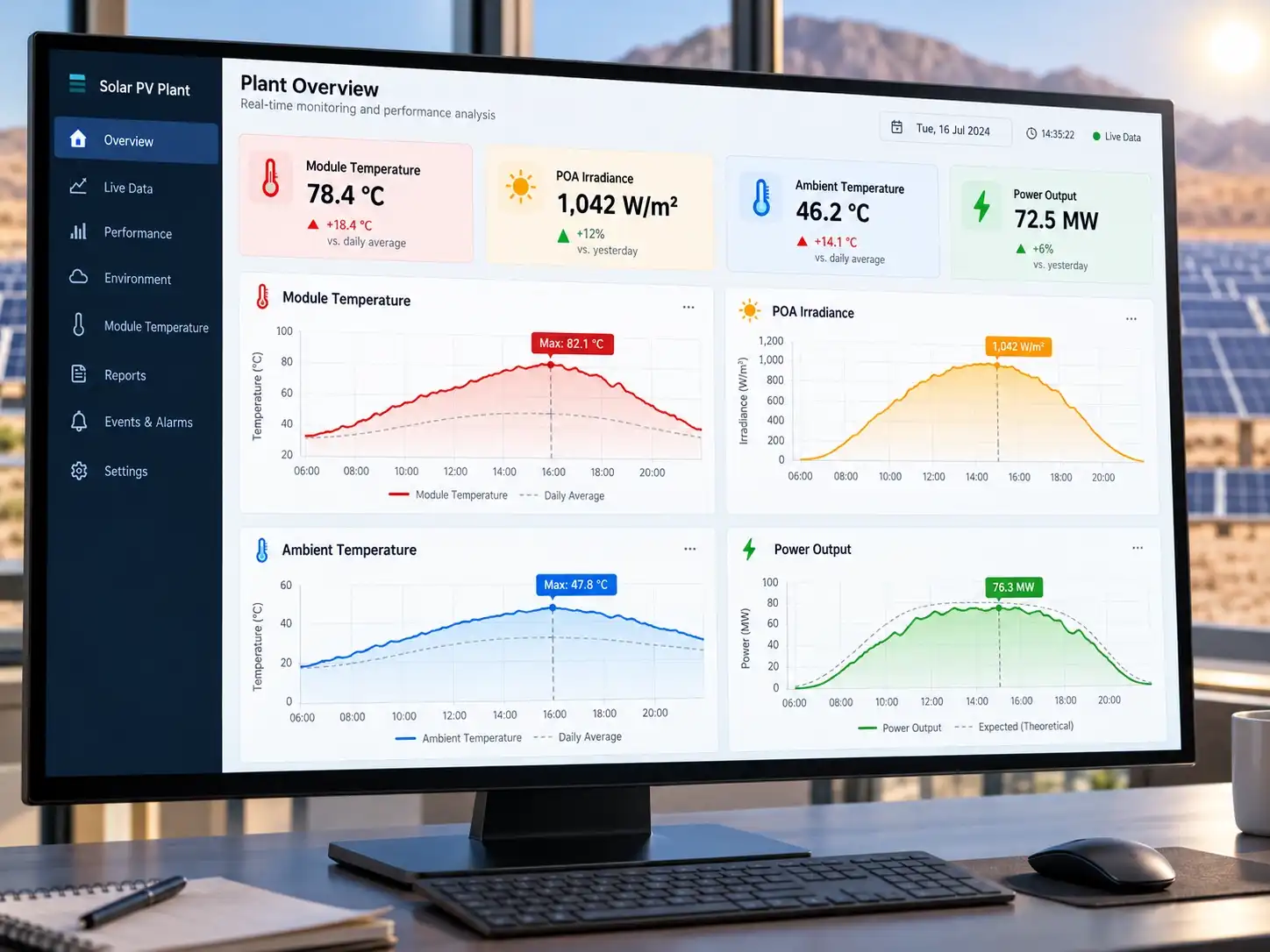
5.4 Remote Temperature Monitoring and Data Visualization
When supported by the selected data acquisition system, temperature measurements can be transmitted to a centralized monitoring platform.
Useful dashboard functions include:
- Real-time module temperature trends
- Temperature comparisons between monitoring points
- Irradiance and temperature correlation charts
- Historical data analysis
- Sensor communication status
- Configurable abnormal-temperature alerts
Alerts should be based on project-specific operating conditions rather than a single universal temperature threshold.
6. Recommended PV Temperature Monitoring Kit for Hot-Climate Solar Plants
For EPC contractors, system integrators, and solar plant operators, a modular monitoring configuration allows sensor selection to match project requirements.
6.1 Suggested Monitoring Components
| Component | Recommended Function |
| PV module temperature sensors | Rear-surface temperature measurement |
| Solar irradiance sensor / pyranometer | POA irradiance monitoring |
| Ambient temperature sensor | Local air temperature measurement |
| Wind speed sensor | Wind and cooling-condition monitoring |
| Data logger / RTU | Sensor data acquisition and recording |
| Communication gateway | Remote data transmission where required |
| SCADA / monitoring platform | Data visualization and performance analysis |
These are suggested system components rather than a fixed product bundle. The final configuration depends on project scale, accuracy requirements, and existing plant infrastructure.
6.2 JW-IoT Monitoring Equipment Options
Option A: Integrated Solar PV Weather Station
The Solar PV Weather Station for Power Plant Monitoring combines solar irradiance, module temperature, and meteorological monitoring.
The listed JW-XF500S-CWB(YN22) configuration includes:
- Module temperature measurement range: −20°C to +80°C
- Module temperature accuracy: ≤ ±0.2°C
- Solar irradiance measurement: 0–2000 W/m²
- RS485 Modbus RTU communication
- Integrated wind and environmental measurements
The sensor’s expected operating temperatures should be checked against its specified measurement range before selection for extreme-heat applications.
Option B: Configurable PV Weather Monitoring Station
The PV Weather Monitoring Station for Distributed Solar Plants offers environmental measurement and data acquisition functions for solar monitoring projects.
The published JW-QTF(LC6) configuration lists a module temperature measurement range of −50°C to +150°C.
The appropriate system should be selected according to the required parameters, project architecture, and technical specifications.
Option C: Customized Solar Monitoring System
Projects requiring several monitoring locations can consider the Solar PV Monitoring System with IoT Automation.
Depending on configuration, this solution supports integration of environmental sensors, remote communication equipment, and centralized monitoring systems.
For remote desert sites, particular attention should be paid to communication availability, power supply, data continuity, and maintainability.
7. Frequently Asked Questions
What is the best location for a solar panel temperature sensor?
For conventional rear-contact measurement, a representative module’s rear surface near its center is generally preferred. The final location and mounting method should follow the applicable monitoring standard and sensor manufacturer’s instructions.
How hot can PV modules get in desert environments?
PV module temperatures depend on irradiance, ambient temperature, wind, module construction, and installation conditions. There is no single maximum operating temperature applicable to all desert solar projects.
Why is module temperature monitoring important for solar farm performance?
It helps quantify temperature-related performance effects and provides context for comparing expected and actual power generation. It is especially useful alongside irradiance and electrical measurements.
Can one temperature sensor monitor an entire solar farm?
A single sensor cannot represent every local condition in a large PV plant. The required number and distribution of sensors depend on array size, monitoring class, and differences in module type and installation conditions.
Can high module temperature monitoring detect solar panel faults?
Temperature trends can help identify unusual operating conditions, but a single rear-surface temperature sensor cannot reliably diagnose every module fault or localized hotspot. Additional electrical testing or thermal imaging may be required.
8. Conclusion: Reliable Temperature Data for High-Heat Solar Projects
For solar power plants operating in the Middle East, India, Africa, and Australia, high module temperature is an important factor in energy performance evaluation.
Accurate PV module temperature monitoring helps operators understand thermal behavior, interpret performance losses, and compare operating conditions across solar arrays.
The greatest value comes from combining temperature measurements with irradiance, weather, and electrical-generation data.
With suitable sensors, reliable installation, and consistent data acquisition, solar plant operators can make more informed performance and maintenance decisions.
Request Temperature Monitoring Kit
Planning a solar farm or rooftop PV project in a hot climate?
JW-IoT provides configurable PV temperature and weather monitoring solutions for EPC contractors, solar system integrators, and plant operators.
Contact our team with your project location, plant capacity, required measurement parameters, and communication requirements.
Request Temperature Monitoring Kit
Alternatively, contact info@jingelway.com for equipment selection and technical information.