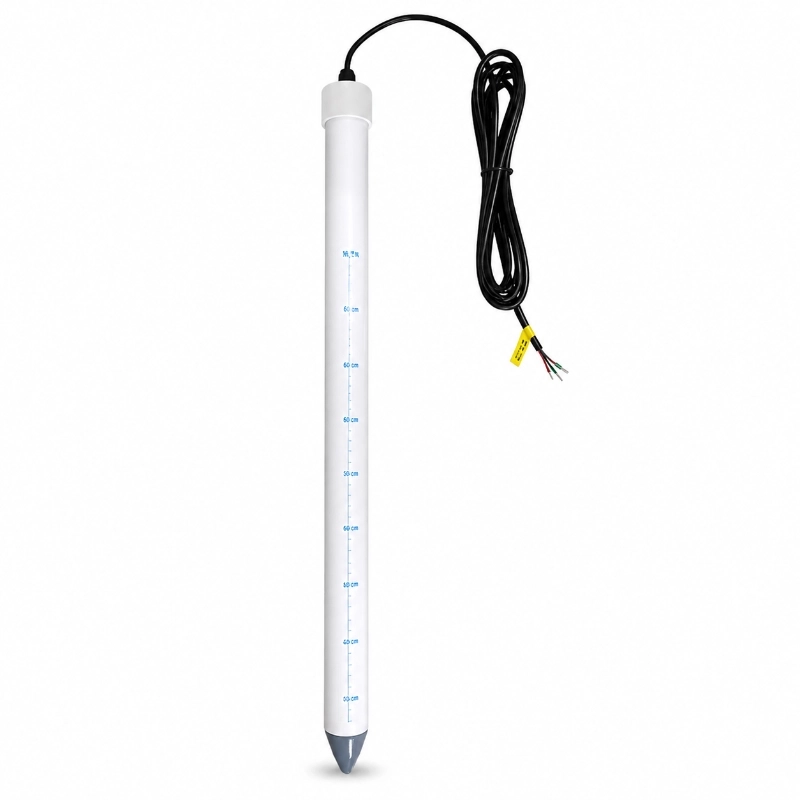
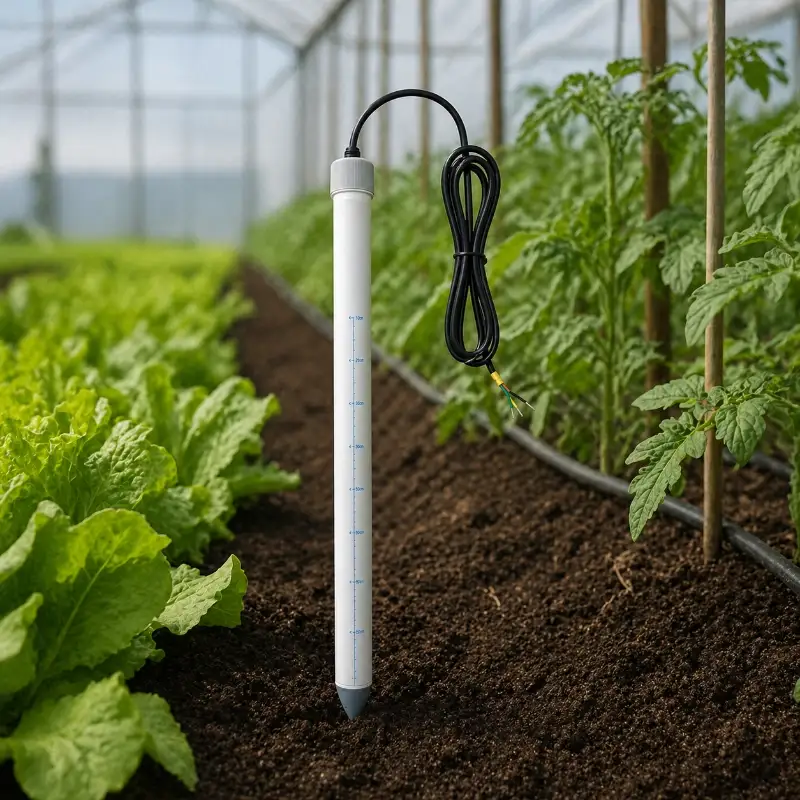
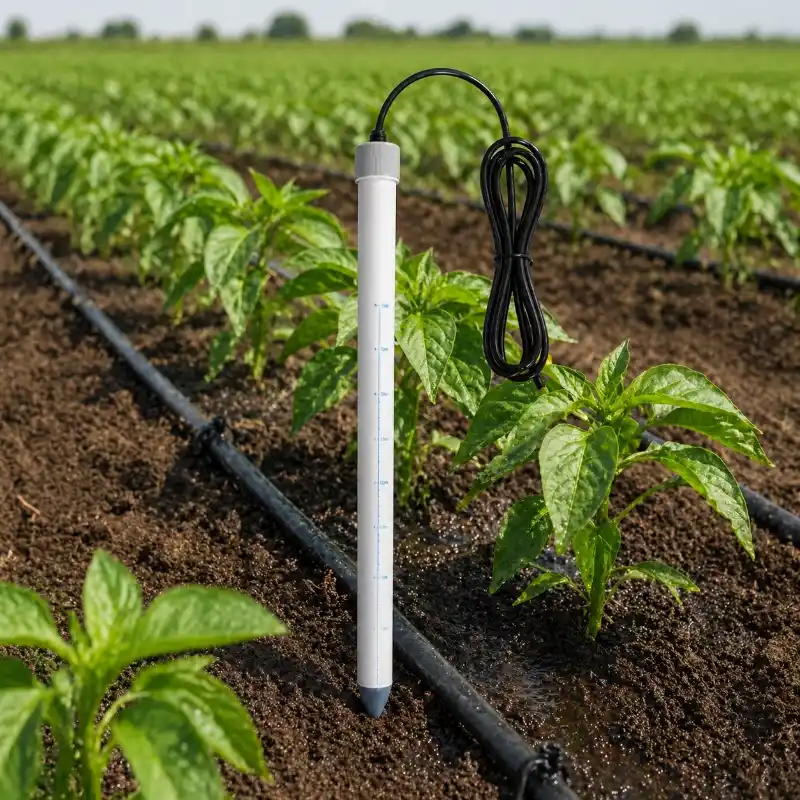
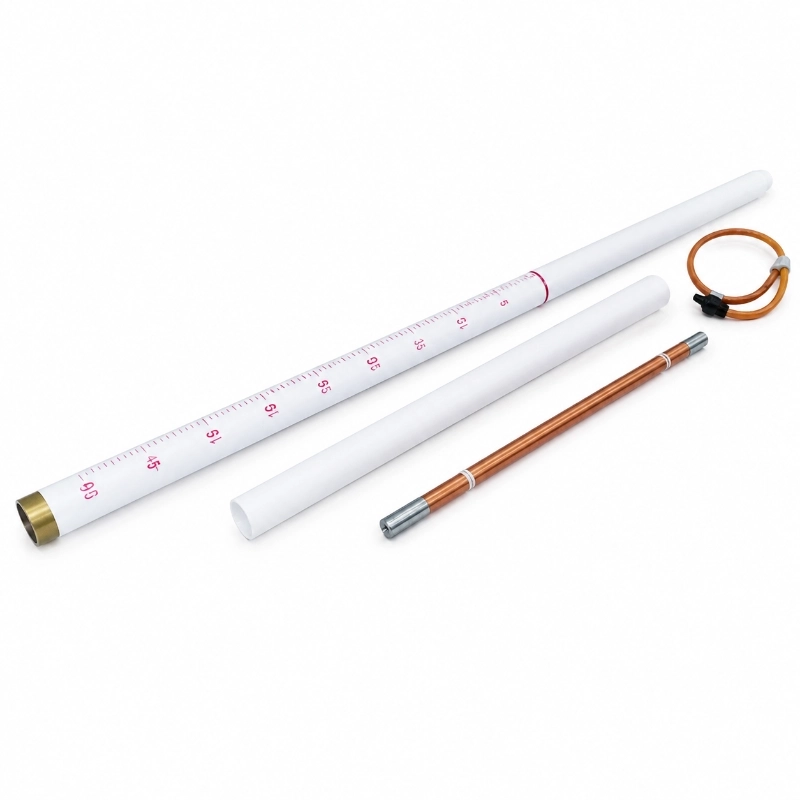
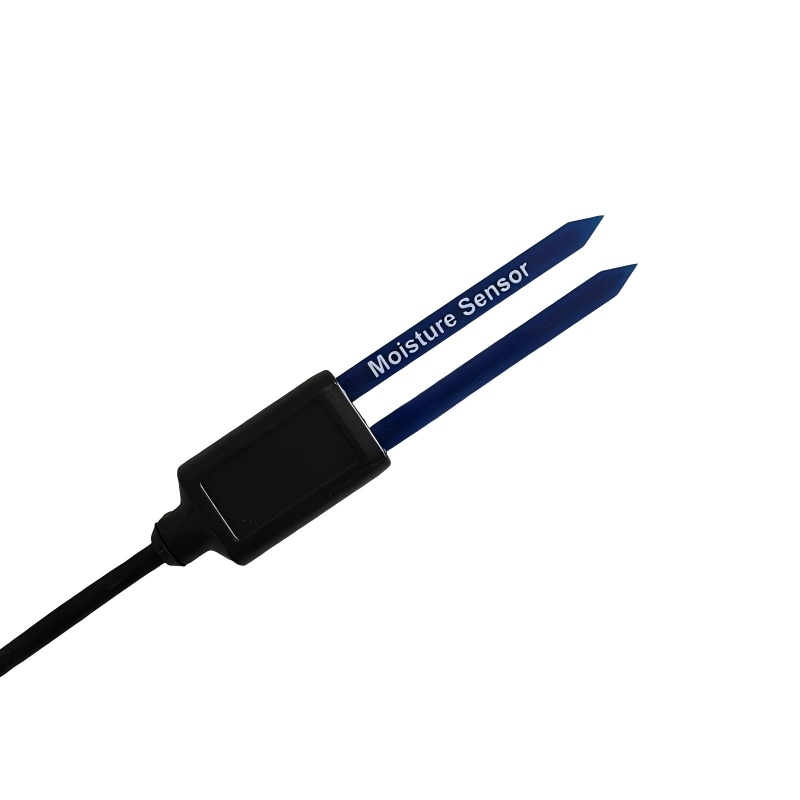
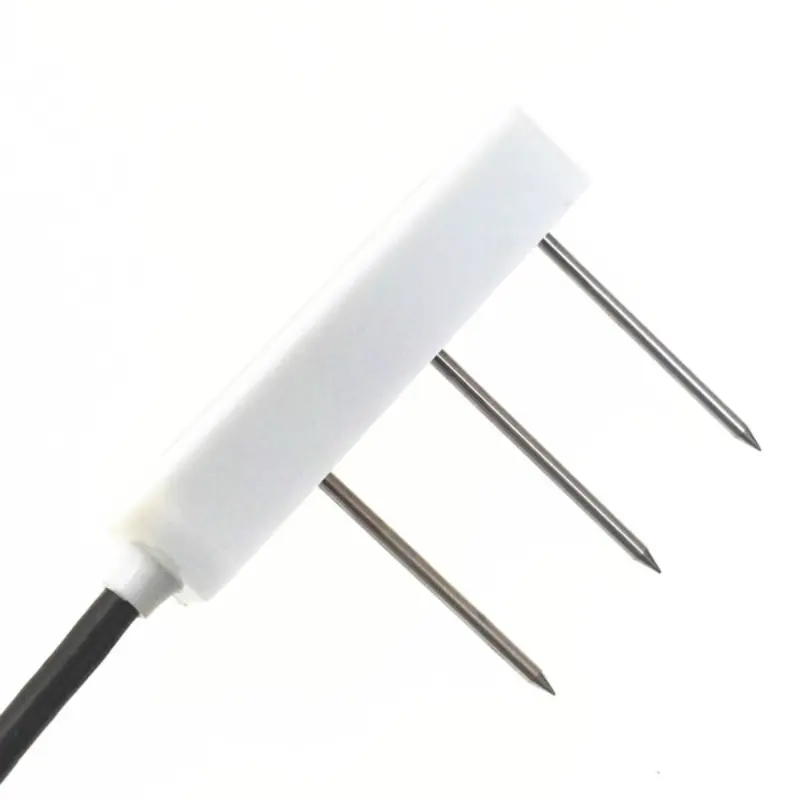
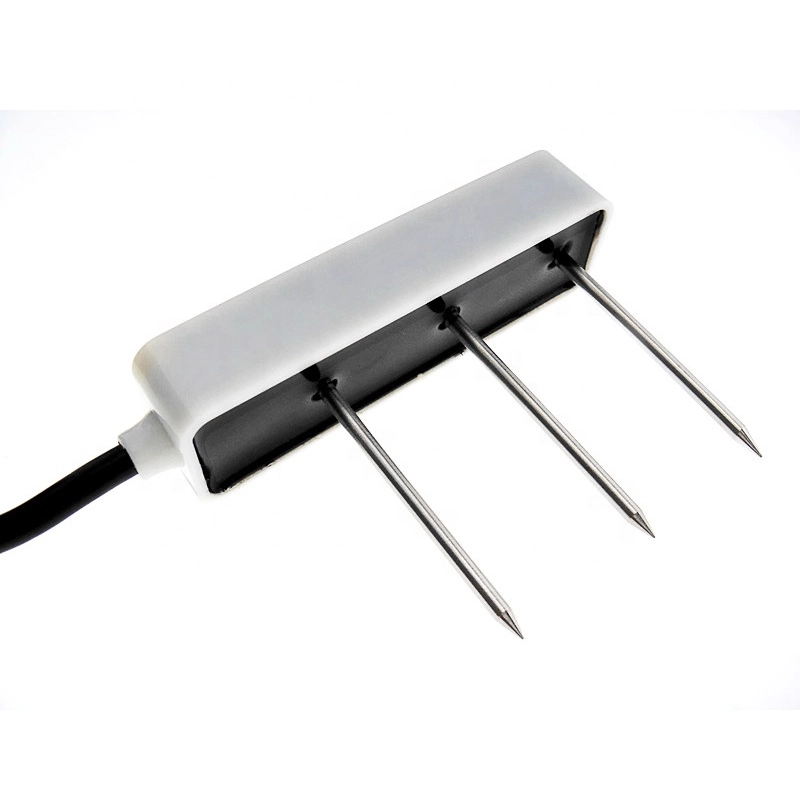
Multi-Layer Tubular Soil Moisture and Temperature Sensor
Key Features
Integrated probe structure: Simple one-piece design for easy installation and stable long-term soil monitoring.
Soil moisture and temperature measurement: Measures volumetric soil moisture and ambient soil temperature for irrigation and crop growth analysis.
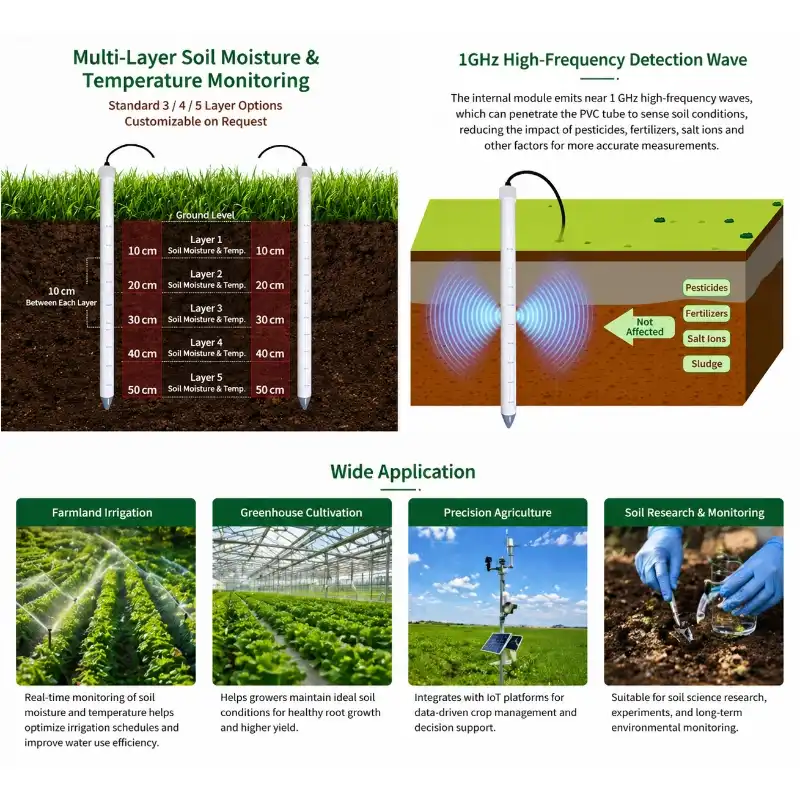
High-frequency detection technology: Uses near 1 GHz high-frequency sensing waves to penetrate the PVC tube and detect soil conditions without direct electrode exposure.
Less affected by soil salinity and fertilizer: Helps reduce interference from pesticides, fertilizers, salt ions and irrigation residues.
Multi-layer soil profile monitoring: Standard options include 3-layer 4-layer and 5-layer measurement configurations. Custom depth layers are available on request.
RS485 Modbus RTU output: Supports stable wired data transmission for data loggers, RTUs, controllers and IoT monitoring platforms.
IP68 waterproof protection: Fully sealed structure allows the whole probe to be buried underground or immersed in waterlogged soil environments.
Durable high-density PVC housing: Corrosion-resistant and dustproof construction for farmland, greenhouse and outdoor field applications.
Low power consumption: Standby current around 4 mA and acquisition current around 21 mA, suitable for solar-powered monitoring systems.
Wide power input: Supports DC 5–30 V power supply for flexible system integration.
The JW-TRSQ(LC3) Multi-Layer Tubular Soil Moisture and Temperature Sensor is designed for continuous soil profile monitoring at multiple depths. It measures volumetric soil moisture and soil temperature through a sealed PVC tube and transmits each layer’s data through RS485 Modbus RTU.
Standard configurations include 3-layer, 4-layer and 5-layer soil monitoring, while customized measuring depths can be provided according to crop root depth, irrigation method and project requirements.
The tubular sensor is suitable for smart irrigation, open-field farming, greenhouses, orchards, pasture, drought monitoring, agricultural research and water conservancy projects. Its IP68 sealed structure allows long-term vertical installation below ground without exposing metal sensing electrodes directly to soil.
A multi-layer soil moisture sensor measures soil conditions at several depths with one vertically installed probe.
A conventional single-point sensor provides data from one local depth. A multi-layer tubular sensor collects separate readings from different sections of the soil profile, helping users observe how irrigation water moves downward through the root zone.
For example, a multi-depth sensor can help identify whether:
Water remains only near the soil surface
Irrigation has reached the active crop root zone
Water is moving below the main roots
A deeper layer remains dry
Excess irrigation may be causing deep percolation
Soil temperature differs between shallow and deeper layers
This profile data gives irrigation managers more context than a single moisture reading.
Why Monitor Soil Moisture at Different Depths?
Soil water is not distributed evenly through the profile. Rainfall, irrigation volume, soil texture, drainage, evaporation and crop uptake all influence moisture at each depth.
A shallow sensor may respond quickly after irrigation but cannot confirm whether water has reached deeper roots. A deep sensor may remain wet even when the upper root zone is becoming dry.
Multi-layer monitoring helps users understand three important processes:
Water Infiltration
Comparing readings at different depths shows how quickly water moves downward after irrigation or rainfall.
Root-Zone Water Availability
Measurements can be aligned with the primary and secondary root zones of the crop, helping users evaluate whether available water is located where plants can use it.
Deep Drainage Risk
If the deepest layer becomes wetter soon after every irrigation event, the applied water may be moving below the effective root zone. This can indicate that irrigation duration or volume should be reviewed.
Sensor data should be interpreted together with crop type, growth stage, soil characteristics, weather and irrigation system performance.
How the Tubular Soil Profile Sensor Works?
The JW-TRSQ(LC3) uses high-frequency dielectric sensing technology to detect changes in the surrounding soil.
The measurement signal operates near 1 GHz and penetrates the sealed PVC housing. Because the sensing components do not need exposed electrodes in direct contact with the soil, the structure helps reduce corrosion and direct contamination from fertilizer or irrigation residues.
Each sensing layer measures the surrounding cylindrical soil area. The sensor converts the measurement into digital values and transmits data through RS485 Modbus RTU.
A typical data flow is:
Multi-Layer Soil Sensor → RS485 Data Logger or RTU → 4G, LoRaWAN or Ethernet Gateway → Cloud Platform
The wireless communication method is provided by the connected data logger, RTU or gateway rather than directly by the tubular sensor.
JW-IoT can integrate the sensor into broader smart agriculture IoT solutions involving soil, weather, irrigation and cloud monitoring.
Measured Parameters
Soil Moisture
The sensor measures volumetric soil moisture from 0 to 100% Vol. Separate layer values help users evaluate moisture distribution through the monitored soil profile.
Soil Temperature
Soil temperature is measured at the configured monitoring layers. Temperature information can support crop growth analysis, irrigation interpretation, frost studies and soil research.
Soil Profile Trends
Although the sensor does not physically measure water flow, the time sequence of moisture values at different depths can help users analyze infiltration, retention, water uptake and drainage trends.
Technical Specifications
Parameter
Specification
Product Model
JW-TRSQ(LC3)
Communication version
TRSQ-485
Measured Parameters
Soil moisture and soil temperature
Soil Moisture Range
0–100% Vol
Soil Moisture Accuracy
±3% Vol
Soil Moisture Resolution
0.01% Vol
Soil Temperature Range
-40–85°C
Soil Temperature Accuracy
±0.5°C
Soil Temperature Resolution
0.01°C
Moisture Measurement Area
Cylindrical area within approx. 10 cm diameter around the sensor
Power Supply
DC 5–30 V
Power Consumption
Standby 4 mA acquisition 21 mA
Communication Output
RS485 Modbus RTU
Communication Format
8N1
Baud Rate
1200 2400 4800 9600 optional
Protection Rating
IP68
Housing Material
High-density PVC
Sensor Length
Approx. 660 mm for standard 3 4 5 layer version
Increment per Layer
Approx. 100 mm per additional layer
Sensing Area
Approx. 400 mm
Weight
Approx. 1 kg
Installation Method
Vertical buried installation
Customization
Multi-layer depth customization available
Actual structure, length and layer positions should be confirmed according to the selected configuration before ordering.
3-Layer, 4-Layer or 5-Layer: How to Select
The number and position of measuring layers should be based on the crop root profile and the purpose of monitoring.
3-Layer Sensor
A 3-layer version may be suitable when the project needs to compare shallow, middle and deeper root-zone moisture with a relatively simple data structure.
Typical uses include:
Vegetable fields
Greenhouses
Shallow-rooted crops
Basic irrigation evaluation
Demonstration monitoring stations
4-Layer Sensor
A 4-layer configuration provides additional detail for observing water movement through medium-depth soil profiles.
It may be suitable for:
Grain crops
Orchards with developing roots
Research plots
Irrigation uniformity studies
Soil water balance monitoring
5-Layer Sensor
A 5-layer version offers a more detailed vertical moisture profile and may be selected for deeper root systems, long-duration monitoring or research projects.
Typical applications include:
Mature orchards
Vineyards
Deep-rooted crops
Pasture and grassland
Drought monitoring
Hydrology and soil research
These examples are general guidance rather than fixed installation rules. Final layer depths should be selected according to crop species, soil profile, irrigation method and project objectives.
JW-IoT can provide customized sensing positions when the standard layer configuration does not match the required root-zone depths.
Multi-Layer Sensor vs Single-Point Soil Probe
Comparison
Multi-Layer Tubular Sensor
Single-Point Soil Probe
Monitoring depth
Several depths in one borehole
One local depth per probe
Main purpose
Soil profile and infiltration monitoring
Local root-zone measurement
Installation
One vertical tubular installation
One or several separate probes
Soil disturbance
Requires a vertical borehole
Requires insertion or burial at each point
Data structure
Separate values for multiple layers
One set of values per probe
Suitable projects
Profile monitoring and irrigation research
Distributed point monitoring
Maintenance access
Probe normally remains buried
Depends on probe installation
Expandability
Layer positions selected before production
More probes can be added individually
A tubular profile sensor is preferable when the objective is to understand vertical water movement at one representative location.
Separate point sensors may be preferable when the objective is to compare many horizontal locations or when moisture, EC and temperature must all be measured at each individual point.
A complete irrigation monitoring system may include:
Multi-layer soil moisture and temperature sensor
RS485 data logger or RTU
Rainfall and weather sensors
4G, LoRaWAN, NB-IoT or Ethernet communication
Cloud monitoring platform
Irrigation controller
Solenoid valves, pumps or control relays
Alarm and reporting functions
The soil profile sensor supplies field measurements. The controller or cloud platform applies the configured irrigation logic.
A typical system may use shallow-layer moisture to identify surface drying, middle-layer moisture to assess root-zone water availability and deep-layer moisture to detect possible excess irrigation. The actual control thresholds must be established for the crop, soil and irrigation method at the deployment site.
Correct installation is critical because air gaps, stones and loose soil around the tube can reduce measurement representativeness.
1. Select a Representative Location
Choose an area that reflects normal crop, soil and irrigation conditions.
Avoid:
Field edges
Drainage channels
Leaking emitters
Large stones
Large roots
Vehicle tracks
Depressions with abnormal water accumulation
Areas directly beside irrigation pipes unless specifically required
2. Confirm the Required Monitoring Depth
Check the sensor length, ground reference mark and sensing layer positions before drilling.
The upper sensing section should align with the intended shallow monitoring depth, while lower layers should correspond to the crop root profile or hydrological observation plan.
3. Drill a Vertical Hole
Use a suitable soil auger to create a straight hole at approximately 90 degrees to the ground surface.
The hole diameter should match the sensor body as closely as practical. An oversized hole may create air gaps or poor contact between the surrounding soil and the sensing tube.
4. Prepare Fine Soil or Soil Slurry
Remove stones, roots and coarse debris from the excavated soil.
When required by the installation method, mix fine native soil with water to form a uniform slurry. Using soil from the same location helps maintain representative contact around the sensor.
5. Partially Fill the Hole
Place the prepared soil or slurry into the hole according to the installation instructions. Do not leave large air pockets.
6. Insert the Sensor Vertically
Lower the tubular sensor slowly into the hole. Slight rotation may help release trapped air and distribute the surrounding soil material.
Do not use excessive force, strike the housing or push the probe against stones.
7. Align the Ground Reference Mark
Make sure the designated ground line is level with the soil surface. Incorrect vertical position will shift all measurement layers away from their intended depths.
8. Compact and Stabilize the Surrounding Soil
Remove excess slurry and gently compact the surface soil around the probe.
Allow the installation area to stabilize before treating the initial readings as the long-term baseline.
9. Record Installation Information
Document:
Sensor model and serial number
GPS or site location
Installation date
Crop and growth stage
Soil type
Layer depths
Irrigation method
Cable route
Communication address
Initial readings
These records are important when comparing data across fields and monitoring seasons.
Application Scenarios
Water-Saving Irrigation
Multi-depth moisture data helps users determine whether irrigation water remains near the surface, reaches the active root zone or passes into deeper soil.
It can support drip, sprinkler and other controlled irrigation projects.
Open-Field Crop Monitoring
The sensor can be deployed in corn, wheat, vegetables, cotton and other field crops to monitor water infiltration and root-zone conditions.
Multiple sensors may be installed in different management zones when soil texture, elevation or irrigation uniformity varies across the field.
Orchard and Vineyard Irrigation
Orchards and vineyards may contain both shallow feeder roots and deeper structural roots. A multi-layer profile helps evaluate moisture availability across these zones.
Sensor positions should represent the wetting pattern created by drippers or micro-sprinklers.
Greenhouse Cultivation
In greenhouse vegetable, flower and seedling production, the sensor supports root-zone moisture and temperature monitoring for irrigation scheduling.
The sensor can be connected to an RTU or IoT gateway to create a digital soil monitoring network.
Data from multiple field zones can be combined with rainfall, weather, crop and irrigation records to support management decisions.
Pasture and Grassland
Long-term profile measurements can support pasture irrigation, ecological research, vegetation monitoring and drought assessment.
Soil and Irrigation Research
Agricultural universities and research institutes can use multi-layer data to study:
Soil water movement
Infiltration rates
Moisture retention
Irrigation treatments
Crop water uptake
Soil temperature profiles
Drought response
Water balance
Water Conservancy and Hydrology
The sensor may be used in watershed observation, drought monitoring, soil water balance studies and water conservancy projects where profile moisture information is required.
Soil Contact and Measurement Area
The sensor measures a cylindrical soil area around the probe rather than only the surface of the tube.
For the current model, the approximate moisture measurement area extends across a cylindrical zone of about 10 cm in diameter around the sensor.
Because the surrounding soil contributes to the reading, installation quality is important. Large air spaces, stones or non-representative backfill can cause the measured zone to differ from the undisturbed field soil.
After installation, readings may also change while the soil settles and moisture redistributes around the probe.
Fertilizer and Soil Salinity Considerations
The sealed PVC tube and high-frequency detection method help reduce direct problems associated with exposed metal electrodes, including corrosion and deposits.
However, soil texture, bulk density, temperature, salinity and installation conditions may still influence dielectric soil moisture measurements to varying degrees.
For projects requiring high comparability across unusual soil types or strongly saline conditions, site verification or soil-specific calibration should be considered.
When direct EC and salinity monitoring is required, a dedicated soil moisture and EC sensor should be used rather than inferring salinity from moisture data alone.
Data Interpretation for Irrigation
A single moisture value should not automatically trigger irrigation without considering the complete field context.
Useful interpretation may include:
Comparing each layer with its own baseline
Watching the sequence in which layers respond after irrigation
Evaluating drying rates between irrigation events
Comparing profile data with rainfall
Reviewing deep-layer increases for drainage risk
Adjusting thresholds by crop growth stage
Comparing several representative monitoring zones
Irrigation thresholds should be established using crop requirements, soil characteristics and local agronomic experience.
The sensor provides measurement data; it does not independently determine the correct irrigation volume for every crop and field.
Operation and Maintenance
Recommended inspection tasks include:
Check the exposed cable and connector
Protect cables from machinery and animals
Inspect the data logger power supply
Confirm RS485 communication
Review values for abrupt or unrealistic changes
Compare readings with rainfall and irrigation records
Check whether field construction has disturbed the sensor
Back up historical data
Record maintenance and system changes
Because the tubular probe is installed below ground, it should not be repeatedly removed unless maintenance or relocation is necessary.
Related Soil Monitoring Options
This multi-layer sensor is designed primarily for vertical soil profile monitoring.
Other JW-IoT products may be more appropriate for different measurement objectives:
Browse the complete Soil Sensors category for other monitoring options.
Request a Multi-Layer Soil Monitoring Solution
Please provide the following information when requesting a quotation:
Crop type
Approximate root depth
Required number of layers
Preferred measurement depths
Soil type
Irrigation method
Number of monitoring locations
RS485 cable length
Data logger or RTU requirement
4G, LoRaWAN or other communication requirement
Cloud platform or API requirement
Installation country and project schedule
Contact JW-IoT to configure a multi-layer soil moisture and temperature monitoring solution for your irrigation, agriculture or research project.
FAQ
Q
1. What does this soil moisture temperature sensor measure?
A
It measures volumetric soil moisture and soil temperature at several configured depths. Each layer supplies an individual value through the RS485 Modbus communication interface.
Q
2. Can it measure soil moisture at different depths?
A
Yes. Standard versions support 3-layer, 4-layer and 5-layer measurements. Layer spacing and overall depth can also be customized for specific projects.
Q
3. How should I choose the number of layers?
A
Select the number and depth of layers according to crop root depth, soil profile, irrigation method and monitoring objectives. Shallow-rooted crops may require fewer layers, while orchards, vineyards and research sites may benefit from more detailed depth monitoring.
Q
4. What area around the sensor is measured?
A
The current model measures an approximate cylindrical soil area with a diameter of around 10 cm surrounding the probe. Good soil contact is therefore important.
Q
5. Is the sensor suitable for automatic irrigation?
A
Yes. Its RS485 Modbus RTU output can connect to an irrigation controller, PLC, RTU, data logger or IoT gateway. Irrigation logic and thresholds are configured in the connected control system.
Q
6. Is it affected by fertilizer or soil salinity?
A
The sealed high-frequency design helps reduce direct electrode corrosion and contamination. However, unusual soil texture, density or high salinity may still influence dielectric measurements, so site verification may be appropriate.
Q
7. Can it connect to a cloud monitoring platform?
A
Yes. The sensor connects first to a compatible data logger, RTU or gateway. The gateway can then upload data through 4G, LoRaWAN, Ethernet or another supported communication network.
Q
8. How is the tubular sensor installed?
A
It is installed vertically in a straight borehole. The tube should remain in close contact with representative soil, and the ground reference mark should align with the soil surface.
Q
9. Can JW-IoT customize the measuring depths?
A
Yes. JW-IoT can customize the number of layers, layer spacing and probe depth according to crop, soil and project requirements.
 +86 13520127780
  info@jingelway.com