+86 13520127780
  info@jingelway.com







What Is a Water Quality Monitoring System? Complete Guide
Release time: 2026-06-25
Introduction
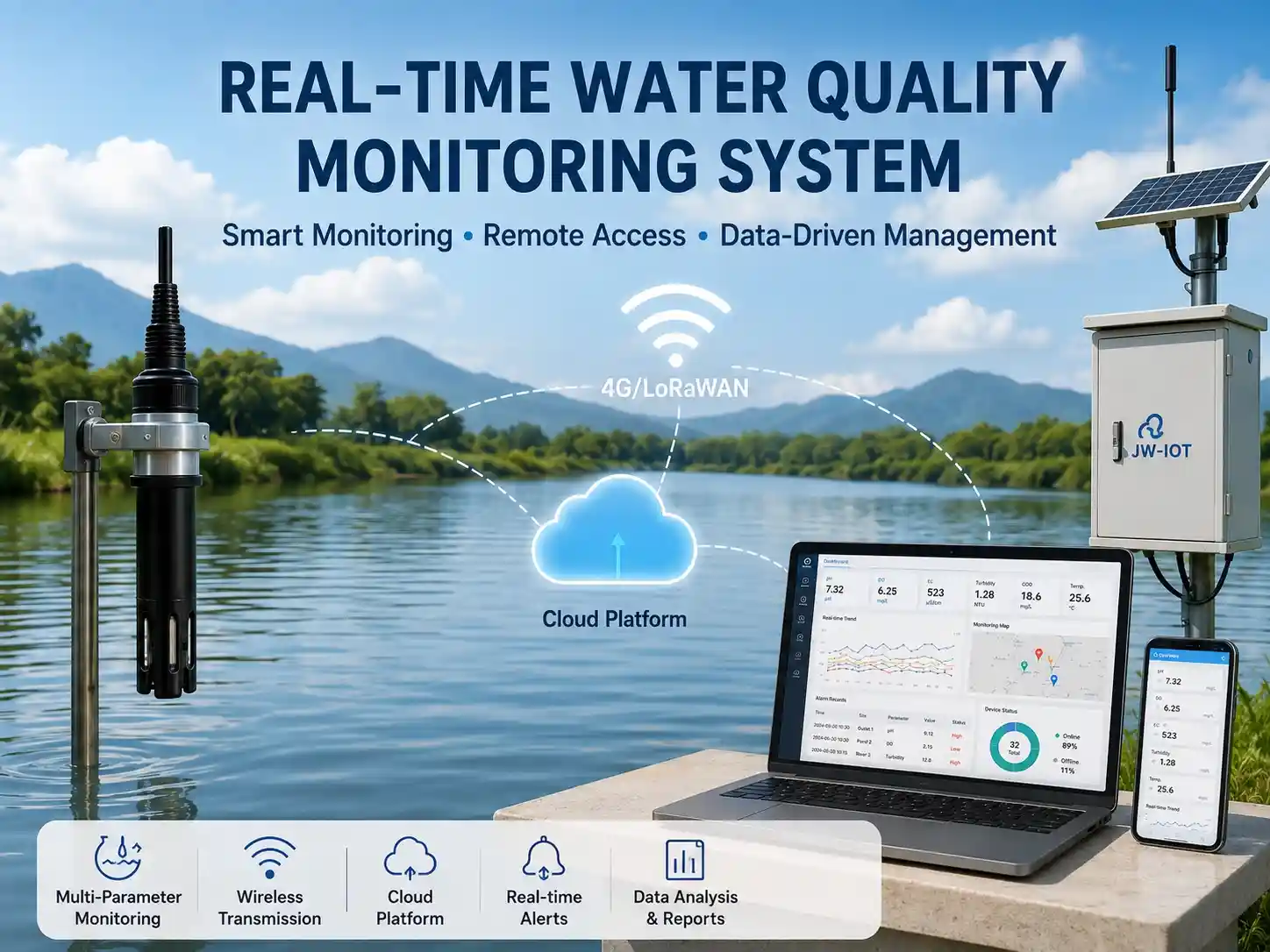
A water quality monitoring system is an integrated solution used to measure, collect, transmit, and analyze water quality data in real time. It helps users understand whether water conditions are safe, stable, and suitable for a specific application, such as drinking water supply, river monitoring, wastewater discharge, aquaculture, irrigation, or industrial process control.For project planning, sensor selection, communication architecture, and cloud integration, explore the complete JW-IoT online water quality monitoring solution.
In the past, water quality was often checked through manual sampling and laboratory testing. While laboratory analysis is still important, it cannot always provide immediate visibility into changing water conditions. In many real-world applications, water quality may change quickly due to rainfall, industrial discharge, algae growth, chemical dosing, seasonal temperature changes, or equipment failure.
This is why more projects now use online water quality monitoring systems. By combining sensors, data loggers, communication devices, cloud platforms, and alarm functions, these systems allow users to monitor key water parameters continuously and respond faster when abnormal conditions occur.
For projects that require online sensing hardware, JW-IoT provides a wide range of water quality sensors for environmental monitoring, wastewater treatment, aquaculture, irrigation, industrial water, and smart water management applications.
What Is a Water Quality Monitoring System?
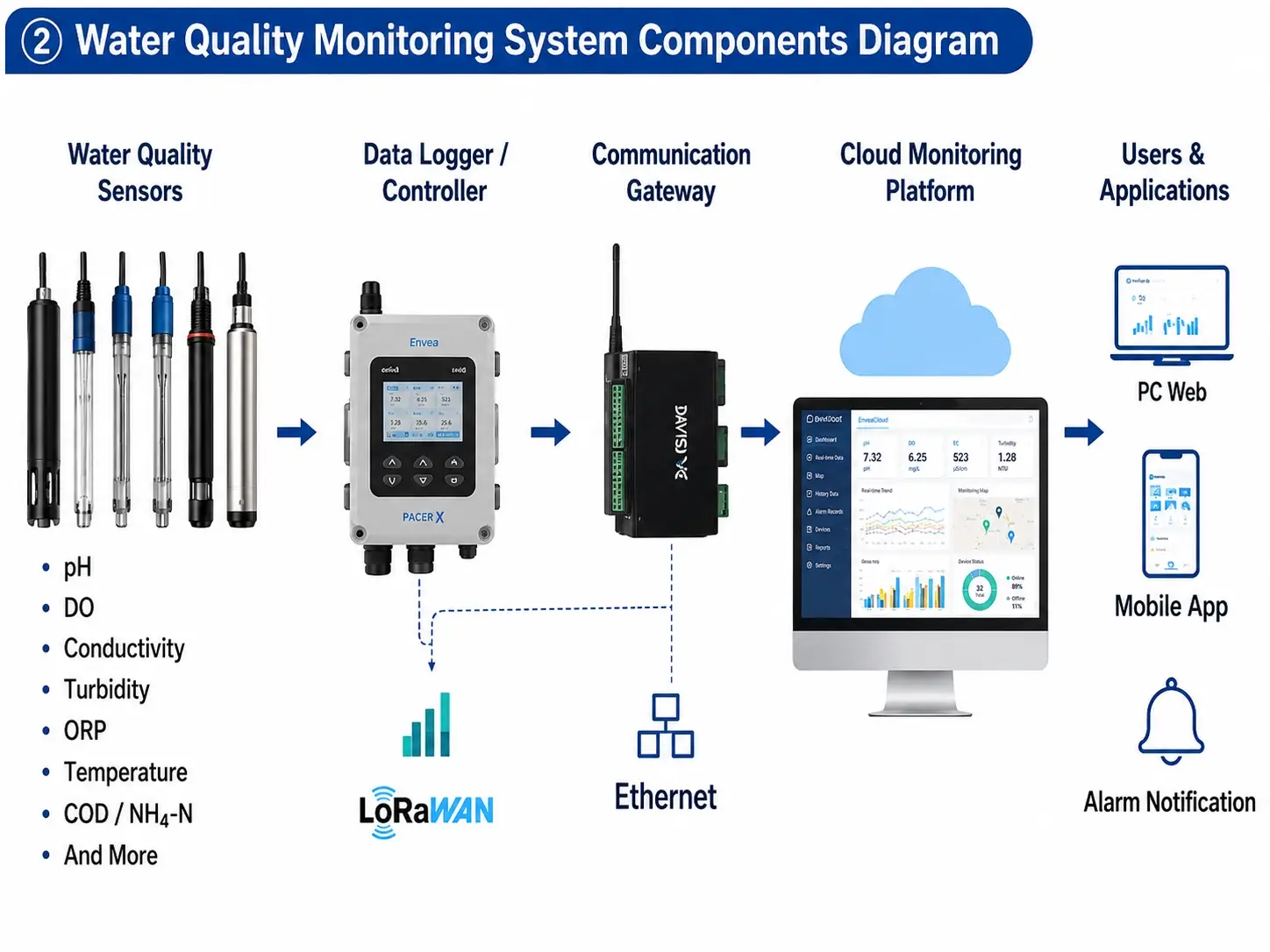
A water quality monitoring system is a complete technical system that measures physical, chemical, and sometimes biological indicators of water. Its purpose is to help users evaluate water conditions, detect abnormal changes, improve operational control, and support data-driven decision-making.
A typical water quality monitoring system includes:
- Online water quality sensors
- Data logger or sensor controller
- Power supply system
- Communication gateway
- Cloud monitoring platform
- Alarm and reporting functions
- Installation accessories and protection cabinets
Unlike a single handheld meter, a water quality monitoring system is designed for continuous or scheduled monitoring. It can be installed at fixed monitoring points such as rivers, reservoirs, discharge outlets, fish ponds, tanks, pipelines, irrigation canals, or wastewater treatment stations.
In an IoT-based system, water quality data can be transmitted to a cloud platform through RS485 Modbus, 4G, LoRaWAN, Ethernet, or other communication methods. This makes it possible to view real-time data remotely, compare multiple monitoring points, generate historical reports, and trigger alarms when values exceed preset thresholds.
Why Water Quality Monitoring Matters?
Water quality affects public health, ecological balance, industrial production, agricultural efficiency, and environmental compliance. Without reliable monitoring, many risks may remain hidden until they become serious problems.
For environmental projects, real-time water quality monitoring helps detect pollution events, track river or reservoir changes, and support long-term water resource management. For wastewater treatment, it helps factories and treatment plants identify abnormal discharge risks and optimize treatment processes. For aquaculture, water quality directly affects fish and shrimp health, growth rate, feed efficiency, and survival rate. For irrigation, poor water quality may cause soil salinity problems, clogged emitters, or crop stress.
A well-designed water quality monitoring system helps users answer important questions:
Is the water becoming more polluted?
Is dissolved oxygen too low for aquaculture?
Is the pH range suitable for the application?
Is turbidity increasing after rainfall or discharge?
Is conductivity or TDS rising due to salinity or dissolved ions?
Is the wastewater treatment process stable?
Are monitoring points showing abnormal trends?
By converting water conditions into measurable data, the system helps users move from reactive management to preventive management.
Main Components of a Water Quality Monitoring System
1. Water Quality Sensors
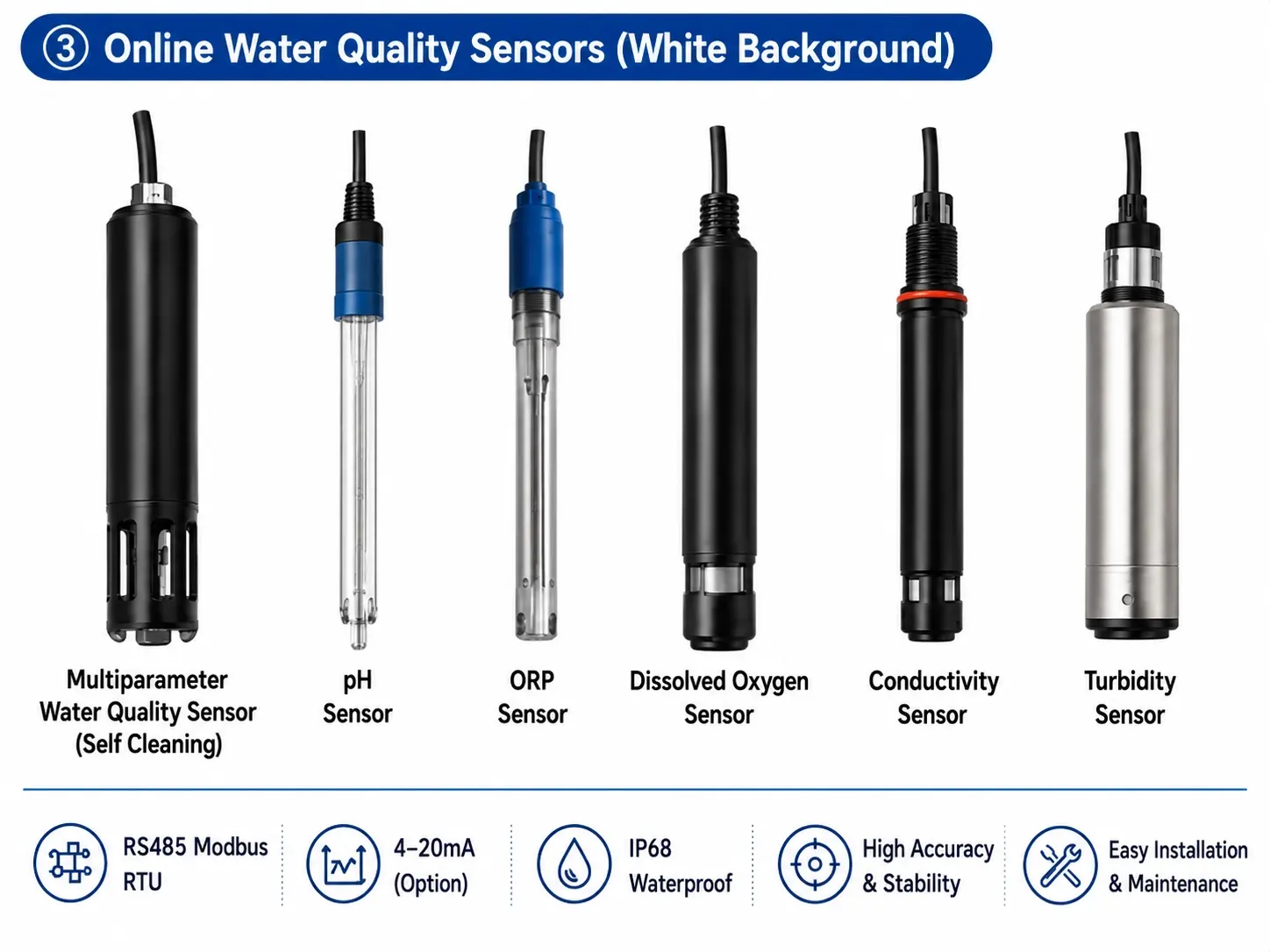
Sensors are the field-level devices that directly measure water parameters. Depending on the project, a system may use single-parameter sensors or multi-parameter probes.
Common online water quality sensors include:
- pH sensor
- ORP sensor
- Dissolved oxygen sensor
- Conductivity sensor
- TDS sensor
- Turbidity sensor
- Temperature sensor
- Salinity sensor
- Ammonium sensor
- COD sensor
- Chlorophyll sensor
- Blue-green algae sensor
- Ion selective sensors
- Water level and flow sensors
For projects that require multiple parameters in one device, a multiparameter water quality sensor can reduce installation complexity and support continuous online monitoring of several indicators from one probe body.d data loggers to provide real-time irradiance and temperature data for solar performance analysis.
2. Data Logger or Controller
The data logger collects sensor readings and manages local data storage, communication, device status, and alarm logic. In many industrial and environmental projects, sensors output data through RS485 Modbus RTU, 4–20 mA, SDI-12, or pulse signals.
A data logger can connect multiple sensors, process the collected data, and send it to a platform or local control system. It can also support threshold alarms, local storage, remote configuration, and integration with PLC, SCADA, or third-party platforms.
For system integration, users can refer to JW-IoT IoT data logger and sensor controller options.
3. Communication Devices
Communication is essential for remote monitoring. Depending on the project environment, water quality monitoring systems may use wired or wireless transmission.
Common communication methods include:
- RS485 Modbus RTU
- 4G LTE
- LoRaWAN
- Ethernet
- Wi-Fi
- NB-IoT
- MQTT
- TCP/IP
- API integration
For remote rivers, reservoirs, fish ponds, farms, or industrial parks, wireless communication reduces wiring difficulty and enables multi-point monitoring over larger areas. JW-IoT provides communication devices such as gateways and data transmission units for IoT monitoring systems.
4. Cloud Monitoring Platform
The cloud platform is where data becomes useful for daily management. A good platform should provide:
- Real-time data dashboard
- Historical trend curves
- Multi-point comparison
- Alarm records
- Device status monitoring
- Data export
- Report generation
- User permission management
- API access for third-party systems
For managers, the platform makes it easier to check water quality without visiting every monitoring point. For engineers, historical curves help identify process changes, sensor drift, abnormal discharge, or seasonal patterns.
5. Power Supply and Protection
Many water quality monitoring systems are installed outdoors or in harsh environments. Therefore, power and protection design are important.
Common configurations include:
- AC power supply
- Solar power system
- Battery backup
- Outdoor monitoring cabinet
- Waterproof connectors
- Lightning protection
- Anti-corrosion mounting structure
- Sensor cleaning accessories
For continuous outdoor operation, protection design can directly affect system stability and maintenance cost.
A practical system normally combines online sensors, data acquisition, field communication, cloud software, alarm management, and API integration. See how these components work together in a complete water quality monitoring system.
What Parameters Does a Water Quality Monitoring System Measure?
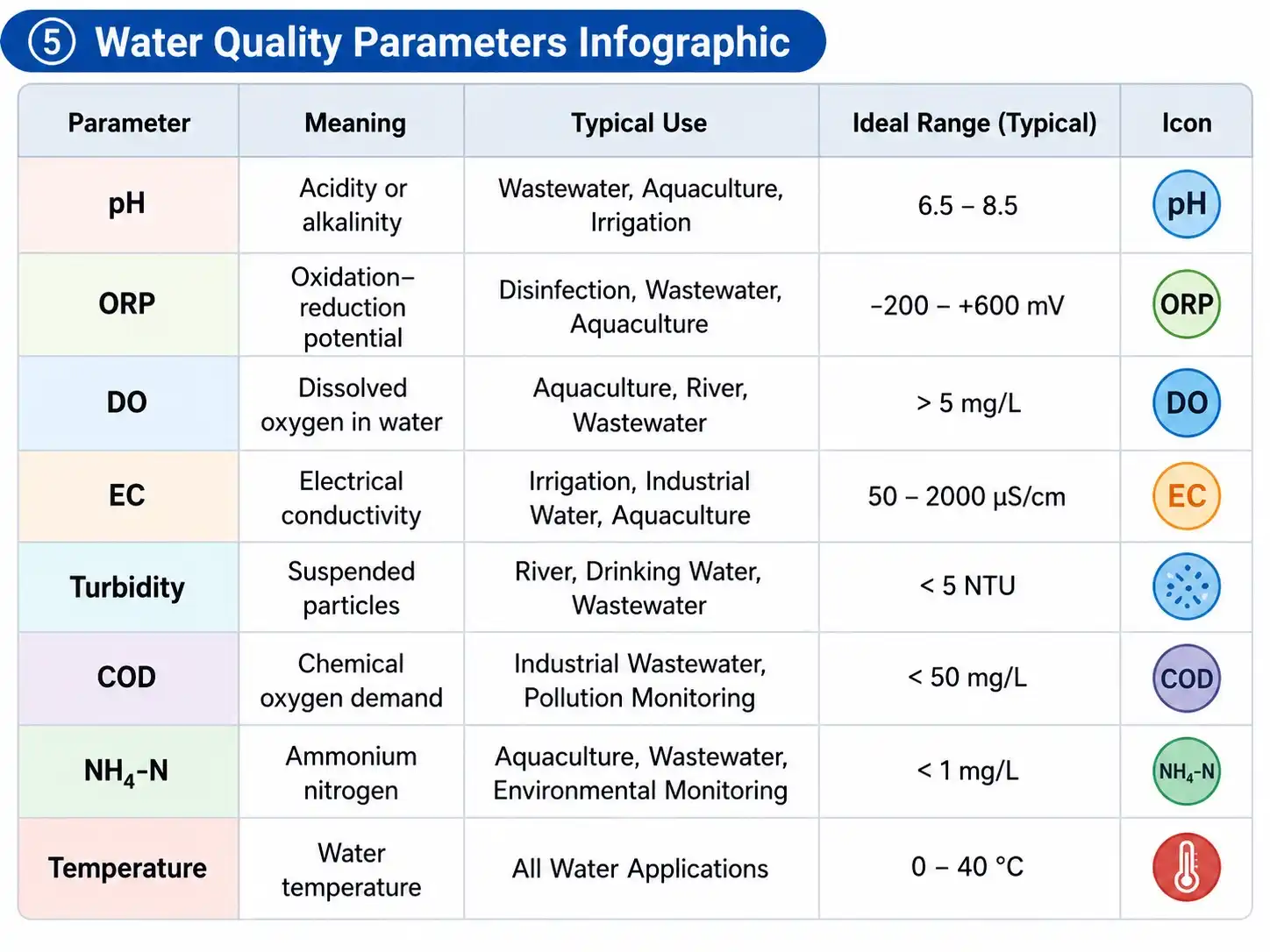
Different projects require different water quality parameters. The correct configuration depends on application type, monitoring objective, budget, and regulatory requirements.
pH
pH measures how acidic or alkaline the water is. It is one of the most common water quality indicators. Abnormal pH can affect chemical reactions, biological activity, wastewater treatment efficiency, fish health, and crop irrigation quality.
ORP
ORP stands for oxidation-reduction potential. It reflects the oxidizing or reducing condition of water and is often used in wastewater treatment, disinfection control, aquaculture, and industrial process water.
Dissolved Oxygen
Dissolved oxygen is critical for aquatic life and biological treatment processes. Low dissolved oxygen may cause fish stress, odor problems, or unstable wastewater treatment performance.
Conductivity and TDS
Conductivity measures the ability of water to conduct electrical current, which is related to dissolved ions. TDS is usually estimated from conductivity and represents total dissolved solids. These parameters are important for irrigation water, industrial water, aquaculture, and salinity monitoring.
For continuous conductivity measurement, JW-IoT offers an online conductivity sensor for water quality monitoring with RS485 Modbus RTU output and optional 4–20 mA signal.
Turbidity
Turbidity measures water clarity and suspended particles. High turbidity may indicate sediment, algae, pollution, or process instability. It is widely used in surface water, drinking water, wastewater, and industrial water treatment.
Temperature
Water temperature affects dissolved oxygen, chemical reaction speed, biological activity, and sensor compensation. It is often measured together with other parameters.
Ammonium and Nitrogen Indicators
Ammonium monitoring is important in aquaculture, wastewater treatment, and environmental water monitoring. High ammonium levels may indicate pollution, poor treatment performance, or biological imbalance.
COD
COD, or chemical oxygen demand, is used to estimate the amount of organic pollutants in water. It is especially important for industrial wastewater and municipal wastewater monitoring.
How Does a Water Quality Monitoring System Work?
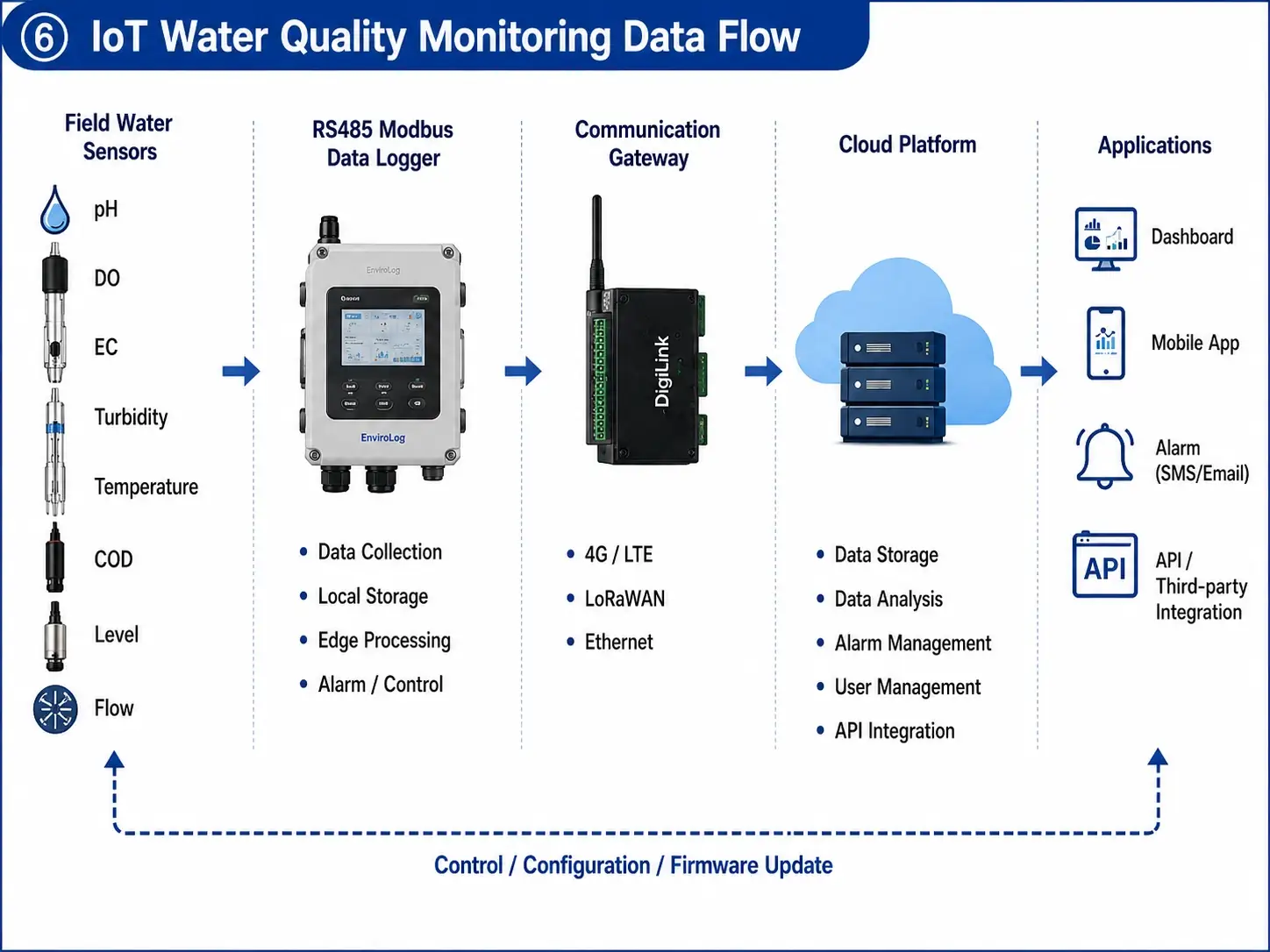
A water quality monitoring system works through a complete data flow from field sensing to platform analysis.
First, sensors installed in water measure specific parameters such as pH, dissolved oxygen, conductivity, turbidity, or temperature. These sensors convert physical or chemical changes into digital or analog signals.
Second, the data logger collects readings from the sensors. It may perform signal conversion, temperature compensation, local storage, and basic data validation.
Third, the communication gateway transmits data to a remote platform through 4G, LoRaWAN, Ethernet, or other networks.
Fourth, the cloud platform displays real-time values, historical trends, alarm status, and system reports.
Finally, users can take action based on the data. For example, a wastewater plant may adjust treatment processes, an aquaculture farm may increase aeration, or an environmental agency may investigate abnormal river pollution.
In more advanced systems, water quality data can be integrated with weather data, water level data, flow data, video monitoring, pump control, or automatic sampling systems.
Common Applications of Water Quality Monitoring Systems
1. River and Reservoir Monitoring
Rivers and reservoirs are affected by rainfall, runoff, industrial discharge, agricultural pollution, and seasonal changes. Online monitoring helps authorities and project operators track water quality trends and detect abnormal events.
Typical parameters include pH, dissolved oxygen, turbidity, conductivity, temperature, ammonia nitrogen, COD, chlorophyll, and blue-green algae.
2. Industrial Wastewater Monitoring
Industrial wastewater monitoring is one of the most important applications. Factories need to monitor discharge outlets, treatment stations, process water, and industrial park drainage networks.
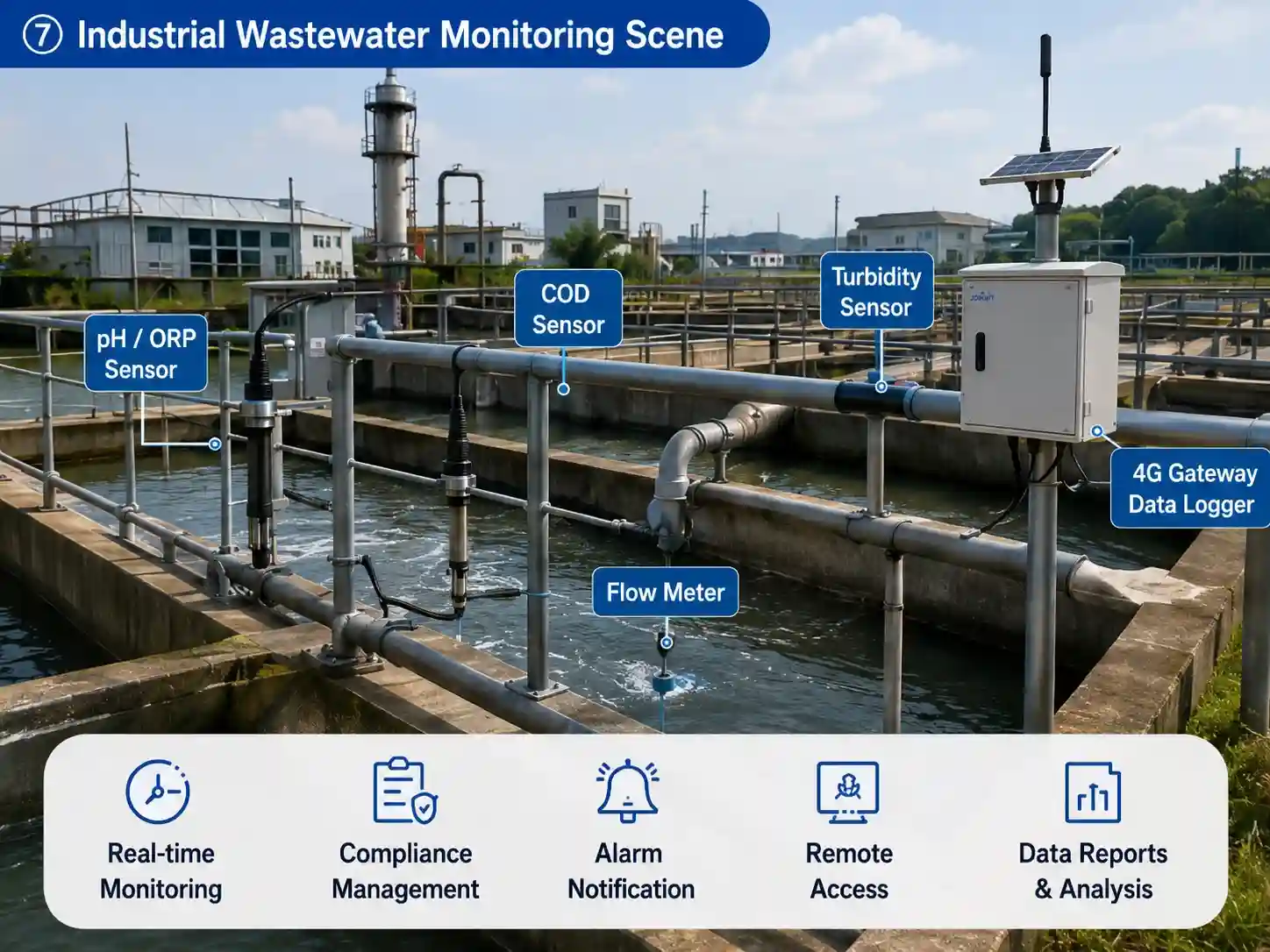
A smart wastewater monitoring system can help detect abnormal discharge risks, improve treatment visibility, and support environmental compliance. JW-IoT provides an industrial wastewater monitoring solution that integrates online sensors, IoT data loggers, wireless communication, edge alarm processing, cloud visualization, and API integration.
3. Aquaculture Water Quality Monitoring
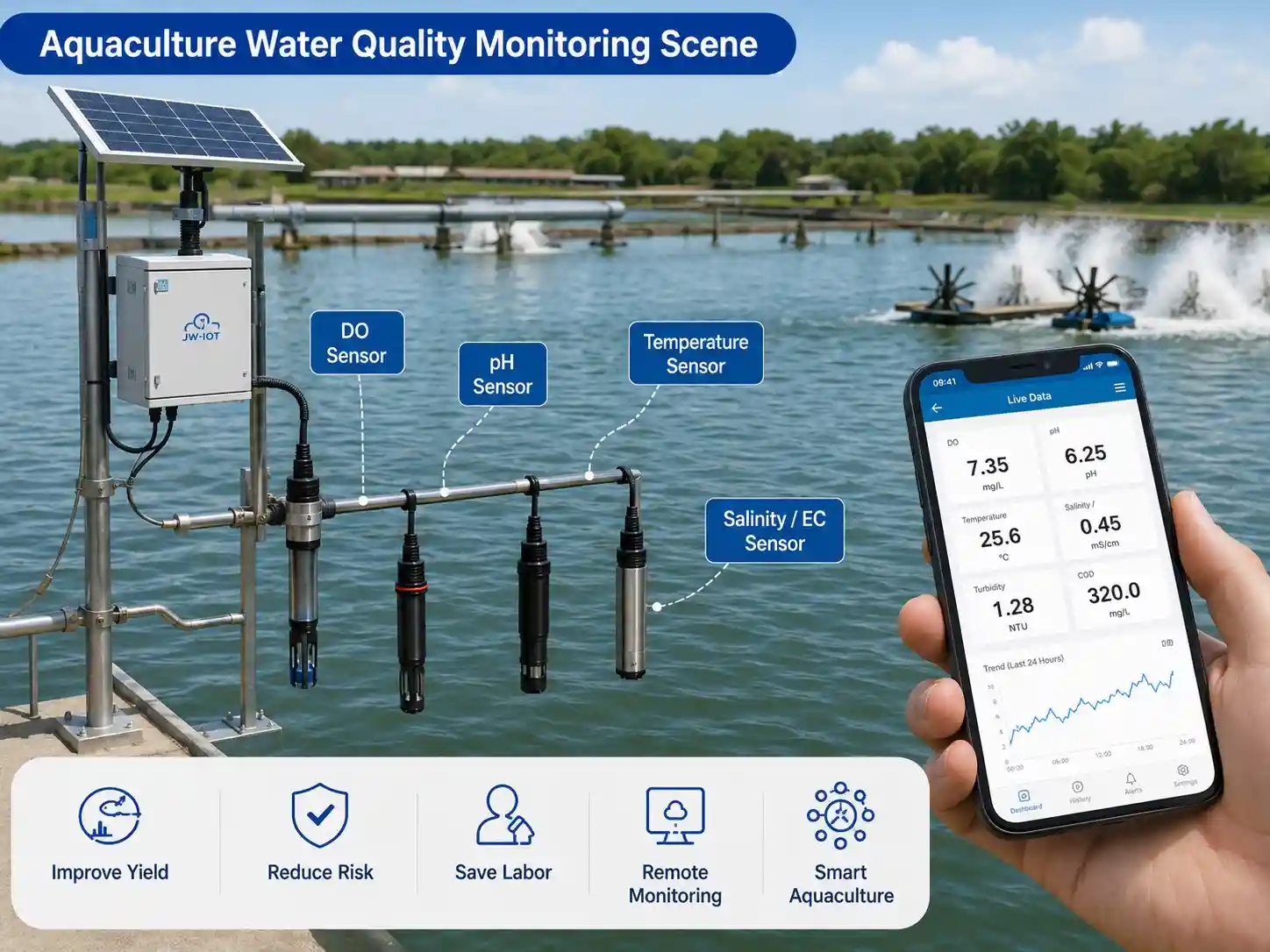
In aquaculture, water quality has a direct impact on fish and shrimp growth. Low dissolved oxygen, unstable pH, high ammonia, or abnormal temperature can cause serious losses.
A water quality monitoring system can help aquaculture farms monitor pond conditions in real time and make better decisions about aeration, water exchange, feeding, and disease prevention.
Typical parameters include dissolved oxygen, pH, temperature, salinity, ammonia, turbidity, and conductivity.
In aquaculture, continuous water quality monitoring helps operators detect oxygen depletion, ammonia accumulation, temperature changes, and abnormal pH conditions. A dedicated aquaculture monitoring system can combine sensors, data loggers, cloud dashboards, and automatic alarms.
4. Irrigation and Agricultural Water Monitoring
Irrigation water quality affects crop growth, soil structure, fertilizer efficiency, and irrigation equipment. High salinity, high TDS, unsuitable pH, or poor water quality may cause long-term agricultural problems.
By combining water quality sensors with soil sensors and smart irrigation systems, farms can manage both water supply and field conditions more precisely.
5. Drinking Water and Water Supply Systems
In water supply systems, monitoring helps track water clarity, pH stability, disinfectant control, conductivity changes, and pipeline water quality. Online monitoring provides faster visibility than manual inspection alone.
6. Industrial Process Water
Many factories use water in cooling, cleaning, production, chemical processing, or circulation systems. Monitoring conductivity, pH, ORP, temperature, and turbidity helps protect equipment and improve process stability.
Benefits of an IoT Water Quality Monitoring System
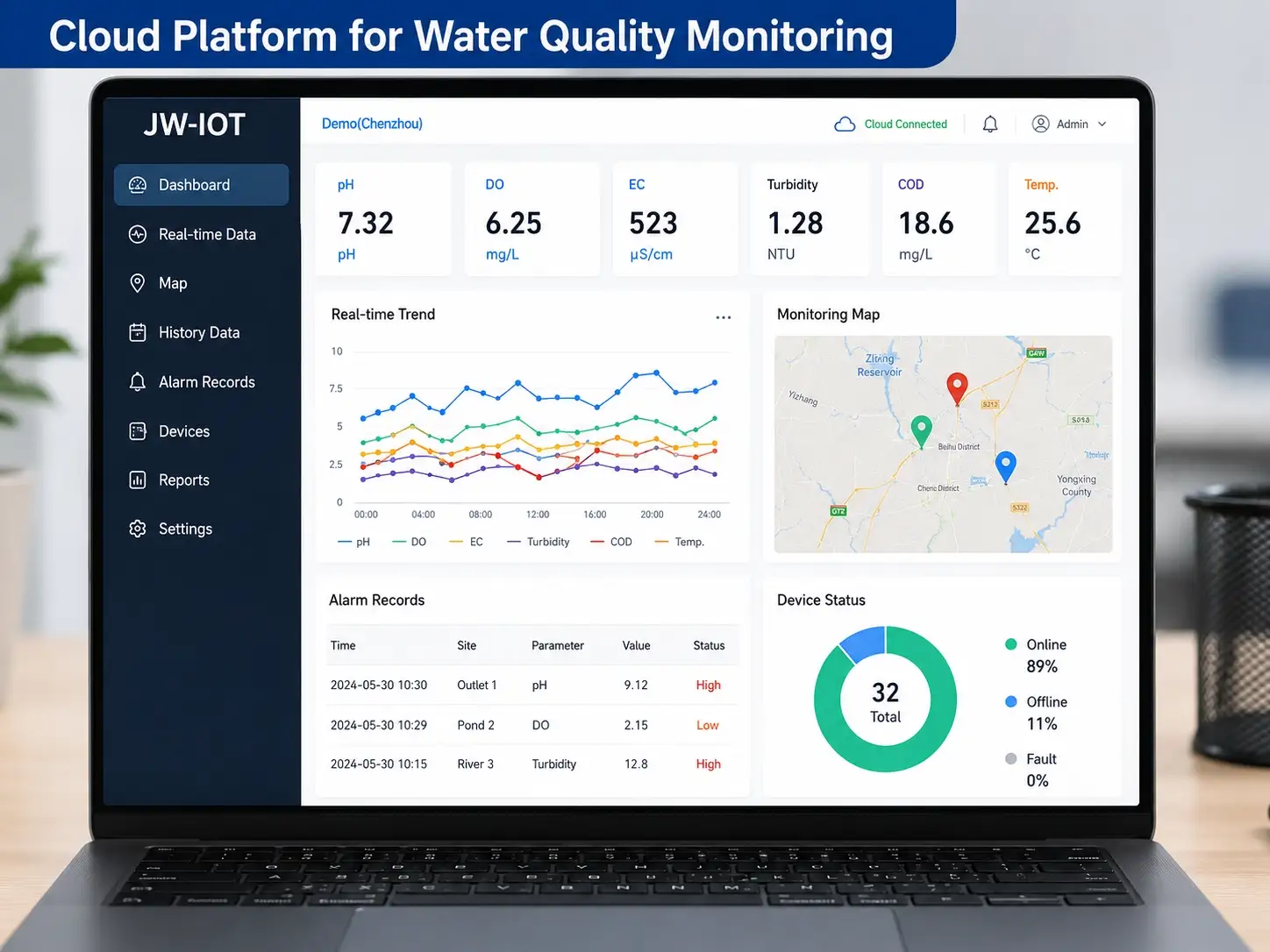
Real-Time Visibility
The biggest advantage of online monitoring is real-time visibility. Users no longer need to wait for periodic manual samples to understand water conditions.
Faster Abnormal Detection
When parameters exceed thresholds, the system can trigger alarms through the platform, SMS, email, or other notification methods. This helps users respond faster to pollution events, treatment failures, or aquaculture risks.
Lower Manual Workload
Manual sampling requires labor, time, transportation, and laboratory cost. Online monitoring reduces the frequency of manual inspection and allows staff to focus on maintenance and decision-making.
Better Historical Analysis
Long-term data helps users understand seasonal changes, treatment performance, pollution sources, and recurring issues.
Multi-Point Management
For projects with many monitoring points, an IoT platform allows centralized monitoring of rivers, ponds, discharge outlets, tanks, pipelines, or industrial parks.
Easier System Integration
With standard communication protocols such as RS485 Modbus, MQTT, TCP/IP, and API access, water quality monitoring systems can be integrated with SCADA, PLC, environmental platforms, or smart city systems.
How to Choose the Right Water Quality Monitoring System
Choosing the right system requires more than selecting sensors. A complete configuration should match the actual project conditions.
Define the Monitoring Purpose
The first step is to clarify the purpose. Is the project for wastewater compliance, aquaculture safety, river pollution warning, irrigation management, or industrial process control? Different purposes require different parameters.
Select the Right Parameters
For example, aquaculture projects usually focus on dissolved oxygen, pH, temperature, salinity, and ammonia. Wastewater projects may require pH, ORP, conductivity, turbidity, COD, ammonia nitrogen, flow, and level. Irrigation projects may focus on pH, EC, TDS, and temperature.
Consider Installation Conditions
Sensor installation depends on water depth, flow rate, sediment, algae, bubbles, tank structure, pipe diameter, maintenance access, and power availability.
Choose Suitable Communication
For short-distance industrial sites, RS485 and Ethernet may be suitable. For remote outdoor projects, 4G or LoRaWAN may be more practical.
Plan Maintenance and Calibration
Water quality sensors work in direct contact with water, so maintenance is important. Some projects may require automatic cleaning, anti-fouling design, regular calibration, or easy sensor replacement.
Check Platform and Data Requirements
Before deployment, confirm whether the project needs cloud access, local server deployment, API integration, alarm management, report export, or multi-user permission control.
Recommended System Architecture
A practical water quality monitoring system can be designed with four layers:
Field Sensing Layer
This layer includes water quality sensors, water level sensors, flow meters, sampling devices, and installation structures.
Data Acquisition Layer
This layer includes data loggers, sensor controllers, power modules, edge alarm processing, and local data storage.
Communication Layer
This layer includes 4G gateways, LoRaWAN gateways, Ethernet devices, or other data transmission equipment.
Platform Layer
This layer includes real-time dashboards, historical data analysis, alarms, device management, reports, and API integration.
This architecture allows the system to be expanded from a single monitoring point to a multi-site monitoring network.
Water Quality Monitoring System vs Manual Testing
Manual testing and online monitoring are not competitors. They are often used together.
Manual testing is useful for laboratory-level accuracy, regulatory sampling, and detailed chemical analysis. Online monitoring is better for continuous visibility, trend tracking, early warning, and daily operation.
In many projects, the best approach is to use online monitoring for real-time management and manual testing for verification and calibration.
Why Work with JW-IoT for Water Quality Monitoring?
JW-IoT focuses on IoT sensing technologies and integrated monitoring systems for smart water, environmental monitoring, industrial IoT, smart agriculture, and smart city applications.
For water quality projects, JW-IoT can provide:
- Online water quality sensors
- Multiparameter monitoring probes
- Conductivity, pH, ORP, DO, turbidity, COD, ammonium, and ion sensors
- IoT data loggers and controllers
- 4G and LoRaWAN communication devices
- Cloud monitoring platform integration
- Industrial wastewater monitoring solutions
- Custom monitoring configurations for different project scenarios
Whether the project is for river monitoring, aquaculture, wastewater discharge, irrigation water, or industrial process water, JW-IoT can help build a practical online monitoring system based on real field requirements.
Explore more related solutions:
- Water Quality Sensor
- Multiparameter Water Quality Sensor with Self Cleaning
- Online Conductivity Sensor for Water Quality Monitoring
- Industrial Wastewater Monitoring Solutions for Manufacturing
- Smart Water & Environmental Monitoring
- Communication Devices
FAQ
1. What is a water quality monitoring system?
A water quality monitoring system is a complete solution that uses sensors, data loggers, communication devices, and software platforms to measure and analyze water quality data in real time.
2. What parameters can a water quality monitoring system measure?
Common parameters include pH, ORP, dissolved oxygen, conductivity, TDS, turbidity, temperature, salinity, ammonium, COD, water level, and flow.
3. Where can water quality monitoring systems be used?
They can be used in rivers, reservoirs, lakes, wastewater treatment plants, industrial discharge outlets, aquaculture ponds, irrigation systems, drinking water systems, and industrial process water.
4. Does JW-IoT provide online water quality sensors?
Yes. JW-IoT provides online water quality sensors for pH, ORP, dissolved oxygen, conductivity, turbidity, temperature, COD, ammonium, and multiparameter monitoring applications.
5. What is the difference between online monitoring and manual sampling?
Online monitoring provides continuous real-time data and alarms, while manual sampling provides periodic laboratory analysis. Many projects use both methods together.
6. Can a water quality monitoring system send data to the cloud?
Yes. With data loggers and communication gateways, the system can transmit data to a cloud platform through 4G, LoRaWAN, Ethernet, or other communication methods.
7. Can JW-IoT water quality systems be integrated with other platforms?
Yes. JW-IoT systems can support common industrial communication methods and platform integration through protocols such as RS485 Modbus, MQTT, TCP/IP, and API interfaces depending on the project requirements.
8. How often should water quality sensors be maintained?
Maintenance frequency depends on water conditions, sensor type, pollution level, and installation environment. Wastewater and aquaculture applications usually require more frequent cleaning and calibration than clean water applications.
9. How do I choose the right water quality monitoring system?
Start by defining the application, required parameters, installation environment, communication method, power supply, maintenance plan, and platform integration needs. For complex projects, a customized configuration is usually recommended.
Conclusion
A water quality monitoring system is an essential tool for modern water management. It helps users monitor key water parameters in real time, detect abnormal changes, reduce manual workload, improve process control, and support better environmental decision-making.
From rivers and reservoirs to wastewater treatment, aquaculture, irrigation, and industrial water systems, online monitoring provides the data foundation for smarter and more reliable water management.
For projects that require real-time water quality monitoring, JW-IoT provides sensors, data loggers, communication devices, and integrated IoT solutions to help users build stable and scalable monitoring systems.
Need a water quality monitoring system for your project? Contact JW-IoT to discuss your monitoring parameters, installation environment, communication method, and platform requirements.