+86 13520127780
  info@jingelway.com




How do IoT rain gauges facilitate rainfall monitoring in smart agriculture?
Release time: 2026-08-11
In agricultural production, rainfall might seem like a simple data point, but it actually influences various stages, including sowing, irrigation, fertilization, and crop growth. Historically, agricultural management relied heavily on weather forecasts or manual observation, making it difficult to gauge the actual rainfall on specific plots of land. With the rise of smart agriculture, real-time, accurate meteorological data has become increasingly vital. IoT rain gauges automatically collect rainfall data and transmit it to a cloud platform via wireless communication, allowing managers to remotely monitor rainfall variations across different areas. For large-scale farms, agricultural parks, and remote fields requiring precision management, this approach reduces manual monitoring costs and provides reliable data to support decisions regarding irrigation and production.
Table of Contents
Why does smart agriculture require real-time rainfall monitoring?
In the past, farmers largely relied on weather forecasts and on-site observation to assess rainfall. However, weather forecasts reflect regional trends; actual rainfall on a specific field can differ significantly from these general predictions.
For instance, a rainfall forecast might be issued for a region, yet one field might experience only light rain while another sees heavy downpours. Without actual rainfall data as a reference, subsequent irrigation decisions are prone to error.
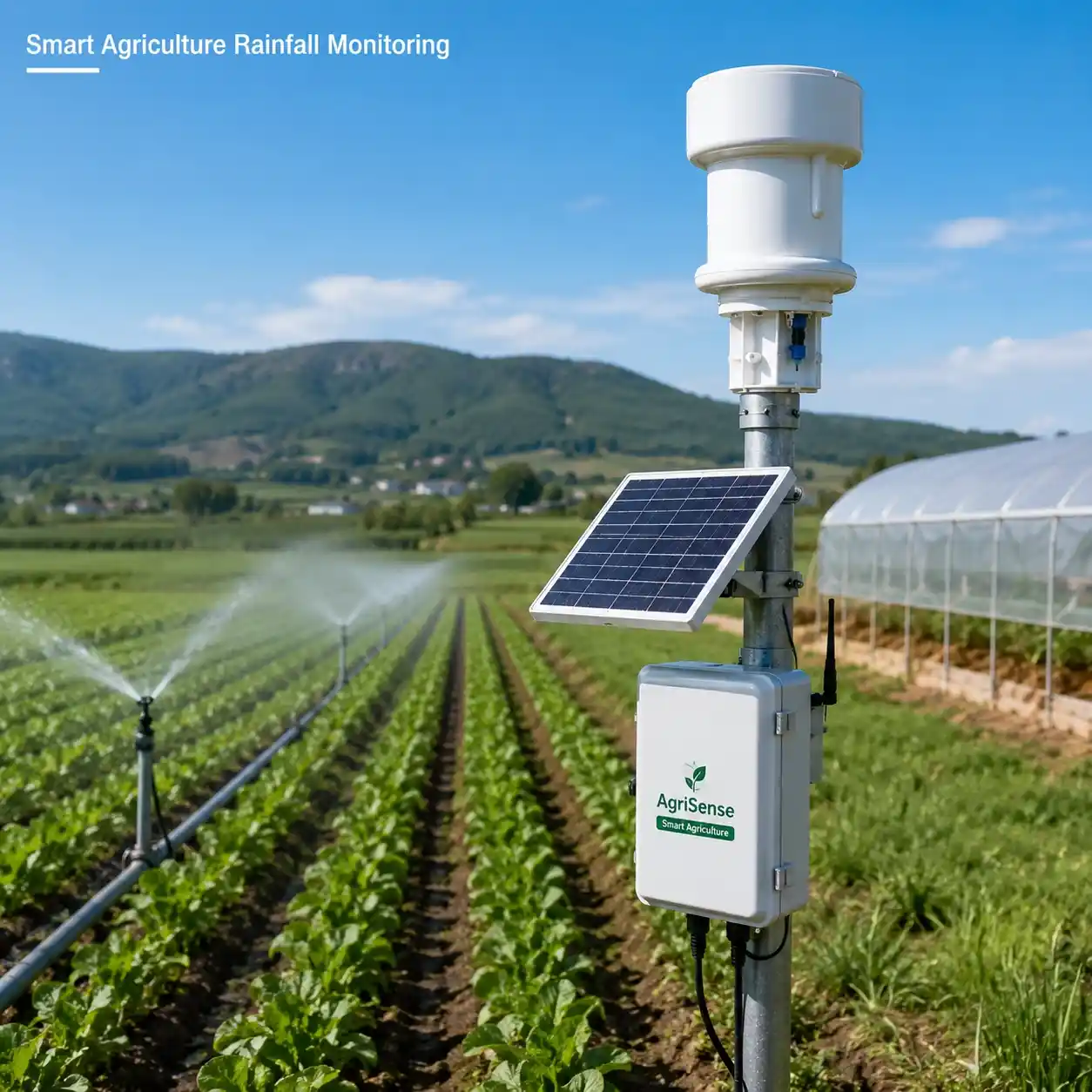
IoT rain gauges can be installed directly in fields, orchards, near greenhouses, or at agricultural weather monitoring stations to automatically measure rainfall. Data collected by the devices is uploaded to a cloud platform at set intervals, enabling managers to track rainfall changes via computer or smartphone.
This shifts agricultural decision-making from a reliance on experience alone to a process backed by real, empirical data.
How do IoT rain gauges enable remote rainfall monitoring?
The core advantage of IoT rain gauges lies in the “IoT” (Internet of Things) aspect itself.
While traditional rain gauges are primarily designed for measurement and recording, IoT rain gauges build upon this by adding data acquisition, communication, and remote management capabilities. When the device detects rainfall, it records data—such as cumulative rainfall, timing, and fluctuations over specific periods—according to pre-set protocols. Subsequently, this data can be transmitted to a server or cloud platform via communication technologies such as 4G, NB-IoT, or LoRa. Agricultural managers do not need to visit the site daily to read data; provided they have the appropriate access rights, they can view it remotely.
This is particularly practical for large-scale agricultural projects. For instance, a farm might have multiple monitoring points; relying solely on manual inspections would require significant manpower and increase the risk of missed data entries. By using IoT rain gauges, data from multiple points can be centralized for easier comparison and analysis.
How does rainfall data assist in irrigation decision-making?
Irrigation is a crucial component of smart agriculture, and rainfall volume is a key factor in determining whether irrigation is necessary.
Suppose significant rainfall occurred the previous day; if managers can access actual rainfall data promptly, they can combine it with information on soil moisture and crop growth stages to decide whether to reduce or postpone irrigation.
Conversely, if the equipment detects consistently low rainfall, managers can adjust irrigation schedules in advance to prevent crops from suffering due to water scarcity.
It is important to note that an IoT rain gauge cannot directly determine whether irrigation is required on a specific day. Its primary function is to provide reliable rainfall data, which is then combined with other metrics—such as soil moisture, temperature, and crop type—to make a comprehensive assessment. Decisions based on this type of data are far more scientific than scheduling irrigation based on experience alone.
How does this benefit rain-fed agriculture and remote farmland?
In regions with distinct rainy seasons, agricultural production relies heavily on natural rainfall. This is especially true in parts of Africa, where the onset and adequacy of the rainy season directly impact sowing and crop growth.
In such scenarios, IoT rain gauges serve as fundamental meteorological data collection devices. By continuously recording rainfall, agricultural managers gain a clearer understanding of local precipitation patterns.
The advantages of remote data transmission are particularly evident for remote or hard-to-access farmland. Once installed, the devices perform continuous, automated monitoring, eliminating the need for managers to make frequent site visits to collect data. Features such as solar power and low-power communication further ensure the equipment is well-suited for long-term operation in the field.
In what other smart agriculture scenarios can IoT rain gauges be applied? Beyond farmland irrigation, IoT rain gauges can be deployed in orchards, tea plantations, greenhouses, agricultural research stations, and large-scale farms.
In orchard management, rainfall data can be integrated with pest and disease monitoring as well as temperature and humidity readings to help assess changes in the field environment. In agricultural research, continuous rainfall data serves as a vital foundation for studying crop growth. In large agricultural complexes, multiple rain monitoring points can be interconnected to establish a regional agrometeorological monitoring network.
When integrated with automatic weather stations, soil moisture sensors, temperature and humidity sensors, and smart irrigation systems, the IoT rain gauge transcends simple rainfall measurement to become a fundamental node in a smart agriculture data acquisition ecosystem.
What should be considered when selecting an IoT rain gauge?
For agricultural applications, price should not be the sole deciding factor. Priority should be given to measurement accuracy and long-term operational stability, followed by the device’s resistance to water and dust, as well as its ability to withstand outdoor conditions.
If the installation site is remote, communication methods and power supply options are critical considerations. Different communication technologies—such as 4G, NB-IoT, and LoRa—are suited to different network environments, so the choice must align with local connectivity conditions. Additionally, solar power and low-power designs help minimize maintenance requirements during long-term operation.
Ease of use regarding the data platform is also important. For agricultural managers, the ability to clearly view real-time data, historical records, and rainfall trends is often more valuable than complex features.
The core of smart agriculture lies not merely in adding a few smart devices, but in enabling data-driven management through continuous, accurate data collection. As a key component of agrometeorological monitoring systems, IoT rain gauges support everything from rainfall data collection and wireless transmission to remote platform management, providing the foundation for irrigation, rainfall analysis, and production decision-making. Jw-iot specializes in IoT monitoring equipment and data acquisition solutions, offering tailored IoT rainfall monitoring systems based on practical agricultural needs. Through automated data collection, remote wireless transmission, and centralized platform management, Jw-iot helps users establish stable, convenient rainfall monitoring systems for smart agriculture, delivering professional digital weather monitoring support for agricultural projects of all scales. Jw-IoT Rain Gauge Solutions:
Smart agriculture is not merely about connecting traditional farming equipment to the internet; its true value lies in enabling collected data to inform agricultural production decisions. Through automatic measurement, remote transmission, and centralized data management, IoT rain gauges transform fragmented rainfall information into a continuous, intuitive data stream, providing a reliable foundation for irrigation management, sowing schedules, and agrometeorological analysis. As smart agriculture and digital farming continue to evolve, IoT rain gauges will integrate with soil, weather, and irrigation equipment to form a comprehensive data monitoring system, delivering more timely and scientifically grounded support for agricultural production.