+86 13520127780
  info@jingelway.com








Urban Flood Water Level Monitoring Devices Support Smarter Drainage Management
Release time: 2026-05-12
As extreme rainfall events become more frequent, urban waterlogging has become a major challenge for city drainage systems and emergency response teams. Roads, underpasses, low-lying intersections, tunnels, and drainage outlets may face rapidly rising water levels during storms, making real-time monitoring increasingly important for public safety and municipal management.
Against this background, urban flood water level monitoring devices are being adopted more widely to help cities collect on-site water level data, identify overflow risks, and improve emergency decision-making. By combining sensing, data logging, communication, alerting, and remote management, these devices provide a more intelligent foundation for urban flood prevention.Individual water level devices provide important field data, but city-scale projects normally require rainfall monitoring, remote communication, cloud dashboards, cameras, warning displays, and multi-level alarms. These components can be integrated into a complete urban flood monitoring system.
Real-Time Water Level Data Improves Flood Response
Traditional flood response often depends on manual inspection or delayed reporting. In contrast, IoT-based monitoring equipment can continuously track changes in accumulated water depth and transmit data to monitoring centers in real time.
An electronic water level monitoring terminal can support:
- Continuous water depth measurement
- Timely reporting of abnormal water rise
- Remote alarm triggering
- Historical data storage and query
- Multi-point monitoring for drainage networks
According to the technical information provided, the referenced device supports 0–320 cm water level measurement, ±1 cm accuracy, and 1 cm resolution, making it suitable for monitoring changing water conditions in urban flood-prone areas.
Multi-Channel Communication for Smarter Urban Drainage
For city-scale deployment, communication flexibility is essential. The device described in the source materials supports several optional communication methods, including:
- Serial communication
- 4G
- NB-IoT
- Bluetooth
It can also connect with monitoring centers through multiple network options and supports remote data access, parameter configuration, and system maintenance. This makes it suitable for integration into broader smart drainage monitoring systems and urban emergency platforms.
Early Warning Functions Help Reduce Risk
A key value of urban flood monitoring equipment lies in its ability to provide warnings before conditions become more dangerous. The referenced system supports:
- Multi-level alarm strategies
- Sound and light alarm linkage
- LED warning display
- Remote alarm control
- Threshold-based warning when monitored values exceed limits
These functions help local managers, rescue teams, and traffic operators respond faster when roads or public areas begin to flood.
For municipal drainage and underpass monitoring projects, JW-IoT can integrate water level sensors, rain gauges, 4G or LoRaWAN communication, LED displays, sirens, cameras, and cloud-based alarms into an IoT flood early warning solution.
Strong Local Storage and Remote Maintenance Capability
Reliable data retention is important during severe weather events, especially if communication is temporarily unstable. The device specifications indicate support for large local data storage, regular data reporting, and historical record query.
In addition, the equipment supports several remote maintenance functions, such as:
- Remote parameter setting
- OTA program upgrades
- Time synchronization
- Accuracy calibration
- Status diagnostics
These features reduce on-site maintenance workload and improve long-term operation efficiency for distributed monitoring networks.
Suitable for Diverse Urban Flood Monitoring Scenarios
Urban flood water level monitoring equipment can be used in a wide range of locations, including:
- Low-lying roads
- Underpasses
- Urban intersections
- Drainage channels
- Pump station surroundings
- Underground passageways
- Flood-prone community areas
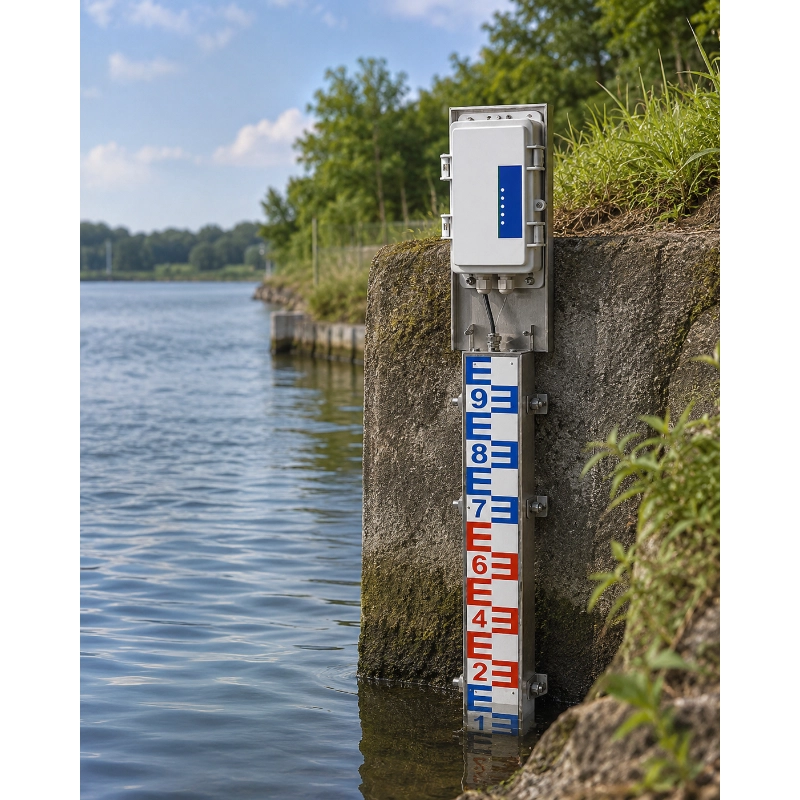
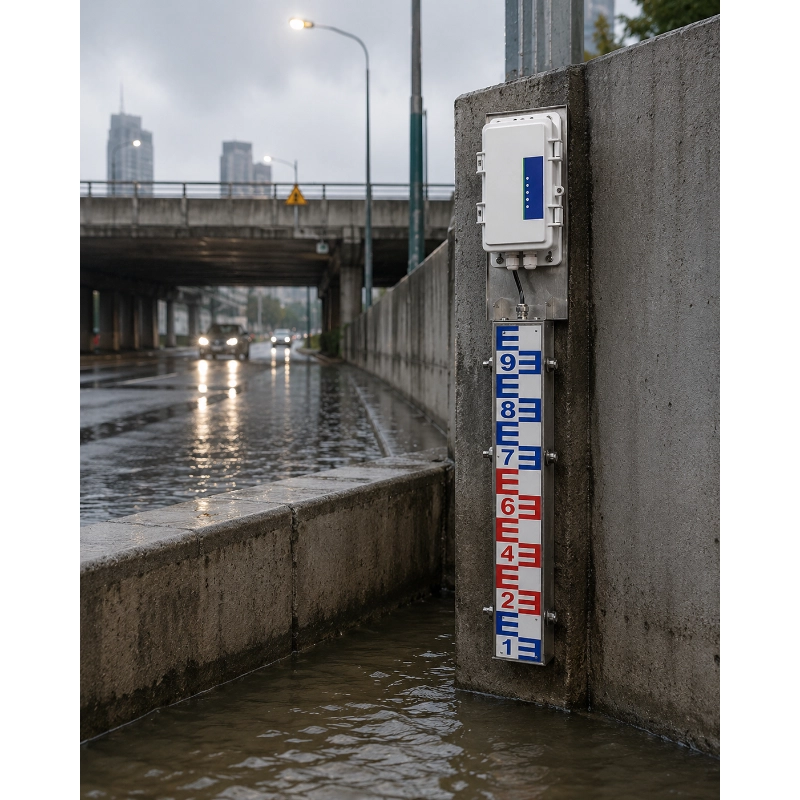
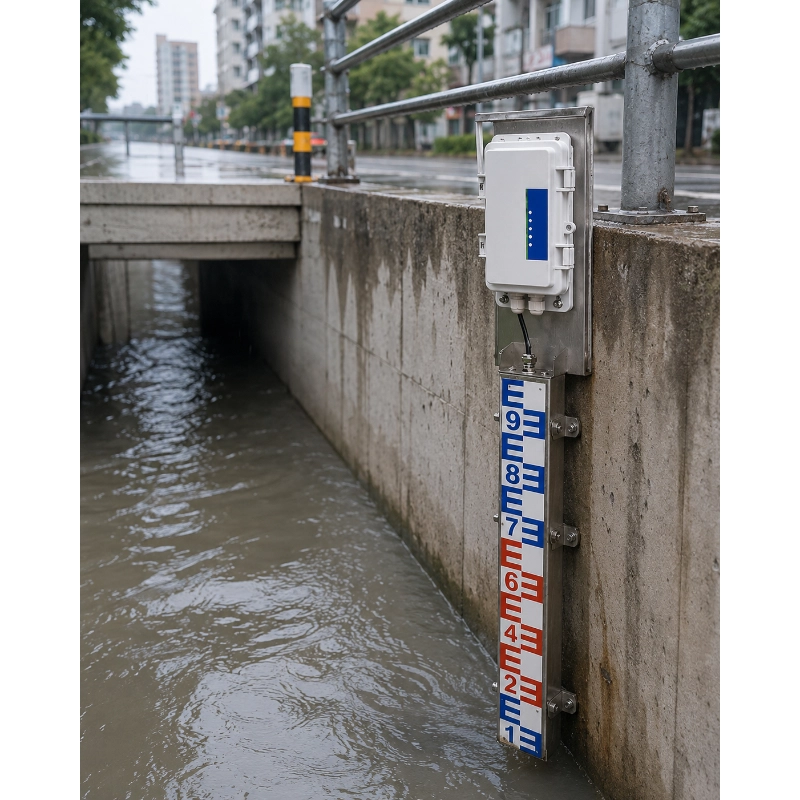
With optional solar power, DC power, and AC power support, the device can be adapted to different installation environments. The technical materials also mention IP68/IP65 protection options, which are important for outdoor and high-humidity deployment.
Industry Outlook
As cities continue to strengthen flood resilience and digital infrastructure, urban waterlogging monitoring systems are expected to play a larger role in public safety and drainage management. Future development will increasingly focus on:
- Higher monitoring density
- Faster data transmission
- More accurate early warning
- Integration with GIS and command platforms
- AI-assisted flood risk analysis
The transition from passive inspection to real-time, data-driven flood monitoring is becoming an important direction for smart city construction.
Conclusion
Urban flood water level monitoring devices are becoming essential tools for modern drainage safety. By combining accurate sensing, real-time communication, local storage, remote maintenance, and early warning functions, they help cities improve their ability to detect flood risks and respond to severe rainfall events more efficiently.
For smart city and municipal drainage projects, these devices provide a practical foundation for building safer and more responsive urban flood prevention systems.