+86 13520127780
 info@jingelway.com









Top Sensors Every PV Plant Monitoring System Should Include
Release time: 2026-09-14
A photovoltaic plant does not generate power under fixed laboratory conditions. Solar irradiance changes throughout the day, module temperature rises and falls, wind affects heat transfer, rainfall can change surface conditions, and dust accumulation may gradually reduce the amount of sunlight reaching the modules.
For this reason, electrical generation data alone does not always explain why a PV plant is performing at a particular level.
A properly designed PV monitoring system combines electrical data with environmental measurements so that operators can compare available solar resources, operating conditions, and actual power generation.
International PV monitoring guidance such as IEC 61724-1:2021 provides a framework for photovoltaic system performance monitoring, including monitoring equipment, irradiance measurement, data collection, and soiling measurement.
However, not every solar project needs exactly the same sensor package.
A rooftop commercial system, a utility-scale solar farm, a desert PV plant, and a floating solar project may require different monitoring configurations.
This guide explains the most important PV plant sensors, what each one measures, and where it can add value.
1. Why Sensor Selection Matters in a PV Monitoring System
Imagine that the output of a solar array suddenly falls.
The power data tells the operator that production has dropped, but it does not immediately explain the cause.
Several questions may need to be answered:
- Did solar irradiance decrease because of clouds?
- Did module temperature increase?
- Has dust accumulated on the modules?
- Is one section of the plant receiving different environmental conditions?
- Did a weather event affect the site?
- Or is the loss more likely to come from the inverter, wiring, modules, or other electrical equipment?
Environmental sensors provide the reference data needed to separate weather-related variation from potential equipment-related performance issues.
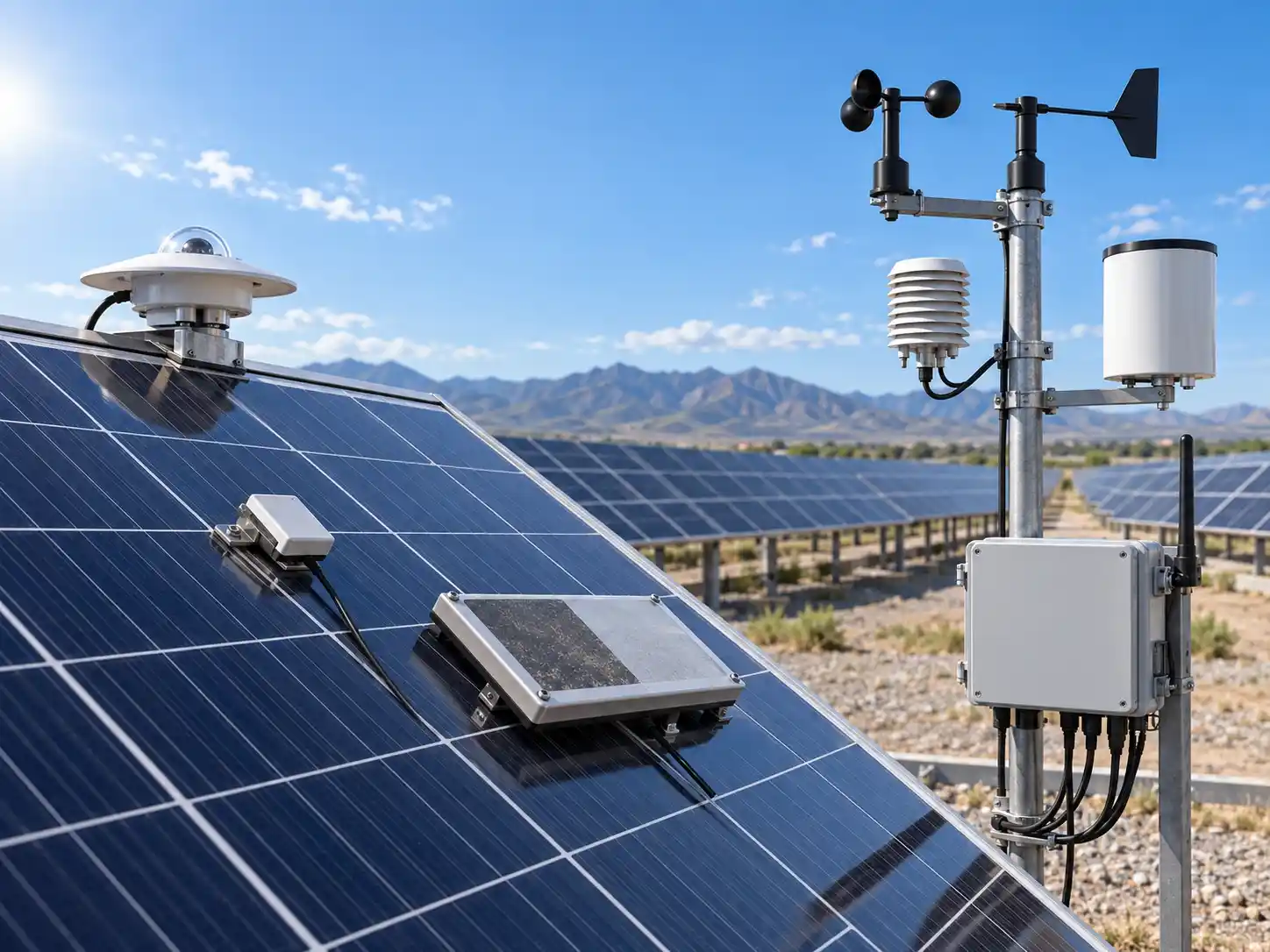
A complete monitoring architecture may combine:
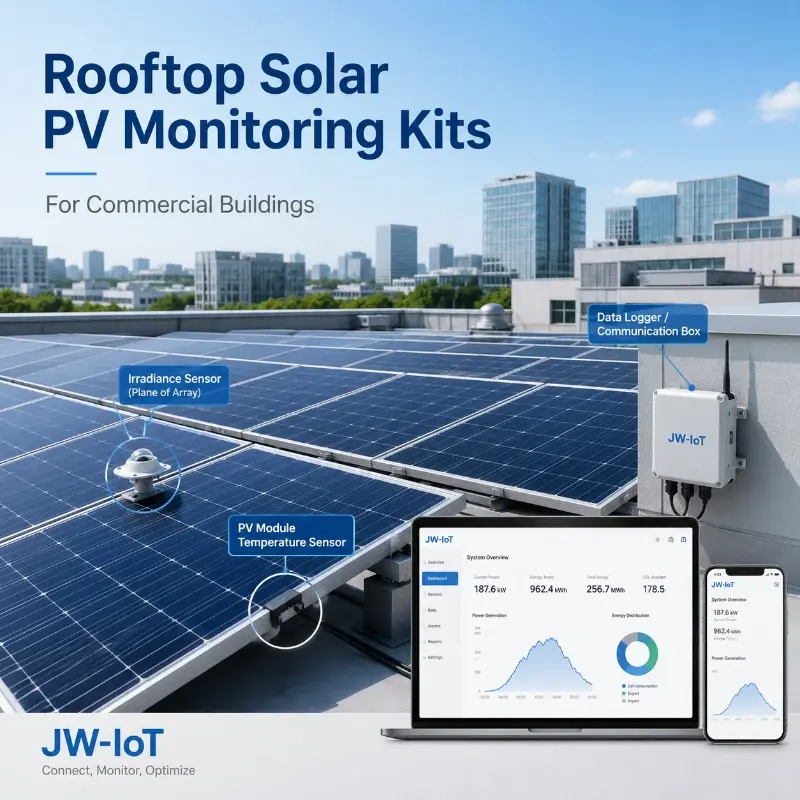
Environmental sensors → Data logger / RTU → Communication network → Monitoring platform → PV performance analysis
JW-IoT’s Solar PV Monitoring Solution integrates solar radiation, module temperature, weather monitoring, data acquisition, communications, and cloud-based monitoring for photovoltaic applications.
The objective is therefore not to install as many sensors as possible.
The objective is to collect the right environmental variables for the required level of performance analysis.
2. Solar Irradiance Sensors: The Foundation of PV Performance Monitoring
Among all environmental measurements used in photovoltaic plants, solar irradiance is one of the most important.
Irradiance describes the solar power arriving at a surface and is generally expressed in watts per square meter (W/m²).
Because photovoltaic modules convert incoming solar radiation into electricity, operators need irradiance data to understand the solar resource available to the array.
Without on-site irradiance measurement, a reduction in power generation can be difficult to interpret.
For example:
Lower PV output + lower irradiance
may simply indicate that less solar energy was available.
But:
Normal irradiance + unexpectedly low PV output
can justify further investigation into module temperature, soiling, shading, inverter operation, electrical losses, or other plant conditions.
Common Irradiance Measurements
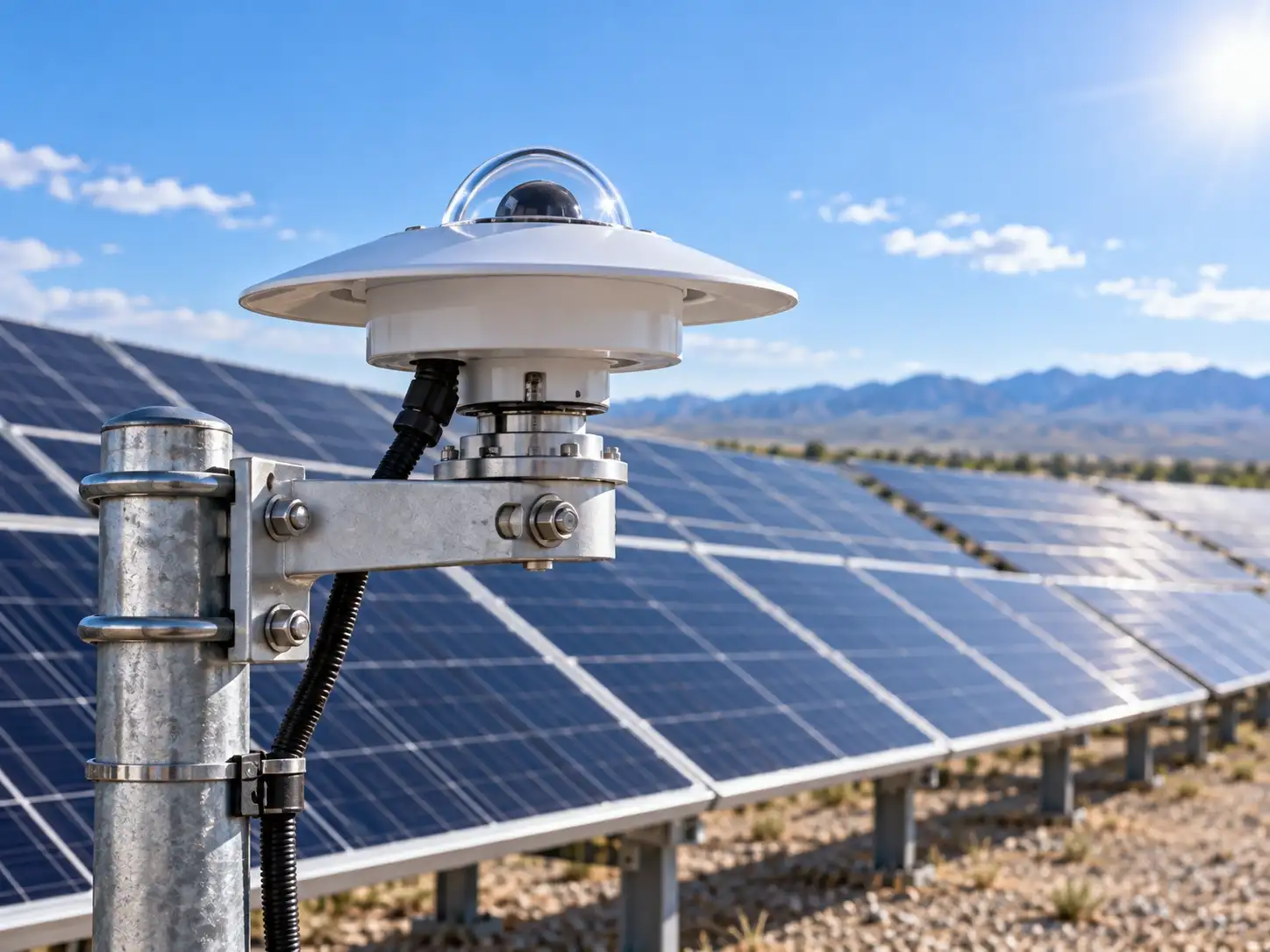
Depending on the monitoring objective, a PV project may use:
- Plane-of-array irradiance
- Global horizontal irradiance
- Pyranometers
- Silicon irradiance sensors
- Reference-cell-type irradiance devices
For performance monitoring, the location, orientation, mounting plane, sensor technology, and measurement accuracy should all be considered.
A plane-of-array sensor, for example, is normally positioned to represent the solar radiation received by the PV modules.
For projects requiring solar radiation monitoring, explore JW-IoT’s Solar Irradiance Sensor for PV Monitoring and related solar radiation sensors.
Why Irradiance Data Is So Valuable
Irradiance data can support:
- PV performance evaluation
- Performance ratio analysis
- Comparison between solar resource and power generation
- Identification of abnormal generation trends
- Solar resource monitoring
- Long-term performance analysis
For large plants, multiple representative monitoring points may also be considered when site size, terrain, array orientation, or local conditions make one measurement point insufficient.
3. PV Module Temperature Sensors
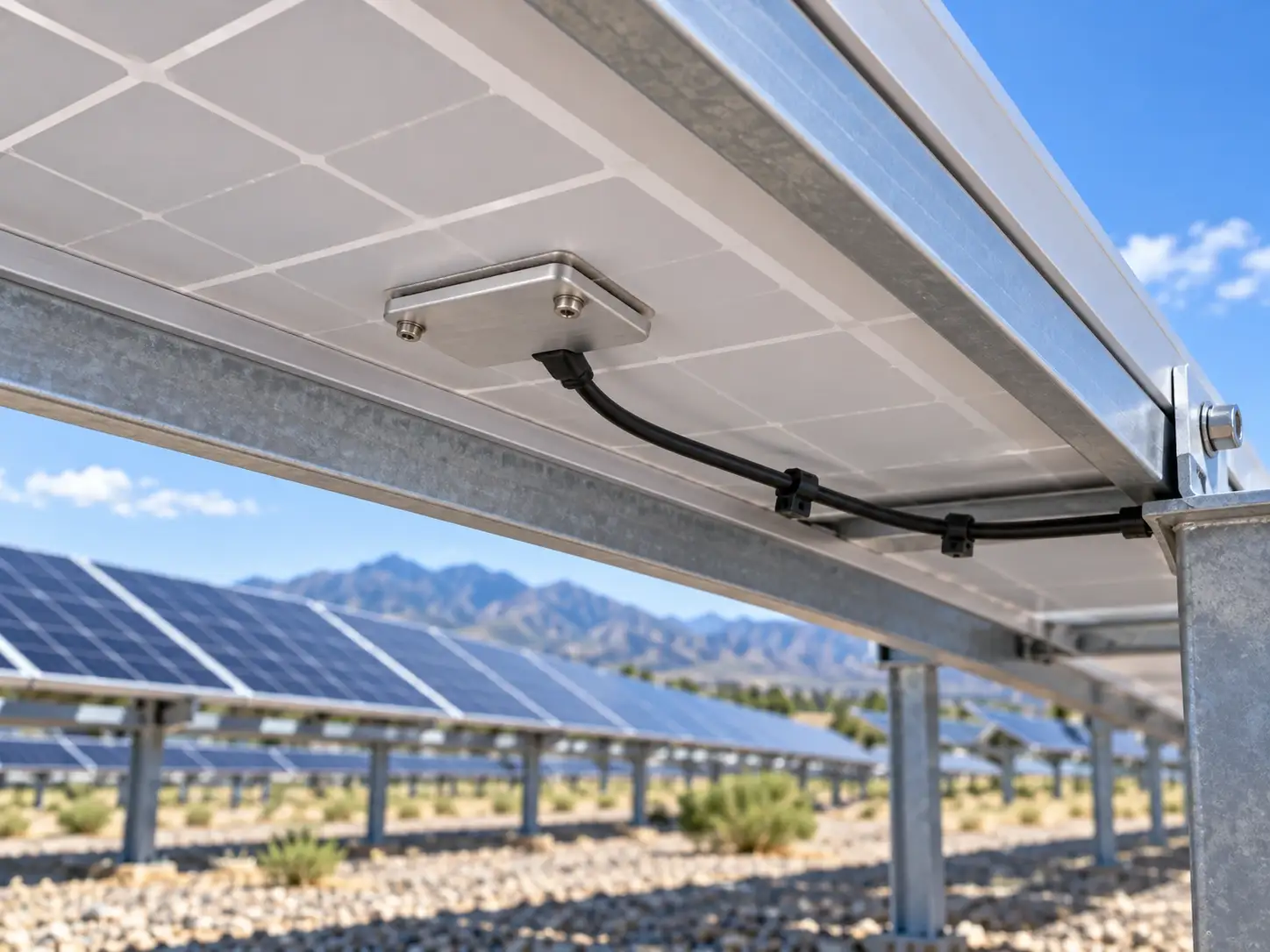
Solar modules can become considerably warmer than the surrounding air during operation.
That makes module temperature different from ambient temperature, and the distinction matters when analysing photovoltaic performance.
PV module electrical characteristics are temperature-dependent. Consequently, performance analysis becomes more meaningful when irradiance measurements are evaluated together with module temperature.
A PV module temperature sensor is normally installed in thermal contact with the module, commonly on the rear surface, according to the monitoring design and sensor installation requirements.
Module Temperature Data Can Help Operators:
- Compare module temperature with irradiance
- Understand temperature-related performance variation
- Compare operating conditions between arrays
- Investigate unusually high module temperatures
- Improve environmental context for performance analysis
Rather than looking at irradiance alone, operators can therefore analyse:
Irradiance + Module Temperature + Electrical Output
This combination provides a much stronger basis for evaluating whether changing power output is consistent with actual environmental conditions.
JW-IoT’s PV monitoring architecture can integrate PV module temperature sensors together with irradiance and meteorological measurements.
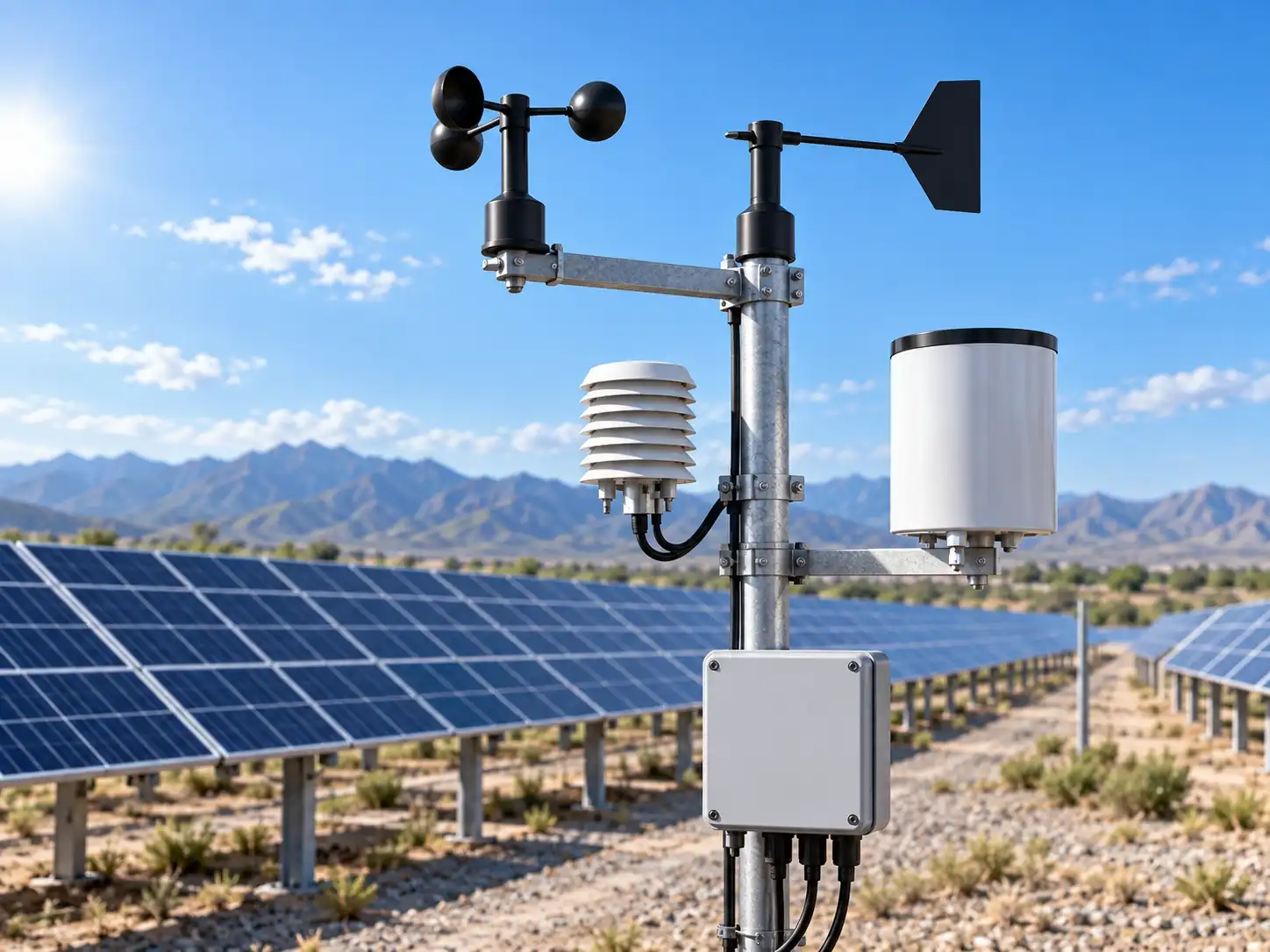
4. Wind Speed and Wind Direction Sensors
Wind is sometimes treated as a secondary measurement in solar projects, but it can provide valuable context for both PV performance analysis and site operation.
Air movement influences heat exchange around photovoltaic modules. Wind conditions can therefore contribute to differences in module operating temperature even when irradiance and ambient temperature appear similar.
Depending on the project, wind monitoring may include:
- Wind speed
- Wind direction
- Maximum or gust-related observations where required by the monitoring system
- Historical wind trends
Where Wind Monitoring Is Especially Useful
Wind measurements can be valuable for:
- Utility-scale PV plants
- Exposed open-field solar farms
- Desert installations
- Floating solar plants
- Coastal PV projects
- Sites subject to strong or highly variable wind conditions
Wind data can also provide additional environmental context when investigating module temperatures or unusual site conditions.
JW-IoT provides different wind speed and wind direction sensors that can be integrated into PV weather monitoring systems according to project requirements.
5. Rain Gauges, Ambient Temperature and Humidity Sensors
Not every environmental parameter directly calculates PV generation performance, but weather information can help operators understand the conditions surrounding the plant.
Ambient Temperature
Ambient air temperature provides a reference for evaluating the thermal environment around the PV array.
When recorded together with module temperature and irradiance, it helps operators distinguish between general weather conditions and module-specific heating.
Relative Humidity
Humidity monitoring can be useful for understanding site microclimate conditions.
Its importance depends strongly on the location and project type.
Examples include:
- Coastal solar plants
- Tropical PV installations
- Floating PV systems
- Sites with frequent condensation or high humidity
- Environmental monitoring stations integrated with solar plants
Humidity should therefore be considered a project-dependent parameter rather than a universal performance sensor.
Rainfall
A rain gauge records precipitation at the site.
Rainfall information can provide useful context when evaluating environmental changes and module surface conditions.
For example, rainfall records can be compared with:
- Soiling trends
- Weather events
- Maintenance records
- Cleaning activities
- Changes in environmental conditions
Rainfall should not automatically be interpreted as equivalent to effective module cleaning. The result can vary with rainfall intensity, dust characteristics, module angle, site environment, and other factors.
For this reason, projects where soiling losses are commercially important should consider direct soiling measurement rather than relying only on rainfall data.
6. PV Soiling Sensors: Measuring a Loss That May Be Difficult to See
Dust, sand, pollen, pollution, and other deposits can accumulate on PV module surfaces.
When deposits reduce the solar radiation reaching the photovoltaic cells, power generation can be affected.
The importance of soiling varies considerably by location.
It can be particularly relevant in:
- Desert solar plants
- Arid and semi-arid regions
- Sites near unpaved roads
- Agricultural areas
- Industrial environments
- Regions with long dry periods
NREL has conducted extensive research into photovoltaic soiling because operators need to understand the relationship between contamination, energy loss, and cleaning requirements.
A PV soiling sensor or soiling measurement system provides operators with more direct information about surface contamination than rainfall or visual inspection alone.
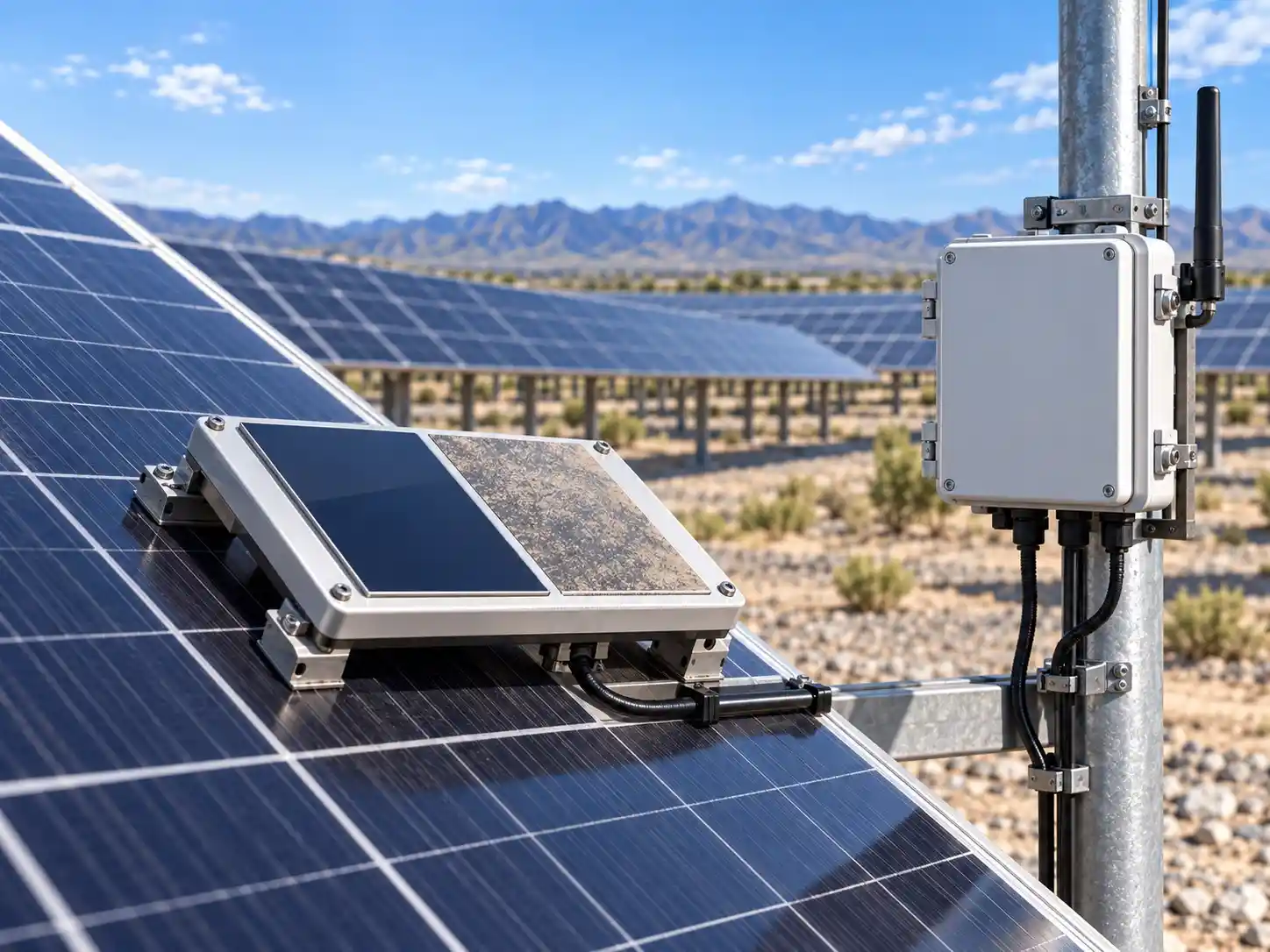
Soiling Data Can Support:
- Detection of increasing contamination
- Comparison of clean and contaminated conditions
- Cleaning schedule decisions
- Evaluation of cleaning effectiveness
- Long-term O&M analysis
This does not mean every small rooftop PV system needs a dedicated soiling sensor.
For a large desert solar farm, however, even small changes in soiling conditions can become important when applied across a large installed capacity.
JW-IoT provides a PV Soiling Measurement System for Solar Panel Monitoring for applications where direct soiling monitoring is required.
7. The Data Logger Is the Connection Between Sensors and Decisions
Installing accurate sensors is only part of a PV monitoring system.
The data must also be collected, timestamped, stored, transmitted, and made available for analysis.
This is the role of the data logger, RTU, IoT gateway, or monitoring controller.
Depending on the project architecture, a data acquisition system may collect information from:
- Irradiance sensors
- Module temperature sensors
- Air temperature and humidity sensors
- Wind sensors
- Rain gauges
- Soiling sensors
- Electricity meters
- Inverters
- Other plant equipment
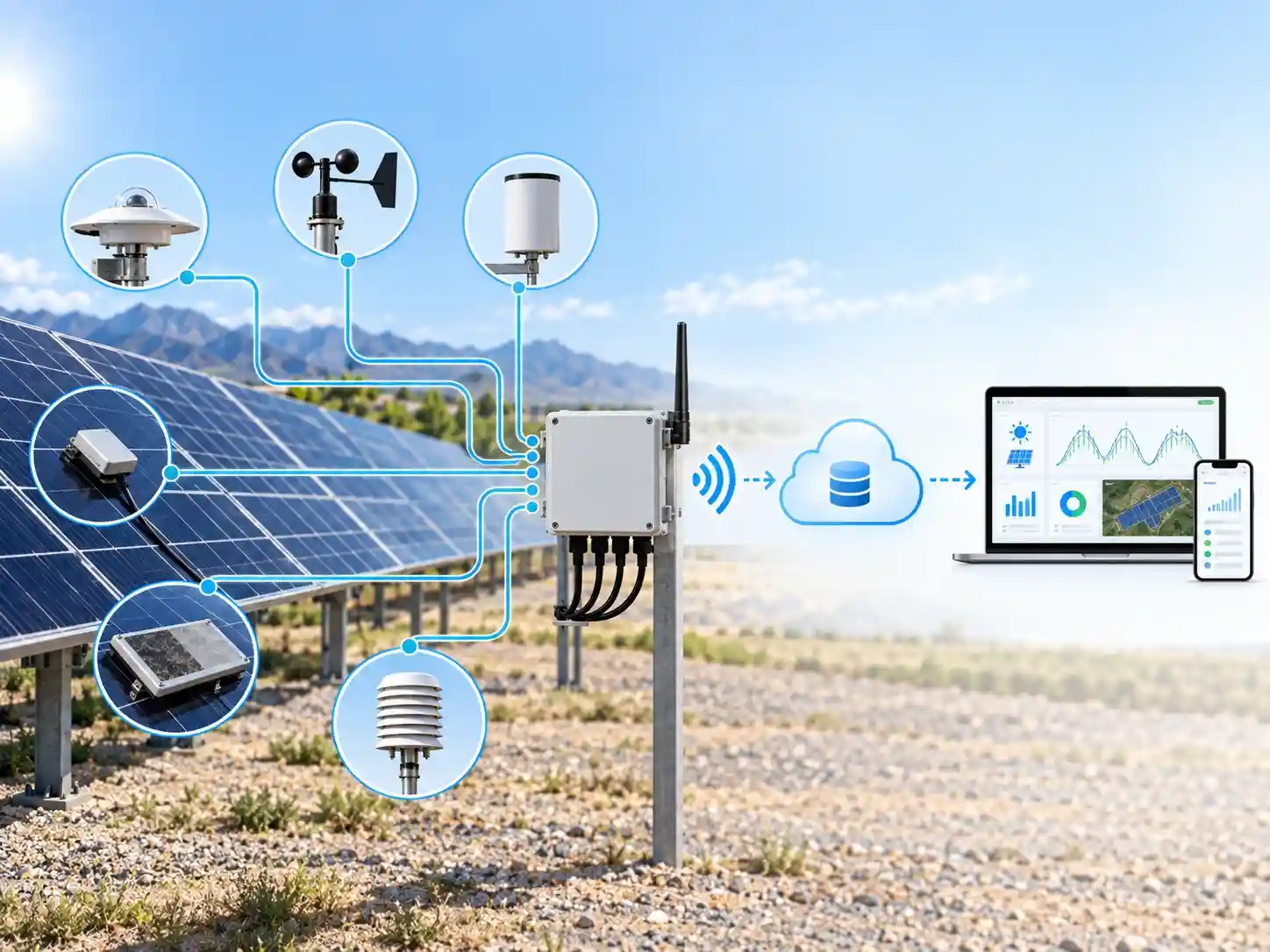
Communication options may include technologies such as:
- RS485 / Modbus
- Ethernet
- LoRaWAN
- 4G LTE
- MQTT-based data transmission
- API integration
The correct architecture depends on plant scale, sensor distribution, existing SCADA infrastructure, communication coverage, power availability, and the required monitoring platform.
A useful rule is:
Good sensors without reliable data acquisition still produce a weak monitoring system.
Sensor accuracy, installation quality, data acquisition, timestamp consistency, communication reliability, and data analysis must work together.
8. Recommended PV Sensor Package by Project Type
There is no single sensor package that fits every photovoltaic project.
A better approach is to configure the monitoring system according to project scale, climate, site conditions, and performance-monitoring objectives.
Commercial Rooftop PV
A typical environmental monitoring package may include:
- Solar irradiance sensor
- PV module temperature sensor
- Ambient temperature sensor
- Data logger or gateway
Additional weather parameters can be added when required by the project.
Utility-Scale Solar Farm
A more comprehensive configuration may include:
- Plane-of-array irradiance sensor
- Additional reference irradiance measurement where required
- PV module temperature sensors
- Ambient temperature and humidity
- Wind speed and direction
- Rain gauge
- Data logger / RTU
- Communication gateway
- Monitoring platform
Large or geographically distributed plants may require multiple representative monitoring points.
Desert PV Plant
Soiling becomes much more important in dusty environments.
A configuration may therefore include:
- Irradiance sensors
- Module temperature sensors
- Ambient temperature and humidity
- Wind monitoring
- Rainfall measurement
- PV soiling measurement system
- Data acquisition and remote communication
The environmental monitoring system can then provide data to support both performance analysis and cleaning decisions.
Floating PV Plant
Floating photovoltaic installations introduce a different operating environment.
Depending on project requirements, monitoring may include:
- Solar irradiance
- Module temperature
- Ambient temperature and humidity
- Wind speed and direction
- Rainfall
- Water-related environmental monitoring where required
- Data logger
- Remote communications
JW-IoT also provides a Floating Solar Monitoring Station Solution for reservoir-based and other floating PV applications.
9. Core Sensors vs Project-Dependent Sensors
One common mistake when designing a PV weather station is treating every possible environmental parameter as equally important.
A more practical approach is to divide sensors into two groups.
Core Performance Reference Measurements
For many performance-monitoring applications, the most important environmental measurements include:
Solar irradiance + PV module temperature
These directly improve the ability to compare available solar energy, operating temperature, and power generation.
Project-Dependent Measurements
Other measurements can then be selected according to actual site conditions:
Wind — useful for thermal and site-condition context.
Rainfall — useful for precipitation and environmental records.
Humidity — particularly relevant in humid, coastal, tropical, or floating environments.
Soiling — particularly valuable where dust-related generation loss and cleaning optimization are important.
The final monitoring configuration should therefore be based on engineering requirements rather than simply maximizing the number of sensors.
10. How to Choose PV Plant Sensors
Before selecting sensors for a photovoltaic monitoring project, consider the following questions:
- What performance indicators need to be analysed?
- Is the project rooftop, utility-scale, desert, coastal, or floating PV?
- Is plane-of-array irradiance required?
- How many representative monitoring points are necessary?
- Is soiling a significant operational risk?
- Which weather parameters are important for the site?
- Which output signals are required?
- Will the system connect to an existing SCADA or monitoring platform?
- What communication infrastructure is available?
- What environmental protection level is required?
The sensor itself should never be considered in isolation.
Installation position, orientation, calibration strategy, maintenance, data logging, communication, and analysis all influence the usefulness of the final dataset.
FAQ
1. What sensors are most important for a PV plant?
Solar irradiance and PV module temperature are among the most important environmental measurements for PV performance monitoring. Wind, rainfall, humidity, and soiling measurements can be added according to project scale, climate, monitoring objectives, and site conditions.
2. Why does a solar plant need an irradiance sensor?
An irradiance sensor measures the solar energy available at the site. Comparing irradiance with electrical generation helps determine whether changes in output are consistent with changing sunlight conditions or whether further investigation may be required.
3. Why measure PV module temperature?
PV module electrical performance changes with temperature. Module temperature data therefore provides important context when analysing generation performance together with solar irradiance.
4. Does every PV plant need a soiling sensor?
No. The value of direct soiling measurement depends on the site. It is particularly useful in dusty, desert, agricultural, industrial, or other environments where contamination may significantly influence cleaning strategy and plant performance.
5. Do PV plants need wind and rain sensors?
They are useful in many projects but should be selected according to monitoring objectives. Wind provides environmental and thermal context, while rainfall records precipitation and can support analysis of site conditions and soiling events.
6. What does a PV data logger do?
A data logger collects measurements from environmental sensors and other devices, timestamps and stores the data, and can transmit it to SCADA, IoT, or cloud monitoring platforms for visualization and analysis.
Build the Monitoring System Around the Question You Need to Answer
The best PV monitoring system is not necessarily the one with the largest number of sensors.
It is the system that collects the measurements needed to explain plant performance reliably.
For many PV plants, this starts with:
Solar irradiance → Module temperature → Electrical generation
Weather data can then add environmental context, while soiling monitoring can address location-specific contamination risks.
When these sensors are connected through a reliable data acquisition and communication architecture, operators gain a clearer picture of the relationship between sunlight, weather, module conditions, and actual energy production.
JW-IoT provides solar irradiance sensors, PV module temperature monitoring, weather sensors, soiling monitoring devices, data acquisition equipment, communication gateways, and integrated PV monitoring solutions for rooftop, utility-scale, desert, and floating solar projects.
Request a Complete PV Sensor Kit
Planning a PV monitoring project?
Send JW-IoT your:
- PV plant type
- Installed capacity
- Site location and environmental conditions
- Required monitoring parameters
- Number of monitoring points
- Communication requirements
- Existing SCADA or monitoring platform requirements
Our team can recommend a suitable PV sensor and monitoring configuration for your project.
CTA: Request Complete PV Sensor Kit
Technical References
This article is based on established PV monitoring principles including IEC 61724-1:2021 — Photovoltaic system performance — Part 1: Monitoring, together with photovoltaic monitoring and solar-resource research published by the U.S. National Renewable Energy Laboratory (NREL).
These references support the use of irradiance, temperature, meteorological data, data acquisition, and soiling information in photovoltaic system performance monitoring and analysis.