+86 13520127780
  info@jingelway.com








Weather Monitoring System Design Guide for IoT Projects
Release time: 2026-06-16
Introduction
Designing weather monitoring points is one of the most important steps in an IoT environmental monitoring project.
A properly designed monitoring network ensures accurate environmental data collection, reliable communication, and long-term system stability. Poor planning, however, may lead to inaccurate measurements, communication failures, and unnecessary installation costs.
Different applications require different weather monitoring strategies.
For example:
- Agricultural projects focus on temperature, humidity, rainfall, solar radiation, and soil conditions.
- Solar PV projects require irradiance and module temperature monitoring.
- Smart city projects require distributed environmental observation networks.
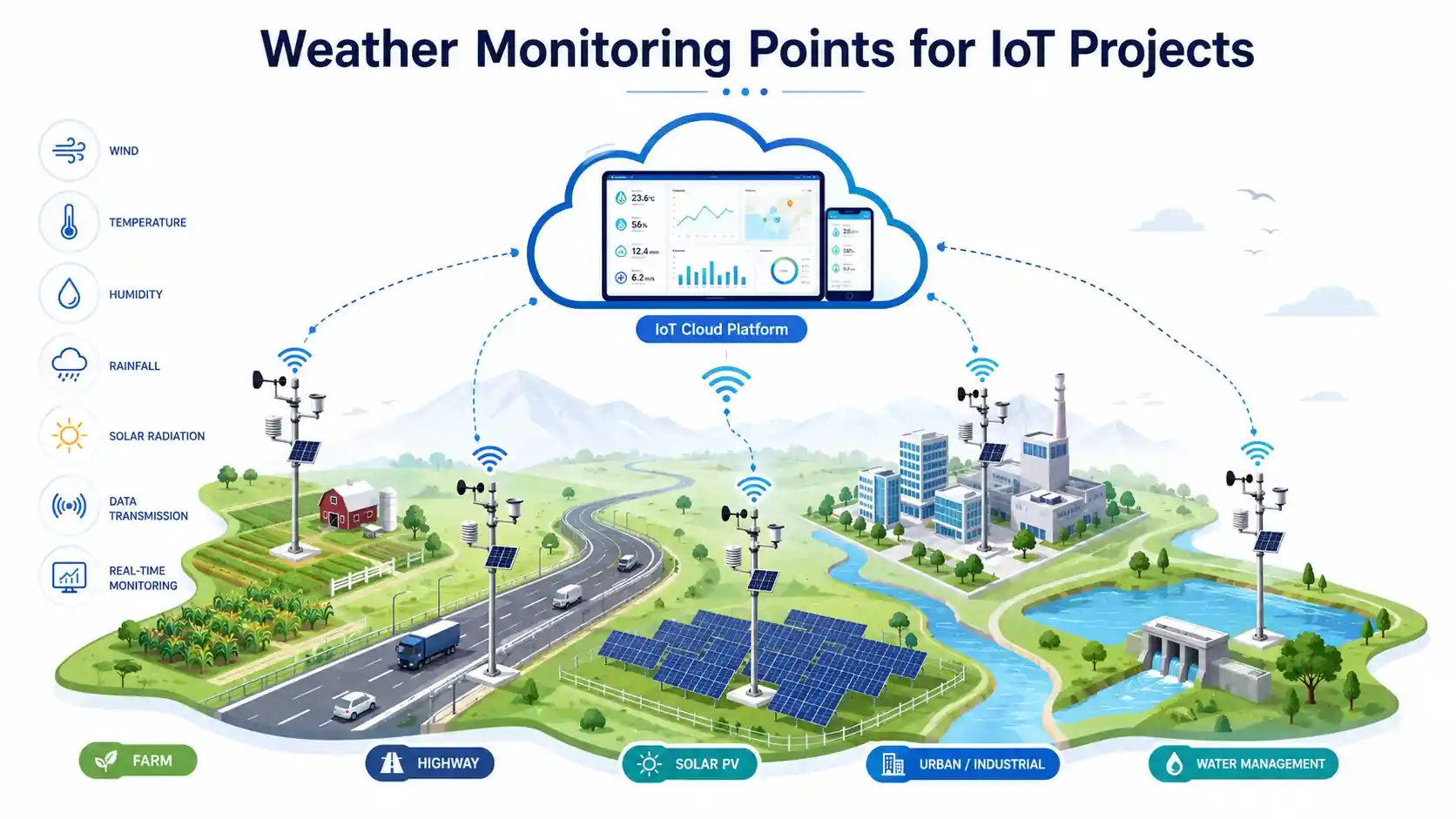
A complete IoT weather monitoring system normally combines sensors, data acquisition devices, communication networks, and cloud platforms to transform environmental data into actionable insights.
JW-IoT provides customized remote weather monitoring systems for agriculture, renewable energy, environmental monitoring, and industrial applications.
1. Why Weather Monitoring Point Design Matters
Weather monitoring is not simply about installing sensors in an outdoor location.
The position, density, and configuration of monitoring points directly influence the accuracy of collected data.
Common deployment problems include:
| Problem | Impact |
| Installed near buildings | Wind measurement errors |
| Poor sunlight exposure | Radiation measurement deviation |
| Incorrect installation height | Temperature and humidity errors |
| Weak communication signal | Data transmission interruption |
| Too few monitoring points | Cannot represent regional conditions |
For professional IoT projects, the objective is not collecting more data, but collecting representative and reliable environmental data.
2. Define Monitoring Objectives Before Designing Weather Monitoring Points
Before selecting locations, project owners should define what decisions the collected data will support.
Different applications require different monitoring parameters.
2.1 Weather Monitoring for Smart Agriculture
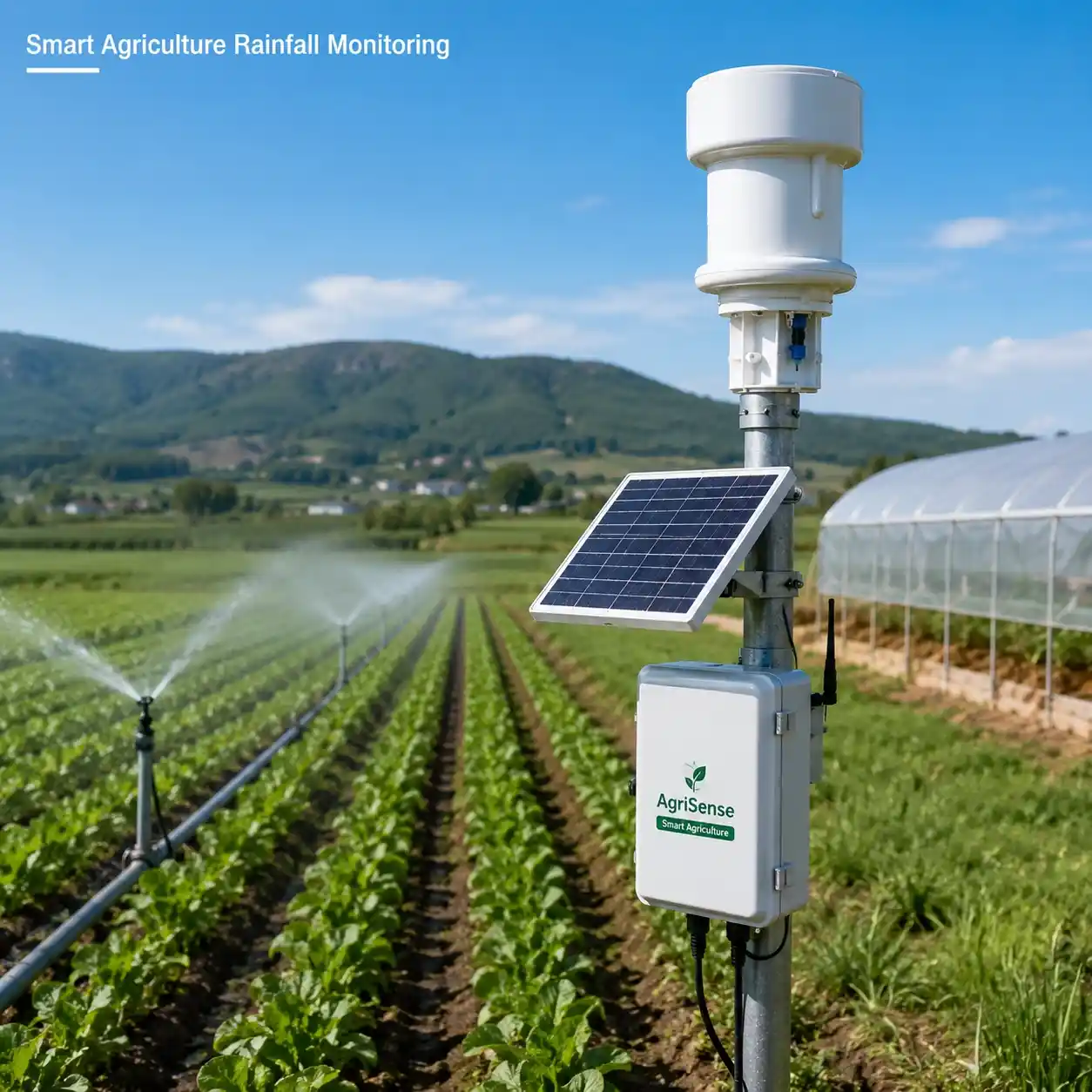
Agricultural weather monitoring helps farmers optimize irrigation, improve crop management, and respond to changing climate conditions.
Typical monitoring parameters include:
- Air temperature
- Relative humidity
- Rainfall
- Wind speed
- Wind direction
- Solar radiation
- Soil moisture
For large farms, monitoring points should consider:
- Crop zones
- Irrigation areas
- Terrain differences
- Local microclimates
By combining weather stations with soil sensors and irrigation controllers, farmers can build a complete smart agriculture monitoring system for precision farming.
Related solution:
→ Smart agriculture monitoring system
2.2 Weather Monitoring for Solar PV Projects
Solar photovoltaic projects require accurate environmental data to analyze energy generation performance.
Important parameters include:
- Solar irradiance
- Module temperature
- Ambient temperature
- Wind speed
- Wind direction
- Rainfall
A properly designed PV weather monitoring network helps operators:
- Analyze PV performance ratio
- Identify environmental impacts
- Optimize cleaning schedules
- Improve operational efficiency
For solar projects, JW-IoT provides dedicated PV weather monitoring station solutions integrating irradiance sensors, weather sensors, data loggers, and communication modules.
Recommended reading:
Distributed PV Weather Stations Improve Solar Power Efficiency
2.3 Weather Monitoring for Smart Cities and Industrial Sites
Urban and industrial environments often require distributed monitoring networks because environmental conditions can vary significantly between locations.
Common monitoring parameters include:
- Temperature
- Humidity
- Wind
- Rainfall
- Air quality
- Noise
For these applications, integrated environmental monitoring stations can provide real-time information for city management and industrial safety.
JW-IoT’s environmental monitoring system solutions support remote sensing, wireless communication, cloud dashboards, and alarm functions.
3. How to Select Weather Monitoring Point Locations
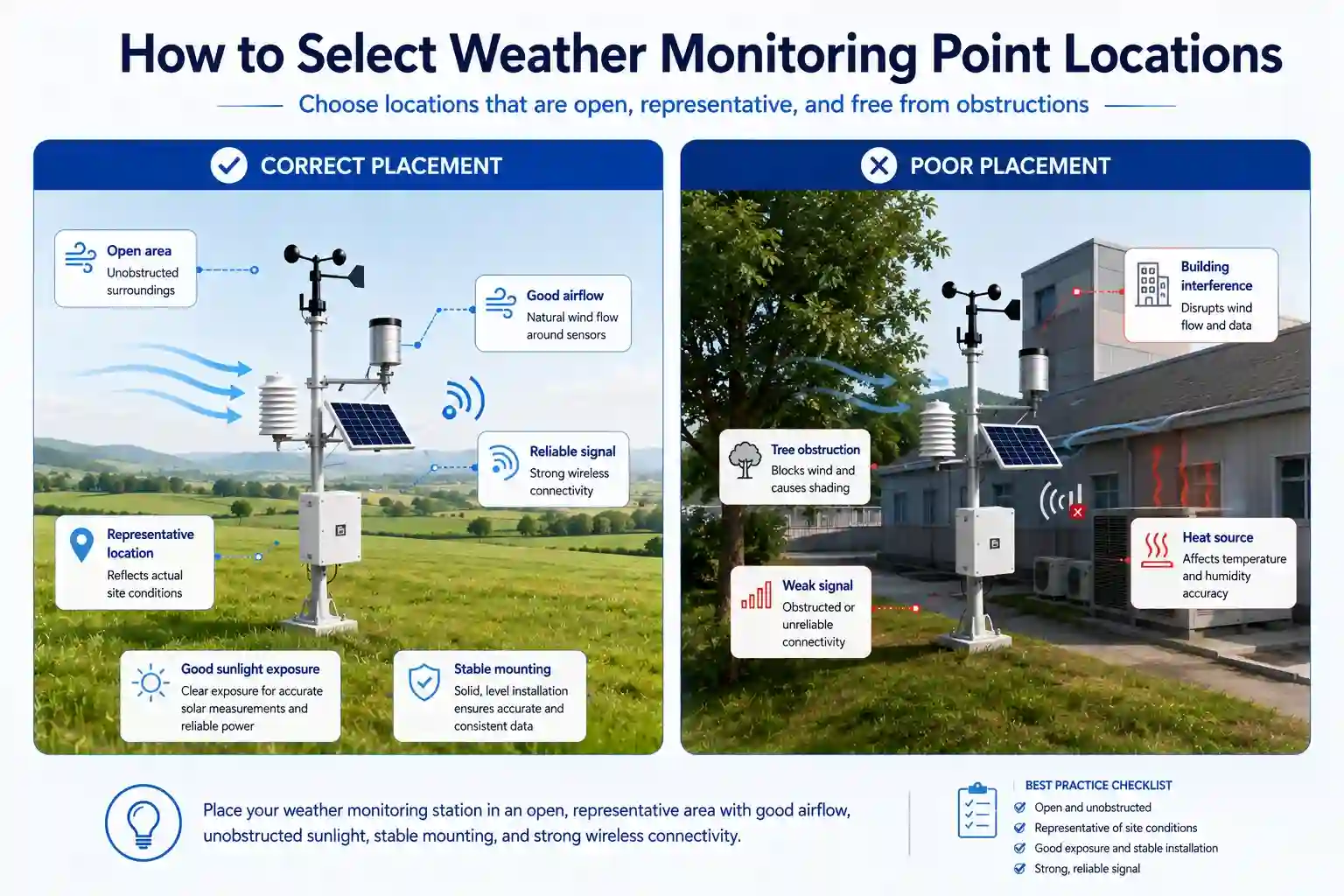
Selecting suitable locations is the core of weather monitoring system design.
3.1 Choose Representative Monitoring Locations
A monitoring point should represent the surrounding environment rather than only measure conditions at one specific spot.
Recommended locations usually have:
- Open space
- Stable airflow
- Good sunlight exposure
- Reliable power supply
- Strong communication coverage
For agricultural projects, monitoring stations should be distributed according to field conditions instead of being installed only near farm buildings.
3.2 Avoid Environmental Interference
Weather sensors should be installed away from factors that influence measurements.
Avoid:
- Buildings blocking wind
- Trees affecting airflow
- Heat sources
- Artificial shadows
- Abnormal moisture sources
Correct installation improves measurement accuracy and reduces unnecessary maintenance.
3.3 Consider Terrain Differences
Different environments require different deployment strategies.
Mountain Areas
Consider:
- Elevation
- Slope direction
- Wind exposure
Large Farms
Consider:
- Soil variation
- Irrigation zones
- Crop distribution
Coastal Areas
Consider:
- Salt corrosion protection
- Strong wind conditions
3.4 Solutions for Enclosures and Cable Entry Protection
To safeguard weather station electronics from the elements, it’s important to use robust, weatherproof enclosures designed specifically for outdoor use. Look for NEMA-rated or IP-rated enclosures that offer sealed protection against dust, moisture, and UV exposure.
When choosing an enclosure:
- Select models with proper cable entry glands or sealed ports to prevent water ingress
- Consider materials like polycarbonate or ABS plastic for corrosion resistance
- Use stainless steel hardware in coastal or humid environments
Carefully sealing all entry points ensures your monitoring equipment stays protected, reducing the risk of damage and minimizing maintenance needs.
4. How Many Weather Monitoring Points Are Required?
The number of monitoring points depends on:
- Project size
- Terrain complexity
- Monitoring objectives
- Required accuracy
Small Projects
Examples:
- Greenhouses
- Research fields
- Small facilities
Usually:
1-3 monitoring points may be sufficient.
Medium Agricultural Projects
For farms covering tens or hundreds of hectares:
Multiple monitoring stations are recommended.
The deployment should consider:
- Crop zones
- Irrigation areas
- Climate differences
A distributed monitoring network provides more accurate field-level environmental information.
Large Projects
Large farms, solar plants, and environmental networks normally require:
- Multiple weather stations
- Wireless sensor networks
- Central cloud management
A professional weather monitoring system can expand monitoring points according to project requirements.
5. Selecting Sensors for IoT Weather Monitoring Systems
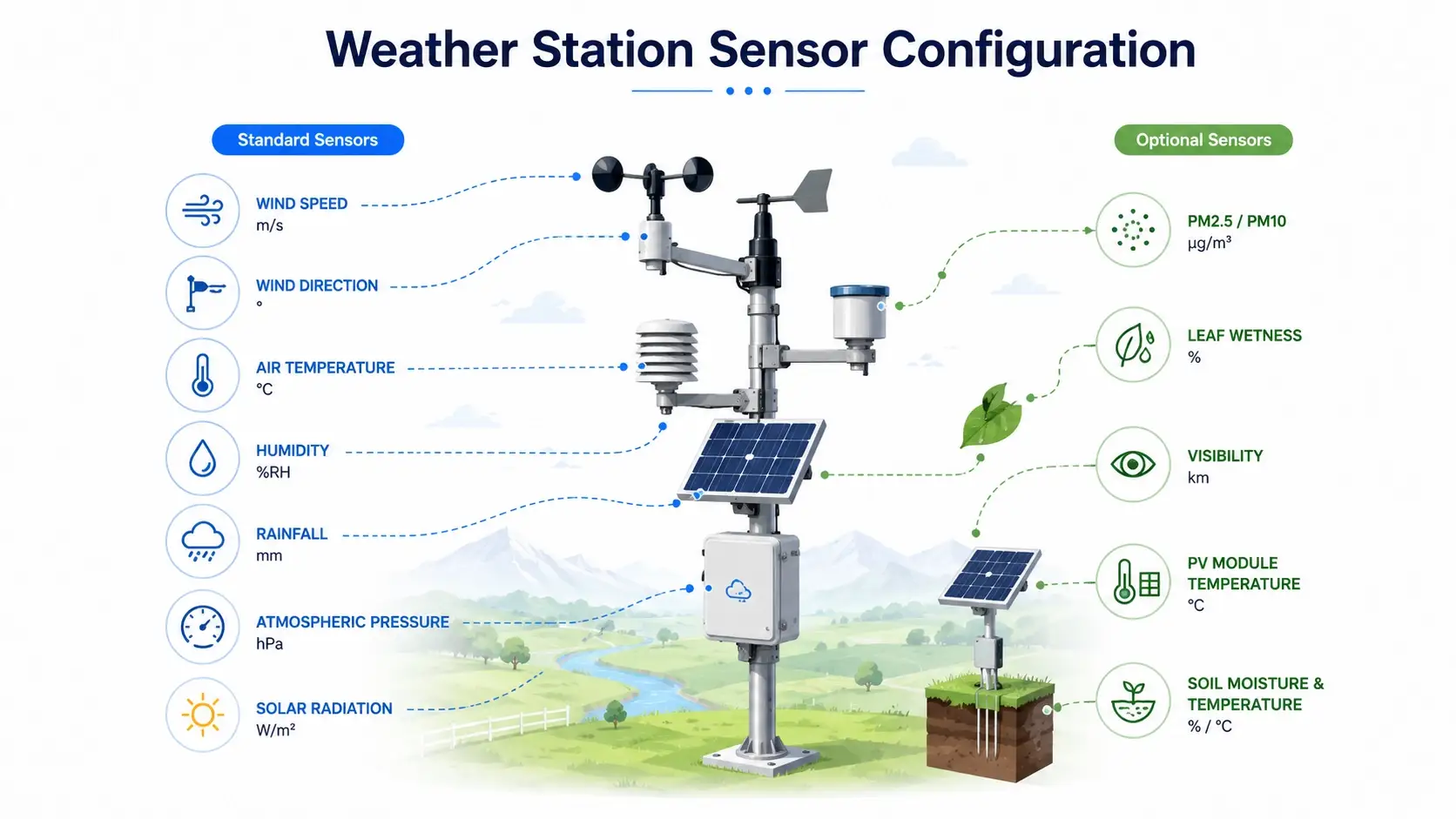
Sensor selection should match project objectives.
| Application | Recommended Sensors |
| Agriculture | Temperature, humidity, rainfall, radiation, wind |
| Solar PV | Irradiance, module temperature, wind, rainfall |
| Environmental projects | Temperature, humidity, pressure, air quality |
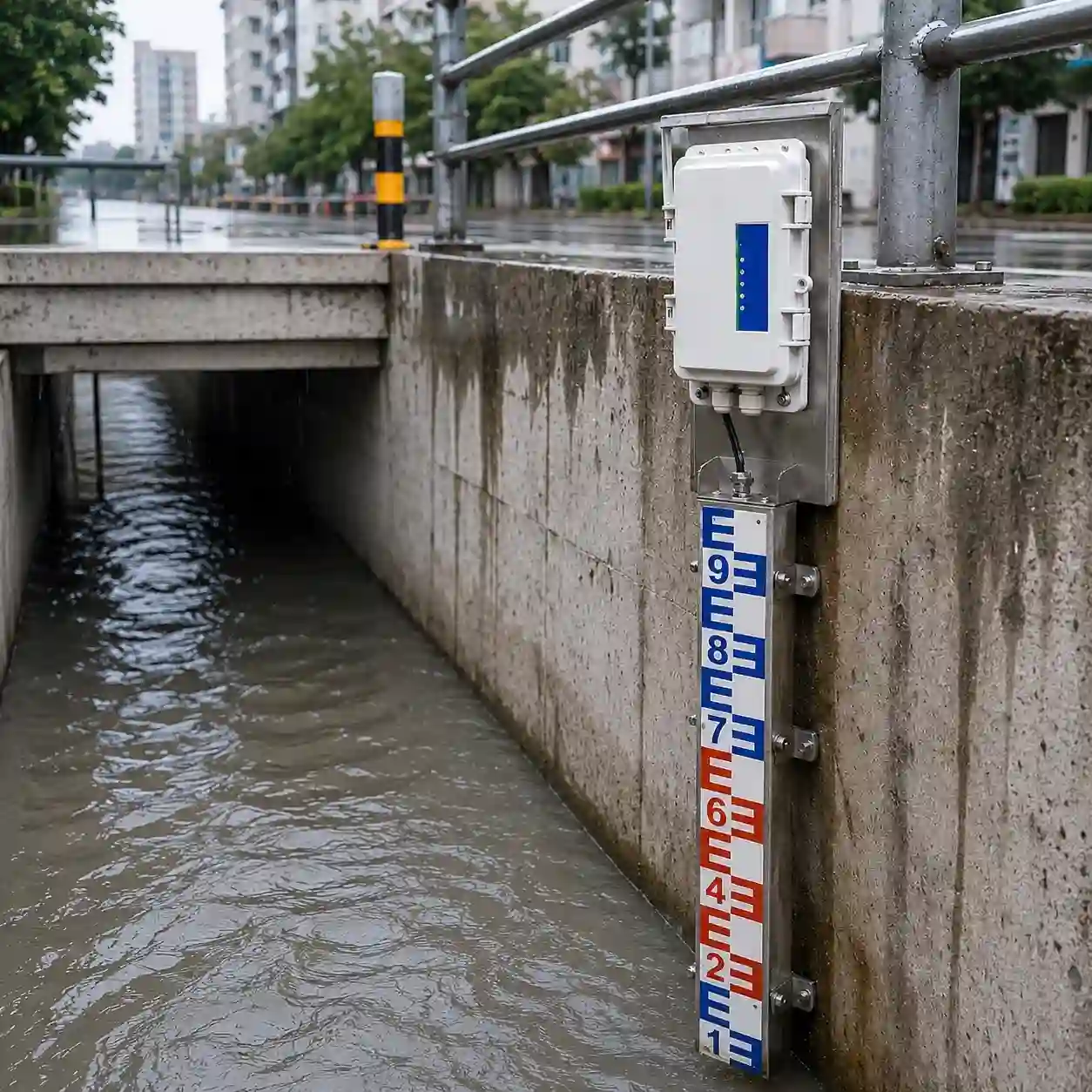
| Flood monitoring | Rainfall and weather sensors |
| Industrial monitoring | Weather and environmental parameters |
JW-IoT offers various integrated weather stations for different deployment scenarios.
6. Communication and Power Supply Planning
Remote monitoring projects require reliable communication and energy solutions.
Communication Options
| Technology | Suitable Applications |
| RS485 Modbus | Industrial fixed installations |
| LoRaWAN | Large farms and distributed networks |
| 4G LTE | Remote monitoring sites |
| Satellite | Areas without cellular coverage |
JW-IoT supports multiple communication methods, including:
- RS485 Modbus
- LoRaWAN
- 4G LTE
- MQTT
- Cloud API integration
For remote locations, a complete remote environmental monitoring system can combine solar power, wireless communication, and cloud platforms.
7. IoT Weather Monitoring System Architecture
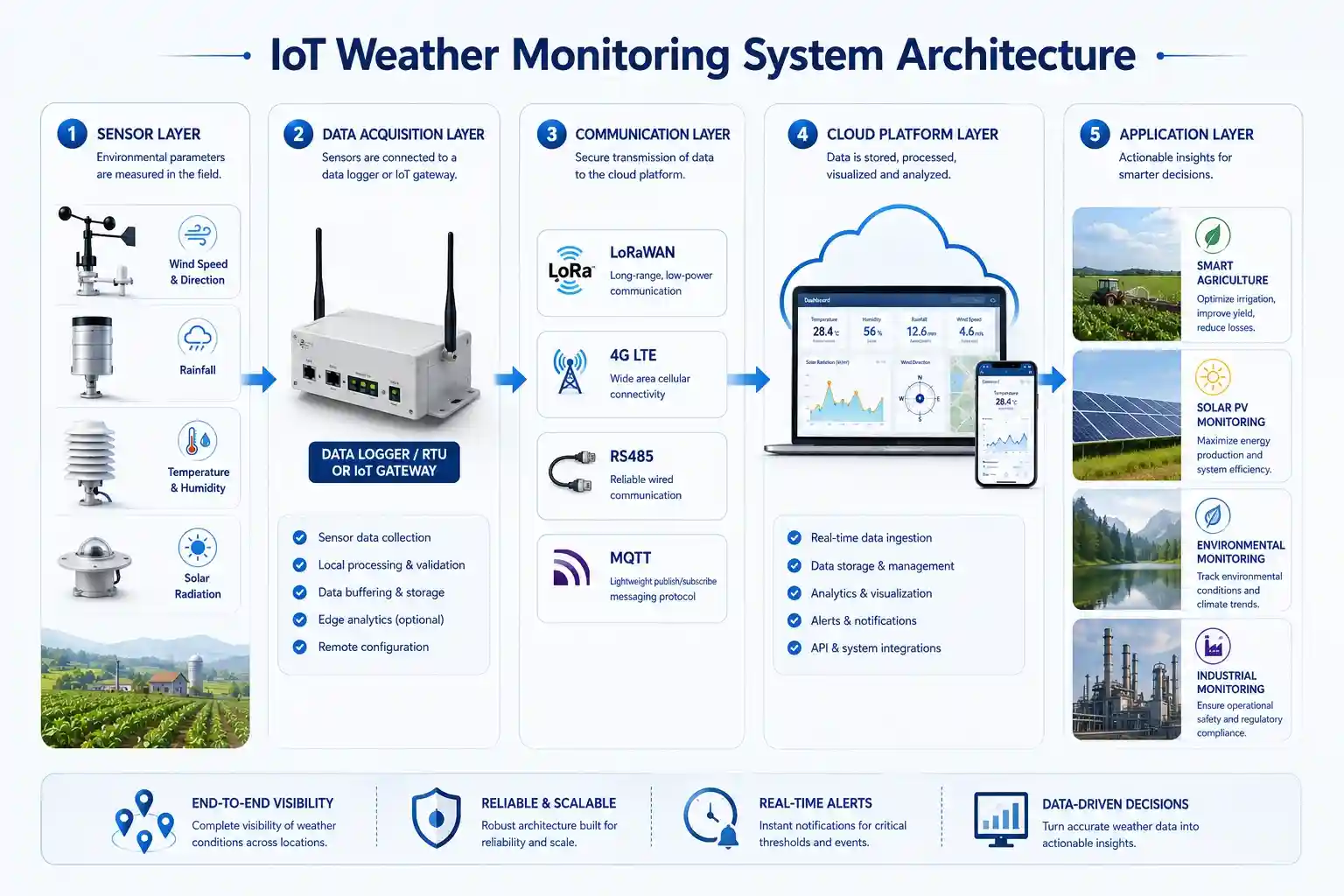
A complete IoT weather monitoring system usually includes five layers.
7.1 Sensor Layer
Collects:
- Weather parameters
- Soil information
- Radiation data
7.2 Data Acquisition Layer
Includes:
- Data loggers
- RTU controllers
- IoT gateways
7.3 Communication Layer
Uses:
- LoRaWAN
- 4G LTE
- RS485
- MQTT
7.4 Cloud Platform Layer
Provides:
- Data visualization
- Historical analysis
- Alarm management
- API integration
7.5 Application Layer
Supports:
- Smart irrigation
- PV analysis
- Environmental management
- Industrial monitoring
8. Example: Weather Monitoring Deployment for a Large Farm
For a 200-hectare agricultural project, a practical deployment may include:
Main Weather Station
Monitoring:
- Temperature
- Humidity
- Rainfall
- Wind
- Solar radiation
Distributed Monitoring Points
Additional sensors:
- Soil moisture
- Soil temperature
- EC
Communication:
- LoRaWAN network
- Solar-powered stations
- Cloud dashboard
This approach enables farmers to understand field conditions and make better irrigation decisions.
9. How JW-IoT Helps Design Weather Monitoring Systems
JW-IoT provides complete IoT weather monitoring solutions, including:
- Integrated weather stations
- Weather sensors
- Data loggers
- IoT gateways
- Cloud monitoring platforms
Our solutions support:
- Smart agriculture
- Solar PV monitoring
- Environmental observation
- Water resource management
- Industrial applications
From sensor selection to system deployment, JW-IoT helps customers build reliable and scalable monitoring networks.
Explore related solutions:
- Weather monitoring system
- Smart agriculture monitoring
- Environmental monitoring system
- PV monitoring solutions
FAQ
1. How many weather monitoring points are needed for a farm?
The required number depends on farm size, terrain, crop type, and monitoring objectives. Large farms usually require multiple monitoring stations.
2. Where should a weather station be installed?
Weather stations should be installed in open areas away from buildings, trees, and heat sources.
3. What sensors are used in IoT weather monitoring?
Common sensors include temperature, humidity, rainfall, wind speed, wind direction, solar radiation, and atmospheric pressure sensors.
4. Can one weather station cover a large area?
For small areas yes. Large farms and complex environments usually require multiple monitoring points.
5. Which communication method is suitable for remote weather monitoring?
LoRaWAN is suitable for distributed sensor networks, while 4G LTE works well for remote locations with cellular coverage.
6. How does JW-IoT design weather monitoring systems?
JW-IoT combines sensors, communication devices, gateways, and cloud platforms to create customized monitoring solutions.
7. Can weather monitoring stations use solar power?
Yes. Solar-powered weather stations are widely used in farms, mountains, rivers, and remote areas.
8. What is the difference between a weather station and individual sensors?
A weather station integrates multiple sensors into one system, while individual sensors usually measure only one parameter.
9. Can weather monitoring data connect with other IoT platforms?
Yes. JW-IoT systems support API integration with irrigation systems, SCADA platforms, and third-party applications.
Conclusion
A successful IoT weather monitoring project requires careful planning of monitoring points, sensors, communication networks, and data platforms.
By designing the right monitoring structure, organizations can transform environmental data into valuable insights for agriculture, renewable energy, smart cities, and industrial applications.
JW-IoT provides scalable weather monitoring solutions that help global customers build reliable IoT environmental monitoring networks.