+86 13520127780
  info@jingelway.com








Top 5 Air Quality Monitoring Trends to Watch in 2026
Release time: 2026-08-07
Air quality monitoring is entering a new stage of development.
For many years, environmental monitoring was mainly focused on periodic measurements, compliance reports and manual inspections. However, with stricter environmental regulations, industrial digitalization and the growth of IoT technologies, companies are moving toward continuous, connected and intelligent air quality monitoring systems.
In 2026, air monitoring is no longer only a compliance requirement. It is becoming an operational tool that helps companies improve safety, optimize processes and make data-driven decisions.
From factories and industrial parks to smart cities and energy facilities, the future of air quality monitoring will be shaped by five major trends.
1. Real-Time and Connected Data Will Become the New Standard
Traditional air quality monitoring often relied on manual sampling or periodic inspections.
Although these methods can provide valuable information, they only represent conditions at a specific moment. They may miss short-term pollution events, abnormal emissions or rapid changes caused by production activities and weather conditions.
One of the most important air quality monitoring trends 2026 is the transition from occasional measurement to continuous sensor networks.
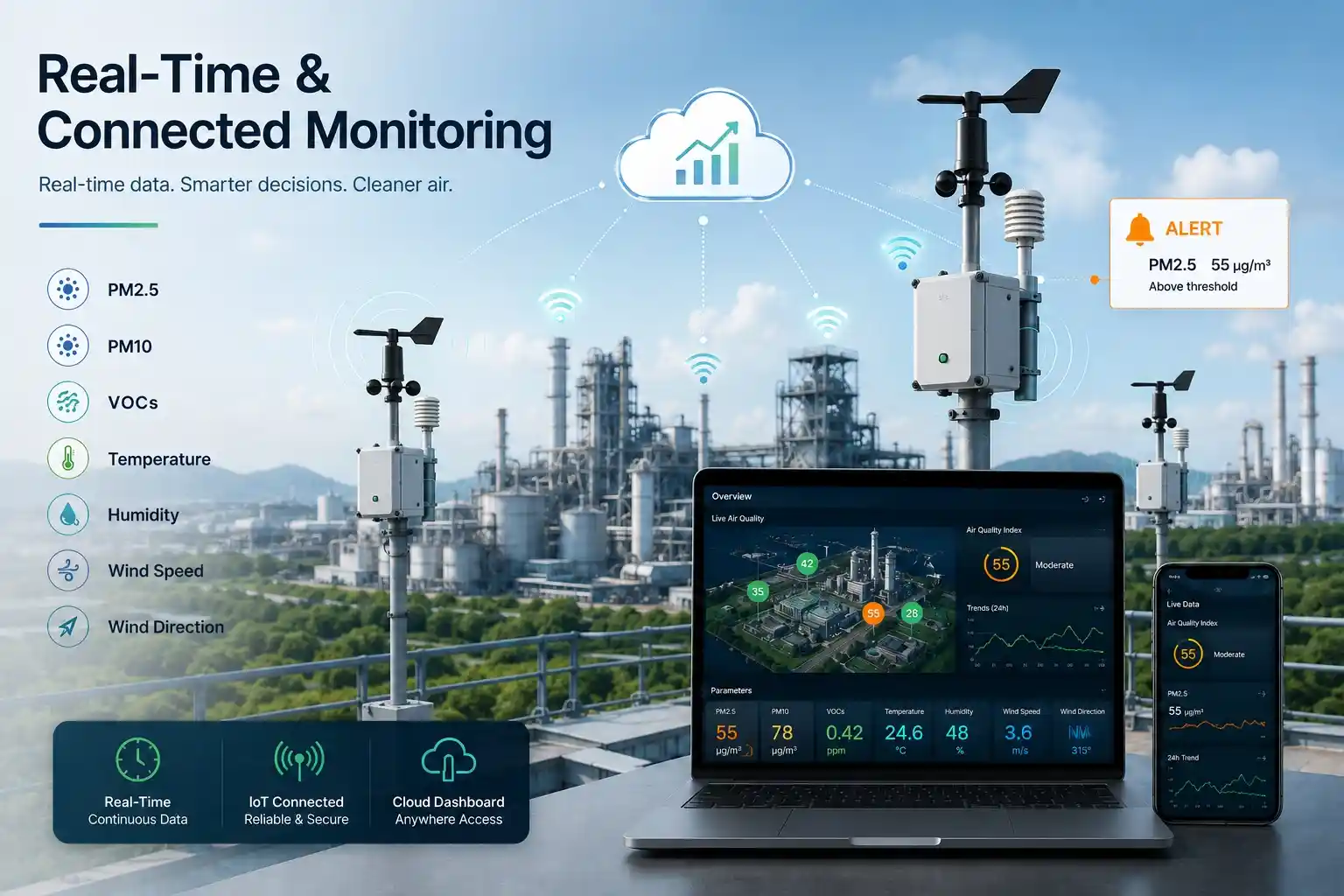
Modern industrial air quality monitoring systems combine:
- Environmental sensors
- Data acquisition units
- Wireless communication
- Cloud platforms
- Remote dashboards
- Alarm systems
This architecture allows companies to monitor environmental conditions continuously and receive alerts when abnormal values occur.
For example, industrial facilities may monitor:
- PM2.5 and PM10
- Total suspended particles (TSP)
- CO and CO₂
- SO₂ and NO₂
- VOCs
- H₂S
- Temperature and humidity
- Wind speed and direction
By combining air pollution data with meteorological information, operators can better understand pollution sources and dispersion patterns.
This trend is particularly important as environmental regulations become stricter in many regions, including Europe and North America. Companies increasingly need transparent, traceable and real-time environmental data.
JW-IoT provides configurable industrial air quality monitoring systems integrating sensors, communication modules and remote monitoring platforms for factories, industrial parks and environmental projects.
2. AI Will Improve Sensor Calibration and Predictive Analysis
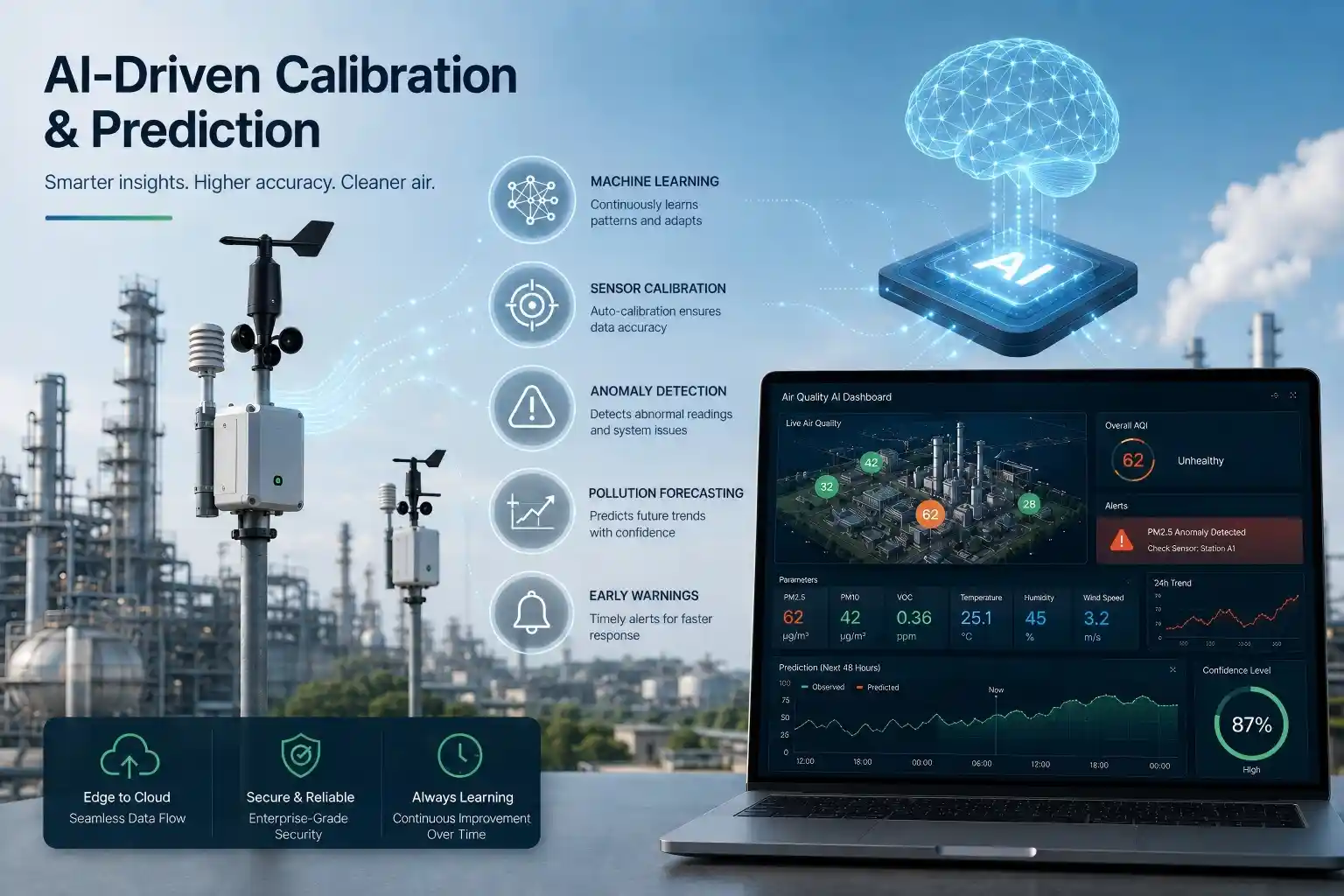
Another major direction in IoT air monitoring 2026 is the combination of sensors with artificial intelligence.
Low-cost air quality sensors have become increasingly popular because they allow companies to deploy more monitoring points at lower costs. However, sensor accuracy can be affected by:
- Temperature changes
- Humidity variations
- Sensor aging
- Environmental interference
AI-based calibration technology helps improve measurement reliability by analyzing large amounts of historical data and identifying correction patterns.
Instead of simply displaying current readings, future monitoring platforms will increasingly provide:
- Data quality improvement
- Automatic anomaly detection
- Pollution trend prediction
- Early warning recommendations
- Maintenance suggestions
For industrial users, predictive analytics can provide more value than simple measurement.
For example:
A factory may discover that particulate concentration increases during specific production periods.
An AI-powered monitoring platform can identify this pattern and help managers investigate possible causes before a serious environmental issue occurs.
This shift represents a move from:
“What is happening now?”
to:
“What is likely to happen next?”
AI will become an important component of smart environmental monitoring solutions.
3. Satellite and Ground Sensor Integration Will Create Multi-Level Monitoring Networks
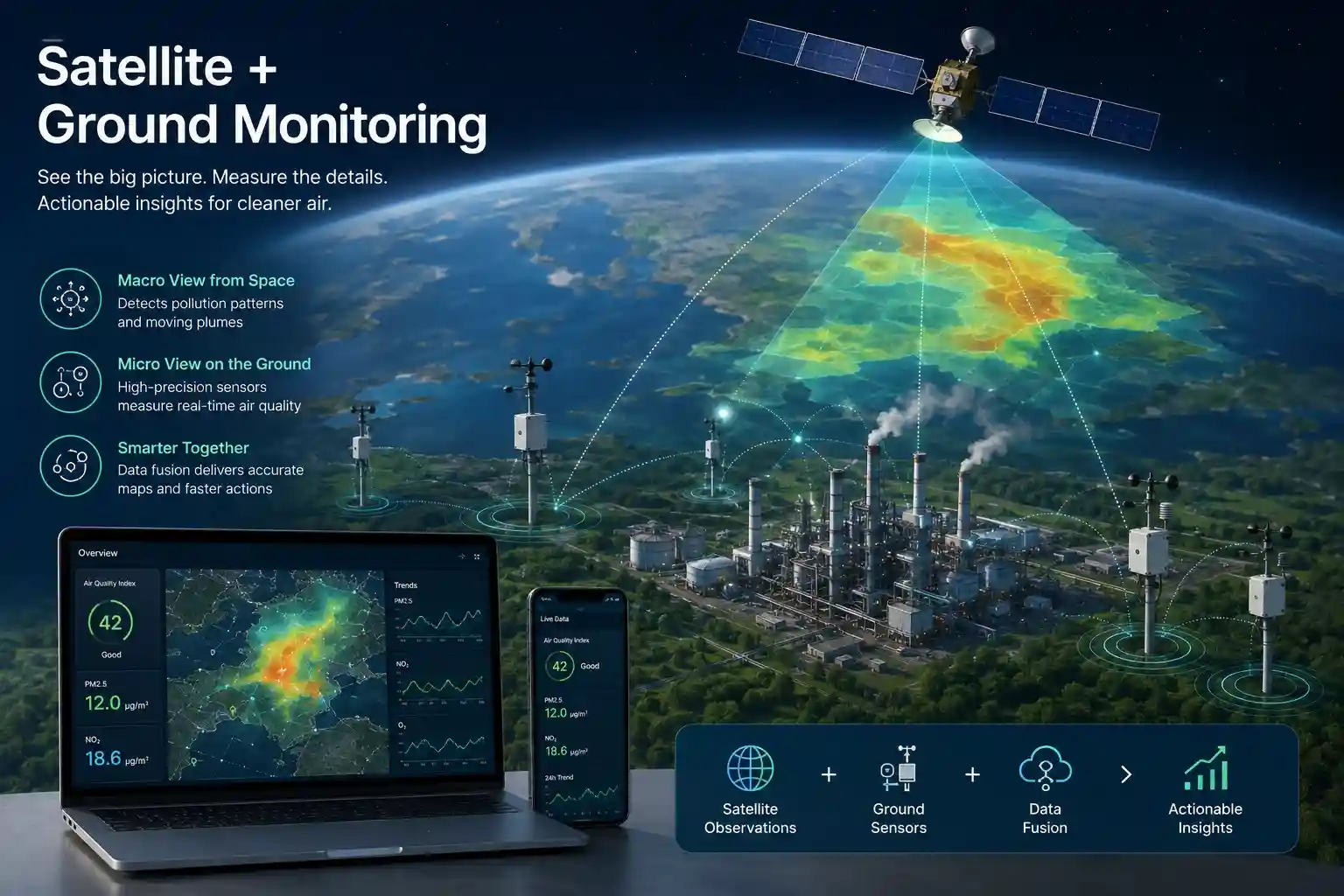
Environmental monitoring is becoming more comprehensive through the combination of satellite observation and ground-based sensors.
Satellites provide large-scale environmental information and can identify regional pollution patterns or potential emission sources.
However, satellites cannot replace ground sensors.
Ground monitoring systems provide:
- Higher local accuracy
- Continuous measurements
- Site-level information
- Real-time alerts
The future monitoring model will combine both approaches:
Satellite monitoring = large-scale overview
- Ground sensors = detailed local measurement
This combination is especially valuable for applications such as:
- Industrial emission monitoring
- Urban air quality management
- Methane emission tracking
- Environmental compliance verification
For example, in methane monitoring, satellites can identify potential large emission areas, while ground sensors help confirm local conditions and provide continuous data.
Similar concepts can be applied to industrial air quality monitoring.
A large industrial park may use regional environmental data together with distributed monitoring stations installed around:
- Production areas
- Storage facilities
- Transportation zones
- Factory boundaries
This creates a more complete environmental intelligence network.
JW-IoT supports distributed monitoring architectures combining outdoor sensors, communication technologies and cloud platforms for large-scale environmental applications.
4. Sensing-as-a-Service Models Will Reduce Monitoring Barriers
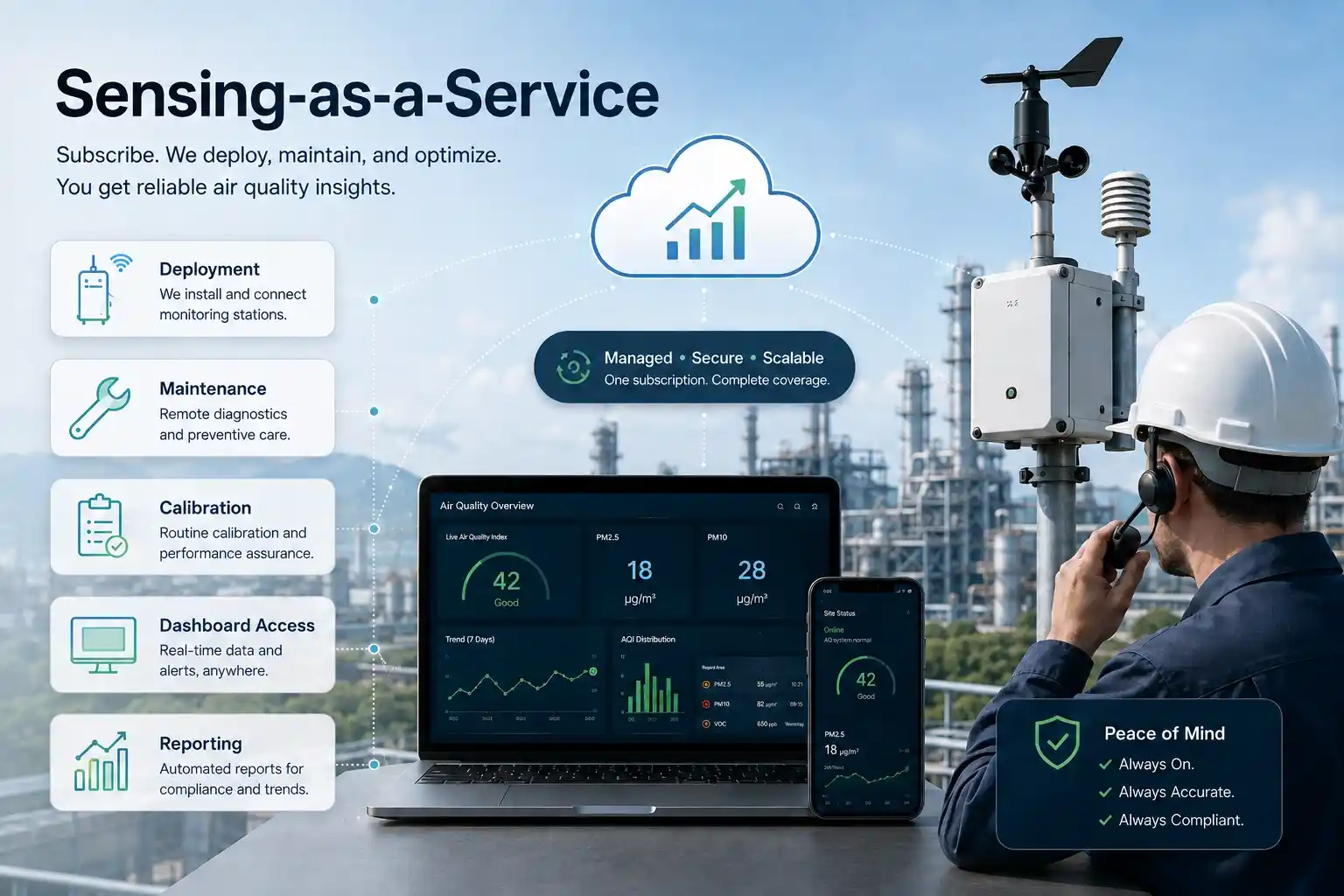
Installing and maintaining environmental monitoring networks requires technical expertise.
Many companies face challenges including:
- Equipment selection
- Sensor calibration
- Data management
- System maintenance
- Compliance reporting
As a result, Sensing-as-a-Service is becoming an emerging business model.
Instead of purchasing and managing all monitoring infrastructure independently, companies can access monitoring services through subscription-based solutions.
These services may include:
- Hardware deployment
- Remote data access
- Cloud platform services
- Calibration management
- Technical support
- Environmental reporting
This model lowers the entry barrier for small and medium-sized enterprises while allowing larger organizations to scale monitoring networks more efficiently.
For system integrators and environmental service companies, this also creates new opportunities.
They can build customized monitoring services using:
- IoT sensors
- Wireless communication networks
- Cloud platforms
- Data analytics tools
The future of environmental monitoring will not only be about selling sensors. It will increasingly focus on delivering continuous environmental intelligence.
5. Compliance Requirements and ESG Goals Will Continue Driving Adoption
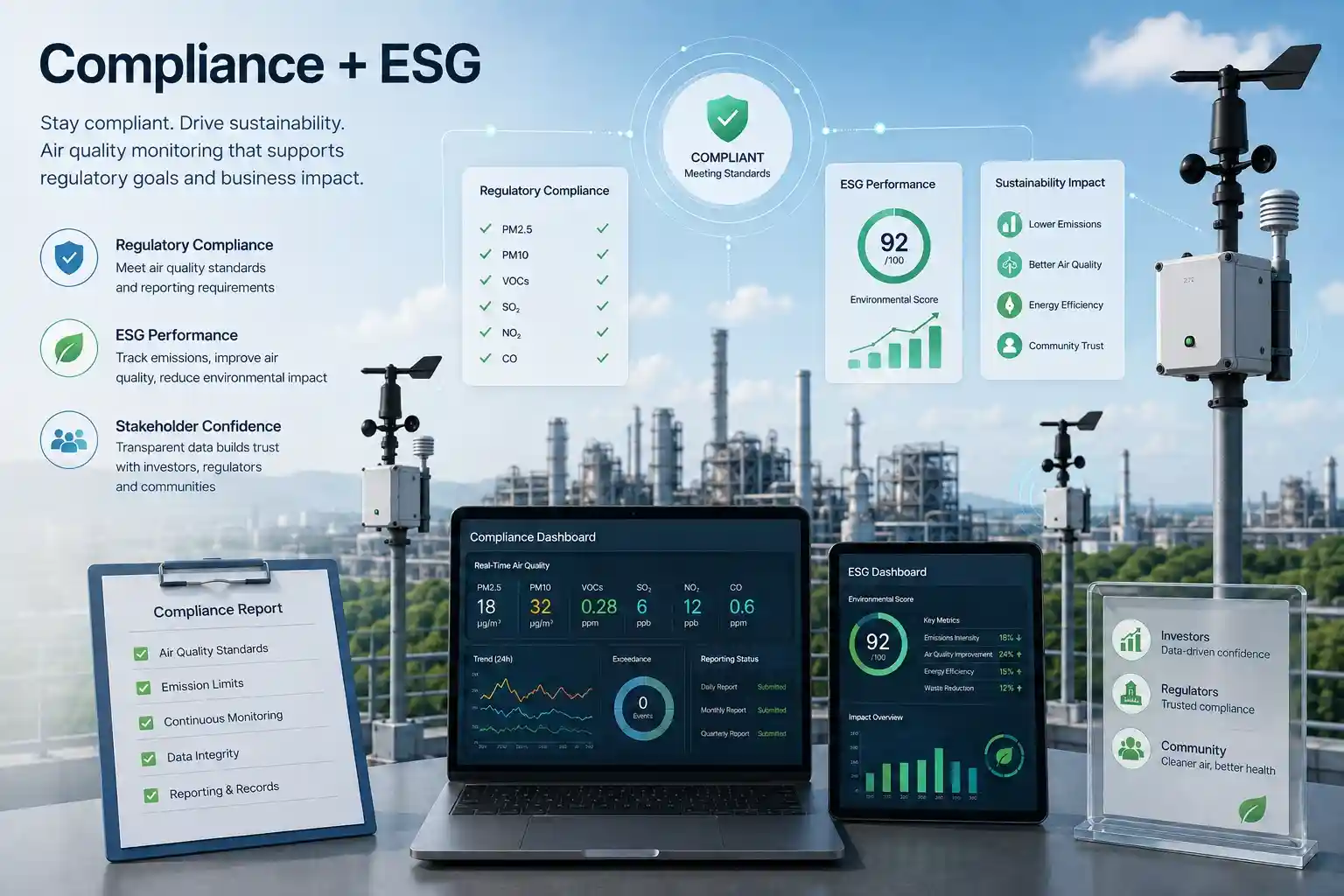
Environmental regulations remain one of the strongest drivers behind air quality monitoring growth.
Governments and regulatory organizations worldwide are increasing requirements related to:
- Industrial emissions
- Workplace safety
- Environmental transparency
- Pollution control
At the same time, ESG (Environmental, Social and Governance) considerations are becoming increasingly important for companies and investors.
Environmental data is no longer only used for regulatory reports.
It is becoming part of:
- Corporate sustainability reports
- Investor evaluation
- Risk management
- Operational improvement
Companies that collect reliable environmental data can better demonstrate their commitment to sustainability.
For industrial organizations, continuous monitoring provides measurable evidence of environmental performance.
A modern industrial environmental monitoring system can help companies:
✔ Improve emission management
✔ Reduce environmental risks
✔ Support ESG reporting
✔ Improve workplace safety
✔ Build stakeholder confidence
As environmental expectations continue increasing, monitoring will become a strategic business asset rather than a compliance burden.
The Future of Air Quality Monitoring: From Compliance Tool to Business Asset
The five major air quality monitoring trends 2026 share one common direction:
Environmental monitoring is becoming more connected, intelligent and valuable.
Real-time IoT networks provide continuous visibility.
AI improves analysis and prediction.
Satellite integration expands monitoring coverage.
Sensing-as-a-Service simplifies deployment.
ESG and regulations accelerate adoption.
Together, these trends are transforming air quality monitoring from a passive measurement activity into an active decision-support system.
For factories, industrial parks, energy companies and environmental solution providers, investing in smart monitoring infrastructure today can create long-term operational and sustainability advantages.
JW-IoT helps global partners develop customized environmental monitoring solutions, including air quality sensors, industrial monitoring stations, IoT communication systems and cloud-based platforms.
Explore JW-IoT Environmental Monitoring Solutions
Related solutions:
- Industrial Air Quality Monitoring System
- Factory Boundary Air Quality Monitoring Solution
- Industrial Environmental Monitoring System
- Gas Detection Weather Station
- Outdoor Air Quality Sensor
Need an air monitoring solution for your project?
Send us your application details, required parameters, installation environment and communication requirements.