+86 13520127780
  info@jingelway.com








How Accurate Are IoT Rain Gauges for Agriculture and Weather Monitoring?
Release time: 2026-07-19
Accurate rainfall data can help make many practical decisions. These include optimizing irrigation scheduling and drainage management, flood monitoring, analyzing local weather events, and environmental recording. Agricultural enterprises, weather stations, water-management projects, and smart cities are using IoT rain gauges for data collection and remote transfer to IoT platforms.
Table of Contents
But just how accurate is an IoT rain gauge?
The right rainfall sensor installed properly and maintained regularly can supply accurate data for agricultural decisions, routine weather observations, environmental recording, and hydrological applications. Total accuracy is affected by more than “the IoT part.” Factors include the measurement principle, resolution, rainfall intensity, installation environment, calibration routine, maintenance procedures, and data processing.
Basically, applying IoT connectivity to rainfall monitoring makes the data easier to access, but it doesn’t automatically increase rain sensor accuracy.
What Is an IoT Rain Gauge?
An IoT rain gauge isn’t its own principle of rain measurement. IoT capabilities means the rain gauge is connected to additional components. A tipping bucket, weighing, optical, or piezoelectric rain sensor can typically link to a data logger, communication device, and IoT platform.
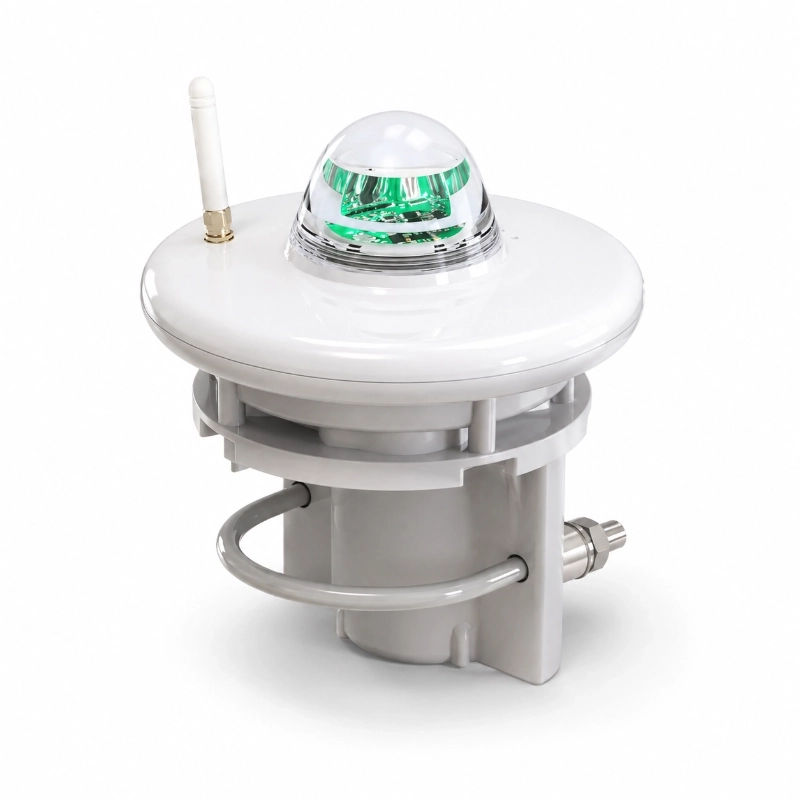
A complete system for monitoring rainfall with IoT capabilities could include:
* Rainfall sensor
* Data acquisition unit (RTU)
* RS485, pulse output, SDI-12, LoRaWAN, NB-IoT, 4G, or other communication interface
* Solar or AC power supply
* On-board data storage
* Cloud-based monitoring platform
* Alarm and reporting capabilities
These features allow users to monitor rainfall remotely, compare rain events across many sites, receive alarms, and export historical rainfall records without traveling to each monitoring point.
The measurement accuracy still begins with the rainfall sensor itself, though.
Accuracy Isn’t the Same Thing as Resolution
A common mistake when choosing a rain gauge is to assume accuracy and resolution are interchangeable specifications.
Resolution
The resolution is how much rain the sensor can detect and record at one time. For instance, a tipping bucket rain gauge might be set to produce one pulse for every 0.1 mm, 0.2 mm, or 0.5 mm of rain collected. Resolution is the size of each measurement increment, not the overall measurement error.
Accuracy
The accuracy of rainfall recording is how close the measured value is to the true value during stated conditions. Just because a rain gauge has a resolution of 0.2 mm doesn’t mean its accuracy is plus or minus 0.2 mm. Rain gauge accuracy can vary with rainfall intensity, mechanical conditions, calibration settings, nearby obstructions, wind, and proper maintenance.
Repeatability
Another measurement consideration is the consistency of the rain gauge when subjected to the same conditions multiple times.
Data Availability
For IoT systems, data availability matters too. If the sensor is very accurate but there are communication problems that cause rainfall data to get lost, what good is the rain gauge? On-site data storage with auto-retransmission features can help with data-collection networks that have gaps in communications.
Which Factors Influence IoT Rain Gauge Accuracy?
Rain gauge type
The technology used to measure precipitation is the first big difference between rain gauges. Here’s how four common rainfall-sensing principles work.
1.Tipping bucket rain gauges
Tip bucket rain gauges work by collecting precipitation through a funnel. Rainwater collects on one side of a small internal bucket. When enough water is collected to tip the mechanism, it empties and sends a pulse of information to the logger. Total rainfall is the number of tips multiplied by the amount of rainfall required for each tip.
Tip bucket rain gauges are popular because they’re simple, affordable, easy to connect to data loggers, and work well in networks with multiple monitoring points.
Potential issues with this method include:
* Decreased accuracy at high-intensity rainfall
* Delayed reporting during low-intensity rainfall
* Wear and balance issues with the tipping mechanism
* Clogging of the funnel or rain-outlet
* Loss of water during tip action
Since there is a time delay between when water enters the funnel and when a tip is recorded, the sensor must be dynamically calibrated for best results. Studies done on tipping bucket rain gauges have shown how measurement uncertainty is related to rainfall intensity, calibration methods, tipping bucket mechanical properties, and error-correcting techniques.
- Weighing rain gauges
Weighing automatic rain gauges record how much the collected precipitation increases or decreases in weight. These instruments provide a continuous record of accumulated precipitation. They don’t rely on bucket tips to quantify how much rain fell.
Since they measure total weight, these gauges tend to perform well under a variety of precipitation intensities. Weighing gauges are commonly used in professional meteorology, climatology, and research applications. Some models are even designed to quantify mixed precipitation or solid precipitation like snow and hail.
Tradeoffs can include:
* Higher upfront cost
* Installation is more involved
* Higher power use and maintenance
* Vulnerable to vibration, evaporation, temperature, and system drift
- Optical rain sensors
Optical rain sensors detect rain by changes in light that are caused by rain droplets. These sensors have no tipping bucket and are often small and easy to integrate into compact weather sensors.
Pros include minimal maintenance requirements and small size. Cons include a limited measurement range and that calculation of accumulated rainfall is entirely dependent on the manufacturer’ s algorithm.
- Piezoelectric rain sensors
Piezoelectric sensors measure the energy of raindrop impacts. Piezo sensors have a very quick response time and are sized differently than conventional buckets.
Piezoelectric sensors are useful for rain detection, getting rainfall-intensity trends, compact weather stations, and small IoT monitoring nodes. Accuracy of calculated rainfall amounts are affected by drop size, sensor vibration, mounting setup, wind, and the manufacturer’ s processing algorithm.
How Rainfall Intensity Affects Measurement Performance
Rainfall intensity can also play a role in how well a rain gauge records precipitation. Low intensity rain, heavy rain, and rapidly changing rainfall conditions all affect rain gauges differently.
- Little or no rain
If rain is falling very slowly, a tipping bucket rain gauge must first collect enough water for the bucket to tip. This means small amounts of rain could be on the funnel or inside the unit and not recorded.
- Heavy rain
If rain is falling heavily, more water will try to enter the tipping bucket rain gauge while it’ s in the process of emptying. The gauge will under-record rainfall unless the measurement system is designed to account for this.
The relationship between incoming water and bucket movement is why dynamic calibration is helpful. That’ s also why you should look at more than just the stated accuracy when evaluating rain gauges.
How Installation Environment Impacts Rainfall Data Accuracy
A well-made rain gauge can provide poor information if it isn’ t installed correctly.
- Rain Gauge Should Be Level
A tipping bucket rain gauge should be perfectly level during installation. Any tilt can change the balance of the tipping mechanism which can change how much rain is needed to send a tip.
Should be checked during initial installation and regularly as part of a maintenance routine. It’ s especially important to double-check after high winds, ground movement, or when conducted maintenance near the rain gauge.
- Nearby Objects
Rainfall accuracy can be affected by nearby objects such as trees, walls, buildings, fences, towers, or other structures that can block rainfall or create turbulence.
Ideally, the rain gauge should be far enough away from these obstructions to not significantly impact rain measurements. The installation guidelines should also follow whichever meteorological or hydrological standards are being used for the project.
- Wind Conditions
Wind can also cause undercatch by blowing raindrops around the collection funnel. Installation design should limit wind effects as much as possible. Projects that require high-quality reference data should consider using a wind shield or selecting a more sheltered installation location.
- Splashing Rain
Raindrop can splash into or out of the rain gauge. Limiting these effects starts with correct installation height and using suitable ground surfaces under the rain gauge.
- Collector & Funnel Should Be Kept Clean
Insects, bird droppings, leaves, dust, sand, and other materials can build-up on the rain gauge and impact how it collects and measures rain. If debris partially blocks the funnel, rainfall may be delayed before the tipping mechanism triggers a tip registration.
- Calibration and Maintenance Matter
How a rain gauge is calibrated and how often it’ s maintained will impact how accurate it is.
IoT capabilities don’ t eliminate the need for proper installation, field maintenance, and calibration. These factors help ensure the rain gauge is giving you accurate and consistent information about rain events at your monitoring site.