+86 13520127780
  info@jingelway.com








Soil Moisture Sensor Buying Guide 2026
Release time: 2026-07-26
Resistive vs Capacitive vs FDR vs TDR vs TDT
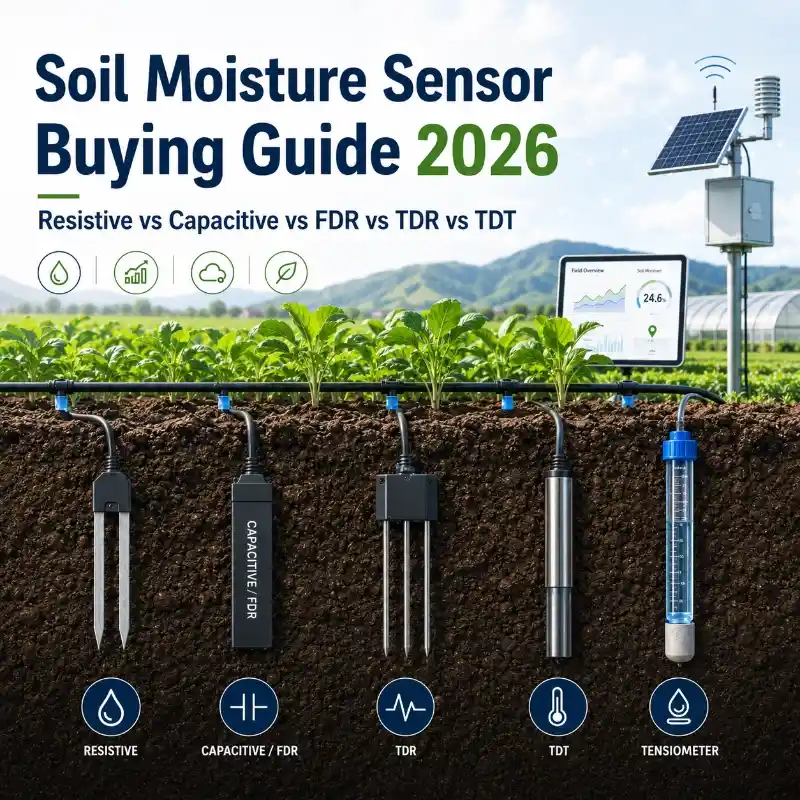
Choosing a soil moisture sensor is not simply a matter of comparing accuracy specifications.
A sensor may work well in a greenhouse substrate but produce misleading readings in saline farmland. Another sensor may deliver research-grade data but be too expensive for a large irrigation network. Even a highly accurate probe can lead to poor irrigation decisions when it is installed at the wrong depth or in a location that does not represent the crop root zone.
The right question is therefore not:
“Which soil moisture sensor is the most accurate?”
The better question is:
“Which sensing technology fits my soil, crop, irrigation objective, installation environment and monitoring system?”
This soil moisture sensor buying guide compares resistive, capacitive, FDR, TDR, TDT and tensiometer technologies. It also explains calibration, installation depth, communication output and system integration so that farmers, irrigation contractors and IoT integrators can select a practical solution for real field conditions.
What Does a Soil Moisture Sensor Actually Measure?
The term “soil moisture sensor” is used for several different types of instruments.
Some sensors estimate volumetric water content, usually expressed as a percentage. Others measure soil water tension or matric potential, which indicates how much effort plant roots must make to extract water from the soil.
These two measurements answer different questions.
Volumetric water content answers:
- How much water is present in a volume of soil?
- Is the soil becoming wetter or drier?
- How quickly is water moving through the root zone?
- Has irrigation reached the required depth?
- Is water accumulating below the active root zone?
Soil water tension answers:
- How tightly is water held by the soil?
- How difficult is it for roots to absorb that water?
- Is the crop approaching water stress?
- Has the soil reached an irrigation trigger point?
A soil containing 25% volumetric water content may provide adequate water in one soil type but cause stress in another. Sandy soil, loam and heavy clay have different relationships between water content and plant-available water.
For this reason, soil moisture readings should be interpreted together with:
- Soil texture
- Bulk density
- Salinity
- Crop type
- Rooting depth
- Field capacity
- Permanent wilting point
- Allowable depletion level
The most costly monitoring mistake is often not selecting an inexpensive sensor. It is selecting a sensor that measures the wrong variable—or interpreting its output without understanding the soil.
Main Types of Soil Moisture Sensors
The most common technologies used in agriculture and irrigation monitoring include:
- Resistive sensors
- Capacitive sensors
- Frequency Domain Reflectometry sensors
- Time Domain Reflectometry sensors
- Time Domain Transmissometry sensors
- Tensiometers and matric-potential sensors
Although capacitive and FDR sensors are closely related, they are separated in this guide because the term “capacitive sensor” is often used for both basic low-cost probes and more advanced industrial FDR instruments.
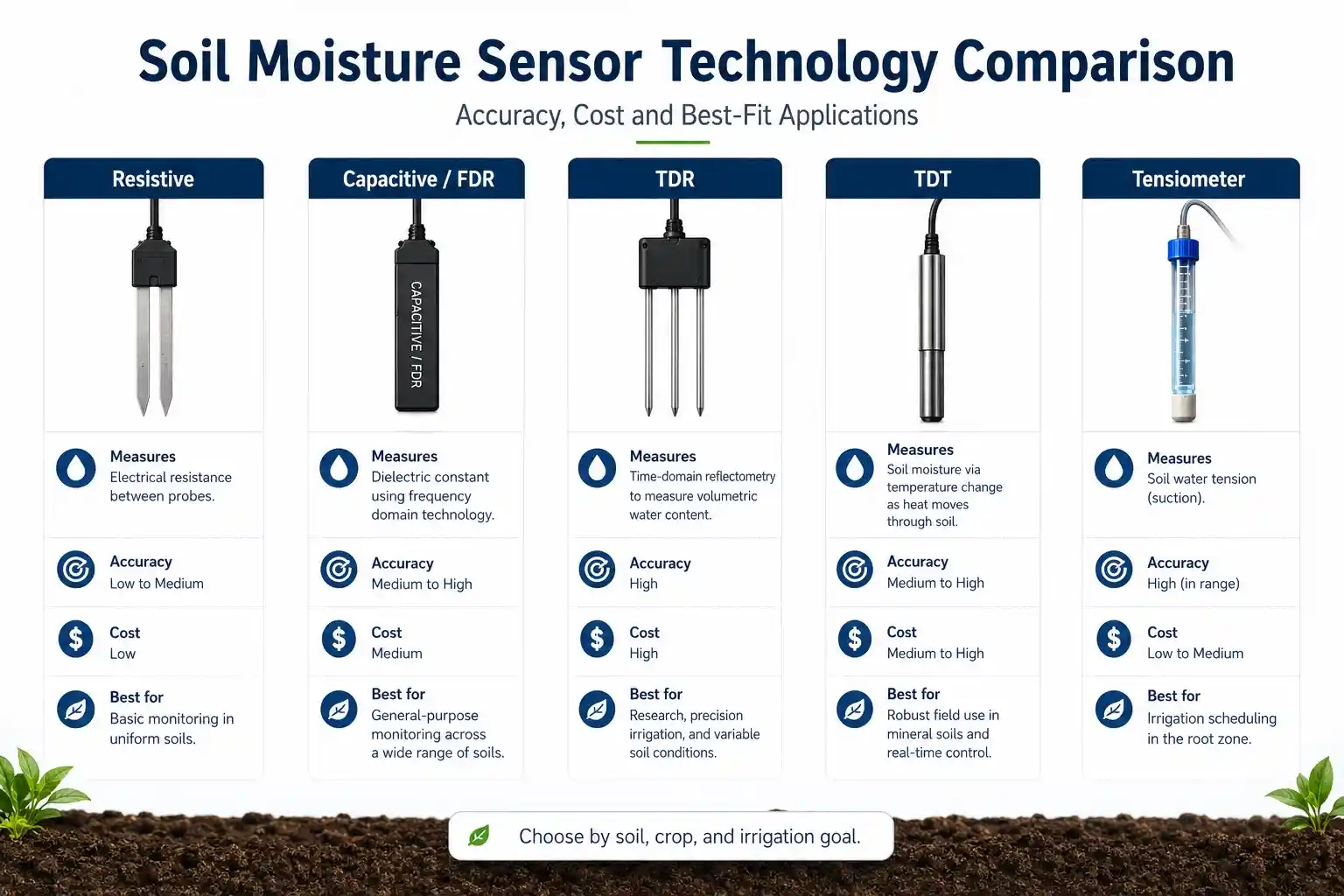
1. Resistive Soil Moisture Sensors
How resistive sensors work
A basic resistive soil moisture sensor uses two exposed electrodes inserted into the soil. An electrical current passes between the electrodes, and the instrument measures electrical resistance or conductivity.
Wet soil normally conducts electricity more easily than dry soil, so resistance generally decreases as soil moisture increases.
Advantages
- Very low purchase cost
- Simple electrical design
- Easy to connect to Arduino, ESP32 and other development boards
- Low power requirements
- Suitable for basic wet-or-dry indication
Limitations
The electrical resistance of soil is affected by more than water.
Readings may change because of:
- Fertilizer concentration
- Soil salinity
- Mineral composition
- Electrode corrosion
- Temperature
- Soil compaction
- Contact between the electrode and soil
Exposed metal electrodes may also corrode during long-term deployment, causing gradual signal drift.
Best applications
Basic resistive probes are generally suitable for:
- Home gardens
- Educational projects
- Temporary demonstrations
- Low-cost prototypes
- Rough wet-or-dry alarms
They are usually not the preferred option for commercial irrigation scheduling, long-term buried monitoring or projects that require stable comparison between different fields.
It is also important not to confuse basic two-electrode hobby sensors with professional resistance-based matric potential devices, such as granular matrix sensors. Professional devices use different construction and calibration methods and can be used for irrigation scheduling in suitable soils.
2. Capacitive Soil Moisture Sensors
How capacitive sensors work
A capacitive soil moisture sensor creates an electromagnetic field around its sensing elements. The surrounding soil acts as part of the dielectric medium.
Because water has a much higher dielectric constant than dry soil particles and air, changes in soil water content affect the sensor’s capacitance or frequency response.
The instrument converts this response into an estimated volumetric water content value.
Advantages
- More durable than exposed resistive probes
- Low power consumption
- Fast response
- Suitable for continuous monitoring
- Easy to integrate into automatic irrigation systems
- Available in compact and waterproof designs
- More affordable than many research-grade time-domain instruments
Limitations
Capacitive readings can be influenced by:
- Soil texture
- Bulk density
- Salinity
- Temperature
- Air gaps around the probe
- Installation disturbance
- Factory calibration assumptions
A sensor calibrated in mineral soil may not provide the same accuracy in peat, coco coir, rock wool or another growing medium.
For applications where absolute volumetric water content is critical, site-specific calibration may be required. For applications where the primary objective is observing wetting and drying trends, a stable capacitive sensor can still provide useful operational data.
Best applications
Capacitive sensors can be suitable for:
- Greenhouse irrigation
- Landscape irrigation
- Nursery production
- Soil drying trend monitoring
- Low-power wireless monitoring nodes
- Cost-sensitive agricultural projects
- Multi-point monitoring networks
The buyer should confirm whether the device is a basic capacitive probe or an industrial sensor with temperature compensation, stable electronics, waterproof sealing and digital communication.
3. FDR Soil Moisture Sensors
What is FDR?
FDR stands for Frequency Domain Reflectometry.
An FDR sensor applies an oscillating electrical signal and measures how the surrounding soil affects the signal frequency or impedance. The response is correlated with the soil’s dielectric properties and then converted into volumetric water content.
FDR is widely used in modern agricultural soil probes because it offers a practical balance between performance, power consumption, integration capability and project cost.
Advantages
- Continuous volumetric water content monitoring
- Fast measurement response
- Low power consumption
- Suitable for solar-powered field stations
- Compact sensor construction
- Practical for multi-point deployment
- Can be integrated with temperature and EC measurement
- Commonly available with RS485 Modbus output
- Suitable for data loggers, RTUs, PLCs and IoT gateways
For example, the JW-IoT soil moisture and temperature sensor uses FDR sensing technology and supports analog or RS485 Modbus outputs for greenhouse, irrigation and environmental monitoring projects.
Limitations
FDR sensor accuracy depends on:
- Sensor design and operating frequency
- Soil-specific calibration
- Soil electrical conductivity
- Soil texture
- Temperature compensation
- Installation quality
- Contact between the probe and surrounding soil
High soil salinity or rapidly changing fertilizer concentration can influence some electromagnetic measurements. This is particularly relevant in fertigation, reclaimed-water irrigation and saline agricultural land.
An FDR sensor should therefore not be judged only by the accuracy number shown on its specification sheet. Buyers should also evaluate the calibration method and intended soil conditions.
Best applications
Industrial FDR sensors are commonly selected for:
- Routine irrigation scheduling
- Smart irrigation systems
- Greenhouse soil monitoring
- Orchard root-zone monitoring
- Open-field agriculture
- Remote IoT stations
- Multi-point agricultural networks
- Soil moisture trend analysis
- Water-saving irrigation projects
For projects that also need nutrient or salinity information, a combined soil moisture, EC and temperature sensor can reduce the number of separate probes and simplify installation.
4. TDR Soil Moisture Sensors
What is TDR?
TDR stands for Time Domain Reflectometry.
A fast electromagnetic pulse travels along metal rods or a waveguide inserted into the soil. The instrument measures the time required for the pulse to travel and reflect back.
Because signal travel time is related to soil dielectric permittivity, the system can estimate volumetric water content.
Advantages
- High measurement accuracy when correctly installed
- Strong repeatability
- Suitable for scientific measurements
- Better performance than many basic capacitance sensors under variable soil conditions
- Useful for validating other soil moisture sensors
- Capable of detailed waveform analysis in advanced instruments
TDR is often treated as a reference technology in soil-water research. However, performance still depends on sensor design, calibration, probe installation and soil conditions.
Limitations
- Higher equipment cost
- More complex electronics
- Greater installation requirements
- May be unnecessary for routine irrigation control
- Some systems require specialized data loggers or software
- Signal interpretation can be affected by highly conductive or saline soils
- Large-scale deployment may be economically difficult
Best applications
TDR is particularly suitable for:
- Agricultural research stations
- Soil science experiments
- Crop breeding trials
- Sensor validation
- High-value specialty crops
- Irrigation research
- Projects requiring high-confidence volumetric water content data
A research-grade sensor may be justified in a vineyard research block or experimental station but may not be the most economical choice for hundreds of ordinary irrigation zones.
5. TDT Soil Moisture Sensors
What is TDT?
TDT stands for Time Domain Transmissometry.
TDT belongs to the same general time-domain family as TDR. Instead of analyzing the reflection of a pulse, the instrument measures the time required for an electromagnetic signal to travel through a defined transmission path.
The travel time is related to soil dielectric properties and therefore to soil water content.
Advantages
- High potential measurement accuracy
- Fast digital measurement
- Suitable for automated monitoring
- Good compatibility with precision irrigation systems
- Can provide stable long-term measurements when properly calibrated
- Often available in compact field-ready formats
Limitations
- More expensive than many FDR probes
- Accuracy still depends on calibration and installation
- Soil conductivity can affect some sensor designs
- Product quality and algorithms vary between manufacturers
- Not every TDT sensor provides research-grade performance
Best applications
TDT sensors may be appropriate for:
- High-value crop production
- Precision irrigation
- Agricultural research
- Applications requiring high repeatability
- Automated irrigation networks where higher sensor cost is acceptable
The selection should be based on independently validated field performance rather than the technology name alone.
6. Tensiometers
How tensiometers work
A tensiometer measures soil water tension, not volumetric water content.
It normally consists of:
- A water-filled tube
- A porous ceramic cup
- A vacuum gauge or pressure transducer
As the surrounding soil dries, water moves from the ceramic cup into the soil. This creates negative pressure inside the instrument. The reading indicates how strongly water is held by the soil.
Advantages
- Measures a variable closely related to root water extraction
- Provides intuitive irrigation trigger points after setup
- Useful for drip irrigation
- Relatively affordable
- Less dependent on converting water content into plant stress
- Available with electronic pressure transducers for automatic control
Limitations
- Requires periodic maintenance
- Must remain filled with water
- Air bubbles can affect measurements
- Ceramic cups require good soil contact
- Measurement range is limited in very dry soil
- Readings are normally expressed in kPa or centibars rather than percentage
Best applications
Tensiometers are often used for:
- Vegetable production
- Orchards
- Greenhouses
- Drip irrigation
- Shallow- to medium-rooted crops
- Irrigation scheduling based on soil tension
- Applications where direct crop water availability is more important than percentage water content
Tensiometers and volumetric soil moisture sensors can also be used together. One instrument shows how much water is present, while the other shows how difficult it is for the crop to extract that water.
Soil Moisture Sensor Comparison Table
| Technology | Main Measurement | Typical Accuracy Potential | Maintenance | Relative Cost | Recommended Use |
| Basic resistive | Electrical resistance | Low | Medium to high | Low | Hobby and rough wet/dry indication |
| Capacitive | Estimated volumetric water content | Low to moderate | Low | Low to medium | Trend monitoring and cost-sensitive projects |
| FDR | Volumetric water content | Moderate to high with calibration | Low | Medium | Commercial irrigation and IoT monitoring |
| TDR | Volumetric water content | High | Low | High | Research and high-value applications |
| TDT | Volumetric water content | High with suitable calibration | Low | High | Precision irrigation and research |
| Tensiometer | Soil water tension | High within operating range | Medium | Low to medium | Plant-availability-based irrigation |
These categories describe general tendencies. Actual performance depends on the individual sensor, calibration, soil conditions and installation.
FDR vs TDR: Which Is Better?
FDR and TDR are both electromagnetic measurement technologies, but they differ in signal processing, cost and typical application.
Choose FDR when:
- A large number of monitoring points is required
- Power consumption must remain low
- RS485 Modbus integration is important
- The project requires continuous trend monitoring
- The available budget does not support research-grade instruments
- Site-specific calibration can be performed when necessary
- The sensor will be connected to an irrigation controller or IoT gateway
Choose TDR when:
- High absolute accuracy is a priority
- The project involves research or validation
- Soil conditions vary significantly
- The value of the crop or experiment justifies the investment
- The sensor will be used as a reference instrument
- Advanced waveform or dielectric analysis is required
For many commercial agriculture projects, a properly installed industrial FDR sensor provides a practical balance between cost, integration and monitoring performance.
For scientific research or high-risk irrigation decisions, TDR or validated TDT instruments may provide greater confidence.
Soil Type Can Change the Meaning of the Reading
A soil moisture percentage should never be interpreted without soil context.
Sandy soil
Sandy soil usually drains rapidly and retains less plant-available water. A small reduction in volumetric water content can move the soil quickly toward crop stress.
Monitoring may require:
- Shorter sampling intervals
- More frequent irrigation
- Sensors at several root-zone depths
- Careful observation of deep drainage
Loam soil
Loam often provides a wider range of plant-available water and is generally easier to manage using volumetric moisture thresholds.
However, field calibration and representative placement are still important.
Clay soil
Clay can contain a relatively high percentage of water while holding that water tightly.
This means a volumetric reading that appears “wet” may not guarantee that roots can extract water easily.
In clay soil, growers may benefit from combining:
- Volumetric water content
- Soil water tension
- Crop observations
- Weather and evapotranspiration data
Saline soil
Salinity increases bulk electrical conductivity and may affect electromagnetic measurements.
Projects involving saline soil, brackish irrigation water or intensive fertigation should evaluate:
- Salinity compensation
- Soil EC measurement
- Calibration under local conditions
- Whether the selected sensor has been tested in conductive media
A combined soil moisture, EC and temperature probe can help users distinguish irrigation changes from salt accumulation and fertilizer-related conductivity changes.
Installation Depth Matters as Much as Sensor Technology
A highly accurate sensor installed at the wrong depth can still produce the wrong irrigation decision.
The appropriate depth depends on:
- Crop rooting characteristics
- Crop growth stage
- Soil profile
- Irrigation method
- Monitoring objective
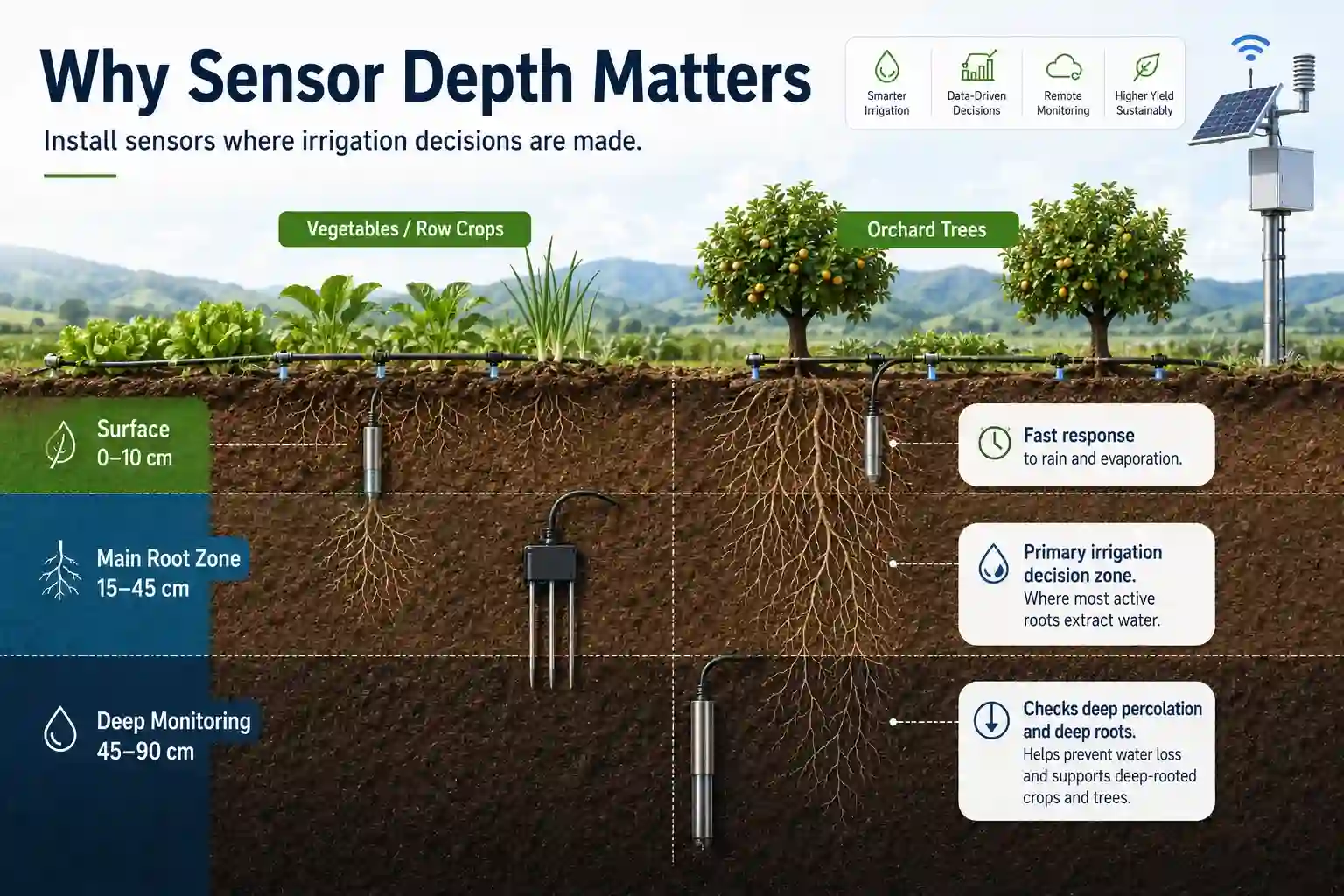
Shallow measurement depths
Shallow sensors respond quickly to:
- Rainfall
- Drip irrigation
- Surface evaporation
- Light irrigation events
They are useful for detecting whether water has entered the upper root zone, but they may cause excessive irrigation if surface drying is interpreted as whole-profile water shortage.
Main root-zone depths
Sensors placed within the active root zone are normally the most important for irrigation scheduling.
For many vegetables and row crops, this may be approximately 15–45 cm, although the correct depth must be determined for the specific crop, soil and growth stage.
Deep measurement depths
Deep sensors help determine whether:
- Irrigation has penetrated below the target root zone
- Water is being lost through deep percolation
- Tree crops are extracting moisture from deeper layers
- The lower soil profile is gradually drying
For orchards, vineyards and deep-rooted crops, several monitoring depths are often more useful than one single probe.
JW-IoT’s multi-layer soil moisture and temperature sensor supports profile monitoring at multiple depths, helping users observe infiltration, root-zone extraction and deep drainage.
One Sensor Is Rarely Enough for a Large Field
Soil moisture can vary across the same farm because of:
- Soil texture
- Elevation
- Drainage
- Compaction
- Irrigation uniformity
- Crop condition
- Shading
- Organic matter
- Previous land management
A single sensor placed in a convenient location may not represent the entire irrigation zone.
A practical placement strategy
Divide the site into management zones based on:
- Soil map
- Topography
- Irrigation layout
- Crop variety
- Planting date
- Historical yield
- Known wet or dry areas
Within each important zone, install sensors in representative locations rather than at extreme wet or dry points.
For high-value sites, consider placing sensors at:
- A representative location
- A known dry location
- More than one root-zone depth
- A deeper drainage-control depth
The objective is not necessarily to maximize the number of sensors. It is to capture the variability that could change an irrigation decision.
Factory Calibration vs Site-Specific Calibration
Many sensors are supplied with a factory calibration curve developed using standard mineral soils or laboratory media.
Factory calibration may be sufficient when:
- Trend monitoring is the main objective
- Soil conditions are close to the calibration medium
- Moderate uncertainty is acceptable
- Irrigation thresholds will be adjusted through field observation
Site-specific calibration is more important when:
- Absolute volumetric water content is required
- Soil contains high clay content
- Salinity is high
- Organic soil or artificial substrate is used
- Data will support research or regulatory reporting
- Irrigation margins are narrow
- Different soil layers have different textures
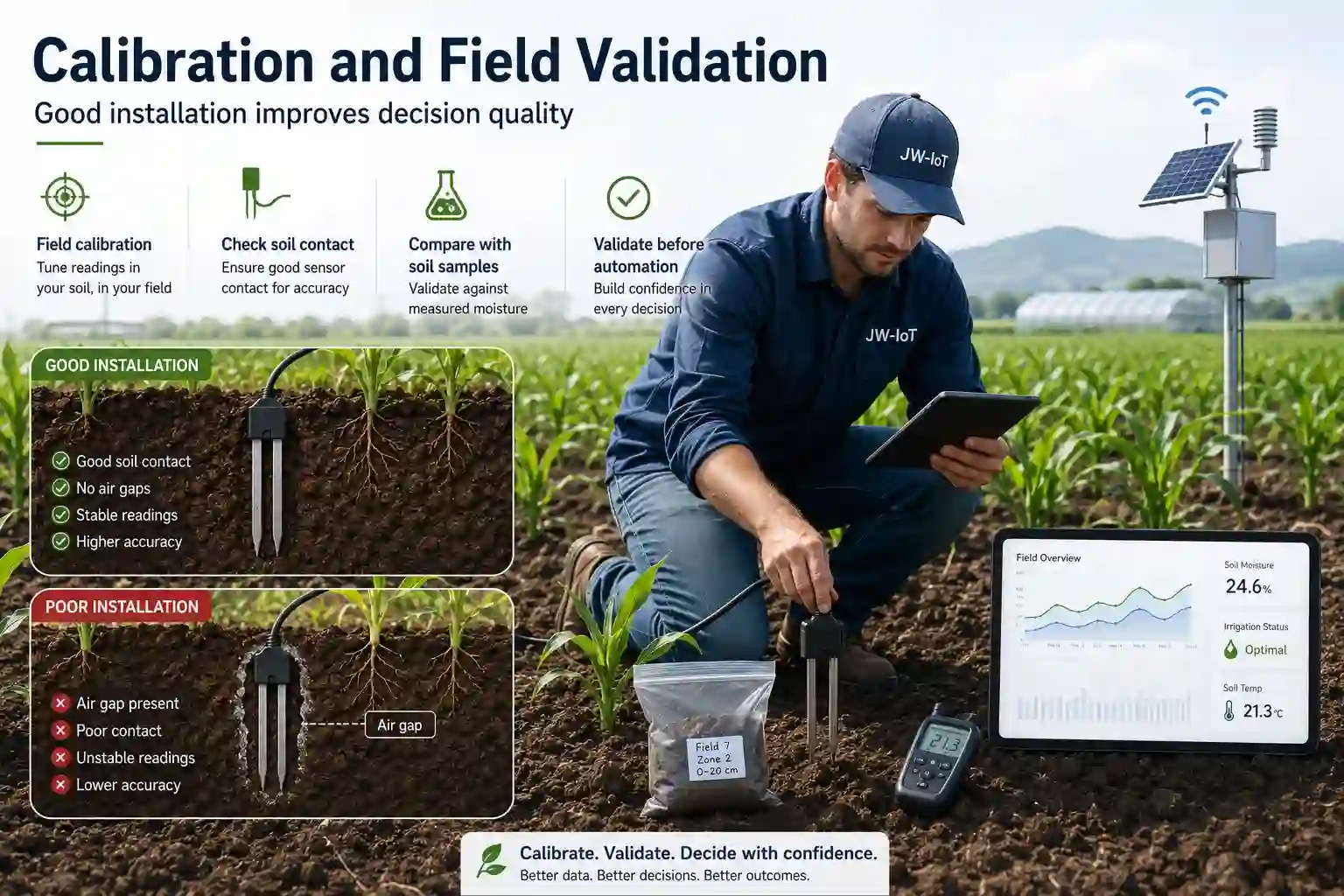
Basic field validation process
A practical validation process may include:
- Install the sensor using the final field method.
- Record sensor output under several moisture conditions.
- Collect soil samples close to the sensor’s measurement zone.
- Determine gravimetric water content through oven drying.
- Measure or estimate soil bulk density.
- Convert the result to volumetric water content.
- Compare laboratory values with sensor readings.
- Develop a correction curve if necessary.
Calibration should not be used to compensate for poor installation. Air gaps, loose soil contact and disturbed structure must be corrected before calibration results can be trusted.
Important Specifications to Compare Before Buying
Technology type is only one part of sensor selection.
Buyers should also compare the following specifications.
Measurement parameters
Determine whether the project needs:
- Soil moisture only
- Soil moisture and temperature
- Soil moisture, temperature and EC
- Salinity
- NPK estimation
- Multi-layer soil profile data
Additional parameters should be selected only when they contribute to a real management decision.
Output signal
Common outputs include:
- RS485 Modbus RTU
- SDI-12
- 4–20 mA
- 0–5 V
- 0–2 V
- LoRaWAN
- 4G cellular
- NB-IoT
For fixed agricultural monitoring networks, RS485 Modbus is widely used because it supports long cable distances, multi-sensor networks and integration with PLCs, RTUs and data loggers.
Waterproof protection
Long-term buried probes should normally use a fully sealed, corrosion-resistant structure.
Check:
- IP rating
- Cable entry sealing
- Probe material
- Electrode material
- Resistance to fertilizer and agricultural chemicals
- Suitability for permanent burial
Power consumption
Power consumption is especially important for:
- Solar-powered stations
- Battery-powered LoRaWAN nodes
- Remote farmland
- Seasonal monitoring sites
The datasheet should distinguish between standby current and measurement current.
Operating temperature
Confirm that both the sensing element and electronics can operate across the expected field temperature range.
Cable length
Long analog cable runs can introduce signal loss or interference. Digital RS485 or SDI-12 communication is often more suitable for remote sensor installations.
Protocol documentation
For system integration, confirm that the supplier can provide:
- Register map
- Modbus address settings
- Baud-rate settings
- Data format
- Scaling factors
- Wiring diagram
- Command examples
- Error-handling information
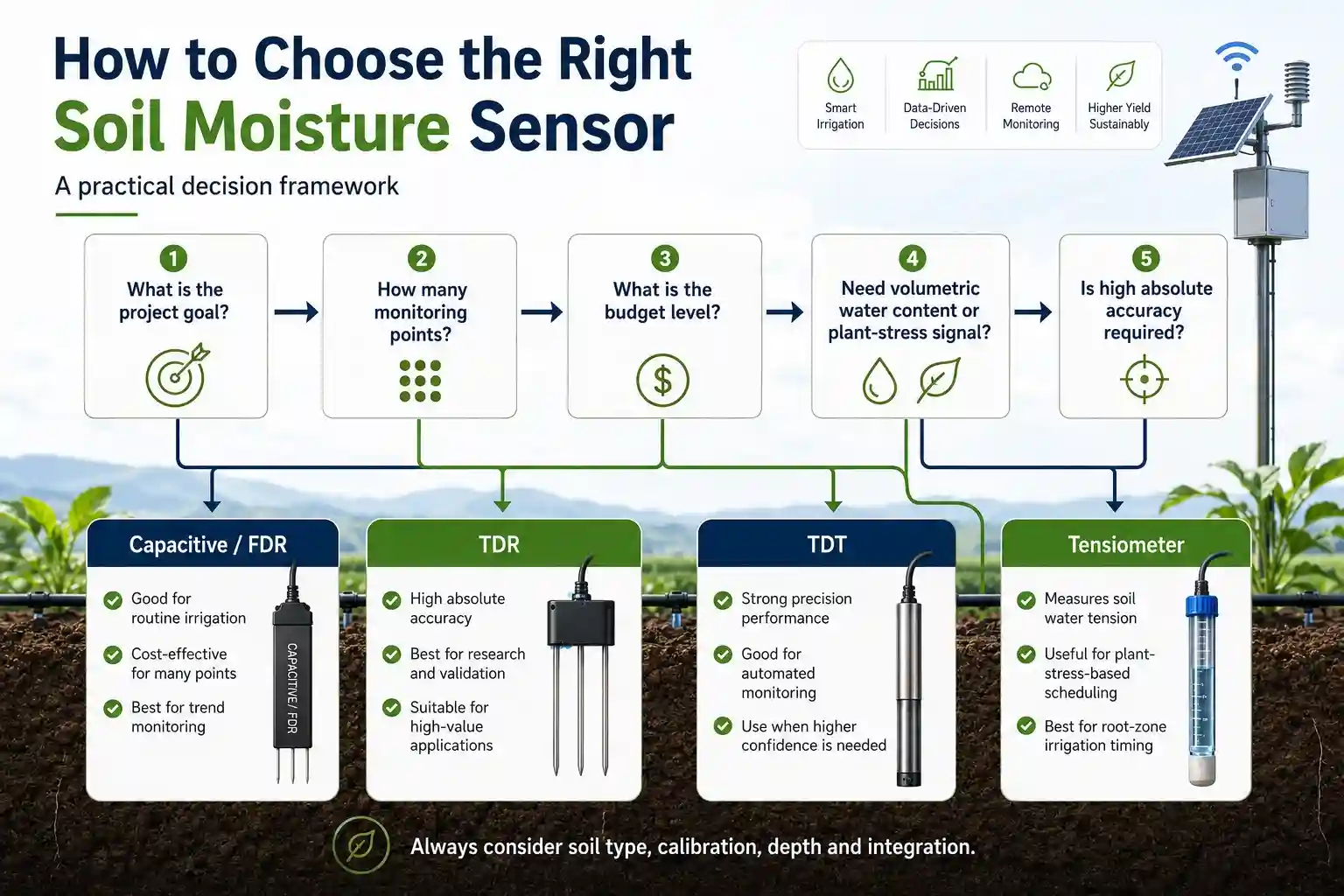
Choosing a Sensor by Application
Smart irrigation in open fields
Recommended priorities:
- Industrial FDR, TDR or validated TDT technology
- IP68 protection
- RS485 or wireless communication
- Low power consumption
- Multiple representative locations
- Root-zone and deep-drainage measurements
- Field calibration where accuracy is critical
A complete smart irrigation control system can combine soil moisture data with weather conditions, irrigation valves, flow measurement and cloud-based control.
Greenhouse cultivation
Recommended priorities:
- Soil or substrate compatibility
- Fast response
- Moisture and temperature measurement
- Optional EC measurement for fertigation
- Compact waterproof probe
- Integration with irrigation and climate controllers
- Multiple sensors for separate cultivation zones
JW-IoT’s greenhouse monitoring system integrates soil and substrate sensors with air temperature, humidity, CO₂, light, irrigation control and cloud monitoring.
Orchards and vineyards
Recommended priorities:
- Multi-depth monitoring
- Stable long-term installation
- Root-zone and deep-profile data
- Soil-specific calibration
- Wireless or solar-powered field connectivity
- Multiple monitoring zones
- Optional soil EC measurement
For deep-rooted crops, monitoring only the topsoil may result in unnecessary irrigation or failure to detect deep water depletion.
Agricultural research
Recommended priorities:
- TDR, validated TDT or another reference-grade method
- Documented calibration
- Raw data access
- High measurement repeatability
- Temperature and EC compensation
- Data export
- Comparison with gravimetric sampling
- Detailed installation records
Low-cost hobby projects
A basic resistive or capacitive probe may be sufficient when:
- Failure has limited consequences
- Only rough wet-or-dry detection is needed
- The probe can be replaced frequently
- Long-term stability is not important
- Commercial irrigation decisions are not involved
Integrating Soil Moisture Sensors into an IoT Monitoring System
A soil sensor becomes more valuable when its readings are connected to a complete monitoring and decision system.
A typical architecture is:
Soil sensor → Data logger or RTU → LoRaWAN or 4G communication → Cloud platform → Irrigation decision or valve control
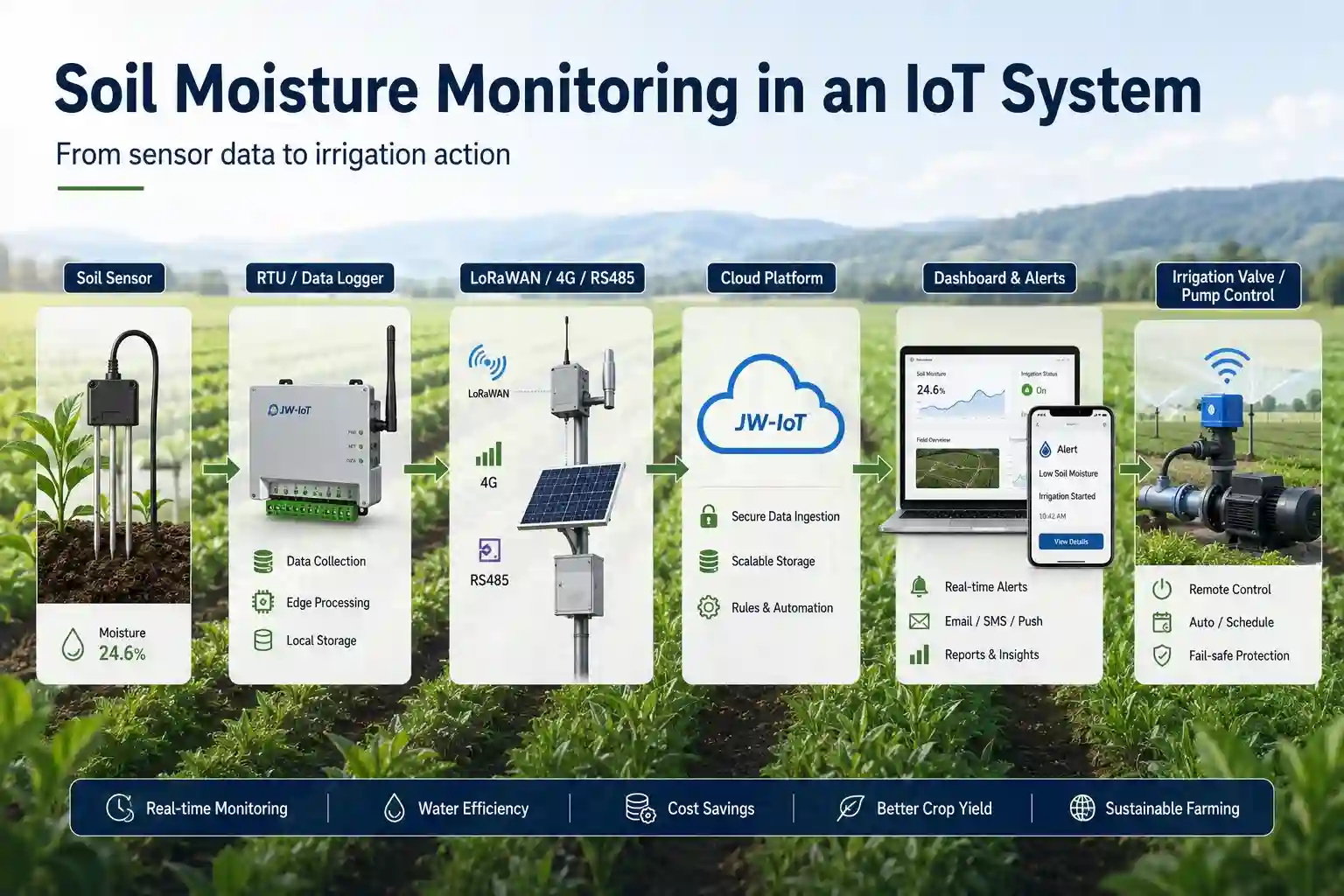
Sensor layer
The sensor measures soil moisture, temperature, EC or other root-zone parameters.
Data acquisition layer
An RTU, PLC, data logger or wireless node collects and processes the sensor output.
Communication layer
Depending on site conditions, data may be transmitted through:
- RS485 cable
- LoRaWAN
- 4G LTE
- NB-IoT
- Ethernet
- Satellite communication
JW-IoT provides communication devices for connecting field sensors, gateways, RTUs and cloud platforms.
Platform layer
The monitoring platform can provide:
- Real-time dashboards
- Historical trends
- Threshold alarms
- Multi-field management
- Irrigation reports
- Mobile access
- Data export
- API integration
Control layer
When sufficient safeguards are in place, soil moisture data can be used to:
- Start irrigation
- Stop irrigation
- Select irrigation zones
- Detect possible valve failure
- Identify insufficient irrigation
- Prevent deep drainage
- Send low-moisture alarms
Automatic control should not rely on a single unverified sensor value. Recommended safeguards include minimum and maximum run times, sensor fault detection, flow confirmation and manual override.
Common Soil Moisture Sensor Buying Mistakes
1. Selecting by price alone
The lowest-cost sensor may require more maintenance, replacement and troubleshooting than an industrial probe.
2. Selecting by datasheet accuracy alone
Laboratory accuracy may not represent performance in clay, saline soil, organic substrate or disturbed field soil.
3. Ignoring calibration requirements
Factory calibration does not guarantee identical accuracy in every soil.
4. Installing only one sensor
One location may not represent a large or variable irrigation zone.
5. Installing at only one depth
A shallow sensor cannot show whether irrigation reached deeper roots or caused deep drainage.
6. Leaving air gaps around the probe
Poor soil contact can create unstable or unrealistically low readings.
7. Installing beside an emitter without a clear objective
A sensor directly beneath a drip emitter may remain wet while most of the root zone is dry. Sensor distance from the emitter should match the intended monitoring objective.
8. Ignoring salinity
Fertilizer, brackish water and salt accumulation can interfere with some electromagnetic measurements.
9. Buying a sensor without integration documentation
A sensor with RS485 output is difficult to integrate if the supplier cannot provide a complete Modbus register map and wiring instructions.
10. Automating irrigation before validating the data
Sensor readings should first be compared with soil observations, crop condition and irrigation behavior.
Soil Moisture Sensor Selection Checklist
Before requesting a quotation, prepare the following information:
- Crop type
- Rooting depth
- Soil texture
- Expected salinity
- Irrigation method
- Number of irrigation zones
- Required measurement depths
- Required accuracy
- Monitoring objective
- Required parameters
- Power availability
- Communication distance
- Output protocol
- Data platform requirements
- Installation period
- Local climate conditions
- Automation requirements
Providing this information helps the sensor supplier recommend a system rather than simply quoting an individual probe.
Frequently Asked Questions
What is the best soil moisture sensor for irrigation?
There is no single best sensor for every irrigation project. Industrial FDR sensors are often suitable for routine commercial monitoring because they balance cost, power consumption and integration capability. TDR or validated TDT sensors may be more appropriate when higher absolute accuracy is required. Tensiometers are useful when irrigation decisions should be based directly on soil water tension.
Is a capacitive soil moisture sensor accurate?
A well-designed capacitive or FDR sensor can provide stable and useful measurements, especially for observing wetting and drying trends. Absolute accuracy depends on soil texture, salinity, temperature, calibration and installation.
What is the difference between FDR and TDR?
FDR analyzes the soil’s response to an oscillating electromagnetic signal in the frequency domain. TDR measures the travel and reflection time of a fast pulse. TDR generally offers higher accuracy potential but often costs more, while FDR is widely used in commercial irrigation and multi-point IoT deployments.
Does a soil moisture sensor require calibration?
Calibration requirements depend on the technology and project objective. Factory calibration may be adequate for trend monitoring, while site-specific calibration is recommended for research, saline soils, unusual substrates and applications requiring accurate volumetric water content.
How deep should a soil moisture sensor be installed?
The sensor should be installed within the active crop root zone. For many projects, multiple depths are recommended: one in the main root zone and another near the bottom of the root zone to detect irrigation penetration and deep drainage. The correct depths depend on the crop, soil and growth stage.
Can one soil moisture sensor control an entire field?
Usually not. Large fields often contain variations in soil texture, elevation, drainage and irrigation uniformity. Sensors should be installed by management zone, with representative locations selected for each important condition.
Can soil moisture sensors work in saline soil?
They can, but salinity may affect electromagnetic sensor readings. Buyers should select a sensor designed for the expected conductivity range, consider soil-specific calibration and monitor soil EC when salt accumulation is a concern.
Is RS485 suitable for agricultural soil sensors?
Yes. RS485 Modbus is widely used for fixed agricultural monitoring because it supports long-distance wired transmission, multi-sensor networks and integration with RTUs, PLCs, data loggers and IoT gateways.
Can JW-IoT provide a complete soil monitoring system?
Yes. JW-IoT can integrate soil moisture, temperature, EC and multi-layer profile sensors with data loggers, LoRaWAN or 4G communication, cloud platforms, alarms and irrigation control according to project requirements.
Final Recommendation
The best soil moisture sensor is not necessarily the sensor with the highest advertised accuracy.
It is the sensor that matches:
- The variable you need to measure
- The soil and salinity conditions
- The crop root zone
- The acceptable level of uncertainty
- The required number of monitoring points
- The communication architecture
- The available project budget
- The decisions that will be made from the data
For routine smart irrigation and greenhouse projects, industrial FDR sensors with waterproof construction and RS485 Modbus output often provide a practical solution.
For research, sensor validation and high-value precision applications, TDR or validated TDT technology may justify the higher investment.
For irrigation decisions based directly on plant water availability, tensiometers can remain highly useful within their operating range.
Most importantly, sensor selection should be treated as part of a complete monitoring system—not as an isolated hardware purchase.
Explore JW-IoT’s complete range of soil sensors for agriculture and irrigation, or contact JW-IoT to discuss soil conditions, sensor depth, communication method and system integration for your project.