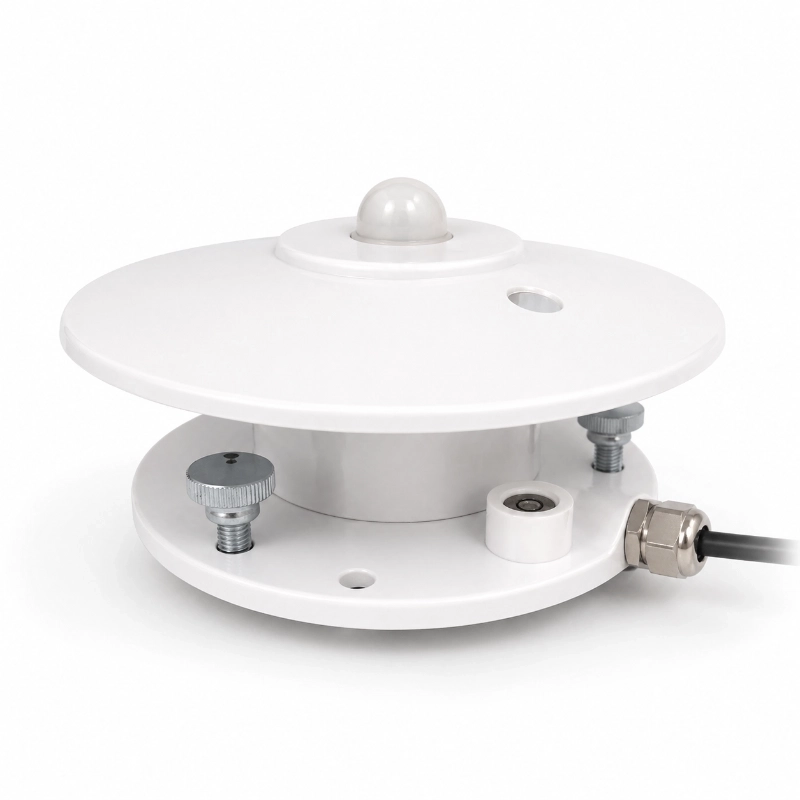
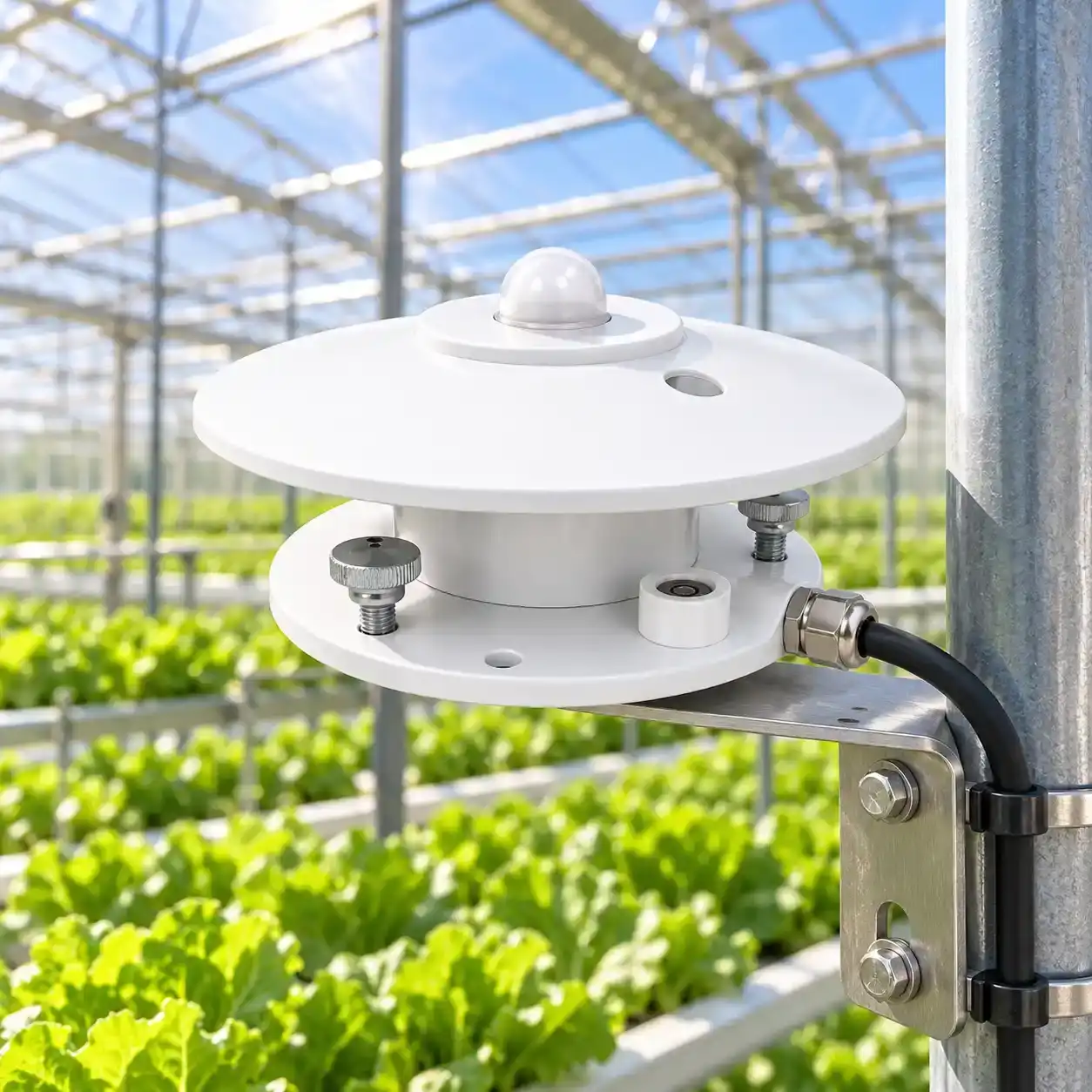
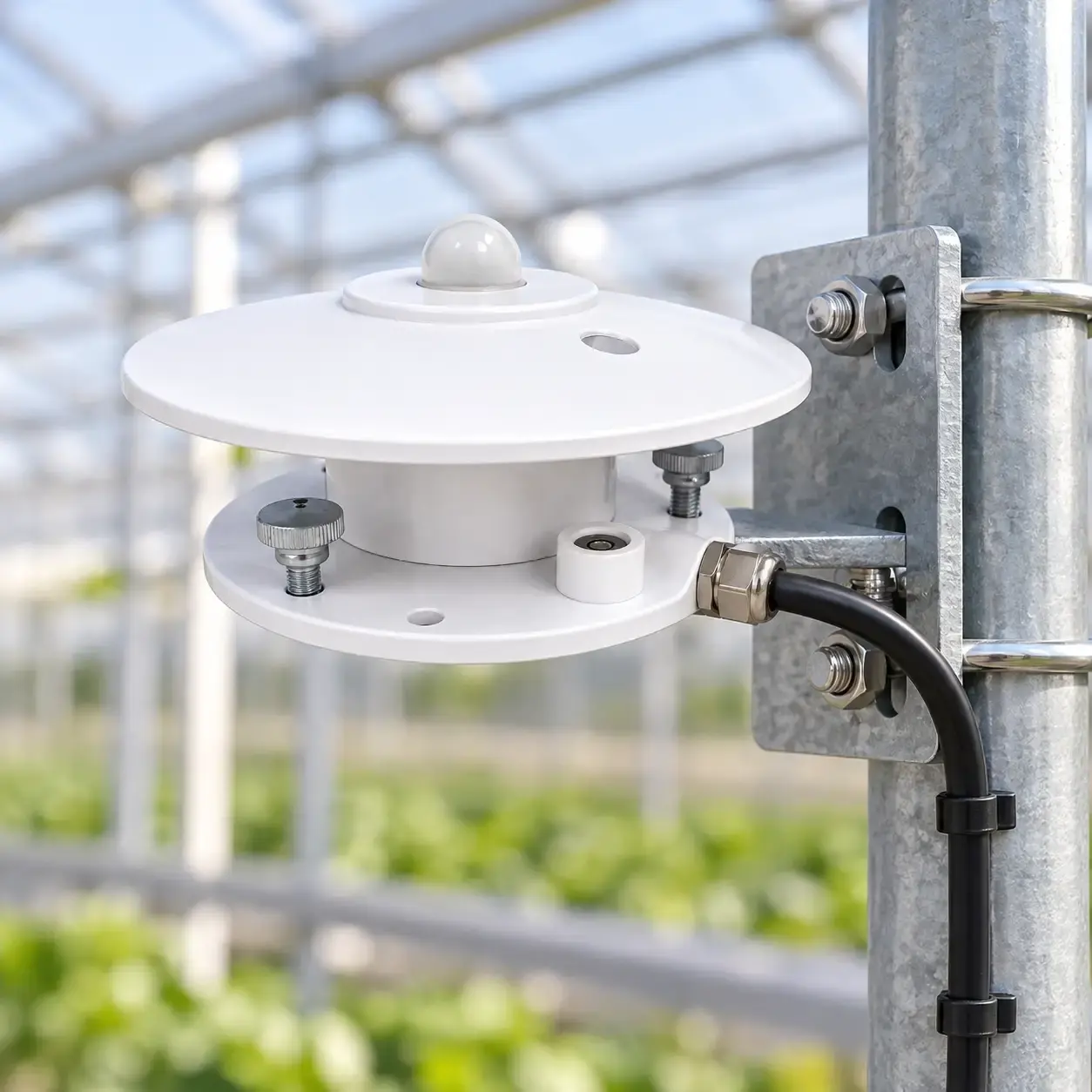
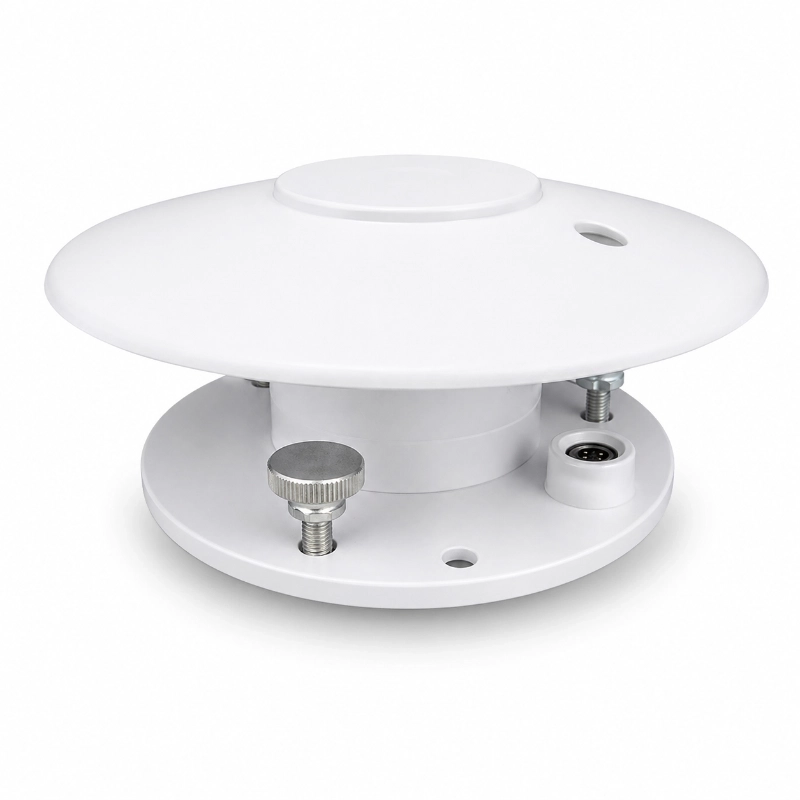
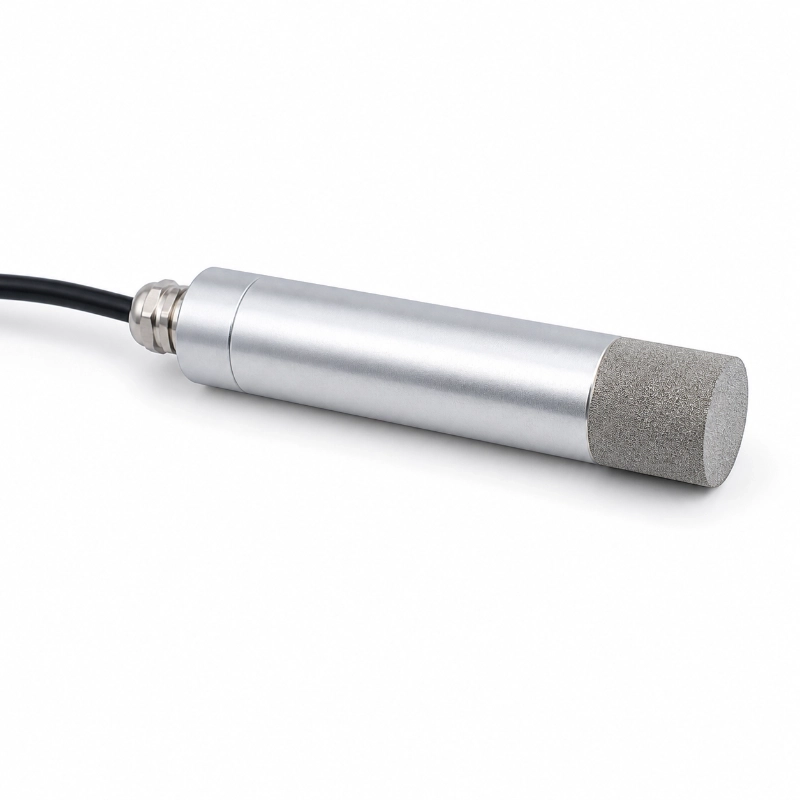
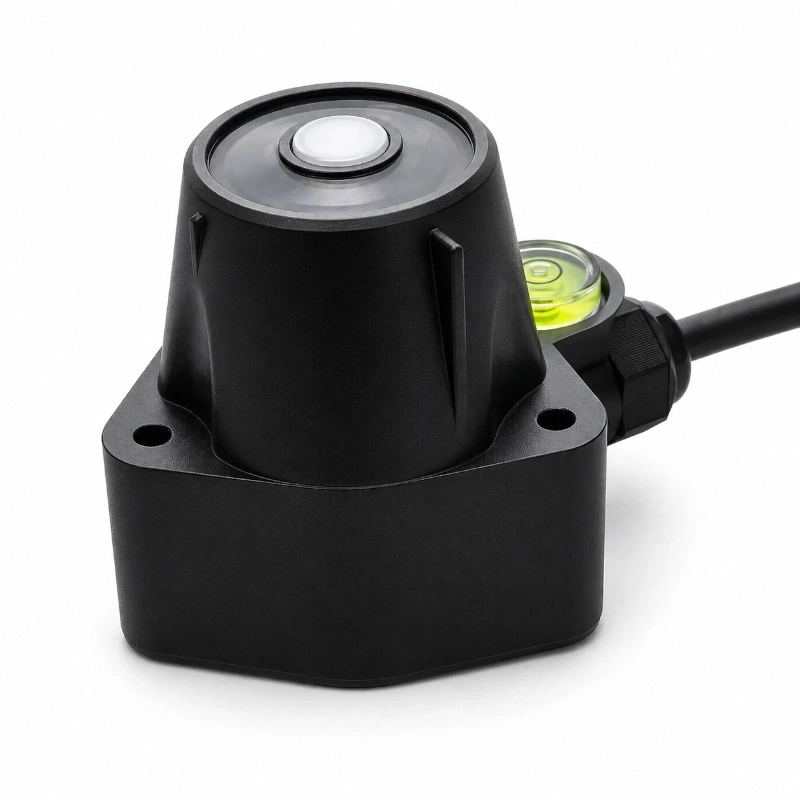
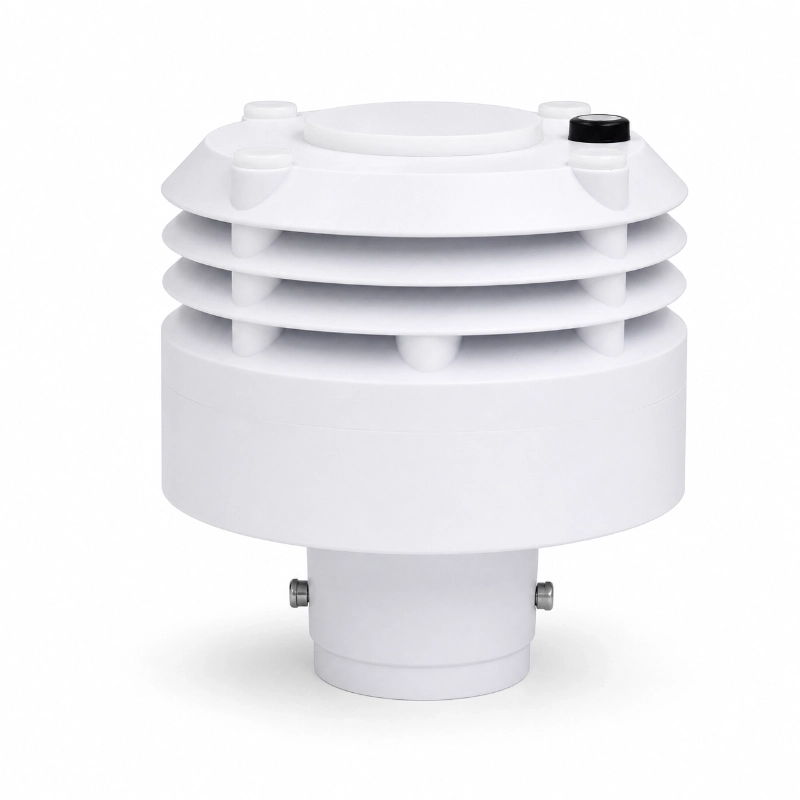
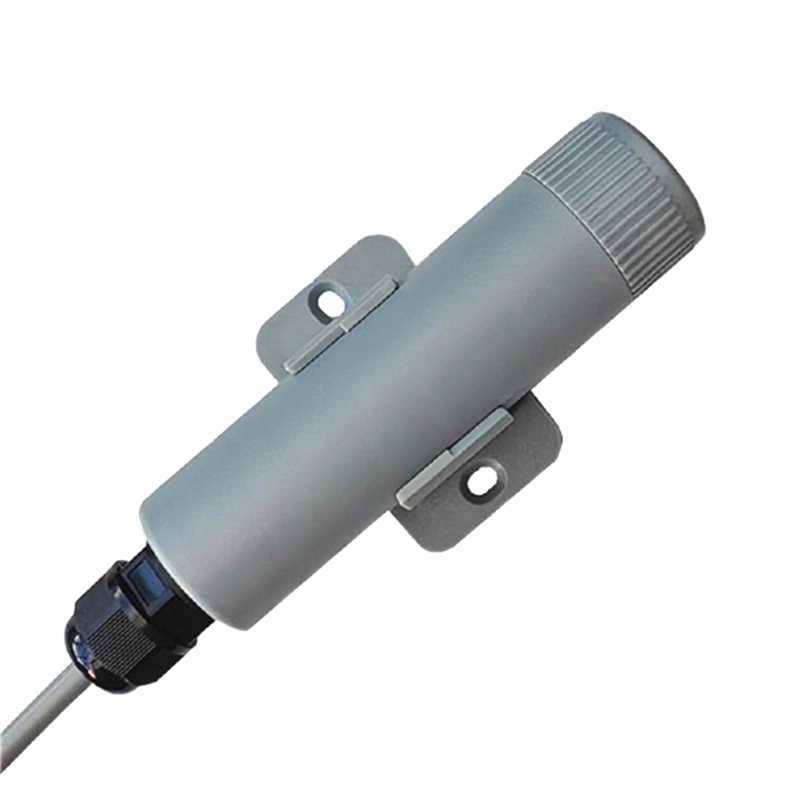
The JW-RG-GZD(LC43) Light Intensity Sensor is designed for continuous illuminance monitoring in commercial greenhouses, agricultural IoT systems, industrial lighting applications, and outdoor environmental monitoring stations.
With a wide 0–200,000 Lux measurement range, ≤5% accuracy, and multiple signal output options, this light intensity sensor enables system integrators to collect illumination data and connect it to greenhouse controllers, PLCs, data loggers, and remote monitoring platforms.
Its DC12V power supply, approximately 0.15W power consumption, and compact structure make it a practical sensing component for distributed environmental monitoring systems.
1. Product Overview
What Is the JW-RG-GZD(LC43) Light Intensity Sensor?
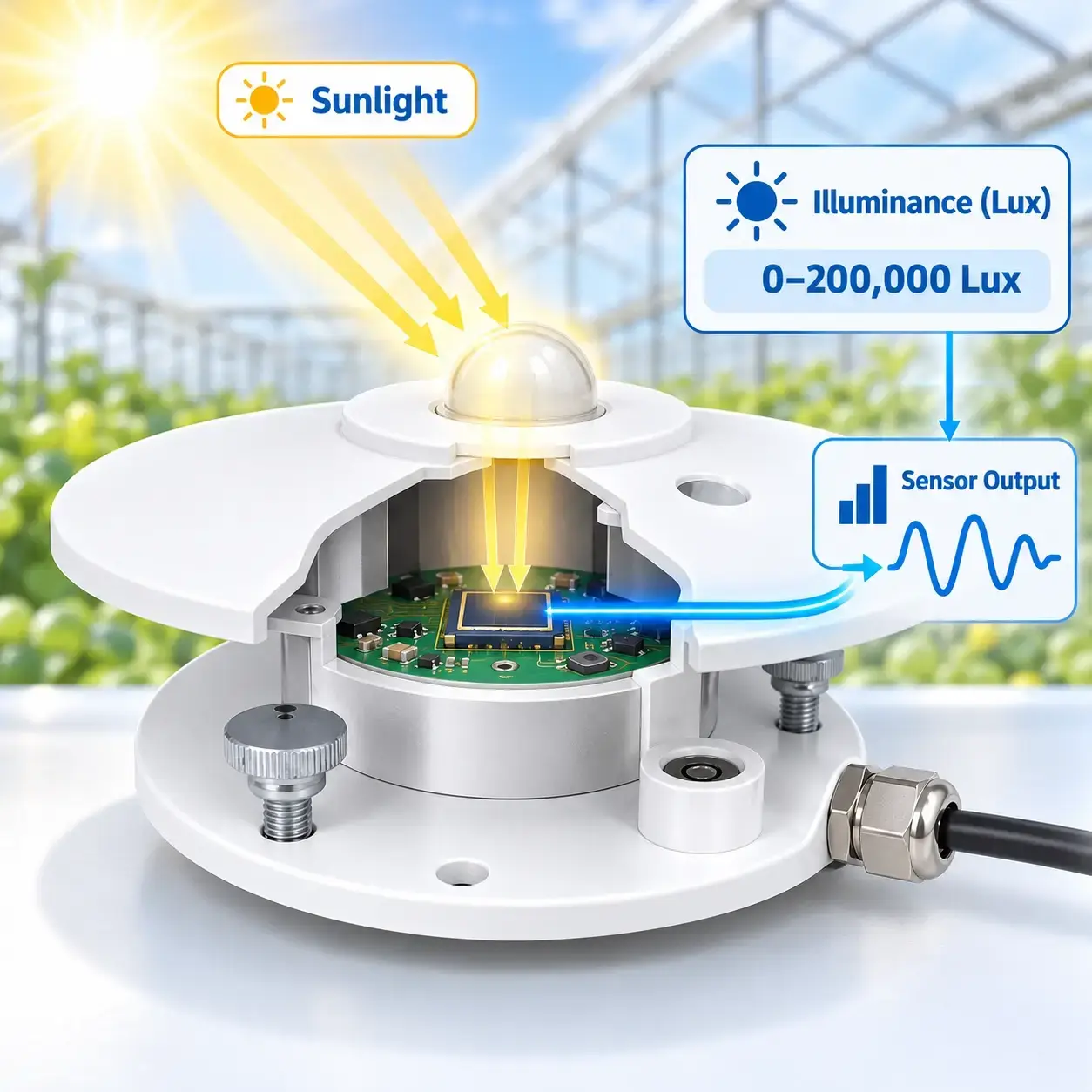
The JW-RG-GZD(LC43) is an industrial light intensity sensor that measures illuminance in Lux. It converts measured illumination levels into an electrical signal that compatible controllers or monitoring equipment can acquire and process.
Unlike handheld light meters designed primarily for occasional inspections, this sensor is intended for integration into continuous monitoring systems.
In smart greenhouse applications, measured light intensity can be combined with temperature, humidity, CO₂, and other environmental data to support climate management and lighting decisions.
The sensor can also serve as a measurement point in distributed monitoring networks for factories, buildings, agricultural facilities, and outdoor environments.
Illuminance describes how much luminous flux reaches a given surface area. It is measured in Lux (lx), where one Lux equals one lumen per square meter.
A light intensity sensor detects incident illumination and produces a corresponding electrical output.
The monitoring system then interprets this signal as a Lux measurement for display, recording, alarm processing, or automated control.
Why Is a 0–200000 Lux Range Useful?
Lighting conditions can vary considerably between enclosed growing facilities and outdoor locations.
Greenhouses experience changing natural illumination throughout the day due to weather, seasonal sunlight, shading structures, and greenhouse coverings.
A wide measuring range allows one selected sensor configuration to monitor these different illuminance conditions without requiring separate low-range and high-range instruments for every location.
The JW-RG-GZD(LC43) provides a specified measurement resolution of 10 Lux and accuracy of ≤5%.
The measurement range alone does not determine plant growth performance. Light quality, exposure duration, and crop-specific requirements must also be considered.
3. Technical Specifications
Parameter
Specification
Product Model
JW-RG-GZD(LC43)
Product Type
Light Intensity / Illuminance Sensor
Measured Parameter
Illuminance (Lux)
Measurement Range
0–200,000 Lux
Measurement Accuracy
≤5%
Resolution
10 Lux
Power Supply
DC12V
Output Options
RS485 / 4–20mA / 0–20mV
Power Consumption
Approximately 0.15W
Current Consumption
10mA (listed specification)
Operating Temperature
-35°C to +75°C
Standard Cable Length
1.5m
Cable Customization
Available according to project requirements
Cable Voltage Rating
300V
Cable Temperature Rating
80°C
Product Weight
Approximately 160g
Technical note: Electrical specifications and communication settings should be confirmed against the documentation for the selected output version before installation.
4. RS485 and Analog Output Options
The JW-RG-GZD(LC43) is available with different electrical output configurations to support existing monitoring and automation infrastructure.
4.1 RS485 Light Intensity Sensor
The RS485 version is suitable for digital data acquisition systems that need to read illuminance measurements from field sensors.
Typical receiving equipment includes:
Industrial data loggers
Greenhouse environmental controllers
PLC monitoring systems
Remote terminal units (RTUs)
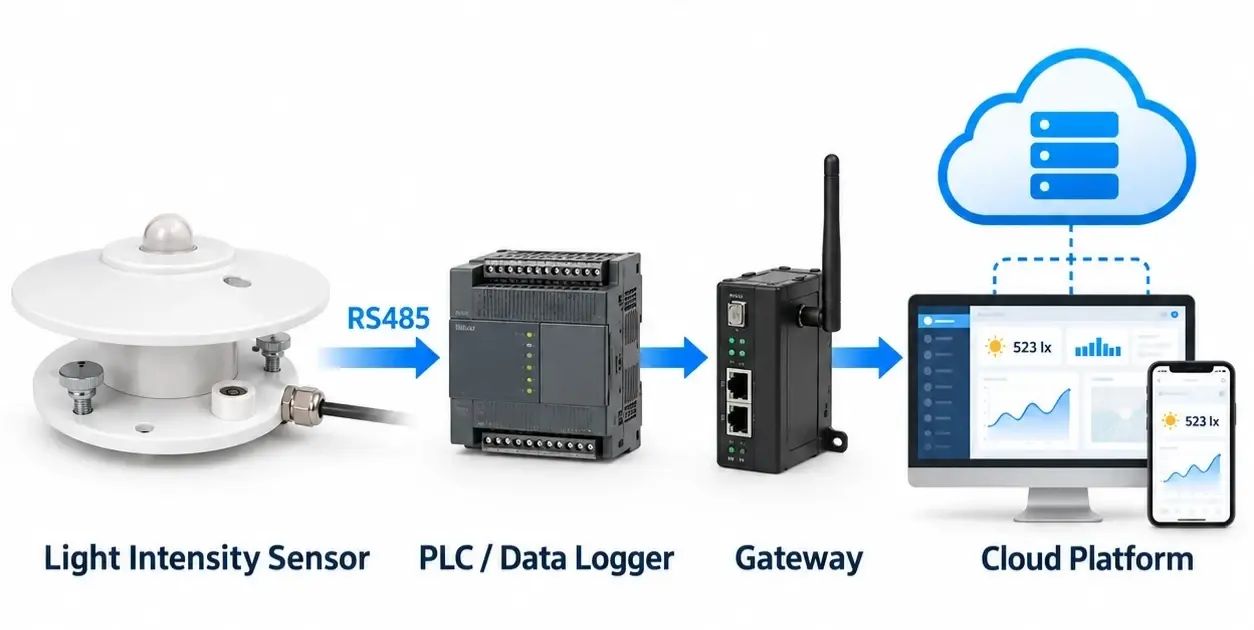
Industrial IoT gateways
RS485 provides a differential communication interface commonly used in industrial monitoring networks.
For project implementation, the integrator should confirm the sensor’s communication protocol, baud rate, device address, register definitions, and wiring requirements.
Where Modbus RTU is required, protocol compatibility must be checked for the selected model.
4.2 4–20mA Light Intensity Sensor
The 4–20mA version is intended for systems equipped with compatible analog current input channels.
It can be incorporated into industrial control cabinets and centralized monitoring systems without requiring a digital RS485 interface.
The controller converts the received current signal into an illuminance value according to the specified output scaling.
4.3 0–20mV Analog Output
The 0–20mV version provides a low-voltage analog signal for compatible acquisition equipment.
When selecting this version, engineers should consider input resolution, signal interference, cable length, and appropriate signal conditioning.
The signal scaling and electrical connection details should be confirmed before commissioning.
5. Greenhouse Light Monitoring Applications
5.1 Commercial Greenhouse Illuminance Monitoring
Natural light availability changes with weather conditions, greenhouse orientation, surrounding structures, and seasonal variation.
A greenhouse light sensor provides continuous Lux measurements that operators can use to observe changes in the growing environment.
Typical monitoring objectives include:
Tracking daytime illumination variations
Comparing daylight levels between greenhouse zones
Identifying shading patterns
Recording historical light conditions
Integrating lighting data with greenhouse climate monitoring
When combined with other sensors, illuminance measurements provide useful context for greenhouse operation and environmental analysis.
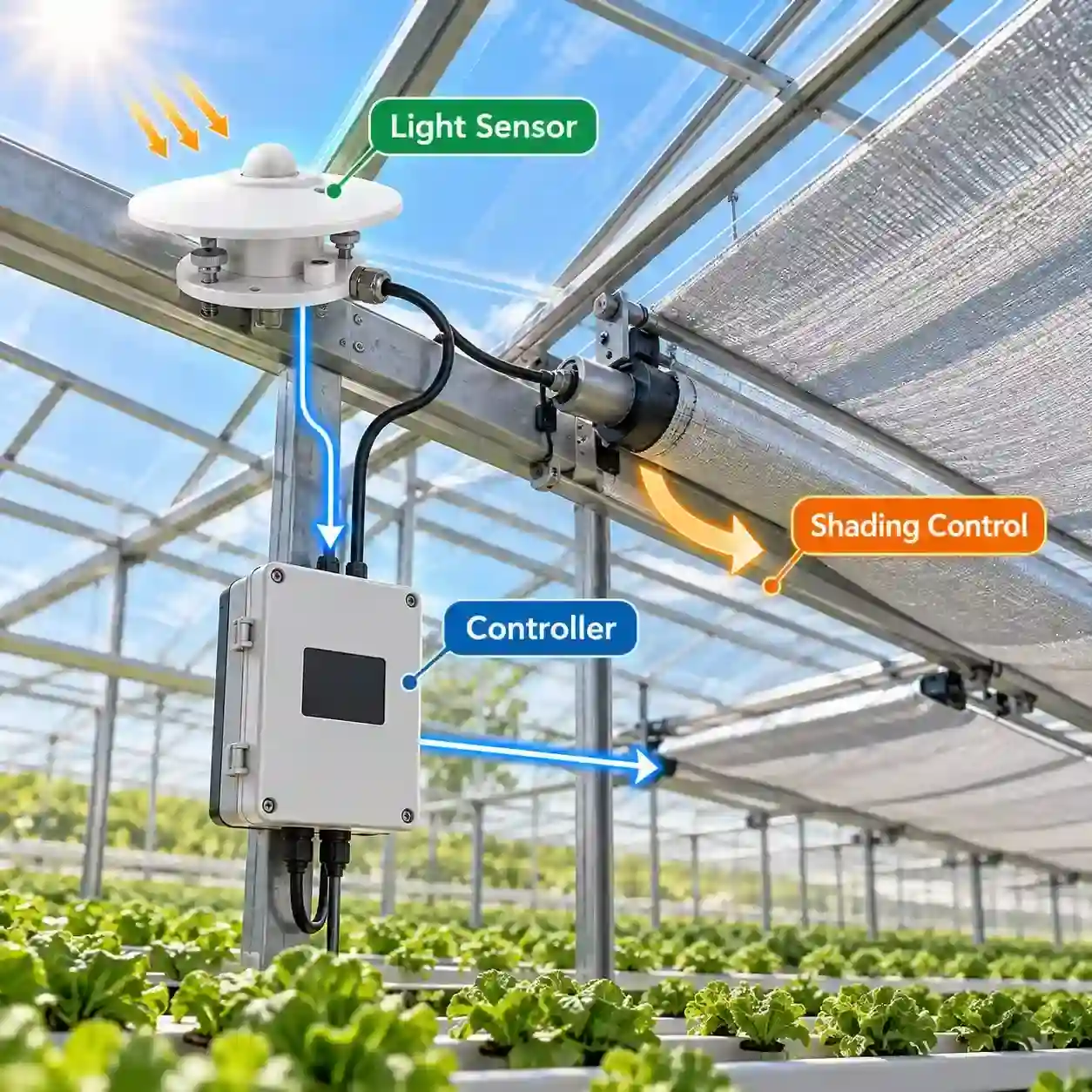
5.2 Greenhouse Shading Control
Greenhouse shading systems may use light measurements as one of several inputs for automated control.
For example, a greenhouse controller can compare measured illuminance against project-defined control thresholds.
When the configured conditions are met, the controller may operate shading equipment through an appropriate motor control system.
Shading decisions should also account for crop requirements, air temperature, solar heat load, and the characteristics of the greenhouse.
The JW-RG-GZD(LC43) provides the measurement signal; shading control logic and motor operation are implemented by external control equipment.
5.3 Supplemental Grow Light Monitoring
Artificial lighting is widely used to supplement natural light in controlled growing environments.
An illuminance sensor can help monitor changes in visible light levels and support comparative lighting checks where the light source and measurement conditions remain consistent.
However, Lux is a human-vision-based measurement and does not directly represent the number of photosynthetically active photons reaching a crop.
For applications requiring plant-light measurements expressed in PPFD, a dedicated PAR or quantum sensor is generally more appropriate.
5.4 Multi-Zone Greenhouse Monitoring
Larger greenhouses may contain multiple growing zones with different lighting conditions.
System integrators can connect appropriately configured sensors to a central data acquisition system to collect measurements from selected locations.
This arrangement supports:
Comparison between greenhouse sections
Identification of uneven daylight distribution
Remote environmental monitoring
Historical illumination analysis
Integration with broader smart agriculture platforms
The number of sensors, network topology, and control architecture should be selected according to project requirements.
6. Industrial and Outdoor Applications
The JW-RG-GZD(LC43) can also be considered for applications beyond greenhouse agriculture.
6.1 Industrial Lighting Monitoring
In factories, warehouses, and industrial facilities, illuminance monitoring can provide data for lighting supervision and facility management.
Measured Lux values can be transmitted to compatible acquisition equipment for recording or further analysis.
For regulated workplace lighting assessments, the suitability of the sensing system and the applicable measurement standard must be independently verified.
6.2 Smart Building Lighting Systems
Building automation projects may use illuminance data to support daylight monitoring and lighting management.
For example, a building management controller can compare measured illumination with configured operating conditions to inform lighting adjustments.
The sensor serves as a measurement component rather than a standalone lighting controller.
6.3 Outdoor Environmental Monitoring
Outdoor environmental monitoring stations may collect illumination data together with temperature, humidity, wind, rainfall, and other environmental measurements.
The sensor’s wide measurement range and specified operating temperature support consideration for outdoor monitoring projects.
For exposed outdoor installation, the enclosure protection rating, mounting arrangement, and environmental suitability should be confirmed before deployment.
6.4 Agricultural IoT Data Acquisition
Agricultural IoT systems often combine measurements from multiple sensor types.
Light intensity measurements can be integrated into an environmental monitoring dataset alongside soil moisture, air temperature, humidity, and other variables.
This enables centralized visualization and supports further analysis through compatible monitoring software.
7. Lux Sensor vs PAR Sensor: Which Should You Choose?
Lux sensors and PAR sensors measure different characteristics of light.
Comparison
Lux Light Sensor
PAR / PPFD Sensor
Measurement
Illuminance
Photosynthetic photon flux density
Unit
Lux (lx)
µmol/m²/s
Measurement Basis
Human visual response
Photosynthetically active photons
Typical Application
Lighting and general environmental monitoring
Crop lighting and plant research
Greenhouse Use
Daylight trends and illumination monitoring
Plant-relevant light measurement
Product Selection
JW-RG-GZD(LC43)
Dedicated PAR sensor
When Should You Use a Lux Sensor?
Choose a Lux sensor when the monitoring objective is visible-light illuminance, lighting supervision, or comparison of lighting conditions.
When Should You Use a PAR Sensor?
Choose a PAR sensor when the primary objective is measuring light available for photosynthesis, calculating daily light integral (DLI), or assessing crop-light exposure.
Lux and PPFD are not interchangeable through a universal conversion factor because their relationship depends on the spectral distribution of the light source.
Correct sensor placement is essential for meaningful illuminance measurements.
Recommended Installation Practices
Select a mounting position representative of the area being monitored.
Avoid unintended shadows from support frames, pipes, cables, and nearby equipment.
Keep the sensing surface oriented according to the manufacturer’s installation instructions.
Use appropriate cable protection and electrical connections.
Confirm that the selected controller input matches the sensor output version.
Check power supply and signal readings before normal operation.
Protect the installation from environmental conditions beyond the sensor’s confirmed protection specifications.
For greenhouse installations, place sensors according to the monitoring objective, such as incoming daylight measurement or representative growing-zone illumination.
Routine Maintenance
Inspect the sensor surface for accumulated dust and dirt.
Clean optical surfaces using a suitable non-abrasive method.
Check mounting stability and cable integrity.
Compare readings with expected operating conditions.
Follow the manufacturer’s inspection and calibration guidance where available.
These practices help reduce measurement errors caused by shading, contamination, installation changes, or electrical faults.
10. Selecting the Right Light Intensity Sensor
Before purchasing an illuminance sensor for a greenhouse or industrial project, confirm the following requirements:
Measurement range: Does the application require measurement up to 200,000 Lux?
Output interface: Does the existing controller require RS485, 4–20mA, or low-voltage analog input?
Power supply: Is a suitable DC12V power source available?
Installation environment: What are the temperature, moisture, enclosure, and mounting requirements?
System compatibility: What communication protocol, electrical scaling, and acquisition hardware are required?
Application objective: Is the project measuring illuminance in Lux, or does it require PAR/PPFD measurements?
For applications requiring alternative measuring ranges, a wider input voltage selection, or a specified IP66 enclosure, consider the JW-ALS20(Z26) Light Intensity Sensor.
12. Request a Light Intensity Sensor for Your Project
The JW-RG-GZD(LC43) 200000 Lux Light Intensity Sensor provides a practical illuminance measurement option for greenhouse automation, environmental monitoring, lighting management, and industrial IoT data acquisition.
JW-IoT supports customers evaluating sensor integration into agricultural monitoring equipment and control systems.
For product selection or a quotation, please provide:
Required quantity
Preferred output signal
Installation environment
Controller or data logger model
Cable length requirements
Destination country
Contact JW-IoT to discuss your greenhouse Lux sensor requirements, technical compatibility, and project integration.
1. What is the measurement range of the JW-RG-GZD(LC43)?
A
The JW-RG-GZD(LC43) measures illuminance from 0 to 200,000 Lux, with a specified resolution of 10 Lux and measurement accuracy of ≤5%.
Q
2. Is this an RS485 light intensity sensor?
A
Yes. RS485 is one of the available output options. The communication configuration should be confirmed for the selected version before integration.
Q
3. Can the sensor be integrated into a PLC system?
A
Yes, provided the PLC has a compatible RS485 or analog input interface and the required signal configuration.
Q
4. Can it support greenhouse shading automation?
A
Yes. Its illuminance measurements can serve as input data for a greenhouse controller. The controller, not the sensor alone, performs the shading control logic.
Q
5. Does the sensor measure PAR or PPFD?
A
No PAR or PPFD output is specified for this model. It measures illuminance in Lux. A dedicated PAR sensor should be selected for direct photosynthetic photon measurements.
Q
6. What output options are available?
A
The listed options are RS485, 4–20mA, and 0–20mV. Customers should specify the required output when ordering.
Q
7. What power supply does the sensor require?
A
The published product specification lists a DC12V power supply and approximately 0.15W power consumption.
Q
8. Can the sensor be used in outdoor monitoring systems?
A
The model has a specified operating temperature range of -35°C to +75°C. For outdoor installations, confirm its enclosure protection and environmental suitability before deployment.
Q
9. Can the sensor connect to an IoT cloud platform?
A
Yes, through compatible external data loggers, controllers, or communication gateways. The sensor does not independently provide a cloud connection.
Q
10. What is the difference between JW-RG-GZD(LC43) and JW-ALS20(Z26)?
A
JW-RG-GZD(LC43) is offered with a specified 0–200,000 Lux range, DC12V supply, and RS485, 4–20mA, or 0–20mV outputs.
JW-ALS20(Z26) offers multiple selectable measuring ranges, alternative voltage configurations, an IP66 enclosure, and different output options.
Selection depends on the project’s electrical interface, environmental conditions, and measurement requirements.
 +86 13520127780
 info@jingelway.com