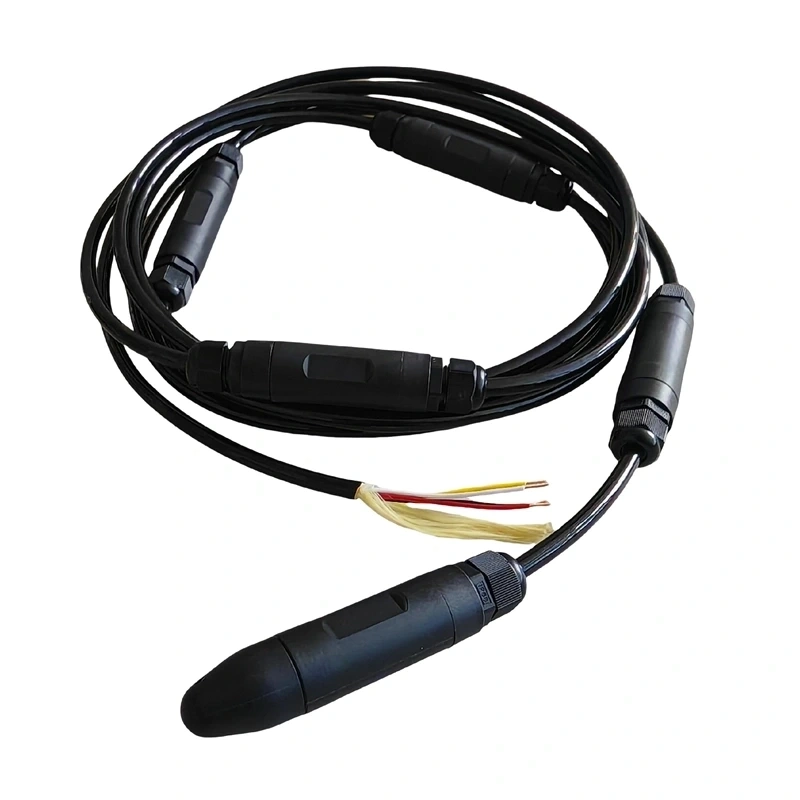
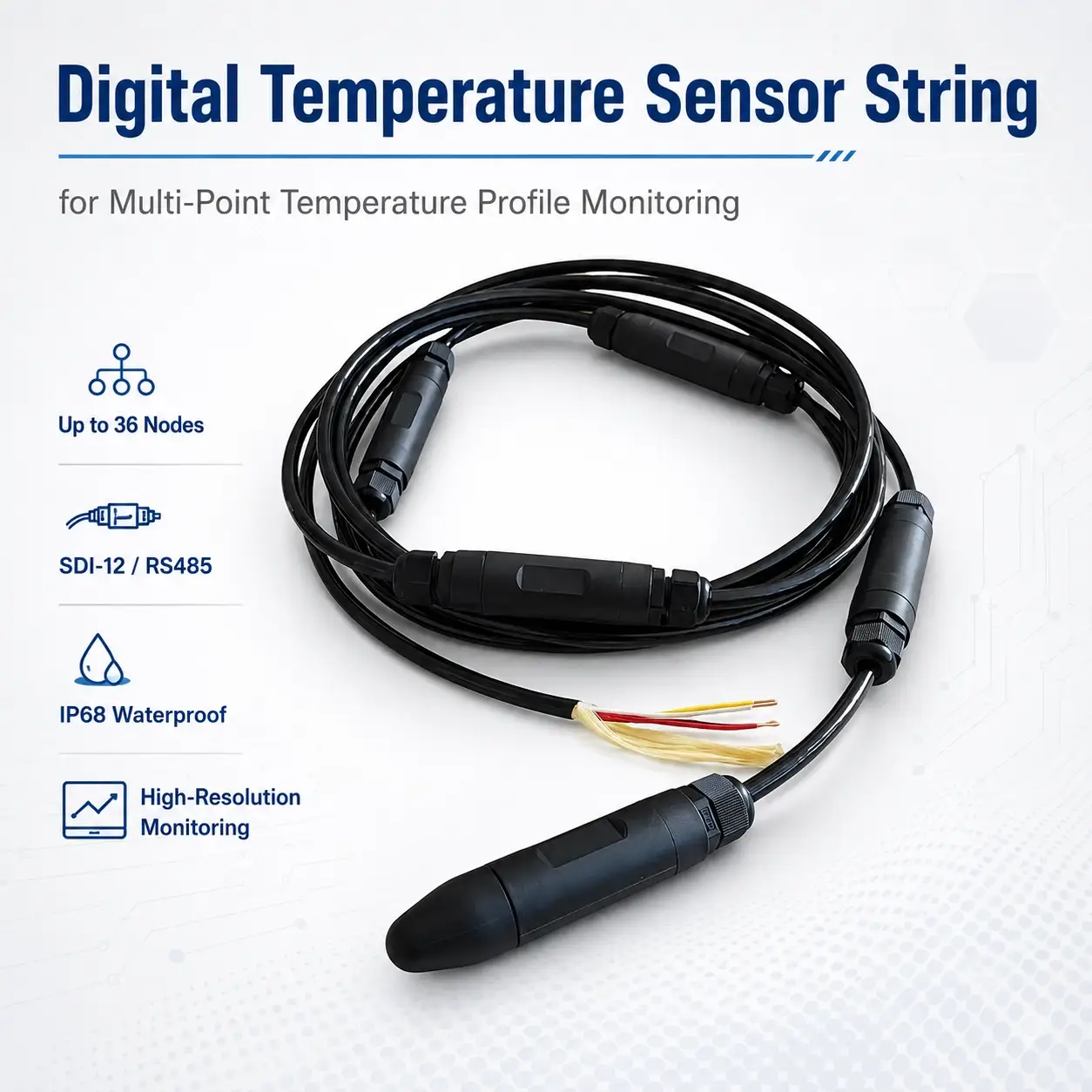
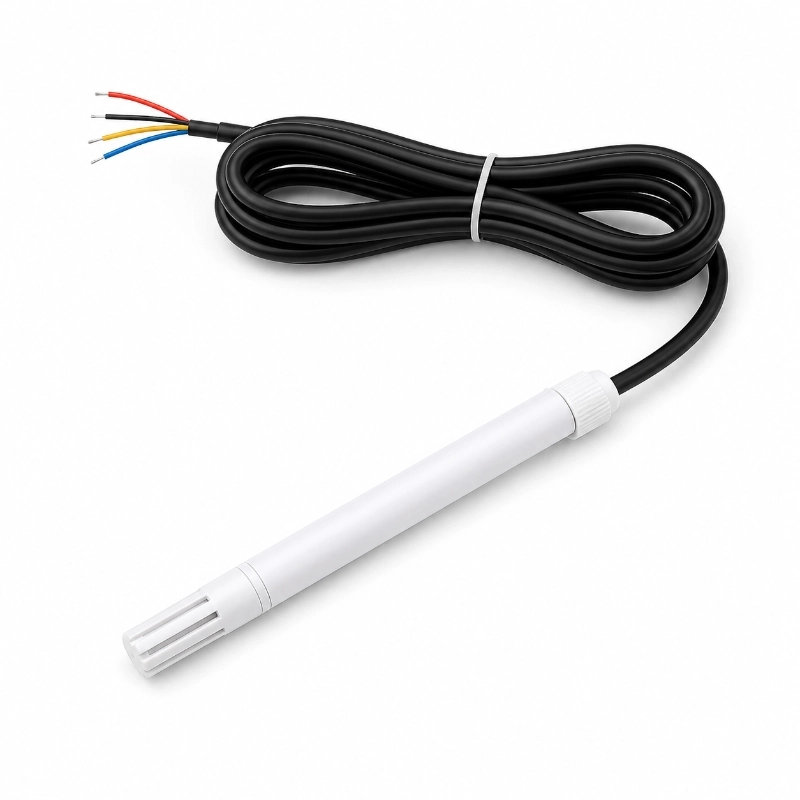
The JW-S1S(Z4) Digital Temperature Sensor String is designed for continuous multi-point temperature measurement across different depths or positions.
With up to 36 individually identifiable temperature nodes, a measurement range of -55°C to 85°C, typical accuracy of ±0.2°C, IP68 waterproof construction, and optional SDI-12 or RS485 Modbus RTU communication, the sensor string is suitable for long-term temperature profile monitoring in:
Permafrost and frozen ground
Soil profiles
Lakes and reservoirs
Oceans and coastal water
Roadbeds and embankments
Boreholes
Sediment
Geotechnical structures
Environmental research stations
Unlike a conventional single-point temperature sensor, a temperature sensor string measures temperature at multiple locations along one reinforced cable, helping users observe how temperature changes with depth or distance.
What Is a Digital Temperature Sensor String?
A digital temperature sensor string is a multi-point temperature measurement system in which multiple temperature sensing nodes are distributed along a single cable.
Instead of installing many independent temperature probes with separate cables, one sensor string can collect temperature measurements from different depths or positions through one communication line.
For example, a vertically installed temperature string may include nodes at:
0.5 m
1 m
2 m
3 m
5 m
10 m
The resulting data produces a temperature profile rather than only one temperature value.
This is particularly useful when temperature changes with depth are more important than surface temperature alone.
Typical examples include:
Permafrost active-layer monitoring
Soil thermal profiling
Lake thermal stratification
Reservoir temperature gradients
Borehole temperature observation
Roadbed freeze-thaw monitoring
How Does Multi-Point Temperature Profile Monitoring Work?
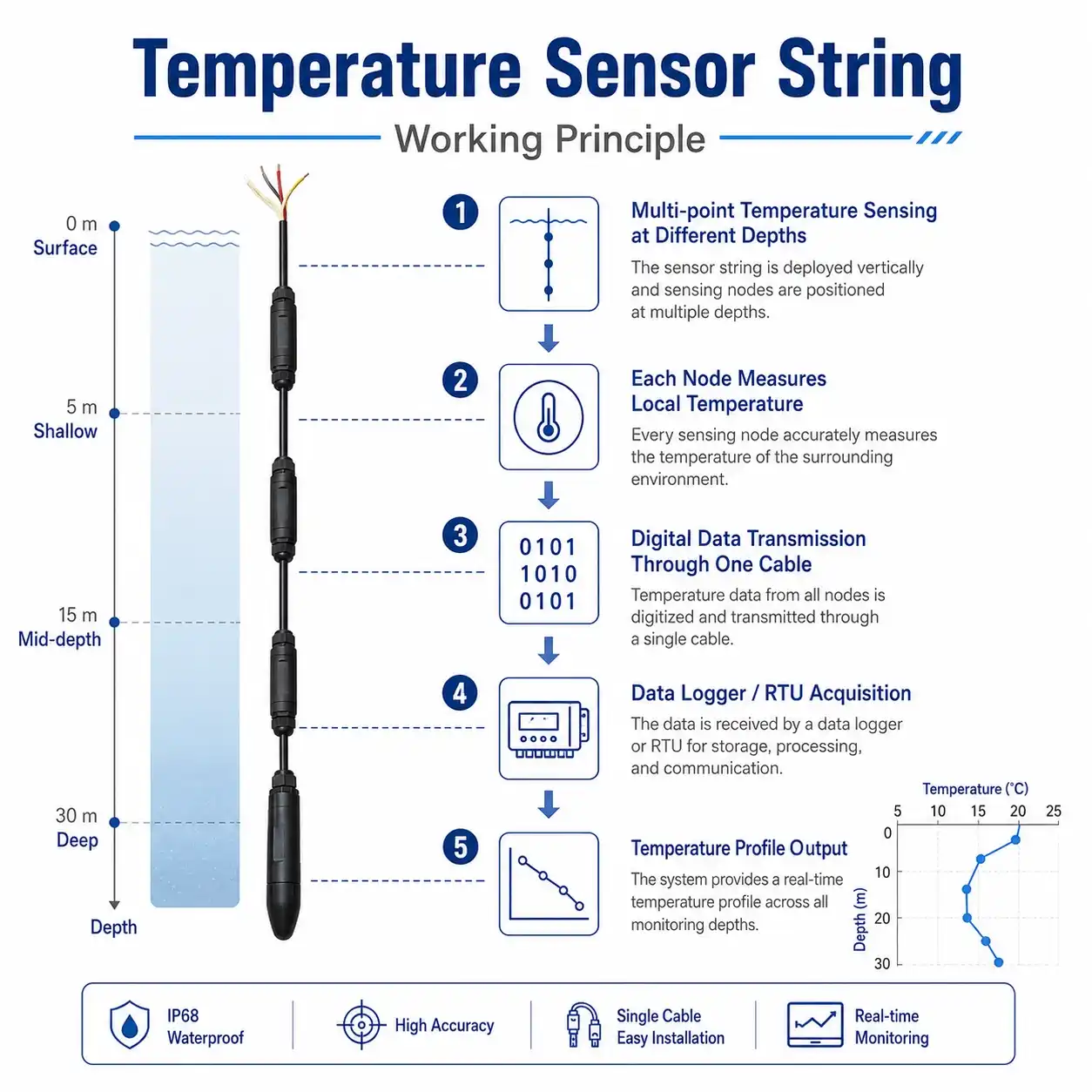
The JW-S1S(Z4) contains multiple digital temperature nodes installed at predefined positions along a reinforced cable.
Each node measures temperature at its own location.
The monitoring process can be summarized as:
Temperature Nodes → Digital Communication → Data Logger / RTU → Network → Monitoring Platform
The data acquisition system reads the temperature value associated with each node and reconstructs the temperature distribution along the sensor string.
For vertical deployment, this produces a temperature-versus-depth profile.
For horizontal deployment, it can provide a temperature-versus-distance profile.
This approach makes it possible to observe:
Thermal gradients
Freeze-thaw boundaries
Temperature inversion layers
Soil thermal changes
Water-column stratification
Long-term seasonal trends
Why Use a Temperature Sensor String Instead of Multiple Independent Sensors?
A project requiring temperature measurements at ten or twenty depths could theoretically use the same number of independent sensors.
However, this often means:
More cables
More wiring
More connectors
More data acquisition channels
More installation work
More potential failure points
A sensor string combines multiple temperature measurement locations into one integrated system.
Main Advantages
Simplified Field Wiring
Multiple measurement nodes share one sensor string and communication connection.
Easier Depth Management
Each node can correspond to a predetermined monitoring depth.
Reduced Installation Complexity
One cable is easier to deploy in a borehole, soil profile, water column, or embankment than many independent cables.
Consistent Data Structure
Measurements from different depths can be collected through one communication interface.
Easier System Expansion
The string can be customized according to the required number of nodes and depth interval.
Technical Specifications
Parameter
Model No.
JW-S1S(Z4)
Product Type
Digital Temperature Sensor String
Output Signal
SDI-12 V1.3 or RS485 Modbus RTU
Power Supply
9–28V DC
Temperature Range
-55°C to 85°C
Typical Accuracy
±0.2°C at -40°C to 85°C
Worst-Case Accuracy
±0.4°C at -40°C to 85°C, ±0.5°C at -55°C to -40°C
Resolution
0.004°C
Sampling Mode
Measurement on request or automatic periodic measurement
Sampling Interval
Configurable from 1 to 43200 seconds
Warm-Up Time
Less than 10 seconds
Maximum Temperature Nodes
36 nodes
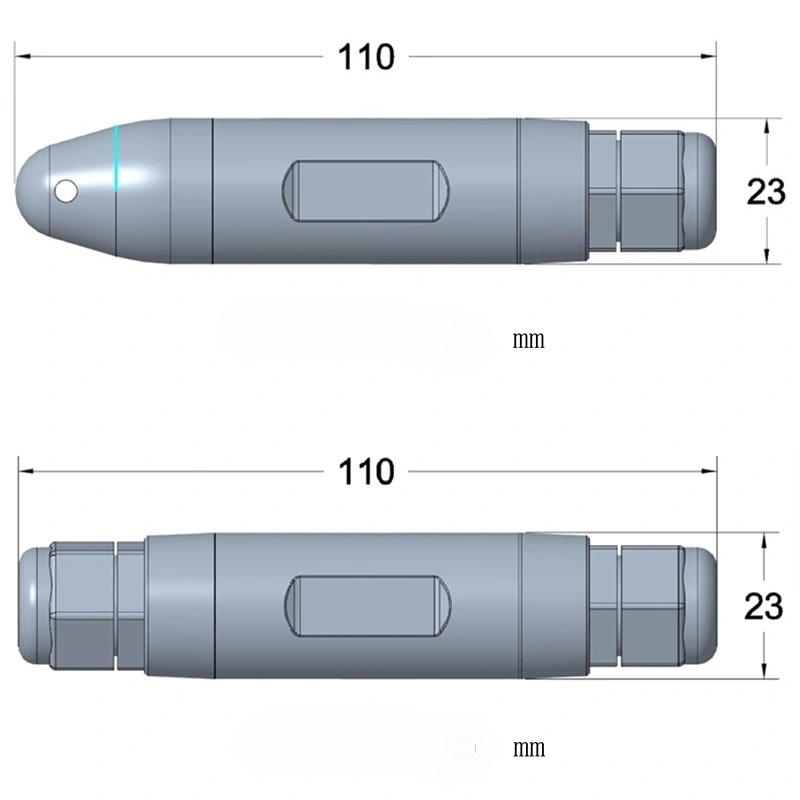
Node Size
110 mm × 23 mm
Maximum Cable Length
152 m or 500 ft
Minimum Sensor Spacing
15 cm or 6 inch
Sensor Node Material
Nylon
Cable Material
PUR
Cable Type
Reinforced Kevlar cable
Cable Outer Diameter
Less than 7.5 mm
Protection Rating
IP68
Communication Protocol
SDI-12 or Modbus RTU
Installation Media
Soil, water, roadbed, frozen ground, sediment
SDI-12 vs RS485 Modbus RTU: Which Output Should You Choose?
The JW-S1S(Z4) is available with either SDI-12 or RS485 Modbus RTU communication.
Both options support digital temperature profile monitoring, but they are typically used in different system environments.
SDI-12 Version
SDI-12 is widely used in environmental and hydrometeorological monitoring systems.
It is particularly suitable for:
Hydrological stations
Meteorological data loggers
Remote scientific stations
Permafrost monitoring
Reservoir monitoring
Low-power field systems
Solar-powered environmental stations
Typical advantages include:
Low power demand
Simple field wiring
Compatibility with many environmental data loggers
Digital addressing
Long-term unattended operation
RS485 Modbus RTU Version
RS485 Modbus RTU is more common in industrial automation and IoT monitoring systems.
It is suitable for:
RTUs
PLC systems
IoT gateways
Environmental monitoring controllers
Industrial monitoring networks
Smart agriculture
Geotechnical monitoring
Typical advantages include:
Standard Modbus integration
Compatibility with industrial control systems
Easy connection to gateways
Centralized remote monitoring
Flexible cloud integration
Quick Selection Guide
Project Type
Recommended Output
Hydrological station
SDI-12
Meteorological research station
SDI-12
Battery-powered remote station
SDI-12
Permafrost research
SDI-12 / RS485
PLC monitoring system
RS485
Industrial IoT
RS485
Cloud gateway integration
RS485
Geotechnical monitoring
RS485
Smart agriculture
RS485 / SDI-12
The final choice should depend on the existing data logger, power system, communication architecture, and integration requirements.
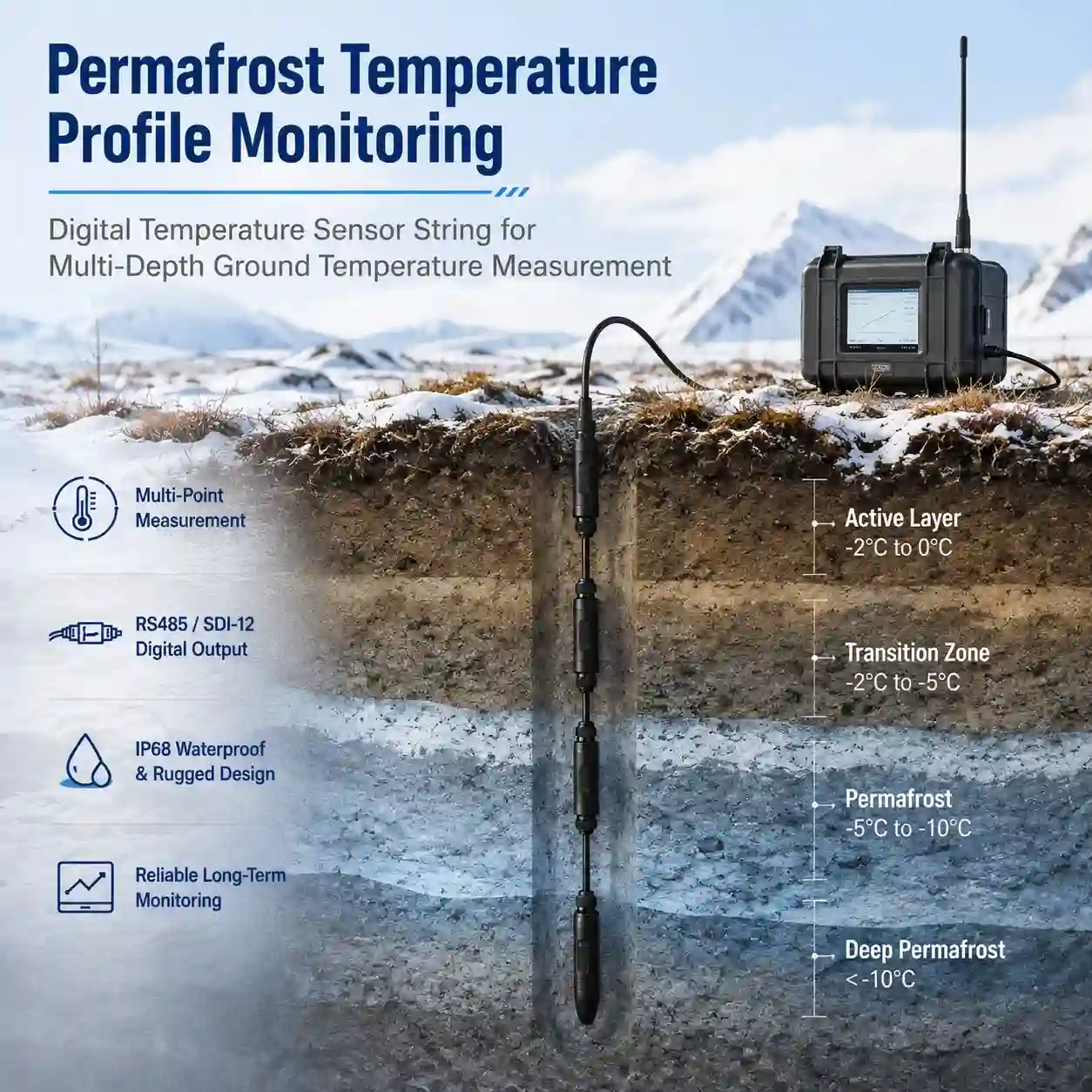
Permafrost Temperature Profile Monitoring
Permafrost temperature is strongly related to ground thermal conditions and freeze-thaw processes.
A multi-point temperature sensor string can be installed vertically in frozen ground or a borehole to record temperature at different depths.
Typical monitoring objectives include:
Active-layer depth observation
Frozen ground temperature changes
Freeze-thaw cycle analysis
Seasonal thermal variation
Long-term permafrost degradation monitoring
Cold-region infrastructure research
Typical Configuration
A permafrost monitoring profile may contain nodes at different depths such as:
0.5 m → 1 m → 2 m → 3 m → 5 m → 10 m → deeper layers
The actual node spacing should be determined according to expected thermal gradients and project objectives.
Typical projects include:
Permafrost observation stations
Polar research
Alpine research
Cold-region highways
Railways
Pipelines
Foundations
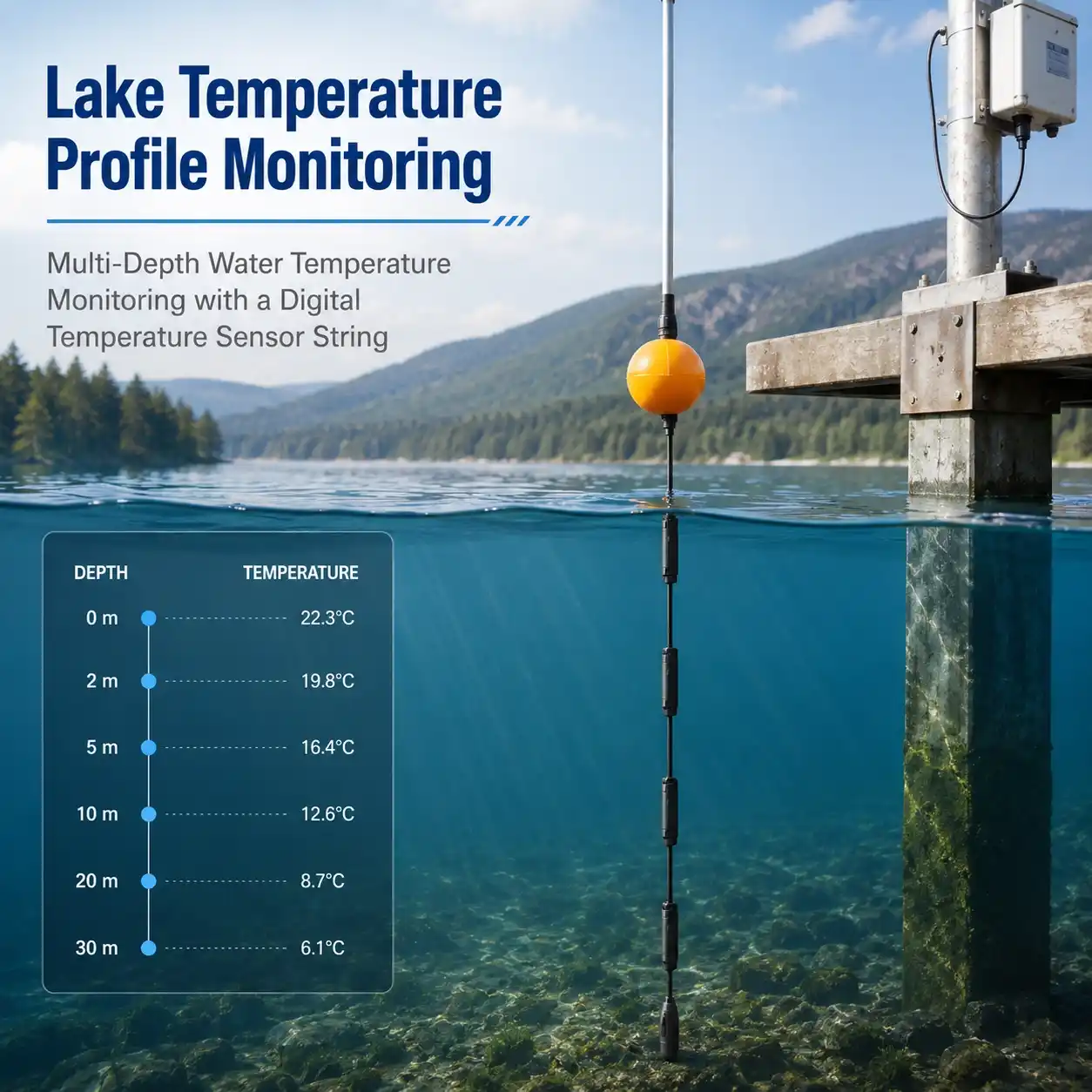
Lake and Reservoir Temperature Profile Monitoring
Water temperature can vary significantly with depth.
A single surface temperature measurement cannot show the thermal structure of the entire water column.
A vertically deployed temperature sensor string can provide continuous measurements at multiple depths.
This is useful for studying:
Thermal stratification
Thermocline development
Seasonal turnover
Reservoir temperature gradients
Aquatic habitat conditions
Hydrological processes
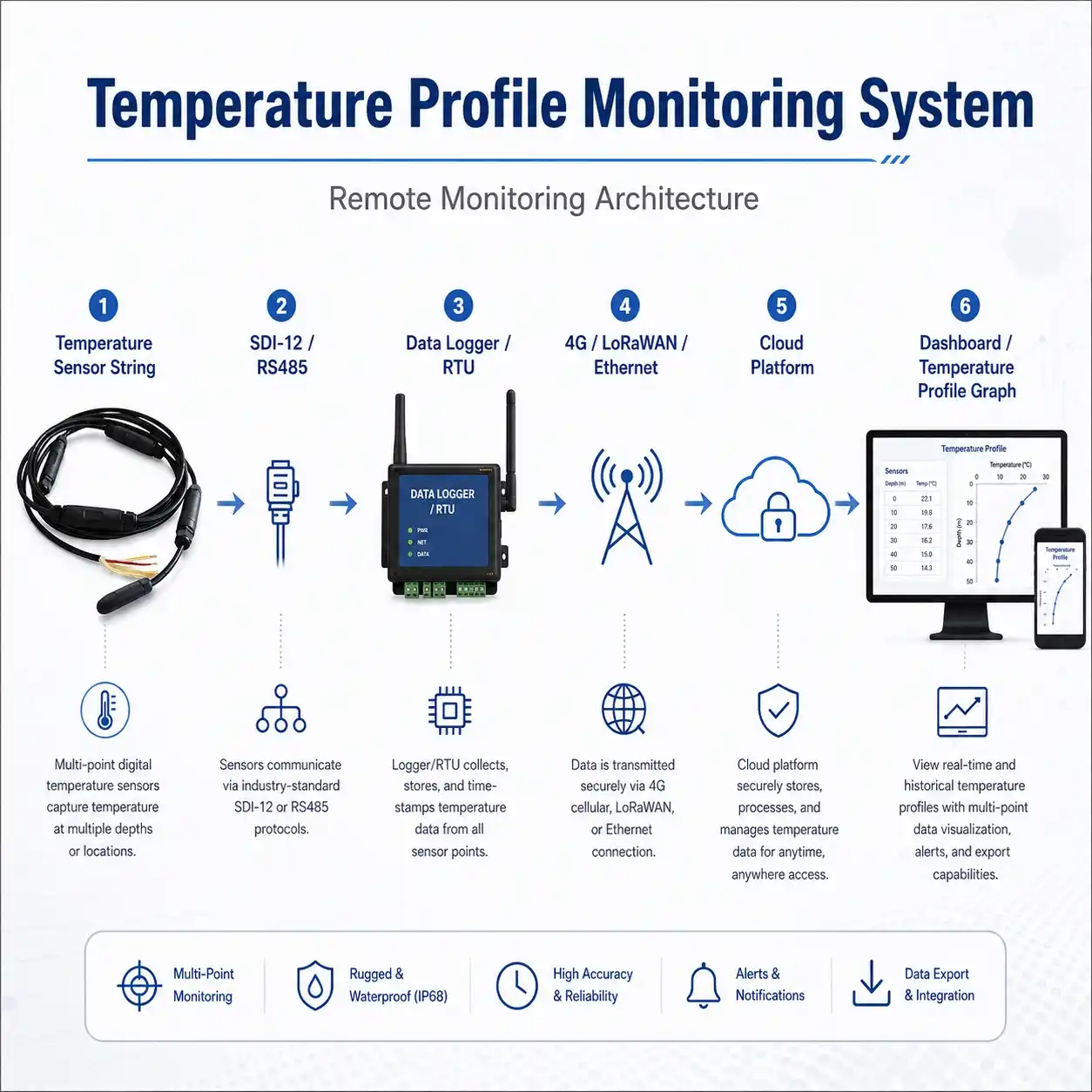
Typical Monitoring Architecture
Temperature Sensor String → SDI-12 / RS485 → Data Logger → 4G / LoRaWAN / Ethernet → Cloud Platform
For buoy-based installations, the temperature sensor string can be suspended vertically below the buoy.
For fixed monitoring stations, it can be installed near:
Reservoir intakes
Dams
Observation towers
Lake research stations
Coastal platforms
Ocean and Coastal Water Temperature Monitoring
The IP68 waterproof temperature string can also be used for water-column temperature observation in coastal and marine environments where multiple depth measurements are required.
Typical applications include:
Coastal research
Marine ecological monitoring
Aquaculture
Port environmental monitoring
Water-column studies
Oceanographic research
For marine deployment, installation hardware, cable protection, biofouling conditions, and corrosion exposure should be considered during system design.
Soil Temperature Profile Monitoring
Soil temperature affects many physical and biological processes.
A multi-depth temperature string can monitor temperature changes throughout the soil profile rather than only at the surface.
Typical applications include:
Agricultural research
Crop root-zone monitoring
Smart farming
Ecological research
Soil science
Greenhouse experiments
Soil heat transfer studies
Common monitoring depths may include:
5 cm
10 cm
20 cm
40 cm
60 cm
100 cm
Actual depth selection depends on crop root depth, soil type, experimental objectives, and local environmental conditions.
For projects requiring simultaneous soil moisture and temperature profiling, JW-IoT also provides multi-layer soil monitoring sensors.
Roadbed and Railway Temperature Monitoring
Temperature strongly influences freeze-thaw behavior in roadbeds, railway embankments, and other cold-region infrastructure.
The sensor string can be embedded vertically or horizontally to monitor internal temperature distribution.
Typical applications include:
Highway roadbeds
Railway embankments
Airport foundations
Slopes
Tunnel structures
Frozen soil foundations
Temperature profile data can support evaluation of:
Frost penetration depth
Freeze-thaw boundaries
Frost heave risk
Thermal deformation
Seasonal structural changes
Borehole and Geotechnical Temperature Monitoring
Temperature sensor strings can also be deployed inside boreholes or embedded in geotechnical structures.
Typical applications include:
Borehole temperature profiles
Foundation monitoring
Embankments
Dams
Slopes
Underground structures
Geothermal research
Custom node spacing allows higher measurement density in locations where greater temperature gradients are expected.
Scientific Research and Long-Term Environmental Monitoring
With high measurement resolution, configurable sampling intervals, individually identifiable nodes, and SDI-12 or RS485 communication, the JW-S1S(Z4) is suitable for unattended environmental research.
Potential users include:
Universities
Research institutes
Hydrological agencies
Meteorological organizations
Environmental monitoring agencies
Geotechnical laboratories
Climate observation networks
The sensor can support long-term datasets for:
Climate research
Soil thermal studies
Hydrology
Permafrost science
Limnology
Geotechnical research
Ecosystem monitoring
How to Determine Temperature Node Spacing
Node spacing is one of the most important configuration decisions for a temperature sensor string.
There is no universal spacing that fits every project.
The correct design depends on where temperature changes are expected.
Use Closer Spacing Where Temperature Changes Rapidly
Examples include:
Near the ground surface
Around the freeze-thaw boundary
Near a thermocline
Root zones
Structural interfaces
Use Wider Spacing Where Temperature Is More Stable
Deeper soil or water layers may require fewer measurement points if temperature changes slowly.
Example: Permafrost
A project may use closer spacing near the active layer and wider spacing at greater depth.
Example: Lake
More nodes may be placed around the expected thermocline depth.
Example: Agriculture
Measurement depths may correspond to crop root zones.
JW-IoT can customize node quantity, depth interval, and cable length according to project requirements.
Temperature Sensor String vs Single-Point Temperature Sensor
Feature
Temperature Sensor String
Single-Point Sensor
Measurement Positions
Multiple
One
Temperature Profile
Yes
No
Wiring for Multiple Points
Simplified
Separate sensors required
Borehole Deployment
Well suited
More complex
Water Column Profiling
Well suited
Multiple devices required
Custom Depth Layout
Yes
Limited
Best Application
Profile monitoring
Local temperature monitoring
If only one measurement location is required, a conventional temperature probe may be more economical.
For projects requiring multiple depths, a digital temperature sensor string usually provides a cleaner monitoring architecture.
Correct installation is essential for obtaining representative temperature data.
Maintain Good Thermal Contact
Each node should be in close contact with the surrounding soil, water, sediment, or structural material.
Air gaps can delay temperature response and produce unrepresentative readings.
Record Node Depths
Document the exact depth or position of every node after deployment.
Avoid Sharp Cable Bends
Do not sharply bend, twist, or excessively tension the reinforced cable.
Protect Against Mechanical Damage
Use protective conduits or installation structures where the cable may be exposed to:
Vehicles
Machinery
Rocks
Ice movement
Animals
Construction activity
Test Communication Before Final Installation
Verify:
Power
Communication
Node addressing
Temperature readings
before backfilling a borehole, closing a structure, or completing permanent deployment.
Consider Surge Protection
Outdoor installations in lightning-prone regions should use appropriate grounding and surge protection.
How to Specify a Temperature Sensor String for Your Project
To receive an appropriate configuration, provide the following information:
Application
Total monitoring depth or length
Number of temperature nodes
Required node spacing
Temperature range
SDI-12 or RS485 output
Cable length
Installation medium
Data logger or RTU model
Power supply
Communication method
Platform or API requirements
For example:
Application: Permafrost monitoring Total depth: 20 m Nodes: 15 Spacing: 0.5–2 m customized Output: SDI-12 Power: Solar station Communication: 4G Data: Cloud monitoring platform
Providing this information helps reduce configuration errors before ordering.
Configure Your Temperature Profile Monitoring System
Planning a permafrost, soil, lake, reservoir, roadbed, borehole, or environmental temperature monitoring project?
Send us:
Application
Monitoring depth
Number of nodes
Node spacing
Communication output
Cable length
Installation environment
Data logger requirements
Platform requirements
JW-IoT can recommend a suitable digital temperature sensor string configuration and monitoring architecture.
1. What is a digital temperature sensor string used for?
A
A digital temperature sensor string is used to measure temperature at multiple points along a cable. It is commonly applied in permafrost monitoring, lake and ocean temperature profile monitoring, soil temperature measurement, roadbed temperature monitoring, and scientific research.
Q
2. How many temperature nodes can this sensor string support?
A
This sensor string can support up to 36 temperature nodes, making it suitable for vertical profile monitoring or distributed temperature field measurement.
Q
3. Does the sensor support RS485 Modbus RTU?
A
Yes. The product is available with an RS485 interface using Modbus RTU protocol, which makes it easy to integrate with RTUs, data loggers, PLCs, and IoT gateways.
Q
4. Does the sensor support SDI-12?
A
Yes. The product also supports SDI-12 V1.3, which is widely used in environmental monitoring, hydrology, and meteorological data acquisition systems.
Q
5. Can JW-IoT provide this sensor for permafrost monitoring projects?
A
Yes. JW-IoT can provide the digital temperature sensor string for permafrost temperature profile monitoring, including customized node spacing, cable length, and communication output based on project requirements.
Q
6. Is the sensor waterproof?
A
Yes. The sensor string has an IP68 waterproof rating, making it suitable for soil, water, sediment, and harsh outdoor environments.
Q
7. What is the temperature measurement range?
A
The sensor measures from -55°C to 85°C, which allows it to be used in cold-region monitoring, frozen soil studies, and general environmental temperature monitoring.
Q
8. Can JW-IoT integrate this product with a cloud monitoring platform?
A
Yes. JW-IoT can integrate the sensor string with data loggers, gateways, and cloud-based monitoring platforms for remote data collection, visualization, and alarm management.
Q
9. What is the minimum spacing between temperature nodes?
A
The minimum spacing between temperature nodes is 15 cm or 6 inches. Custom spacing can be designed according to the monitoring depth and project requirements.
Q
10. Is this product suitable for lake or ocean temperature profile monitoring?
A
Yes. The waterproof design and multi-node temperature measurement capability make it suitable for lake, reservoir, ocean, and other water body temperature profile monitoring applications.
Q
11. Can the sampling interval be configured?
A
Yes. The sampling interval can be configured. The sensor can measure only when data is requested, or it can perform automatic periodic measurement from 1 to 43200 seconds.
Q
12. Why choose JW-IoT for temperature profile monitoring solutions?
A
JW-IoT can provide not only the sensor hardware, but also project-based configuration support, data acquisition integration, communication gateway selection, and cloud platform solutions for environmental and scientific monitoring projects.
 +86 13520127780
  info@jingelway.com