+86 13520127780
 info@jingelway.com








How Photosynthetically Active Radiation Monitoring Improves Greenhouse Plant Growth Management
Release time: 2026-09-21
What Is Photosynthetically Active Radiation?
Plants do not use all incoming solar radiation in the same way.
For plant growth monitoring, one of the most important parts of the solar spectrum is photosynthetically active radiation, commonly abbreviated as PAR.
PAR generally refers to radiation within the 400–700 nm wavelength range, which overlaps with the wavelengths commonly associated with photosynthesis.
This makes PAR different from a general solar radiation measurement.
A broadband solar radiation sensor measures a wider range of incoming energy, while a PAR sensor focuses specifically on the part of the spectrum that is most relevant to plant photosynthetic activity.
For greenhouse operators, plant factories, research facilities and smart agriculture projects, that distinction matters.
The real question is not only:
“How bright is the greenhouse?”
It is:
“How much plant-usable light is actually reaching the crop canopy?”
That is where PAR monitoring becomes useful.
Learn more about the JW-IoT Photosynthetically Active Radiation Sensor for Greenhouse Plant Growth Monitoring
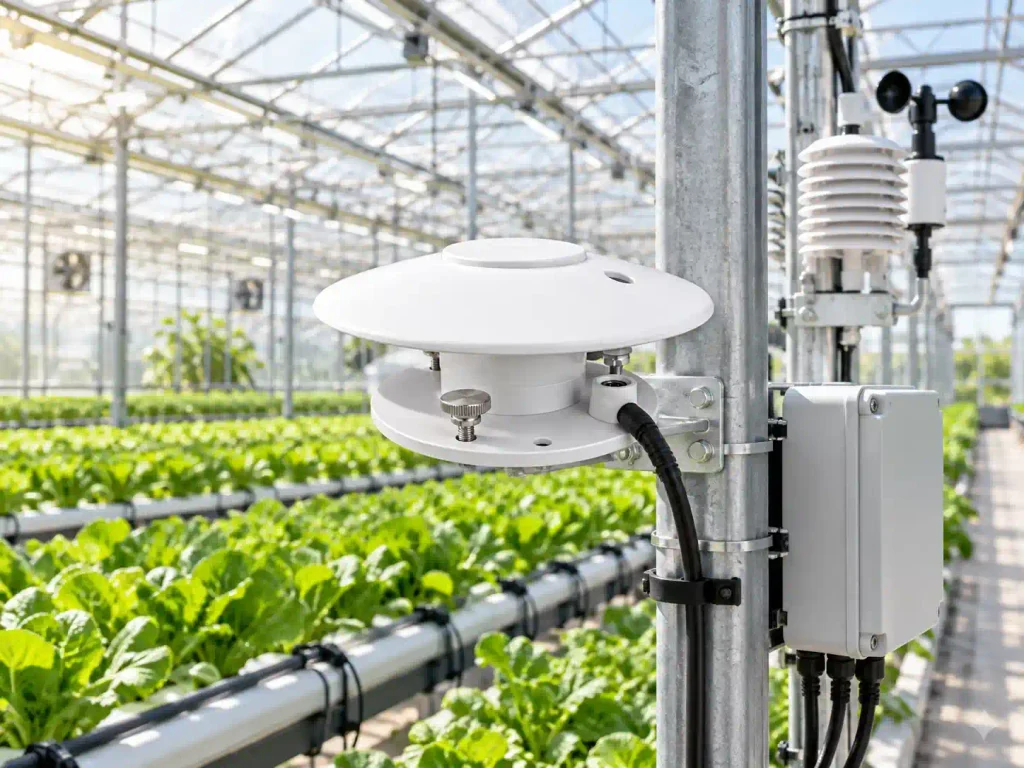
Why PAR Matters in Greenhouse Production
Light is one of the core environmental factors influencing plant growth.
Inside a greenhouse, the amount of usable light reaching plants can change throughout the day because of:
- Solar angle
- Cloud cover
- Greenhouse glazing
- Shade curtains
- Structural shadows
- Crop canopy density
- Supplemental lighting
- Seasonal variation
Two greenhouses can have similar air temperature and humidity while receiving very different light conditions.
Even within the same greenhouse, PAR may differ between:
- Upper and lower canopy levels
- Center and edge zones
- Shaded and unshaded areas
- Different growing benches
- Different times of day
This is why greenhouse light management should not rely only on visual observation.
A PAR sensor provides measurable information about the radiation conditions experienced by plants.
PAR vs Solar Radiation: What Is the Difference?
One common source of confusion is the difference between solar radiation and photosynthetically active radiation.
Solar radiation sensors are commonly used in meteorological monitoring, solar PV systems and agricultural weather stations.
PAR sensors are more specifically related to plant-light interaction.
A simple way to understand the difference is:
| Measurement | Main Purpose |
| Solar radiation | Measures broader incoming solar energy |
| PAR | Focuses on radiation relevant to photosynthesis |
| Air temperature | Describes thermal conditions around plants |
| Soil or substrate moisture | Describes root-zone water conditions |
| Humidity | Helps describe greenhouse moisture conditions |
These measurements answer different questions.
For example, a greenhouse operator may know that outdoor solar radiation is high, but that does not necessarily mean all crops inside the greenhouse are receiving the same amount of photosynthetically useful light.
Greenhouse structures, films, glass, shading systems and plant canopy can all affect the radiation reaching the crop.
What Does a PAR Sensor Measure?
A PAR sensor is used to measure light in the photosynthetically active range.
In horticultural applications, PAR is commonly related to photon-based measurements because photosynthesis responds to the number of photons within the relevant wavelength range rather than simply total radiant energy.
This is why greenhouse growers and plant researchers often use PAR measurements to evaluate plant lighting conditions more directly.
A PAR sensor can therefore be used as part of a monitoring system to observe how plant-available light changes:
- During the day
- Between seasons
- Before and after shading
- Under supplemental grow lights
- Across different greenhouse zones
- At different crop canopy heights
The purpose is not to measure plant growth directly.
Instead, the sensor provides one of the environmental variables that helps explain plant growth conditions.
PAR and PPFD: Are They the Same Thing?
PAR and PPFD are closely related terms, but they are not exactly the same concept.
PAR describes the photosynthetically active wavelength range.
PPFD, or Photosynthetic Photon Flux Density, describes the amount of photosynthetically active photons reaching a surface over time.
For growers, this distinction is useful because PPFD provides a practical way to express instantaneous plant-light intensity.
In a greenhouse monitoring system, PPFD data can be used to understand:
- Whether plants are receiving relatively high or low light
- How supplemental lighting changes the light environment
- How shading affects crop-level radiation
- Whether different greenhouse zones receive similar light conditions
However, a single instantaneous reading only represents one moment.
For long-term crop-light analysis, measurements should be recorded over time.
Why One PAR Reading Is Not Enough
A common mistake is to measure light once and assume that the result represents the whole greenhouse.
In reality, greenhouse radiation conditions are dynamic.
PAR can change significantly because of:
- Moving clouds
- Changing sun angle
- Shading systems opening or closing
- Nearby structures
- Crop growth
- Seasonal changes
For this reason, continuous monitoring provides more useful information than occasional manual readings.
A fixed PAR sensor can record changes over time and send data to a data logger, controller or IoT monitoring platform.
This makes it possible to compare light conditions with other greenhouse parameters.
Using PAR Data with Other Greenhouse Sensors
PAR becomes more valuable when it is analyzed together with other environmental measurements.
A greenhouse monitoring system may combine:
- PAR
- Air temperature
- Relative humidity
- CO₂
- Soil or substrate moisture
- Soil temperature
- EC
- Irrigation data
- Weather conditions
This creates a more complete picture of the growing environment.
For example, strong PAR combined with high temperature may create a very different crop environment from strong PAR combined with moderate temperature.
Similarly, low PAR during cloudy periods may affect irrigation demand differently from bright, dry conditions.
The role of a PAR sensor is therefore not isolated measurement.
It is part of a broader plant growth monitoring system.
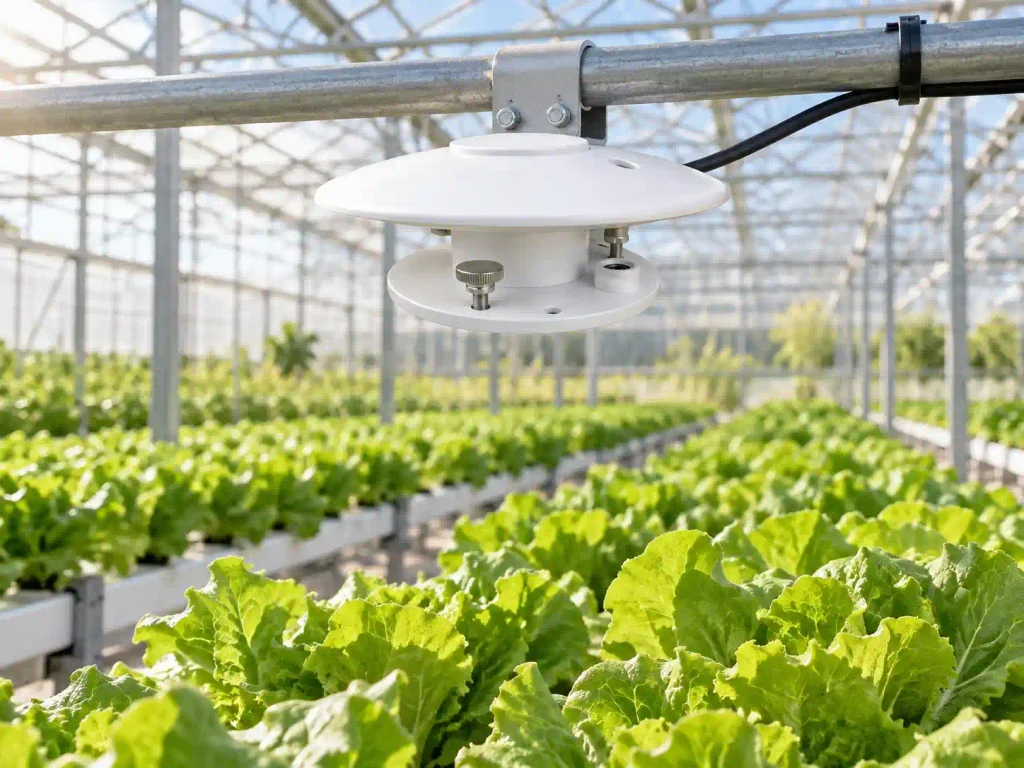
How PAR Monitoring Supports Greenhouse Lighting Decisions
Supplemental lighting is increasingly used in commercial greenhouses and controlled-environment agriculture.
However, turning lights on simply according to a fixed clock schedule may not reflect actual natural-light conditions.
PAR monitoring can provide a real-time reference for available crop light.
For example:
When natural PAR is high
Supplemental lighting may provide less additional benefit depending on the crop and production strategy.
When natural PAR falls
Supplemental lighting may be more useful if the grower is trying to maintain a defined lighting environment.
When shading is activated
PAR data can show how much the shading system actually changes crop-level light conditions.
The key advantage is that growers can evaluate lighting based on measured conditions instead of assumptions.
PAR Monitoring in Multi-Zone Greenhouses
Large greenhouses often contain multiple environmental zones.
Light distribution may vary because of:
- Building orientation
- Roof structure
- Curtain layout
- Crop height
- Equipment placement
- Nearby buildings or trees
For these projects, one PAR sensor may not fully represent the entire greenhouse.
A multi-point monitoring approach may be more appropriate.
Sensors can be installed in representative zones so operators can compare:
- North vs south sections
- Edge vs center areas
- Different crop blocks
- Different lighting zones
- Different canopy heights
This is especially useful when greenhouse management systems already divide irrigation, ventilation or lighting into separate control zones.
PAR Monitoring for Vertical Farms and Indoor Growing
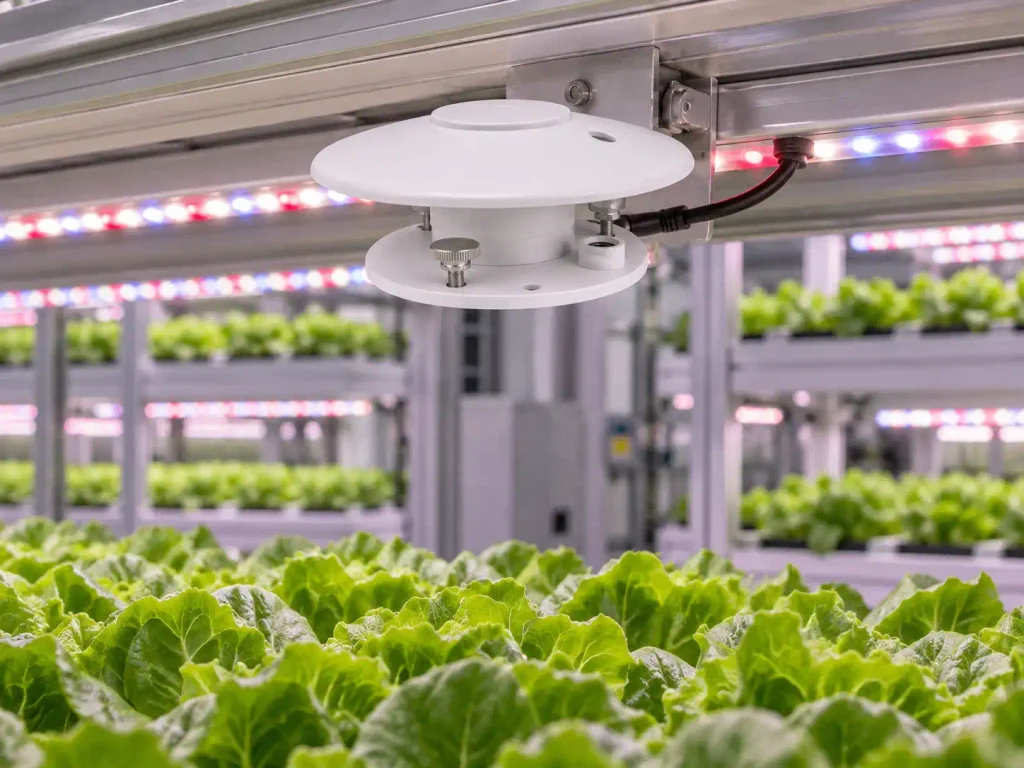
Photosynthetically active radiation monitoring is also useful in indoor agriculture.
Unlike conventional greenhouses, vertical farms rely heavily or entirely on artificial lighting.
This creates a different monitoring challenge.
Growers need to know whether the lighting system is delivering consistent crop-level light across:
- Different shelves
- Different rack heights
- Different fixture positions
- Different growth stages
PAR sensors can be used to verify lighting distribution and identify zones receiving more or less light than expected.
This is particularly valuable during commissioning, system adjustment and long-term operation.
PAR and Daily Light Integral
Instantaneous PAR measurements are useful, but plant light exposure also depends on time.
For this reason, growers may also evaluate Daily Light Integral, commonly called DLI.
DLI represents the total amount of photosynthetically active light received over a day.
This provides a different perspective from a single PPFD reading.
For example:
A crop may receive strong light for a short period but relatively little total light during the rest of the day.
Another crop may receive moderate light for many hours.
These two conditions can produce very different daily light environments.
Continuous PAR monitoring allows growers to record the information needed for longer-term light analysis rather than relying only on spot measurements.
Where Should a PAR Sensor Be Installed?
Installation position is important because the sensor should represent the light conditions that matter for the application.
Depending on the monitoring objective, a PAR sensor may be placed:
- Near crop canopy level
- Above the crop canopy
- Inside a greenhouse
- In a representative production zone
- Near a supplemental lighting area
- At multiple heights in research applications
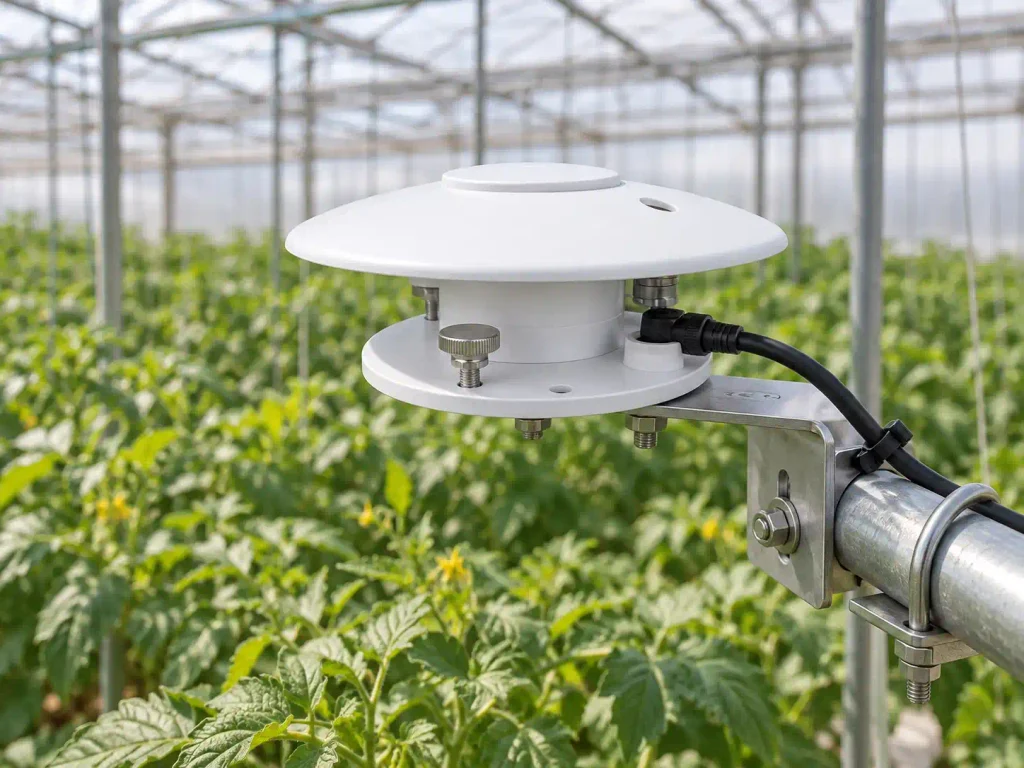
The sensor should not be unintentionally shaded by nearby structures, cables or equipment unless that shading is intentionally part of the measurement.
For greenhouse projects, installation planning should consider both current and future crop height.
A position that works when seedlings are small may not remain representative after the canopy develops.
Common Applications of Photosynthetically Active Radiation Sensors
PAR monitoring can be useful across several plant-production environments.
Commercial Greenhouses
Used to monitor crop-level lighting and compare different greenhouse zones.
Smart Agriculture
Integrated with temperature, humidity, soil and irrigation sensors to support environmental monitoring.
Plant Research
Used to document light conditions during crop, physiology or environmental studies.
Vertical Farming
Used to evaluate artificial-light distribution between racks and cultivation levels.
Nurseries
Used to compare light exposure between propagation and production areas.
Agricultural Weather Monitoring
Can complement broader meteorological measurements when plant-usable radiation data is required.
How a PAR Sensor Fits into a Smart Greenhouse System
A typical greenhouse monitoring architecture may look like:
PAR Sensor + Temperature/Humidity Sensor + Soil Sensor + CO₂ Sensor
↓
Data Logger / IoT Gateway
↓
RS485 / LoRaWAN / 4G / Ethernet
↓
Cloud Platform or Greenhouse Control System
↓
Historical Data + Alerts + Environmental Analysis
The exact system architecture should depend on the project requirements.
In some applications, PAR data is used mainly for monitoring and analysis.
In others, it may become one of several inputs used by a greenhouse automation system.
The important point is that light data becomes part of the same environmental dataset as temperature, humidity, irrigation and other crop conditions.
Frequently Asked Questions About PAR
1. What does PAR mean in plant growth?
PAR stands for Photosynthetically Active Radiation.
It generally refers to the 400–700 nm wavelength range associated with plant photosynthesis.
2. Is PAR the same as sunlight?
No.
Sunlight contains a much broader range of wavelengths.
PAR refers only to the part of the light spectrum commonly used to characterize photosynthetically active radiation.
3. Is PAR the same as PPFD?
Not exactly.
PAR describes the relevant wavelength range, while PPFD expresses the photon flux reaching a surface within that range.
4. Why measure PAR in a greenhouse?
Because the amount of plant-usable light inside a greenhouse can vary with solar conditions, shading, greenhouse structures, crop canopy and artificial lighting.
5. Can one PAR sensor monitor an entire greenhouse?
For a small and relatively uniform greenhouse, one representative location may be sufficient for basic monitoring.
For larger or more complex greenhouses, multiple monitoring points may provide more useful information.
6. Can PAR sensors be used under LED grow lights?
Yes, PAR monitoring is commonly relevant to controlled-environment agriculture where artificial lighting is used.
The sensor should be selected and installed according to the specific project and lighting environment.
Conclusion
Photosynthetically active radiation is one of the most useful light-related measurements for modern greenhouse and controlled-environment agriculture.
Rather than simply asking whether a greenhouse is “bright enough,” growers can measure how plant-relevant light changes over time and across different production zones.
When PAR data is combined with:
- Temperature
- Humidity
- Soil or substrate conditions
- CO₂
- Irrigation
- Other environmental measurements
it becomes part of a more complete plant-growth monitoring strategy.
For smart greenhouse projects, the value of PAR monitoring is not only the sensor itself.
The real value comes from connecting light data with the rest of the greenhouse environment so operators can make more informed lighting, shading and crop-management decisions.
Explore the JW-IoT Photosynthetically Active Radiation Sensor for Greenhouse Plant Growth Monitoring for greenhouse, plant research and smart agriculture applications.