+86 13520127780
 info@jingelway.com









3D Ultrasonic Wind Sensor for UAV: Why Lightweight Design Matters
Release time: 2026-09-13
Three-dimensional ultrasonic wind measurement has traditionally focused on parameters such as accuracy, measurement range, output frequency and environmental durability.
However, when a 3D ultrasonic wind sensor is installed on a UAV, portable system or lightweight observation platform, another parameter becomes equally important:
weight.
A compact resin version described in the supplied technical material weighs approximately 110 g, with dimensions of approximately Φ108 × 269 mm and an acoustic measurement path of approximately 35 mm. Its intended application direction includes UAVs, portable systems and mobile platforms.
Reducing a three-dimensional sonic anemometer to this size is not simply a matter of making the housing smaller.
It requires changes in acoustic-path design, electronic timing, structural design, material selection and calibration.
This article explains why lightweight design matters for UAV airflow measurement, how compact three-dimensional ultrasonic measurement works, and what engineering trade-offs need to be considered.
1. Why Weight Becomes Critical for UAV Wind Measurement
Large three-dimensional ultrasonic anemometers are commonly designed for fixed monitoring installations.
Their larger structures can accommodate longer acoustic paths, heavier mechanical structures and stronger environmental protection.
UAV applications create a different engineering requirement.
A small multirotor UAV may have an effective payload of approximately 1–2 kg. If a wind-measurement instrument occupies most of that payload capacity, the remaining capacity available for other equipment or batteries is greatly reduced.
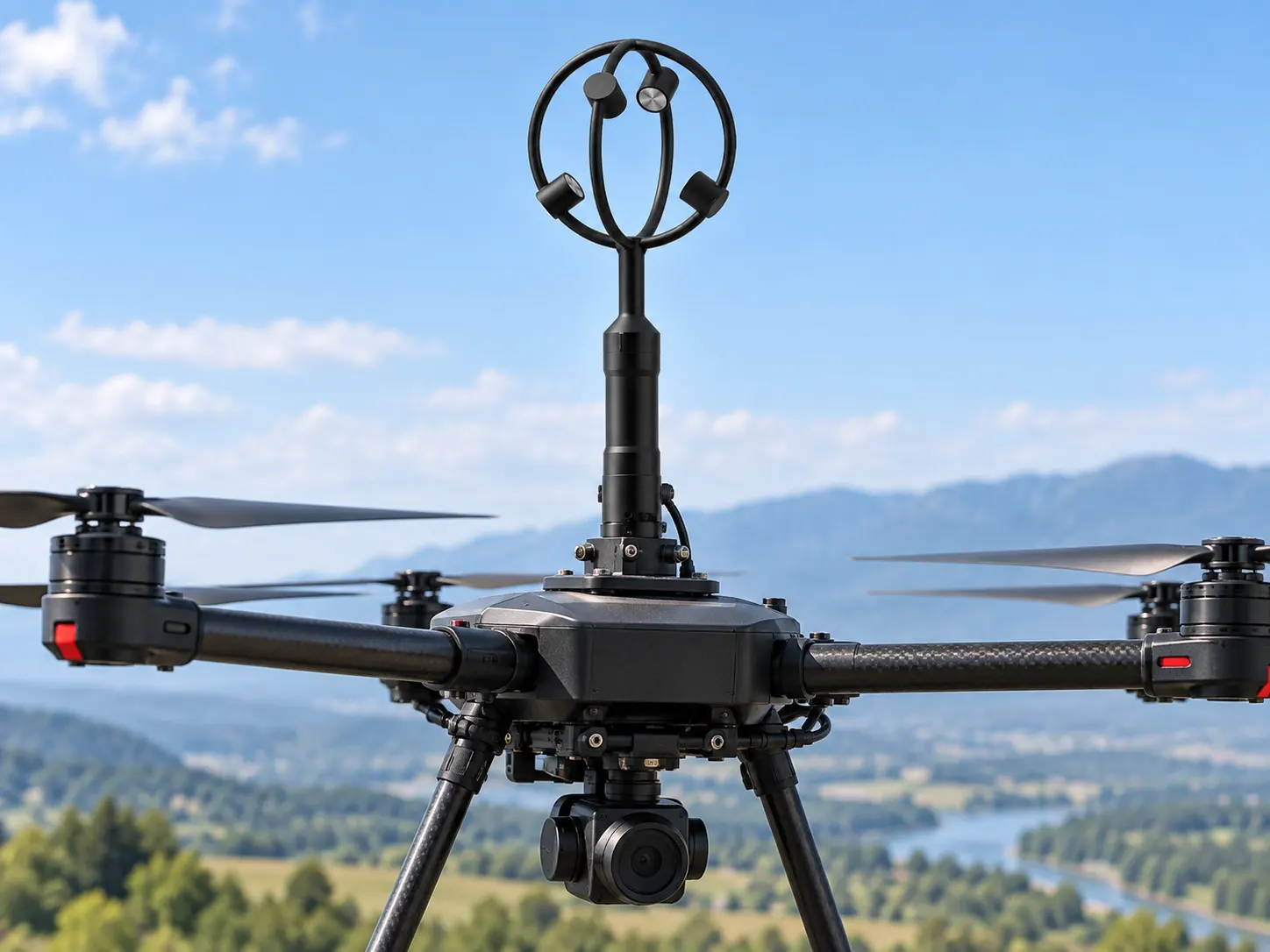
By comparison, a sensor weighing approximately 110 g occupies only a small part of the available payload, leaving more capacity for a camera, gas sensor or battery.
For UAV airflow measurement, therefore, sensor weight affects more than installation convenience.
It affects the overall payload allocation of the aircraft.
2. How Does a 3D Ultrasonic Wind Sensor Measure Wind?
A three-dimensional ultrasonic wind sensor uses the time-of-flight difference of ultrasonic waves.
Ultrasound travels faster when moving with the wind and slower when moving against it.
By accurately measuring the difference between the two propagation times, wind velocity can be calculated.
The relationship can be approximately expressed as:
v ≈ (c² / 2L) × Δt
where:
- v is wind velocity,
- c is the local speed of sound,
- L is the acoustic-path length,
- Δt is the measured propagation-time difference.
The technical material explains that, for the same wind velocity, a longer acoustic path produces a larger time difference. This reduces the timing-resolution requirement placed on the electronics.
This is one reason traditional three-dimensional sonic anemometers often use relatively long acoustic paths.
Compact UAV sensors, however, need a much smaller structure.
That creates a different engineering challenge.
3. Why a Short Acoustic Path Is More Difficult to Measure
The compact three-dimensional sensor described in the source material uses an acoustic path of approximately 35 mm.
This is much shorter than the 10–20 cm acoustic paths historically associated with larger three-dimensional ultrasonic wind instruments.
When the acoustic path becomes shorter, the propagation-time difference caused by the same wind velocity also becomes smaller.
As a result, the electronic measurement system needs much higher timing resolution.
According to the technical material, maintaining wind-speed resolution with a short acoustic path requires electronic timing at the sub-nanosecond or even picosecond level. Digital signal processing is also used to address noise, temperature variation and multipath interference.
In simple terms, miniaturization replaces part of the physical measurement distance with greater electronic measurement capability.
4. How Can a 35 mm Acoustic Path Fit Into a Compact 3D Wind Sensor?
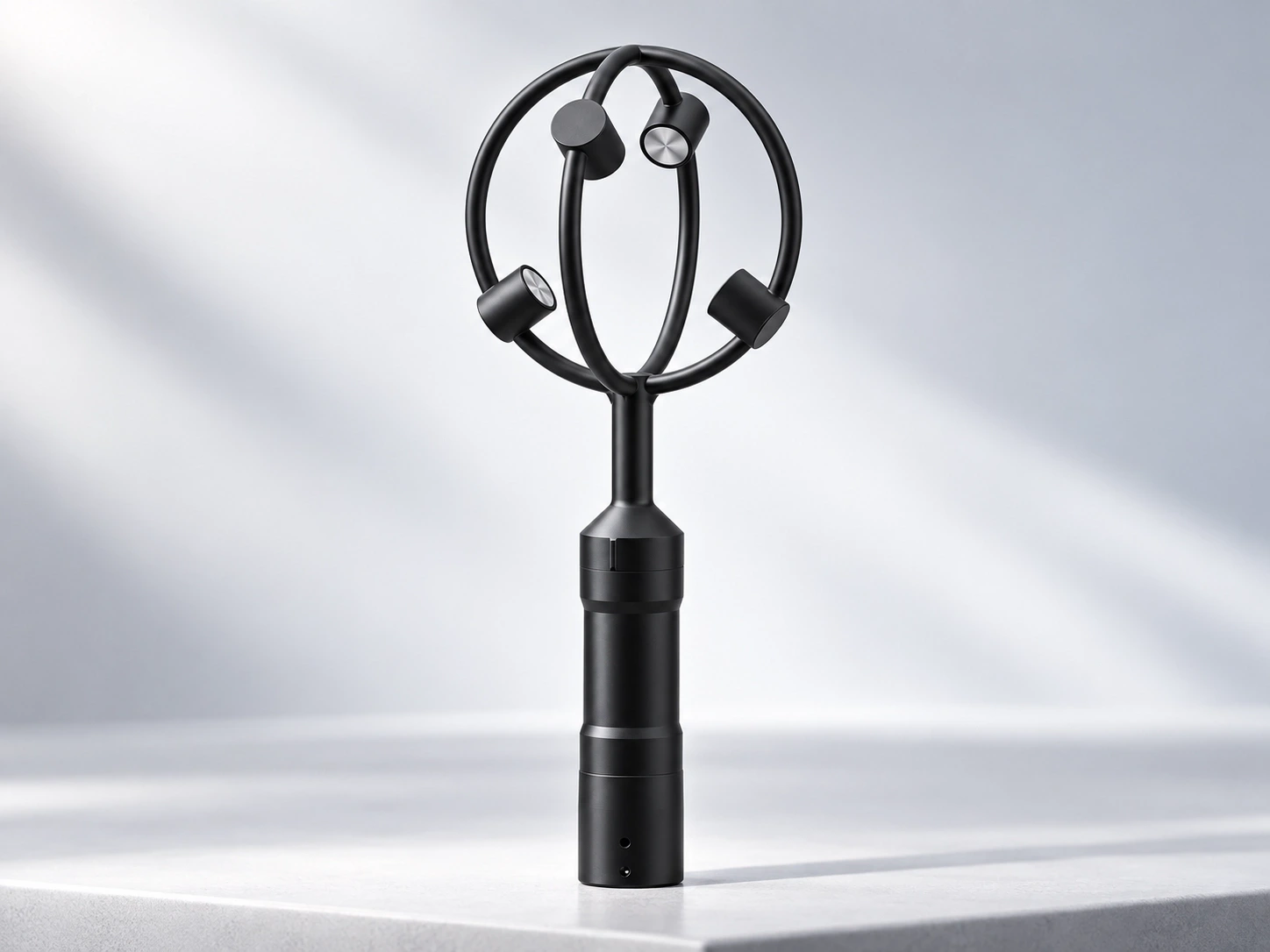
One of the key structural approaches described in the technical material is a reflective acoustic-path design.
Instead of allowing the ultrasonic wave to travel only along a direct straight line between transmitter and receiver, a reflective structure folds the acoustic path inside a compact space.
This enables an effective measurement baseline to be achieved within a much smaller physical structure.
However, the reflective approach introduces additional engineering requirements.
The source material specifically identifies:
- additional acoustic-energy loss,
- phase changes caused by reflection,
- temperature sensitivity of the reflecting surface,
- reflection-loss compensation,
- temperature-drift compensation,
- acoustic-path calibration.
For this reason, making a 3D ultrasonic wind sensor smaller is not simply a mechanical-design exercise. It also depends on electronic measurement accuracy and calibration algorithms.
5. Why 3D Wind Measurement Is Harder to Miniaturize Than 2D Measurement
A two-dimensional ultrasonic wind sensor mainly measures two wind components in the horizontal plane.
A three-dimensional wind sensor requires an additional measurement axis for the vertical wind component.
The source material explains that adding the third dimension means adding another transducer measurement path while maintaining the geometric relationship among all three axes.
The three acoustic paths must remain correctly positioned even when the sensor is affected by:
- temperature changes,
- mechanical vibration,
- manufacturing tolerances,
- assembly tolerances.
The technical challenge therefore goes beyond fitting more transducers into a small housing.
The three-dimensional measurement geometry itself must remain stable.
6. Lightweight Design Requires Engineering Trade-Offs
Reducing the weight of a 3D ultrasonic wind sensor to approximately 110 g brings clear advantages for UAV and portable applications.
But lightweight design also involves trade-offs.
The supplied technical material explicitly notes that some performance dimensions must be balanced when the sensor is reduced to this size.
Short Acoustic Path and Signal-to-Noise Ratio
At low wind speeds, a shorter acoustic path produces a very small difference between the upstream and downstream propagation times.
This makes the measurement more sensitive to factors such as:
- environmental noise,
- turbulent fluctuations,
- electronic timing jitter.
The compact sensor configuration described in the material has a stated wind-speed accuracy of approximately ±2%.
The source therefore positions this lightweight architecture toward applications such as UAV monitoring, emergency response and urban microclimate measurement rather than treating it as a universal replacement for every research-grade instrument.
7. Resin or 316 Stainless Steel: Weight vs. Durability
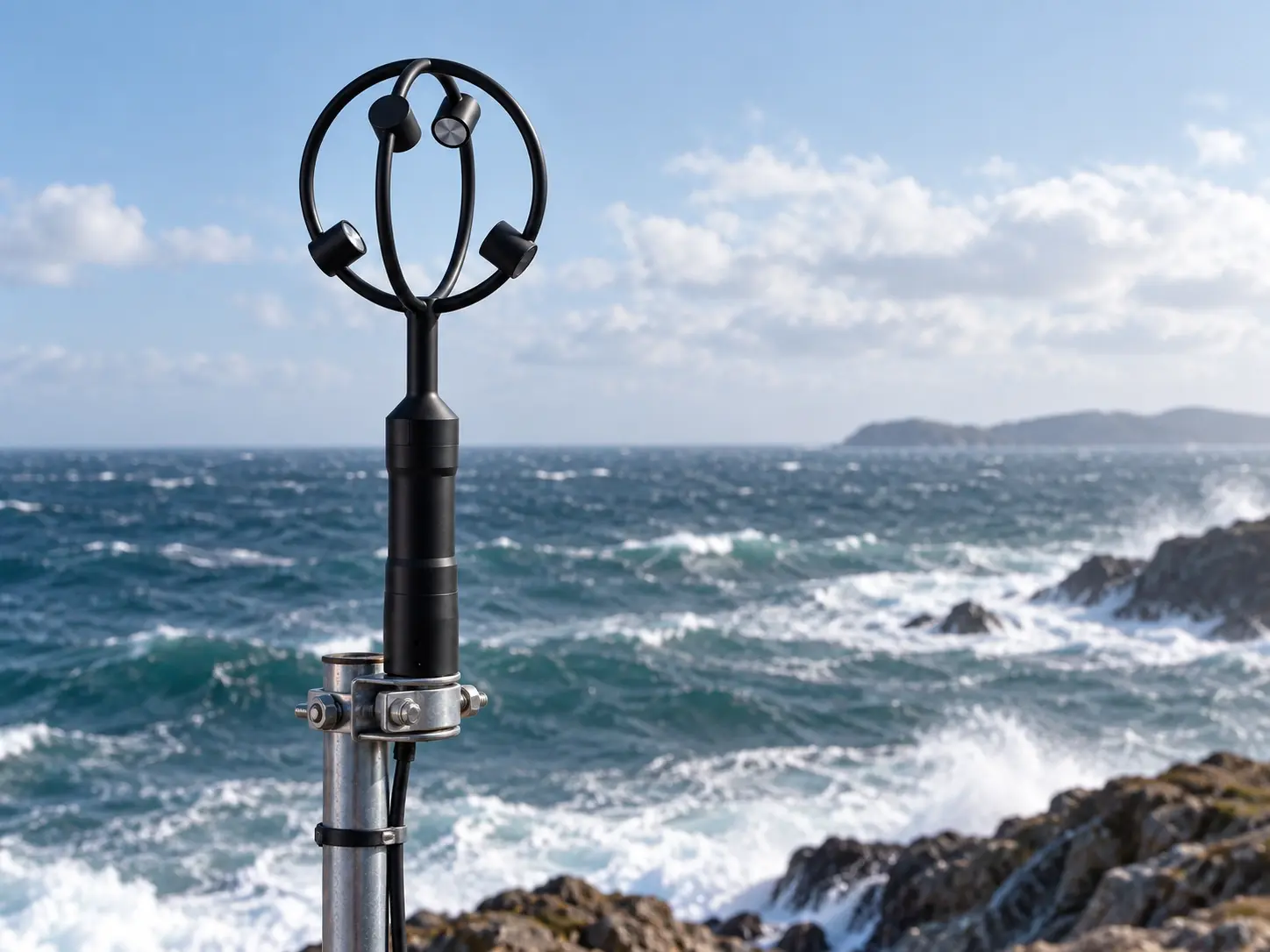
Material selection is another important part of lightweight sensor design.
The technical material describes two structural configurations:
Resin version: approximately 110 g
This lightweight option is intended for applications such as:
- UAV platforms,
- portable measurement systems.
316 stainless-steel version: approximately 480 g
The stainless-steel version provides stronger resistance to:
- UV exposure,
- mechanical impact,
- salt spray.
It is therefore more suitable for long-term outdoor or marine environments.
The choice between the two materials is therefore not simply a question of which version is lighter.
It is a balance among:
weight, durability and thermal expansion characteristics.
8. Why Lightweight Sensors Have Limitations in Icing Conditions
Heating and anti-icing systems require additional power, thermal mass and structural space.
An ultra-light resin housing cannot accommodate the same large heating modules and heat sinks as a heavier industrial sensor.
According to the supplied material, the approximately 110 g resin version is therefore more suitable for above-freezing or non-icing environments.
For long-term operation in very cold environments, a stainless-steel or industrial heated configuration is more appropriate.
This is an important consideration when selecting a 3D ultrasonic wind sensor.
The lowest possible sensor weight is not necessarily the correct priority for every environmental condition.
9. Structural Rigidity Matters on UAV Platforms
Reducing sensor weight and size also affects structural behavior.
The technical material explains that a lightweight structure may have a lower natural frequency and can therefore be more easily excited by strong gusts or aircraft vibration.
For UAV or vehicle-mounted measurement, the source recommends considering:
- IMU-based motion compensation,
- mechanical installation that isolates the sensor from platform vibration.
These factors are important because a mobile measurement platform is fundamentally different from a fixed meteorological station.
The wind sensor and the aircraft must therefore be considered together as part of the measurement system.
10. Smaller Sensor Structures Can Reduce Flow Disturbance
Large supporting structures around an ultrasonic wind sensor can interfere with the airflow being measured.
The source material explains that larger support arms may create wake and blockage around the measurement head, changing the local flow field.
Wind-tunnel calibration and software correction are often used to compensate for this effect.
A smaller structure can reduce the physical disturbance introduced by the instrument itself.
This means sensor miniaturization is not only valuable because it reduces UAV payload.
It can also reduce the physical footprint of the instrument in the measured airflow.
11. Why Lightweight 3D Wind Sensors Expand Mobile Measurement
The benefits of a compact sensor become especially clear when the instrument is moved away from a permanent tower.
A lightweight 3D ultrasonic sensor can be used in applications such as:
UAV Wind Measurement
Low sensor mass reduces the amount of aircraft payload dedicated to wind measurement.
Portable Measurement
A compact instrument is easier to carry and deploy for temporary field monitoring.
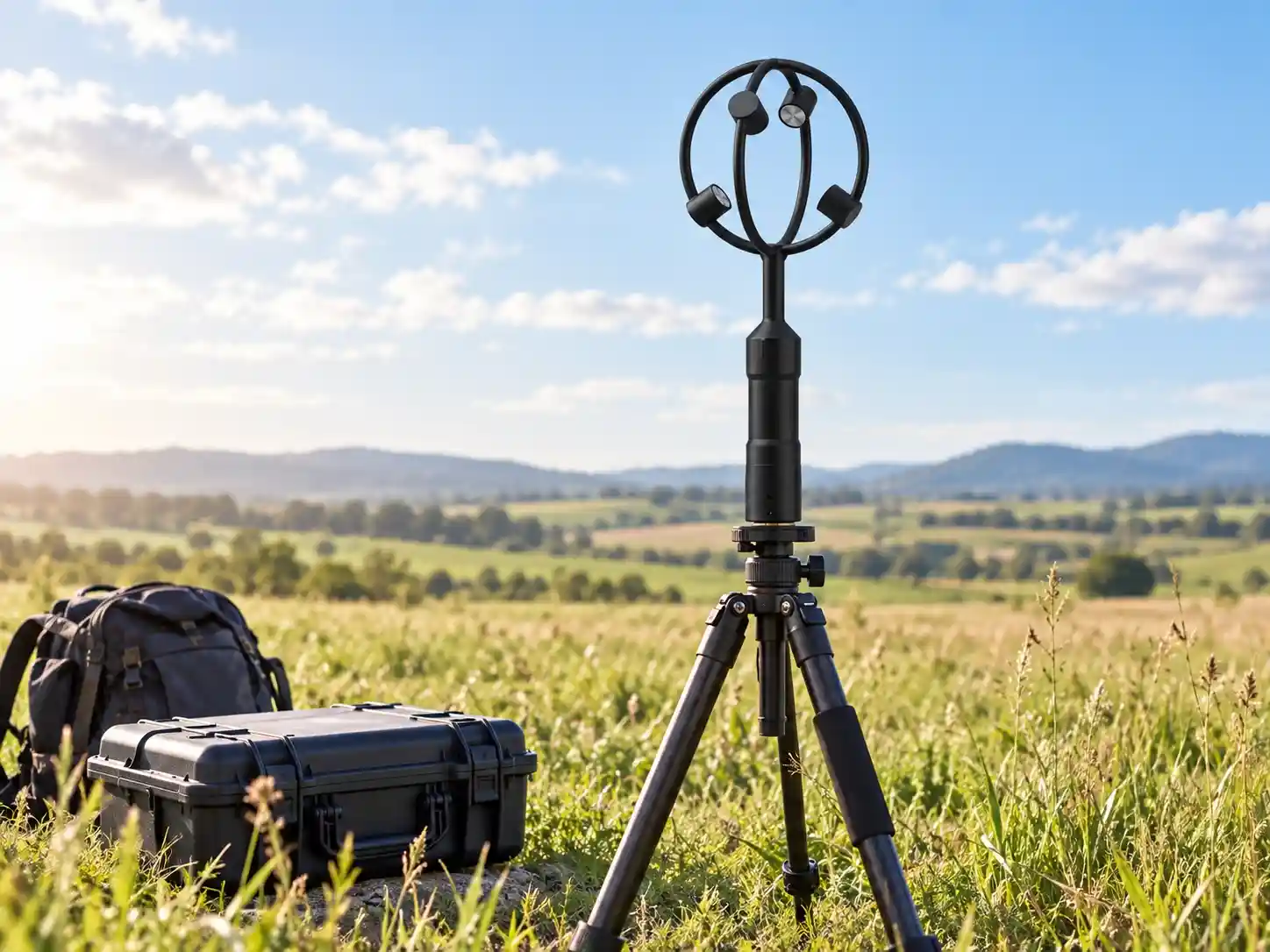
Emergency Response
The supplied material identifies emergency-response scenarios as one application where rapidly deployable wind measurement can be useful.
Urban Microclimate Monitoring
Compact three-dimensional wind measurement can also support temporary observation in urban environments.
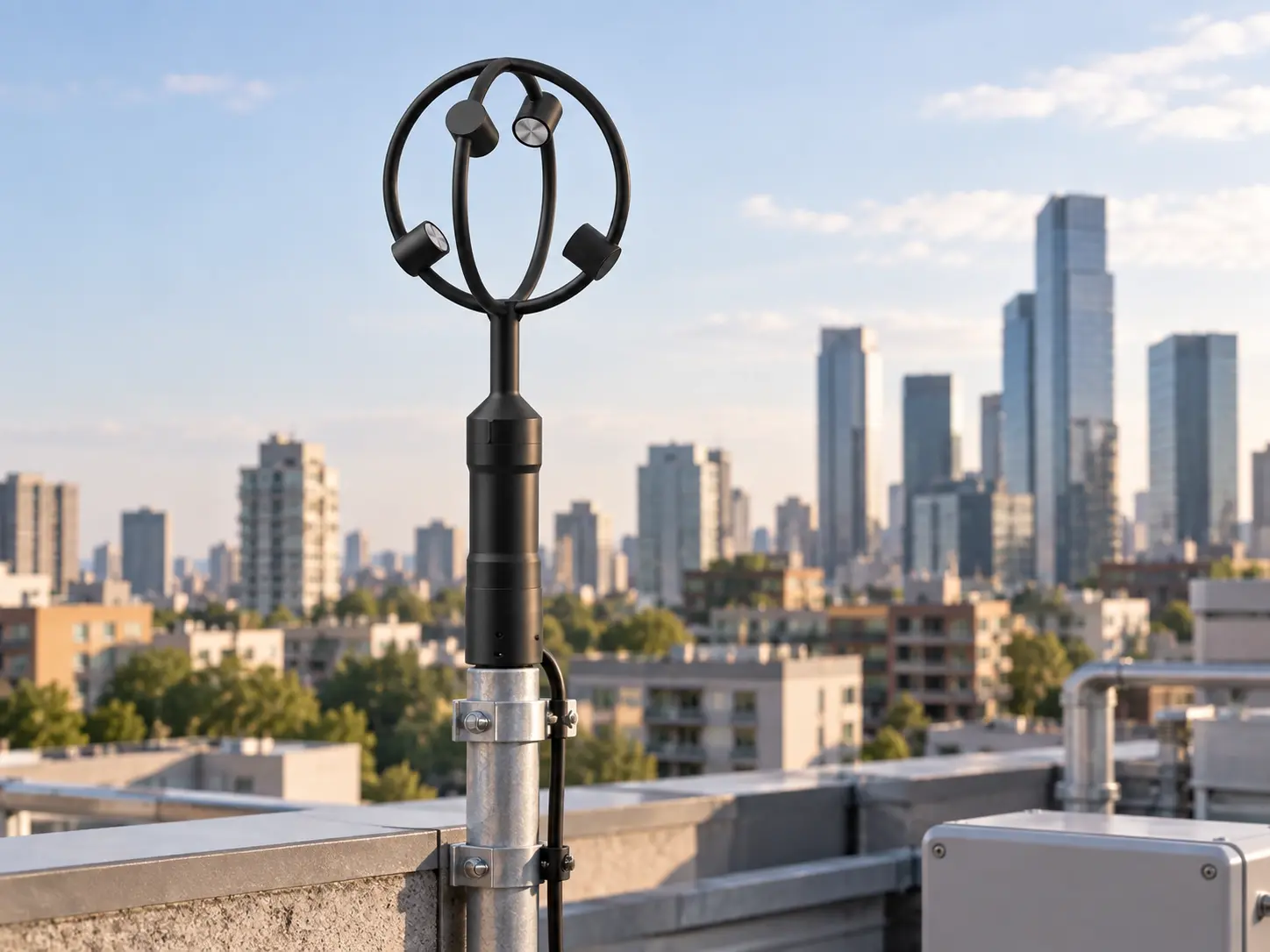
Temporary Observation
Where permanent observation infrastructure is not required, a lightweight sensor can support short-term measurement activities.
The source material emphasizes that miniaturized ultrasonic wind sensors are primarily intended for UAV, handheld and mobile platforms rather than acting as a universal replacement for large fixed observation instruments.
12. Output Frequency: Match the Sensor to the Measurement Task
Sampling frequency should also be considered during sensor selection.
The compact three-dimensional configuration described in the technical material provides approximately 1–10 Hz output.
According to the source, this is suitable for applications such as:
- real-time wind-speed and wind-direction monitoring,
- low-altitude wind-profile observation,
- emergency-response monitoring.
By contrast, applications requiring approximately 50–100 Hz sampling for eddy-covariance flux calculations are better matched to larger research-grade instruments.
This distinction is important.
A sensor should not be selected only according to weight or size.
The required measurement task must also be considered.
13. How to Select a 3D Ultrasonic Wind Sensor
Before selecting a three-dimensional ultrasonic wind sensor, the supplied technical material recommends first considering three questions.
1. Is the platform fixed or mobile?
For long-term fixed stations and severe-environment monitoring, larger and heavier industrial or research instruments may be more suitable.
For:
- UAVs,
- handheld systems,
- temporary observation,
- mobile platforms,
- distributed low-cost measurement,
a compact sensor can provide clear advantages.
2. What accuracy and sampling rate are required?
If the application requires 50–100 Hz sampling for specialized atmospheric-flux measurements, a research-grade instrument is more appropriate.
For real-time wind monitoring, low-altitude profiling and emergency-response applications, an output rate of approximately 1–10 Hz can meet the requirements described in the source material.
3. How severe is the operating environment?
For:
- low-temperature environments,
- high salt-spray exposure,
- strong UV exposure,
- long-term icing conditions,
stainless-steel or heated industrial configurations should be considered.
For moderate environments, temporary missions and rapid deployment, the lightweight resin configuration may be more suitable.
14. Lightweight Does Not Mean Universally Better
There is no single “best” three-dimensional ultrasonic wind sensor for every application.
Large instruments offer advantages when the priority is:
- permanent installation,
- severe environmental exposure,
- high mechanical stability,
- specialized high-frequency research.
Lightweight instruments serve a different purpose.
Their advantages appear when the measurement system must be:
- carried by a UAV,
- moved between locations,
- installed temporarily,
- deployed quickly,
- mounted on a lightweight platform.
The correct question is therefore not:
“Which 3D wind sensor is the lightest?”
The more useful question is:
“Which sensor architecture best matches the measurement platform and operating environment?”
15. From Fixed Observation Towers to UAV Wind Measurement
The miniaturization of three-dimensional ultrasonic wind sensors represents a change in how wind measurements can be deployed.
When the sensor becomes sufficiently light and compact, three-dimensional wind measurement no longer has to remain limited to large fixed observation systems.
It can move into:
- UAV platforms,
- portable equipment,
- temporary monitoring sites,
- urban measurement locations,
- emergency-response environments.
The supplied technical material describes this development as a transition that allows three-dimensional wind data, previously associated mainly with large observation stations, to become available to more mobile measurement scenarios.
For UAV airflow measurement, this is the real value of lightweight sensor design.
It is not simply about reducing a few hundred grams.
It is about making three-dimensional wind measurement practical on a different type of platform.
Explore the JW-IoT 3D Ultrasonic Wind Sensor
For UAV and mobile three-dimensional wind measurement applications, explore:
3D Ultrasonic Wind Sensor for UAV Airflow Measurement
For broader compact meteorological monitoring applications, you can also explore the JW-IoT:
Integrated Weather Station Series
FAQ
1. What is a 3D ultrasonic wind sensor?
A 3D ultrasonic wind sensor determines wind velocity by measuring the propagation-time difference of ultrasonic waves along multiple measurement axes.
The additional vertical measurement axis allows three-dimensional wind information to be obtained.
2. Why does sensor weight matter for UAV wind measurement?
Small UAVs have limited payload capacity.
A lightweight wind sensor occupies less of that payload, leaving more capacity for other equipment or battery resources. The technical material uses a compact configuration weighing approximately 110 g as an example.
3. Why is a short ultrasonic acoustic path difficult to measure?
A short acoustic path produces a smaller propagation-time difference for the same wind velocity.
This increases the requirements placed on electronic timing accuracy, digital signal processing and calibration.
4. What is the acoustic-path length of the lightweight design described here?
The compact configuration described in the supplied technical material uses an acoustic measurement path of approximately 35 mm.
5. What is the wind-speed accuracy?
The lightweight configuration discussed in the technical material has a stated wind-speed accuracy of approximately ±2%.
6. What output frequency is suitable for UAV wind measurement?
The compact three-dimensional configuration described in the source provides approximately 1–10 Hz output, which the material identifies as suitable for real-time wind monitoring, low-altitude wind-profile observation and emergency-response applications.
7. Can the lightweight resin version be used in icing environments?
The source material recommends the resin configuration primarily for above-freezing or non-icing environments.
Long-term deployment in severe cold or icing conditions requires a more suitable stainless-steel or heated configuration.
8. Why may an IMU be needed when using a 3D wind sensor on a UAV?
The technical material notes that UAV and vehicle-mounted applications may require IMU-based motion compensation and mechanical vibration isolation because lightweight structures can be affected by platform movement and vibration.
CTA
Looking for a Lightweight 3D Ultrasonic Wind Sensor for UAV Measurement?
When evaluating a sensor for a UAV or mobile measurement platform, consider:
- required payload weight,
- measurement environment,
- required sampling frequency,
- whether the platform is fixed or moving,
- whether icing or severe environmental exposure is expected.
Explore the JW-IoT solution:
3D Ultrasonic Wind Sensor for UAV Airflow Measurement
Contact JW-IoT to discuss your UAV wind-measurement application.