+86 13520127780
  info@jingelway.com








Smart Fertigation System Upgrade for a Vineyard Estate in South Africa
Release time: 2026-05-15
Project Overview
A vineyard estate in Stellenbosch, Western Cape, South Africa upgraded its irrigation infrastructure with a smart fertigation system to improve grape quality, protect soil health, and reduce operating costs.
The estate combines grape cultivation, agritourism, and farm experience activities, making crop quality and landscape sustainability equally important. Although the site already had basic irrigation and weather monitoring facilities, years of cultivation had gradually led to soil nutrient depletion. As a result, grape production had reached a plateau and, in some blocks, even shown signs of decline.
JW-IoT provided a smart fertigation system that integrates field sensors, irrigation controllers, fertilizer dosing equipment, communication gateways, and a cloud monitoring platform. The system helps vineyard managers make irrigation and fertilization decisions based on real-time field data.
Project Background
Why the Vineyard Needed a Fertigation Upgrade
The vineyard estate had long relied on a conventional clean-water sprinkler irrigation system. While the existing setup could provide automatic water replenishment, soil nutrient maintenance still depended heavily on manual fertilizer application.
This created several operational challenges:
1. Rising Labor Cost
Manual fertilization increased labor demand, especially during peak growing periods. As labor costs continued to rise, overall vineyard operating expenses also increased.
2. Extended Fertilizer Application Intervals
Because fertilizer application depended on manual scheduling, nutrient replenishment was often delayed. Over time, this contributed to a gradual decline in soil fertility and affected vine performance.
3. Reduced Precision in Water and Nutrient Delivery
The old system could irrigate, but it could not deliver water and nutrients in a coordinated and accurate way. This limited the estate’s ability to maintain balanced soil nutrition and consistent grape quality.
4. Pressure on Yield and Fruit Quality
When water and nutrient supply are not well matched, grapevines may experience stress, which can affect berry development, fruit uniformity, and final market value.
Solution Design
A Cost-Effective Smart Fertigation Upgrade
Instead of rebuilding the entire irrigation network, the project adopted a practical retrofit strategy.
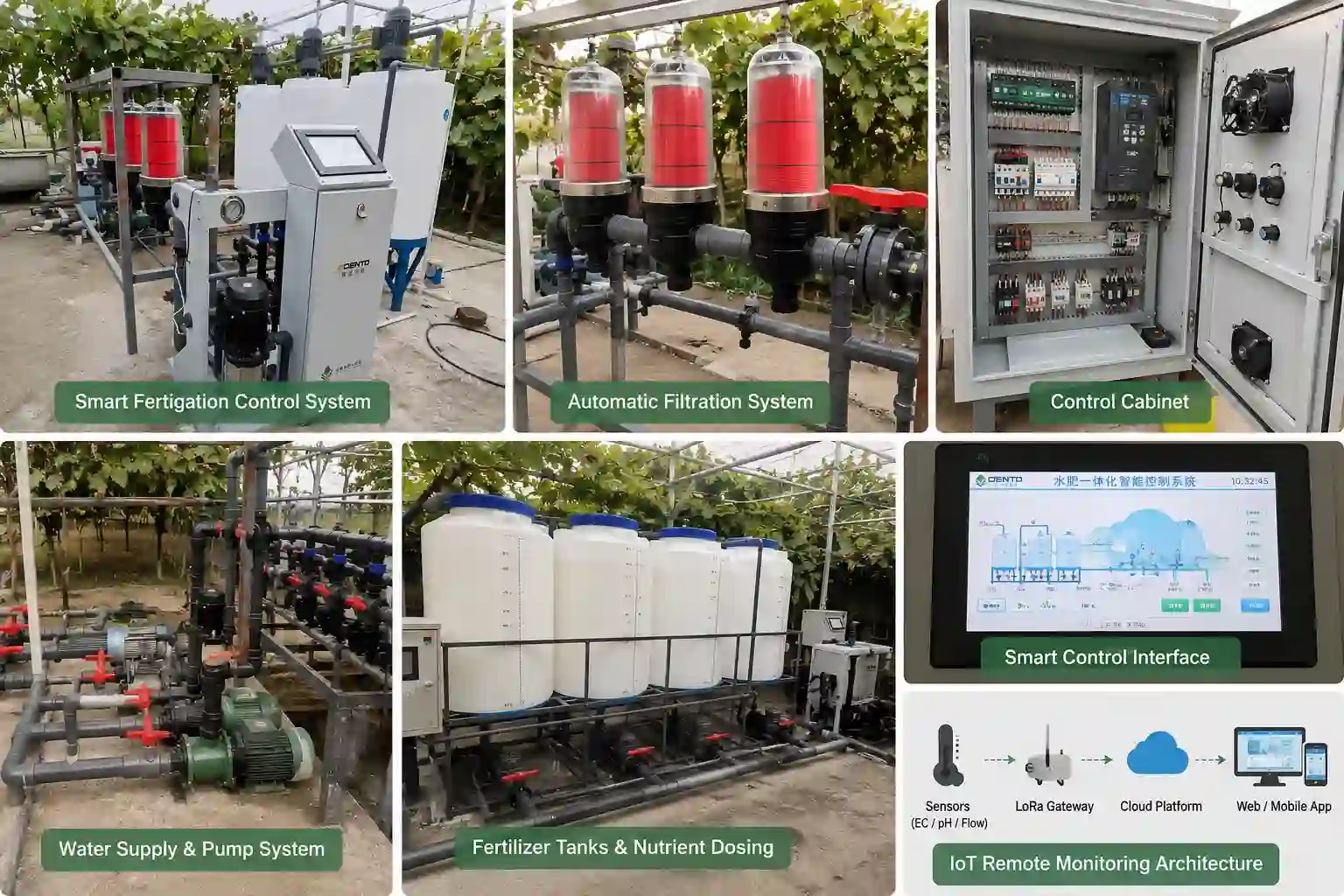
On the basis of the existing usable irrigation and water supply pipeline infrastructure, the estate upgraded only the irrigation head-end system and added key intelligent components, including:
- Smart fertigation machine
- Filtration unit
- Fertilizer tanks
- Variable frequency water pump control cabinet
- Automated control and dosing system
This approach helped the project control upgrade cost while still achieving a modernized fertigation system.
Core System Components
1. Smart Fertigation Unit
The smart fertigation unit automatically injects fertilizer into irrigation water according to preset parameters, ensuring a more stable and precise nutrient supply to grapevine roots.
Key Benefits
- More accurate nutrient dosing
- Better root-zone delivery
- Less fertilizer waste
- Reduced dependence on manual operations
2. Filtration System
The filtration system protects the irrigation network by removing impurities from the water source before it enters the pipeline and fertigation line.
Key Benefits
- Reduces emitter blockage risk
- Improves long-term irrigation stability
- Extends equipment service life
- Supports uniform water and fertilizer application
3. Fertilizer Tanks and Mixing Section
The fertilizer tanks store and prepare nutrient solutions for injection into the irrigation system.
Key Benefits
- Supports flexible nutrient recipes
- Allows better matching of fertilizer programs to different vine growth stages
- Improves consistency compared with manual fertilizer application
4. Variable Frequency Pump Control Cabinet
The water pump variable frequency control cabinet helps regulate system pressure and water delivery more precisely.
Key Benefits
- Stabilizes irrigation operation
- Improves energy efficiency
- Supports more reliable fertigation execution
- Helps adapt irrigation output to actual vineyard demand
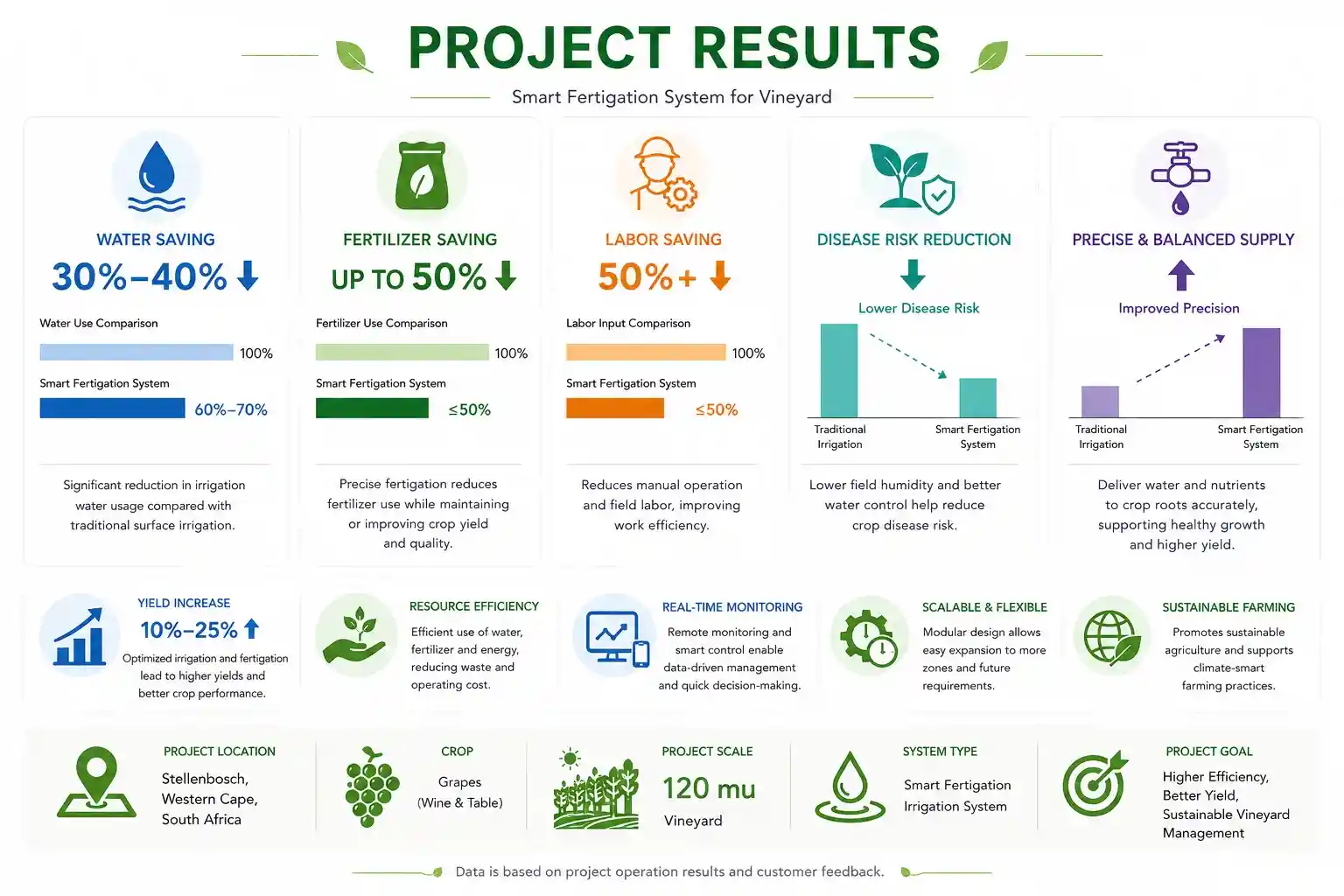
Project Results
Why This Project Matters
A Practical Smart Vineyard Model for Overseas Growers
This project demonstrates how vineyards can upgrade from conventional irrigation to precision fertigation management without replacing the entire infrastructure.
For vineyards in regions such as:
- South Africa
- Chile
- Australia
- California, USA
- Italy
- Spain
the project provides a strong reference for improving:
Vineyard operating profitability
Grape quality
Nutrient efficiency
Labor efficiency
Soil sustainability
Application Value for Vineyard Estates
This type of smart fertigation solution is especially suitable for:
- Commercial vineyards
- Table grape farms
- Wine grape estates
- Vineyard tourism parks
- Agritourism farms with high-quality crop requirements
It is particularly valuable where operators want to balance production efficiency, fruit quality, and environmental sustainability.
Conclusion
The smart fertigation upgrade project in Stellenbosch, South Africa shows how an existing vineyard irrigation system can be transformed into a more efficient, precise, and sustainable management platform.
By upgrading the irrigation headworks with:
- Smart fertigation equipment
- Filtration system
- Fertilizer tanks
- Variable frequency control cabinet
the estate achieved a practical improvement in:
- Grape quality and yield
- Environmental performance
- Cost control
- Irrigation precision
This case offers a valuable model for vineyard operators seeking a cost-effective precision irrigation and fertigation solution for long-term crop and soil management.
FAQ
1. What is a smart fertigation system for vineyards?
A smart fertigation system combines irrigation control, fertilizer dosing, soil sensors, weather monitoring, and cloud-based management to help vineyard managers apply water and nutrients more accurately.
2. Why do vineyard estates need soil moisture monitoring?
Soil moisture monitoring helps vineyard managers understand water availability in the root zone and avoid over-irrigation or delayed irrigation.
3. Can JW-IoT smart fertigation systems support different vineyard zones?
Yes. JW-IoT systems can support multiple vineyard blocks, sensor points, irrigation valves, and fertilizer dosing zones depending on the project layout.
4. What sensors are commonly used in vineyard fertigation projects?
Common sensors include soil moisture sensors, soil temperature sensors, soil EC sensors, weather stations, rain gauges, flow meters, and water pressure sensors.
5. Can the system be connected to existing irrigation infrastructure?
In many projects, JW-IoT can integrate sensors, controllers, communication devices, and cloud software with existing pumps, valves, and irrigation pipelines after technical evaluation.
6. Is the system suitable for orchards and other high-value crops?
Yes. Similar smart fertigation systems can be used in vineyards, orchards, vegetable farms, greenhouses, and other high-value crop irrigation projects.